
2 From Words to Major Phrase Types Part

- Slides: 35
2 From Words to Major Phrase Types Part II ENGT 243 Morphology & Syntax
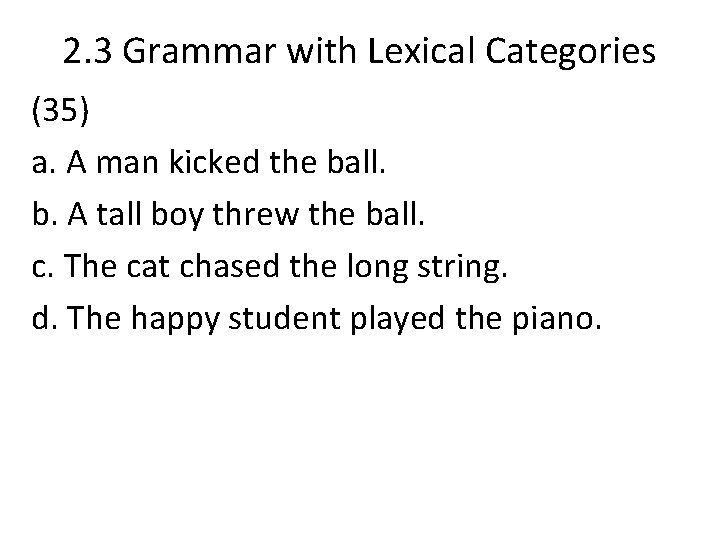
2. 3 Grammar with Lexical Categories (35) a. A man kicked the ball. b. A tall boy threw the ball. c. The cat chased the long string. d. The happy student played the piano.
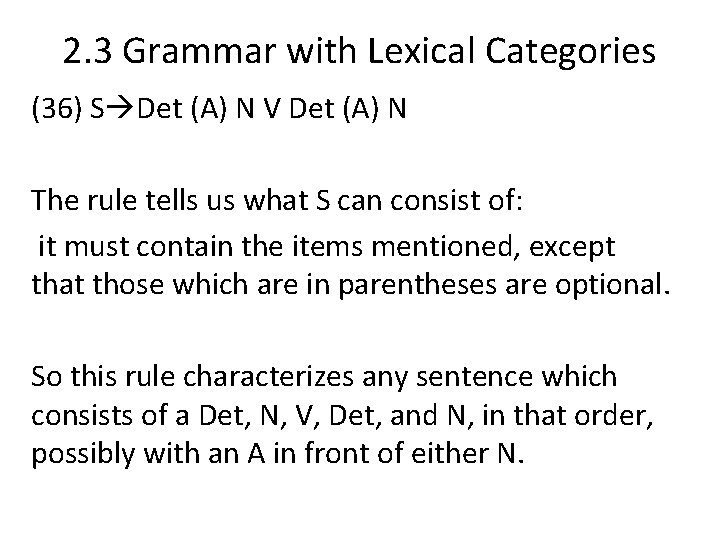
2. 3 Grammar with Lexical Categories (36) S Det (A) N V Det (A) N The rule tells us what S can consist of: it must contain the items mentioned, except that those which are in parentheses are optional. So this rule characterizes any sentence which consists of a Det, N, V, Det, and N, in that order, possibly with an A in front of either N.
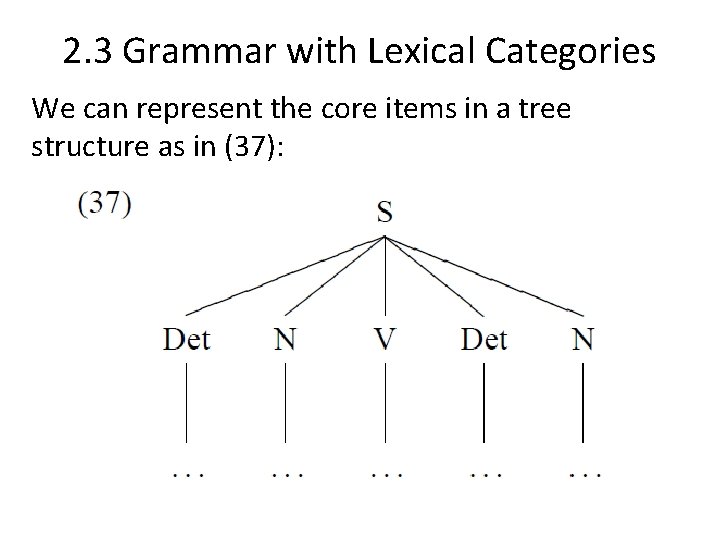
2. 3 Grammar with Lexical Categories We can represent the core items in a tree structure as in (37):
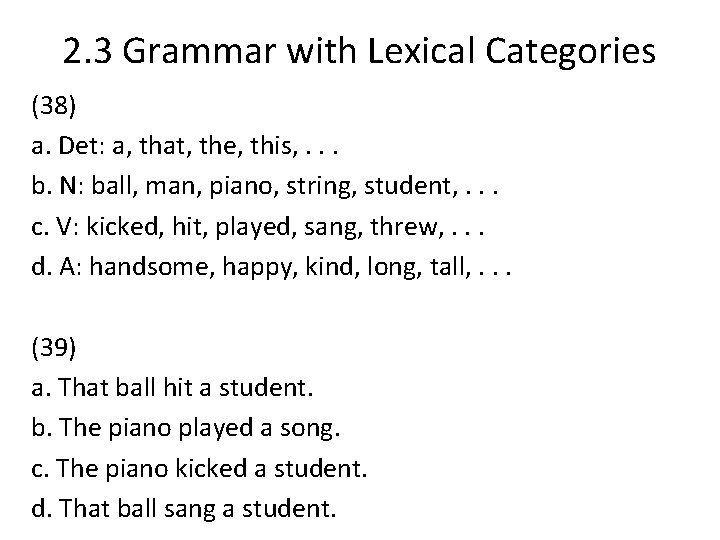
2. 3 Grammar with Lexical Categories (38) a. Det: a, that, the, this, . . . b. N: ball, man, piano, string, student, . . . c. V: kicked, hit, played, sang, threw, . . . d. A: handsome, happy, kind, long, tall, . . . (39) a. That ball hit a student. b. The piano played a song. c. The piano kicked a student. d. That ball sang a student.
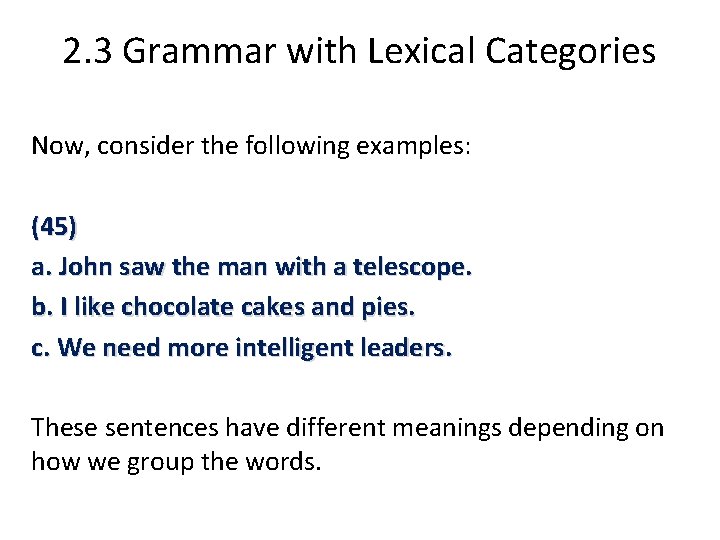
2. 3 Grammar with Lexical Categories Now, consider the following examples: (45) a. John saw the man with a telescope. b. I like chocolate cakes and pies. c. We need more intelligent leaders. These sentences have different meanings depending on how we group the words.
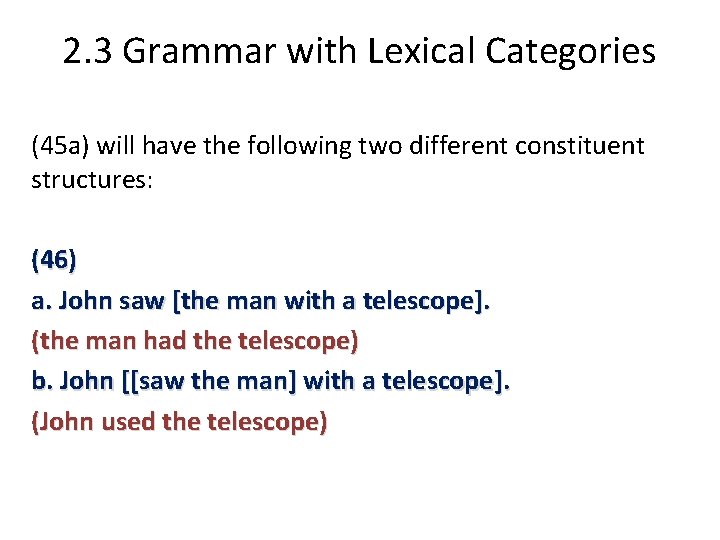
2. 3 Grammar with Lexical Categories (45 a) will have the following two different constituent structures: (46) a. John saw [the man with a telescope]. (the man had the telescope) b. John [[saw the man] with a telescope]. (John used the telescope)
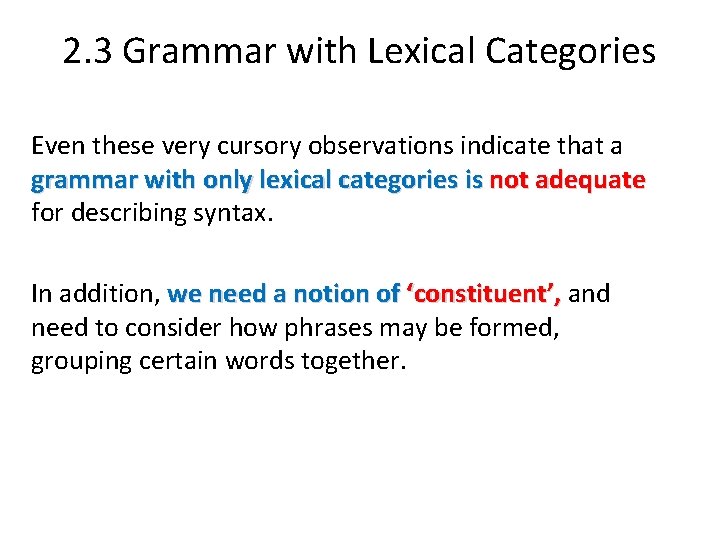
2. 3 Grammar with Lexical Categories Even these very cursory observations indicate that a grammar with only lexical categories is not adequate for describing syntax. In addition, we need a notion of ‘constituent’, and need to consider how phrases may be formed, grouping certain words together.
2. 4 Phrasal Categories Our intuitions may also lead us to hypothesize constituency. If you were asked to group the words in (47) into phrases, what constituents would you come up with? (47) The student enjoyed his English syntax class last semester.
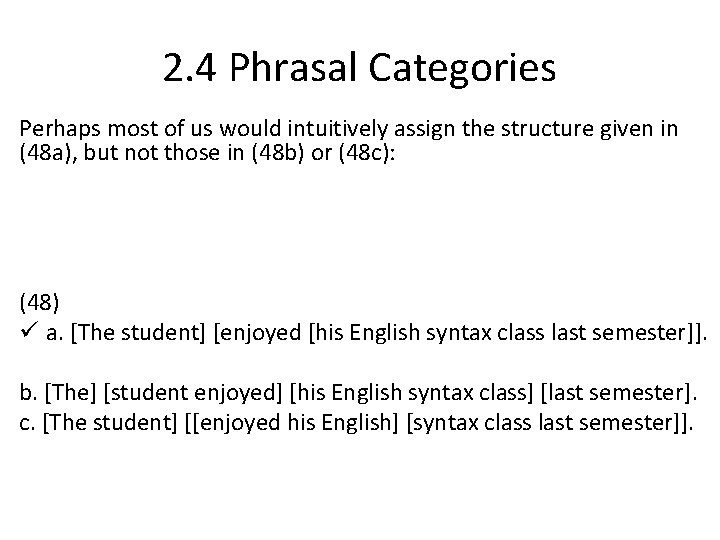
2. 4 Phrasal Categories Perhaps most of us would intuitively assign the structure given in (48 a), but not those in (48 b) or (48 c): (48) ü a. [The student] [enjoyed [his English syntax class last semester]]. b. [The] [student enjoyed] [his English syntax class] [last semester]. c. [The student] [[enjoyed his English] [syntax class last semester]].
2. 4 Phrasal Categories Semantic coherence helps demonstrating constituency? But There are clear syntactic or distributional tests which demonstrate the appropriate grouping of words or specific constituencies.
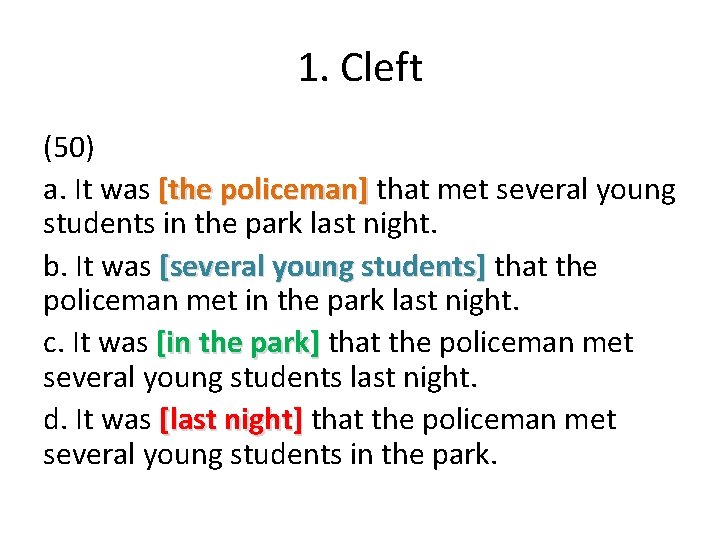
1. Cleft The cleft construction places an emphasized or focused element in the X position in the pattern ‘It is/was X that. . . ’, Phrasal units. We can cleft almost all the constituents we can get from (49) The policeman met several young students in the park last night.
1. Cleft (50) a. It was [the policeman] that met several young students in the park last night. b. It was [several young students] that the policeman met in the park last night. c. It was [in the park] that the policeman met several young students last night. d. It was [last night] that the policeman met several young students in the park.
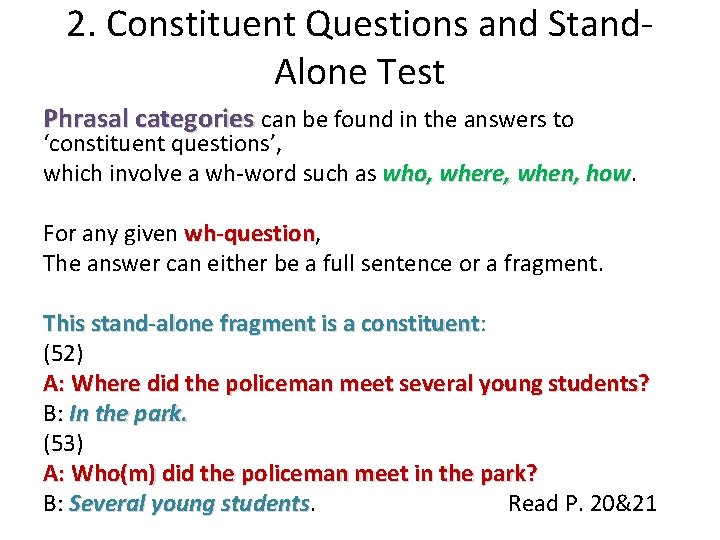
2. Constituent Questions and Stand. Alone Test Phrasal categories can be found in the answers to ‘constituent questions’, which involve a wh-word such as who, where, when, how For any given wh-question, wh-question The answer can either be a full sentence or a fragment. This stand-alone fragment is a constituent: constituent (52) A: Where did the policeman meet several young students? B: In the park. (53) A: Who(m) did the policeman meet in the park? B: Several young students. Read P. 20&21 students
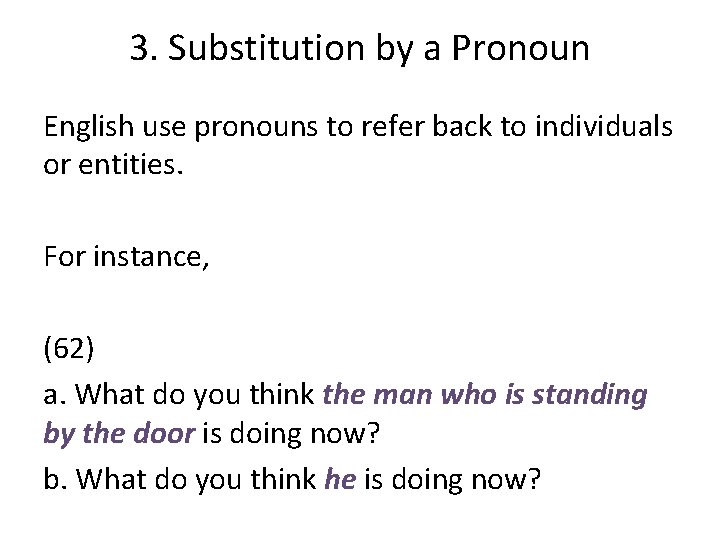
3. Substitution by a Pronoun English use pronouns to refer back to individuals or entities. For instance, (62) a. What do you think the man who is standing by the door is doing now? b. What do you think he is doing now?
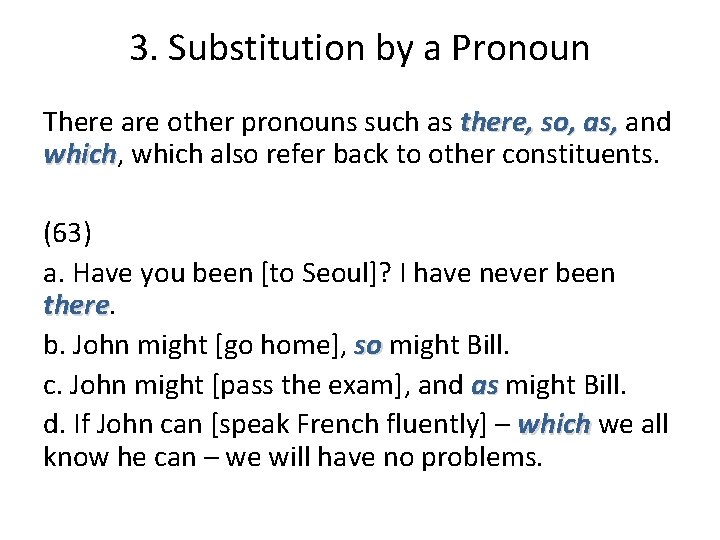
3. Substitution by a Pronoun There are other pronouns such as there, so, as, and which, which also refer back to other constituents. (63) a. Have you been [to Seoul]? I have never been there b. John might [go home], so might Bill. c. John might [pass the exam], and as might Bill. d. If John can [speak French fluently] – which we all know he can – we will have no problems.
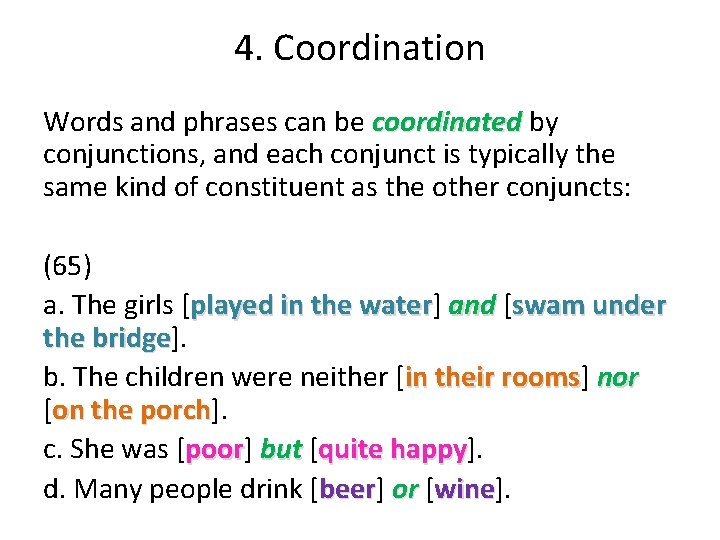
4. Coordination Words and phrases can be coordinated by conjunctions, and each conjunct is typically the same kind of constituent as the other conjuncts: (65) a. The girls [played in the water] water and [swam under the bridge]. bridge b. The children were neither [in their rooms] rooms nor [on the porch]. porch c. She was [poor] poor but [quite happy]. happy d. Many people drink [beer] beer or [wine]. wine
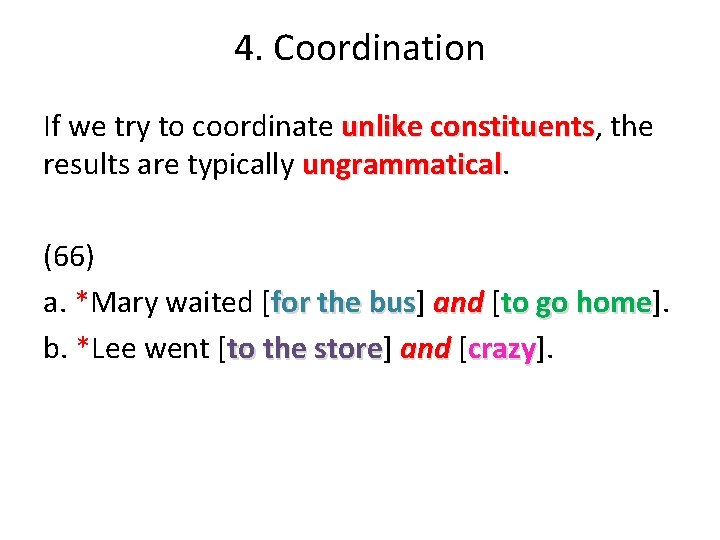
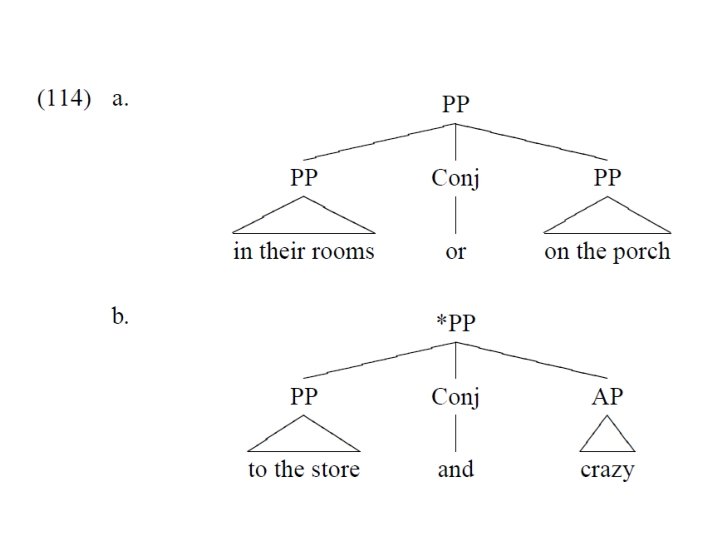
4. Coordination If we try to coordinate unlike constituents, constituents the results are typically ungrammatical (66) a. *Mary waited [for the bus] bus and [to go home]. home b. *Lee went [to the store] store and [crazy]. crazy
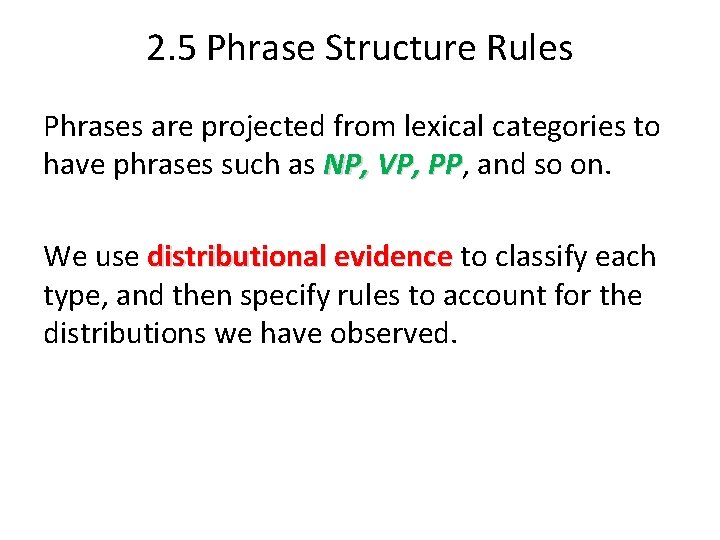
2. 5 Phrase Structure Rules Phrases are projected from lexical categories to have phrases such as NP, VP, PP and so on. We use distributional evidence to classify each type, and then specify rules to account for the distributions we have observed.
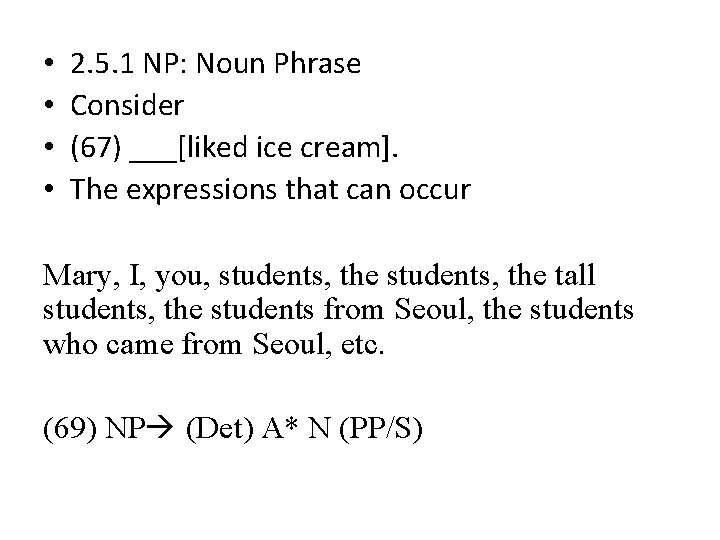
• • 2. 5. 1 NP: Noun Phrase Consider (67) ___[liked ice cream]. The expressions that can occur Mary, I, you, students, the tall students, the students from Seoul, the students who came from Seoul, etc. (69) NP (Det) A* N (PP/S)
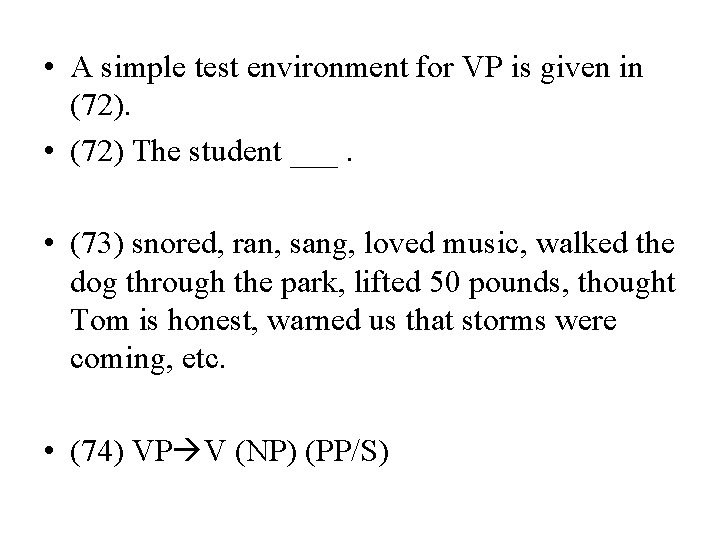
• A simple test environment for VP is given in (72). • (72) The student ___. • (73) snored, ran, sang, loved music, walked the dog through the park, lifted 50 pounds, thought Tom is honest, warned us that storms were coming, etc. • (74) VP V (NP) (PP/S)
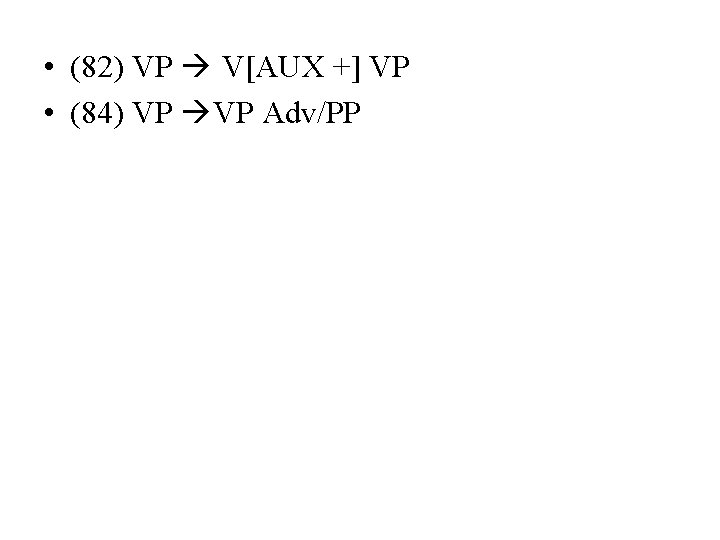
• (82) VP V[AUX +] VP • (84) VP VP Adv/PP
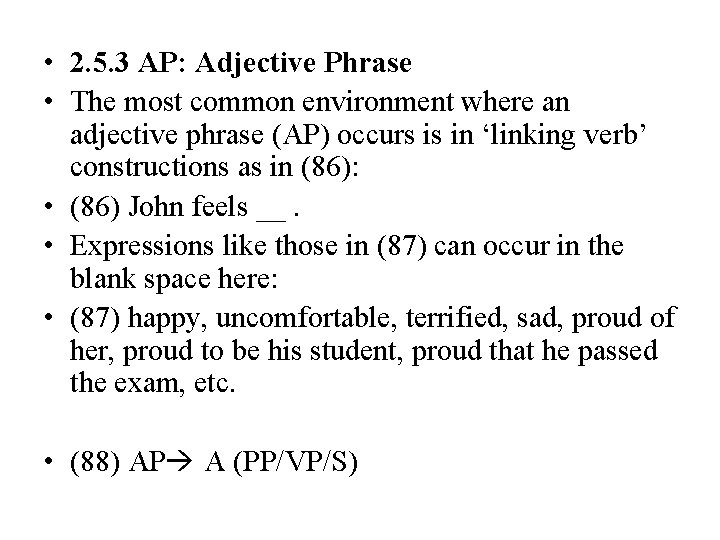
• 2. 5. 3 AP: Adjective Phrase • The most common environment where an adjective phrase (AP) occurs is in ‘linking verb’ constructions as in (86): • (86) John feels __. • Expressions like those in (87) can occur in the blank space here: • (87) happy, uncomfortable, terrified, sad, proud of her, proud to be his student, proud that he passed the exam, etc. • (88) AP A (PP/VP/S)
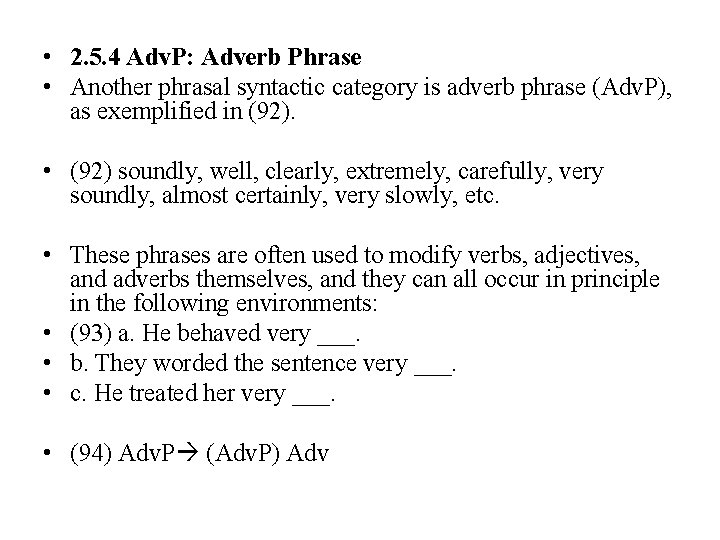
• 2. 5. 4 Adv. P: Adverb Phrase • Another phrasal syntactic category is adverb phrase (Adv. P), as exemplified in (92). • (92) soundly, well, clearly, extremely, carefully, very soundly, almost certainly, very slowly, etc. • These phrases are often used to modify verbs, adjectives, and adverbs themselves, and they can all occur in principle in the following environments: • (93) a. He behaved very ___. • b. They worded the sentence very ___. • c. He treated her very ___. • (94) Adv. P (Adv. P) Adv
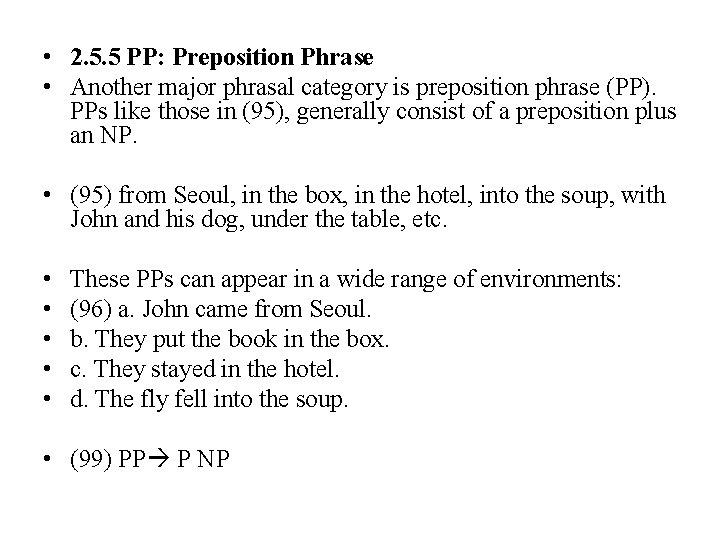
• 2. 5. 5 PP: Preposition Phrase • Another major phrasal category is preposition phrase (PP). PPs like those in (95), generally consist of a preposition plus an NP. • (95) from Seoul, in the box, in the hotel, into the soup, with John and his dog, under the table, etc. • • • These PPs can appear in a wide range of environments: (96) a. John came from Seoul. b. They put the book in the box. c. They stayed in the hotel. d. The fly fell into the soup. • (99) PP P NP
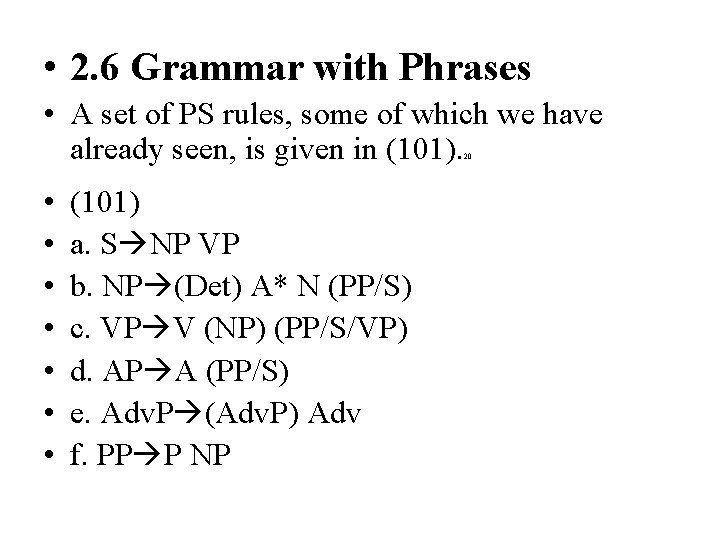
• 2. 6 Grammar with Phrases • A set of PS rules, some of which we have already seen, is given in (101). 20 • • (101) a. S NP VP b. NP (Det) A* N (PP/S) c. VP V (NP) (PP/S/VP) d. AP A (PP/S) e. Adv. P (Adv. P) Adv f. PP P NP
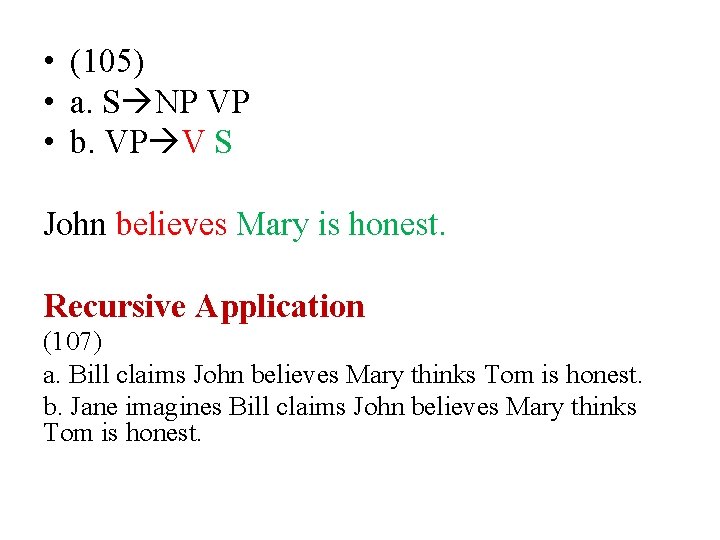
• (105) • a. S NP VP • b. VP V S John believes Mary is honest. Recursive Application (107) a. Bill claims John believes Mary thinks Tom is honest. b. Jane imagines Bill claims John believes Mary thinks Tom is honest.
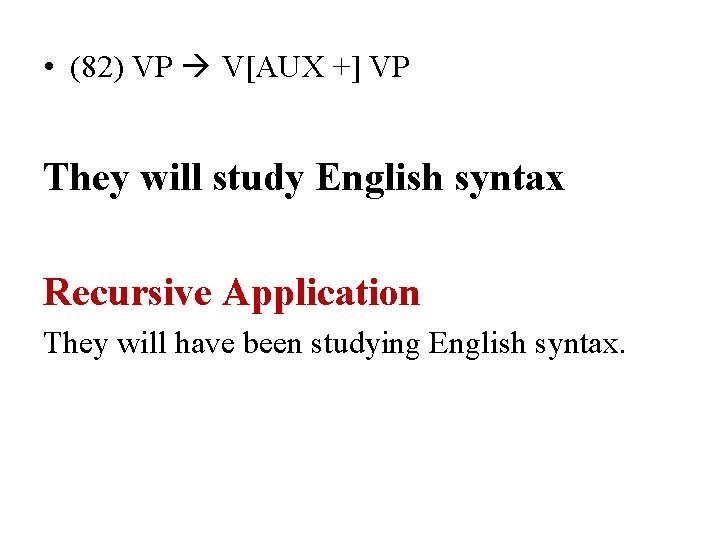
• (82) VP V[AUX +] VP They will study English syntax Recursive Application They will have been studying English syntax.
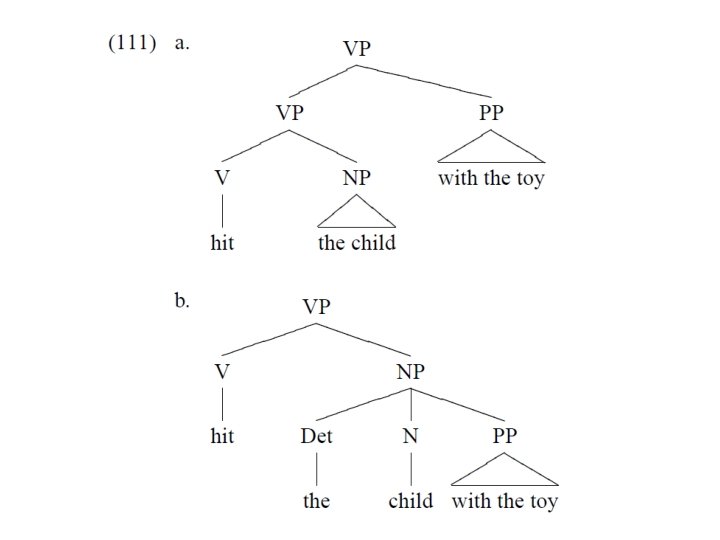
Hierarchical Structures • Depending on which PS rules we apply, for the sentences here, we will have different hierarchical tree structures. • hit the child with the toy.
• (113) XP XP Conj XP The rule says two identical XP categories can be coordinated and form the same category XP. Applying this PS rule, we will then allow (114 a) but not (114 b):
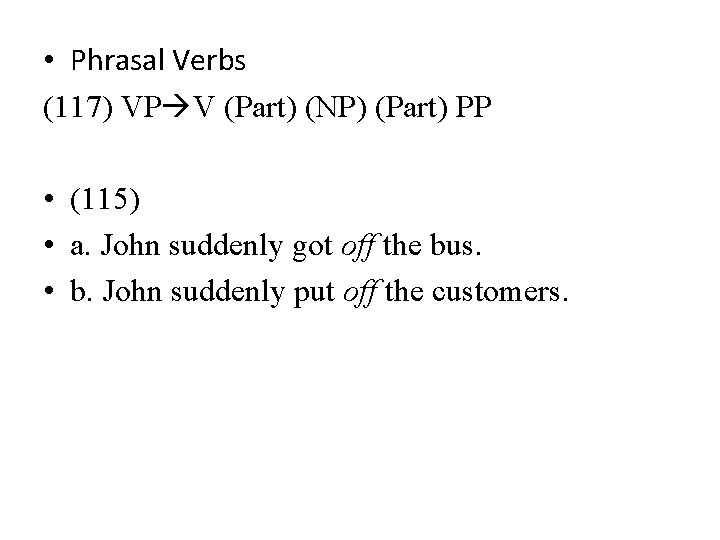
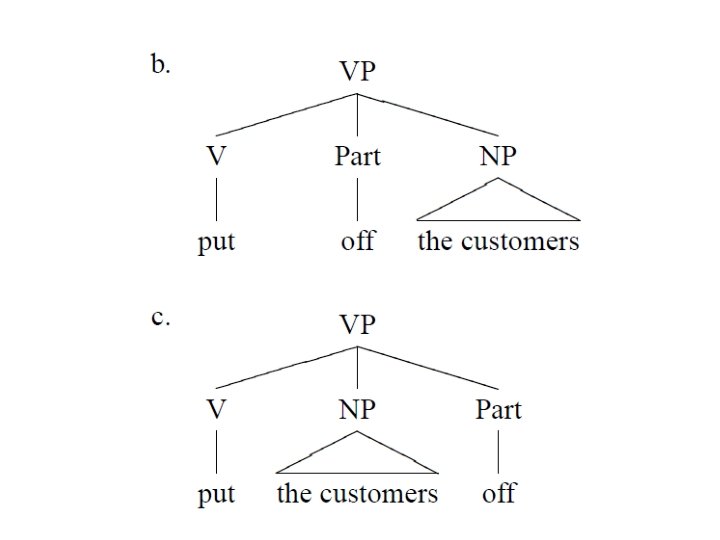
• Phrasal Verbs (117) VP V (Part) (NP) (Part) PP • (115) • a. John suddenly got off the bus. • b. John suddenly put off the customers.