
2 Formation of Cloud droplets 2 1 General

- Slides: 24
2. Formation of Cloud droplets 2. 1 General aspects 2. 2 The curvature effect 2. 3 The solute effect 2. 4 Atmospheric aerosols and CCN
2. 1 General Aspects * Phase changes of water vapor ---- liquid ---- solid vapor ---- solid * Nucleation processes Homogeneous: droplets form in a pure environment Heterogeneous: droplets form on nuclei * Supersaturation: the excess of relative humidity over the equilibrium value of 100%
2. 2 The Curvature Effect • Surface tension – Work per unit area necessary to increase the surface area. – Process stores potential energy in the surface. – Units: J/m 2 or N/m. – For water ~ 7. 5 x 10 -2 N/m at meteorological temps. • Vapor pressure e – The pressure on a liquid or solid surface due to the partial pressure of the molecules of that substance in the gas phase which surrounds the surface.
Curved Surface • Surface energy of a curved surface – equilibrium vapor pressure. – rate of evaporation from droplets. • Surface tension – droplet tends to assume a minimum area to volume ratio. – Lowest possible surface potential energy state. • Curvature – Increased vapor pressure at equilibrium compared with a flat surface.
Pure Water • Nucleation – Depends on partial pressure of water vapor in the surroundings. – Determines the rate which water molecules impinge upon the drops. • Evaporation – Temperature of droplet and surface tension. – Surface molecules must obtain enough energy to overcome the binding forces.
Equilibrium • Condensation and evaporation take place at the same rate. • Vapor pressure = saturation vapor pressure. • Equilibrium vapor pressure over a droplets surface. • Kelvin or Curvature effect – Enhanced equilibrium vapor pressure over curved surfaces, such as drops.
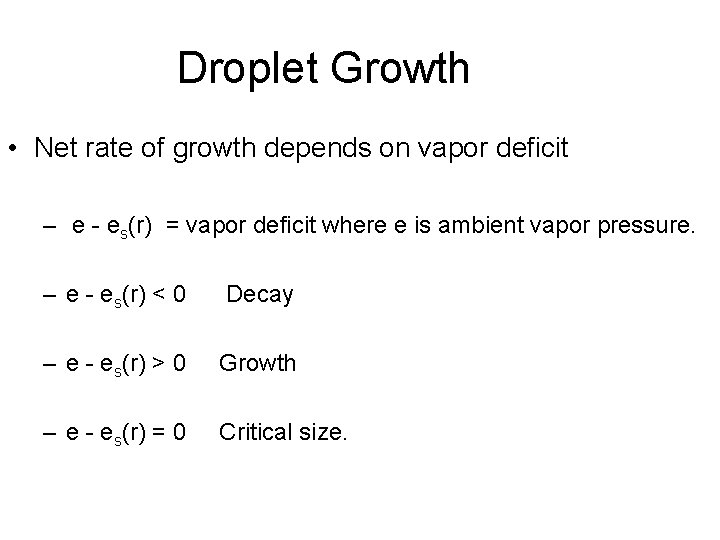
Droplet Growth • Net rate of growth depends on vapor deficit – e - es(r) = vapor deficit where e is ambient vapor pressure. – e - es(r) < 0 Decay – e - es(r) > 0 Growth – e - es(r) = 0 Critical size.
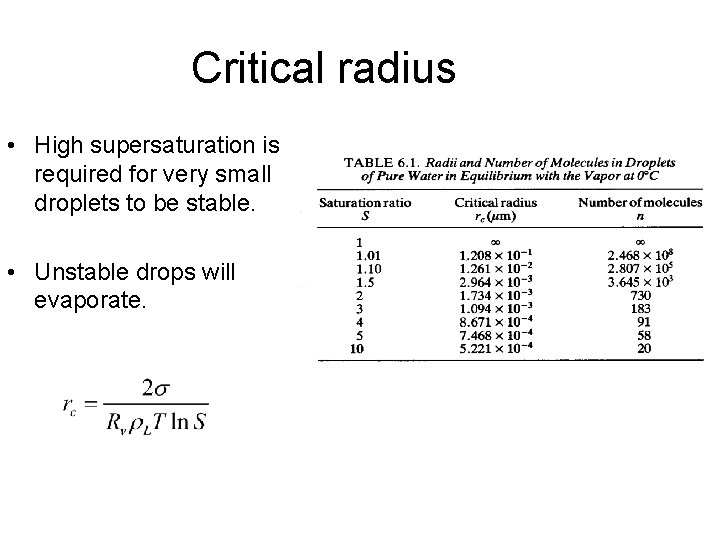
Critical radius • High supersaturation is required for very small droplets to be stable. • Unstable drops will evaporate.
Homogeneous nucleation • Droplets of critical size are formed by random collisions. • What if they capture another drop? – – Drop becomes supercritical. es(r) decreases. Rate of growth increases. Drop grows spontaneously! • Homogenous nucleation does not take place in the atmosphere. – Supersaturation rarely exceeds 1 or 2 percent.
2. 3 The Solute Effect • Cloud drops form on aerosols – condensation nuclei or hygroscopic nuclei • Rate of formation is determined by the number of these nuclei present. • Nuclei keep supersaturation from exceeding a few percent.
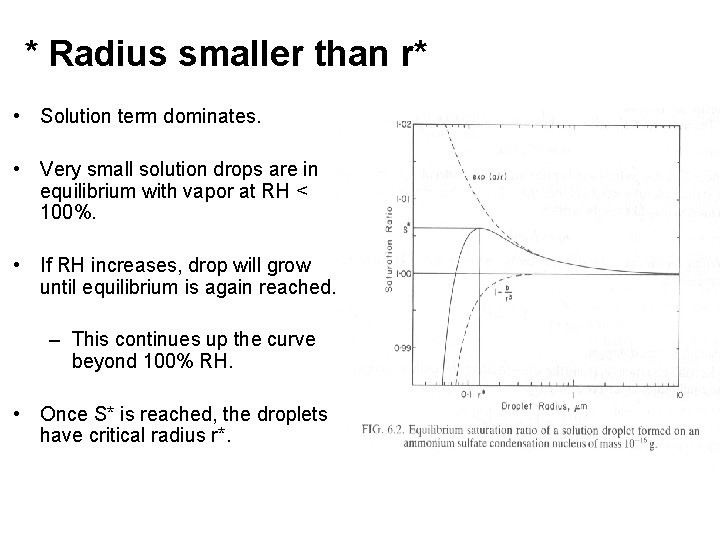
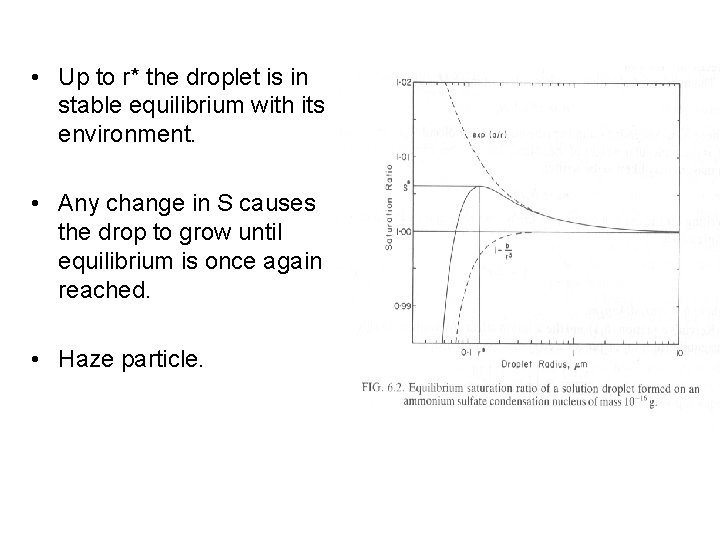
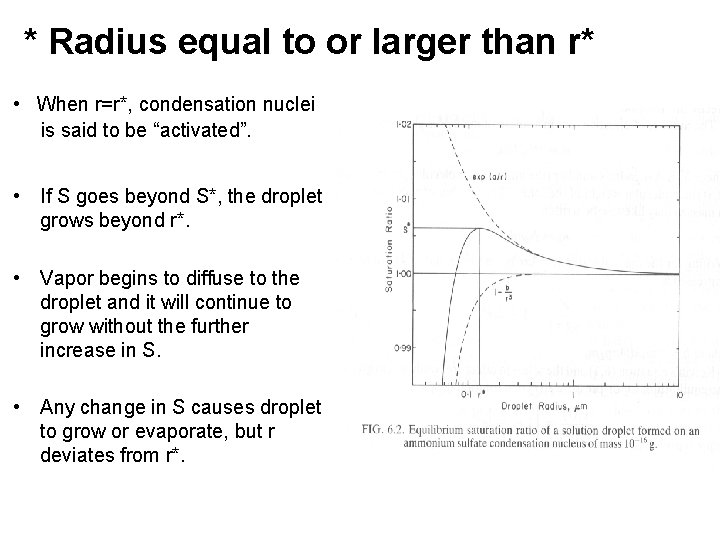
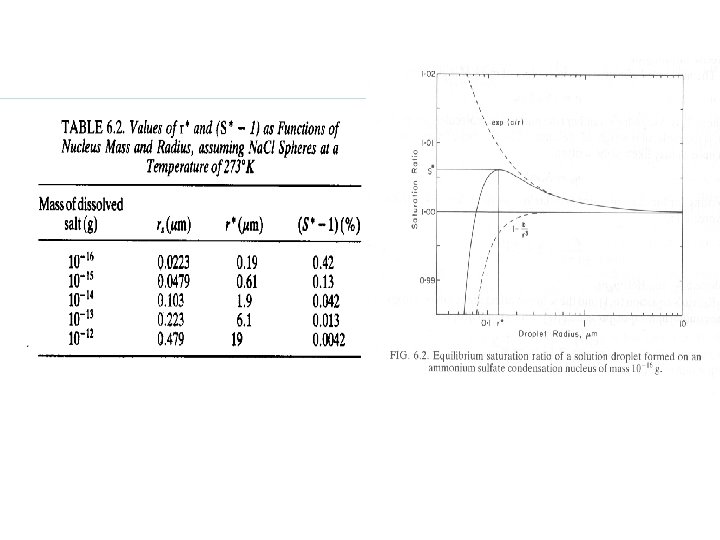
* Radius smaller than r* • Solution term dominates. • Very small solution drops are in equilibrium with vapor at RH < 100%. • If RH increases, drop will grow until equilibrium is again reached. – This continues up the curve beyond 100% RH. • Once S* is reached, the droplets have critical radius r*.
• Up to r* the droplet is in stable equilibrium with its environment. • Any change in S causes the drop to grow until equilibrium is once again reached. • Haze particle.
* Radius equal to or larger than r* • When r=r*, condensation nuclei is said to be “activated”. • If S goes beyond S*, the droplet grows beyond r*. • Vapor begins to diffuse to the droplet and it will continue to grow without the further increase in S. • Any change in S causes droplet to grow or evaporate, but r deviates from r*.
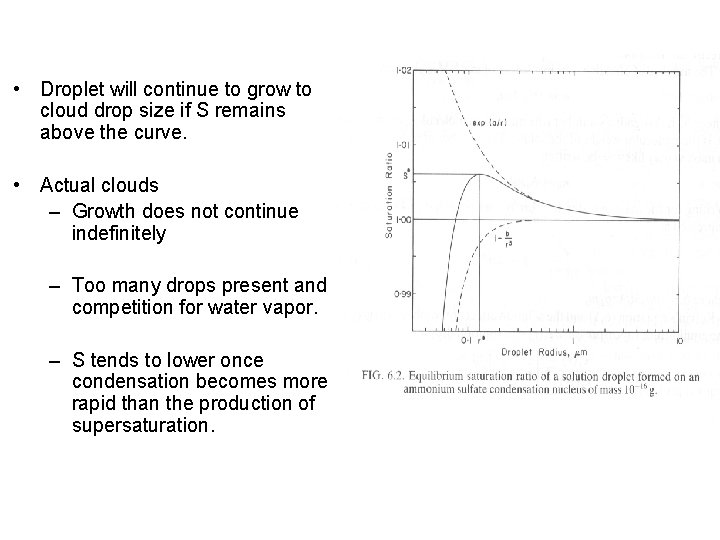
• Droplet will continue to grow to cloud drop size if S remains above the curve. • Actual clouds – Growth does not continue indefinitely – Too many drops present and competition for water vapor. – S tends to lower once condensation becomes more rapid than the production of supersaturation.
2. 4 Atmospheric Aerosol and CCN • 75% of total mass from natural or anthropogenic sources – – Wind-generated dust (20%) Sea spray (40%) Forest fires (10%) Combustion and other industry (5%) • 25% of total mass from conversion of gaseous constituents to small particles by photochemical and other chemical processes. – SO 2, NO 2, Olefins, NH 3
• Categorized according to their affinity for water. • Hydrophobic – Nucleation is difficult and requires even higher supersaturation. • Neutral – Same supersaturation as homogeneous nucleation. • Hygroscopic – Much lower supersaturation required.
Hygroscopic nuclei • A non-volatile dissolved substance tends to lower the equilibrium pressure of a liquid. • When solute is added, solute molecules replace liquid molecules at the surface. • If vapor pressure of solute is less than that of the solvent, the vapor pressure is reduced. • A solution droplet can be in equilibrium at a much lower supersaturation than a pure water droplet of the same size.
Nuclei Formation • Condensation of gases – Spherical • Disintegration of liquids or solids. – Crystals, fibers, agglomerates, irregular fragments. • Equivalent spherical diameter – Diameter of sphere having same volume as the aerosol particle.
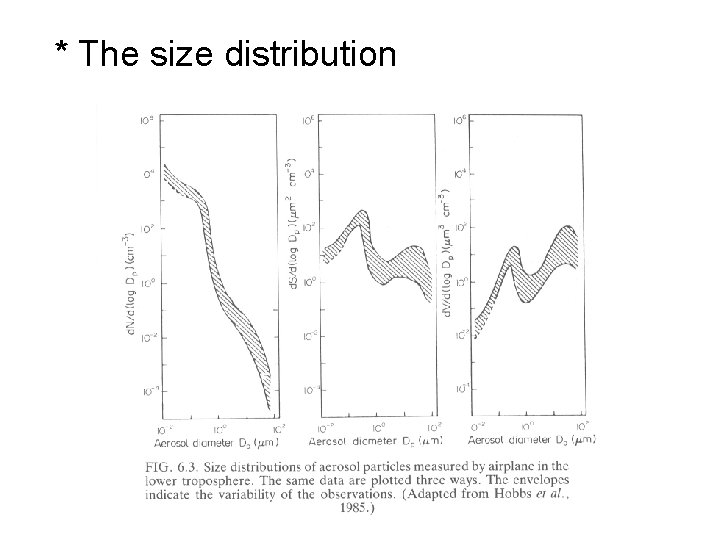
Nuclei Size • Size: 10 -3 m to 10 m in diameter. – Salt, dust, combustion particles. • D > 2 m Giant aerosols • 0. 2 m < D < 2 m Large aerosols • D < 0. 2 m Aitken particles – Overwhelming majority.
Cloud Condensation Nuclei (CCN): The nuclei activated at supersaturations less than a few per cent (S < 1. 02) are called CCN.
* The size distribution
Meteorology 342 Homework (2) 1. Problem 6. 4 2. Problem 6. 10