
2 Finite Automata CIS 5513 Automata and Formal

- Slides: 21
2. Finite Automata CIS 5513 - Automata and Formal Languages – Pei Wang
Deterministic finite automata A deterministic finite automaton (DFA) A = (Q, ∑, δ, q 0, F) where �Q is a finite set of states �∑ is the alphabet of input symbols �δ: Q×∑ → Q, a transition function that specifies the state change given an input �q 0 Q, the start state
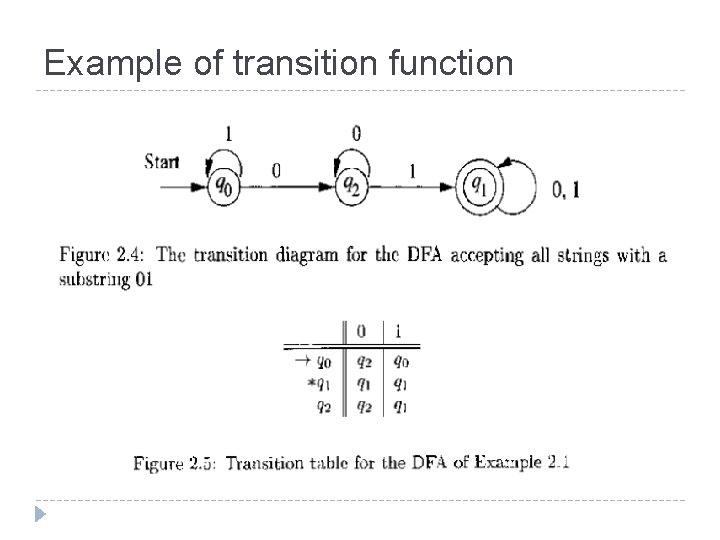
Example of DFA Define a DFA that accepts language L = { x 01 y | x and y are binary strings } �∑ = {0, 1} �Q = {q 0, q 1, q 2} �F = {q 1} �δ: represented as the following transition diagram or table
Example of transition function
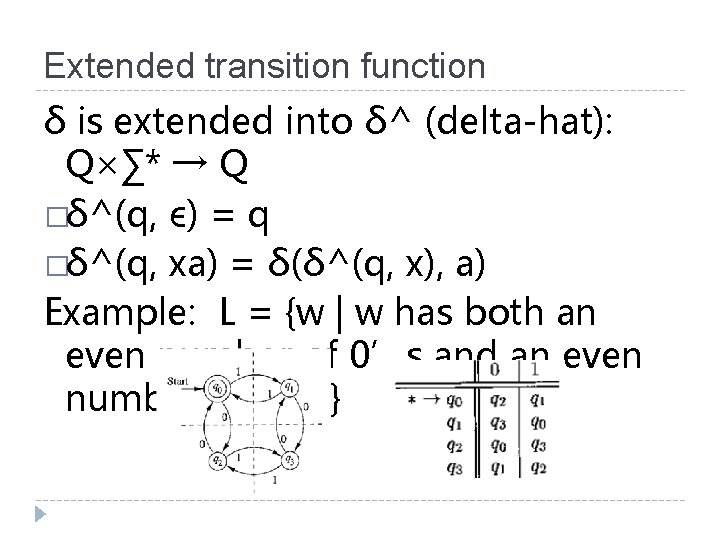
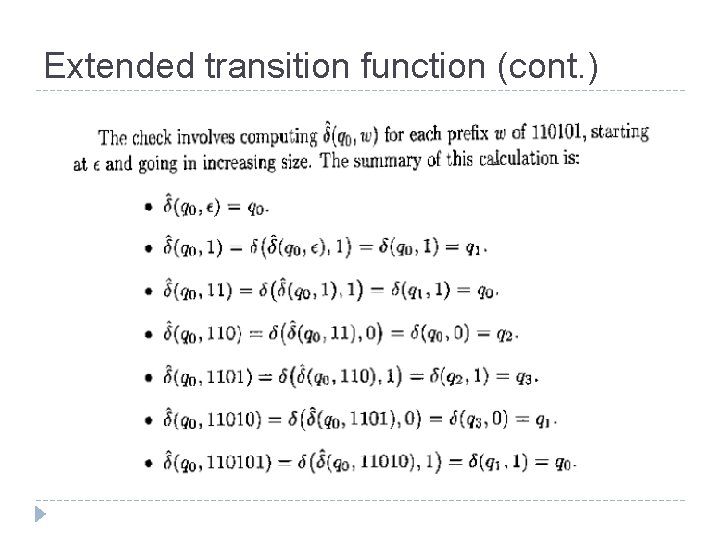
Extended transition function δ is extended into δ^ (delta-hat): Q×∑* → Q �δ^(q, ϵ) = q �δ^(q, xa) = δ(δ^(q, x), a) Example: L = {w | w has both an even number of 0’s and an even number of 1’s}
Extended transition function (cont. )
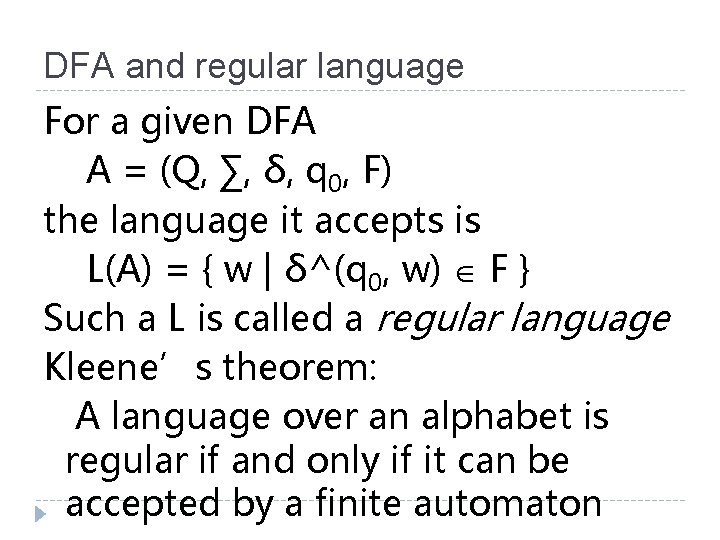
DFA and regular language For a given DFA A = (Q, ∑, δ, q 0, F) the language it accepts is L(A) = { w | δ^(q 0, w) F } Such a L is called a regular language Kleene’s theorem: A language over an alphabet is regular if and only if it can be accepted by a finite automaton
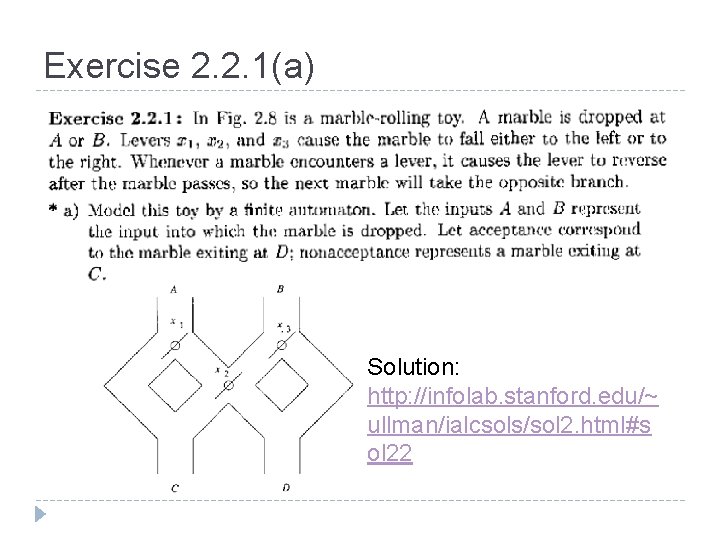
Exercise 2. 2. 1(a) Solution: http: //infolab. stanford. edu/~ ullman/ialcsols/sol 2. html#s ol 22
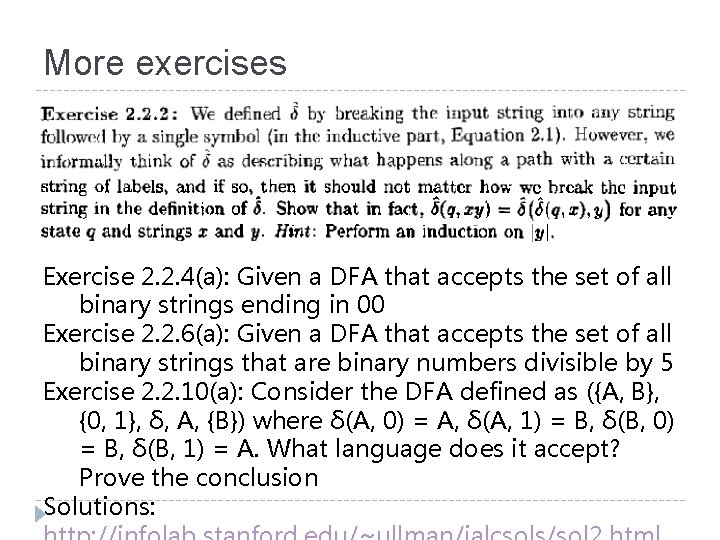
More exercises Exercise 2. 2. 4(a): Given a DFA that accepts the set of all binary strings ending in 00 Exercise 2. 2. 6(a): Given a DFA that accepts the set of all binary strings that are binary numbers divisible by 5 Exercise 2. 2. 10(a): Consider the DFA defined as ({A, B}, {0, 1}, δ, A, {B}) where δ(A, 0) = A, δ(A, 1) = B, δ(B, 0) = B, δ(B, 1) = A. What language does it accept? Prove the conclusion Solutions:
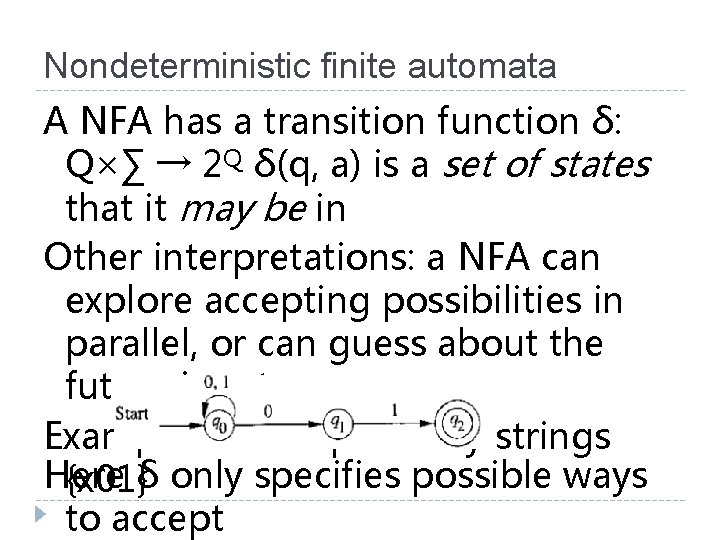
Nondeterministic finite automata A NFA has a transition function δ: Q×∑ → 2 Q δ(q, a) is a set of states that it may be in Other interpretations: a NFA can explore accepting possibilities in parallel, or can guess about the future input Example: to accept binary strings Here {x 01}δ only specifies possible ways to accept
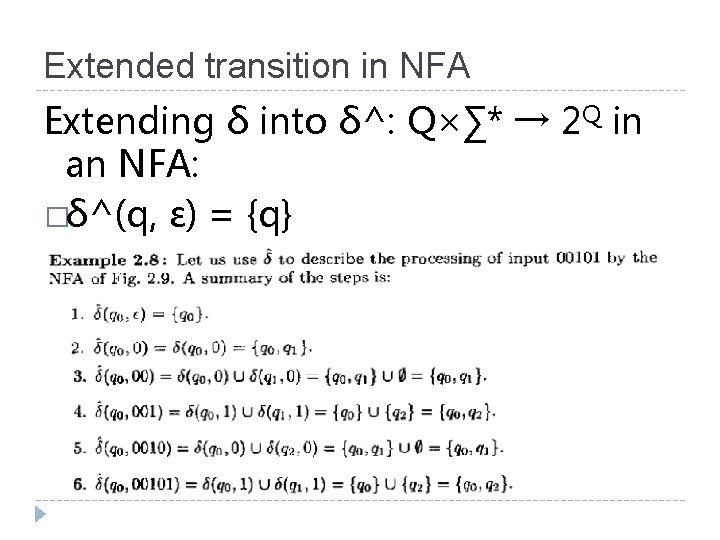
Extended transition in NFA Extending δ into δ^: Q×∑* → 2 Q in an NFA: �δ^(q, ε) = {q} �δ^(q, xa) = δ(pi, a), where pi δ^(q, x)
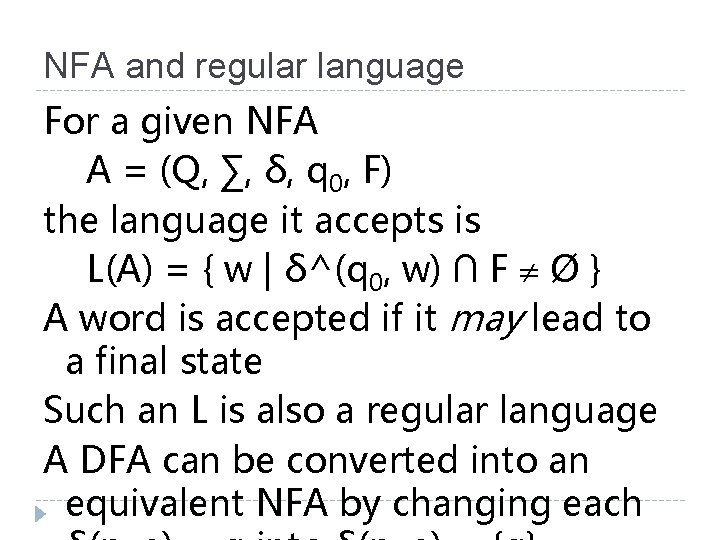
NFA and regular language For a given NFA A = (Q, ∑, δ, q 0, F) the language it accepts is L(A) = { w | δ^(q 0, w) ∩ F Ø } A word is accepted if it may lead to a final state Such an L is also a regular language A DFA can be converted into an equivalent NFA by changing each
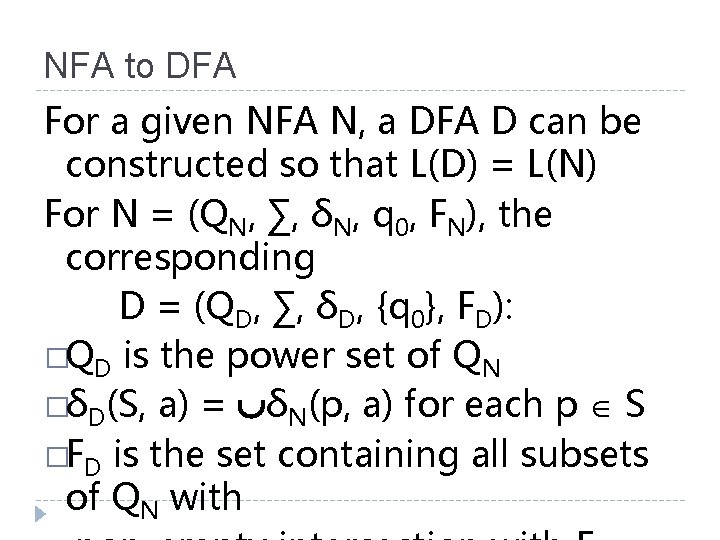
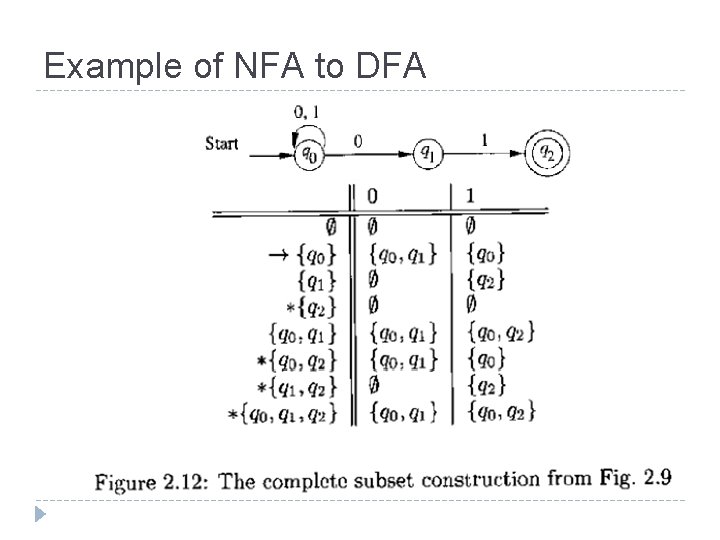
NFA to DFA For a given NFA N, a DFA D can be constructed so that L(D) = L(N) For N = (QN, ∑, δN, q 0, FN), the corresponding D = (QD, ∑, δD, {q 0}, FD): �QD is the power set of QN �δD(S, a) = δN(p, a) for each p S �FD is the set containing all subsets of QN with
Example of NFA to DFA
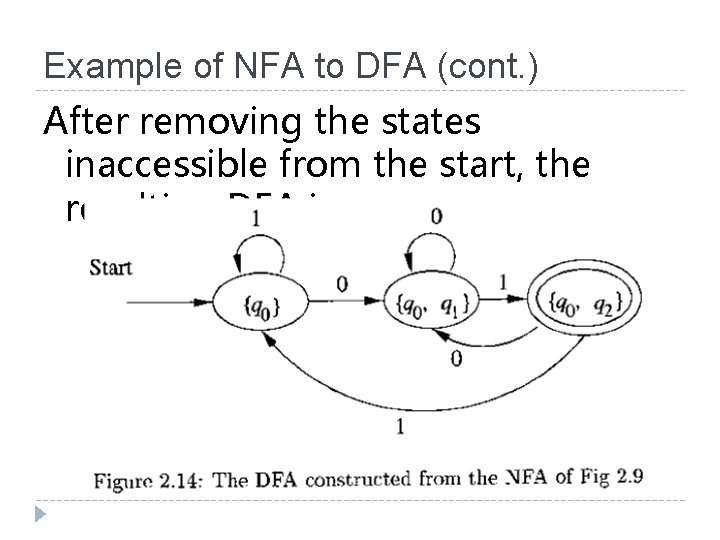
Example of NFA to DFA (cont. ) After removing the states inaccessible from the start, the resulting DFA is:
NFA to DFA: approaches There are two approaches in specifying QD: 1. Exhaustively generate the power set of QN, then remove the inaccessible ones 2. Begin from the start state, and only list the accessible states The state corresponding to empty set of states in N may be an
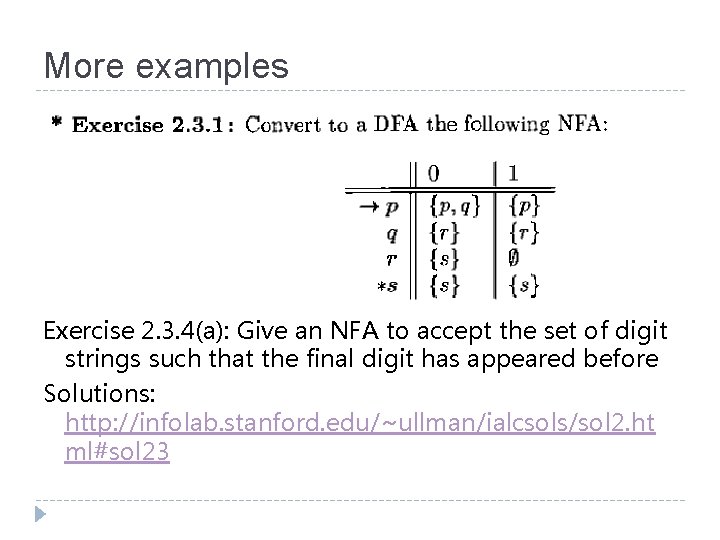
More examples Exercise 2. 3. 4(a): Give an NFA to accept the set of digit strings such that the final digit has appeared before Solutions: http: //infolab. stanford. edu/~ullman/ialcsols/sol 2. ht ml#sol 23
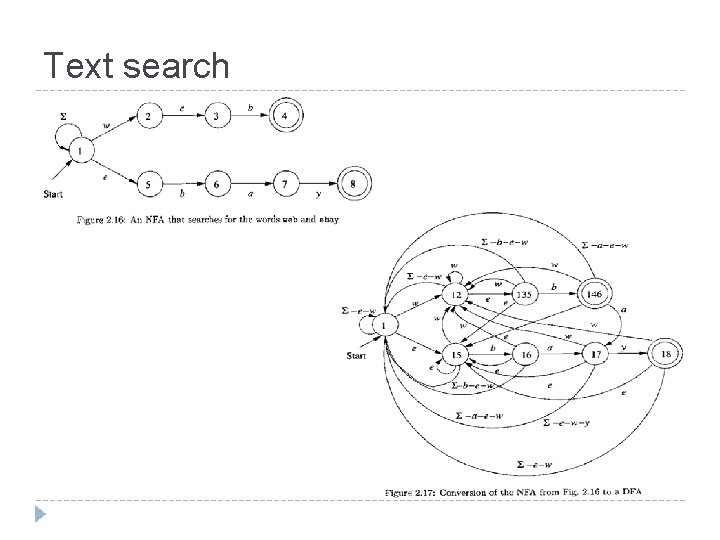
Text search
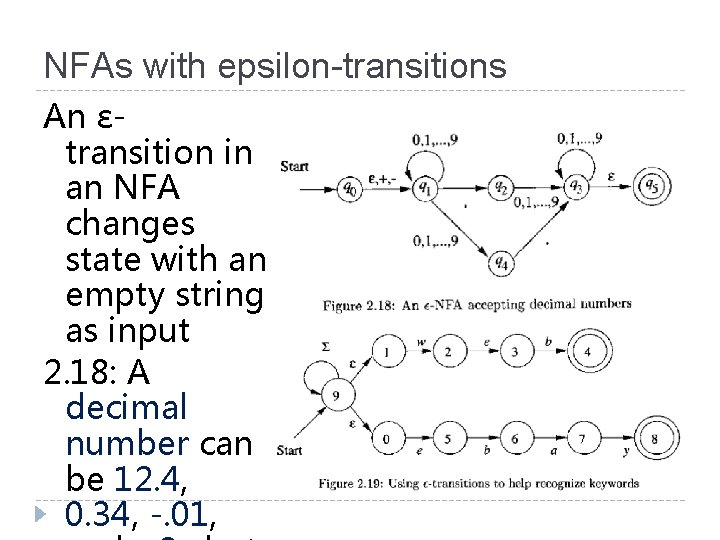
NFAs with epsilon-transitions An εtransition in an NFA changes state with an empty string as input 2. 18: A decimal number can be 12. 4, 0. 34, -. 01,
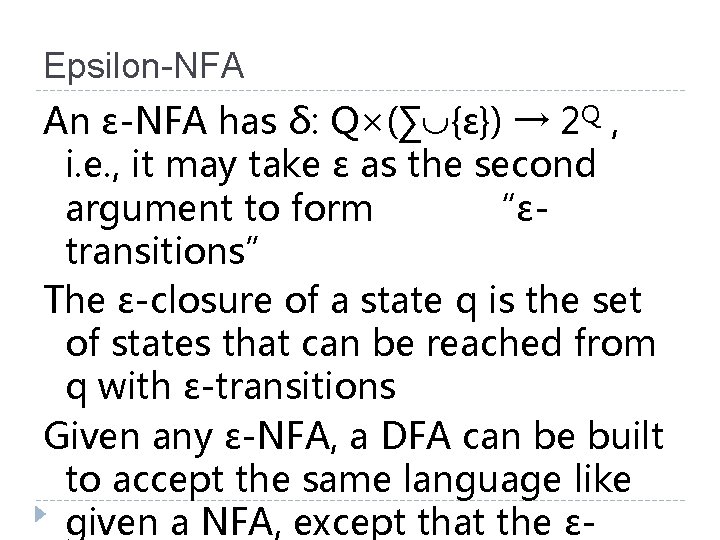
Epsilon-NFA An ε-NFA has δ: Q×(∑ {ε}) → 2 Q , i. e. , it may take ε as the second argument to form “εtransitions” The ε-closure of a state q is the set of states that can be reached from q with ε-transitions Given any ε-NFA, a DFA can be built to accept the same language like given a NFA, except that the ε-
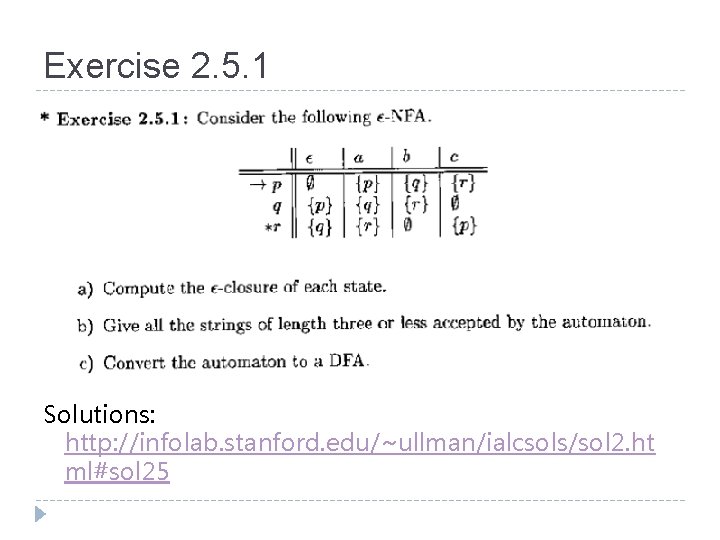
Exercise 2. 5. 1 Solutions: http: //infolab. stanford. edu/~ullman/ialcsols/sol 2. ht ml#sol 25