
2 Engineering Design Objectives for Today 916 Define
2 Engineering Design

Objectives for Today (9/16) • Define engineering design • Describe the steps of the engineering design process. • Highlight the engineering design process in the Marshmallow Design Challenge • Explain how to define a problem and its constraints. • Summarize the processes of creating and testing design solutions. • Explain how to communicate the final design solution. • Describe the purpose of an engineering notebook. © Goodheart-Willcox Co. , Inc. Permission granted to reproduce for educational use only.
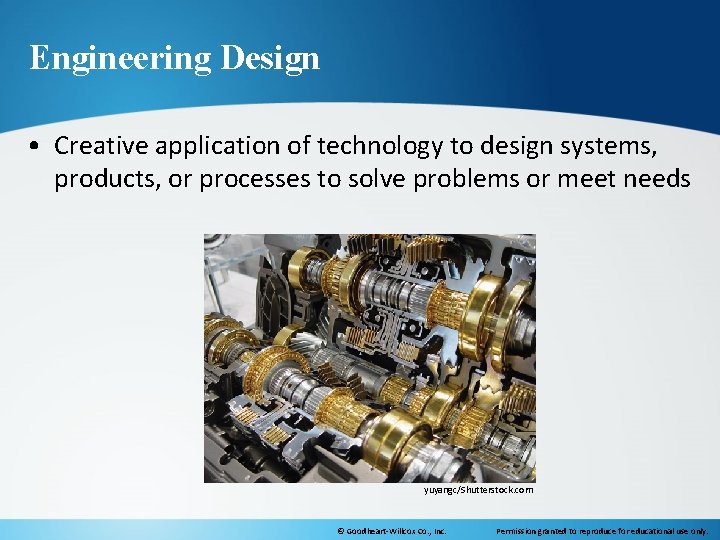
Engineering Design • Creative application of technology to design systems, products, or processes to solve problems or meet needs yuyangc/Shutterstock. com © Goodheart-Willcox Co. , Inc. Permission granted to reproduce for educational use only.
Engineers as Problem Solvers • Engineers use the engineering design process to solve problems/challenges • Take into account design parameters – Specifications: design requirements – Constraints: design limitations • Balance for optimization: best solution to the given problem/challenge given your specifications and constraints • Make trade-offs: losing or sacrificing one quality of your design in order to gain a different quality © Goodheart-Willcox Co. , Inc. Permission granted to reproduce for educational use only.
Engineering Design Process • Series of systematic steps that helps guide engineers from problem identification to reporting design solution • No one set process, but all engineers use some sort of design process • Going back to previous steps in process is common © Goodheart-Willcox Co. , Inc. Permission granted to reproduce for educational use only.
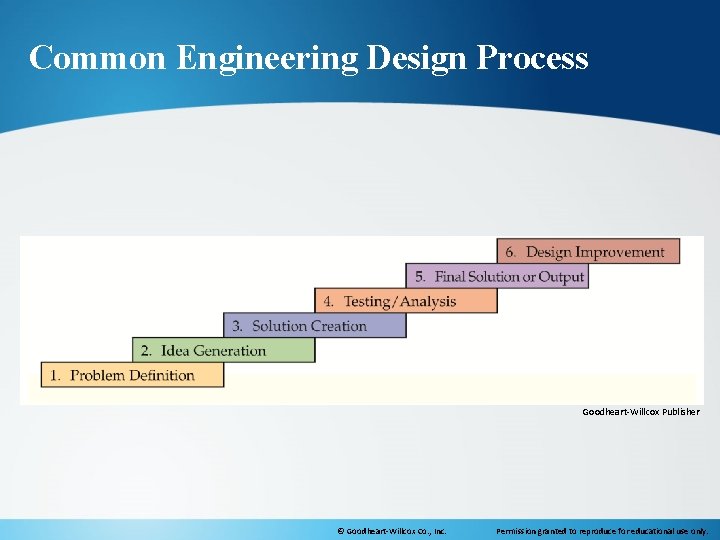
Common Engineering Design Process Goodheart-Willcox Publisher © Goodheart-Willcox Co. , Inc. Permission granted to reproduce for educational use only.
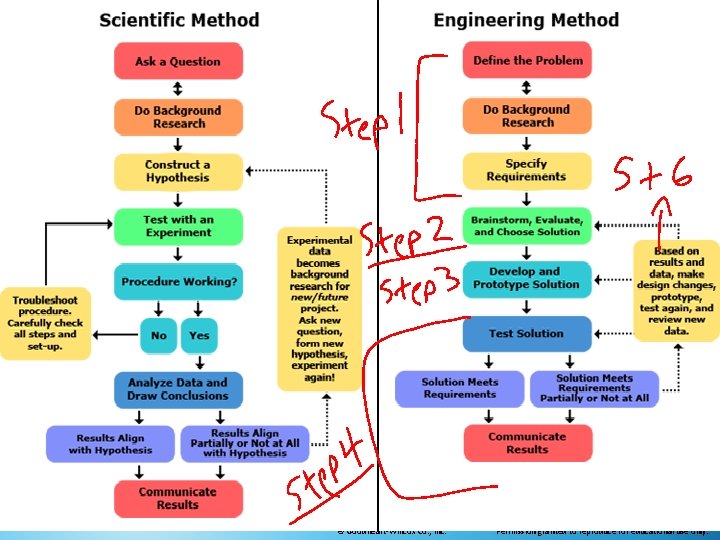
© Goodheart-Willcox Co. , Inc. Permission granted to reproduce for educational use only.
Step 1: Problem Definition A process used by engineers to: • discuss and develop a clear statement about a given problem or challenge (problem statement) • define the constraints and requirements of the problem/challenge This process involves: • Identifying a real problem from everyday life or being presented with a design challenge • Researching this problem to learn more • Developing a problem statement © Goodheart-Willcox Co. , Inc. Permission granted to reproduce for educational use only.
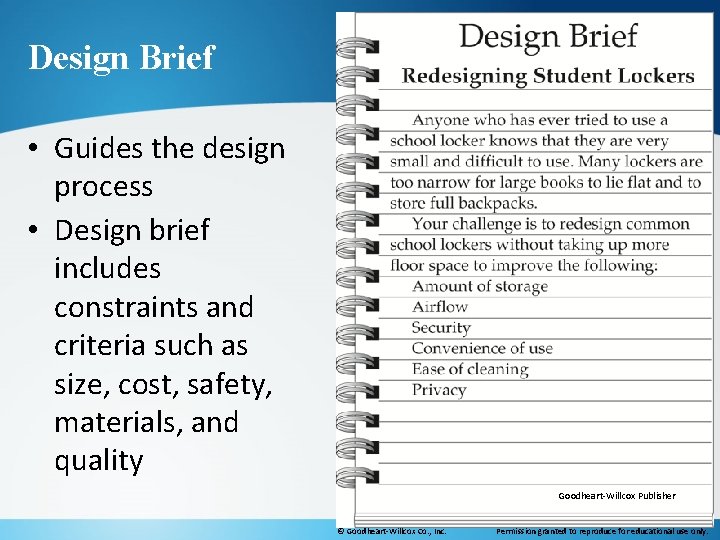
Design Brief • Guides the design process • Design brief includes constraints and criteria such as size, cost, safety, materials, and quality Goodheart-Willcox Publisher © Goodheart-Willcox Co. , Inc. Permission granted to reproduce for educational use only.
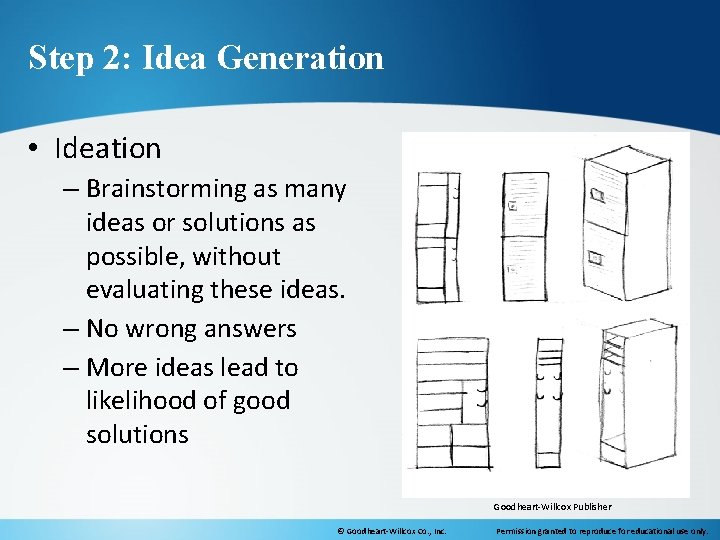
Step 2: Idea Generation • Ideation – Brainstorming as many ideas or solutions as possible, without evaluating these ideas. – No wrong answers – More ideas lead to likelihood of good solutions Goodheart-Willcox Publisher © Goodheart-Willcox Co. , Inc. Permission granted to reproduce for educational use only.
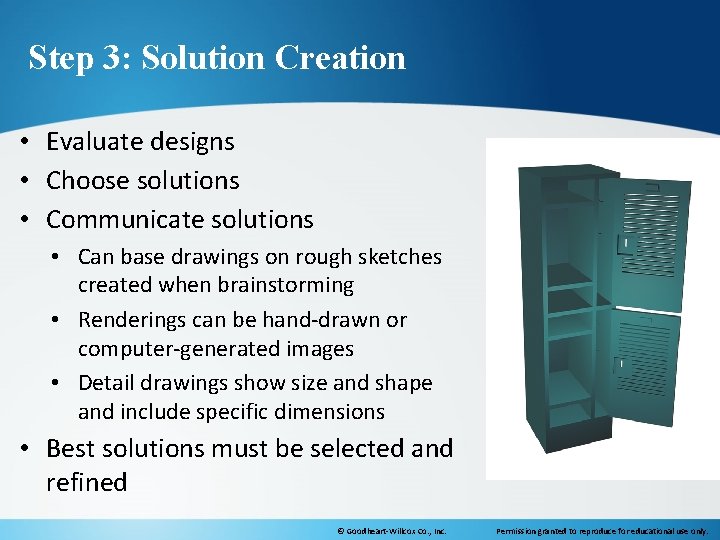
Step 3: Solution Creation • Evaluate designs • Choose solutions • Communicate solutions • Can base drawings on rough sketches created when brainstorming • Renderings can be hand-drawn or computer-generated images • Detail drawings show size and shape and include specific dimensions • Best solutions must be selected and refined © Goodheart-Willcox Co. , Inc. Permission granted to reproduce for educational use only.
Step 4: Testing/Analysis • Carefully sorting through options and analyzing strengths and weaknesses of each design • Testing your solutions and determining which design solution(s) are optimal © Goodheart-Willcox Co. , Inc. Permission granted to reproduce for educational use only.
Step 5: Final Solution or Output • Mechanical drawings • Pictorial drawings • Orthographic drawings (multiview drawings) • Specifications sheets © Goodheart-Willcox Co. , Inc. Permission granted to reproduce for educational use only.
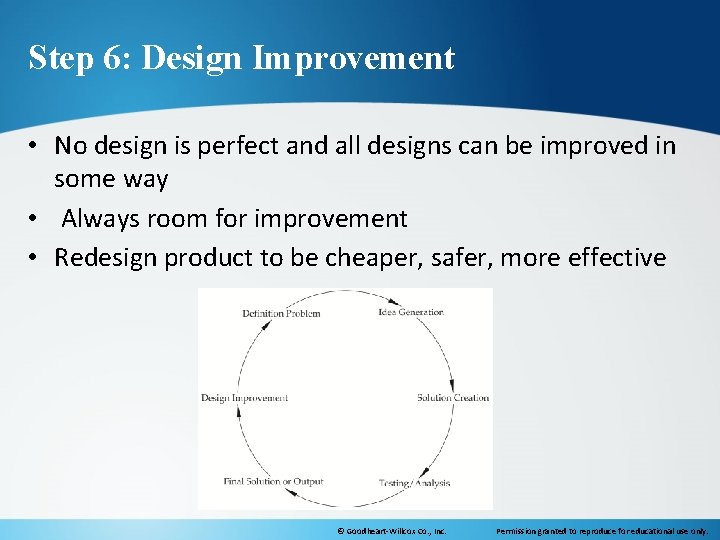
Step 6: Design Improvement • No design is perfect and all designs can be improved in some way • Always room for improvement • Redesign product to be cheaper, safer, more effective © Goodheart-Willcox Co. , Inc. Permission granted to reproduce for educational use only.
Engineering Notebooks • Used to record thoughts, ideas, sketches, calculations, and designs • Legal documents • Fixed binding • Never remove pages • Cross out blank space © Goodheart-Willcox Co. , Inc. Permission granted to reproduce for educational use only.
- Slides: 15