
2 Encouraging Peace United Nations a Creation of

- Slides: 43
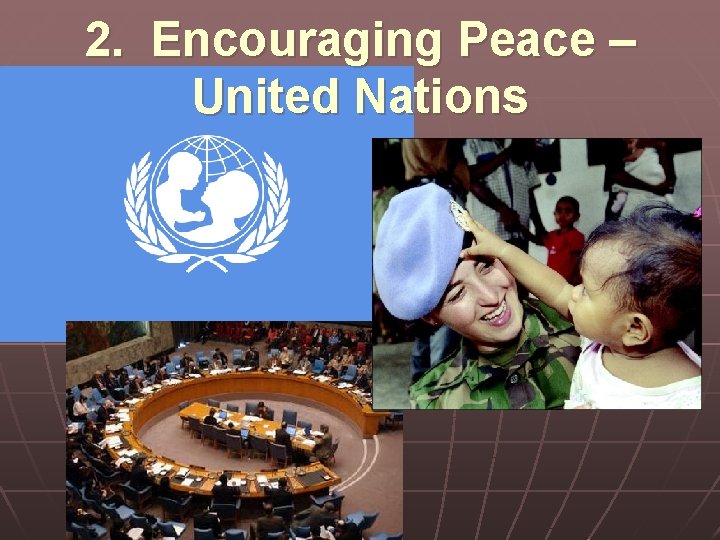
2. Encouraging Peace – United Nations
a) Creation of the United Nations n n n formed in 1945 51 countries including Canada Now 192 members based on idea of collective security - to prevent another global conflict. The basic goals of the organization were peace and social and economic progress. The four main goals were: • • • Keeping world peace and preventing new wars Encouraging cooperation among nations Defending human rights and helping to promote equality • Improving the standard of living for all nations
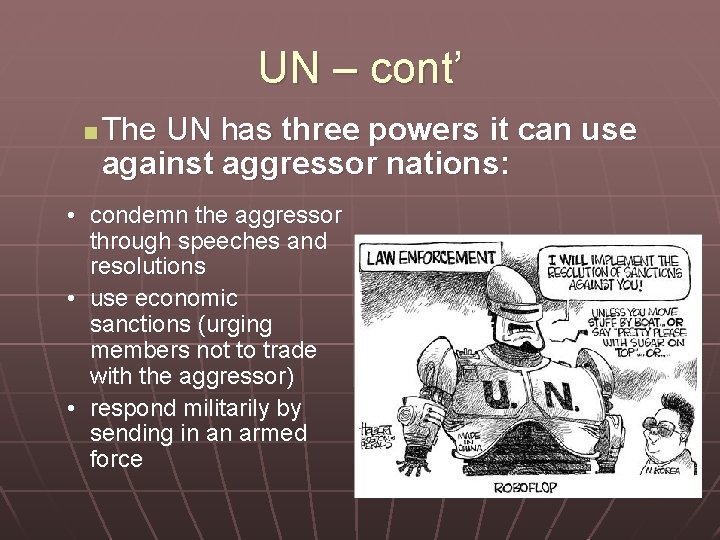
UN – cont’ n The UN has three powers it can use against aggressor nations: • condemn the aggressor through speeches and resolutions • use economic sanctions (urging members not to trade with the aggressor) • respond militarily by sending in an armed force
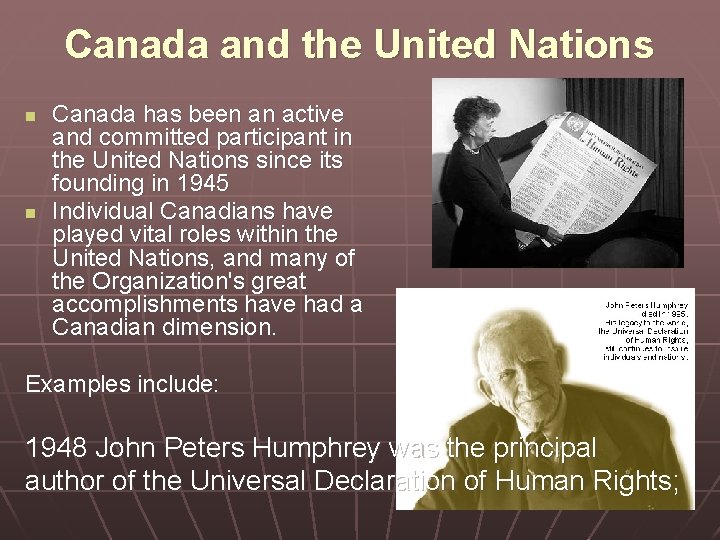
Canada and the United Nations n n Canada has been an active and committed participant in the United Nations since its founding in 1945 Individual Canadians have played vital roles within the United Nations, and many of the Organization's great accomplishments have had a Canadian dimension. Examples include: 1948 John Peters Humphrey was the principal author of the Universal Declaration of Human Rights;
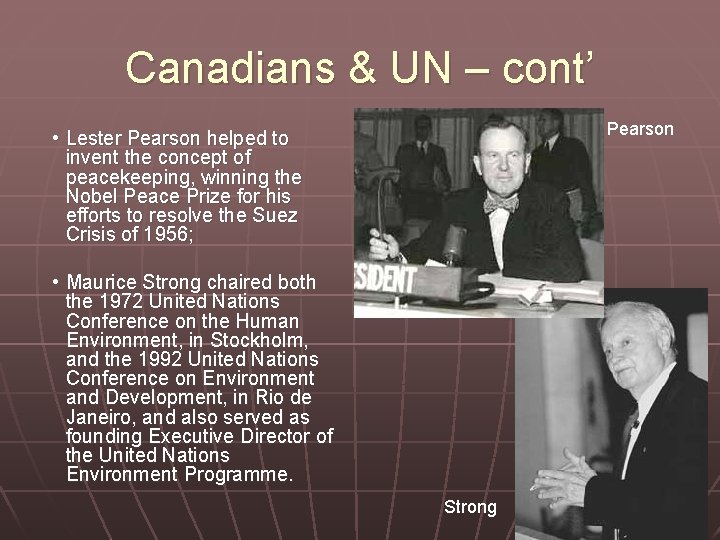
Canadians & UN – cont’ Pearson • Lester Pearson helped to invent the concept of peacekeeping, winning the Nobel Peace Prize for his efforts to resolve the Suez Crisis of 1956; • Maurice Strong chaired both the 1972 United Nations Conference on the Human Environment, in Stockholm, and the 1992 United Nations Conference on Environment and Development, in Rio de Janeiro, and also served as founding Executive Director of the United Nations Environment Programme. Strong
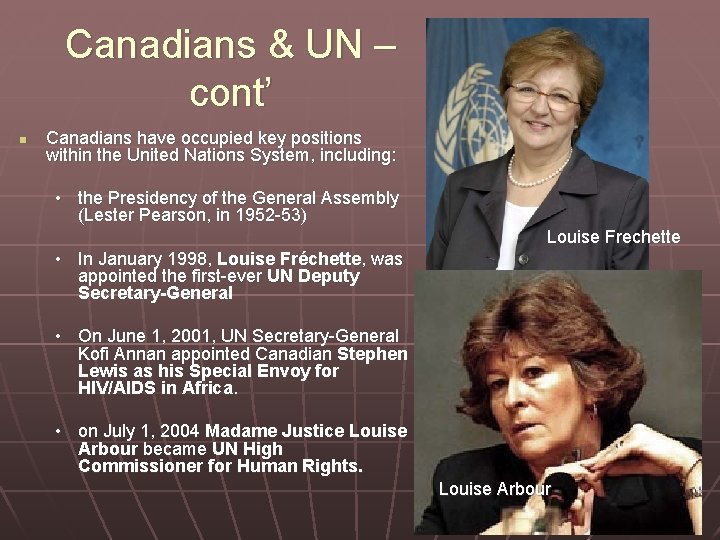
Canadians & UN – cont’ n Canadians have occupied key positions within the United Nations System, including: • the Presidency of the General Assembly (Lester Pearson, in 1952 -53) Louise Frechette • In January 1998, Louise Fréchette, was appointed the first-ever UN Deputy Secretary-General • On June 1, 2001, UN Secretary-General Kofi Annan appointed Canadian Stephen Lewis as his Special Envoy for HIV/AIDS in Africa. • on July 1, 2004 Madame Justice Louise Arbour became UN High Commissioner for Human Rights. Louise Arbour
Reflect & Discuss n n n When and why was the UN established? What are its three basic goals? What are some of the more important Canadian contributions to the UN? • Identify these individuals & their connection to the UN: Louise Arbour n John Humphreys n Lester B. Pearson n
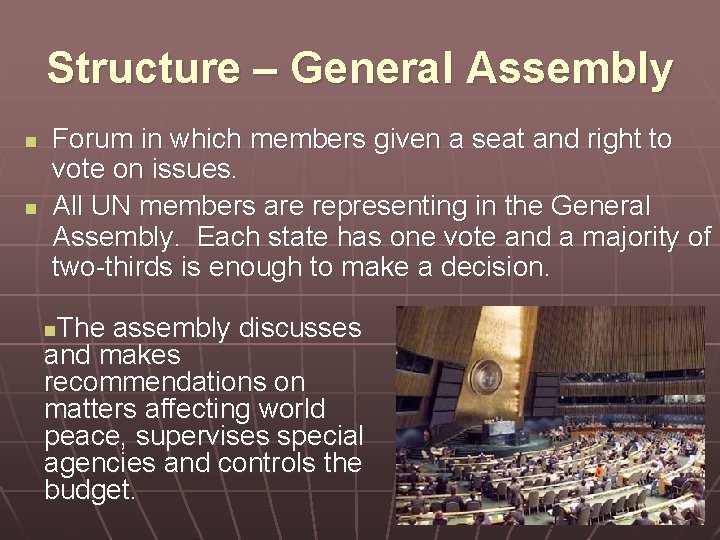
Structure – General Assembly n n Forum in which members given a seat and right to vote on issues. All UN members are representing in the General Assembly. Each state has one vote and a majority of two-thirds is enough to make a decision. The assembly discusses and makes recommendations on matters affecting world peace, supervises special agencies and controls the budget. n
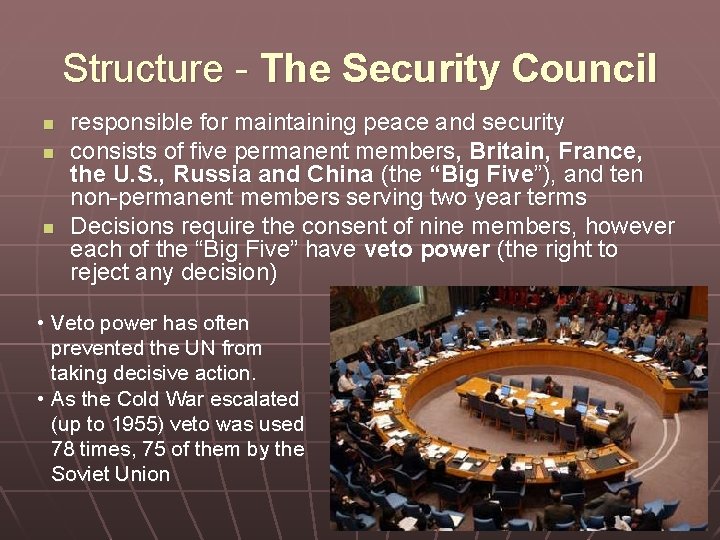
Structure - The Security Council n n n responsible for maintaining peace and security consists of five permanent members, Britain, France, the U. S. , Russia and China (the “Big Five”), and ten non-permanent members serving two year terms Decisions require the consent of nine members, however each of the “Big Five” have veto power (the right to reject any decision) • Veto power has often prevented the UN from taking decisive action. • As the Cold War escalated (up to 1955) veto was used 78 times, 75 of them by the Soviet Union
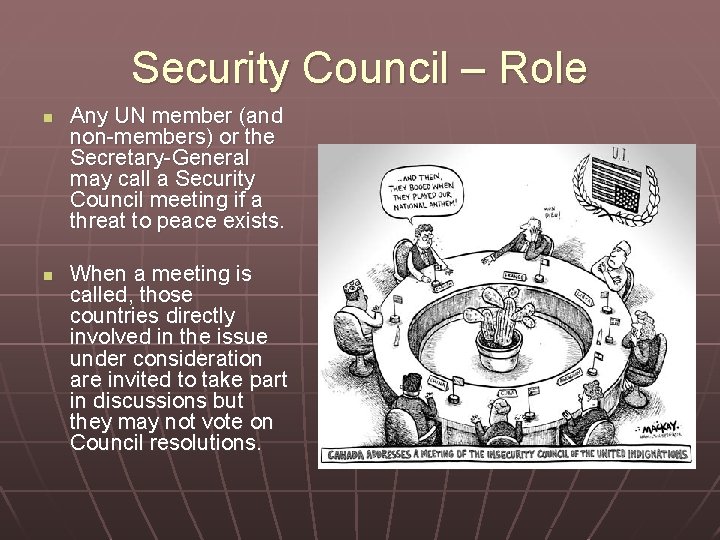
Security Council – Role n n Any UN member (and non-members) or the Secretary-General may call a Security Council meeting if a threat to peace exists. When a meeting is called, those countries directly involved in the issue under consideration are invited to take part in discussions but they may not vote on Council resolutions.
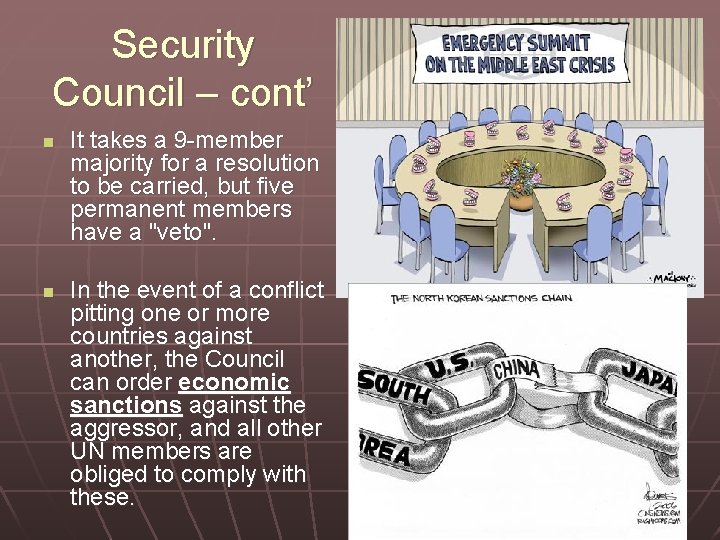
Security Council – cont’ n n It takes a 9 -member majority for a resolution to be carried, but five permanent members have a "veto". In the event of a conflict pitting one or more countries against another, the Council can order economic sanctions against the aggressor, and all other UN members are obliged to comply with these.
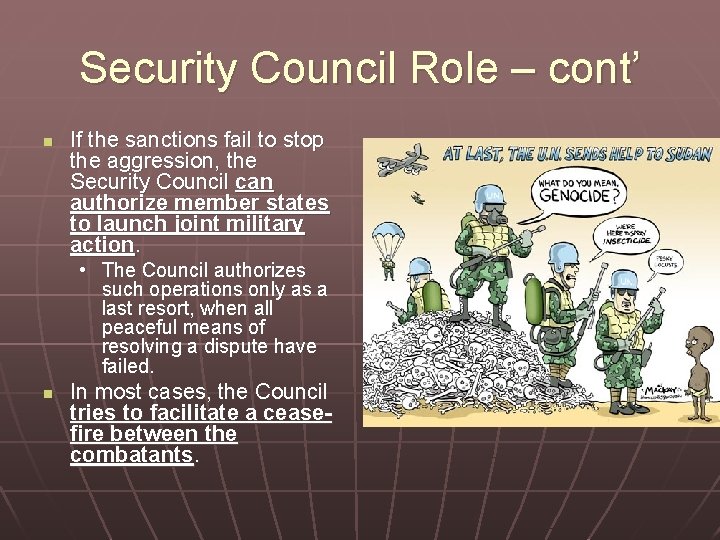
Security Council Role – cont’ n If the sanctions fail to stop the aggression, the Security Council can authorize member states to launch joint military action. • The Council authorizes such operations only as a last resort, when all peaceful means of resolving a dispute have failed. n In most cases, the Council tries to facilitate a ceasefire between the combatants.
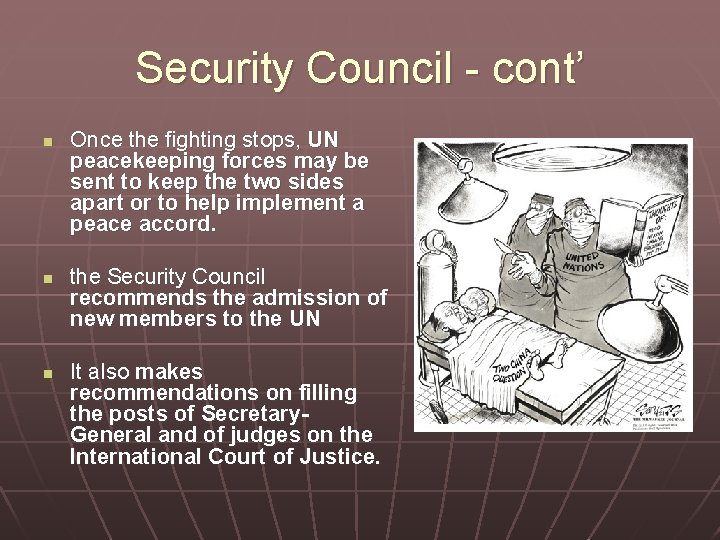
Security Council - cont’ n n n Once the fighting stops, UN peacekeeping forces may be sent to keep the two sides apart or to help implement a peace accord. the Security Council recommends the admission of new members to the UN It also makes recommendations on filling the posts of Secretary. General and of judges on the International Court of Justice.
Canada & Security Council n n Canada has six times been elected to the powerful UN Security Council, serving terms in 1948 -49, 1958 -59, 1967 -68, 1977 -78, 1989 -90 and in 1999 -2000. During its last tenure on the Council, Canada's priorities revolved around issues of: • • n human security, such as the protection of civilians in armed conflict, war-affected children, conflict prevention, peacebuilding, mass refugee flows, illicit small arms trafficking, gross human rights abuses, and failures of governance and the rule of law. Canada also played major role in improving the effectiveness of sanctions, especially in Africa, and in promoting changes to the Council's working methods intended to improve its transparency and accountability to UN members. http: //archives. cbc. ca/IDCC-1 -71 -659 -3817/conflict_war/diplomacy/
Reflect & Discuss n What is the General Assembly? • What is its role and areas of responsibility? • How many members? • How are votes taken? n What is the Security Council? • • How many members sit on the Council? How are votes taken? Who has Veto? What is its role and areas of responsibility? How many times has Canada sat on the Council?
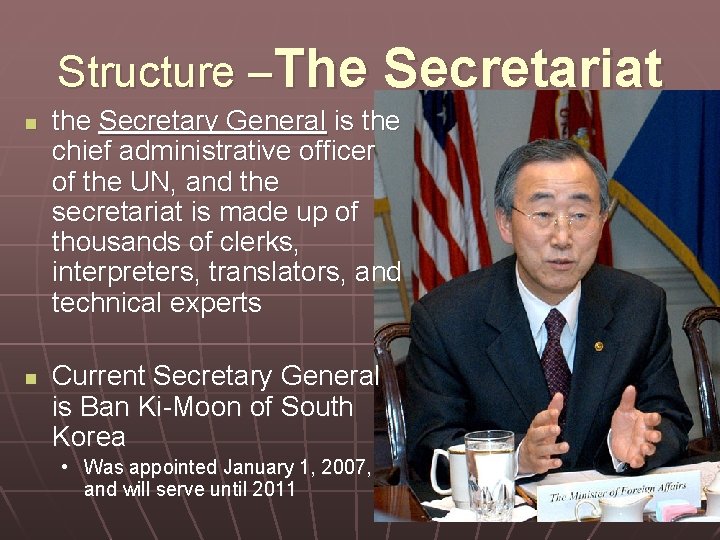
Structure –The Secretariat n n the Secretary General is the chief administrative officer of the UN, and the secretariat is made up of thousands of clerks, interpreters, translators, and technical experts Current Secretary General is Ban Ki-Moon of South Korea • Was appointed January 1, 2007, and will serve until 2011
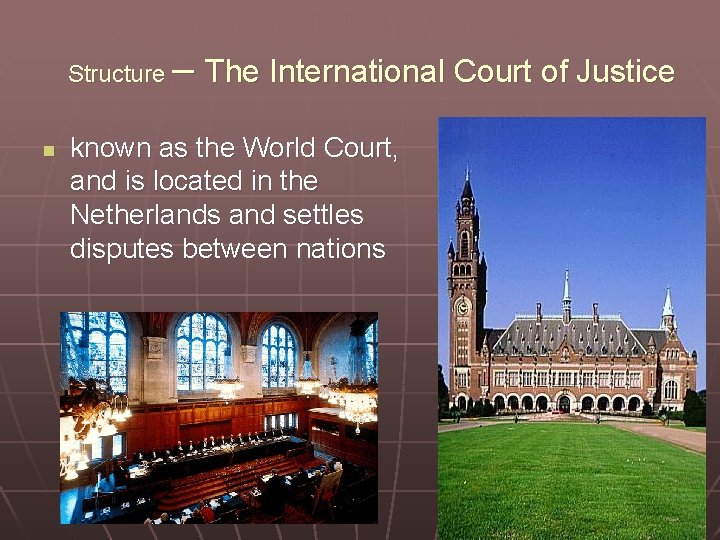
Structure n – The International Court of Justice known as the World Court, and is located in the Netherlands and settles disputes between nations
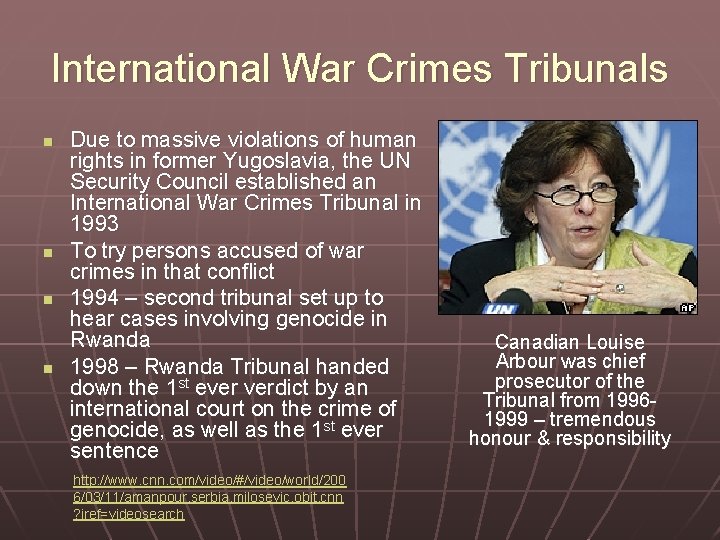
International War Crimes Tribunals n n Due to massive violations of human rights in former Yugoslavia, the UN Security Council established an International War Crimes Tribunal in 1993 To try persons accused of war crimes in that conflict 1994 – second tribunal set up to hear cases involving genocide in Rwanda 1998 – Rwanda Tribunal handed down the 1 st ever verdict by an international court on the crime of genocide, as well as the 1 st ever sentence http: //www. cnn. com/video/#/video/world/200 6/03/11/amanpour. serbia. milosevic. obit. cnn ? iref=videosearch Canadian Louise Arbour was chief prosecutor of the Tribunal from 19961999 – tremendous honour & responsibility
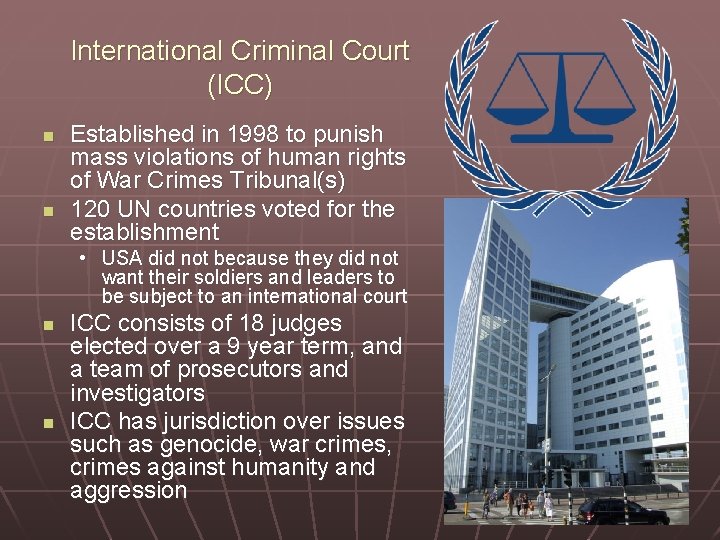
International Criminal Court (ICC) n n Established in 1998 to punish mass violations of human rights of War Crimes Tribunal(s) 120 UN countries voted for the establishment • USA did not because they did not want their soldiers and leaders to be subject to an international court n n ICC consists of 18 judges elected over a 9 year term, and a team of prosecutors and investigators ICC has jurisdiction over issues such as genocide, war crimes, crimes against humanity and aggression
Reflect & Discuss n n n What is the Secretariat? Who is the current Secretary General of the UN? What is the International Court of Justice? (ICJ) • What is its role in international law? n What is an International War Crimes Tribunal? • What were the 1 st two Tribunals and when & why were they established? n What is the International Criminal Court? (ICC) • • • When and Why was it established? What is its area of jurisdiction? Why did the USA not want this Court established?
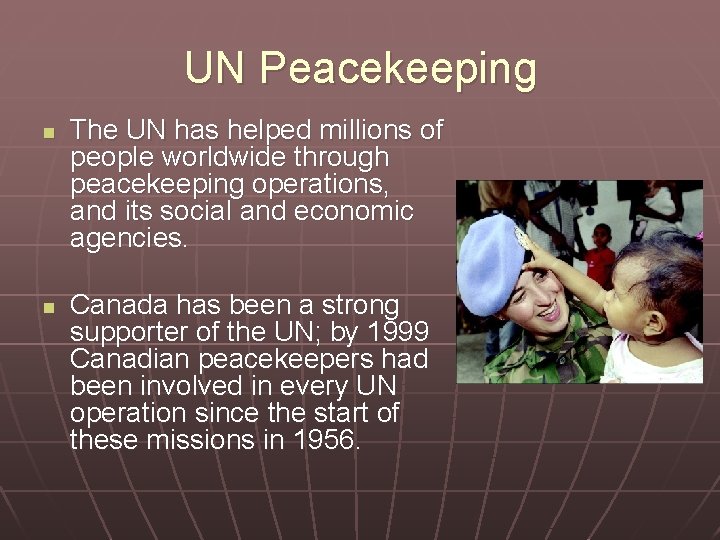
UN Peacekeeping n n The UN has helped millions of people worldwide through peacekeeping operations, and its social and economic agencies. Canada has been a strong supporter of the UN; by 1999 Canadian peacekeepers had been involved in every UN operation since the start of these missions in 1956.
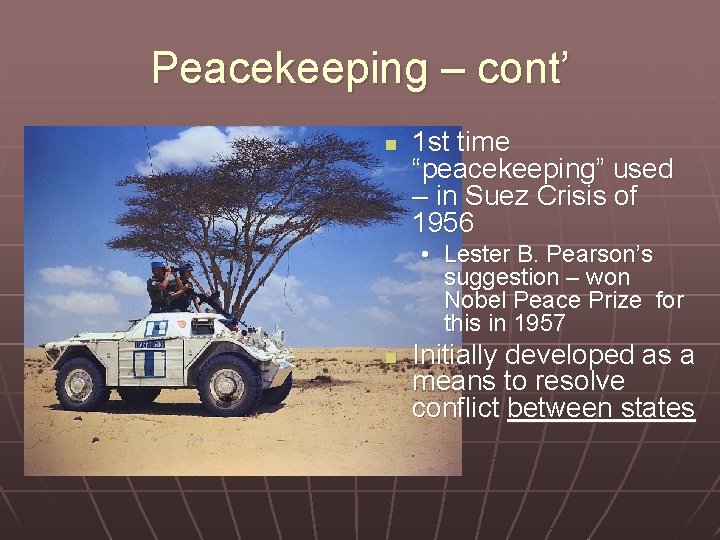
Peacekeeping – cont’ n 1 st time “peacekeeping” used – in Suez Crisis of 1956 • Lester B. Pearson’s suggestion – won Nobel Peace Prize for this in 1957 n Initially developed as a means to resolve conflict between states
Peacekeeping – cont’ n n n Achieved by deploying unarmed or lightly armed military personnel from a number of countries between the armed forces of the states that were formerly at war In these circumstances – ceasefire in place and parties involved agreed to allow UN forces to be present Peacekeepers NOT part of the conflict – they observed the ceasefire
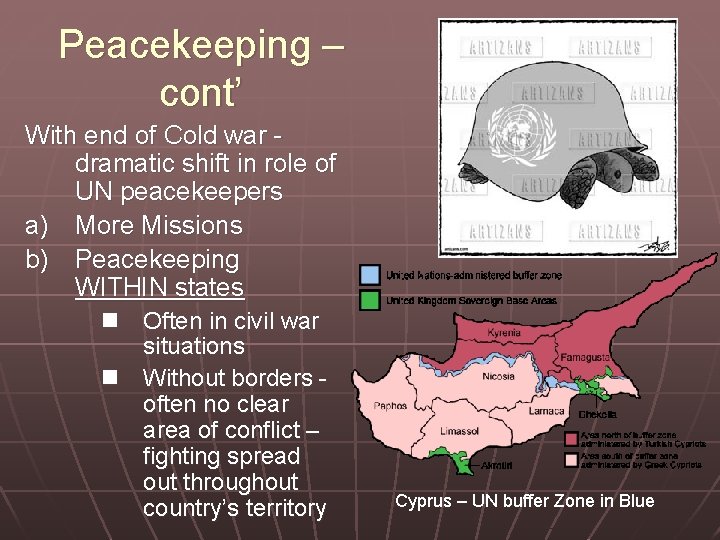
Peacekeeping – cont’ With end of Cold war dramatic shift in role of UN peacekeepers a) More Missions b) Peacekeeping WITHIN states n Often in civil war situations n Without borders often no clear area of conflict – fighting spread out throughout country’s territory Cyprus – UN buffer Zone in Blue
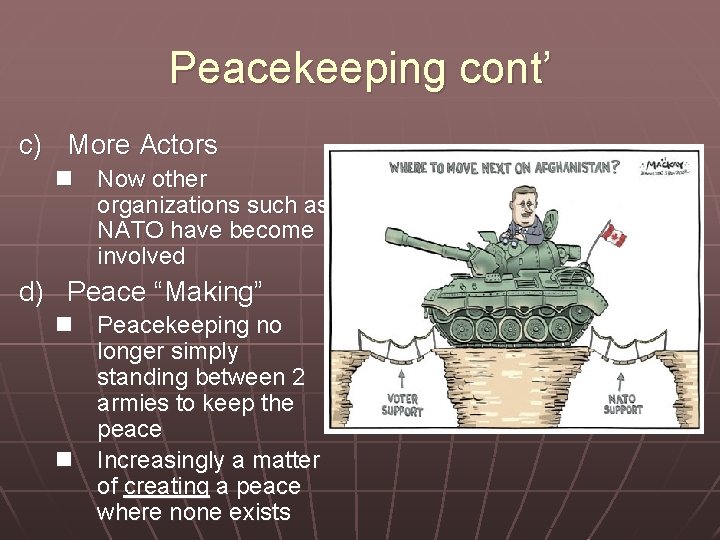
Peacekeeping cont’ c) More Actors n Now other organizations such as NATO have become involved d) Peace “Making” n Peacekeeping no longer simply standing between 2 armies to keep the peace n Increasingly a matter of creating a peace where none exists
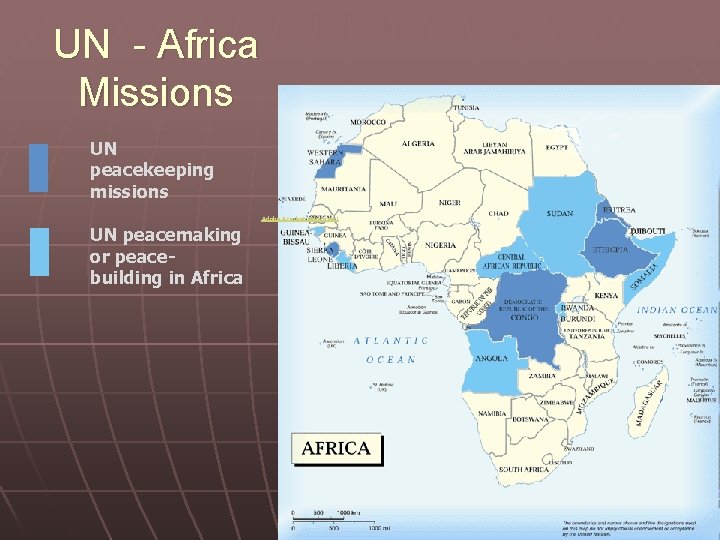
UN - Africa Missions UN peacekeeping missions Adobe Acrobat Required ! UN peacemaking or peacebuilding in Africa
Peacekeeping cont’ e) Changing Role of Peacekeepers Modern peacekeeping involves: n Training and restructuring local police forces n De-mining n Conducting elections n Facilitating the return of refugees n Monitoring human rights n demobilizing and reintegrating former soldiers n Promoting sustainable democracy and economic development
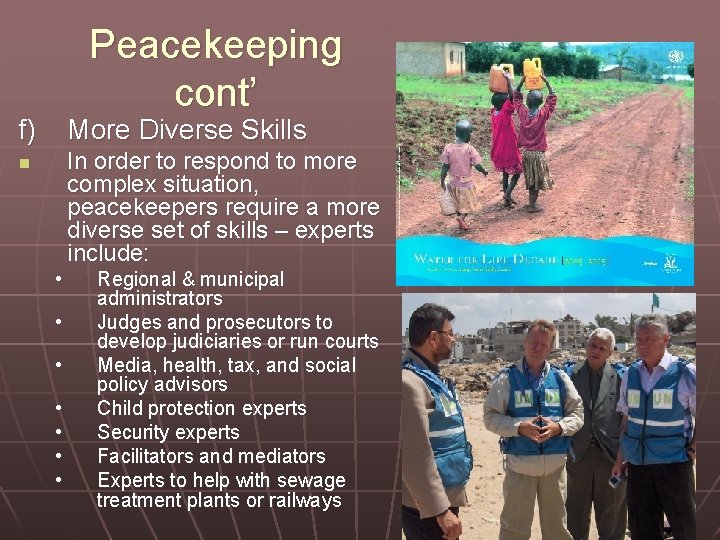
Peacekeeping cont’ f) More Diverse Skills In order to respond to more complex situation, peacekeepers require a more diverse set of skills – experts include: n • • Regional & municipal administrators Judges and prosecutors to develop judiciaries or run courts Media, health, tax, and social policy advisors Child protection experts Security experts Facilitators and mediators Experts to help with sewage treatment plants or railways
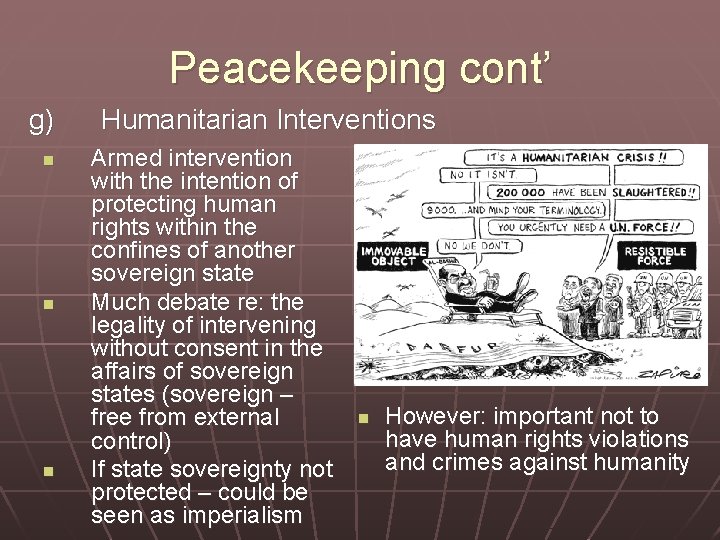
Peacekeeping cont’ g) n n n Humanitarian Interventions Armed intervention with the intention of protecting human rights within the confines of another sovereign state Much debate re: the legality of intervening without consent in the affairs of sovereign states (sovereign – free from external control) If state sovereignty not protected – could be seen as imperialism n However: important not to have human rights violations and crimes against humanity
Reflect & Discuss n n n When did “peacekeeping” being and why? What was the main purpose of peacekeeping when it 1 st began? How did peacekeeping change after the Cold War? (7 ways – explain each a bit)
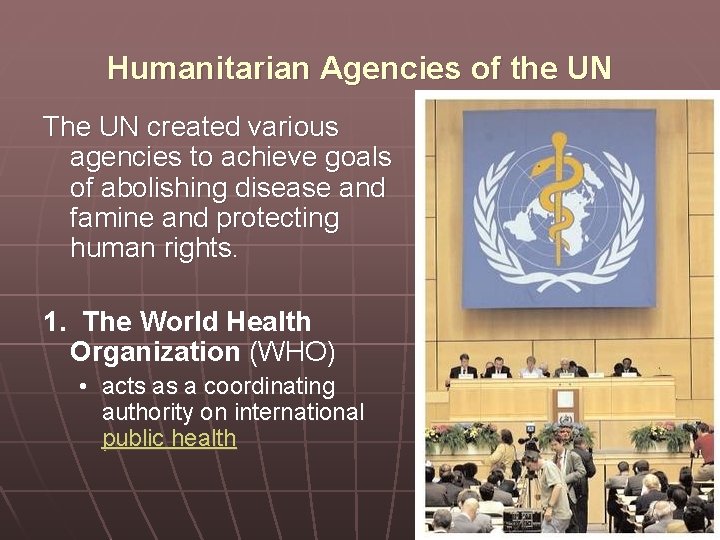
Humanitarian Agencies of the UN The UN created various agencies to achieve goals of abolishing disease and famine and protecting human rights. 1. The World Health Organization (WHO) • acts as a coordinating authority on international public health
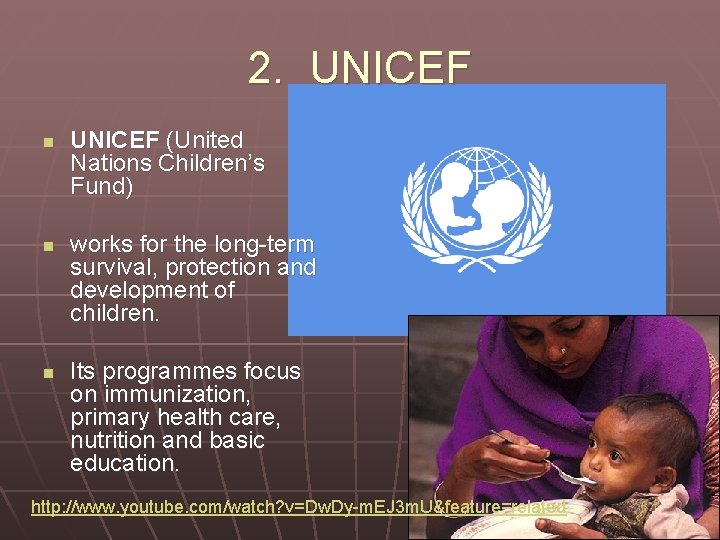
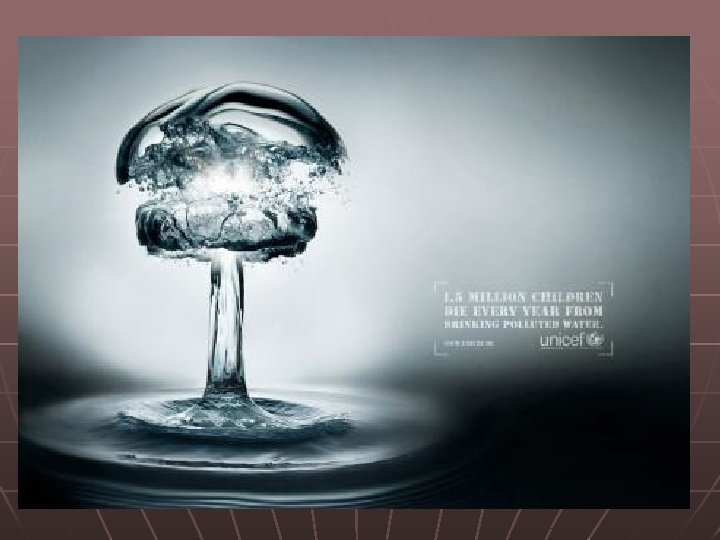
2. UNICEF n n n UNICEF (United Nations Children’s Fund) works for the long-term survival, protection and development of children. Its programmes focus on immunization, primary health care, nutrition and basic education. http: //www. youtube. com/watch? v=Dw. Dy-m. EJ 3 m. U&feature=related
3. the International Labour Organization (ILO) n the UN specialized agency that promotes social justice and internationally recognized human and labour rights. "The primary goal of the ILO today is to promote opportunities for women and men to obtain decent and productive work, in conditions of freedom, equity, security, and human dignity. " -Juan Somavia, Director General, ILO
4. UNESCO • United Nations Educational Scientific and Cultural Organization (UNESCO) • UNESCO was formed to create an organization that would embody a genuine culture of peace by promoting collaboration among nations through education, the sciences, culture, and communication and information n Canada’s active membership in UNESCO plays a major role in promoting Canadian values and objectives on the international stage, reinforcing the ideals of justice, equality and human dignity.
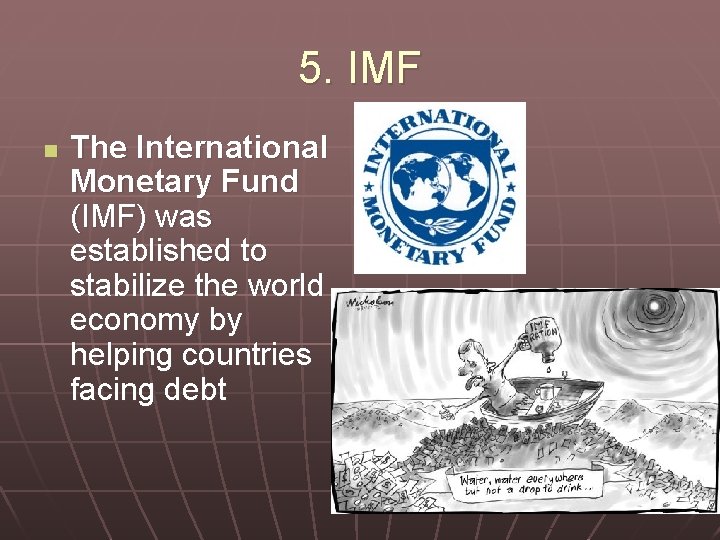
5. IMF n The International Monetary Fund (IMF) was established to stabilize the world economy by helping countries facing debt
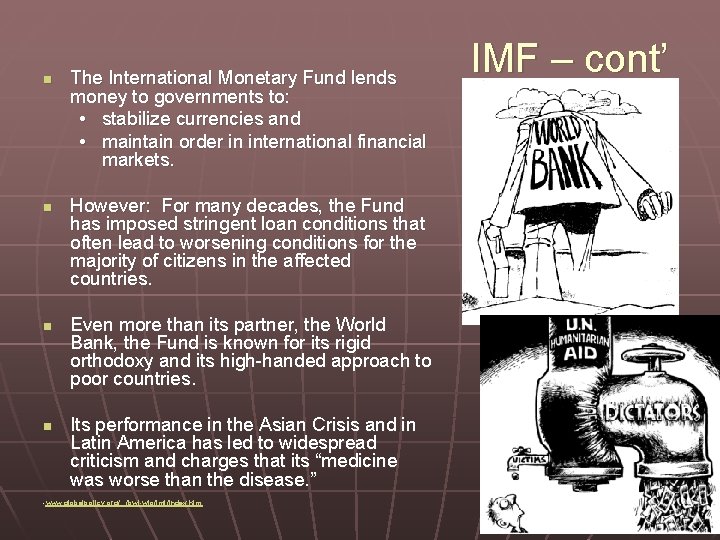
n n The International Monetary Fund lends money to governments to: • stabilize currencies and • maintain order in international financial markets. However: For many decades, the Fund has imposed stringent loan conditions that often lead to worsening conditions for the majority of citizens in the affected countries. Even more than its partner, the World Bank, the Fund is known for its rigid orthodoxy and its high-handed approach to poor countries. Its performance in the Asian Crisis and in Latin America has led to widespread criticism and charges that its “medicine was worse than the disease. ” -www. globalpolicy. org/. . . / bwi-wto/imf/index. htm www. globalpolicy. org/. . . /bwi-wto/imf/index. htm IMF – cont’
6. UNAIDS n Joint United Nations Programme on HIV/AIDS – (UNAIDS) n n The main international advocate for coordinated global action on the HIV epidemic mission includes: • preventing transmission of HIV, • providing care and support for those already living with HIV, and • reducing the epidemic's impact on communities.
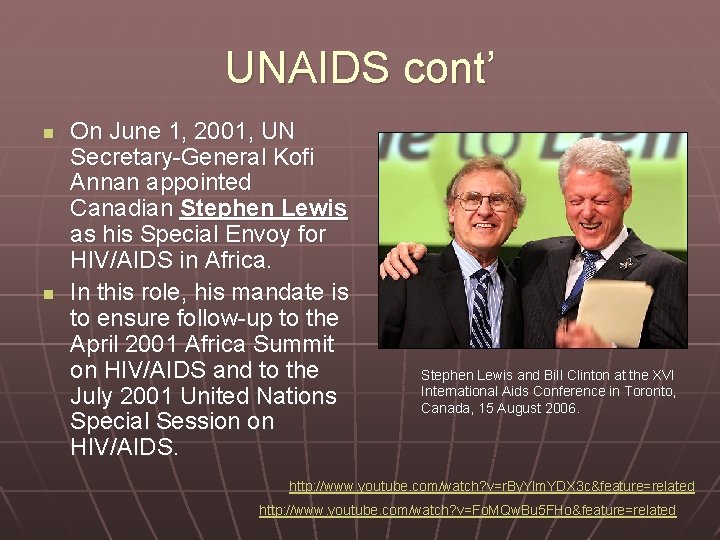
UNAIDS cont’ n n On June 1, 2001, UN Secretary-General Kofi Annan appointed Canadian Stephen Lewis as his Special Envoy for HIV/AIDS in Africa. In this role, his mandate is to ensure follow-up to the April 2001 Africa Summit on HIV/AIDS and to the July 2001 United Nations Special Session on HIV/AIDS. Stephen Lewis and Bill Clinton at the XVI International Aids Conference in Toronto, Canada, 15 August 2006. http: //www. youtube. com/watch? v=r. By. Ylm. YDX 3 c&feature=related http: //www. youtube. com/watch? v=Fo. MQw. Bu 5 FHo&feature=related
7. UNHCR n n n UN High Commissioner for Refugees Assists more than 22 million refugees and displaced people around the world Refugees – people who have left their countries for fear of persecution (persistent mistreatment of an individual/group by another group) based on race, religion, nationality, or political opinion
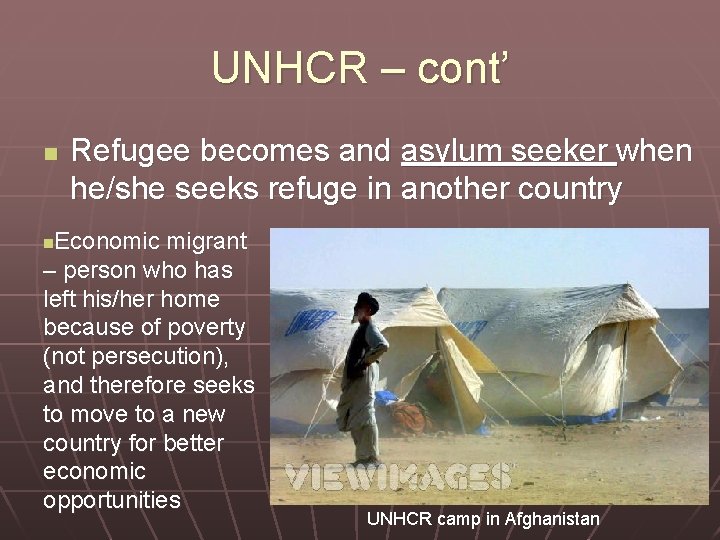
UNHCR – cont’ n Refugee becomes and asylum seeker when he/she seeks refuge in another country Economic migrant – person who has left his/her home because of poverty (not persecution), and therefore seeks to move to a new country for better economic opportunities n UNHCR camp in Afghanistan
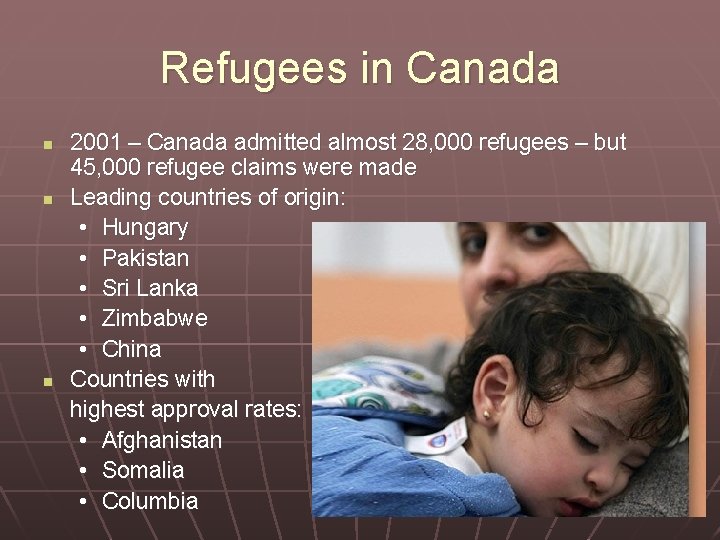
Refugees in Canada n n n 2001 – Canada admitted almost 28, 000 refugees – but 45, 000 refugee claims were made Leading countries of origin: • Hungary • Pakistan • Sri Lanka • Zimbabwe • China Countries with highest approval rates: • Afghanistan • Somalia • Columbia
Reflect & Discuss n 1. 2. 3. 4. 5. 6. 7. For all of the following UN Agencies, spell out what their initials stand for, explain what they are and what their mandates are: WHO UNICEF ILO UNESCO IMF UNAIDS UNHCR