
2 Electricity Topic overview Circuits Circuits are drawn
- Slides: 12
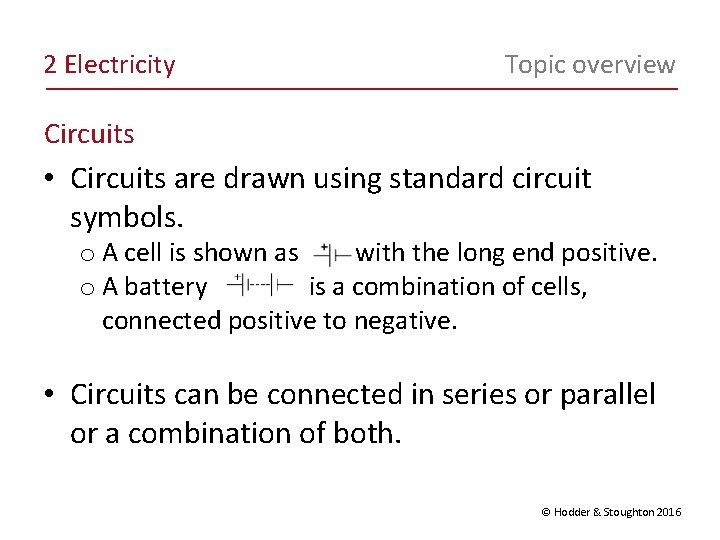
2 Electricity Topic overview Circuits • Circuits are drawn using standard circuit symbols. o A cell is shown as with the long end positive. o A battery is a combination of cells, connected positive to negative. • Circuits can be connected in series or parallel or a combination of both. © Hodder & Stoughton 2016
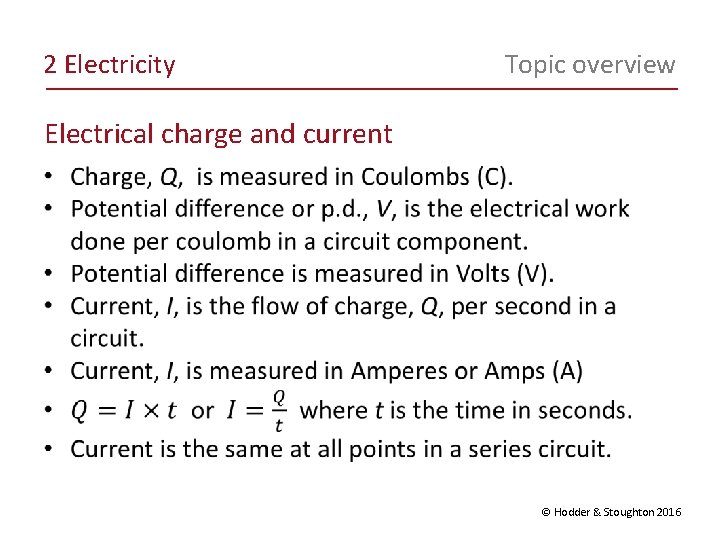
2 Electricity Topic overview Electrical charge and current © Hodder & Stoughton 2016
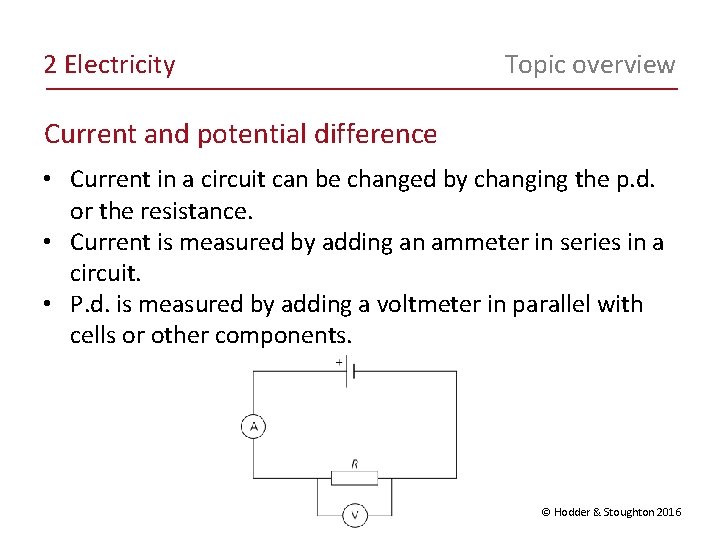
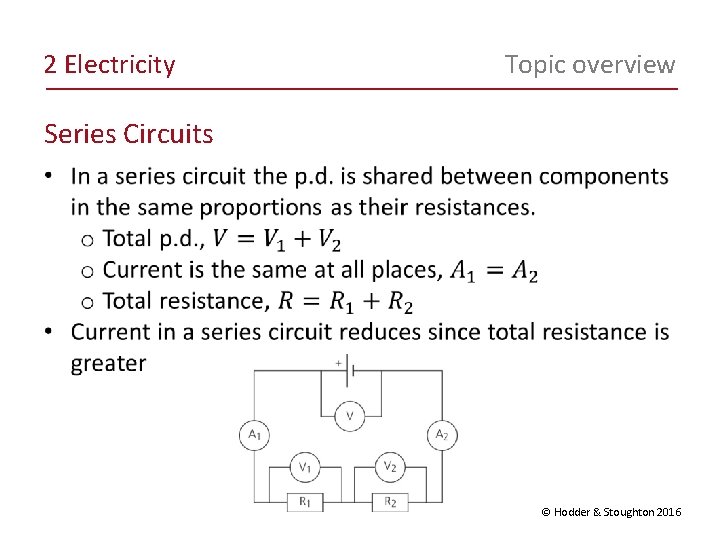
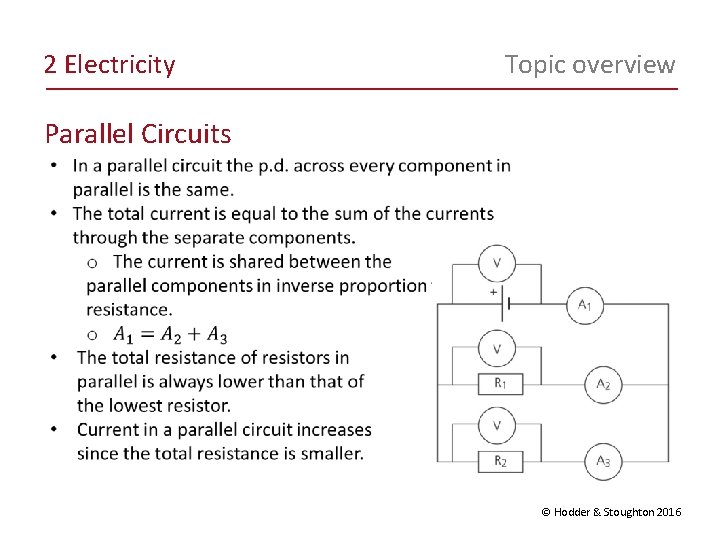
2 Electricity Topic overview Current and potential difference • Current in a circuit can be changed by changing the p. d. or the resistance. • Current is measured by adding an ammeter in series in a circuit. • P. d. is measured by adding a voltmeter in parallel with cells or other components. © Hodder & Stoughton 2016
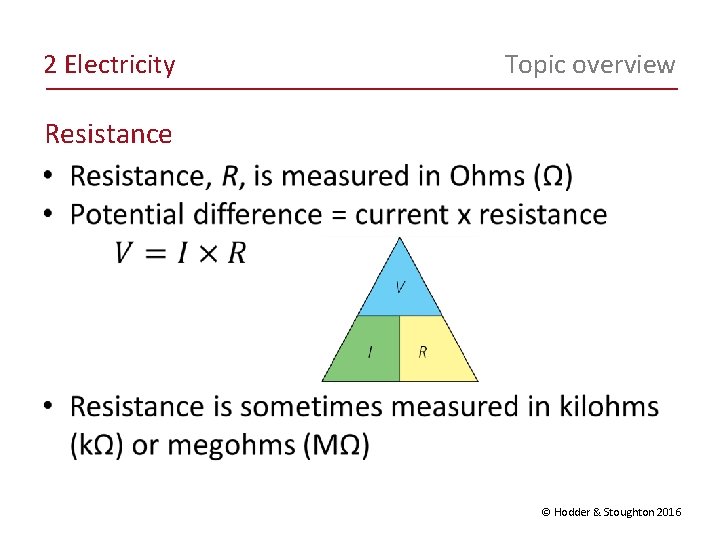
2 Electricity Topic overview Resistance © Hodder & Stoughton 2016
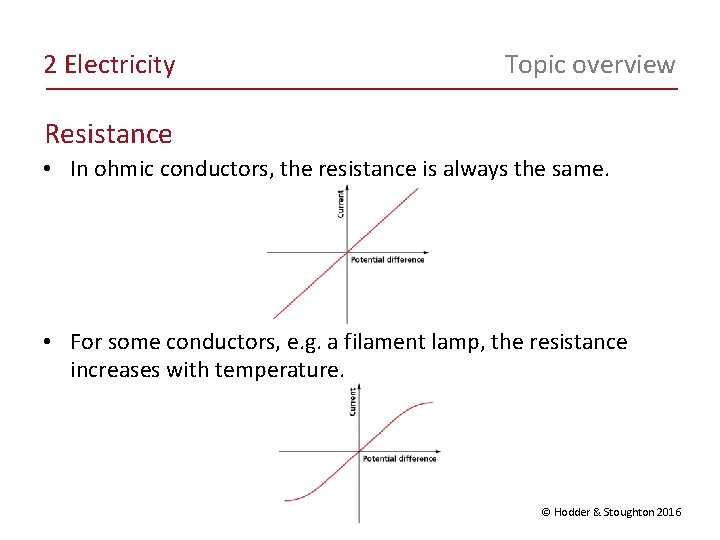
2 Electricity Topic overview Resistance • In ohmic conductors, the resistance is always the same. • For some conductors, e. g. a filament lamp, the resistance increases with temperature. © Hodder & Stoughton 2016
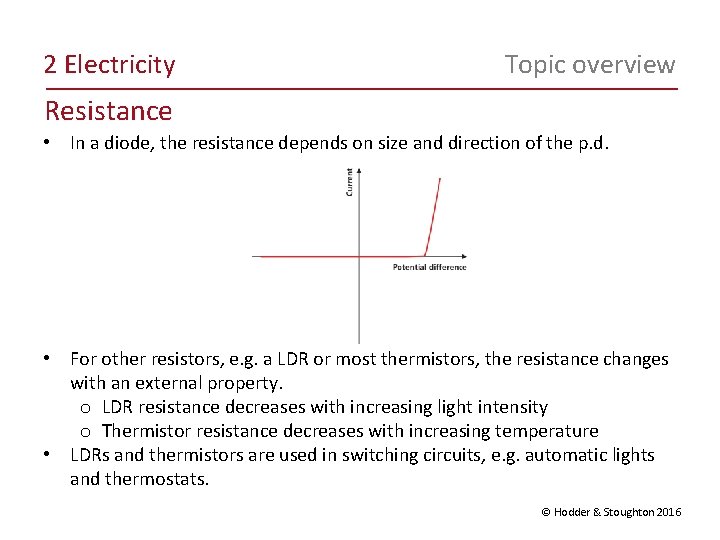
2 Electricity Topic overview Resistance • In a diode, the resistance depends on size and direction of the p. d. • For other resistors, e. g. a LDR or most thermistors, the resistance changes with an external property. o LDR resistance decreases with increasing light intensity o Thermistor resistance decreases with increasing temperature • LDRs and thermistors are used in switching circuits, e. g. automatic lights and thermostats. © Hodder & Stoughton 2016
2 Electricity Topic overview Series Circuits © Hodder & Stoughton 2016
2 Electricity Topic overview Parallel Circuits © Hodder & Stoughton 2016
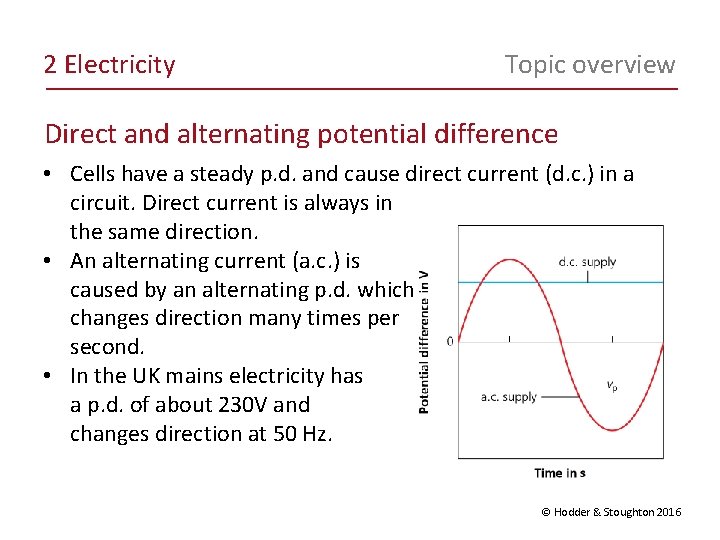
2 Electricity Topic overview Direct and alternating potential difference • Cells have a steady p. d. and cause direct current (d. c. ) in a circuit. Direct current is always in the same direction. • An alternating current (a. c. ) is caused by an alternating p. d. which changes direction many times per second. • In the UK mains electricity has a p. d. of about 230 V and changes direction at 50 Hz. © Hodder & Stoughton 2016
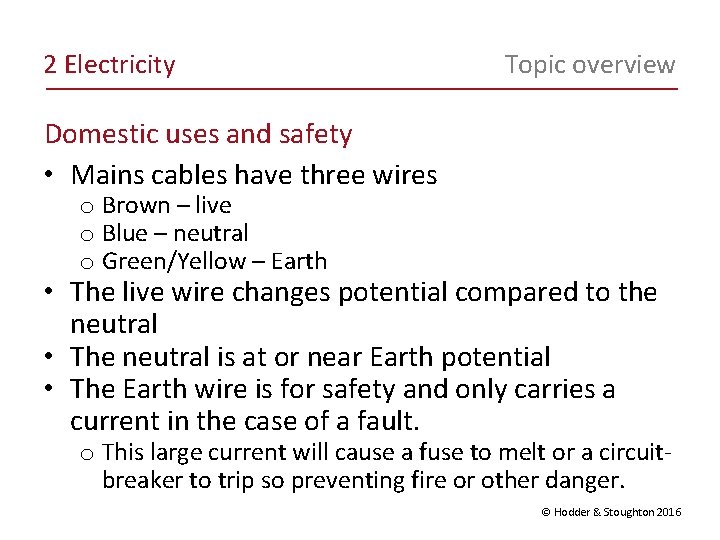
2 Electricity Topic overview Domestic uses and safety • Mains cables have three wires o Brown – live o Blue – neutral o Green/Yellow – Earth • The live wire changes potential compared to the neutral • The neutral is at or near Earth potential • The Earth wire is for safety and only carries a current in the case of a fault. o This large current will cause a fuse to melt or a circuitbreaker to trip so preventing fire or other danger. © Hodder & Stoughton 2016
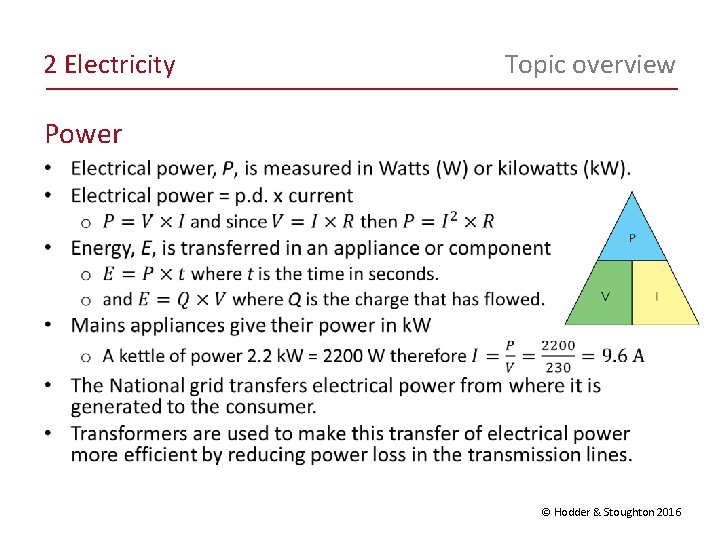
2 Electricity Topic overview Power © Hodder & Stoughton 2016
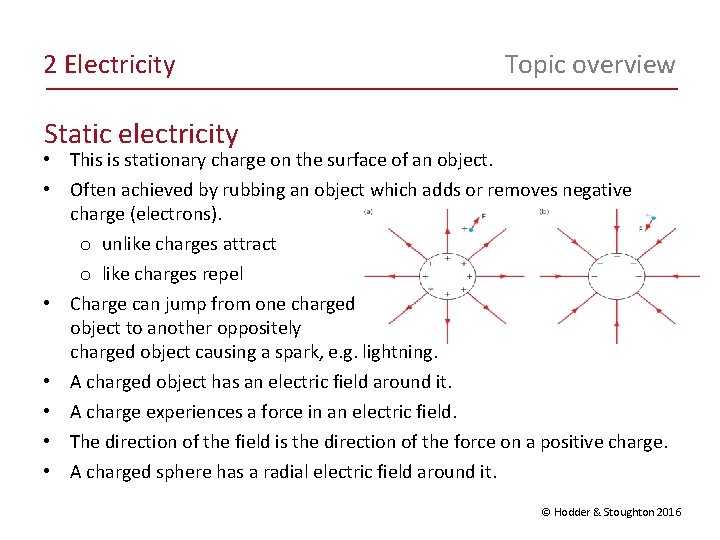
2 Electricity Topic overview Static electricity • This is stationary charge on the surface of an object. • Often achieved by rubbing an object which adds or removes negative charge (electrons). o unlike charges attract o like charges repel • Charge can jump from one charged object to another oppositely charged object causing a spark, e. g. lightning. • A charged object has an electric field around it. • A charge experiences a force in an electric field. • The direction of the field is the direction of the force on a positive charge. • A charged sphere has a radial electric field around it. © Hodder & Stoughton 2016