
2 DResultants Resultants The resultant of a system
- Slides: 9
2 D-Resultants
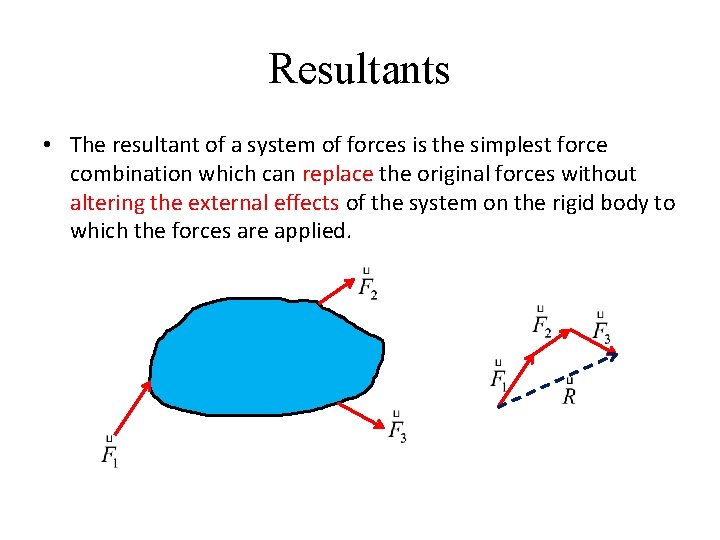
Resultants • The resultant of a system of forces is the simplest force combination which can replace the original forces without altering the external effects of the system on the rigid body to which the forces are applied.
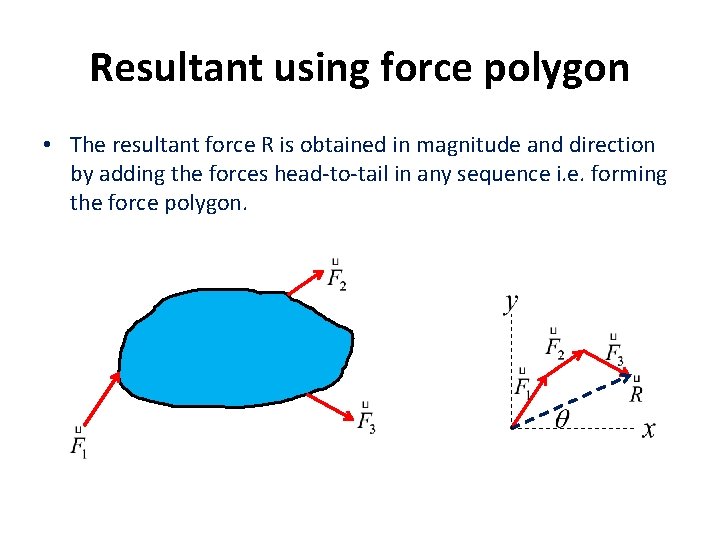
Resultant using force polygon • The resultant force R is obtained in magnitude and direction by adding the forces head-to-tail in any sequence i. e. forming the force polygon.
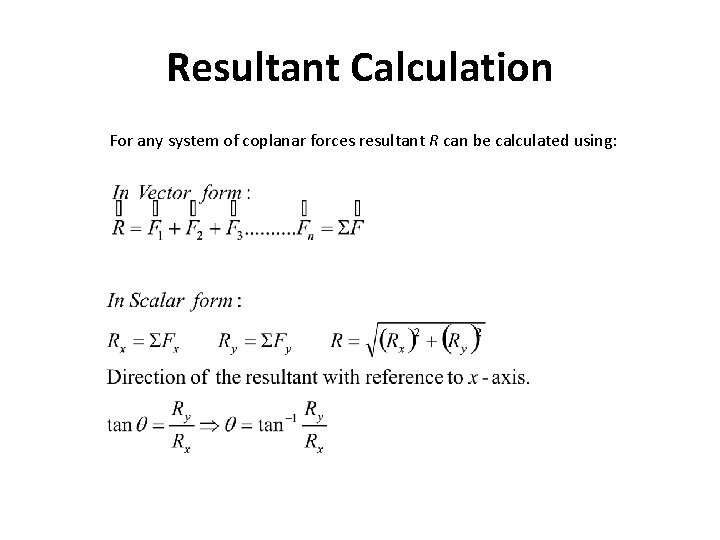
Resultant Calculation For any system of coplanar forces resultant R can be calculated using:
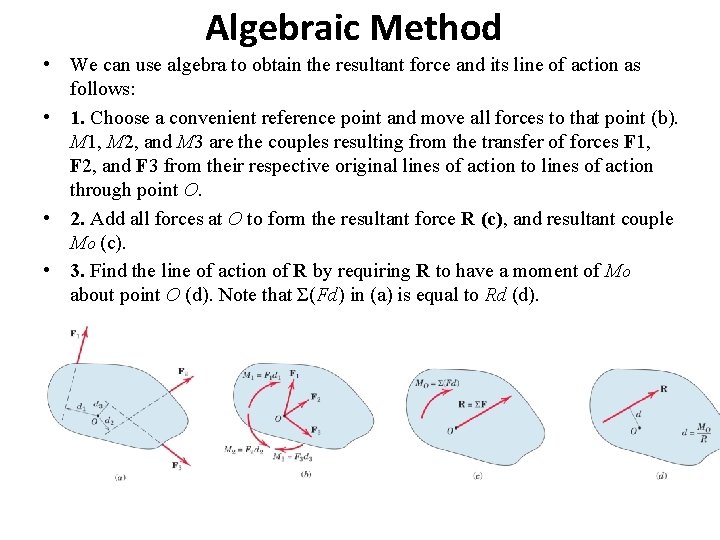
Algebraic Method • We can use algebra to obtain the resultant force and its line of action as follows: • 1. Choose a convenient reference point and move all forces to that point (b). M 1, M 2, and M 3 are the couples resulting from the transfer of forces F 1, F 2, and F 3 from their respective original lines of action to lines of action through point O. • 2. Add all forces at O to form the resultant force R (c), and resultant couple MO (c). • 3. Find the line of action of R by requiring R to have a moment of MO about point O (d). Note that Σ(Fd) in (a) is equal to Rd (d).
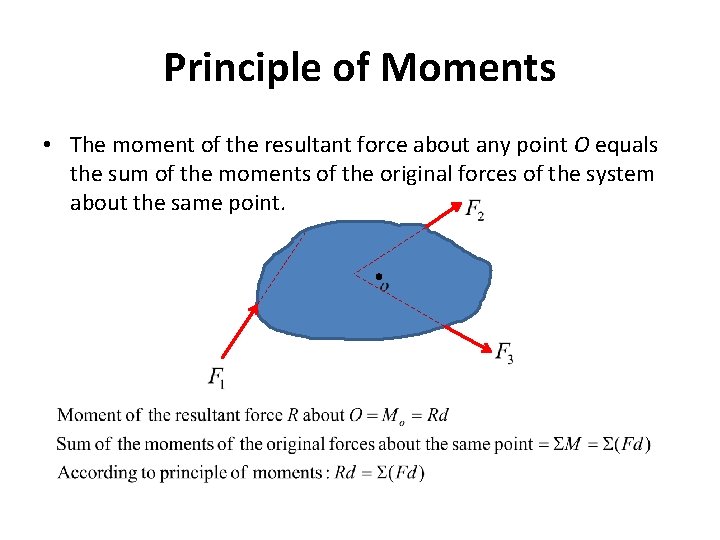
Principle of Moments • The moment of the resultant force about any point O equals the sum of the moments of the original forces of the system about the same point.
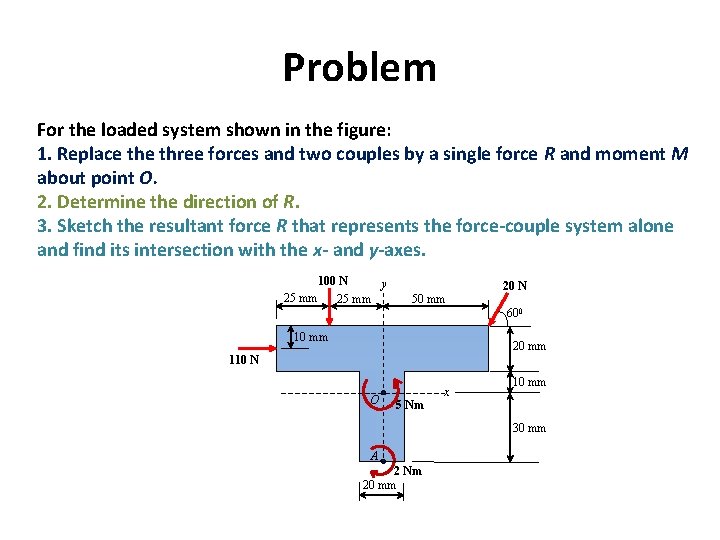
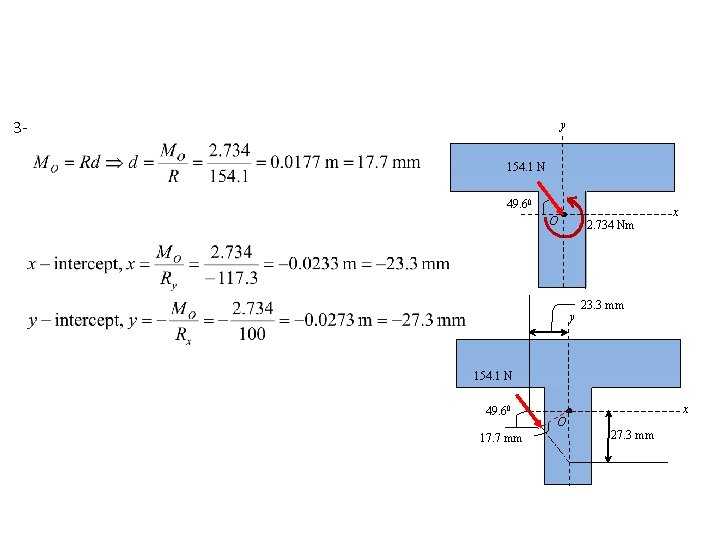
Problem For the loaded system shown in the figure: 1. Replace three forces and two couples by a single force R and moment M about point O. 2. Determine the direction of R. 3. Sketch the resultant force R that represents the force-couple system alone and find its intersection with the x- and y-axes. 100 N y 25 mm 50 mm 20 N 600 10 mm 20 mm 110 N O 5 Nm x 10 mm 30 mm A 2 Nm 20 mm
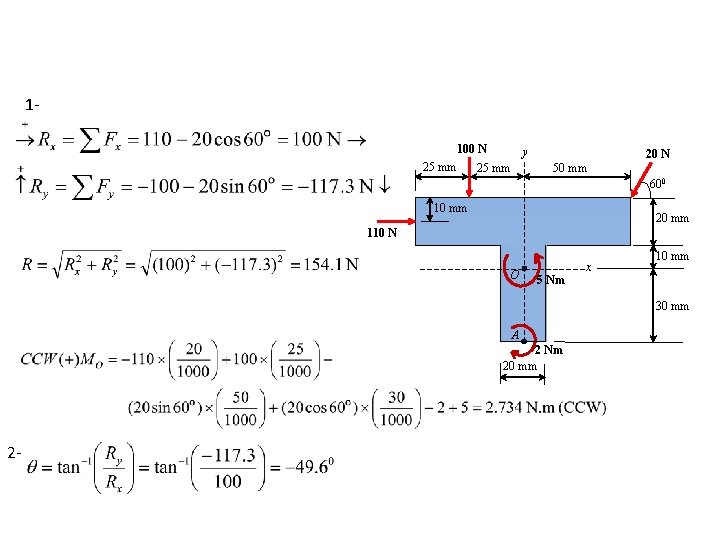
1100 N 25 mm y 25 mm 20 N 50 mm 600 10 mm 20 mm 110 N O x 10 mm 5 Nm 30 mm A 2 Nm 20 mm 2 -
3 - y 154. 1 N 49. 60 O 2. 734 Nm y x 23. 3 mm 154. 1 N 49. 60 17. 7 mm O x 27. 3 mm