
2 D Potential Flow Theory continued Reference 1

- Slides: 66
2 -D Potential Flow Theory - continued Reference: 1. Frank M. White, Chapter 4, Sections 4. 6 & 4. 7; 2. Frank M. White, Chapter 8, Sections 8. 1 to 8. 4 1
2 -D Potential Flow Theory …. 1. Introduction, def. , some basic concepts 2. General governing Eqns; reduced forms, 3. Solving the Potential Flow – – Velocity potential function, Laplace eqn Stream function, Laplace eqn – Superposition of elementary potential flow models; Examples: » Uniform Flow and Source Flow » Uniform Flow and Source / Sink Pair: The Rankine Oval » Uniform Flow and Doublet: Non-lifting flow over a circular cylinder » Uniform Flow, Doublet and Free Vortex: Lifting circular cylinder flow over a 4. Conclusion : The Kutta – Joukowski Thm 2
2 -D Potential Flow Theory – Potential flow is • an inviscid, incompressible, irrotational, steady flow – Potential Flow Theory is • a mathematical method developed to solve flow problems that can be closely approximated as a potential flow 3
2 -D Potential Flow Theory Question What do we mean by ‘solve’ ? 4
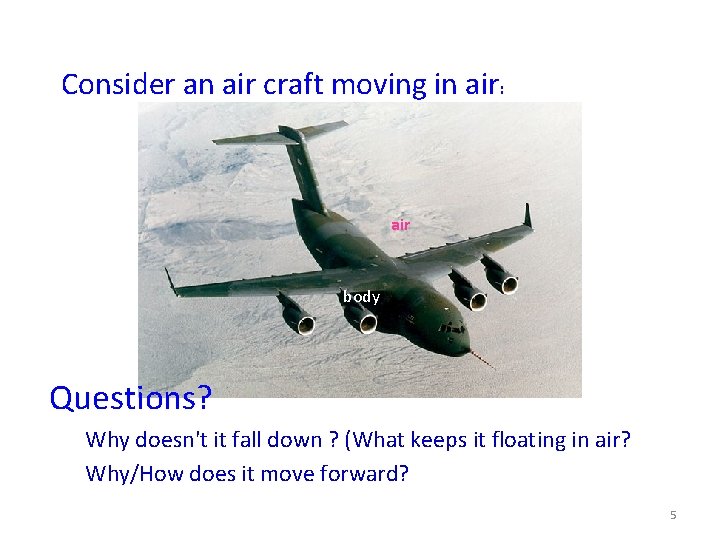
Consider an air craft moving in air: air body Questions? Why doesn't it fall down ? (What keeps it floating in air? Why/How does it move forward? 5
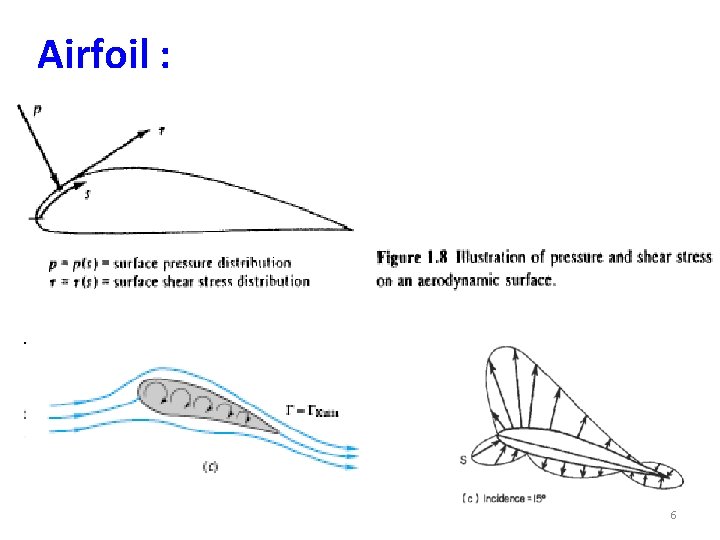
Airfoil : 6
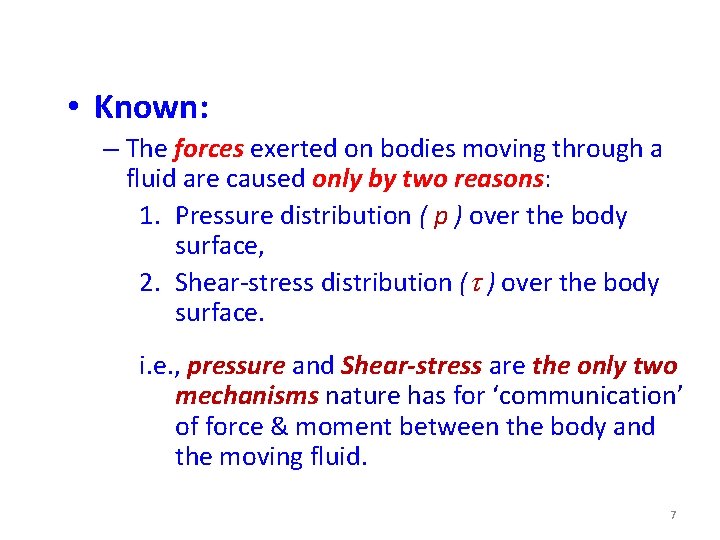
• Known: – The forces exerted on bodies moving through a fluid are caused only by two reasons: 1. Pressure distribution ( p ) over the body surface, 2. Shear-stress distribution ( ) over the body surface. i. e. , pressure and Shear-stress are the only two mechanisms nature has for ‘communication’ of force & moment between the body and the moving fluid. 7
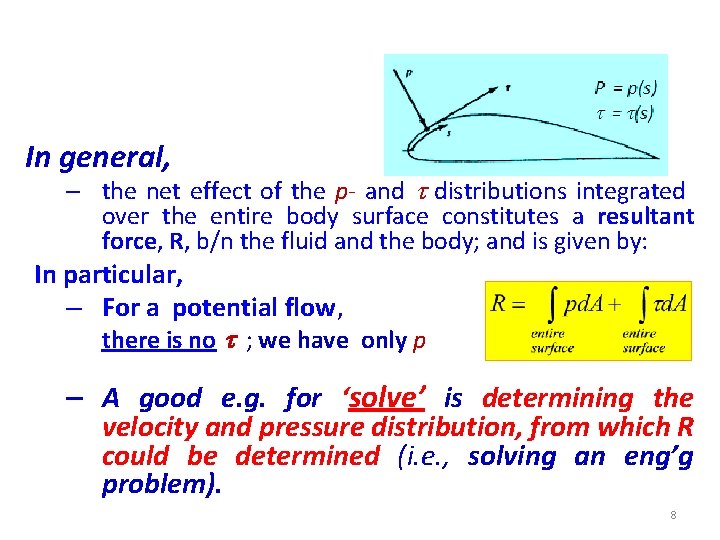
In general, – the net effect of the p- and distributions integrated over the entire body surface constitutes a resultant force, R, b/n the fluid and the body; and is given by: In particular, – For a potential flow, there is no ; we have only p – A good e. g. for ‘solve’ is determining the velocity and pressure distribution, from which R could be determined (i. e. , solving an eng’g problem). 8
2 -D Potential Flow Theory … The starting point for solving a potential flow problem is the set of eqns governing the flow. 9
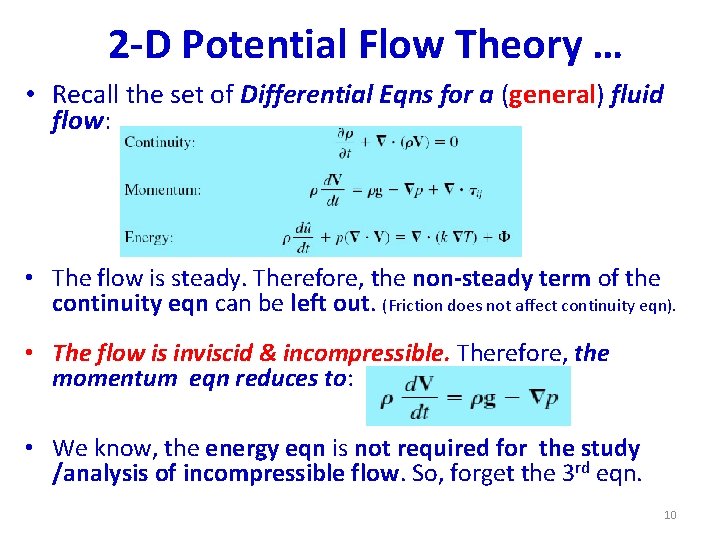
2 -D Potential Flow Theory … • Recall the set of Differential Eqns for a (general) fluid flow: • The flow is steady. Therefore, the non-steady term of the continuity eqn can be left out. (Friction does not affect continuity eqn). • The flow is inviscid & incompressible. Therefore, the momentum eqn reduces to: • We know, the energy eqn is not required for the study /analysis of incompressible flow. So, forget the 3 rd eqn. 10
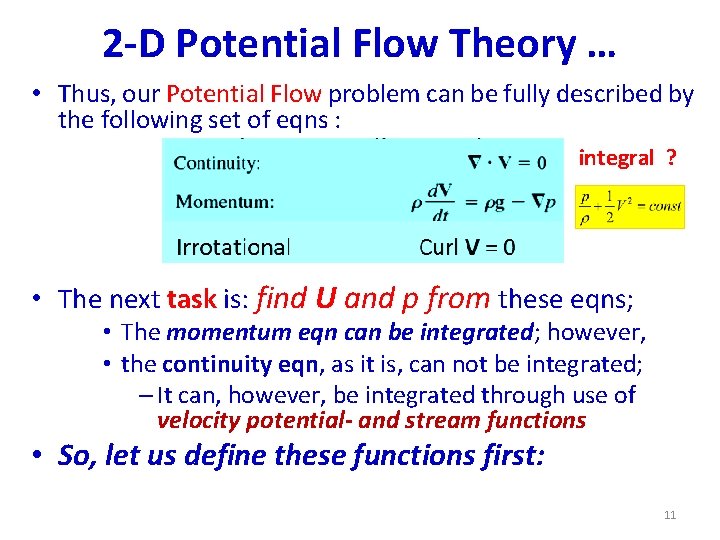
2 -D Potential Flow Theory … • Thus, our Potential Flow problem can be fully described by the following set of eqns : integral ? • The next task is: find U and p from these eqns; • The momentum eqn can be integrated; however, • the continuity eqn, as it is, can not be integrated; – It can, however, be integrated through use of velocity potential- and stream functions • So, let us define these functions first: 11
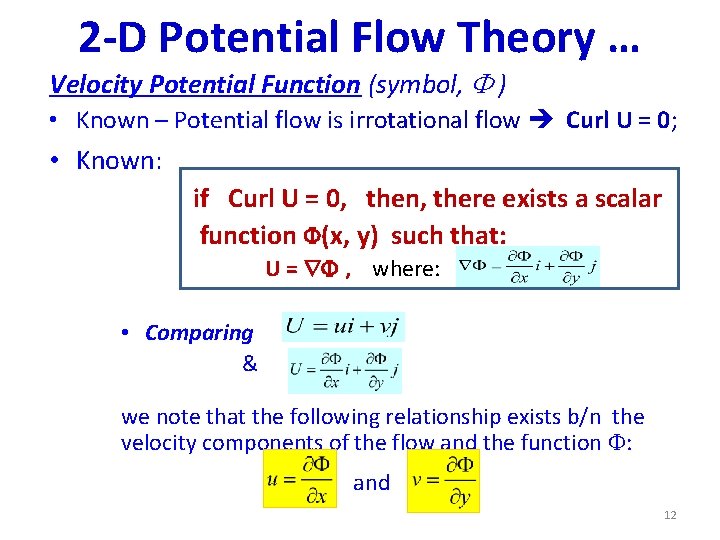
2 -D Potential Flow Theory … Velocity Potential Function (symbol, ) • Known – Potential flow is irrotational flow Curl U = 0; • Known: if Curl U = 0, then, there exists a scalar function (x, y) such that: U = , where: • Comparing & we note that the following relationship exists b/n the velocity components of the flow and the function : and 12
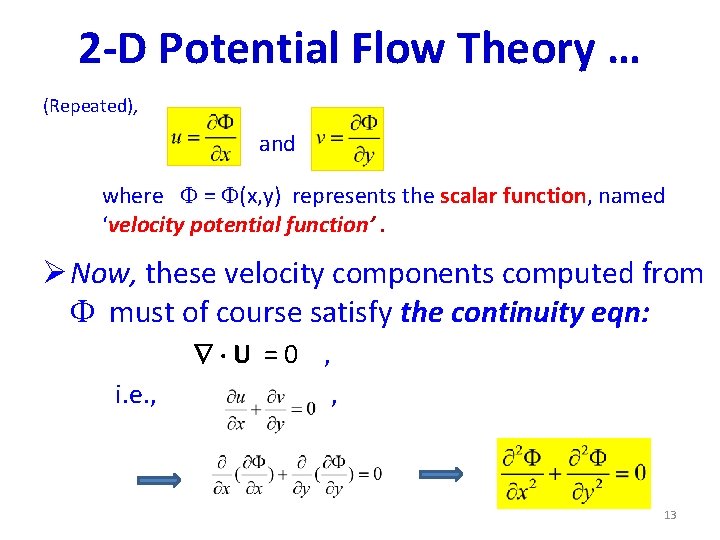
2 -D Potential Flow Theory … (Repeated), and where = (x, y) represents the scalar function, named ‘velocity potential function’. Ø Now, these velocity components computed from must of course satisfy the continuity eqn: U =0 , i. e. , , 13
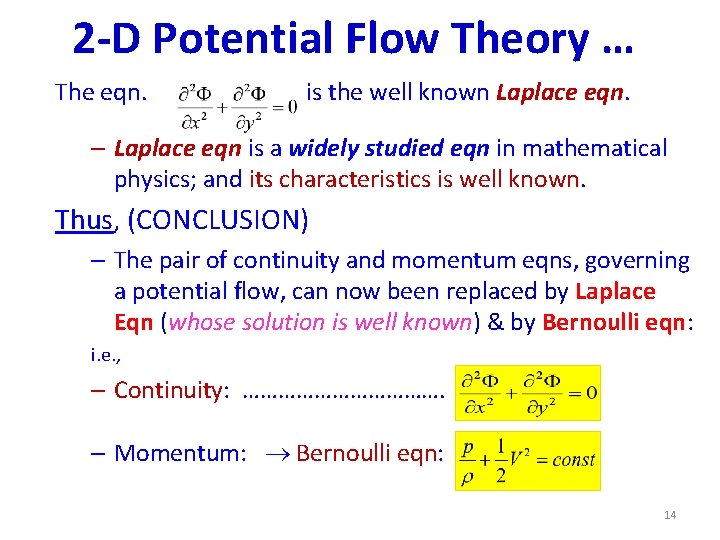
2 -D Potential Flow Theory … The eqn. is the well known Laplace eqn. – Laplace eqn is a widely studied eqn in mathematical physics; and its characteristics is well known. Thus, (CONCLUSION) – The pair of continuity and momentum eqns, governing a potential flow, can now been replaced by Laplace Eqn (whose solution is well known) & by Bernoulli eqn: i. e. , – Continuity: ………………. – Momentum: Bernoulli eqn: 14
2 -D Potential Flow Theory … • and therefore, – the problem of solving the potential flow is now reduced to that of solving simultaneously Laplace and Bernoulli eqns. 15
2 -D Potential Flow Theory … • Another Laplace eqn can be obtained in a similar way, using stream function as follows: • Stream Function (symbol, ) – is defined based on a 2 D continuity eqn and a simple (but clever) mathematical manipulation. 16
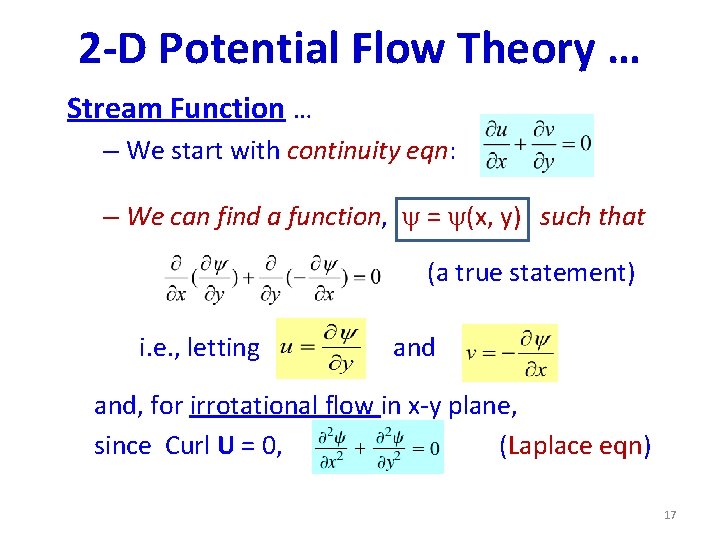
2 -D Potential Flow Theory … Stream Function … – We start with continuity eqn: – We can find a function, = (x, y) such that (a true statement) i. e. , letting and, for irrotational flow in x-y plane, since Curl U = 0, (Laplace eqn) 17
2 -D Potential Flow Theory … • Again, – the problem of solving the potential flow is reduced to that of solving simultaneously another Laplace and Bernoulli eqns. 18
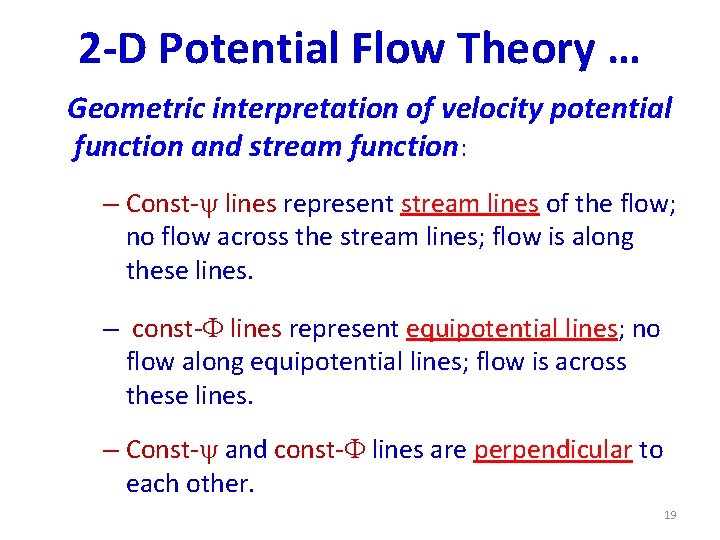
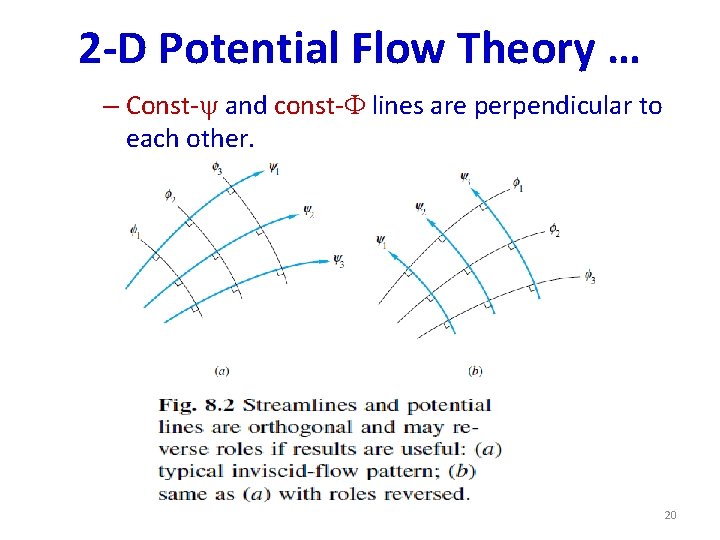
2 -D Potential Flow Theory … Geometric interpretation of velocity potential function and stream function: – Const- lines represent stream lines of the flow; no flow across the stream lines; flow is along these lines. – const- lines represent equipotential lines; no flow along equipotential lines; flow is across these lines. – Const- and const- lines are perpendicular to each other. 19
2 -D Potential Flow Theory … – Const- and const- lines are perpendicular to each other. 20
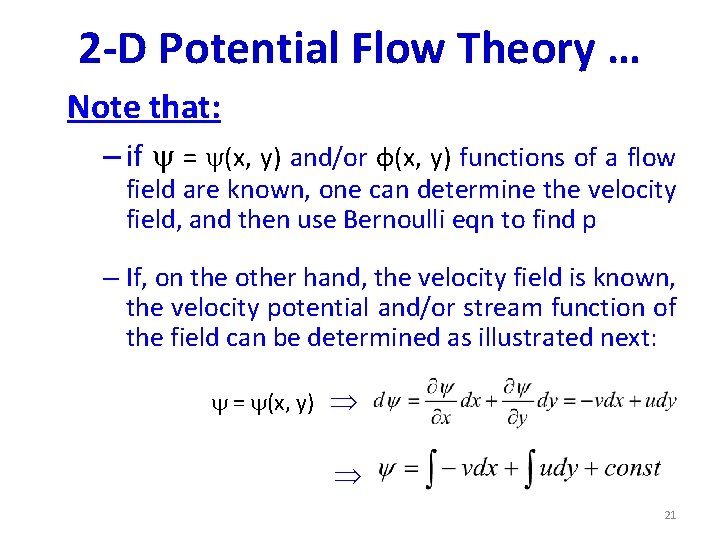
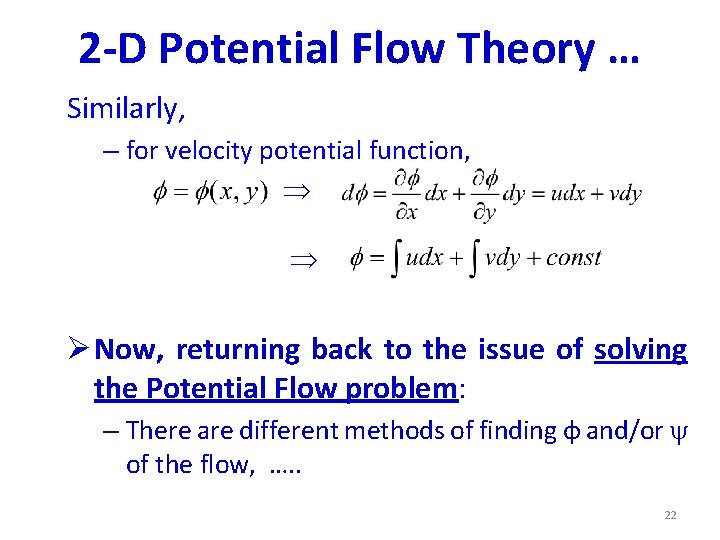
2 -D Potential Flow Theory … Note that: – if = (x, y) and/or φ(x, y) functions of a flow field are known, one can determine the velocity field, and then use Bernoulli eqn to find p – If, on the other hand, the velocity field is known, the velocity potential and/or stream function of the field can be determined as illustrated next: = (x, y) 21
2 -D Potential Flow Theory … Similarly, – for velocity potential function, Ø Now, returning back to the issue of solving the Potential Flow problem: – There are different methods of finding φ and/or of the flow, …. . 22
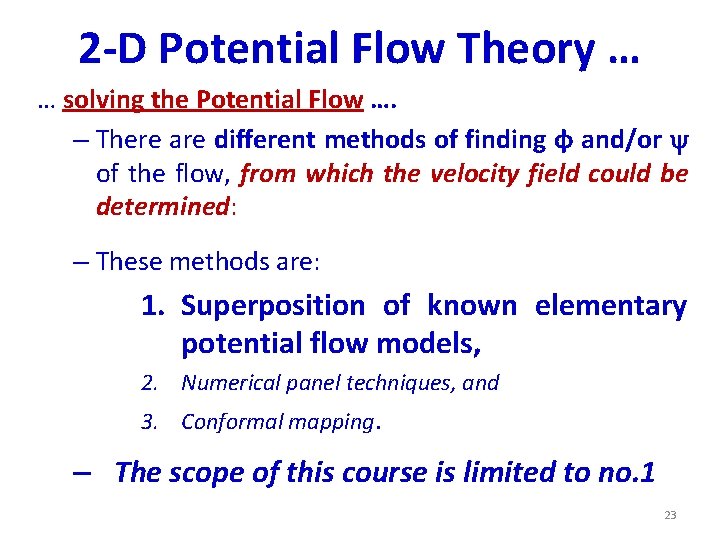
2 -D Potential Flow Theory … … solving the Potential Flow …. – There are different methods of finding φ and/or of the flow, from which the velocity field could be determined: – These methods are: 1. Superposition of known elementary potential flow models, 2. Numerical panel techniques, and 3. Conformal mapping. – The scope of this course is limited to no. 1 23
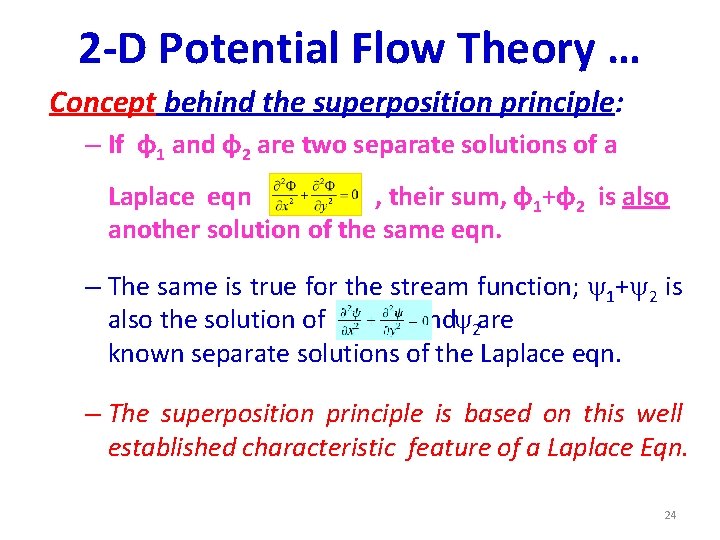
2 -D Potential Flow Theory … Concept behind the superposition principle: – If φ1 and φ2 are two separate solutions of a Laplace eqn , their sum, φ1+φ2 is also another solution of the same eqn. – The same is true for the stream function; 1+ 2 is also the solution of if 1 and 2 are known separate solutions of the Laplace eqn. – The superposition principle is based on this well established characteristic feature of a Laplace Eqn. 24
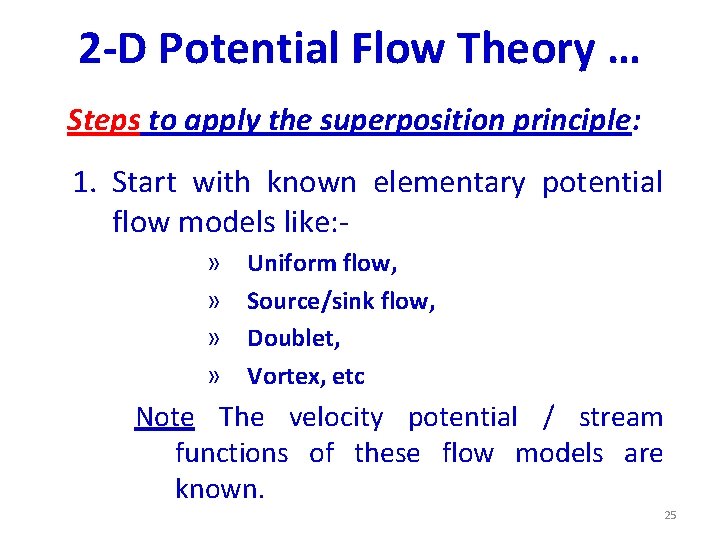
2 -D Potential Flow Theory … Steps to apply the superposition principle: 1. Start with known elementary potential flow models like: » » Uniform flow, Source/sink flow, Doublet, Vortex, etc Note The velocity potential / stream functions of these flow models are known. 25
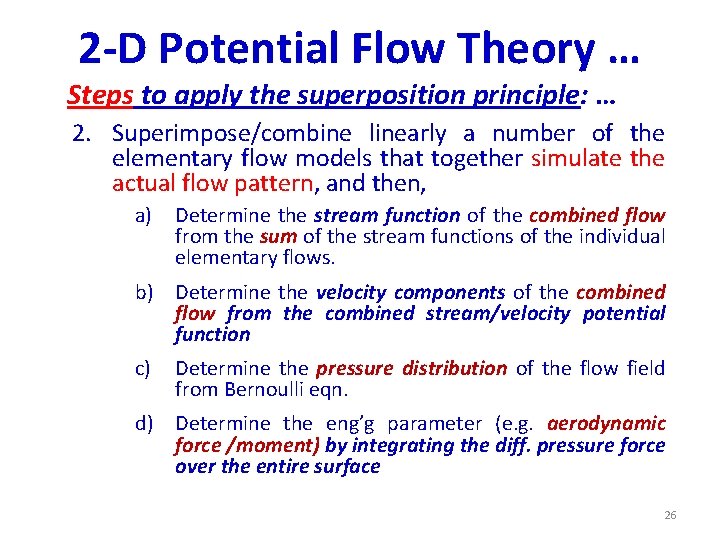
2 -D Potential Flow Theory … Steps to apply the superposition principle: … 2. Superimpose/combine linearly a number of the elementary flow models that together simulate the actual flow pattern, and then, a) Determine the stream function of the combined flow from the sum of the stream functions of the individual elementary flows. b) Determine the velocity components of the combined flow from the combined stream/velocity potential function c) Determine the pressure distribution of the flow field from Bernoulli eqn. d) Determine the eng’g parameter (e. g. aerodynamic force /moment) by integrating the diff. pressure force over the entire surface 26
2 -D Potential Flow Theory … The Elementary Flow Models 27
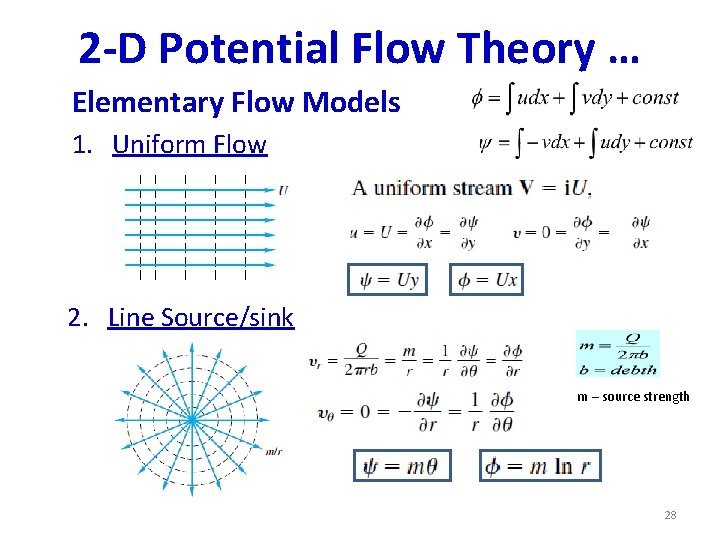
2 -D Potential Flow Theory … Elementary Flow Models 1. Uniform Flow 2. Line Source/sink m – source strength 28
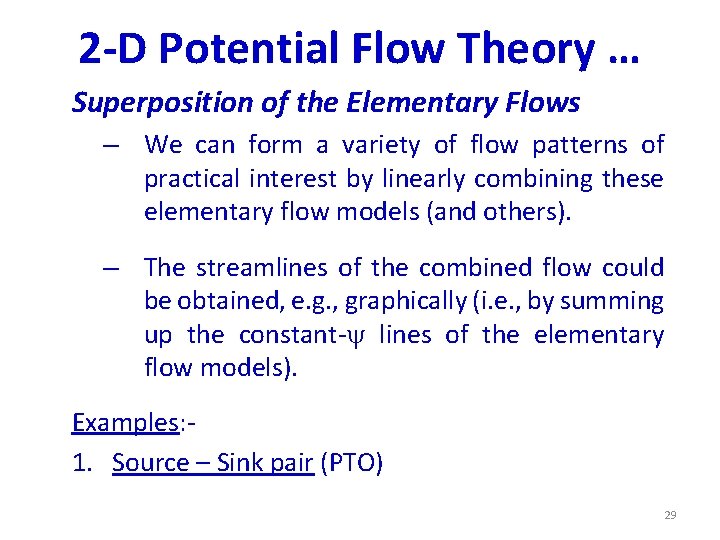
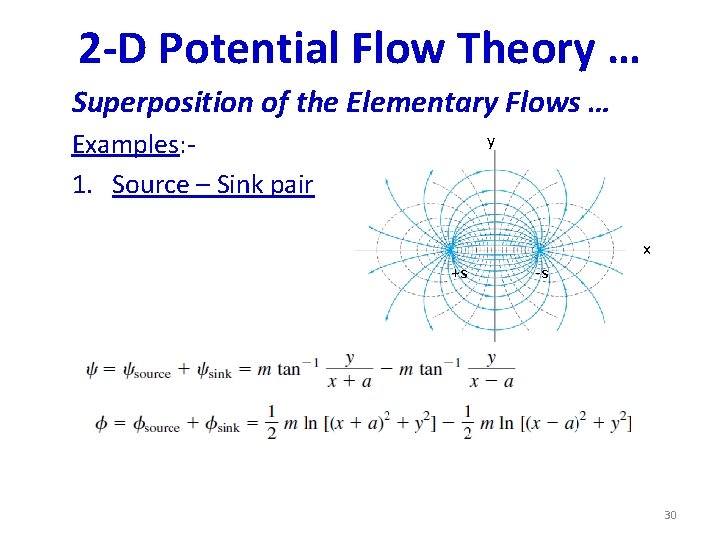
2 -D Potential Flow Theory … Superposition of the Elementary Flows – We can form a variety of flow patterns of practical interest by linearly combining these elementary flow models (and others). – The streamlines of the combined flow could be obtained, e. g. , graphically (i. e. , by summing up the constant- lines of the elementary flow models). Examples: 1. Source – Sink pair (PTO) 29
2 -D Potential Flow Theory … Superposition of the Elementary Flows … Examples: 1. Source – Sink pair y x +s -s 30
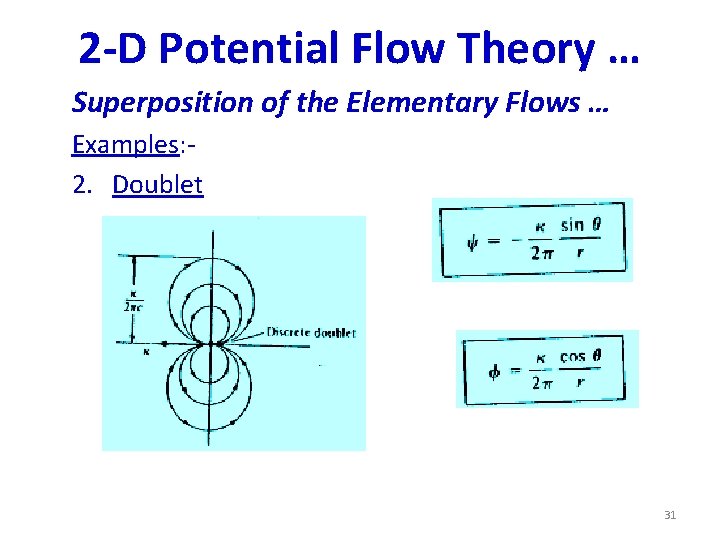
2 -D Potential Flow Theory … Superposition of the Elementary Flows … Examples: 2. Doublet 31
2 -D Potential Flow Theory … Examples of superposition of elementary flows to simulate practical flow problems 32
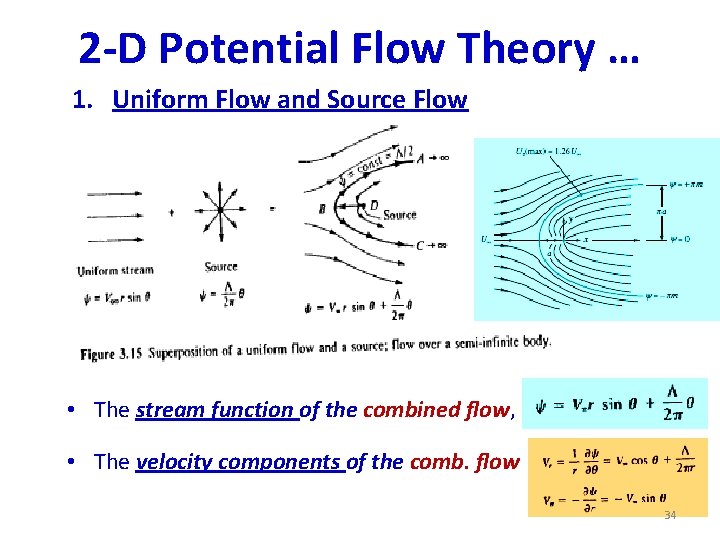
2 -D Potential Flow Theory … Example 1 superposition of Uniform Flow and Source Flow 33
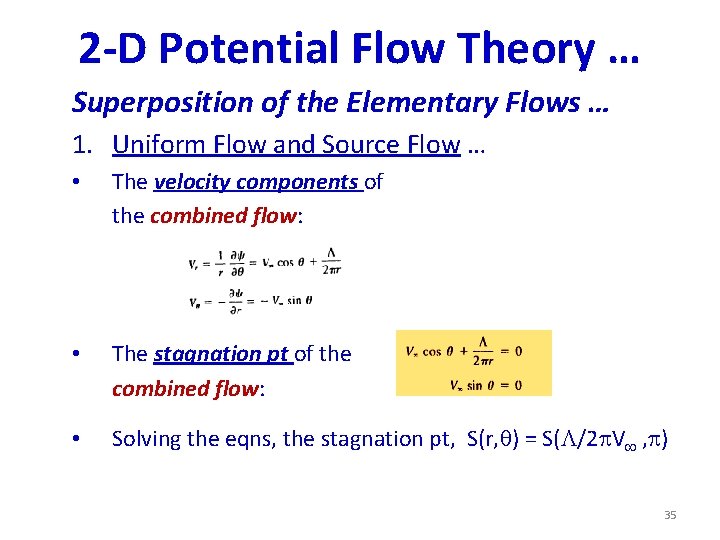
2 -D Potential Flow Theory … 1. Uniform Flow and Source Flow • The stream function of the combined flow, • The velocity components of the comb. flow 34
2 -D Potential Flow Theory … Superposition of the Elementary Flows … 1. Uniform Flow and Source Flow … • The velocity components of the combined flow: • The stagnation pt of the combined flow: • Solving the eqns, the stagnation pt, S(r, ) = S( /2 V , ) 35
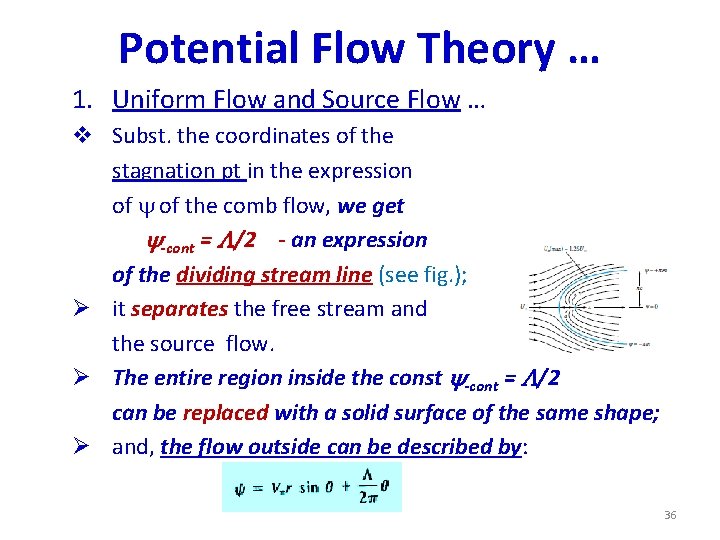
Potential Flow Theory … 1. Uniform Flow and Source Flow … v Subst. the coordinates of the stagnation pt in the expression of the comb flow, we get -cont = /2 - an expression of the dividing stream line (see fig. ); Ø it separates the free stream and the source flow. Ø The entire region inside the const -cont = /2 can be replaced with a solid surface of the same shape; Ø and, the flow outside can be described by: 36
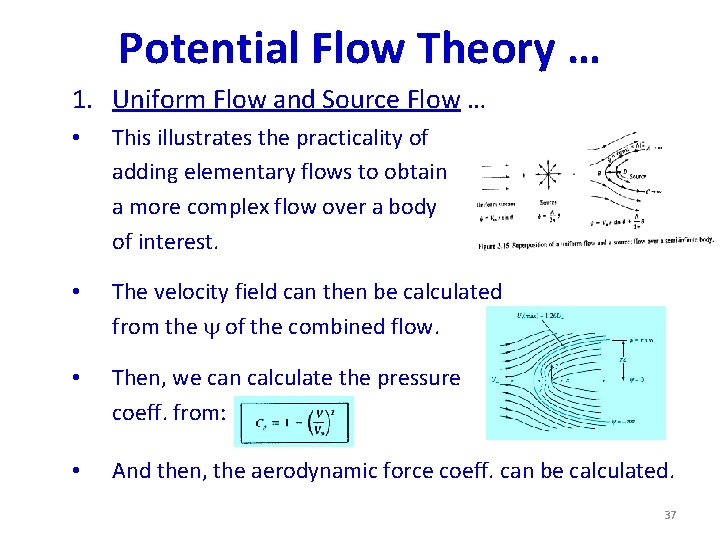
Potential Flow Theory … 1. Uniform Flow and Source Flow … • This illustrates the practicality of adding elementary flows to obtain a more complex flow over a body of interest. • The velocity field can then be calculated from the of the combined flow. • Then, we can calculate the pressure coeff. from: • And then, the aerodynamic force coeff. can be calculated. 37
Potential Flow Theory … Example 2 superposition of Uniform Flow and Source / Sink Pair: - The Rankine Oval 38
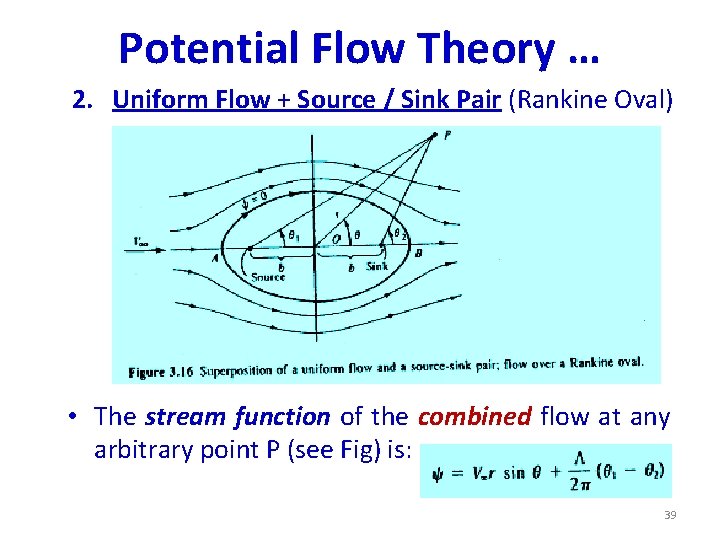
Potential Flow Theory … 2. Uniform Flow + Source / Sink Pair (Rankine Oval) • The stream function of the combined flow at any arbitrary point P (see Fig) is: 39
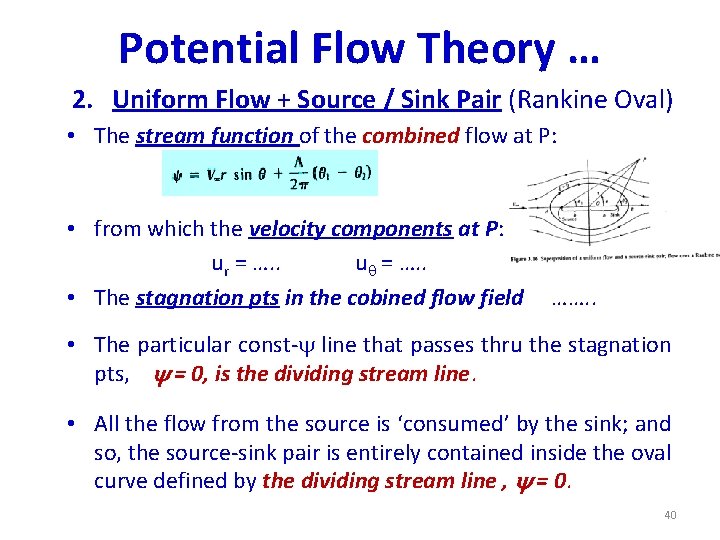
Potential Flow Theory … 2. Uniform Flow + Source / Sink Pair (Rankine Oval) • The stream function of the combined flow at P: • from which the velocity components at P: ur = …. . u = …. . • The stagnation pts in the cobined flow field ……. . • The particular const- line that passes thru the stagnation pts, = 0, is the dividing stream line. • All the flow from the source is ‘consumed’ by the sink; and so, the source-sink pair is entirely contained inside the oval curve defined by the dividing stream line , = 0. 40
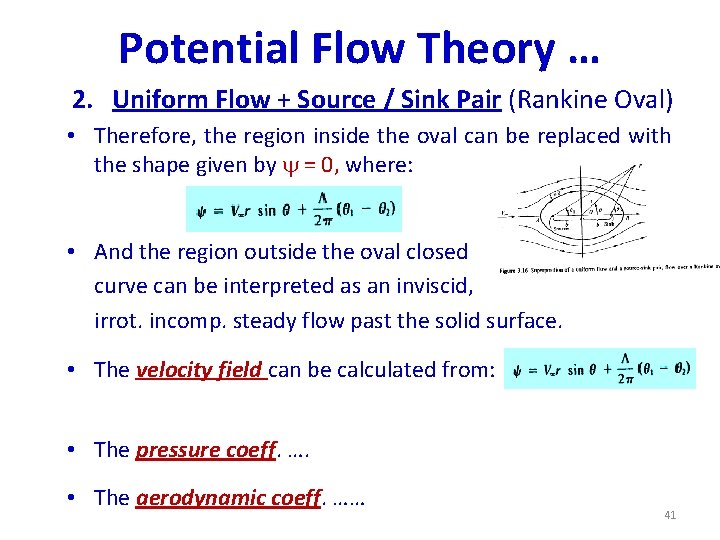
Potential Flow Theory … 2. Uniform Flow + Source / Sink Pair (Rankine Oval) • Therefore, the region inside the oval can be replaced with the shape given by = 0, where: • And the region outside the oval closed curve can be interpreted as an inviscid, irrot. incomp. steady flow past the solid surface. • The velocity field can be calculated from: • The pressure coeff. …. • The aerodynamic coeff. …… 41
Potential Flow Theory … Example 3 superposition of Uniform Flow and Doublet: Non-lifting flow over a circular cylinder 42
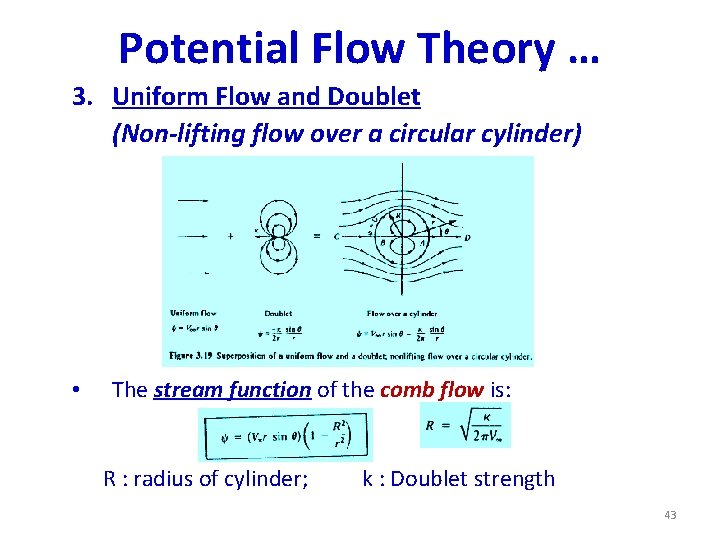
Potential Flow Theory … 3. Uniform Flow and Doublet (Non-lifting flow over a circular cylinder) • The stream function of the comb flow is: R : radius of cylinder; k : Doublet strength 43
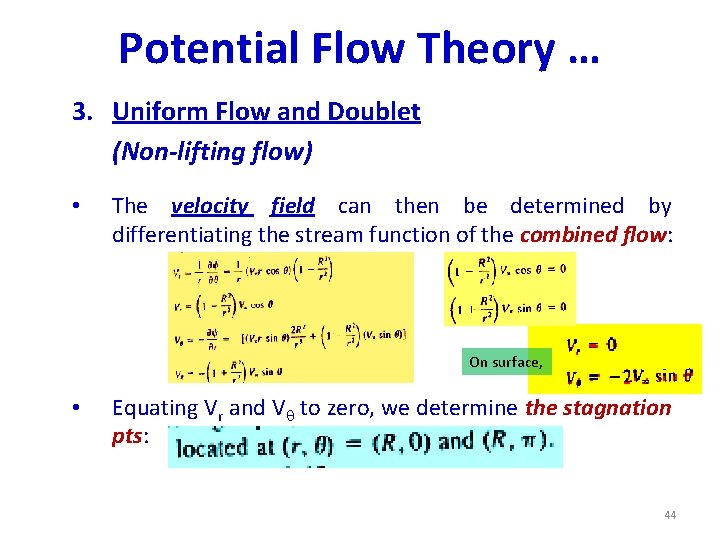
Potential Flow Theory … 3. Uniform Flow and Doublet (Non-lifting flow) • The velocity field can then be determined by differentiating the stream function of the combined flow: On surface, • Equating Vr and V to zero, we determine the stagnation pts: 44
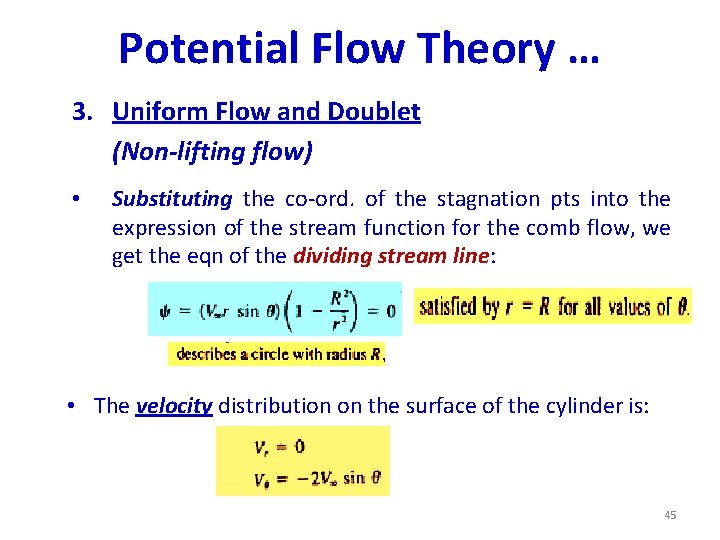
Potential Flow Theory … 3. Uniform Flow and Doublet (Non-lifting flow) • Substituting the co-ord. of the stagnation pts into the expression of the stream function for the comb flow, we get the eqn of the dividing stream line: • The velocity distribution on the surface of the cylinder is: 45
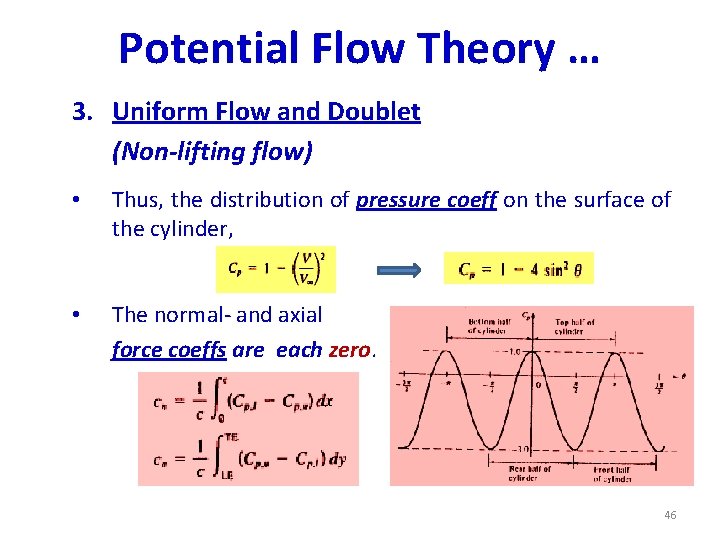
Potential Flow Theory … 3. Uniform Flow and Doublet (Non-lifting flow) • Thus, the distribution of pressure coeff on the surface of the cylinder, • The normal- and axial force coeffs are each zero. 46
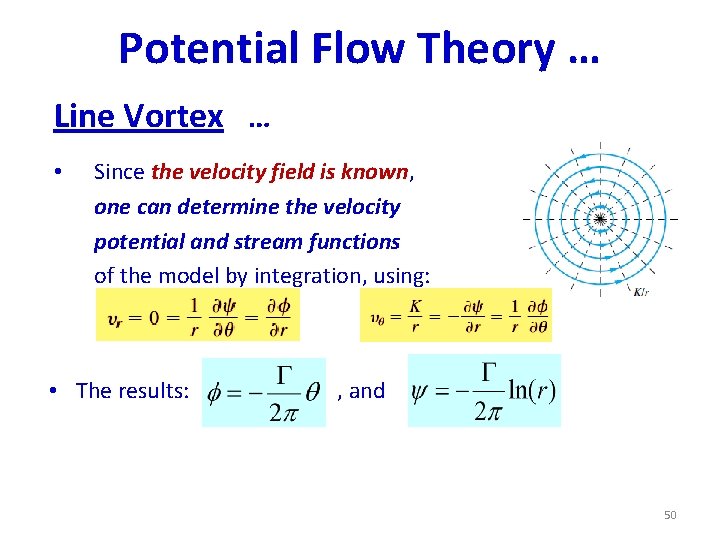
Potential Flow Theory … One More Elementary Flow Model: Line Vortex 47
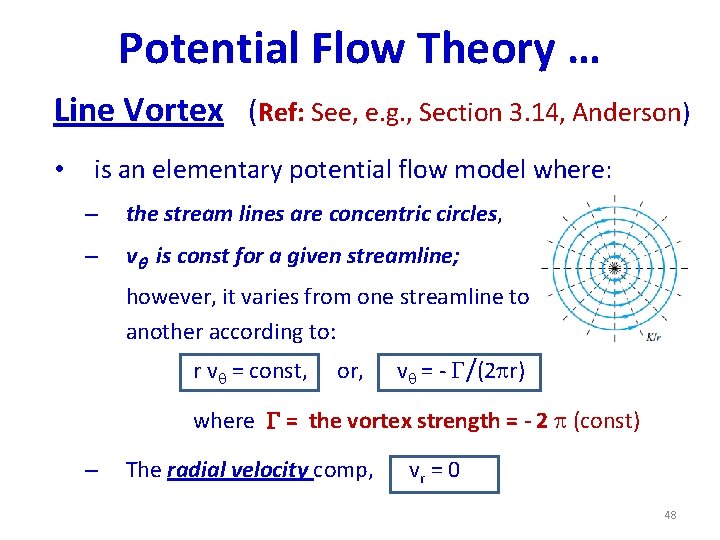
Potential Flow Theory … Line Vortex (Ref: See, e. g. , Section 3. 14, Anderson) • is an elementary potential flow model where: – the stream lines are concentric circles, – v is const for a given streamline; however, it varies from one streamline to another according to: r v = const, or, v = - /(2 r) where = the vortex strength = - 2 (const) – The radial velocity comp, vr = 0 48
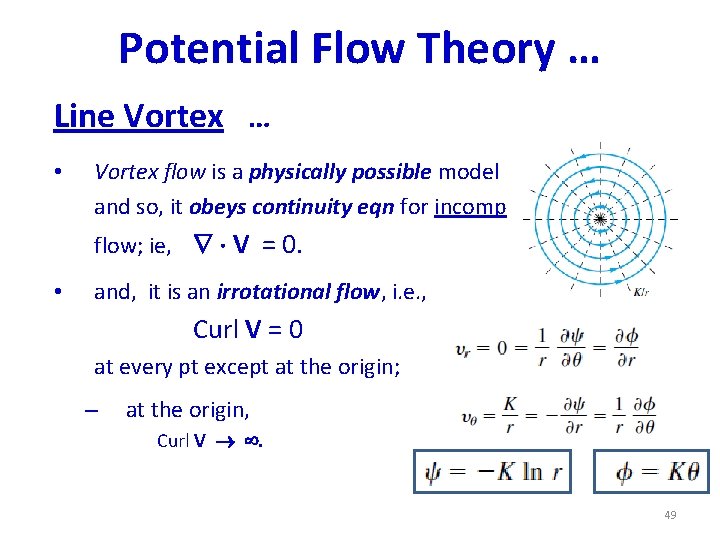
Potential Flow Theory … Line Vortex … • Vortex flow is a physically possible model and so, it obeys continuity eqn for incomp flow; ie, V = 0. • and, it is an irrotational flow, i. e. , Curl V = 0 at every pt except at the origin; – at the origin, Curl V . 49
Potential Flow Theory … Line Vortex … • Since the velocity field is known, one can determine the velocity potential and stream functions of the model by integration, using: • The results: , and 50
Potential Flow Theory … Example 4 superposition of Uniform Flow, Doublet and Free Vortex: Lifting flow over a circular cylinder Ref. See, e. g. , Sec 3. 15, Anderson 51
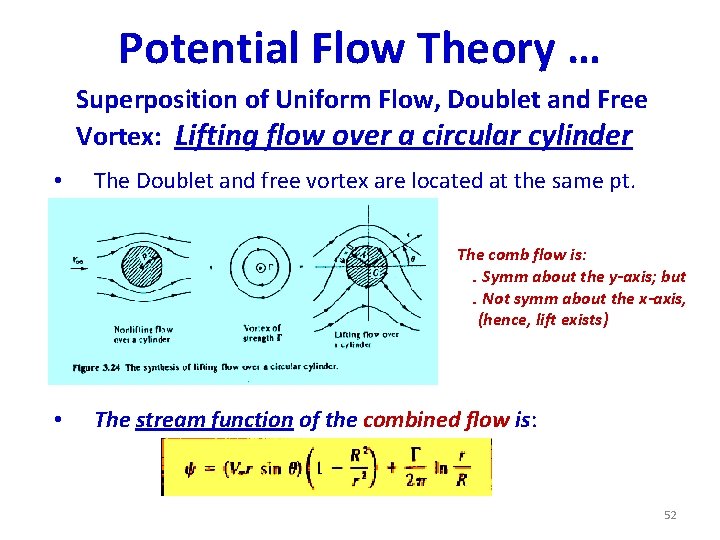
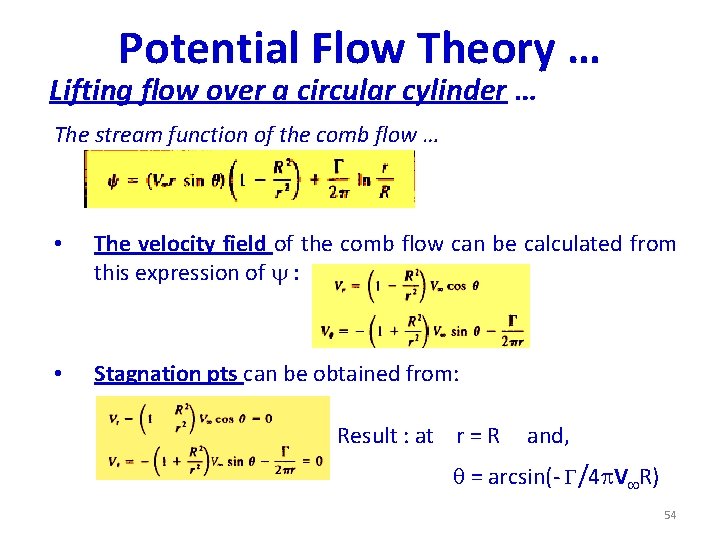
Potential Flow Theory … Superposition of Uniform Flow, Doublet and Free Vortex: Lifting flow over a circular cylinder • The Doublet and free vortex are located at the same pt. The comb flow is: . Symm about the y-axis; but. Not symm about the x-axis, (hence, lift exists) • The stream function of the combined flow is: 52
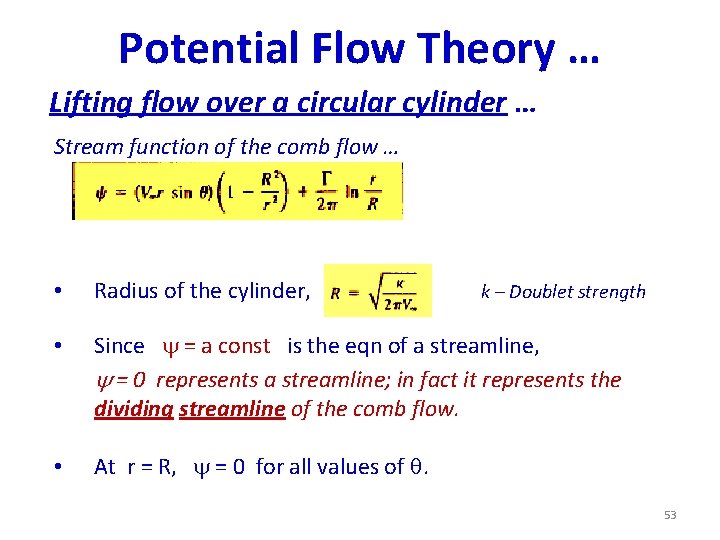
Potential Flow Theory … Lifting flow over a circular cylinder … Stream function of the comb flow … • Radius of the cylinder, • Since = a const is the eqn of a streamline, = 0 represents a streamline; in fact it represents the dividing streamline of the comb flow. • At r = R, = 0 for all values of . k – Doublet strength 53
Potential Flow Theory … Lifting flow over a circular cylinder … The stream function of the comb flow … • The velocity field of the comb flow can be calculated from this expression of : • Stagnation pts can be obtained from: Result : at r = R and, = arcsin(- /4 V R) 54
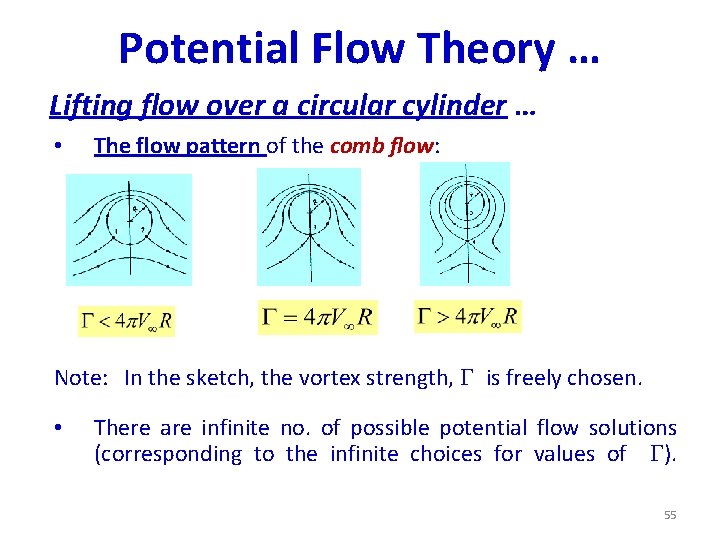
Potential Flow Theory … Lifting flow over a circular cylinder … • The flow pattern of the comb flow: Note: In the sketch, the vortex strength, is freely chosen. • There are infinite no. of possible potential flow solutions (corresponding to the infinite choices for values of ). 55
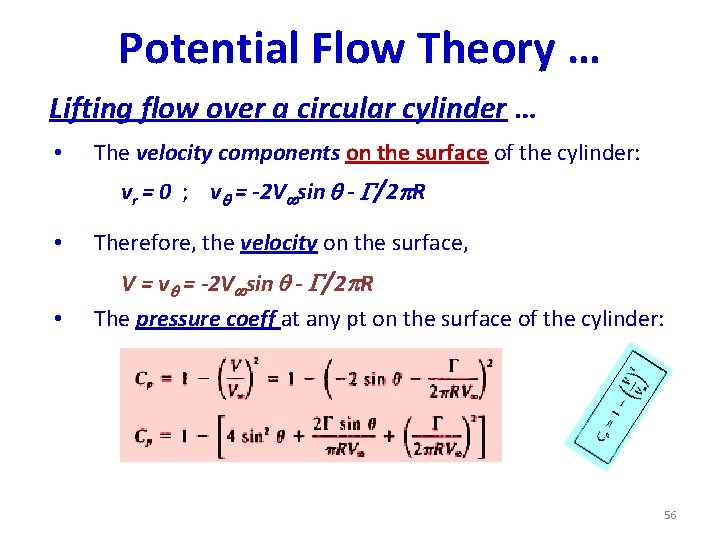
Potential Flow Theory … Lifting flow over a circular cylinder … • The velocity components on the surface of the cylinder: vr = 0 ; v = -2 V sin - /2 R • Therefore, the velocity on the surface, • V = v = -2 V sin - /2 R The pressure coeff at any pt on the surface of the cylinder: 56
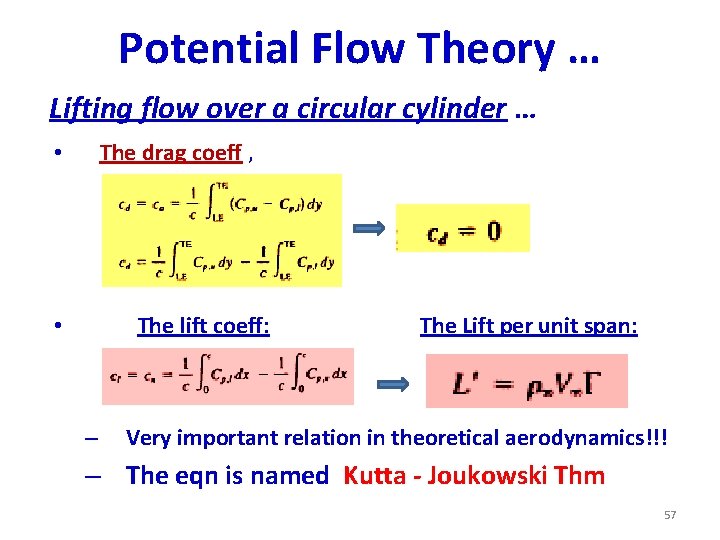
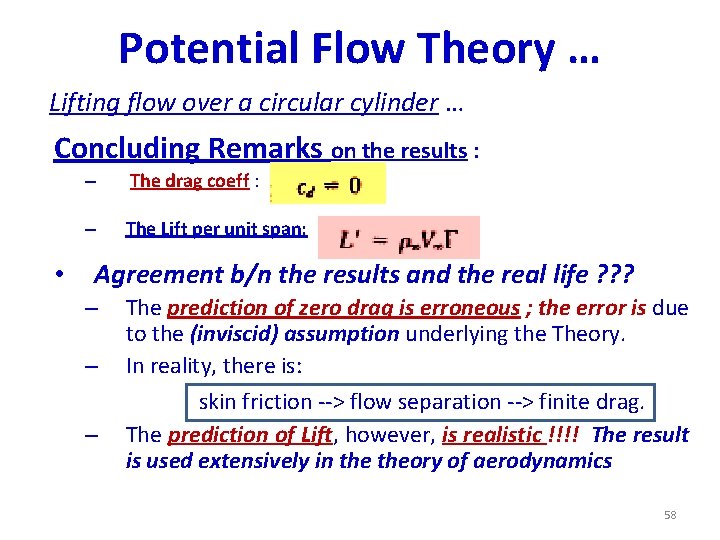
Potential Flow Theory … Lifting flow over a circular cylinder … The drag coeff , • The lift coeff: • – The Lift per unit span: Very important relation in theoretical aerodynamics!!! – The eqn is named Kutta - Joukowski Thm 57
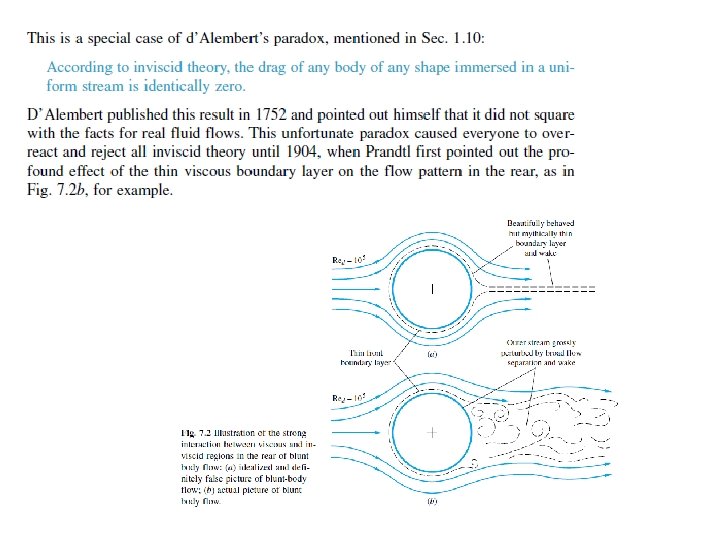
Potential Flow Theory … Lifting flow over a circular cylinder … Concluding Remarks on the results : • – The drag coeff : – The Lift per unit span: Agreement b/n the results and the real life ? ? ? – – – The prediction of zero drag is erroneous ; the error is due to the (inviscid) assumption underlying the Theory. In reality, there is: skin friction --> flow separation --> finite drag. The prediction of Lift, however, is realistic !!!! The result is used extensively in theory of aerodynamics 58
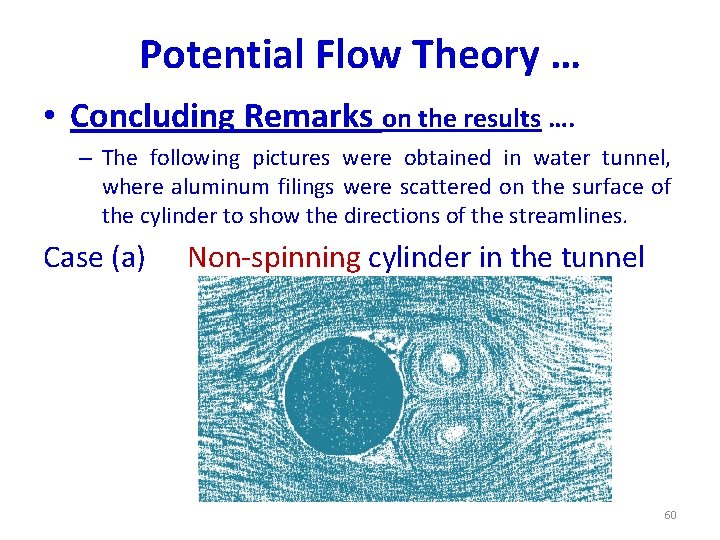
Potential Flow Theory … • Concluding Remarks on the results …. – The following pictures were obtained in water tunnel, where aluminum filings were scattered on the surface of the cylinder to show the directions of the streamlines. Case (a) Non-spinning cylinder in the tunnel 60
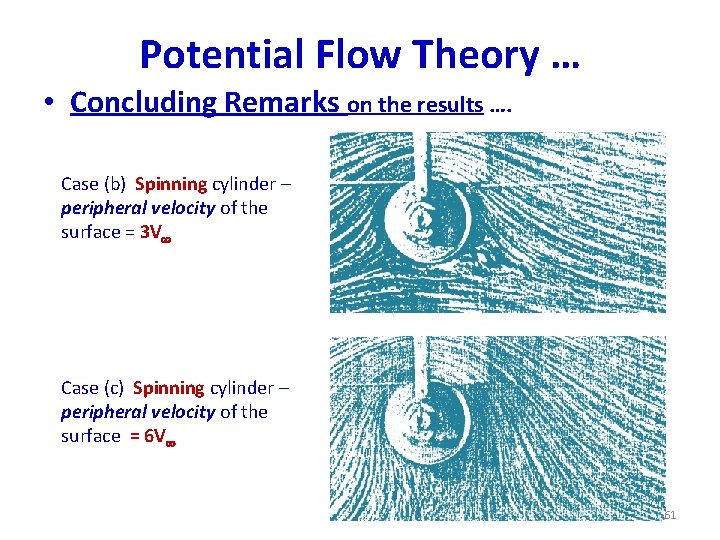
Potential Flow Theory … • Concluding Remarks on the results …. Case (b) Spinning cylinder – peripheral velocity of the surface = 3 V Case (c) Spinning cylinder – peripheral velocity of the surface = 6 V 61
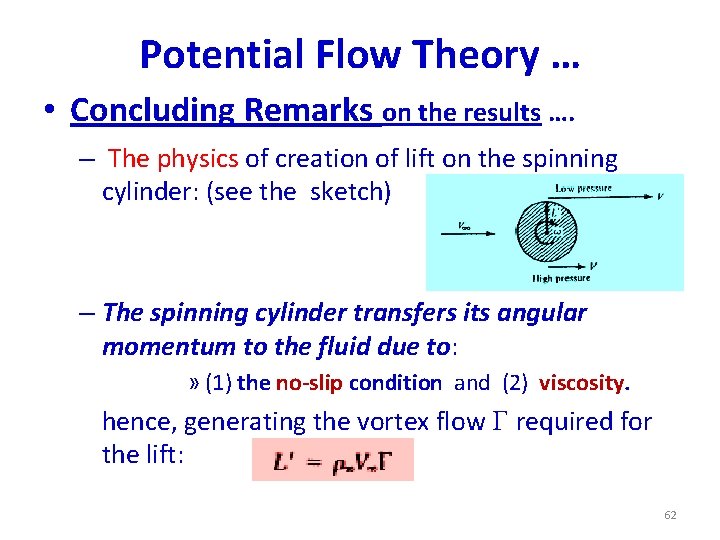
Potential Flow Theory … • Concluding Remarks on the results …. – The physics of creation of lift on the spinning cylinder: (see the sketch) – The spinning cylinder transfers its angular momentum to the fluid due to: » (1) the no-slip condition and (2) viscosity. hence, generating the vortex flow required for the lift: 62
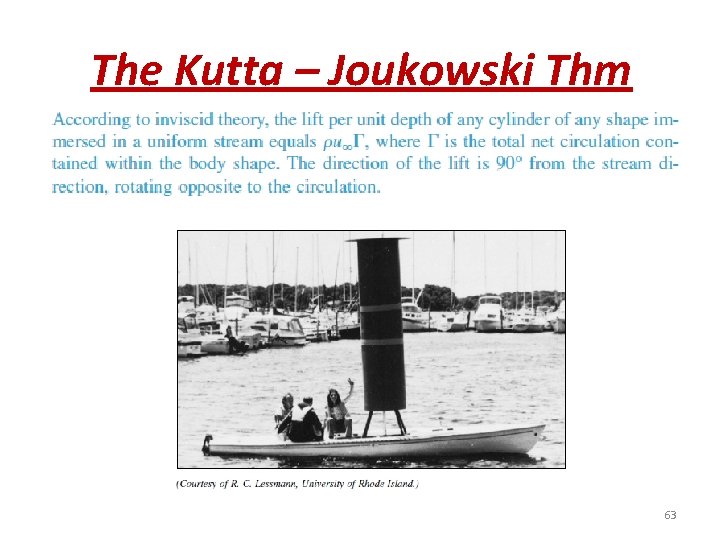
The Kutta – Joukowski Thm 63
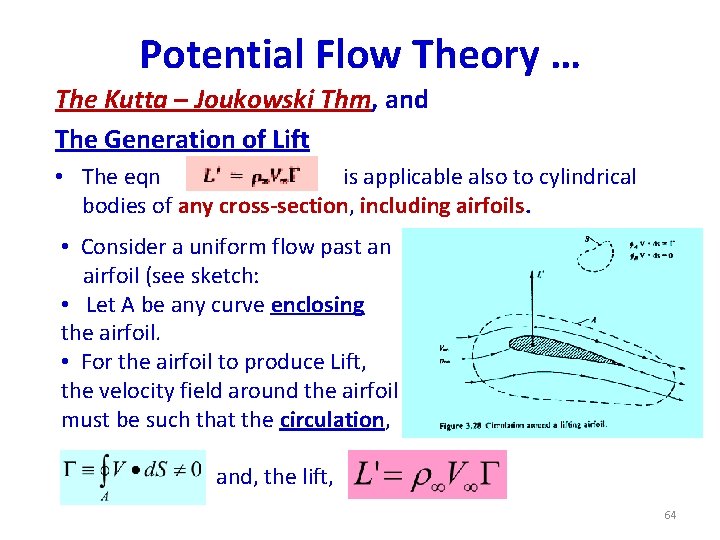
Potential Flow Theory … The Kutta – Joukowski Thm, and The Generation of Lift • The eqn is applicable also to cylindrical bodies of any cross-section, including airfoils. • Consider a uniform flow past an airfoil (see sketch: • Let A be any curve enclosing the airfoil. • For the airfoil to produce Lift, the velocity field around the airfoil must be such that the circulation, and, the lift, 64
Potential Flow Theory … Conclusion – The def of and the use of the eqn to calculate L’ is the core concept of the circulation theory of lift in aerodynamics. – the development of theory (turn of the 20 th century) was a breakthrough in aerodynamics. – Remember, however, that – The circulation theory of lift is simply an alternative way of thinking about the generation of lift; – the physical source of the force is the p- (and ) distribution on the body surface. 65
Potential Flow Theory … Conclusion … – Thus, Kutta-Joukowski Thm is simply an alternative way of expressing the consequences of the p- and distribution; – So, take the Thm is a mathematical tool that is consistent with the physical situation for the inviscid incomp flow over airfoils. – How can we determine the of a given flow problem? – Possible ways are: 1. The thin airfoil theory 2. The Vortex Panel Method 3. etc 66