
2 D Geometric Transformations By Dr Leena Jain
2 D Geometric Transformations By Dr. Leena Jain Prof. & Head-Department of Computer Applications Global Group of Institutes, Amritsar
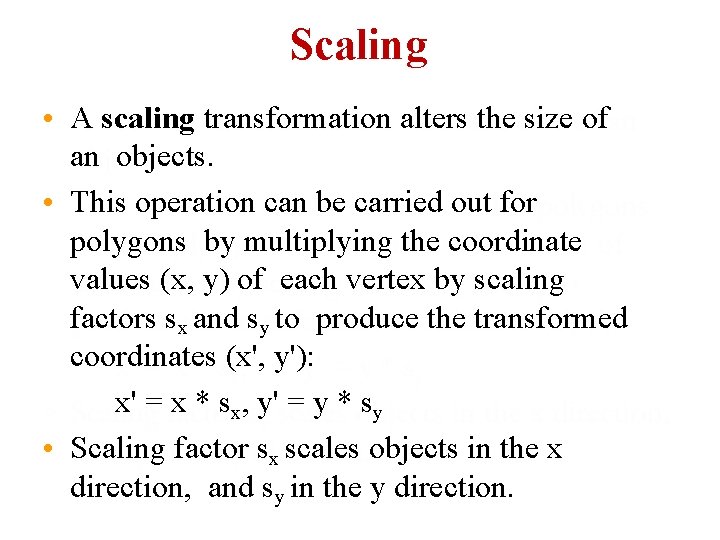
Scaling • A scaling transformation alters the size of an objects. • This operation can be carried out for polygons by multiplying the coordinate values (x, y) of each vertex by scaling factors sx and sy to produce the transformed coordinates (x', y'): x' = x * sx, y' = y * sy • Scaling factor sx scales objects in the x direction, and sy in the y direction.
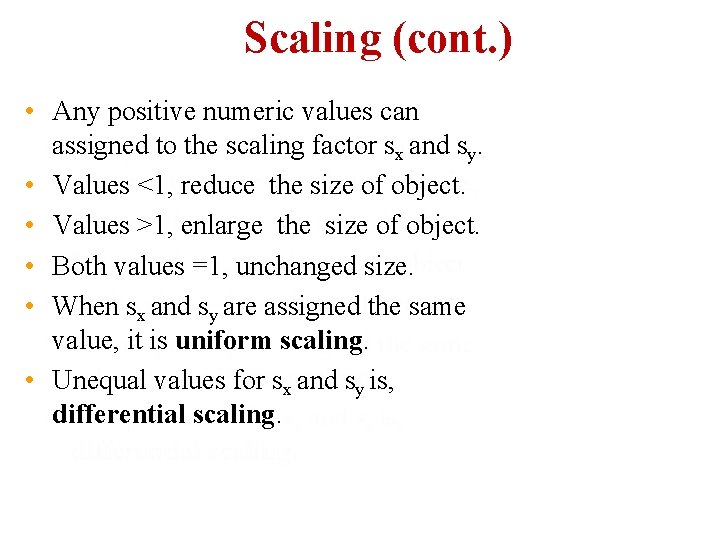
Scaling (cont. ) • Any positive numeric values can assigned to the scaling factor sx and sy. • Values <1, reduce the size of object. • Values >1, enlarge the size of object. • Both values =1, unchanged size. • When sx and sy are assigned the same value, it is uniform scaling. • Unequal values for sx and sy is, differential scaling.
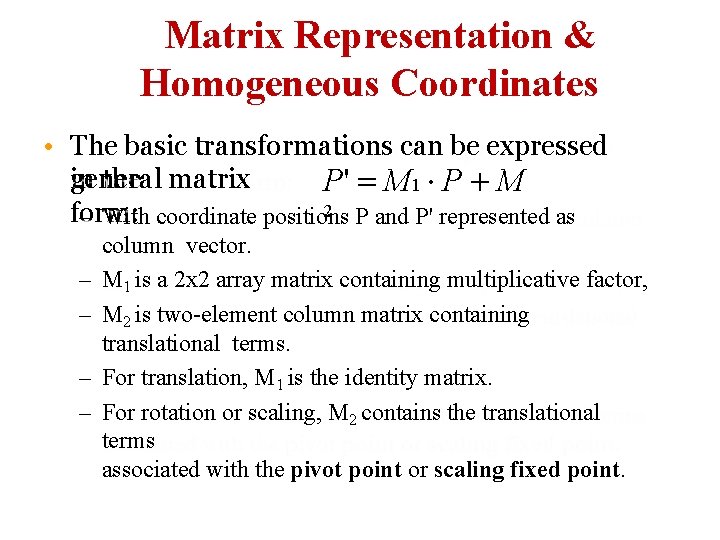
Matrix Representation & Homogeneous Coordinates • The basic transformations can be expressed in the matrix general P' M 1 P M 2 P and P' represented as form: – With coordinate positions – – column vector. M 1 is a 2 x 2 array matrix containing multiplicative factor, M 2 is two-element column matrix containing translational terms. For translation, M 1 is the identity matrix. For rotation or scaling, M 2 contains the translational terms associated with the pivot point or scaling fixed point.

Cont. • It produce a sequence of transformations with equation, such as scaling followed by rotation then translation. • A more efficient approach would be to combine the transformations so that the final coordinate position are obtained directly from the initial coordinates. It eliminates intermediate coordinates. • We can combine the multiplicate and translational terms for 2 D geometric transformations into a single matrix representation by expanding 2 x 2 matrix to 3 x 3.

Cont. • To express any 2 D transformation as a matrix multiplication, we represent each Cartesian coordinate position (x, y) with the homogeneous coordinate triple (xh, yh, h). x x , y h h • Can also be written as (h. x, h. y, h). – h to be any nonzero value. – There is infinite number of equivalent homogeneous representations for each coordinate point (x, y). – A convenient choice is simply to set h=1. then, homogeneous coordinates (x, y, 1).
Cont. • Expressing positions in homogeneous coordinates allow us to represent all geometric transformation equations as matrix multiplications. • Coordinates are represented with threeelement column vector, and transformation operations are written as 3 x 3 matrices.
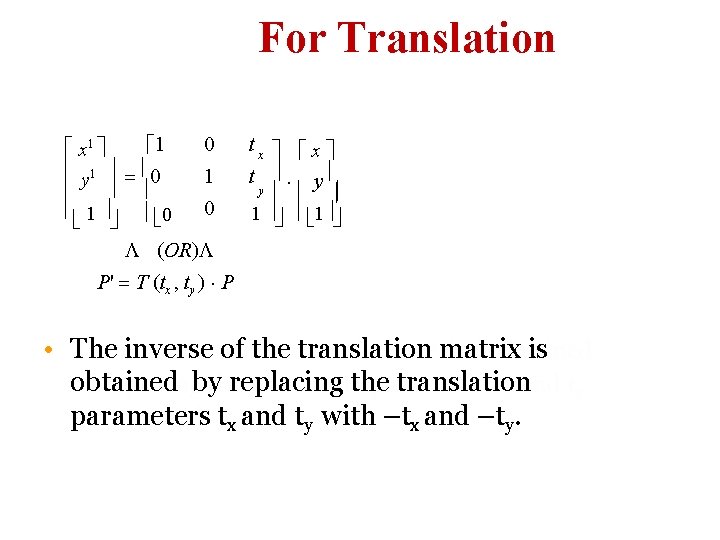
For Translation 0 1 x 1 y 1 0 1 0 1 0 (OR) tx x t y y 1 1 P' T (tx , ty ) P • The inverse of the translation matrix is obtained by replacing the translation parameters tx and ty with –tx and –ty.
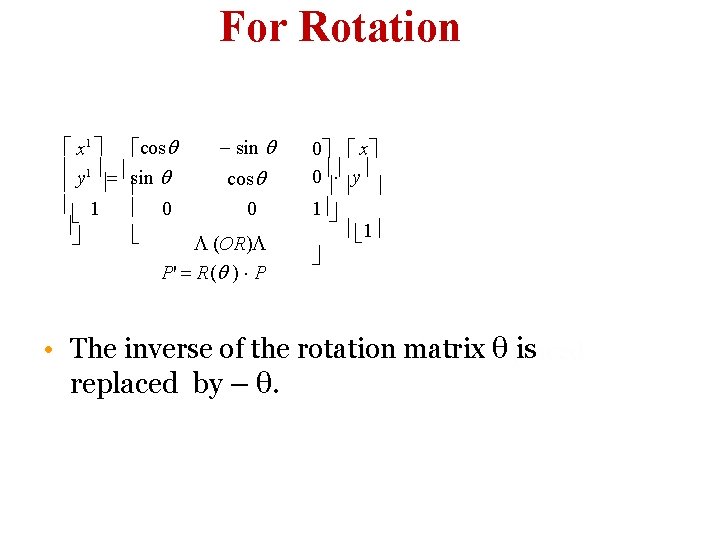
For Rotation x 1 sin cos y 1 sin cos 1 0 0 (OR) P' R( ) P 0 x 0 y 1 • The inverse of the rotation matrix θ is replaced by – θ.
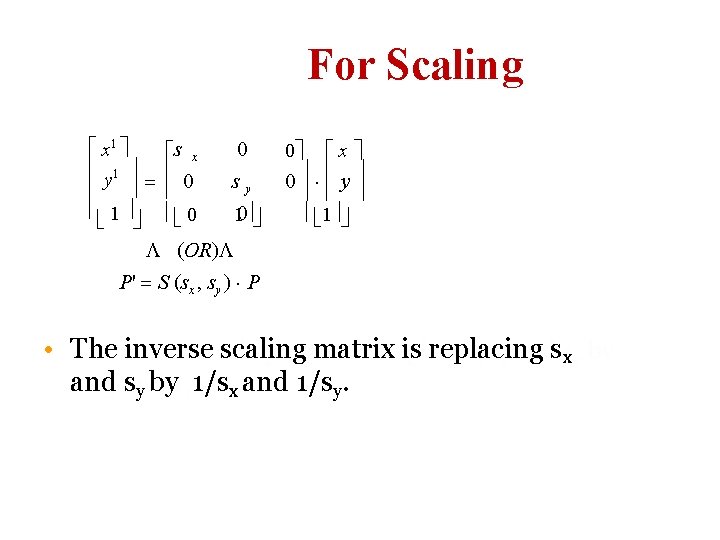
For Scaling x 1 0 s x y 1 sy 0 1 0 10 (OR) 0 x 0 y 1 P' S (sx , sy ) P • The inverse scaling matrix is replacing sx and sy by 1/sx and 1/sy.

Thank You
- Slides: 11