
2 d Arrays 1 Two Dimensional Arrays n
![Declaring 2 -D Arrays n General form: type array_name [row_size][column_size]; n Examples: int marks[4][5];](https://slidetodoc.com/presentation_image_h2/b19f45d3459267bfd9fd1d3c23cda345/image-4.jpg "Declaring 2 -D Arrays n General form: type array_name [row_size][column_size]; n Examples: int marks[4][5];")
![Initializing 2 -d arrays n n n int a[2][3] = {1, 2, 3, 4,](https://slidetodoc.com/presentation_image_h2/b19f45d3459267bfd9fd1d3c23cda345/image-5.jpg "Initializing 2 -d arrays n n n int a[2][3] = {1, 2, 3, 4,")
![Example int a[3][5]; A two-dimensional array of 15 elements Can be looked upon as](https://slidetodoc.com/presentation_image_h2/b19f45d3459267bfd9fd1d3c23cda345/image-7.jpg "Example int a[3][5]; A two-dimensional array of 15 elements Can be looked upon as")
![Array Addresses int main() { int a[3][5]; int i, j; for (i=0; i<3; i++)](https://slidetodoc.com/presentation_image_h2/b19f45d3459267bfd9fd1d3c23cda345/image-10.jpg "Array Addresses int main() { int a[3][5]; int i, j; for (i=0; i<3; i++)")
![More on Array Addresses int main() { int a[3][5]; printf("a = %un", a); printf("&a[0][0]](https://slidetodoc.com/presentation_image_h2/b19f45d3459267bfd9fd1d3c23cda345/image-11.jpg "More on Array Addresses int main() { int a[3][5]; printf(\"a = %un\", a); printf(\"&a[0][0]")
![Example: Matrix Addition int main() { int a[100], b[100], c[100], p, q, m, n;](https://slidetodoc.com/presentation_image_h2/b19f45d3459267bfd9fd1d3c23cda345/image-15.jpg "Example: Matrix Addition int main() { int a[100], b[100], c[100], p, q, m, n;")
![Example Usage int main() { int a[15][25], b[15]25]; : : add (a, b, 15,](https://slidetodoc.com/presentation_image_h2/b19f45d3459267bfd9fd1d3c23cda345/image-17.jpg "Example Usage int main() { int a[15][25], b[15]25]; : : add (a, b, 15,")
- Slides: 17
2 -d Arrays 1
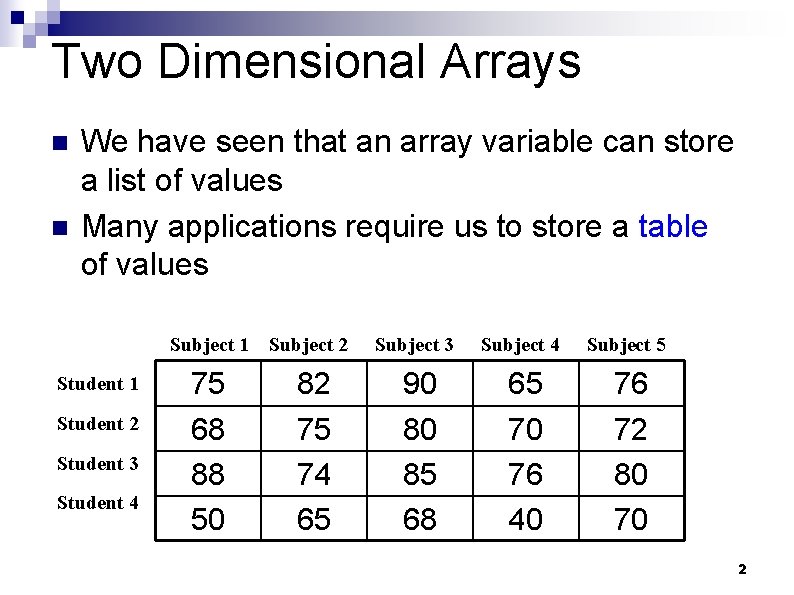
Two Dimensional Arrays n n We have seen that an array variable can store a list of values Many applications require us to store a table of values Subject 1 Subject 2 Student 1 Student 2 Student 3 Student 4 75 68 88 50 82 75 74 65 Subject 3 Subject 4 Subject 5 90 80 85 68 65 70 76 40 76 72 80 70 2
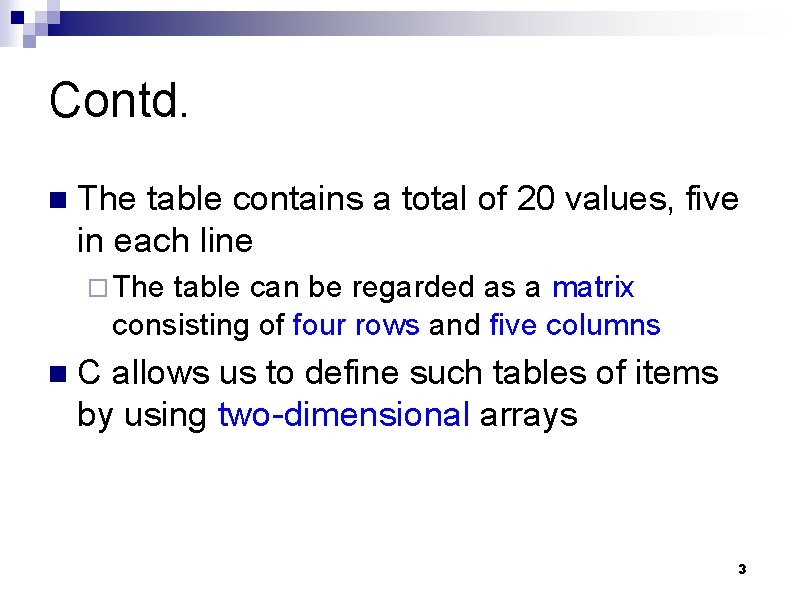
Contd. n The table contains a total of 20 values, five in each line ¨ The table can be regarded as a matrix consisting of four rows and five columns n C allows us to define such tables of items by using two-dimensional arrays 3
Declaring 2 -D Arrays n General form: type array_name [row_size][column_size]; n Examples: int marks[4][5]; float sales[12][25]; double matrix[100]; 4
Initializing 2 -d arrays n n n int a[2][3] = {1, 2, 3, 4, 5, 6}; int a[2][3] = {{1, 2, 3}, {4, 5, 6}}; int a[][3] = {{1, 2, 3}, {4, 5, 6}}; All of the above will give the 2 x 3 array 1 4 2 3 5 6 5
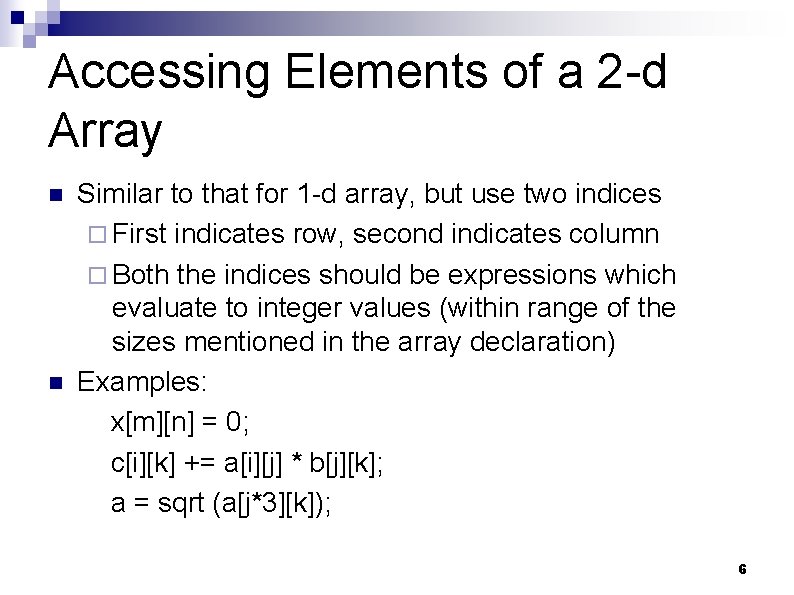
Accessing Elements of a 2 -d Array n n Similar to that for 1 -d array, but use two indices ¨ First indicates row, second indicates column ¨ Both the indices should be expressions which evaluate to integer values (within range of the sizes mentioned in the array declaration) Examples: x[m][n] = 0; c[i][k] += a[i][j] * b[j][k]; a = sqrt (a[j*3][k]); 6
Example int a[3][5]; A two-dimensional array of 15 elements Can be looked upon as a table of 3 rows and 5 columns col 0 col 1 col 2 col 3 col 4 row 0 a[0][0] a[0][1] a[0][2] a[0][3] a[0][4] row 1 a[1][0] a[1][1] a[1][2] a[1][3] a[1][4] row 2 a[2][0] a[2][1] a[2][2] a[2][3] a[2][4] 7
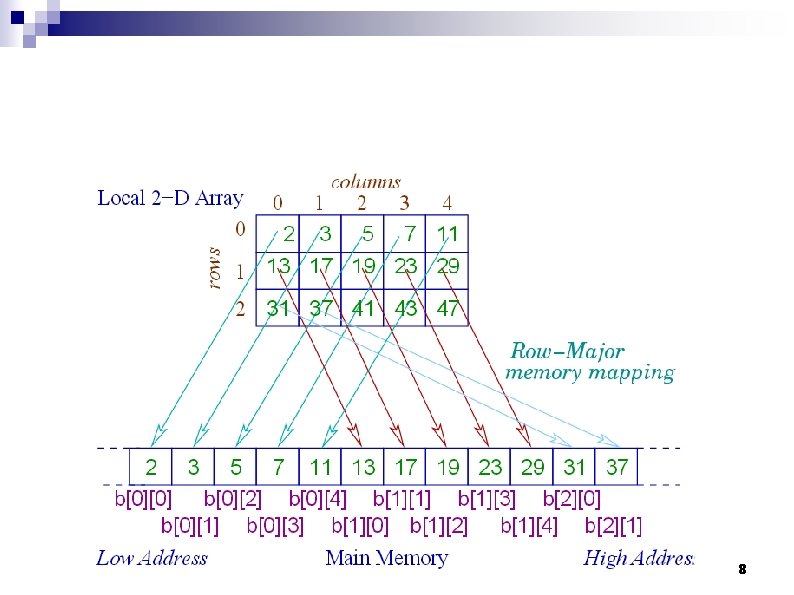
8
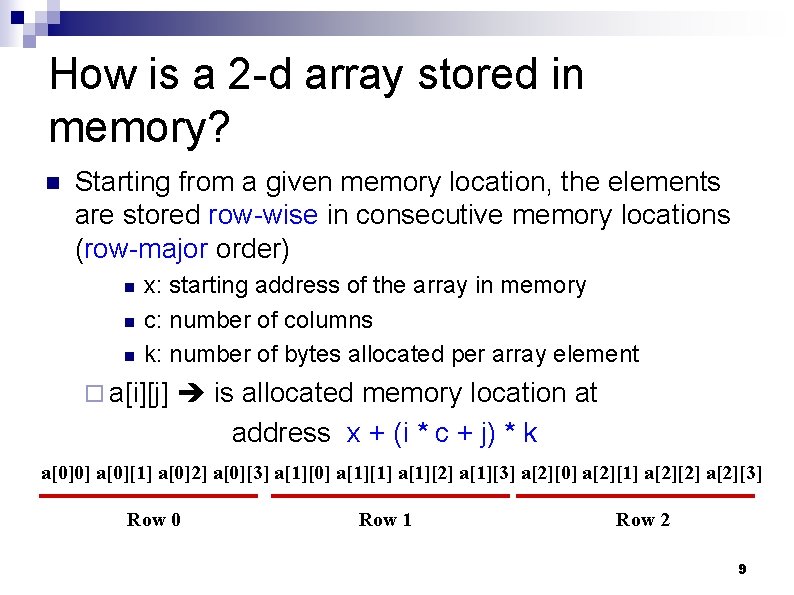
How is a 2 -d array stored in memory? n Starting from a given memory location, the elements are stored row-wise in consecutive memory locations (row-major order) n n n x: starting address of the array in memory c: number of columns k: number of bytes allocated per array element ¨ a[i][j] is allocated memory location at address x + (i * c + j) * k a[0]0] a[0][1] a[0]2] a[0][3] a[1][0] a[1][1] a[1][2] a[1][3] a[2][0] a[2][1] a[2][2] a[2][3] Row 0 Row 1 Row 2 9
Array Addresses int main() { int a[3][5]; int i, j; for (i=0; i<3; i++) { for (j=0; j<5; j++) printf("%un", &a[i][j]); printf("n"); } return 0; } Output 3221224480 3221224484 3221224488 3221224492 3221224496 3221224500 3221224504 3221224508 3221224512 3221224516 3221224520 3221224524 3221224528 3221224532 3221224536 10
More on Array Addresses int main() { int a[3][5]; printf("a = %un", a); printf("&a[0][0] = %un", &a[0][0]); printf("&a[2][3] = %un", &a[2][3]); printf("a[2]+3 = %un", a[2]+3); printf("*(a+2)+3 = %un", *(a+2)+3); printf("*(a+2) = %un", *(a+2)); printf("a[2] = %un", a[2]); printf("&a[2][0] = %un", &a[2][0]); printf("(a+2) = %un", (a+2)); printf("&a[2] = %un", &a[2]); return 0; } Output a = 3221224480 &a[0][0] = 3221224480 &a[2][3] = 3221224532 a[2]+3 = 3221224532 *(a+2) = 3221224520 a[2] = 3221224520 &a[2][0] = 3221224520 (a+2) = 3221224520 &a[2] = 3221224520 11
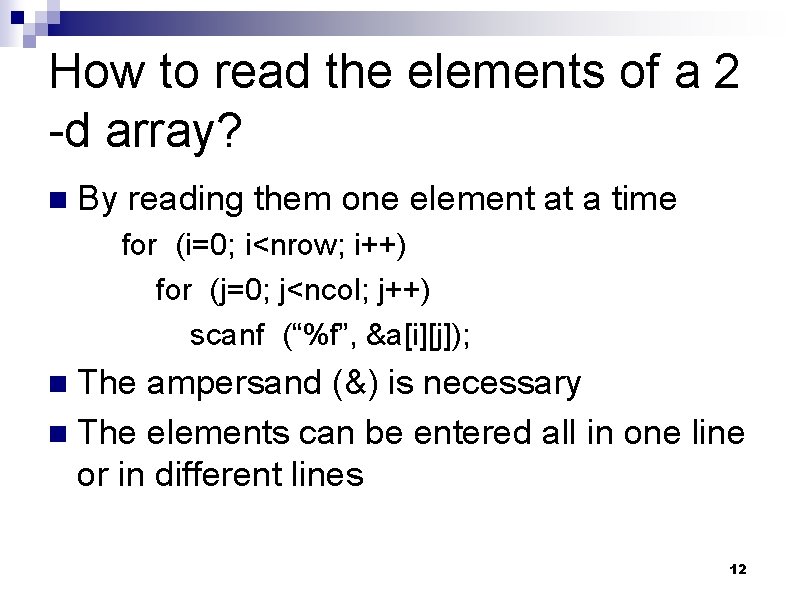
How to read the elements of a 2 -d array? n By reading them one element at a time for (i=0; i<nrow; i++) for (j=0; j<ncol; j++) scanf (“%f”, &a[i][j]); The ampersand (&) is necessary n The elements can be entered all in one line or in different lines n 12
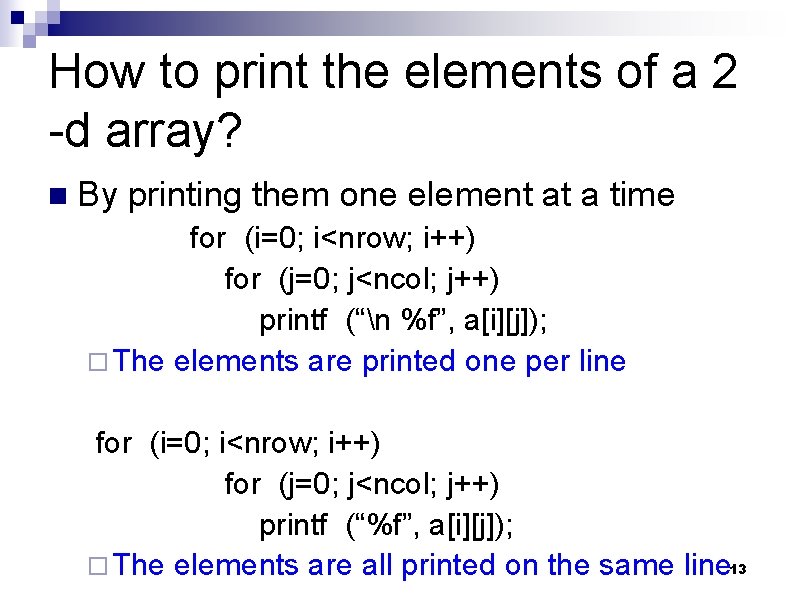
How to print the elements of a 2 -d array? n By printing them one element at a time for (i=0; i<nrow; i++) for (j=0; j<ncol; j++) printf (“n %f”, a[i][j]); ¨ The elements are printed one per line for (i=0; i<nrow; i++) for (j=0; j<ncol; j++) printf (“%f”, a[i][j]); ¨ The elements are all printed on the same line 13
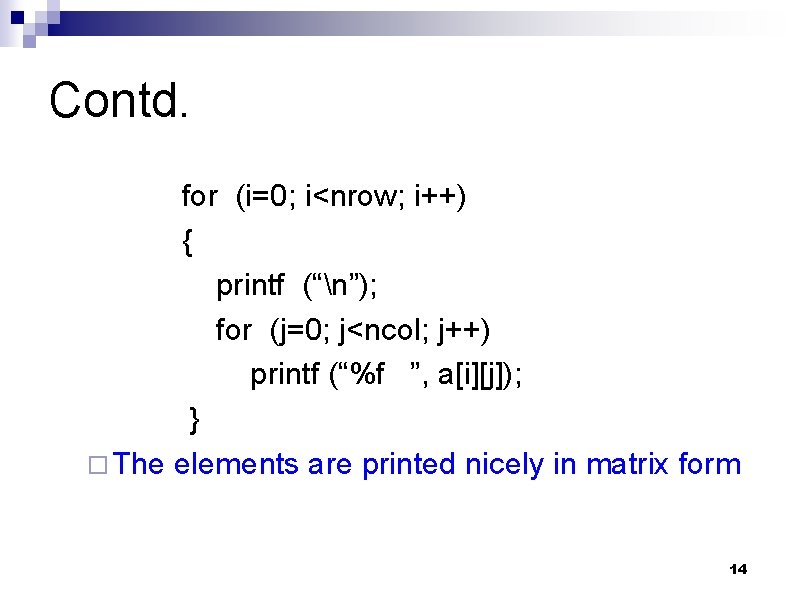
Contd. for (i=0; i<nrow; i++) { printf (“n”); for (j=0; j<ncol; j++) printf (“%f ”, a[i][j]); } ¨ The elements are printed nicely in matrix form 14
Example: Matrix Addition int main() { int a[100], b[100], c[100], p, q, m, n; for (p=0; p<m; p++) for (q=0; q<n; q++) c[p][q] = a[p][q] + b[p][q]; scanf (“%d %d”, &m, &n); for (p=0; p<m; p++) { printf (“n”); for (q=0; q<n; q++) printf (“%d ”, c[p][q]); } return 0; for (p=0; p<m; p++) for (q=0; q<n; q++) scanf (“%d”, &a[p][q]); for (p=0; p<m; p++) for (q=0; q<n; q++) scanf (“%d”, &b[p][q]); } 15
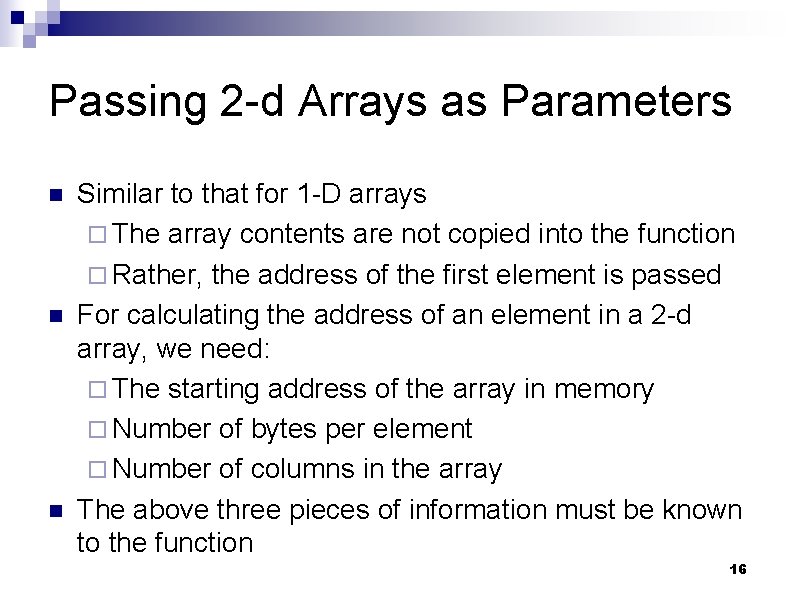
Passing 2 -d Arrays as Parameters n n n Similar to that for 1 -D arrays ¨ The array contents are not copied into the function ¨ Rather, the address of the first element is passed For calculating the address of an element in a 2 -d array, we need: ¨ The starting address of the array in memory ¨ Number of bytes per element ¨ Number of columns in the array The above three pieces of information must be known to the function 16
Example Usage int main() { int a[15][25], b[15]25]; : : add (a, b, 15, 25); : } void add (int x[15][25], int y[15][25], int rows, int cols) { : } Parameter passing 17