
2 CUL CornellColumbia Next Gen Tech Services Robert
2 CUL: Cornell/Columbia Next Gen Tech Services Robert Wolven, Columbia University Scott Wicks, Harvard University Hosted by ALCTS The Association for Library Collections and Technical Services
Who is talking--Full disclosure Scott Wicks Harvard Library
Full disclosure—not CUL Scott Wicks Harvard Library
Overview n What and Why (Scott) n How and Now (Bob) ALCTS Webinar 14 December 2011
Effective Collaborations should include n n n well defined roles and relationships common goals commitment from the top leadership mutual risk shared resources clear benefit for all parties--accomplish jointly more than could be achieved individually http: //www. iatul. org/doclibrary/public/Conf_Proceedings/2004/Murray 20 Sheperd. pdf ALCTS Webinar 14 December 2011
ALCTS Webinar 14 December 2011
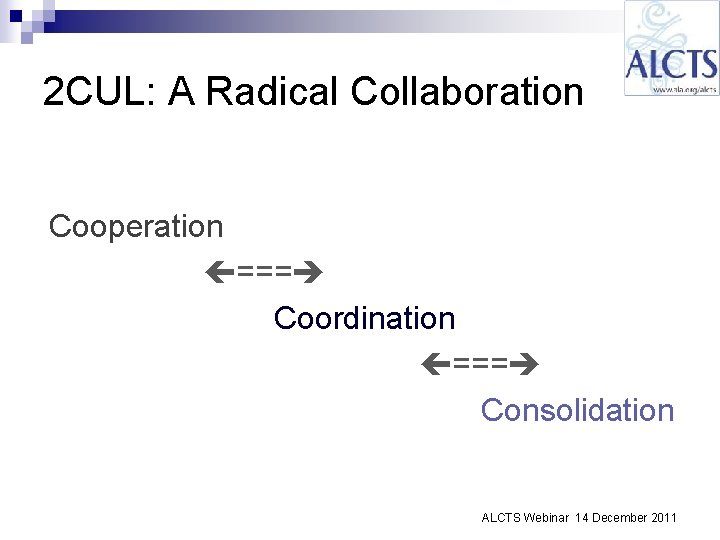
2 CUL: A Radical Collaboration Cooperation === Coordination === Consolidation ALCTS Webinar 14 December 2011
http: //2 CUL. org “ … a transformative and enduring partnership … that enables us to pool resources to provide content, expertise, and services that are impossible to accomplish acting alone. ” ALCTS Webinar 14 December 2011
Why Columbia and Cornell? Both institutions n n n n support major academic research libraries are located in New York state are private Ivy League institutions have similar academic and research characteristics have a track record of collaboration and innovation enjoy similar budget challenges have the will and the interest to work together ALCTS Webinar 14 December 2011
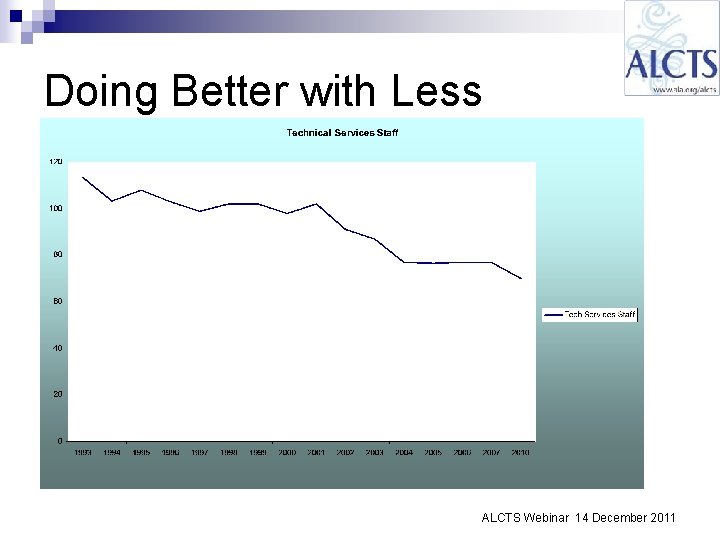
Doing Better with Less ALCTS Webinar 14 December 2011
2 CUL: 8 Goals n Improve the quality of collections, services and expertise available to key constituencies n Lay the foundation for a permanent selective integration n Achieve significant integration of operations, services, collections, and resources n Achieve significant cost savings through shared services, joint collections, and elimination of redundancy ALCTS Webinar 14 December 2011
2 CUL: 8 Goals (cont’d) n Collaborate in generating new resources n Co-invest in critical under-supported areas and innovative new services n Build understanding and support among stakeholders n Share experiences and findings ALCTS Webinar 14 December 2011
2 CUL Work Areas n Collection Development n Shared Access n Technical Services n Technological Infrastructure ALCTS Webinar 14 December 2011
What technical services? n n n n n Acquisitions Cataloging E-Resource management Record Maintenance Batch loading Shelf processing Remote storage transfers Preservation reformatting ILL/Document delivery ALCTS Webinar 14 December 2011
Whose technical services? n Law library? n Medical library? n CJK? n Special collections? n Affiliates? ALCTS Webinar 14 December 2011
Why Collaborate? n Improve the quality of collections, services and expertise available to key constituencies n Achieve significant cost savings through shared services, joint collections, and elimination of redundancy ALCTS Webinar 14 December 2011
Should We Consolidate? “Pool resources to provide content, expertise, and services that are impossible to accomplish acting alone. ” Do we need two (or three or four) … -- Order units -- Slavic cataloging units -- Directors of technical services that do the same thing? ” ALCTS Webinar 14 December 2011
Why Consolidate? n Concentrate (and expand) collective expertise n Build redundant skills n Reduce redundant procedures n Efficiencies of scale ALCTS Webinar 14 December 2011
- Slides: 18