
2 Cryptanalysis of polyalphabetic substitution A Kasiski method
2) Cryptanalysis of polyalphabetic substitution A) Kasiski method: is a method of attacking polyalphabetic substitution ciphers, such as the Vigenère cipher. Repetitions occur when characters of the key appear over the same characters in the ciphertext. The number of characters between repetitions must be a multiple of the length of the key. find the candidates of the key length
• rely on the regularity of English: • high frequency • ending: th, ing, ed, ion, tion, ation, etc. • beginning: im, in, un, re, etc. • pattern: eek-, oot-, -our-, etc. • word: of, and, to, the, with, are, is, that, etc.
Steps of Kasiski method 1) Identify repeated patterns of three or more characters. 2) For each pattern write down the position at which each instance of the pattern begins. 3) Compute the difference between the starting points of successive instances. 4) Determine all factors of each difference. 5) If a polyalphabetic substitution cipher was used, the key length
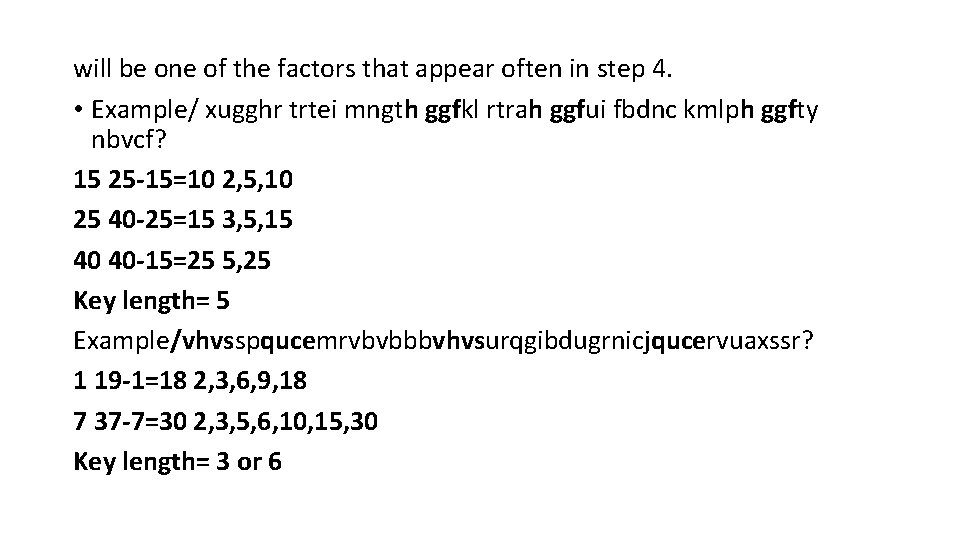
will be one of the factors that appear often in step 4. • Example/ xugghr trtei mngth ggfkl rtrah ggfui fbdnc kmlph ggfty nbvcf? 15 25 -15=10 2, 5, 10 25 40 -25=15 3, 5, 15 40 40 -15=25 5, 25 Key length= 5 Example/vhvsspqucemrvbvbbbvhvsurqgibdugrnicjqucervuaxssr? 1 19 -1=18 2, 3, 6, 9, 18 7 37 -7=30 2, 3, 5, 6, 10, 15, 30 Key length= 3 or 6
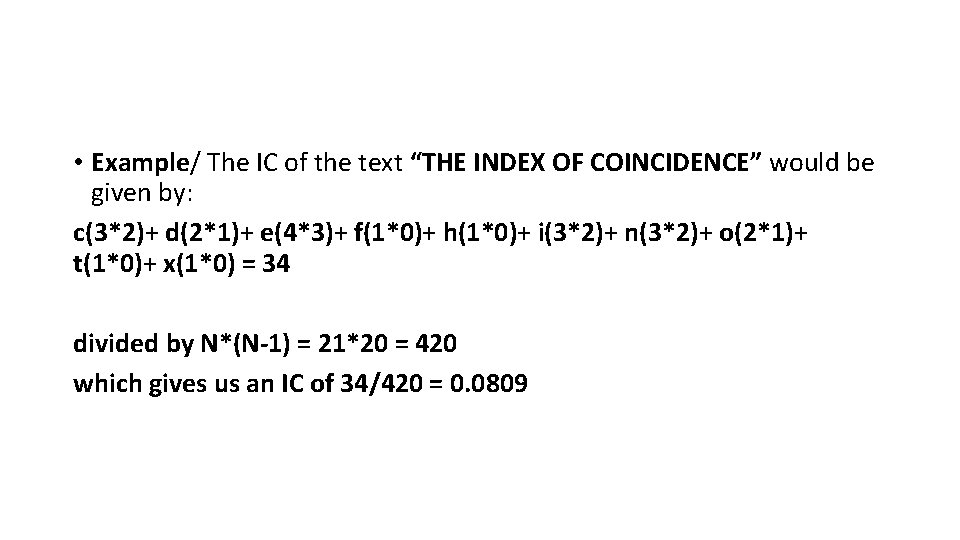
• Example/ The IC of the text “THE INDEX OF COINCIDENCE” would be given by: c(3*2)+ d(2*1)+ e(4*3)+ f(1*0)+ h(1*0)+ i(3*2)+ n(3*2)+ o(2*1)+ t(1*0)+ x(1*0) = 34 divided by N*(N-1) = 21*20 = 420 which gives us an IC of 34/420 = 0. 0809
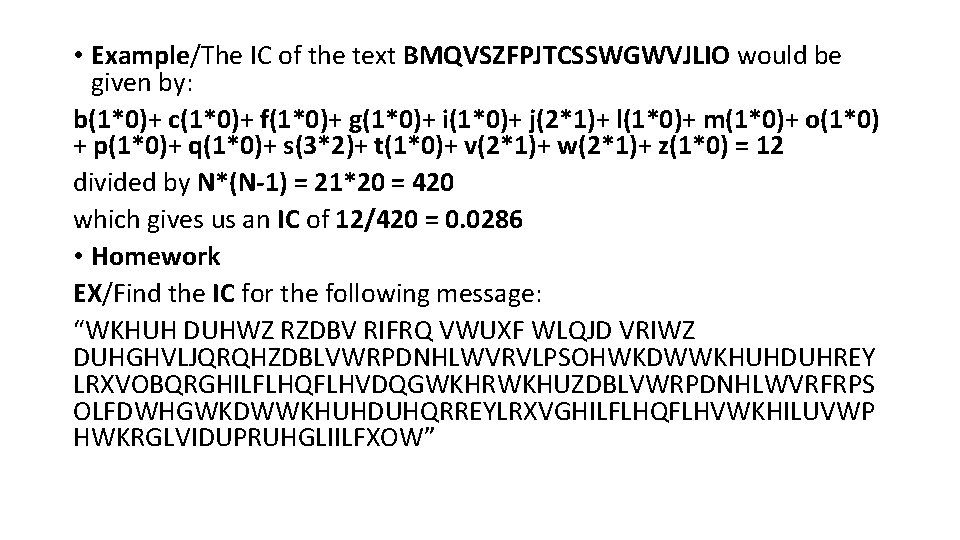
• Example/The IC of the text BMQVSZFPJTCSSWGWVJLIO would be given by: b(1*0)+ c(1*0)+ f(1*0)+ g(1*0)+ i(1*0)+ j(2*1)+ l(1*0)+ m(1*0)+ o(1*0) + p(1*0)+ q(1*0)+ s(3*2)+ t(1*0)+ v(2*1)+ w(2*1)+ z(1*0) = 12 divided by N*(N-1) = 21*20 = 420 which gives us an IC of 12/420 = 0. 0286 • Homework EX/Find the IC for the following message: “WKHUH DUHWZ RZDBV RIFRQ VWUXF WLQJD VRIWZ DUHGHVLJQRQHZDBLVWRPDNHLWVRVLPSOHWKDWWKHUHDUHREY LRXVOBQRGHILFLHQFLHVDQGWKHRWKHUZDBLVWRPDNHLWVRFRPS OLFDWHGWKDWWKHUHDUHQRREYLRXVGHILFLHQFLHVWKHILUVWP HWKRGLVIDUPRUHGLIILFXOW”

Any question
- Slides: 7