
2 Copyright and Infringement COPYRIGHT COPYLEFT FAIR USE
- Slides: 20
2. Copyright and Infringement
COPYRIGHT, COPYLEFT & FAIR USE for Students & Media -makers Juliet Davis, MFA, MAT Associate Professor of Communication The University of Tampa POWERPOINT & VIDEOS located at www. julietdavis. com
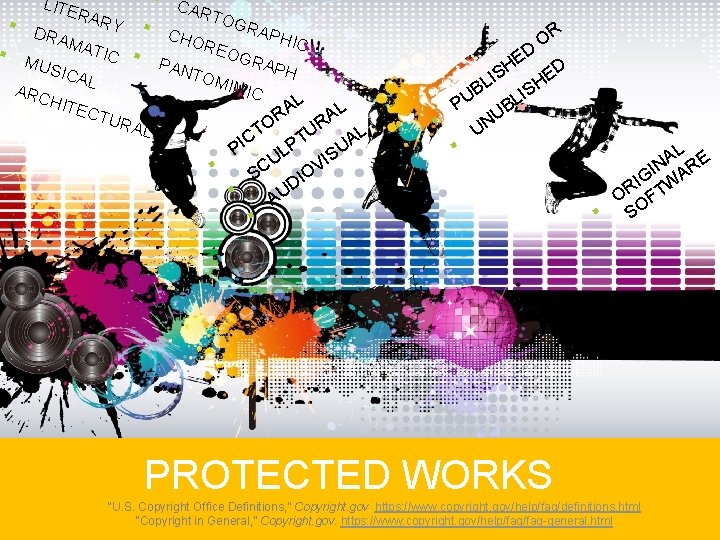
According to the U. S. Copyright Office: Copyright is “a form of protection provided by the laws of the United States for ‘original works of authorship’. . . " Source: “U. S. Copyright Office Definitions, ” Copyright. gov. https: //www. copyright. gov/help/faq/definitions. html
These works are called “Intellectual Property”
§ § LITE RAR § Y § CAR TOG RAP DRA CHO HIC MAT R E OGR § M IC § PAN APH USI CAL TOM IMIC ARC HITE L A L CTU A R RAL R O T U T C AL § PI P L U U SC IO D § AU § S VI OR D E D SH E I L H B S I L PU B U § N U § L E A N R GI WA I OR FT § SO PROTECTED WORKS “U. S. Copyright Office Definitions, ” Copyright. gov. https: //www. copyright. gov/help/faq/definitions. html “Copyright in General, ” Copyright. gov. https: //www. copyright. gov/help/faq-general. html
Copyright protection does not extend to these things: inventions or trademarks. “any idea, procedure, process, system, title, principle, or discovery. ” “names, titles, short phrases, slogans, familiar symbols, mere variations of typographic ornamentation, lettering, coloring, and listing of contents or ingredients. ” works in public domain either because copyright has expired or the work was dedicated to the domain. work created by U. S. Government employees. countries that do not recognize U. S. Copyright Law “Copyright in General, ” Copyright. gov. https: //www. copyright. gov/help/faq-general. html “U. S. Copyright Office Definitions, ” Copyright. gov. https: //www. copyright. gov/help/faq/definitions. html
Copyright protects the exclusive rights of authors to: Reproduce the work Prepare derivative works Distribute copies or recordings of the work Perform the work Display the work publicly Copyright Laws of The United States, Title 17, Chapter 1, Section 106
These rights are Constitutionally based Congress shall have power: “To promote the progress of science and useful arts, by securing for limited times to authors and inventors the exclusive right to their respective writings and discoveries. ” --United States Congress, Article 1, Section 8, Clause 8 https: //www. senate. gov/civics/constitution_item/constitution. htm
Copyright Infringement “. . . copyright infringement occurs when a copyrighted work is reproduced, distributed, performed, publicly displayed, or made into a derivative work without the permission of the copyright owner. ” U. S. Copyright Office Definitions
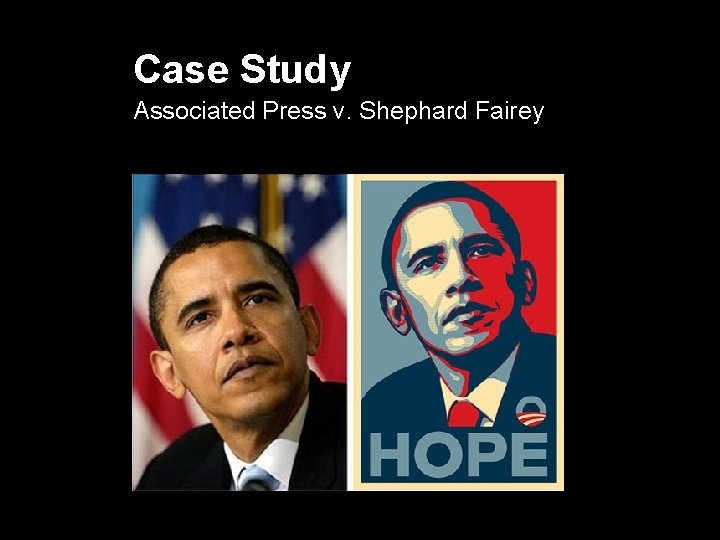
Case Study Associated Press v. Shephard Fairey
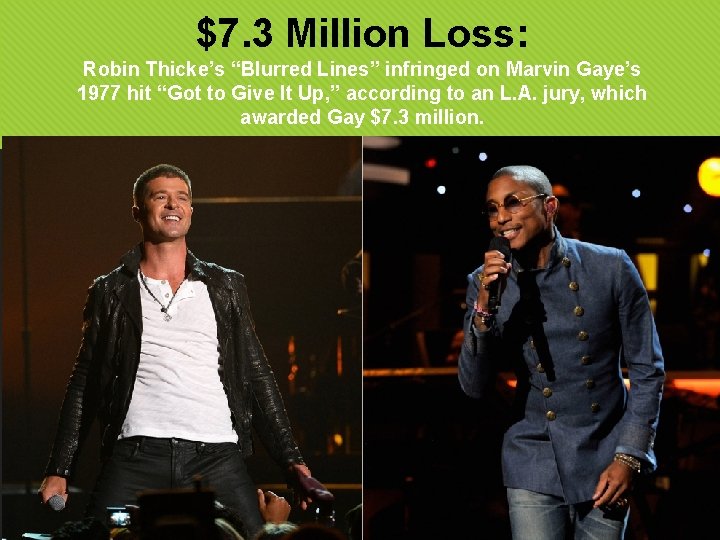
$7. 3 Million Loss: Robin Thicke’s “Blurred Lines” infringed on Marvin Gaye’s 1977 hit “Got to Give It Up, ” according to an L. A. jury, which awarded Gay $7. 3 million.
Some Perspectives on Copyright Purpose of Copyright To promote the progress of science and useful arts by allowing authors to own their works. Too much copyright? Some people believe copyright can impede free speech and favor people with the means to purchase access. Not enough copyright? Others believe limiting copyright removes incentives for authors to advance knowledge. Disney proposed new laws when the copyright on Mickey Mouse was about to expire.
The U. S. Digital Millennium Copyright Act (DMCA), 1998 One aspect of this act states that: Internet Service Providers (that meet specific criteria) have limited liability for transmitting info that infringes on a copyright (EXAMPLE: You. Tube) a copyright owner can demand that a service provider remove material that has infringed on copyright. “a copyright owner can obtain a subpoena from a federal court ordering a service provider to disclose the identity of a subscriber who is allegedly engaging in infringing activities”
What will happen if I infringe? Common Outcomes 1. Nothing 2. Course Grade Impact 3. “Cease and Desist Letter” from the owner 4. Law Suit by Owner
“Can I be sued even if I’ve done nothing wrong? ” YES. Frivolous law suits are sometimes brought against others when they have clearly not infringed, but it’s unusual for this to happen to students.
Questions?
Bibliography All sources will be listed here (they are already listed in individual slide notes). Format here will be CMS: Author Surname, First Name or Initial. Image Title. Year. Medium. size. Museum or place image is, Location, URL.
DISCUSSION 1. Why was Shephard Farey sued for his poster of Barrack Obama if he created the poster himself? 2. What part of the definition of “copyright infringement” applies to this case? 3. What is a “derivative work? ” Google the word if you need to. 4. Locate another example of a “derivative works. ” Do you believe this work infringes on copyright? Explain why or why not.
© 2002 -2020 Juliet Davis. This presentation was made possible by a Learninig Enrichment Grant from The University of Tampa. All media inserted in this presentation was used under one or more of the following conditions: • Licensing/Permission, e. g. , free online sources; paid sources • “Fair Use” (Intended), i. e. , limited use for criticism, comment, news reporting, teaching, scholarship, and/or research). • Public Domain (expired copyright or government source) • Original Authorship (I created it)
CITATIONS OF SOURCES: All media sources are cited in the Power. Point version of this presentation (citations appear in the notes under the slides), and in the video bibliography at the end of this series. Note that citing a media source does not automatically give a person permission to use the media. This presentation explains how to use outside media sources while avoiding copyright infringement.