
2 Constructional features and working of CNC machines
- Slides: 30
2. Constructional features and working of CNC machines Co: -Identify CNC tooling and use as per operation. Visit for more Learning Resources
Summary � What is CNC? � Types of CNC machines �Number of axis �Tools �Control system �Motion system � Actuators � CNC machine and robotic arms � CNC controller �G-code � Communications � Bibliography
What is CNC? �CNC (Computer Numerical Control) is the name received to machines that are able to position a tool without human assistance. �To position the tool, CNC machines have an interpreter that translate a series of instructions (G-Code) to electronic orders (for example, step and direction signals).
CNC Machine example
Types of CNC machines �We can classify these machines by: �Number of axis �Tool used �Control system �Motion system �There are other variable elements in a CNC machine, but these elements don’t change the way our machine works (for example the materials used to build it).
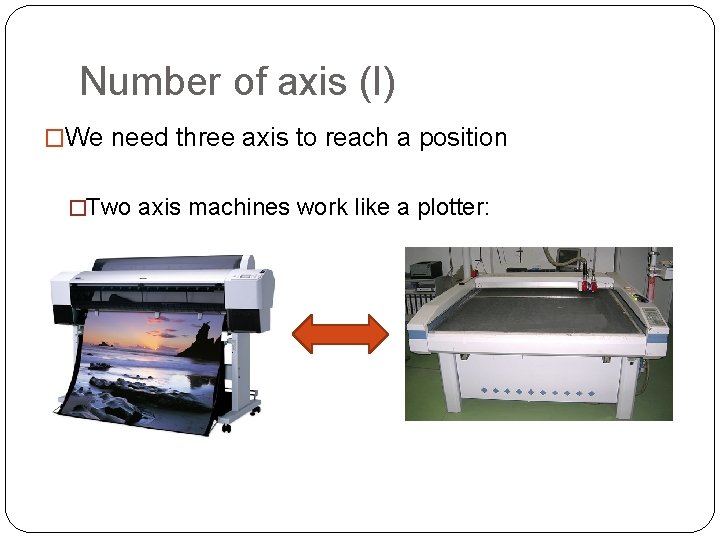
Number of axis (I) �We need three axis to reach a position �Two axis machines work like a plotter:
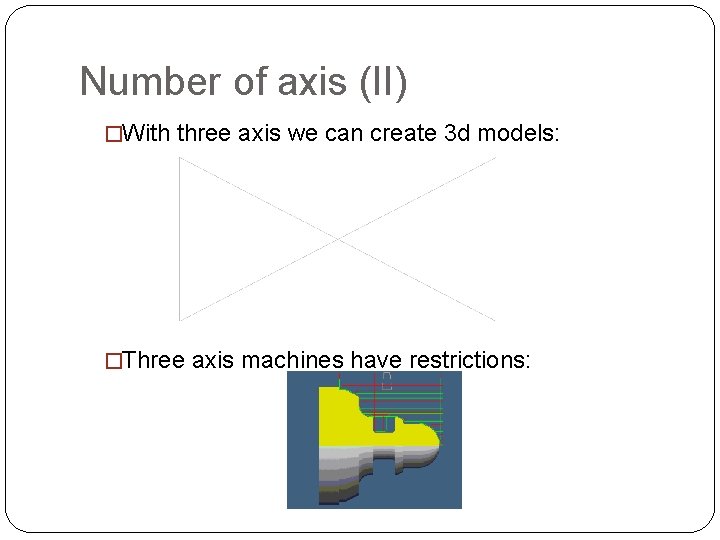
Number of axis (II) �With three axis we can create 3 d models: �Three axis machines have restrictions:
Number of axis (III) �With four or more axis we can orientate the tool, adding more possibilities of machining:
Tools (I) �A wide range of tools can be used. Most common are: �Spindle (showed videos) �Laser engraving and cutting
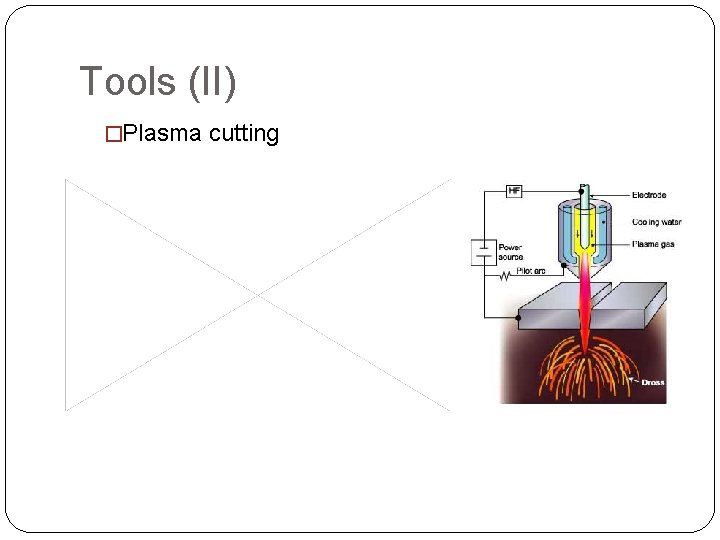
Tools (II) �Plasma cutting
Tools (III) �Inkjet printing
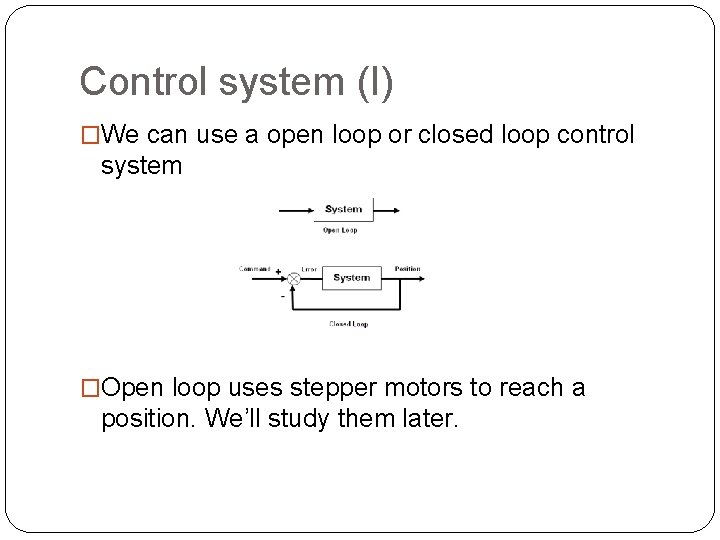
Control system (I) �We can use a open loop or closed loop control system �Open loop uses stepper motors to reach a position. We’ll study them later.
Control system (II) �When we use DC, AC or lineal motors we have to use a closed loop control system. �To capture the position of the tool we need an encoder for each axis, increasing total cost. �Most CNC machines use stepper motors due to their low cost and high precision (0. 9º per steep).
Motion system (I) �There are two type of motion elements: �Active elements: They transmit movement from position motors to mobile elements. �Passive elements: They act like a guide or rail for mobile elements.
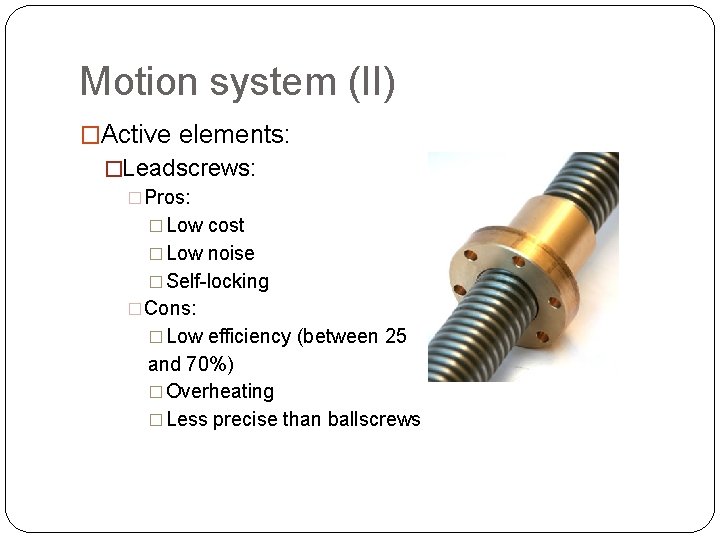
Motion system (II) �Active elements: �Leadscrews: �Pros: � Low cost � Low noise � Self-locking �Cons: � Low efficiency (between 25 and 70%) � Overheating � Less precise than ballscrews
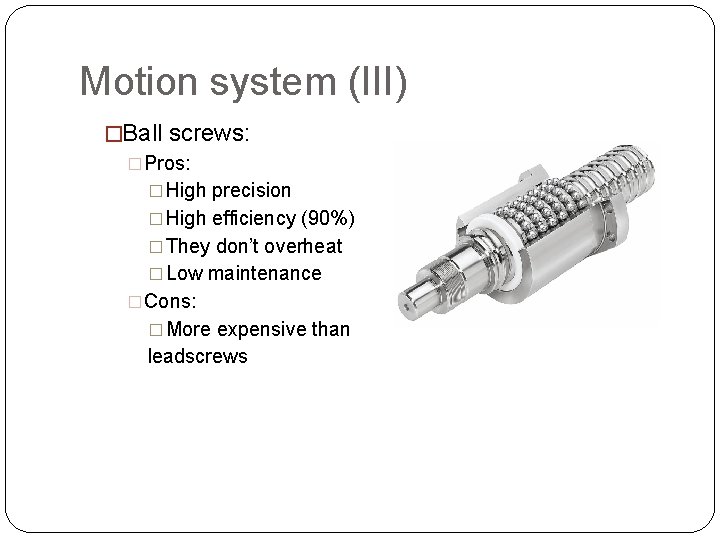
Motion system (III) �Ball screws: �Pros: � High precision � High efficiency (90%) � They don’t overheat � Low maintenance �Cons: � More expensive than leadscrews
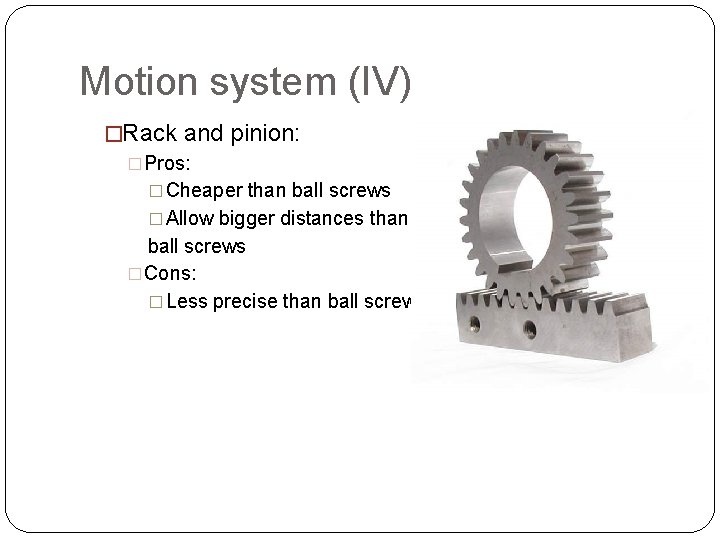
Motion system (IV) �Rack and pinion: �Pros: � Cheaper than ball screws � Allow bigger distances than ball screws �Cons: � Less precise than ball screws
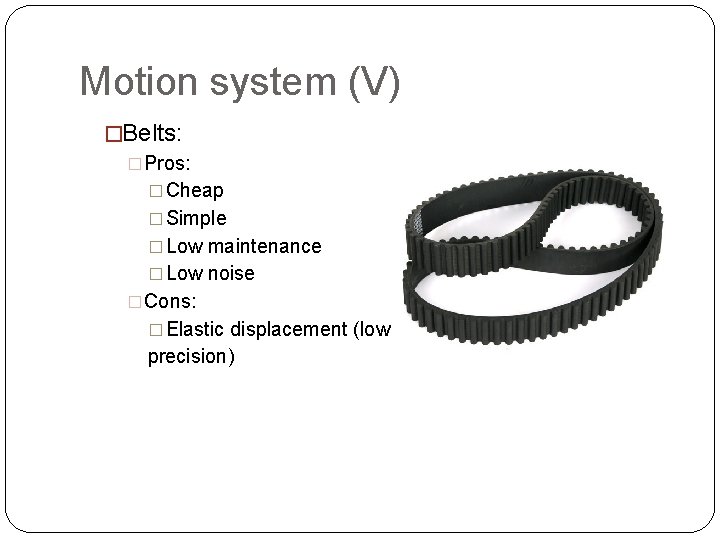
Motion system (V) �Belts: �Pros: � Cheap � Simple � Low maintenance � Low noise �Cons: � Elastic displacement (low precision)
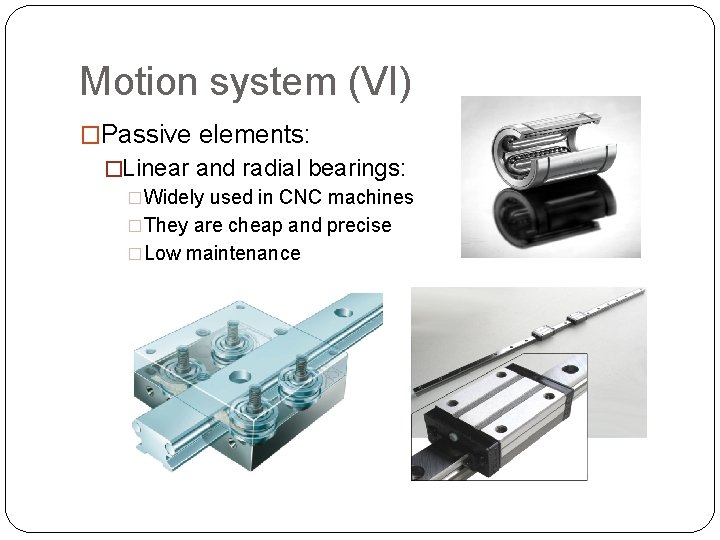
Motion system (VI) �Passive elements: �Linear and radial bearings: �Widely used in CNC machines �They are cheap and precise �Low maintenance
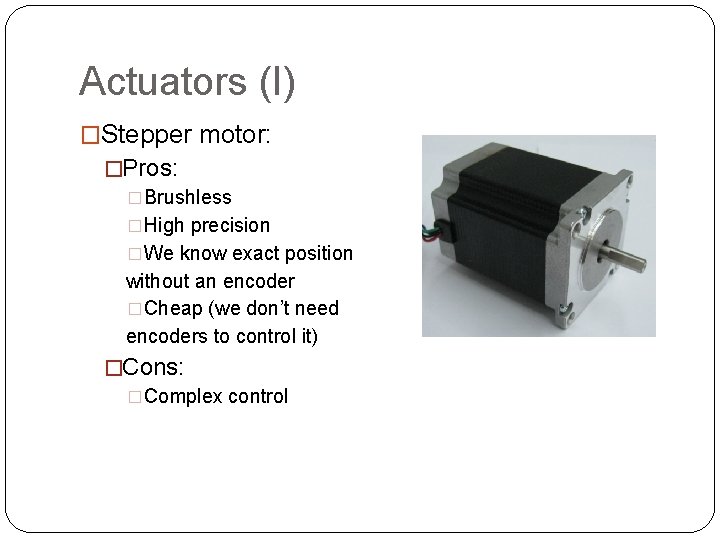
Actuators (I) �Stepper motor: �Pros: �Brushless �High precision �We know exact position without an encoder �Cheap (we don’t need encoders to control it) �Cons: �Complex control
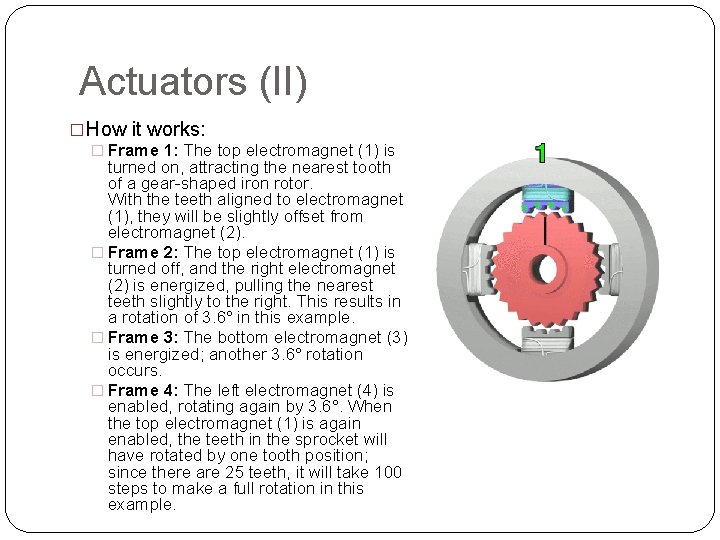
Actuators (II) �How it works: � Frame 1: The top electromagnet (1) is turned on, attracting the nearest tooth of a gear-shaped iron rotor. With the teeth aligned to electromagnet (1), they will be slightly offset from electromagnet (2). � Frame 2: The top electromagnet (1) is turned off, and the right electromagnet (2) is energized, pulling the nearest teeth slightly to the right. This results in a rotation of 3. 6° in this example. � Frame 3: The bottom electromagnet (3) is energized; another 3. 6° rotation occurs. � Frame 4: The left electromagnet (4) is enabled, rotating again by 3. 6°. When the top electromagnet (1) is again enabled, the teeth in the sprocket will have rotated by one tooth position; since there are 25 teeth, it will take 100 steps to make a full rotation in this example.
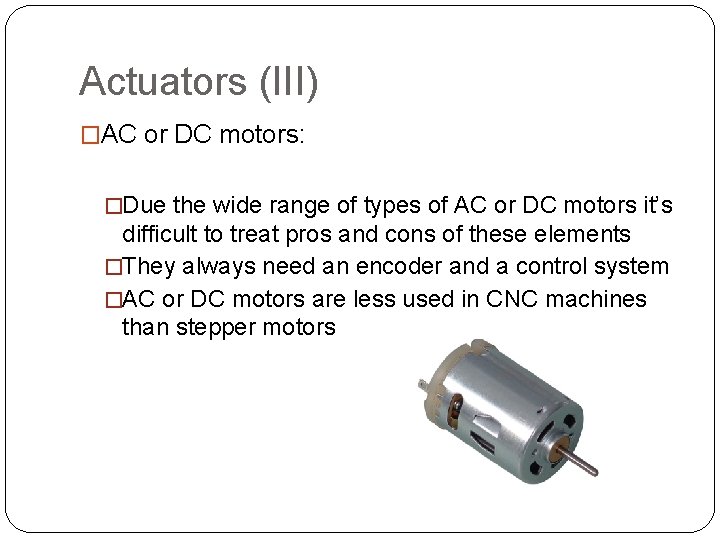
Actuators (III) �AC or DC motors: �Due the wide range of types of AC or DC motors it’s difficult to treat pros and cons of these elements �They always need an encoder and a control system �AC or DC motors are less used in CNC machines than stepper motors
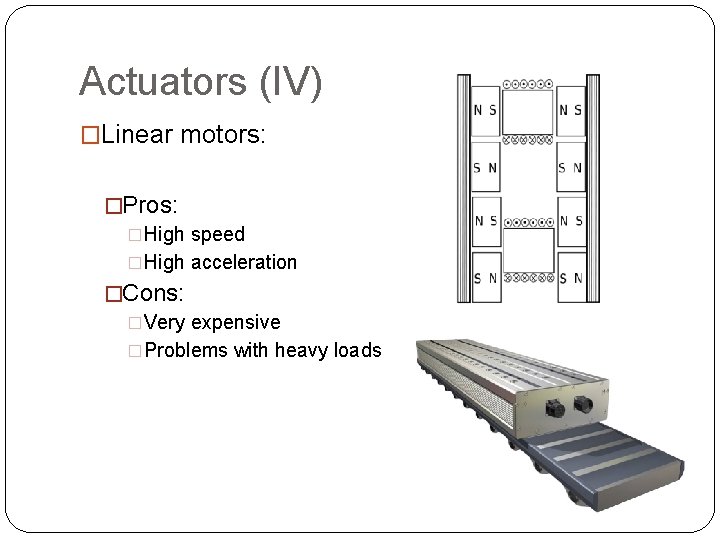
Actuators (IV) �Linear motors: �Pros: �High speed �High acceleration �Cons: �Very expensive �Problems with heavy loads
CNC machines and robotics arms �What is the main difference between CNC machines and robotics arms? �Standard robot arms have no linear axes. They have one rotary axis piled on top of another. This means that all linear motion is interpolated. All axis must constantly move simultaneously in order to create virtually any motion at all.
CNC controller �The main part of a CNC controller is the G-code interpreter �It has to receive a list of G-code instructions and translate it to electronic signals �These electronics signals are sent to motor controllers. These controllers act like a power stage, amplifying and translating the signals that motors will receive.
G-code (I) � The code used to program CNC machines is generically called G-code. However, G-code instructions are only part of the programming language. � Specifically, G-codes give CNC machines the coordinates from which to hold and engage the machining tool in order to cut and shape metal to certain specifications. � The entire series of codes used to operate CNC machines also include M-codes and TCodes, which manage the CNC machine and drill tool, respectively. Tooling speed and feed controls are dictated by S-Codes and F-Codes, while X, Y, and Zcodes determine absolute position.
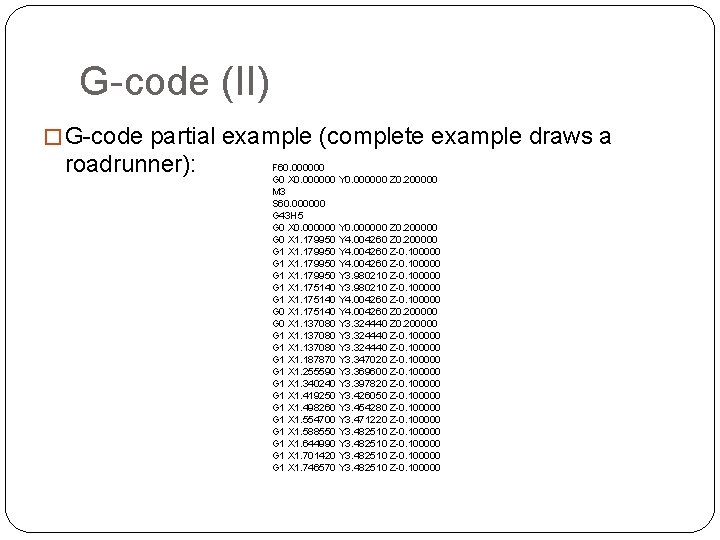
G-code (II) � G-code partial example (complete example draws a roadrunner): F 60. 000000 G 0 X 0. 000000 Y 0. 000000 Z 0. 200000 M 3 S 60. 000000 G 43 H 5 G 0 X 0. 000000 Y 0. 000000 Z 0. 200000 G 0 X 1. 179950 Y 4. 004260 Z 0. 200000 G 1 X 1. 179950 Y 4. 004260 Z-0. 100000 G 1 X 1. 179950 Y 3. 980210 Z-0. 100000 G 1 X 1. 175140 Y 4. 004260 Z-0. 100000 G 0 X 1. 175140 Y 4. 004260 Z 0. 200000 G 0 X 1. 137080 Y 3. 324440 Z 0. 200000 G 1 X 1. 137080 Y 3. 324440 Z-0. 100000 G 1 X 1. 187870 Y 3. 347020 Z-0. 100000 G 1 X 1. 255590 Y 3. 369600 Z-0. 100000 G 1 X 1. 340240 Y 3. 397820 Z-0. 100000 G 1 X 1. 419250 Y 3. 426050 Z-0. 100000 G 1 X 1. 498260 Y 3. 454280 Z-0. 100000 G 1 X 1. 554700 Y 3. 471220 Z-0. 100000 G 1 X 1. 588550 Y 3. 482510 Z-0. 100000 G 1 X 1. 644990 Y 3. 482510 Z-0. 100000 G 1 X 1. 701420 Y 3. 482510 Z-0. 100000 G 1 X 1. 746570 Y 3. 482510 Z-0. 100000
Communications (I) �We need to send signals from CNC controller to motor controllers �Why use Centronics port instead USB? �With centronics you can get completely deterministic timing.
Communications (II) �There are different USB motor controllers in the market �They are more expensive (they have to implement more logic than centronics) �USB controllers can work well in controlled conditions. Centronics works well in all conditions.
Thank you for your attention! Any questions? For more detail contact us