
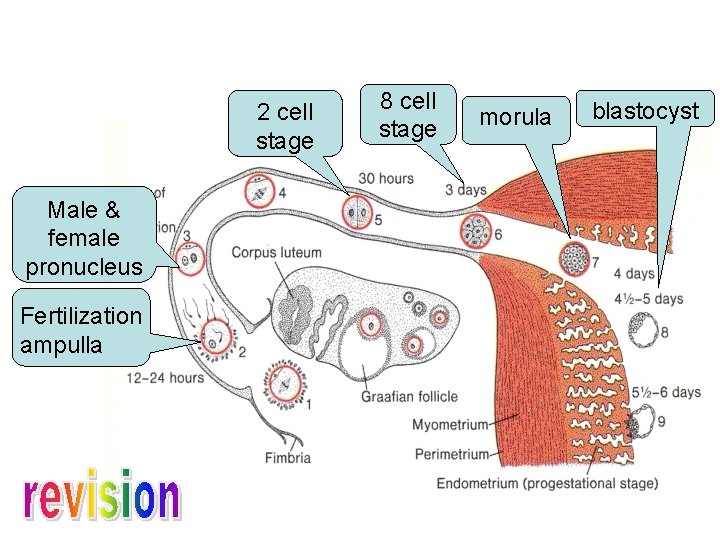
2 cell stage Male female pronucleus Fertilization ampulla

- Slides: 71
2 cell stage Male & female pronucleus Fertilization ampulla 8 cell stage morula blastocyst
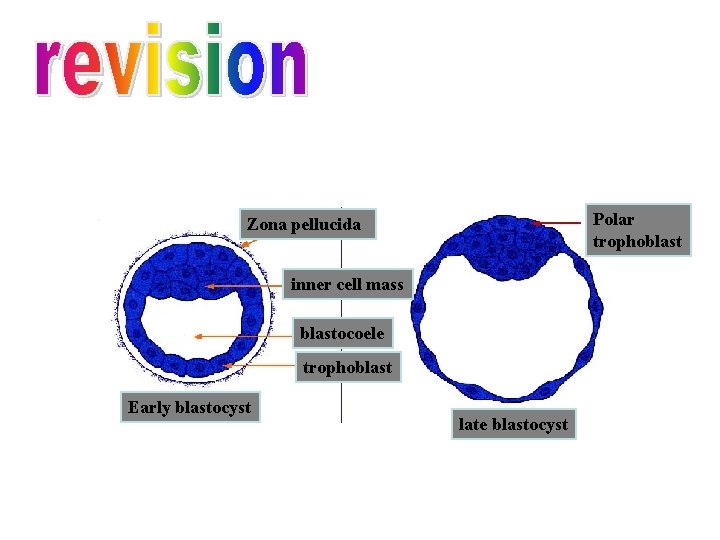
Polar trophoblast Zona pellucida inner cell mass blastocoele trophoblast Early blastocyst late blastocyst
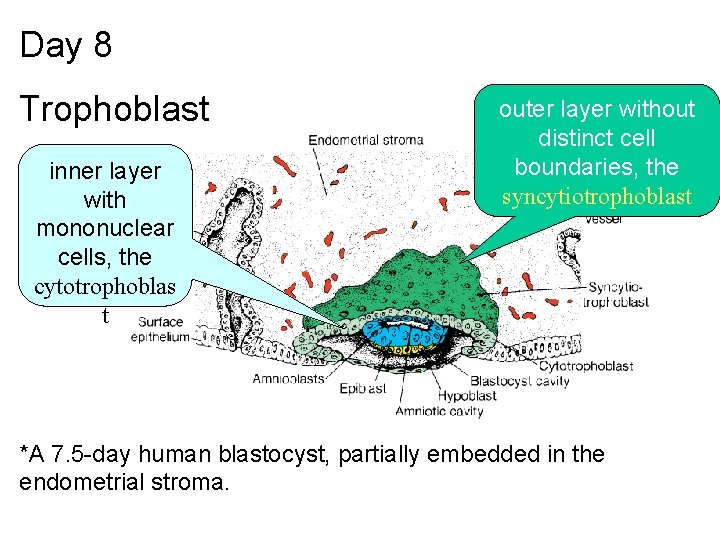
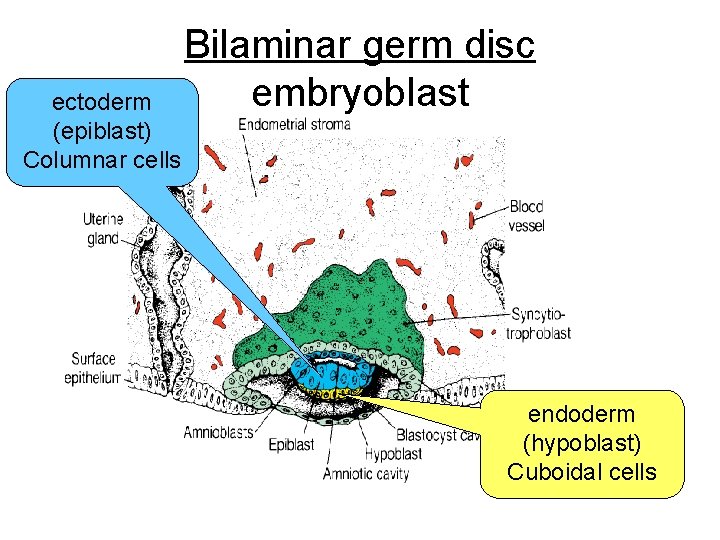
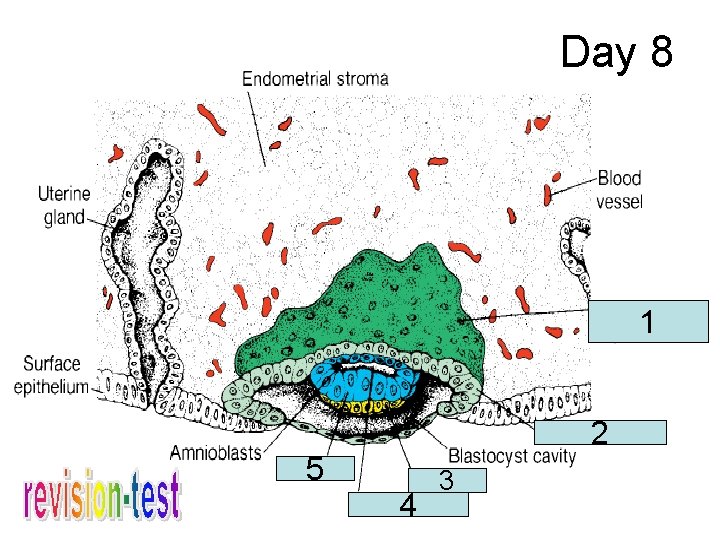
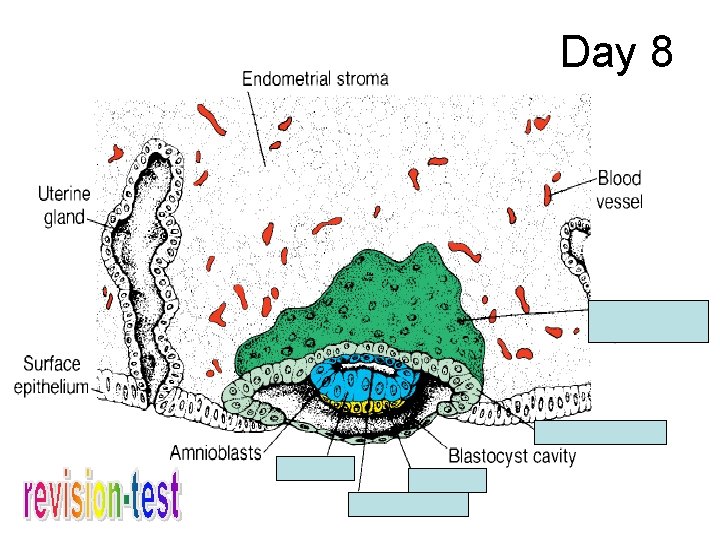
Day 8 Trophoblast inner layer with mononuclear cells, the cytotrophoblas t outer layer without distinct cell boundaries, the syncytiotrophoblast *A 7. 5 -day human blastocyst, partially embedded in the endometrial stroma.
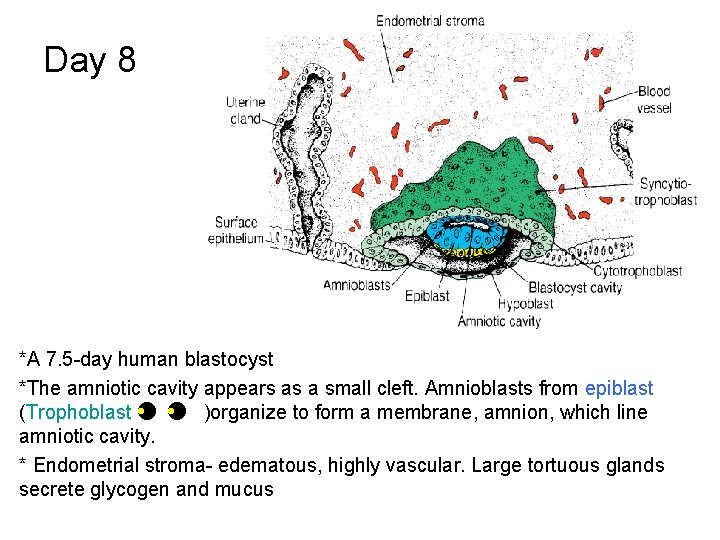
Day 8 *A 7. 5 -day human blastocyst *The amniotic cavity appears as a small cleft. Amnioblasts from epiblast (Trophoblast )organize to form a membrane, amnion, which line amniotic cavity. * Endometrial stroma- edematous, highly vascular. Large tortuous glands secrete glycogen and mucus
ectoderm (epiblast) Columnar cells Bilaminar germ disc embryoblast endoderm (hypoblast) Cuboidal cells
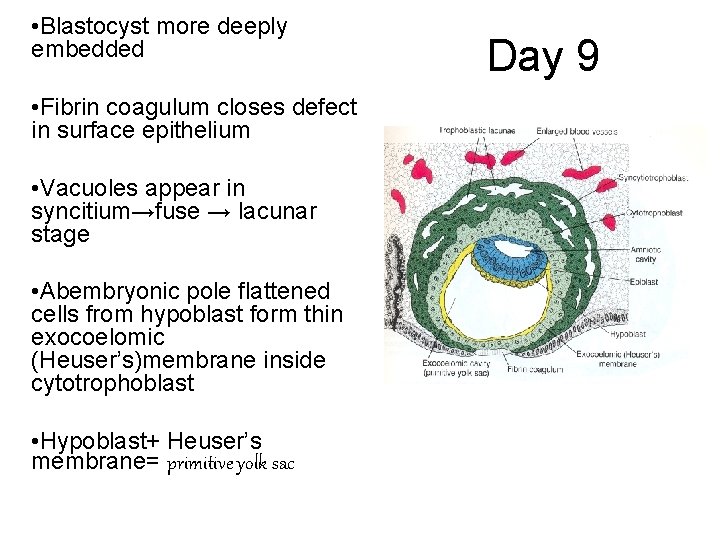
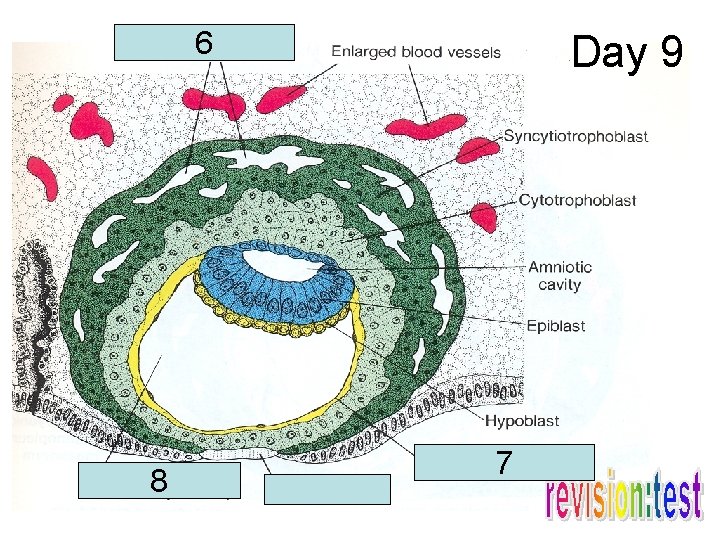
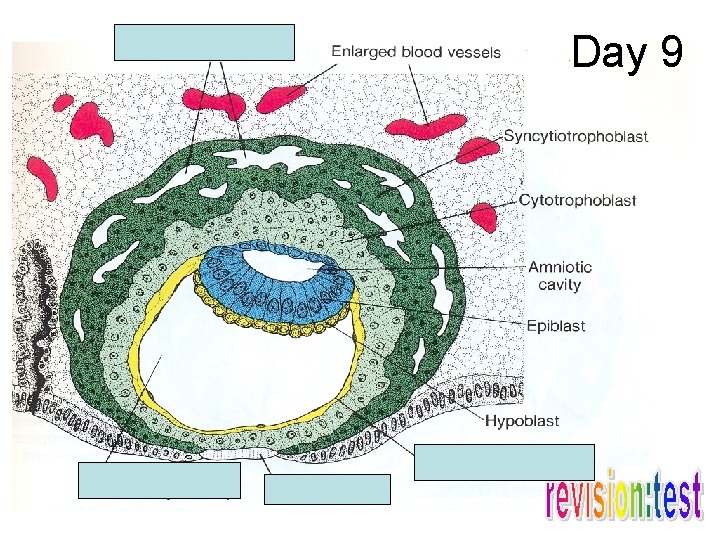
• Blastocyst more deeply embedded • Fibrin coagulum closes defect in surface epithelium • Vacuoles appear in syncitium→fuse → lacunar stage • Abembryonic pole flattened cells from hypoblast form thin exocoelomic (Heuser’s)membrane inside cytotrophoblast • Hypoblast+ Heuser’s membrane= primitive yolk sac Day 9
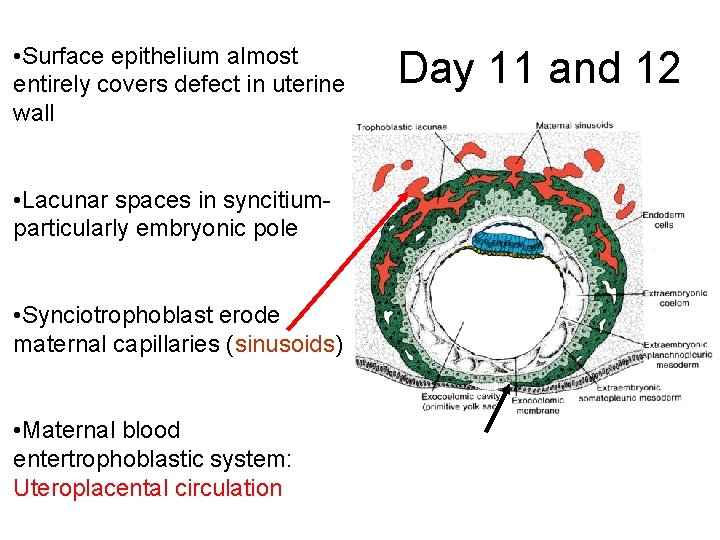
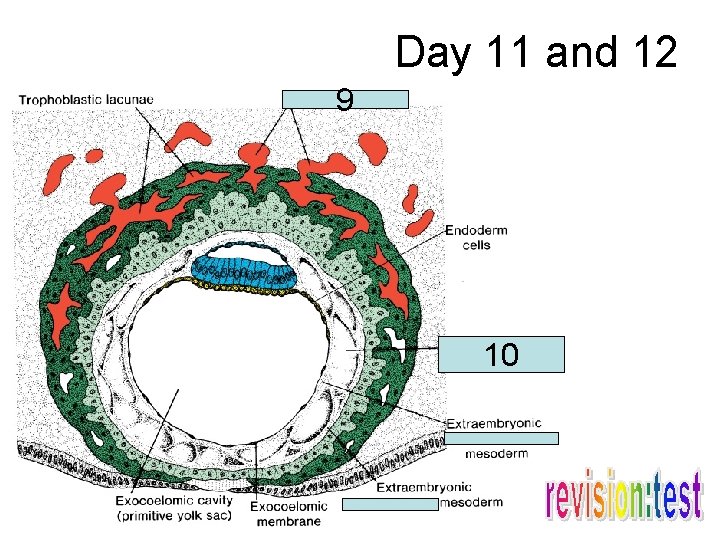
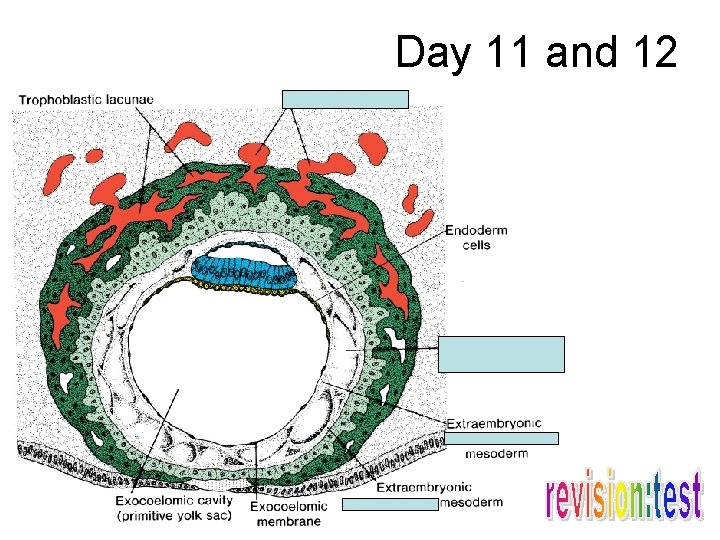
• Surface epithelium almost entirely covers defect in uterine wall • Lacunar spaces in syncitium- particularly embryonic pole • Synciotrophoblast erode maternal capillaries (sinusoids) • Maternal blood entertrophoblastic system: Uteroplacental circulation Day 11 and 12
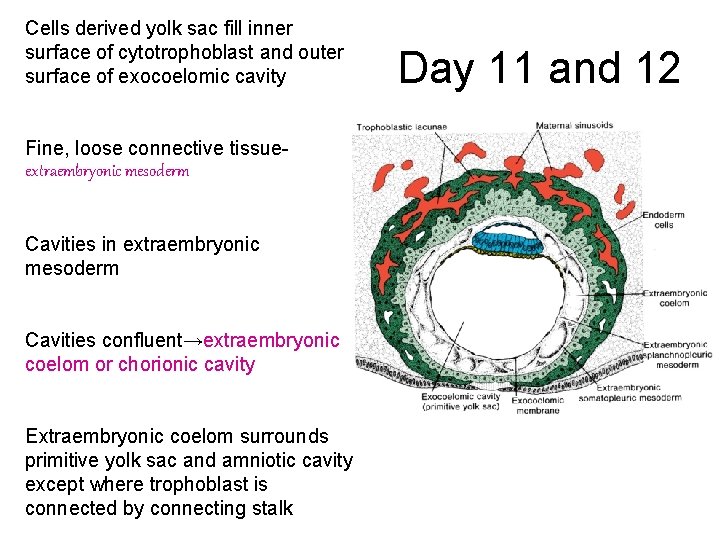
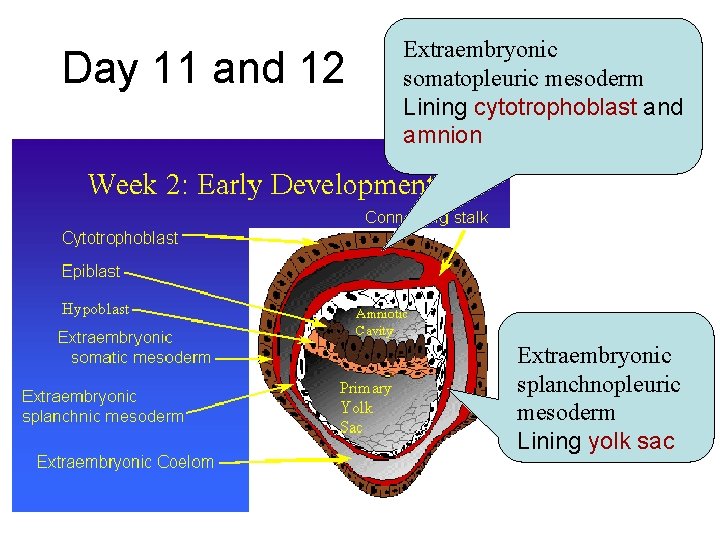
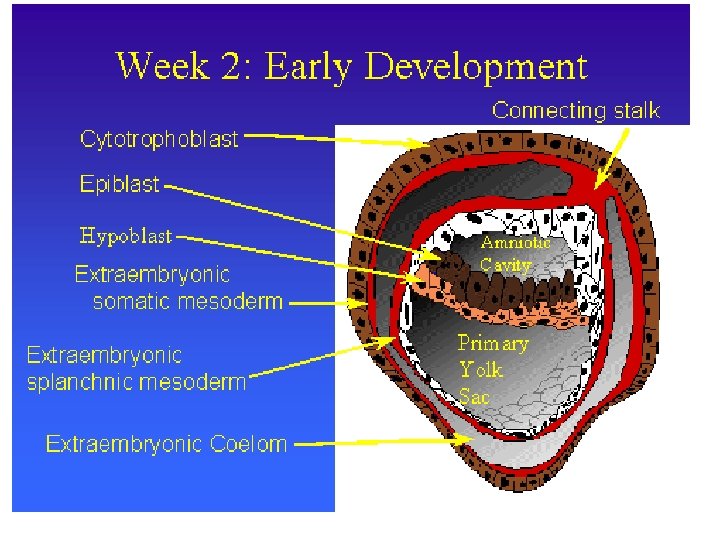
Cells derived yolk sac fill inner surface of cytotrophoblast and outer surface of exocoelomic cavity Fine, loose connective tissue- extraembryonic mesoderm Cavities in extraembryonic mesoderm Cavities confluent→extraembryonic coelom or chorionic cavity Extraembryonic coelom surrounds primitive yolk sac and amniotic cavity except where trophoblast is connected by connecting stalk Day 11 and 12
Day 11 and 12 Extraembryonic somatopleuric mesoderm Lining cytotrophoblast and amnion Extraembryonic splanchnopleuric mesoderm Lining yolk sac
Decidual reaction • decidual response of endometrium • Endometrial changes resulting from adaptation of tissues to implantation of blastocyst • stroma cell → predecidual cell • → decidual cell (cell become polyhedral and rich in glycogen and lipid droplets) • Intercellular spaces filled with extravasate • Tissue edematous
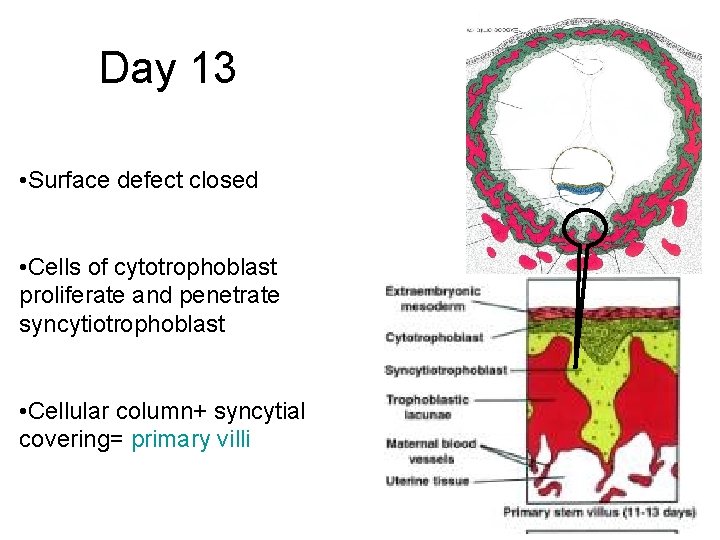
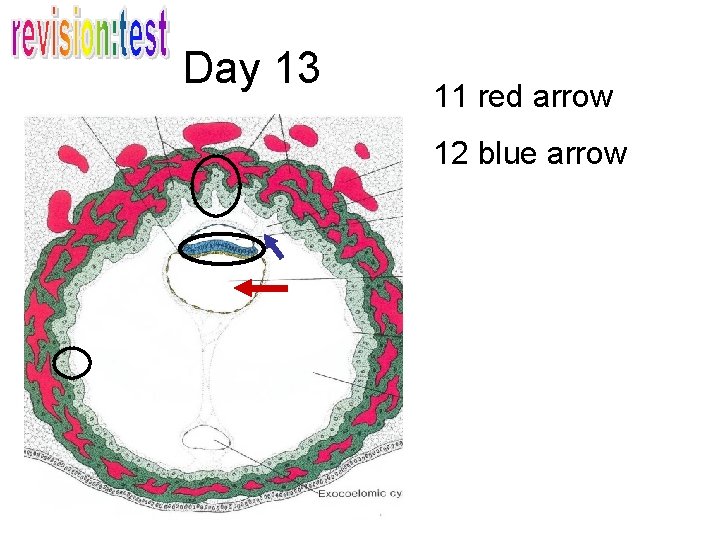
Day 13 • Surface defect closed • Cells of cytotrophoblast proliferate and penetrate syncytiotrophoblast • Cellular column+ syncytial covering= primary villi
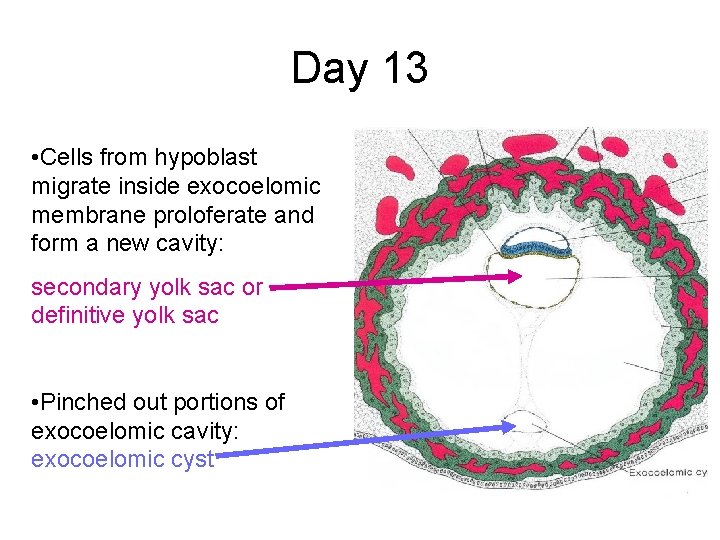
Day 13 • Cells from hypoblast migrate inside exocoelomic membrane proloferate and form a new cavity: secondary yolk sac or definitive yolk sac • Pinched out portions of exocoelomic cavity: exocoelomic cyst
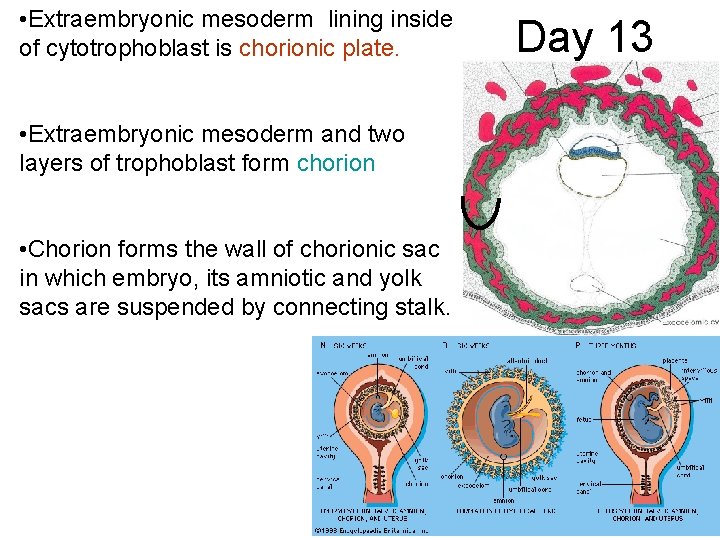
• Extraembryonic mesoderm lining inside of cytotrophoblast is chorionic plate. • Extraembryonic mesoderm and two layers of trophoblast form chorion • Chorion forms the wall of chorionic sac in which embryo, its amniotic and yolk sacs are suspended by connecting stalk. Day 13
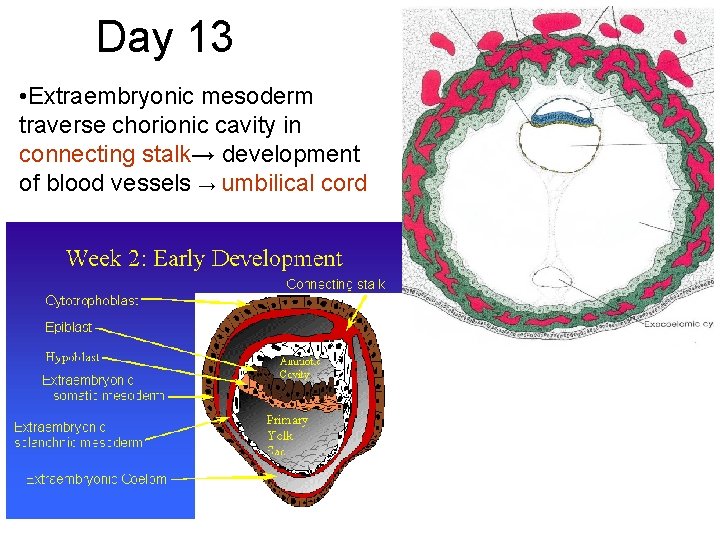
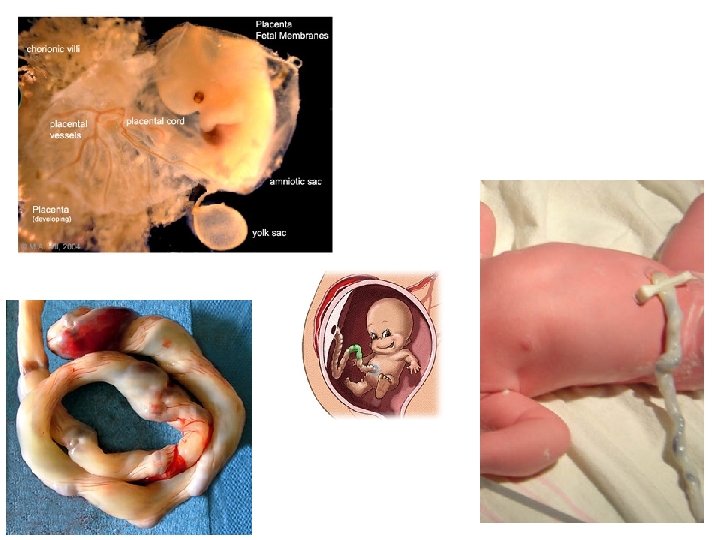
Day 13 • Extraembryonic mesoderm traverse chorionic cavity in connecting stalk→ development of blood vessels → umbilical cord
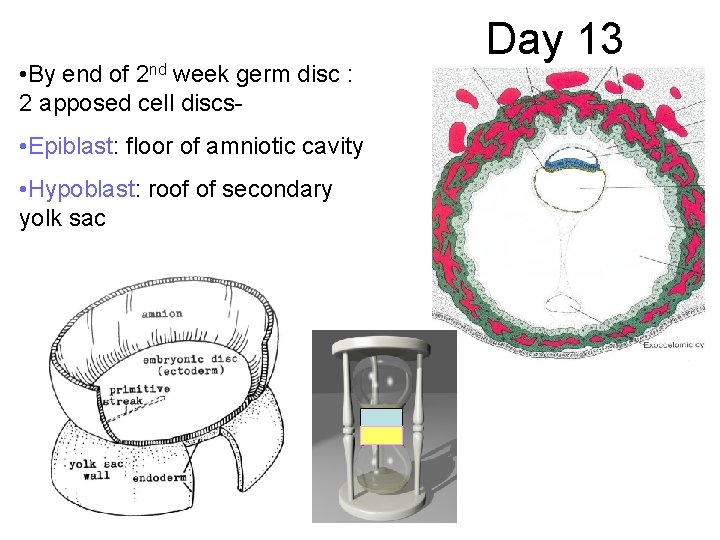
• By end of 2 nd week germ disc : 2 apposed cell discs • Epiblast: floor of amniotic cavity • Hypoblast: roof of secondary yolk sac Day 13
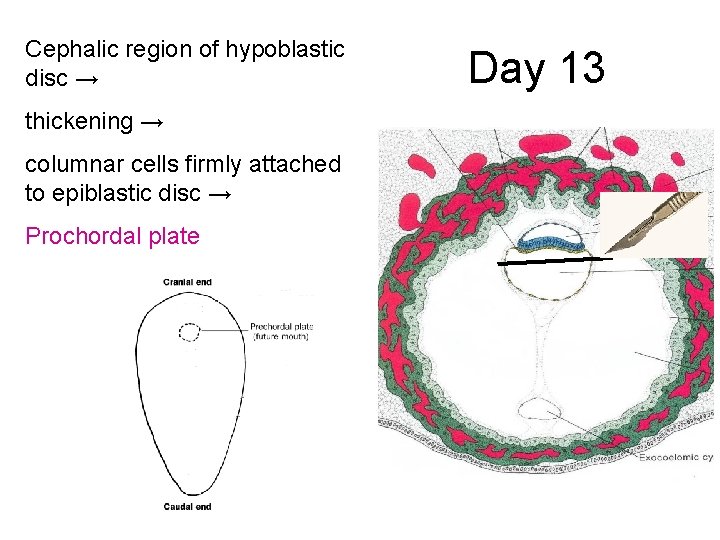
Cephalic region of hypoblastic disc → thickening → columnar cells firmly attached to epiblastic disc → Prochordal plate Day 13
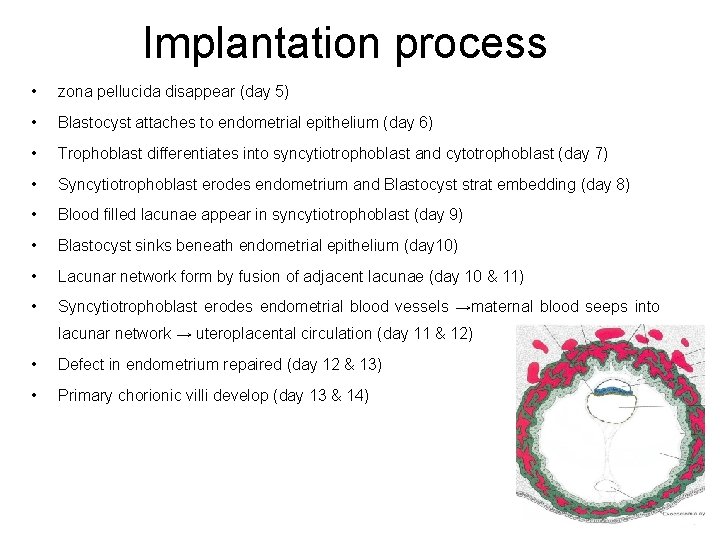
Implantation process • zona pellucida disappear (day 5) • Blastocyst attaches to endometrial epithelium (day 6) • Trophoblast differentiates into syncytiotrophoblast and cytotrophoblast (day 7) • Syncytiotrophoblast erodes endometrium and Blastocyst strat embedding (day 8) • Blood filled lacunae appear in syncytiotrophoblast (day 9) • Blastocyst sinks beneath endometrial epithelium (day 10) • Lacunar network form by fusion of adjacent lacunae (day 10 & 11) • Syncytiotrophoblast erodes endometrial blood vessels →maternal blood seeps into lacunar network → uteroplacental circulation (day 11 & 12) • Defect in endometrium repaired (day 12 & 13) • Primary chorionic villi develop (day 13 & 14)
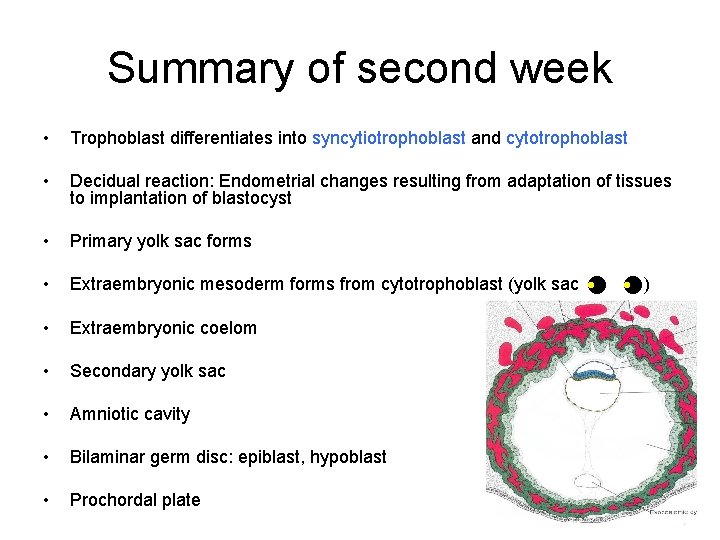
Summary of second week • Trophoblast differentiates into syncytiotrophoblast and cytotrophoblast • Decidual reaction: Endometrial changes resulting from adaptation of tissues to implantation of blastocyst • Primary yolk sac forms • Extraembryonic mesoderm forms from cytotrophoblast (yolk sac ) • Extraembryonic coelom • Secondary yolk sac • Amniotic cavity • Bilaminar germ disc: epiblast, hypoblast • Prochordal plate
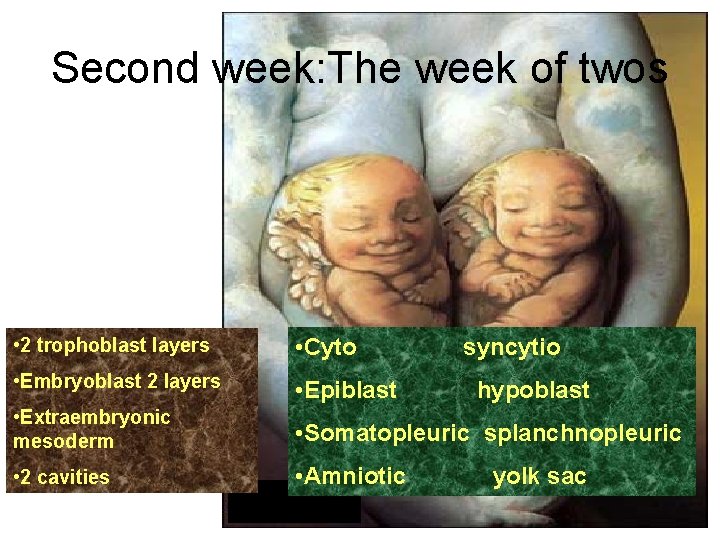
Second week: The week of twos • 2 trophoblast layers • Cyto • Embryoblast 2 layers • Epiblast • Extraembryonic mesoderm • Somatopleuric splanchnopleuric • 2 cavities • Amniotic syncytio hypoblast yolk sac
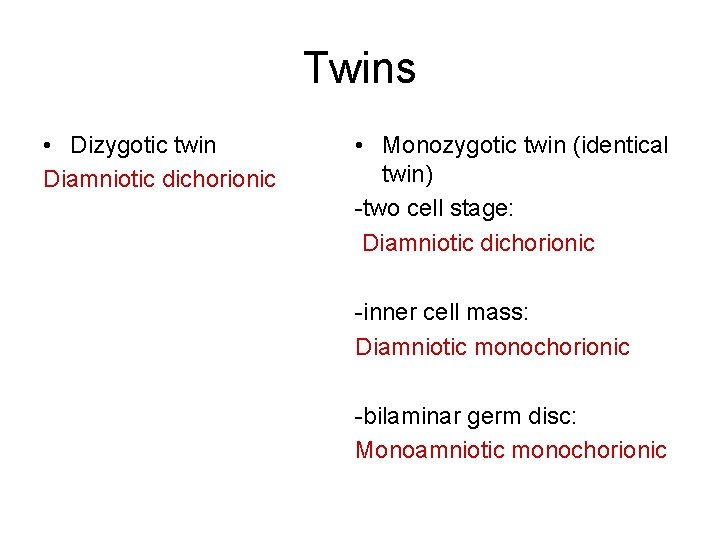
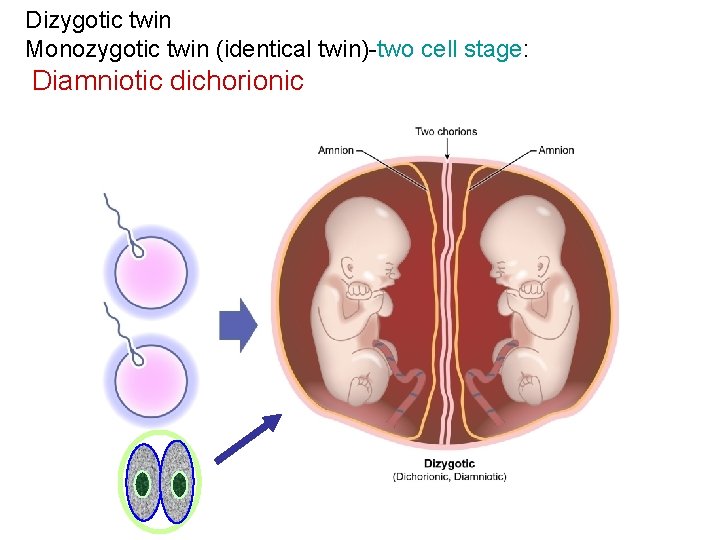
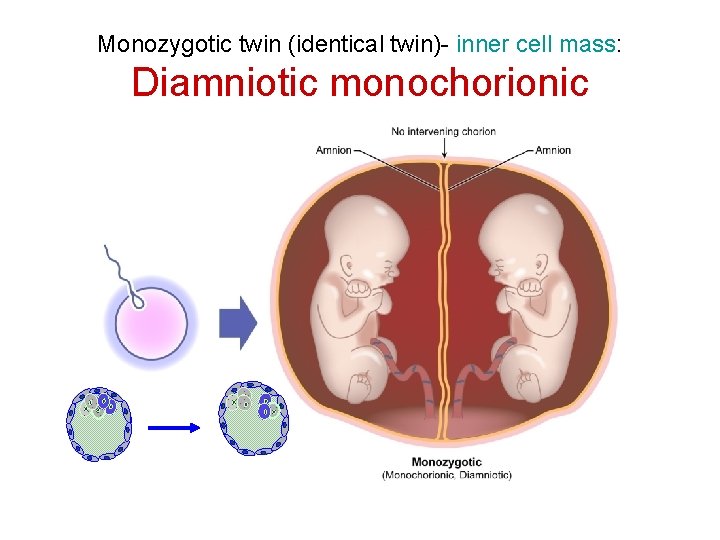
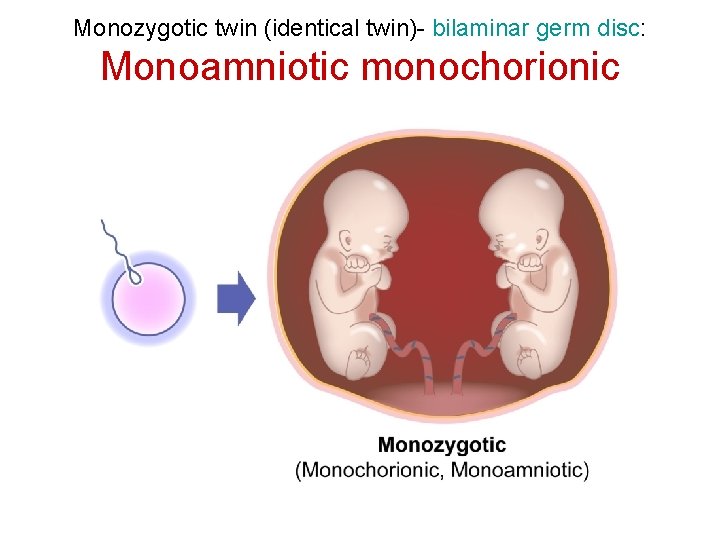
Twins • Dizygotic twin Diamniotic dichorionic • Monozygotic twin (identical twin) -two cell stage: Diamniotic dichorionic -inner cell mass: Diamniotic monochorionic -bilaminar germ disc: Monoamniotic monochorionic
Dizygotic twin Monozygotic twin (identical twin)-two cell stage: Diamniotic dichorionic
Monozygotic twin (identical twin)- inner cell mass: Diamniotic monochorionic
Monozygotic twin (identical twin)- bilaminar germ disc: Monoamniotic monochorionic
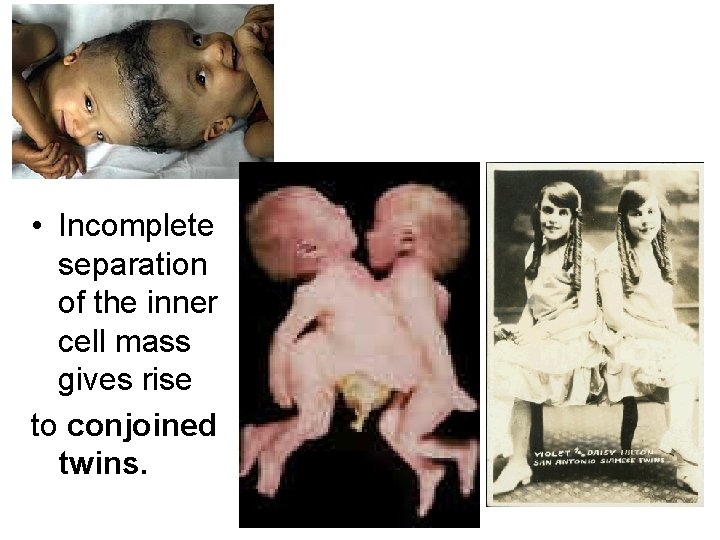
• Incomplete separation of the inner cell mass gives rise to conjoined twins.
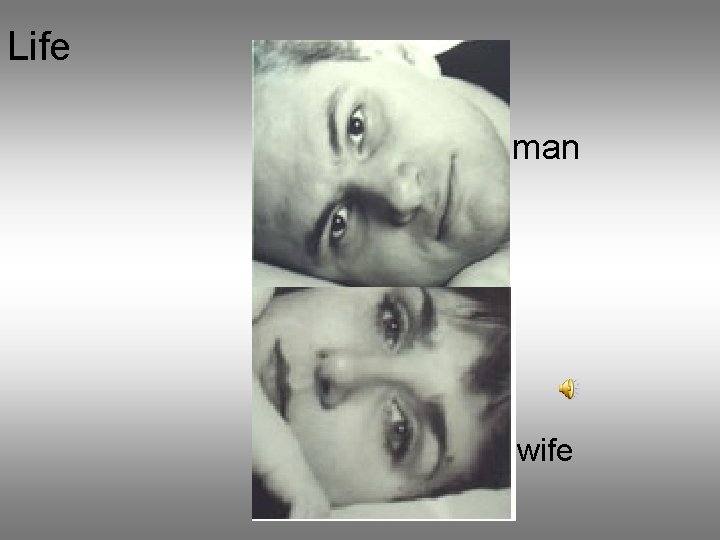
Life man wife
Life papa mom
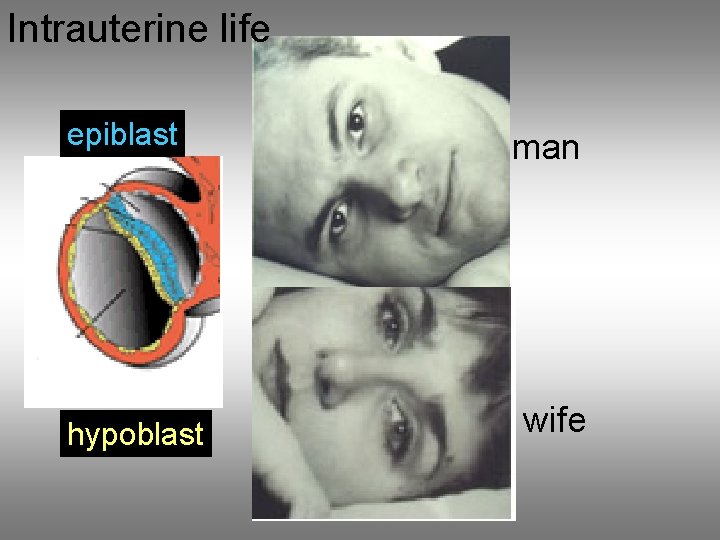
Intrauterine life epiblast hypoblast man wife
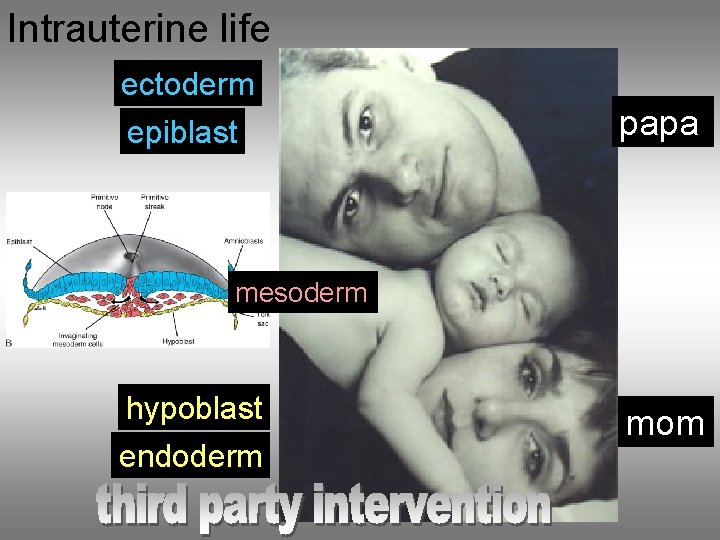
Intrauterine life ectoderm epiblast papa mesoderm hypoblast endoderm mom
Formation of primitive streak, gastrulation , notochord, Third week of development
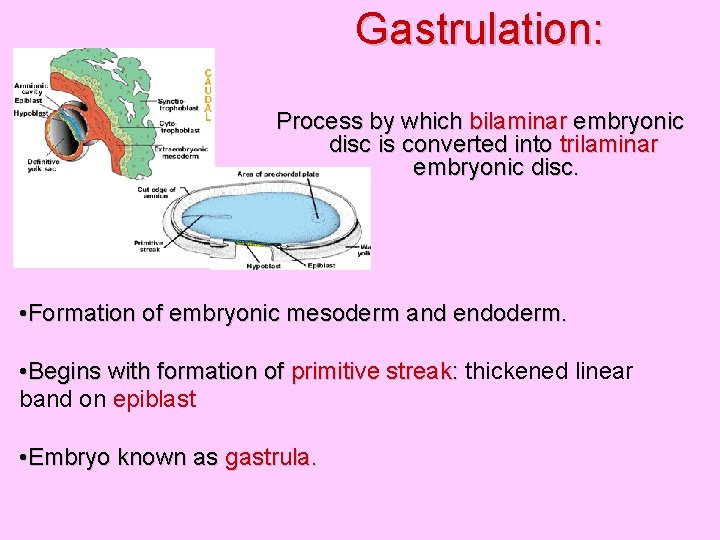
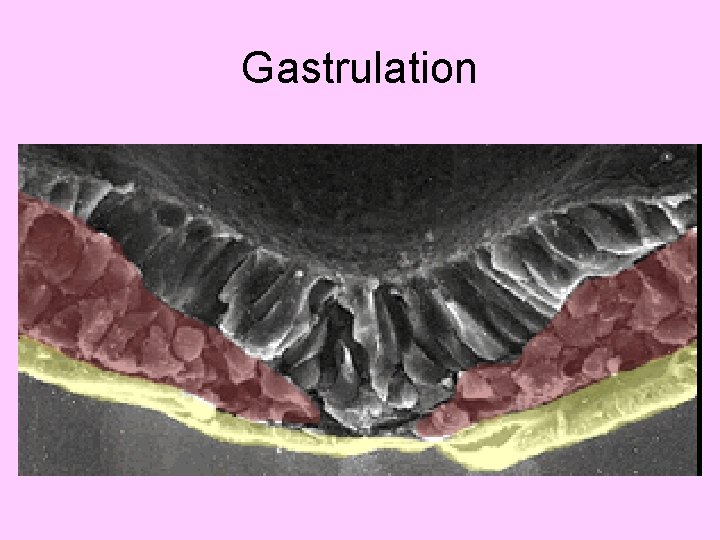
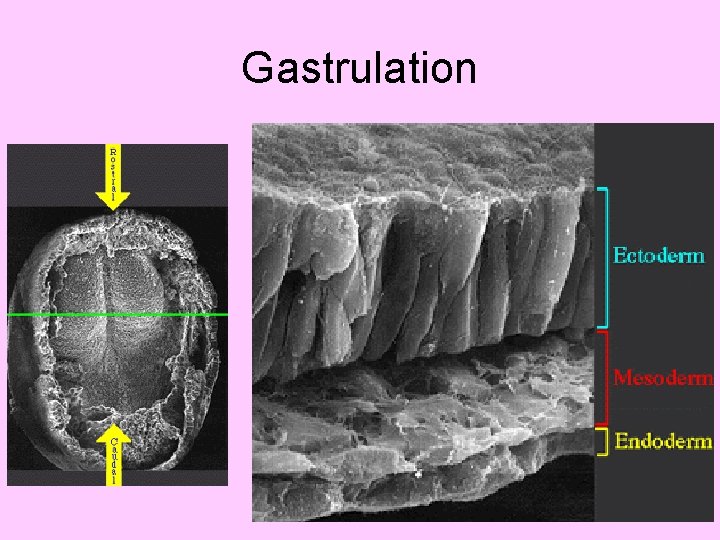
Gastrulation: Process by which bilaminar embryonic disc is converted into trilaminar embryonic disc. • Formation of embryonic mesoderm and endoderm. • Begins with formation of primitive streak: thickened linear : band on epiblast • Embryo known as gastrula.
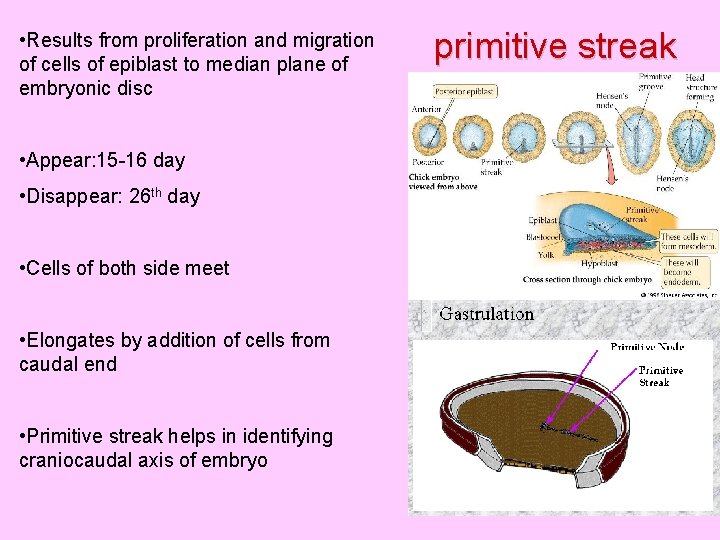
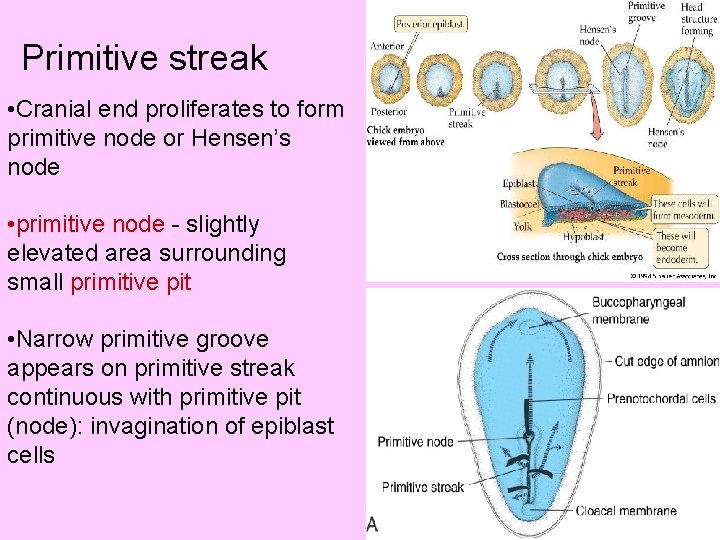
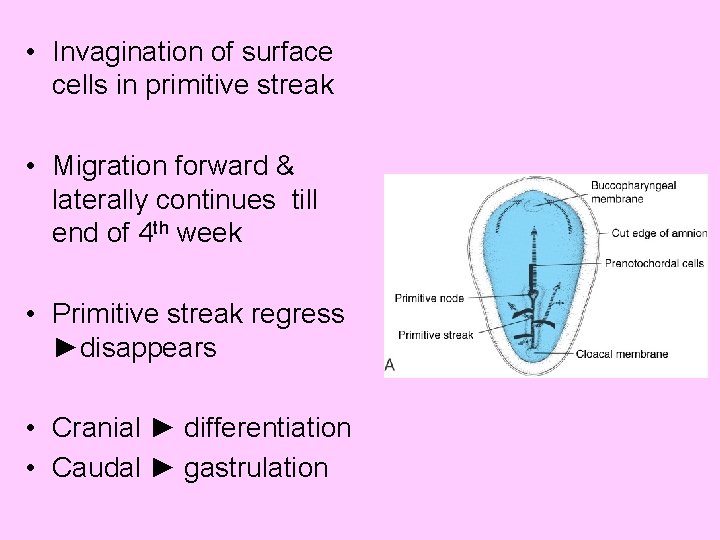
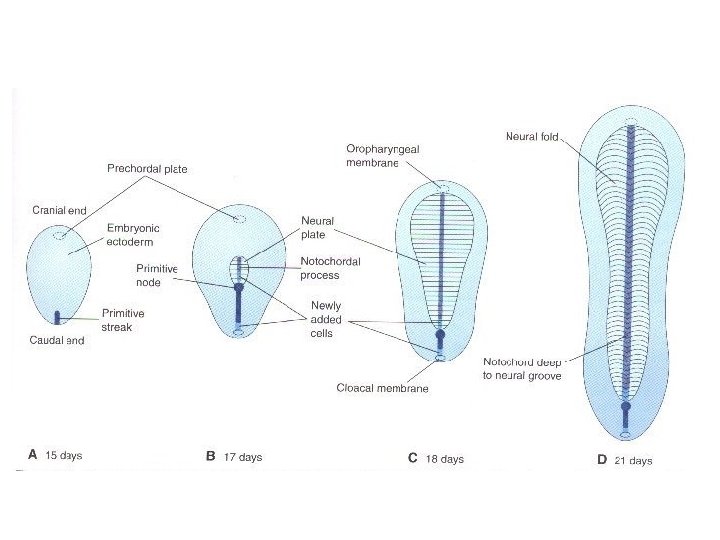
• Results from proliferation and migration of cells of epiblast to median plane of embryonic disc • Appear: 15 -16 day • Disappear: 26 th day • Cells of both side meet • Elongates by addition of cells from caudal end • Primitive streak helps in identifying craniocaudal axis of embryo primitive streak
Primitive streak • Cranial end proliferates to form primitive node or Hensen’s node • primitive node - slightly elevated area surrounding small primitive pit • Narrow primitive groove appears on primitive streak continuous with primitive pit (node): invagination of epiblast cells
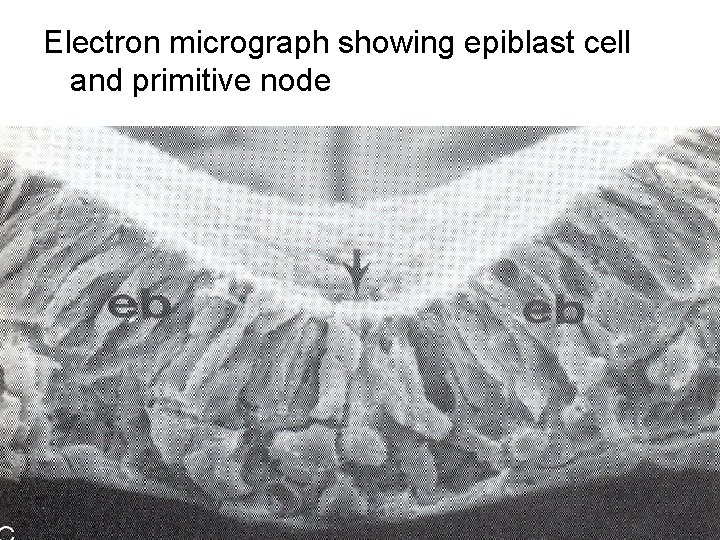
Electron micrograph showing epiblast cell and primitive node
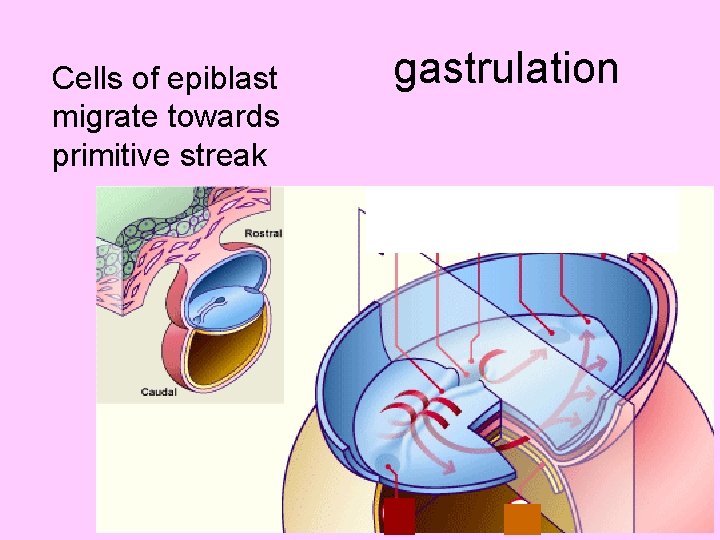
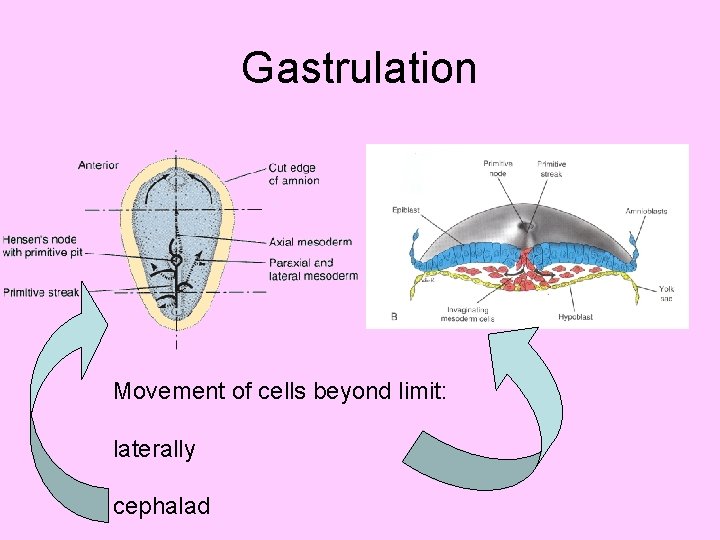
Cells of epiblast migrate towards primitive streak gastrulation
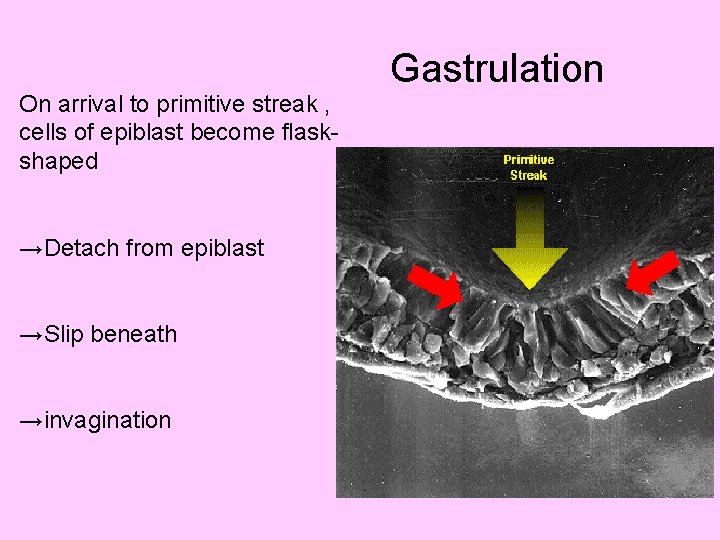
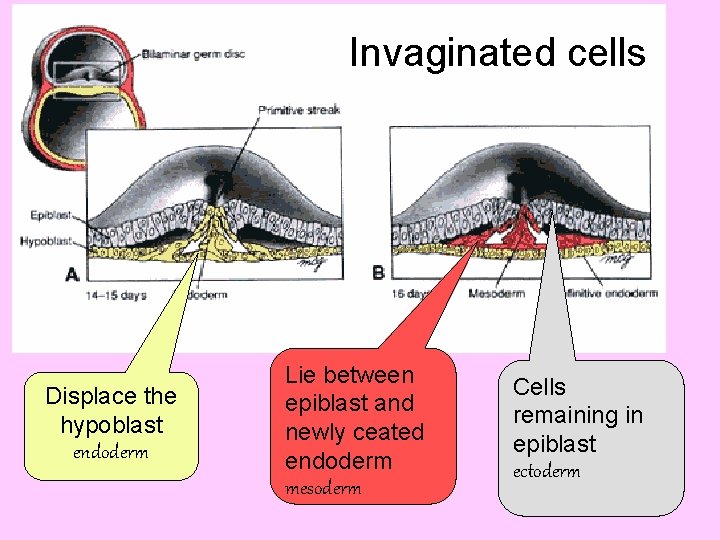
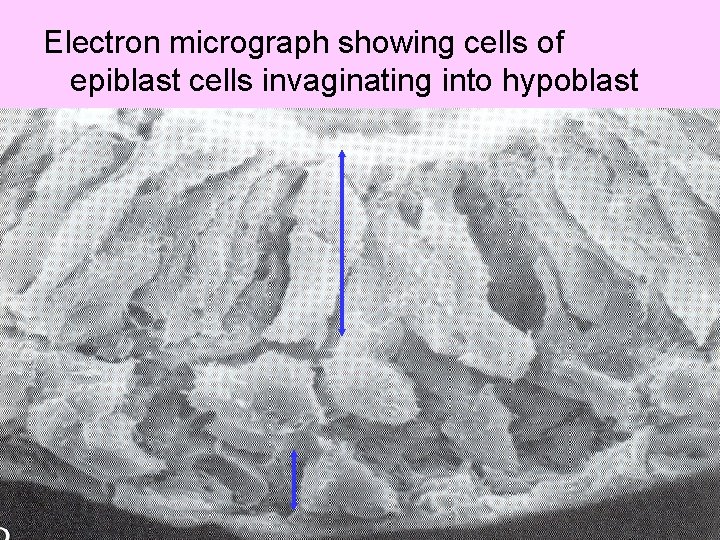
On arrival to primitive streak , cells of epiblast become flask- shaped →Detach from epiblast →Slip beneath →invagination Gastrulation
Invaginated cells Displace the hypoblast endoderm Lie between epiblast and newly ceated endoderm mesoderm Cells remaining in epiblast ectoderm
Electron micrograph showing cells of epiblast cells invaginating into hypoblast
Gastrulation
Gastrulation
Gastrulation Movement of cells beyond limit: laterally cephalad
• Invagination of surface cells in primitive streak • Migration forward & laterally continues till end of 4 th week • Primitive streak regress ►disappears • Cranial ► differentiation • Caudal ► gastrulation
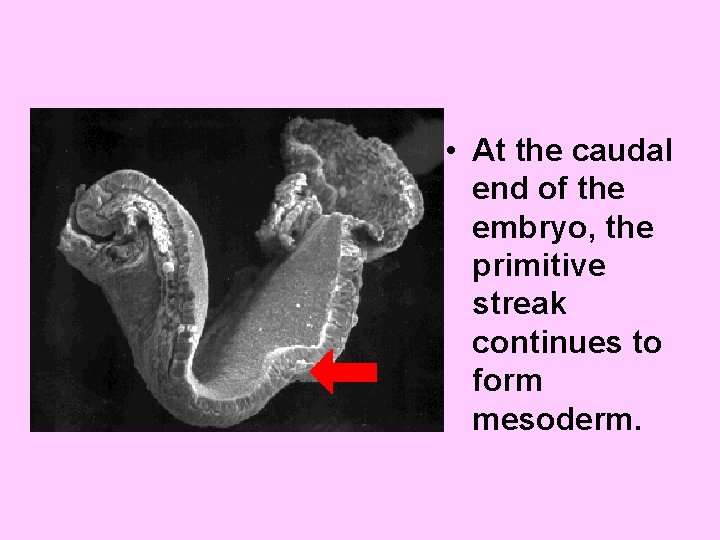
• At the caudal end of the embryo, the primitive streak continues to form mesoderm.
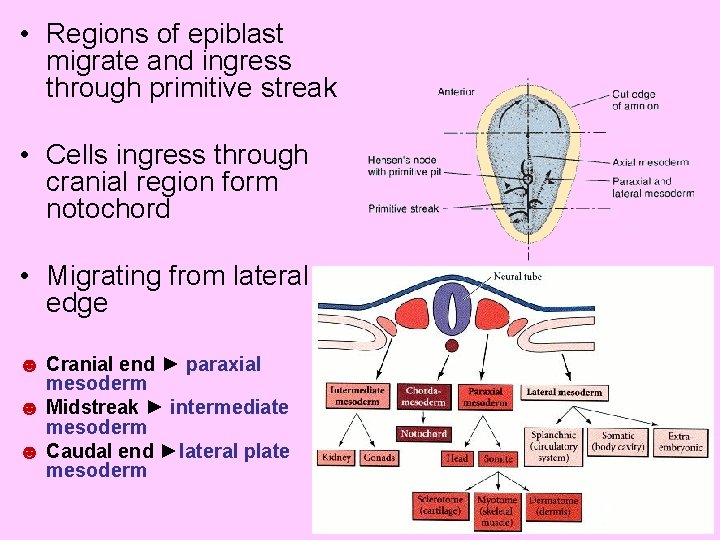
• Regions of epiblast migrate and ingress through primitive streak • Cells ingress through cranial region form notochord • Migrating from lateral edge ☻ Cranial end ► paraxial mesoderm ☻ Midstreak ► intermediate mesoderm ☻ Caudal end ►lateral plate mesoderm
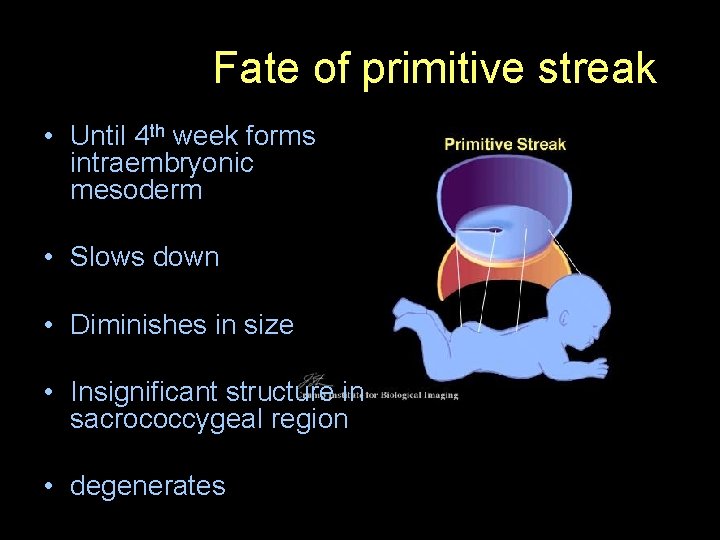
Fate of primitive streak • Until 4 th week forms intraembryonic mesoderm • Slows down • Diminishes in size • Insignificant structure in sacrococcygeal region • degenerates
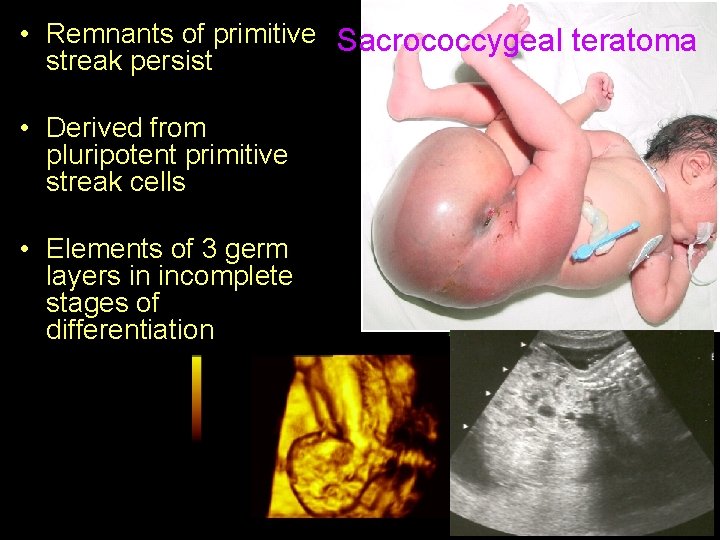
• Remnants of primitive Sacrococcygeal teratoma streak persist • Derived from pluripotent primitive streak cells • Elements of 3 germ layers in incomplete stages of differentiation
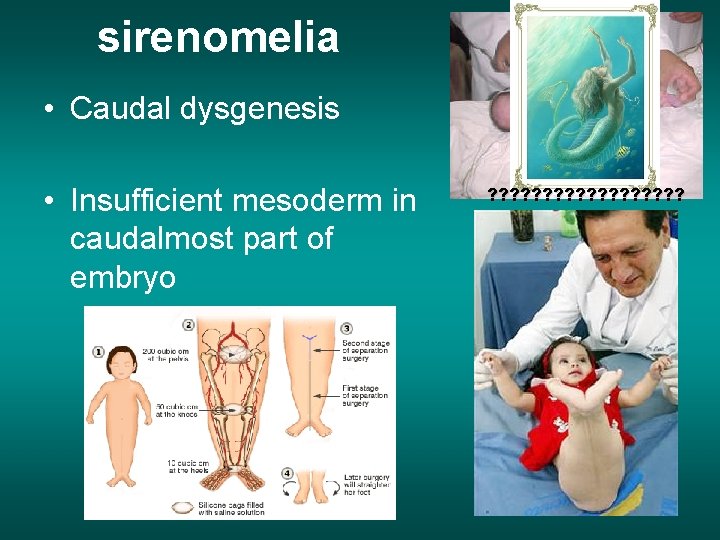
sirenomelia • Caudal dysgenesis • Insufficient mesoderm in caudalmost part of embryo ? ? ? ? ?
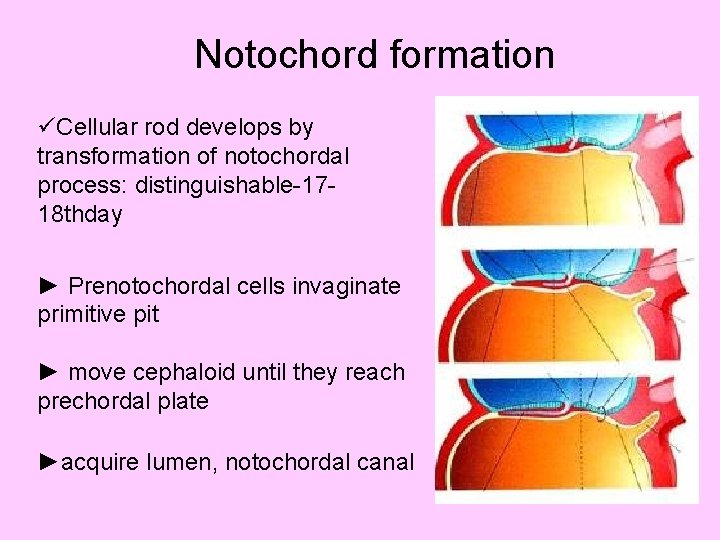
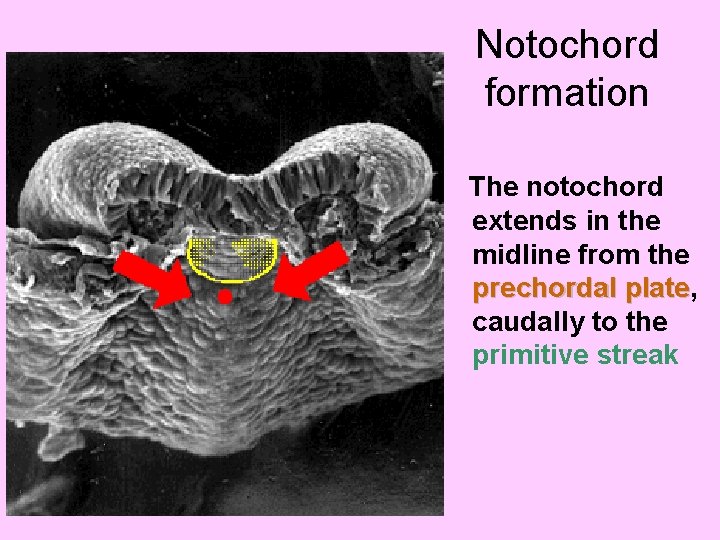
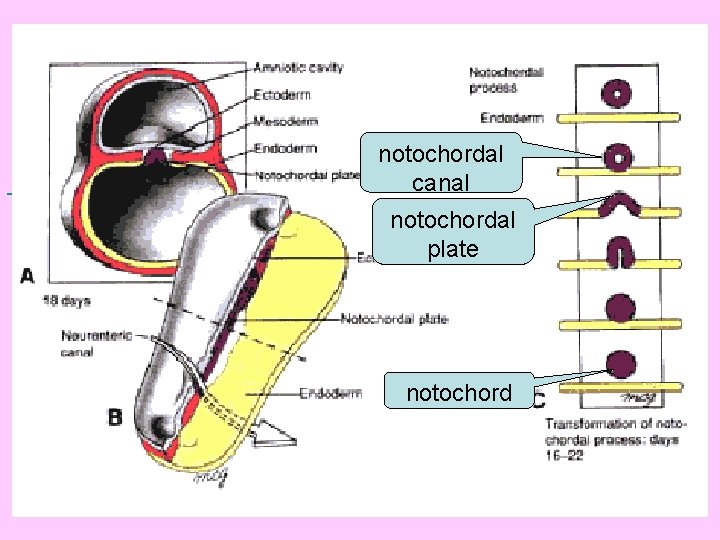
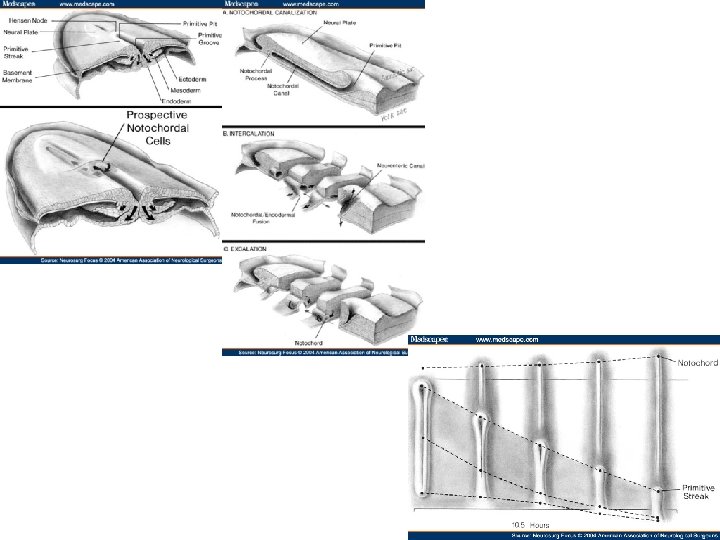
Notochord formation üCellular rod develops by transformation of notochordal process: distinguishable-1718 thday ► Prenotochordal cells invaginate primitive pit ► move cephaloid until they reach prechordal plate ►acquire lumen, notochordal canal
Notochord formation The notochord extends in the midline from the prechordal plate, plate caudally to the primitive streak
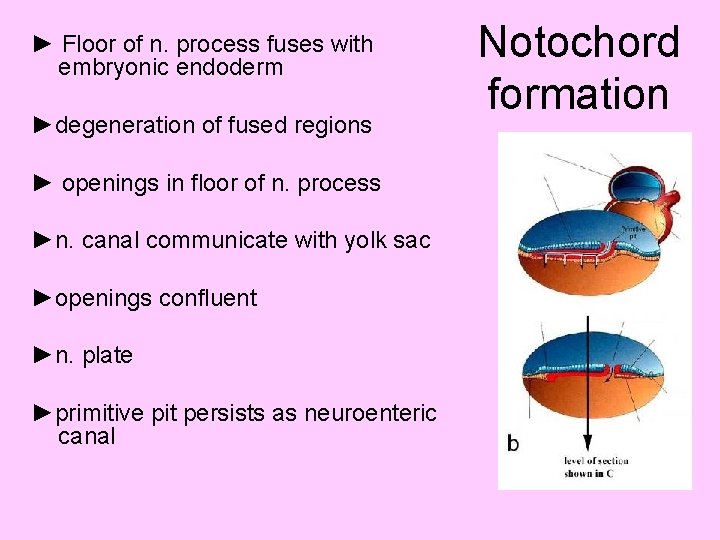
► Floor of n. process fuses with embryonic endoderm ►degeneration of fused regions ► openings in floor of n. process ►n. canal communicate with yolk sac ►openings confluent ►n. plate ►primitive pit persists as neuroenteric canal Notochord formation
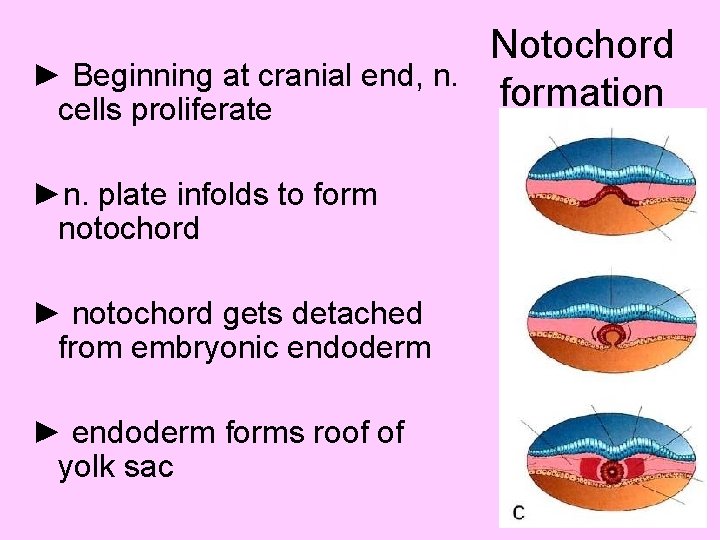
► Beginning at cranial end, n. cells proliferate ►n. plate infolds to form notochord ► notochord gets detached from embryonic endoderm ► endoderm forms roof of yolk sac Notochord formation
notochordal canal notochordal plate notochord
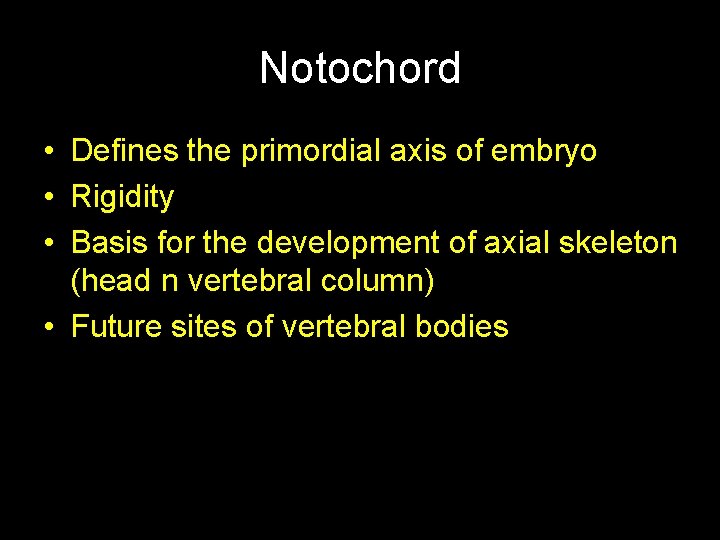
Notochord • Defines the primordial axis of embryo • Rigidity • Basis for the development of axial skeleton (head n vertebral column) • Future sites of vertebral bodies
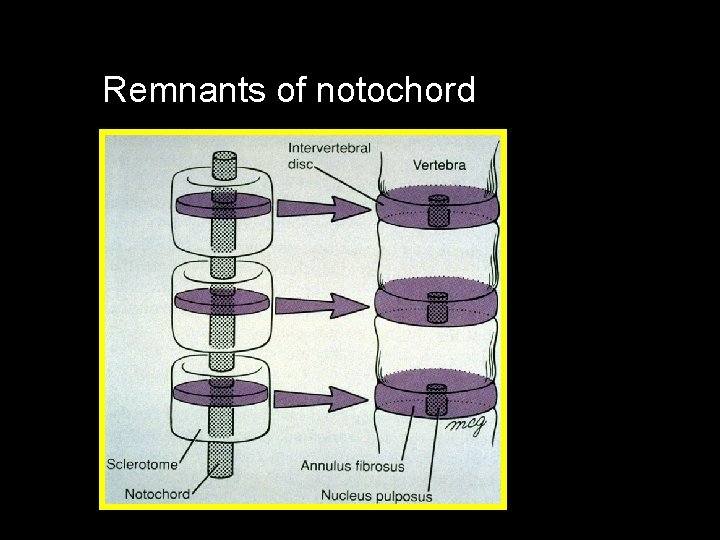
Remnants of notochord
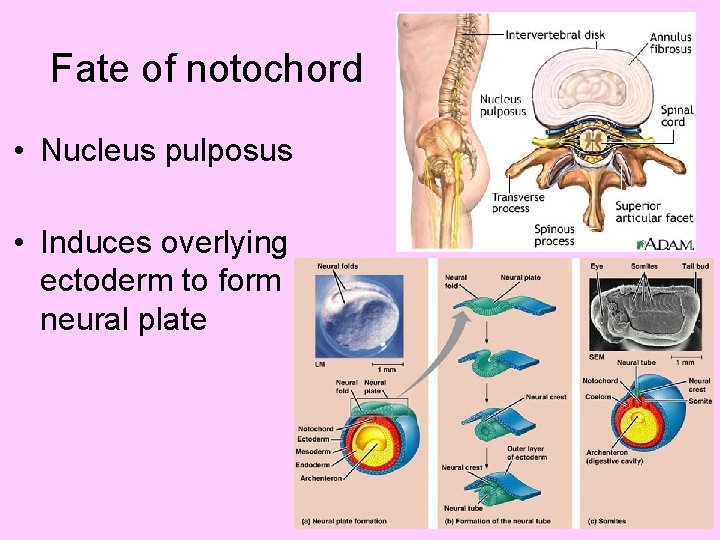
Fate of notochord • Nucleus pulposus • Induces overlying ectoderm to form neural plate
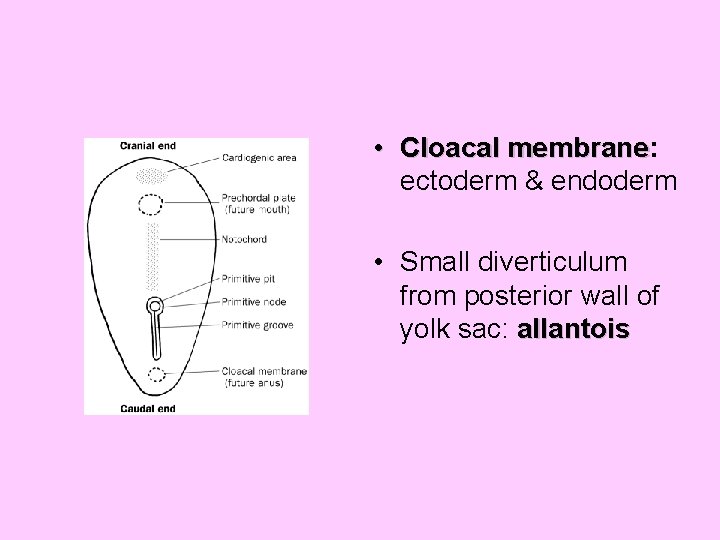
• Cloacal membrane: membrane ectoderm & endoderm • Small diverticulum from posterior wall of yolk sac: allantois
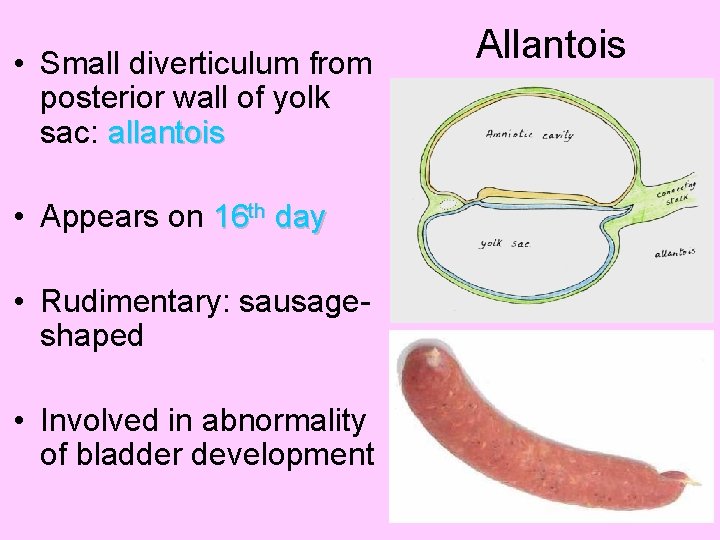
• Small diverticulum from posterior wall of yolk sac: allantois • Appears on 16 th day • Rudimentary: sausage- shaped • Involved in abnormality of bladder development Allantois
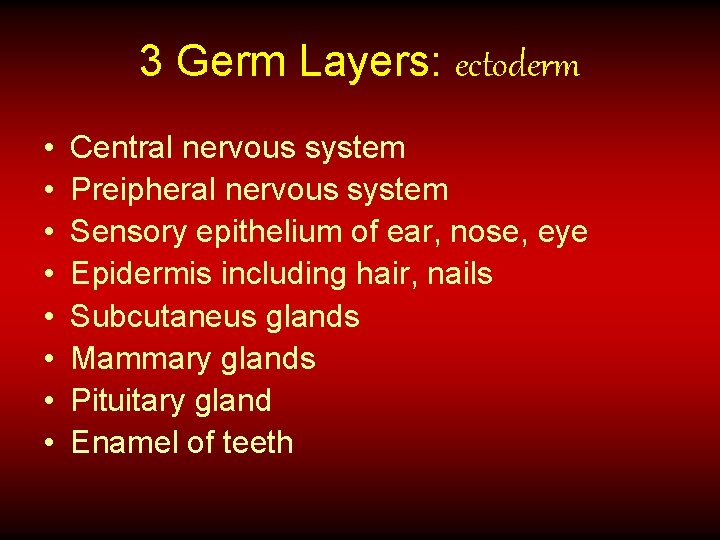
3 Germ Layers: ectoderm • • Central nervous system Preipheral nervous system Sensory epithelium of ear, nose, eye Epidermis including hair, nails Subcutaneus glands Mammary glands Pituitary gland Enamel of teeth
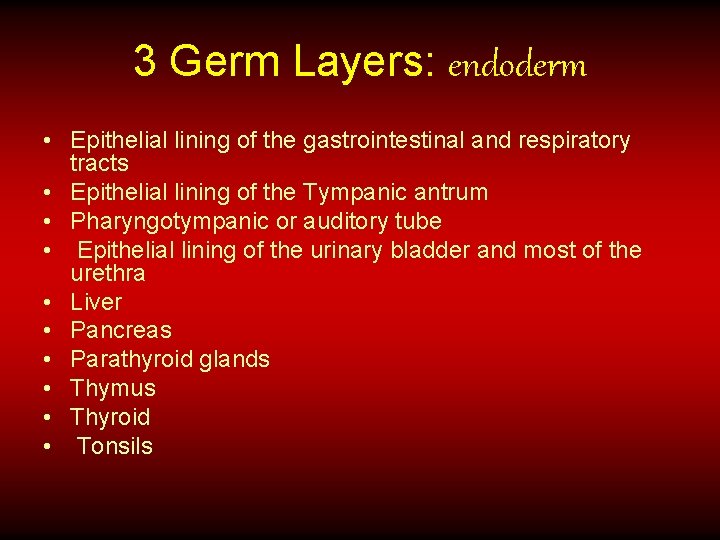
3 Germ Layers: endoderm • Epithelial lining of the gastrointestinal and respiratory tracts • Epithelial lining of the Tympanic antrum • Pharyngotympanic or auditory tube • Epithelial lining of the urinary bladder and most of the urethra • Liver • Pancreas • Parathyroid glands • Thymus • Thyroid • Tonsils
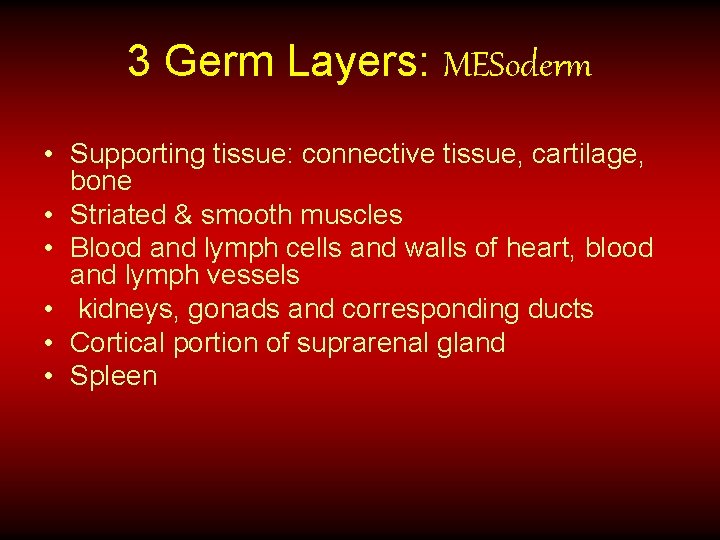
3 Germ Layers: MESoderm • Supporting tissue: connective tissue, cartilage, bone • Striated & smooth muscles • Blood and lymph cells and walls of heart, blood and lymph vessels • kidneys, gonads and corresponding ducts • Cortical portion of suprarenal gland • Spleen
Day 8 1 2 5 4 3
6 8 Day 9 7
Day 11 and 12 9 10
Day 13 11 red arrow 12 blue arrow
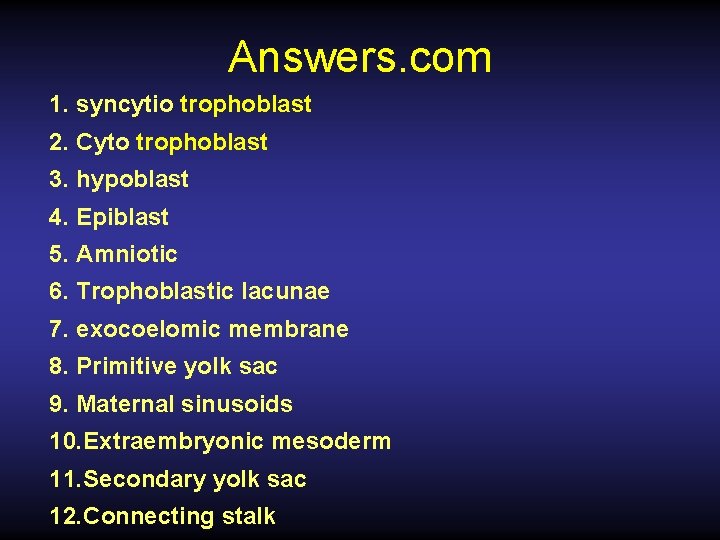
Answers. com 1. syncytio trophoblast 2. Cyto trophoblast 3. hypoblast 4. Epiblast 5. Amniotic 6. Trophoblastic lacunae 7. exocoelomic membrane 8. Primitive yolk sac 9. Maternal sinusoids 10. Extraembryonic mesoderm 11. Secondary yolk sac 12. Connecting stalk
Day 8
Day 9
Day 11 and 12