
2 Cardiovascular Disease Thrombosis and Infarction Phase 2

2
Cardiovascular Disease, Thrombosis and Infarction Phase 2 a Revision Session Sophia and Sally 08/03/16 The Peer Teaching Society is not liable for false or misleading information…
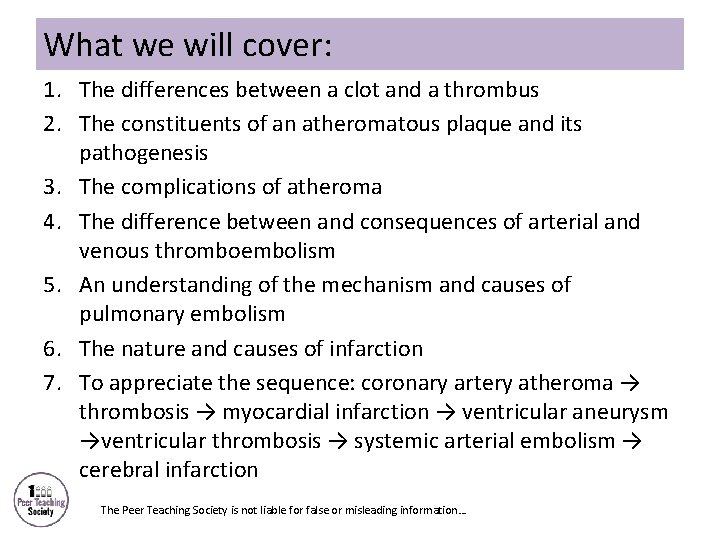
What we will cover: 1. The differences between a clot and a thrombus 2. The constituents of an atheromatous plaque and its pathogenesis 3. The complications of atheroma 4. The difference between and consequences of arterial and venous thromboembolism 5. An understanding of the mechanism and causes of pulmonary embolism 6. The nature and causes of infarction 7. To appreciate the sequence: coronary artery atheroma → thrombosis → myocardial infarction → ventricular aneurysm →ventricular thrombosis → systemic arterial embolism → cerebral infarction The Peer Teaching Society is not liable for false or misleading information…
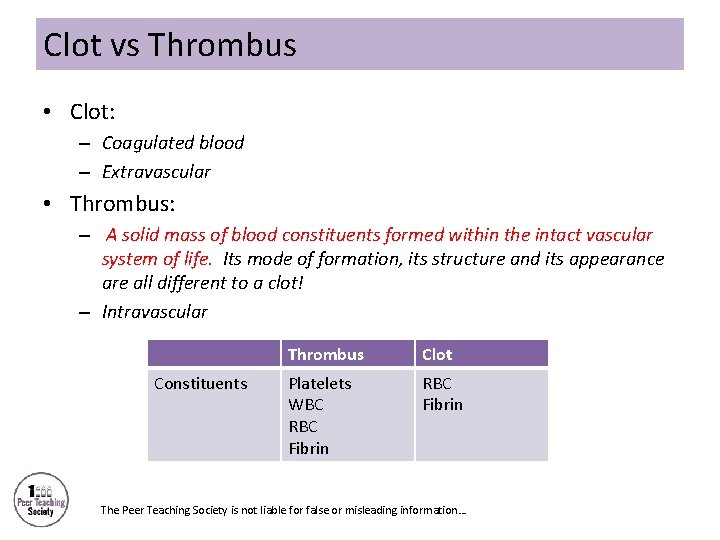
Clot vs Thrombus • Clot: – Coagulated blood – Extravascular • Thrombus: – A solid mass of blood constituents formed within the intact vascular system of life. Its mode of formation, its structure and its appearance are all different to a clot! – Intravascular Constituents Thrombus Clot Platelets WBC RBC Fibrin The Peer Teaching Society is not liable for false or misleading information…

Virchow’s triad- Thrombus formation The Peer Teaching Society is not liable for false or misleading information…
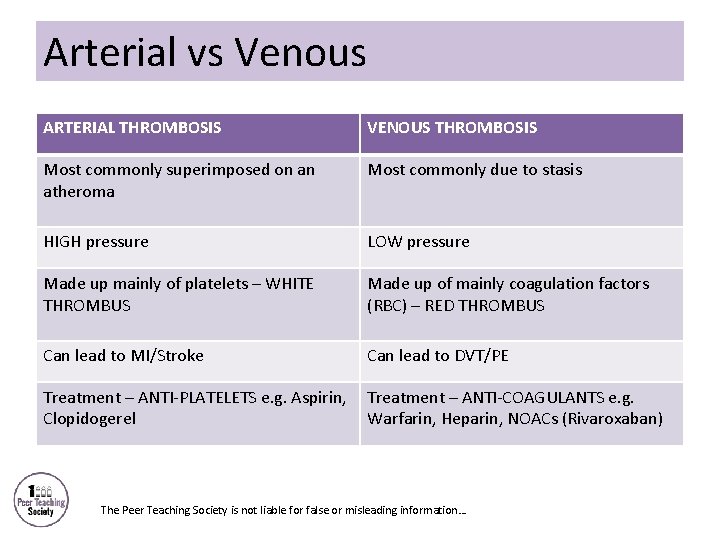
Arterial vs Venous ARTERIAL THROMBOSIS VENOUS THROMBOSIS Most commonly superimposed on an atheroma Most commonly due to stasis HIGH pressure LOW pressure Made up mainly of platelets – WHITE THROMBUS Made up of mainly coagulation factors (RBC) – RED THROMBUS Can lead to MI/Stroke Can lead to DVT/PE Treatment – ANTI-PLATELETS e. g. Aspirin, Clopidogerel Treatment – ANTI-COAGULANTS e. g. Warfarin, Heparin, NOACs (Rivaroxaban) The Peer Teaching Society is not liable for false or misleading information…
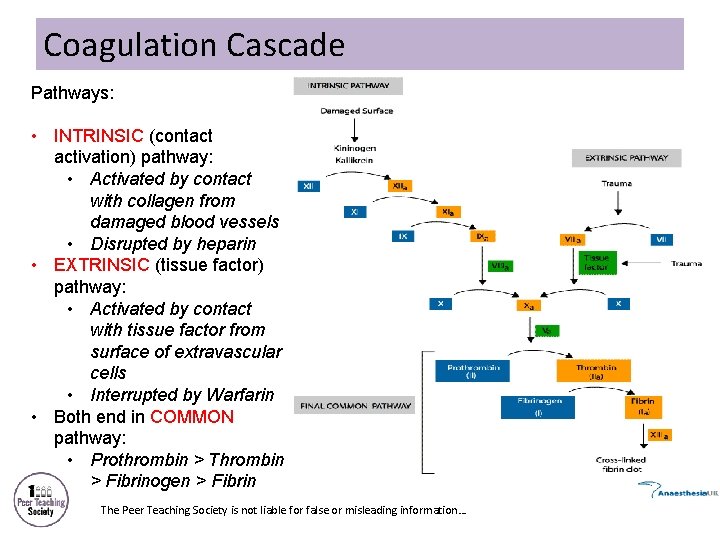
Coagulation Cascade Pathways: • INTRINSIC (contact activation) pathway: • Activated by contact with collagen from damaged blood vessels • Disrupted by heparin • EXTRINSIC (tissue factor) pathway: • Activated by contact with tissue factor from surface of extravascular cells • Interrupted by Warfarin • Both end in COMMON pathway: • Prothrombin > Thrombin > Fibrinogen > Fibrin The Peer Teaching Society is not liable for false or misleading information…
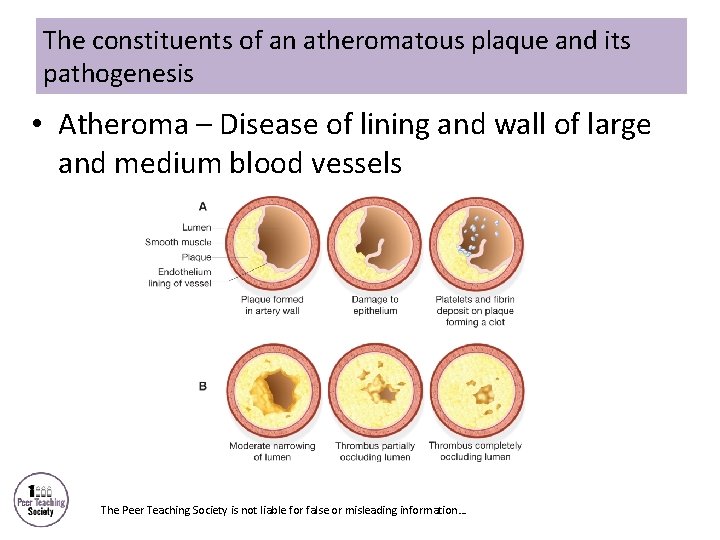
The constituents of an atheromatous plaque and its pathogenesis • Atheroma – Disease of lining and wall of large and medium blood vessels The Peer Teaching Society is not liable for false or misleading information…
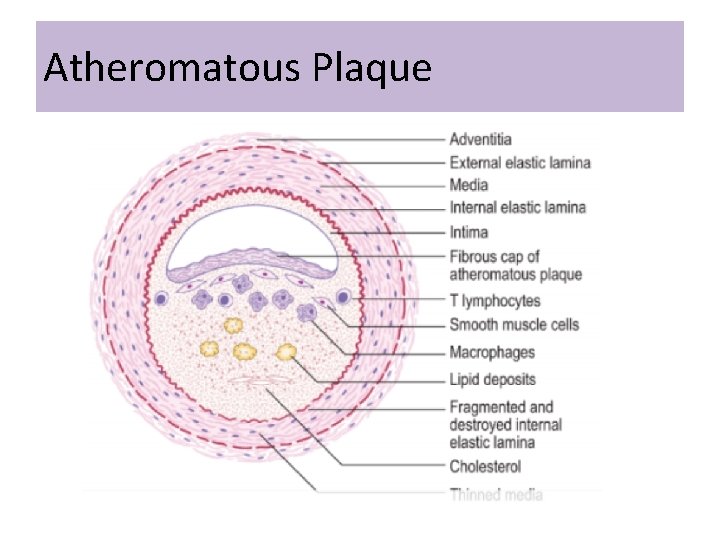
Atheromatous Plaque
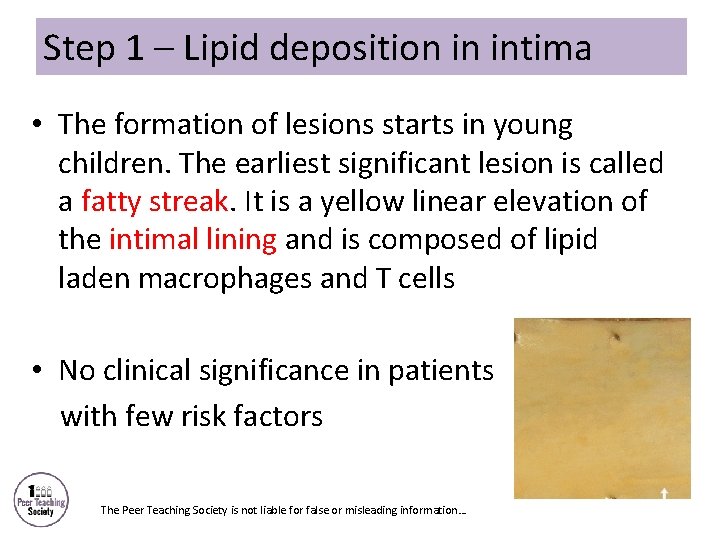
Step 1 – Lipid deposition in intima • The formation of lesions starts in young children. The earliest significant lesion is called a fatty streak. It is a yellow linear elevation of the intimal lining and is composed of lipid laden macrophages and T cells • No clinical significance in patients with few risk factors The Peer Teaching Society is not liable for false or misleading information…
Step 2 – Injury to the endothelium • Over time, the plaque enlarges and protrudes into the lumen • This causes turbulence in the blood flow • This eventually causes loss of intimal cells • Injured cells express adhesion molecules The Peer Teaching Society is not liable for false or misleading information…
Step 3 – Inflammatory reaction • Injured cells express adhesion molecules for monocytes (ICAM-1, E-selectin) • Creates high permeability for LDLs • Inflammatory cells and lipids therefore enter the intimal layer and form plaques • Macrophages and T-lymphocytes accumulate in the plaque tissue The Peer Teaching Society is not liable for false or misleading information…
Step 3 – Inflammatory reaction cont. • Lipid-laden macrophages (foam cells) die through apoptosis and spill their lipid contents into the core of the plaque forming the lipid core • Activated T cells secrete TNF-alpha and IFNgamma, enhancing response • IL-6 contributes to inflammation and activation of adhesion molecules The Peer Teaching Society is not liable for false or misleading information…
Step 4 – Tissue repair • Fibroblast growth factor and platelet-derived growth factor are secreted by endothelium • These attract smooth muscle cells from media and stimulate cellular migration and proliferation • Smooth muscle cells proliferate in plaque, migrate into sub-endothelial space, producing a new intima and extracellular matrix components (collagen) • Leads to formation of fibrous plaque cap The Peer Teaching Society is not liable for false or misleading information…
The Fibrous Plaque • Contains collagen, elastin, smooth muscle cells, macrophages and T cells • Impedes blood flow and is prone to rupture • Rupture – increased enzyme activity digests plaque, it becomes weak and bits break off. This forms a thrombus which can occlude blood vessels The Peer Teaching Society is not liable for false or misleading information…
Risk factors for atherosclerosis Modifiable Hypertension Hyperlipidaemia Diabetes Smoking Obesity/ sedentary lifestyle Non-modifiable Age Family history Gender- male Low socioeconomic status Low birth weight The Peer Teaching Society is not liable for false or misleading information…
Complications of atheroma • Progressive lumen narrowing due to high-grade plaque stenosis can reduce blood flow and lead to ischaemia - can be reversible or irreversible • Acute atherothombotic occlusion - plaque rupture leads to coagulation cascade and thrombotic occlusion of vessel lumen in a short time period • Embolisation of distal arterial bed – small plaque fragments may occlude small vessels leading to infarctions The Peer Teaching Society is not liable for false or misleading information…
Complications of atheroma cont. • Carotid atheroma – TIA, cerebral infarcts • Myocardial atheroma – MI, cardiac failure • Aortic aneurysm – rupture causes sudden death • Peripheral vascular disease – disease with intermittent claudication • Gangrene The Peer Teaching Society is not liable for false or misleading information…
Treatment for atherosclerosis • PCI – stent • Modify risk factors – stop smoking, control BP, lose weight, exercise, eat healthily, statins, low-dose aspirin The Peer Teaching Society is not liable for false or misleading information…
coronary artery atheroma → thrombosis → myocardial infarction → ventricular aneurysm →ventricular thrombosis → systemic arterial embolism → cerebral infarction The Peer Teaching Society is not liable for false or misleading information…
Thromboembolism • Embolus – a mass of material in the vascular system able to become lodged within a vessel and block its lumen • Over 90% of major emboli are derived from thrombi • Other materials include: atheromatous plaque material, vegetations on heart valves (IE), fragments of tumour, amniotic fluid, gas and fat/ The Peer Teaching Society is not liable for false or misleading information…
DVT • Normal vessels in deep veins of the leg • Thrombi form due to stasis and hypercoagulability from fibrin and platelets • Thrombi are liable to embolise – can lead to PE • RISK FACTORS – Age, BMI >30, varicose veins, travel, immobility, trauma/surgery, cardiac or respiratory failure, recent MI/Stroke, OC/HRT The Peer Teaching Society is not liable for false or misleading information…
DVT cont. • SIGNS AND SYMPTOMS: – – Swollen, red, painful leg – unilateral Ankle oedema Engorged superficial veins Hormon’s sign – pain in calf on dorsiflexion of foot • INVESTIGATIONS: – USS – Venography – injecting contrast The Peer Teaching Society is not liable for false or misleading information…
DVT cont. • TREATMENT: – Low-dose heparin – Vitamin K antagonists – Prevent PE • PREVENTION: – – Frequent walking Calf exercises Anti-coagulants - Warfarin, NOACs Compression stockings The Peer Teaching Society is not liable for false or misleading information…
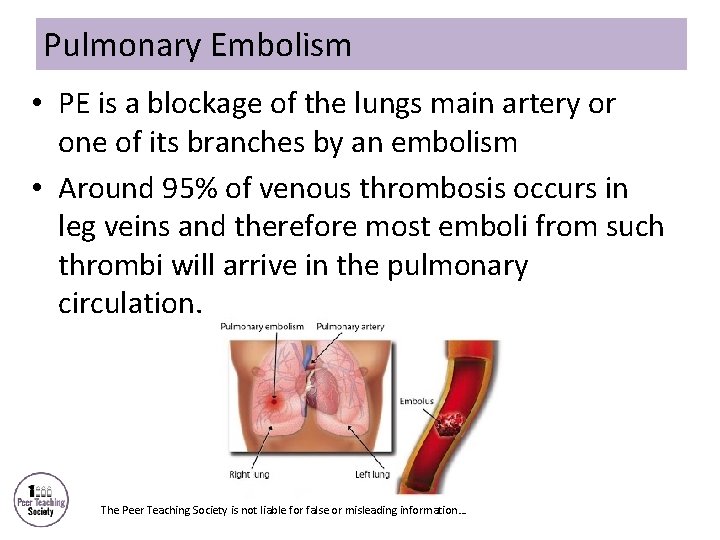
Pulmonary Embolism • PE is a blockage of the lungs main artery or one of its branches by an embolism • Around 95% of venous thrombosis occurs in leg veins and therefore most emboli from such thrombi will arrive in the pulmonary circulation. The Peer Teaching Society is not liable for false or misleading information…
• Pulmonary Embolism – Presentation The effects of a PE depends on their size: • Small emboli – may occur unnoticed. Many small emboli can result in pulmonary hypertension • Larger emboli: – Chest/pleuritc pain – Dyspnoea, dizzy, syncope – Shocked/collapse – Leg pain (DVT) • Massive – sudden death – usually long thrombi arrived from leg veins. They are often impacted across the bifurcation of one of the main pulmonary arteries – saddle embolus. The Peer Teaching Society is not liable for false or misleading information…
• Pulmonary Embolism – Investigations • • • D-dimer Arterial blood gas Doppler (DVT) CTPA, V/Q scan Well’s score ECG, cardiac proteins The Peer Teaching Society is not liable for false or misleading information…
Pulmonary Embolism – Treatment • • ABCDE LMW Heparin Warfarin (at least 3 months) Thrombolysis if massive The Peer Teaching Society is not liable for false or misleading information…
Ischaemia and infarction • ISCHAEMIA - Mismatch of oxygen supply and demand due to impaired blood supply or greater demand than blood supply • 6 P’s of acute ischaemia: • PAIN • PALLOR • PERISHING COLD • PULSELESS • PARATHESIA (pins and needles) • PARALYSIS • INFARCTION - Ischaemic death of tissue within the living body – irreversible The Peer Teaching Society is not liable for false or misleading information…
QUIZ!!!! 1. Define thrombus The Peer Teaching Society is not liable for false or misleading information…
QUIZ!!!! A solid mass of coagulated blood formed within the circulatory system The Peer Teaching Society is not liable for false or misleading information…
QUIZ!!!! 2. Give the 3 components of Virchow’s triad The Peer Teaching Society is not liable for false or misleading information…
QUIZ!!!! • Hypercoagulability • Stasis • Endothelial injury The Peer Teaching Society is not liable for false or misleading information…
QUIZ!!!! 3. What coagulation pathway does Warfarin interrupt? The Peer Teaching Society is not liable for false or misleading information…
QUIZ!!!! Extrinsic The Peer Teaching Society is not liable for false or misleading information…
QUIZ!!!! 4. What is another name for a lipid-laden macrophage? The Peer Teaching Society is not liable for false or misleading information…
QUIZ!!!! Foam cell The Peer Teaching Society is not liable for false or misleading information…
QUIZ!!!! 5. Give 4 features of a fibrolipid plaque The Peer Teaching Society is not liable for false or misleading information…
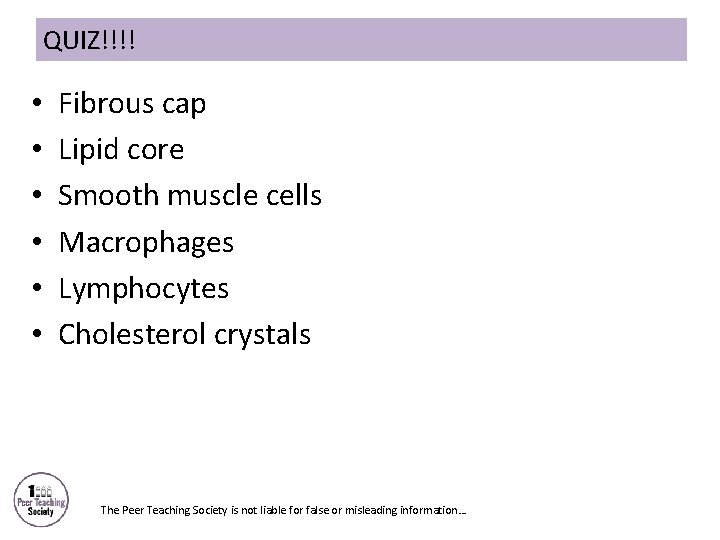
QUIZ!!!! • • • Fibrous cap Lipid core Smooth muscle cells Macrophages Lymphocytes Cholesterol crystals The Peer Teaching Society is not liable for false or misleading information…
QUIZ!!!! 6. Give 3 risk factors for DVT The Peer Teaching Society is not liable for false or misleading information…
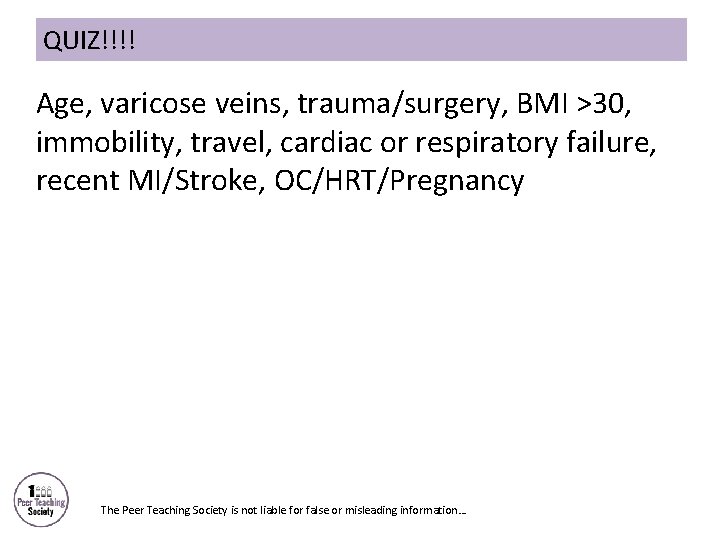
QUIZ!!!! Age, varicose veins, trauma/surgery, BMI >30, immobility, travel, cardiac or respiratory failure, recent MI/Stroke, OC/HRT/Pregnancy The Peer Teaching Society is not liable for false or misleading information…
QUIZ!!!! 7. Name the 6 P’s of acute ischaemia The Peer Teaching Society is not liable for false or misleading information…
QUIZ!!!! • • • PAIN PALLOR PERISHING COLD PULSELESS PARATHESIA (pins and needles) PARALYSIS The Peer Teaching Society is not liable for false or misleading information…
- Slides: 44