
2 c Know how random chromosome segregation explains

- Slides: 27
2 c. Know how random chromosome segregation explains the probability that a particular allele will be in a gamete.
11 -1 The Work of Gregor Mendel
Gregor Mendel’s Peas • Gregor Mendel’s Peas – ______ is the scientific study of heredity. • ________was an Austrian monk. His work was important to the understanding of heredity. • Mendel carried out his work with ordinary garden peas.
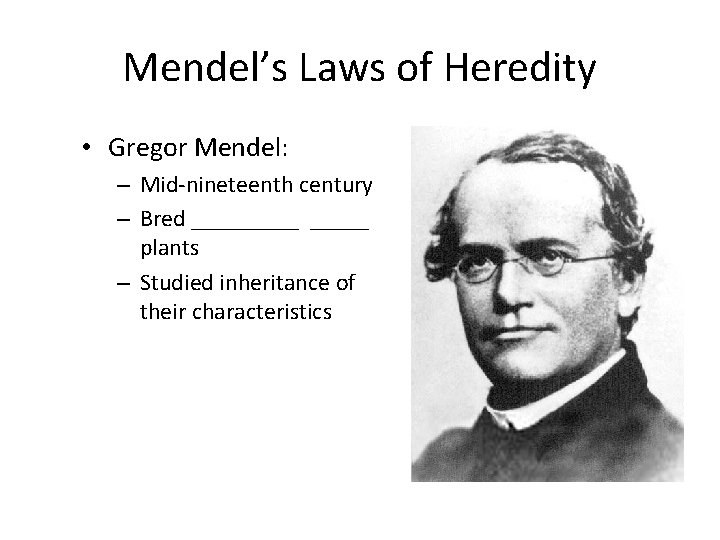
Mendel’s Laws of Heredity • Gregor Mendel: – Mid-nineteenth century – Bred _____ plants – Studied inheritance of their characteristics
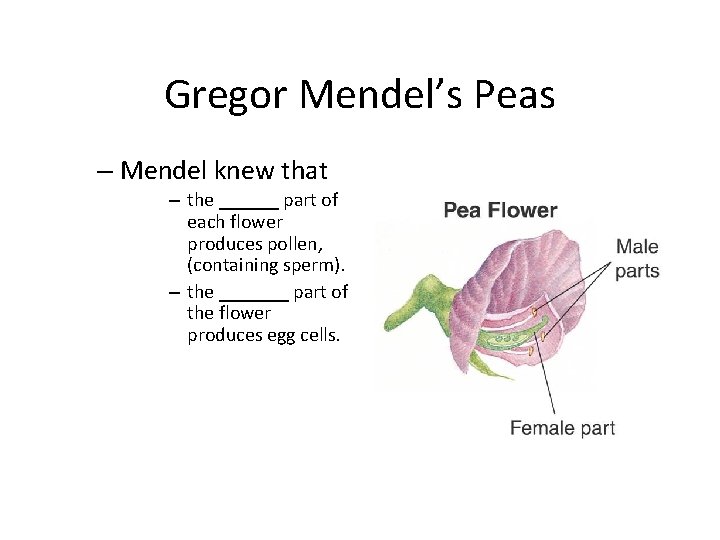
Gregor Mendel’s Peas – Mendel knew that – the ______ part of each flower produces pollen, (containing sperm). – the _______ part of the flower produces egg cells.
Gregor Mendel’s Peas • During _______ reproduction, sperm and egg cells join in a process called fertilization. • ________ produces a new cell.
Gregor Mendel’s Peas • Pea flowers are _______-pollinating. • Sperm cells in ______ fertilize the egg cells in the same flower. • The seeds that are produced by selfpollination inherit all of their characteristics from the single plant that bore them.
Gregor Mendel’s Peas • Mendel had _________ pea plants that, if allowed to self-pollinate, would produce offspring identical to themselves. • Mendel wanted to produce seeds by joining male and female reproductive cells from two different plants. • He cut away the pollen-bearing male parts of the plant and dusted the plant’s flower with pollen from another plant.
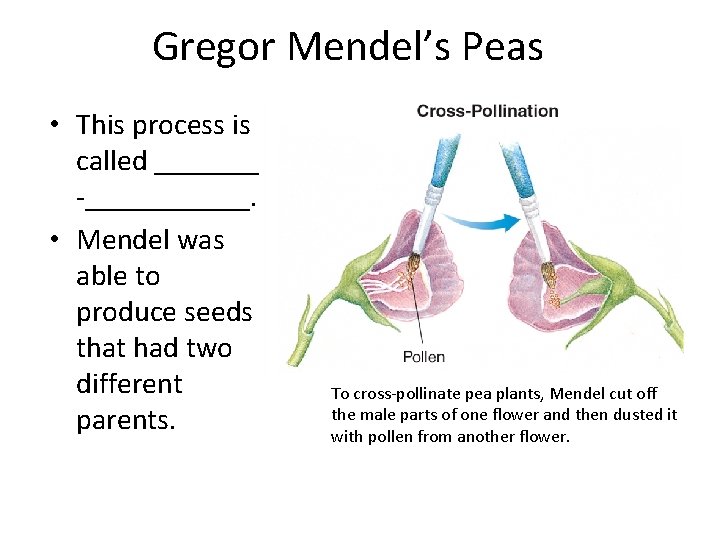
Gregor Mendel’s Peas • This process is called _______ -______. • Mendel was able to produce seeds that had two different parents. To cross-pollinate pea plants, Mendel cut off the male parts of one flower and then dusted it with pollen from another flower.
Genes and Dominance • Genes and Dominance – A ______ is a specific characteristic that varies from one individual to another.
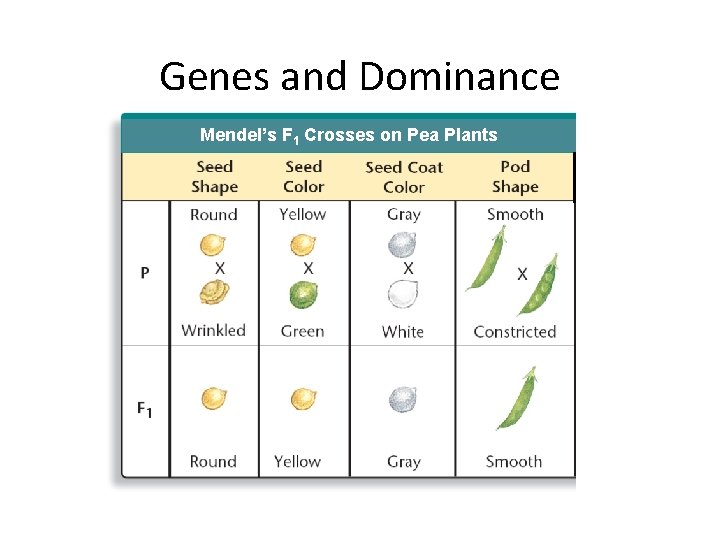
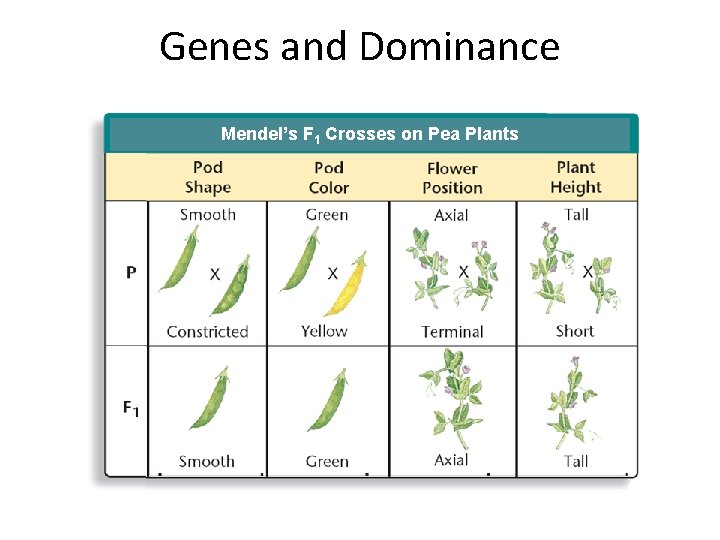
Genes and Dominance • Mendel studied ______ pea plant traits, each with two contrasting characters. • He crossed plants with each of the seven contrasting characters and studied their offspring.
Genes and Dominance • Each original pair of plants is the P (______) generation. • The offspring are called the ____, or “first filial, ” generation. • The offspring of crosses between parents with different traits are called _____. • The F 1 hybrid plants all had the character of only one of the parents.
Genes and Dominance Mendel’s F 1 Crosses on Pea Plants
Genes and Dominance Mendel’s Seven F 1 Crosses on Pea Plants Mendel’s F 1 Crosses on Pea Plants
Genes and Dominance • Mendel's first conclusion was that biological inheritance is determined by factors that are passed from one generation to the next. • Today, scientists call the factors that determine traits ______.
Genes and Dominance • Each of the traits Mendel studied was controlled by one gene that occurred in two contrasting forms that produced different characters for each trait. • The different forms of a gene are called _______. • Mendel’s second conclusion is called the principle of dominance.
Genes and Dominance – What is the principle of dominance? • The principle of ________ states that some alleles are dominant and others are recessive.
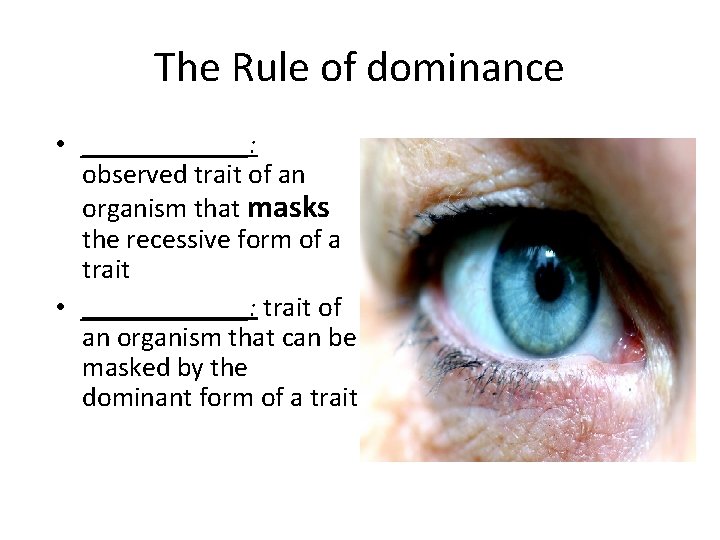
The Rule of dominance • ______: observed trait of an organism that masks the recessive form of a trait • ______: trait of an organism that can be masked by the dominant form of a trait
Genes and Dominance • An organism with a _______ allele for a trait will always exhibit that form of the trait. • An organism with the ______ allele for a trait will exhibit that form only when the dominant allele for that trait is not present.
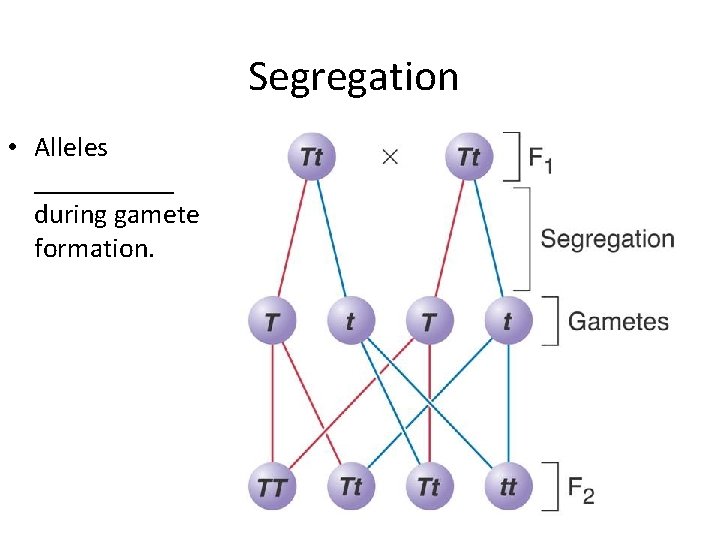
Segregation – What happens during segregation? • Segregation – Mendel crossed the ____ generation with itself to produce the ____ (second filial) generation. – The traits controlled by recessive alleles reappeared in one fourth of the ____ plants.
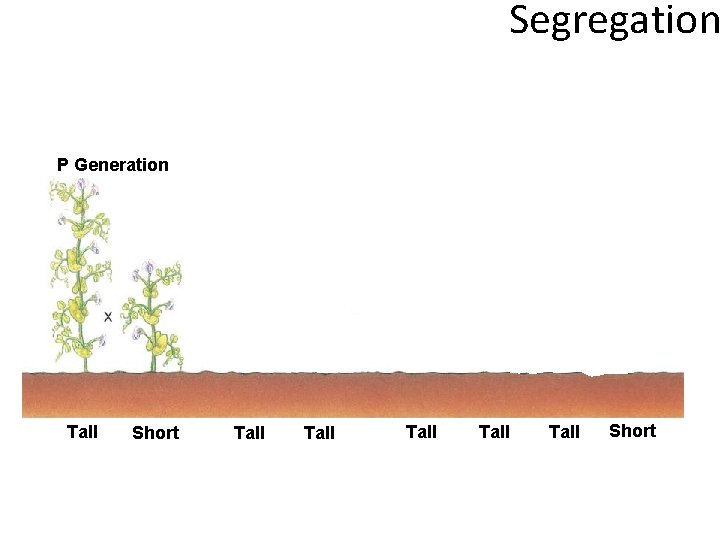
Segregation P Generation F 2 Generation F 1 Generation • Mendel's F 2 Generation Tall Short Tall Tall Short
Segregation • Mendel assumed that a dominant allele had masked the corresponding recessive allele in the ____ generation. • The trait controlled by the recessive allele showed up in some of the ___ plants.
Segregation • The reappearance of the trait controlled by the recessive allele indicated that at some point the allele for shortness had been separated, or _______, from the allele for tallness.
Segregation • Mendel suggested that the alleles for tallness and shortness in the F 1 plants segregated from each other during the formation of the sex cells, or ______.
Segregation – When each ____ plant flowers and produces gametes, the two alleles segregate from each other so that each gamete carries only a single copy of each gene. – Therefore, each ____ plant produces two types of gametes—those with the allele for tallness, and those with the allele for shortness.
Segregation • Alleles _____ during gamete formation.
Think of new allelic combinations as a shuffled deck of cards!