
2 Boolean Algebra cont The digital abstraction Graphs
מבוא למחשבים ספרתיים + מבנה המחשב 2# תרגול Boolean Algebra cont’ The digital abstraction Graphs and Topological Sort
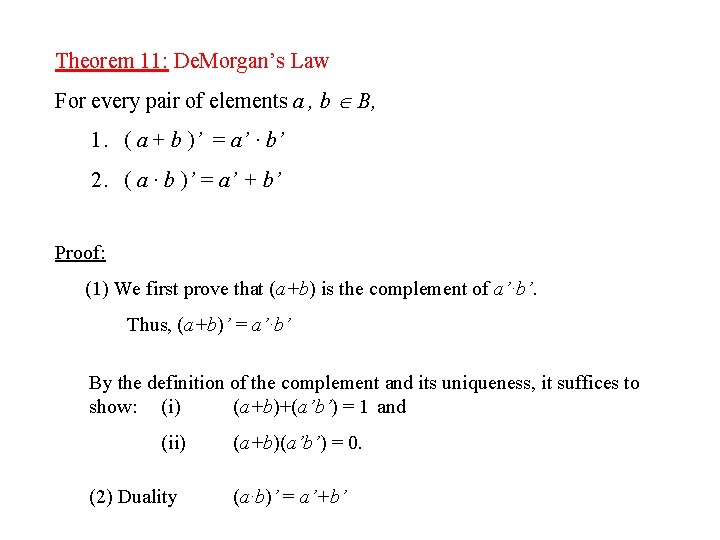
Theorem 11: De. Morgan’s Law For every pair of elements a , b B, 1. ( a + b )’ = a’ · b’ 2. ( a · b )’ = a’ + b’ Proof: (1) We first prove that (a+b) is the complement of a’·b’. Thus, (a+b)’ = a’·b’ By the definition of the complement and its uniqueness, it suffices to show: (i) (a+b)+(a’b’) = 1 and (ii) (2) Duality (a+b)(a’b’) = 0. (a·b)’ = a’+b’

Distributivity Commutativity Associativity a’ and b’ are the complements of a and b respectively Theorem: For any a B, a+1=1 Idempotent Law

Commutativity Distributivity Commutativity Associativity Commutativity a’ and b’ are the complements of a and b respectively Theorem: For any a B, a· 0=0 Idempotent Law
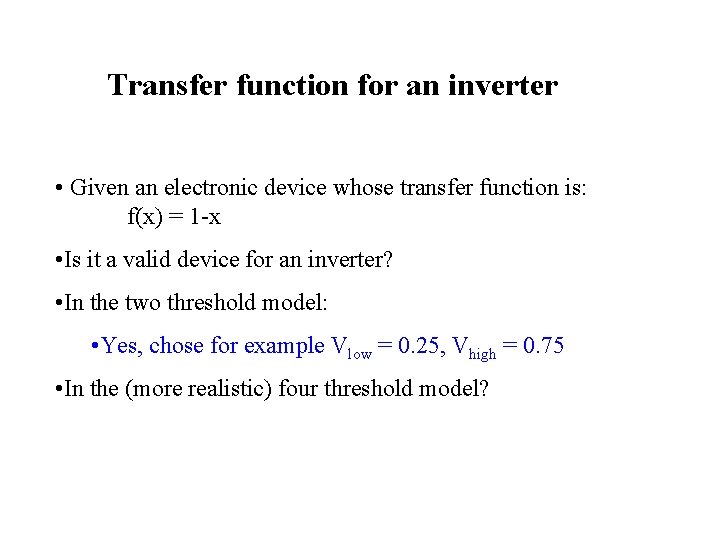
Transfer function for an inverter • Given an electronic device whose transfer function is: f(x) = 1 -x • Is it a valid device for an inverter? • In the two threshold model: • Yes, chose for example Vlow = 0. 25, Vhigh = 0. 75 • In the (more realistic) four threshold model?
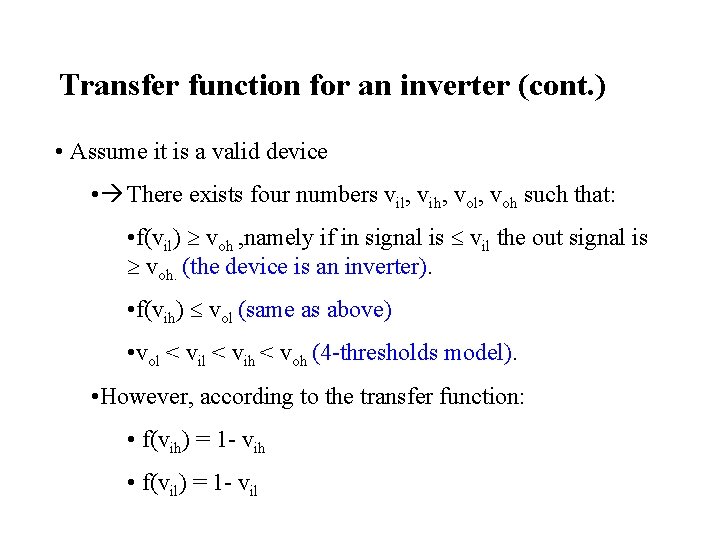
Transfer function for an inverter (cont. ) • Assume it is a valid device • There exists four numbers vil, vih, vol, voh such that: • f(vil) voh , namely if in signal is vil the out signal is voh. (the device is an inverter). • f(vih) vol (same as above) • vol < vih < voh (4 -thresholds model). • However, according to the transfer function: • f(vih) = 1 - vih • f(vil) = 1 - vil
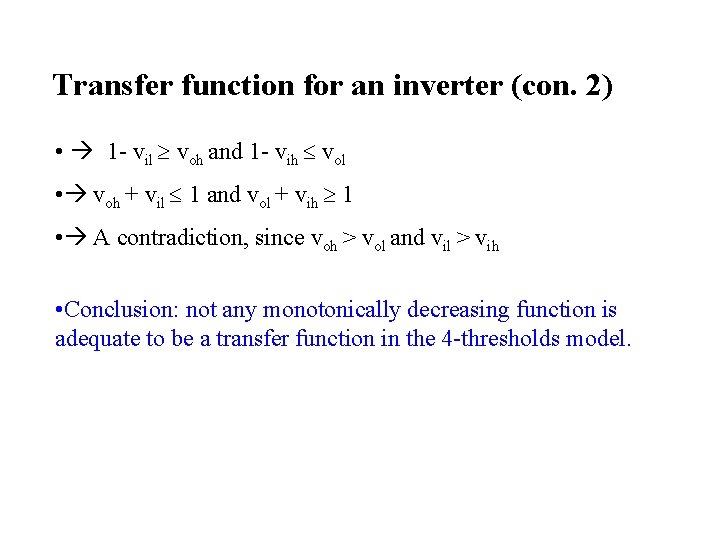
Transfer function for an inverter (con. 2) • 1 - vil voh and 1 - vih vol • voh + vil 1 and vol + vih 1 • A contradiction, since voh > vol and vil > vih • Conclusion: not any monotonically decreasing function is adequate to be a transfer function in the 4 -thresholds model.
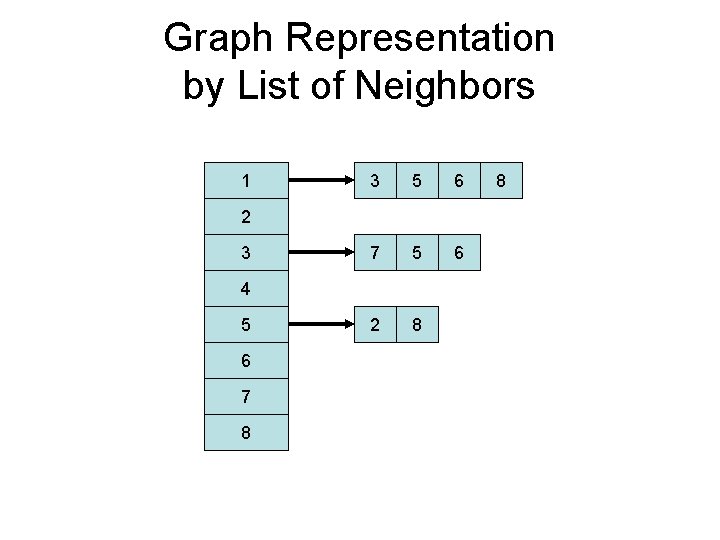
Graph Representation by List of Neighbors 1 3 5 6 7 5 6 2 8 2 3 4 5 6 7 8 8
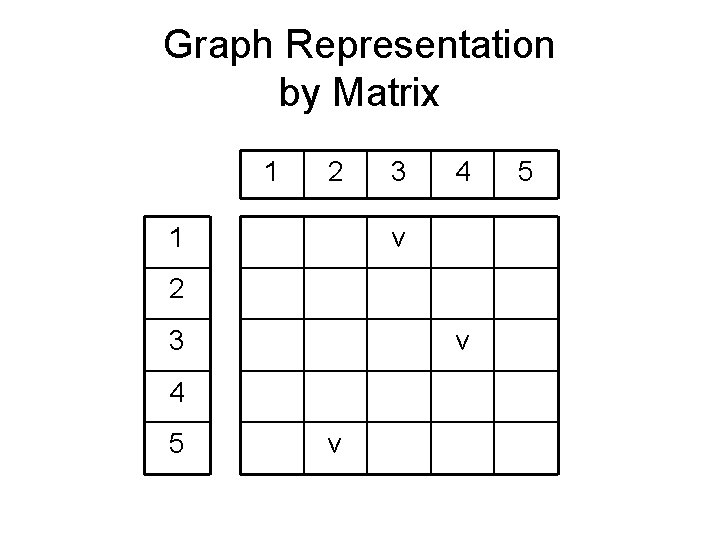
Graph Representation by Matrix 1 2 1 3 4 v 2 3 v 4 5 v 5

Topological Sort • Works only on Directed Acyclic Graphs (DAG). • Notations: – In degree: The number of edges entering a vertex. – Sources: vertices with in-degree 0. • The Algorithm: – Initialize: V The set of all vertices. – While V is not empty • Extract a source s (if non-exists, then not a dag). • Decrease the incoming degree of all its neighbors. • Set s to be the next vertex in the topological order.
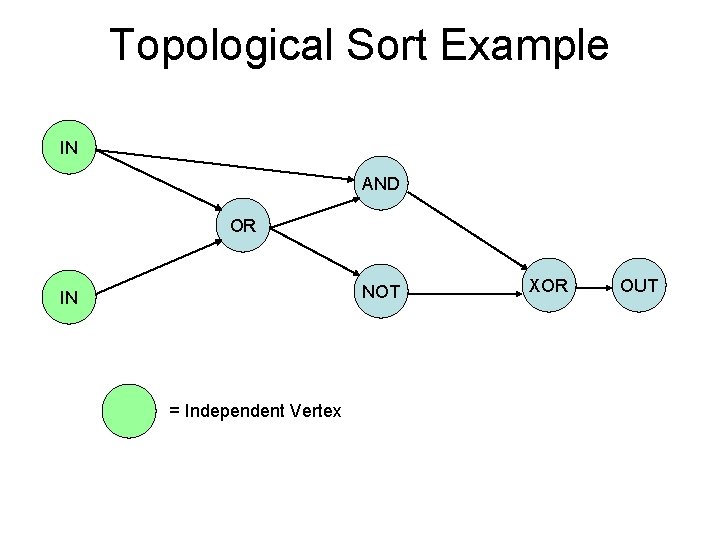
Topological Sort Example IN AND OR NOT IN = Independent Vertex XOR OUT
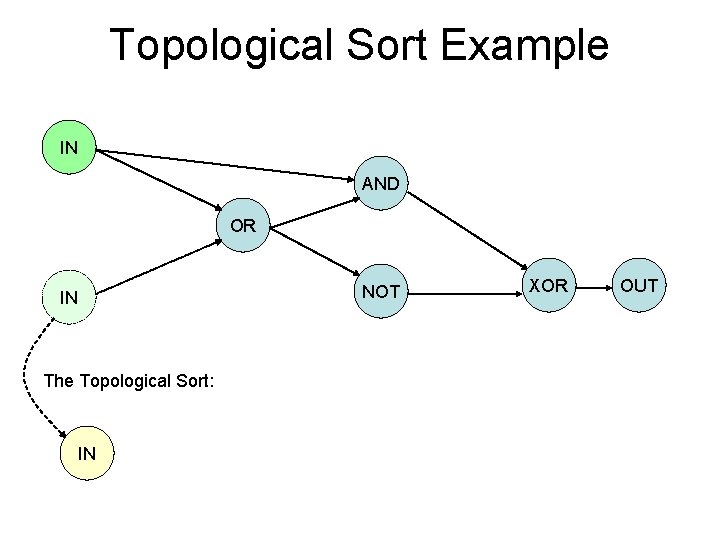
Topological Sort Example IN AND OR NOT IN The Topological Sort: IN XOR OUT
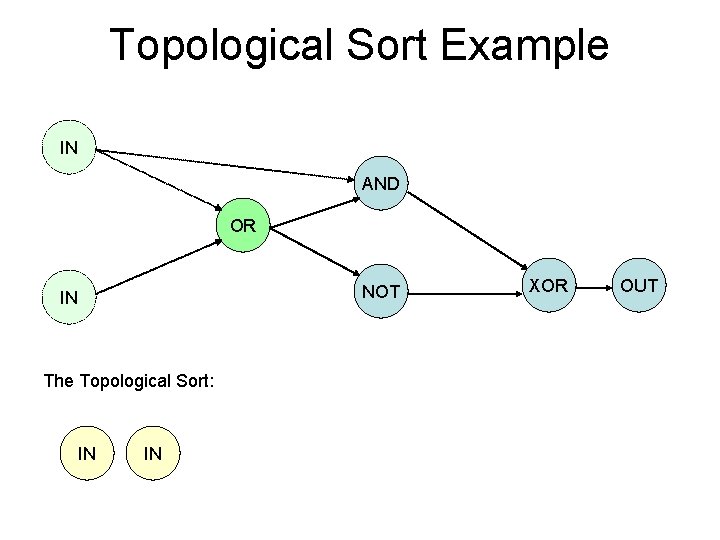
Topological Sort Example IN AND OR NOT IN The Topological Sort: IN IN XOR OUT
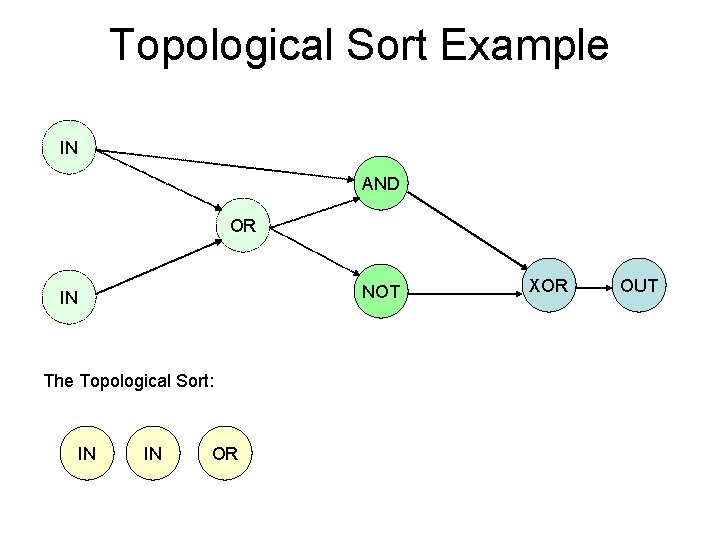
Topological Sort Example IN AND OR NOT IN The Topological Sort: IN IN OR XOR OUT
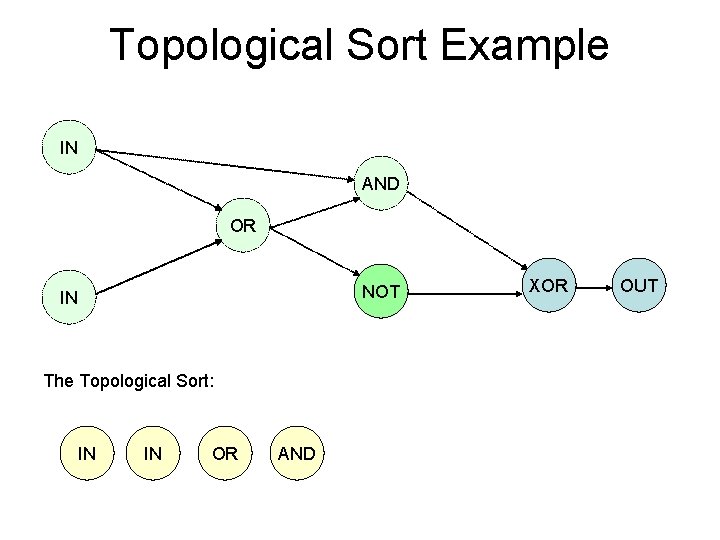
Topological Sort Example IN AND OR NOT IN The Topological Sort: IN IN OR AND XOR OUT
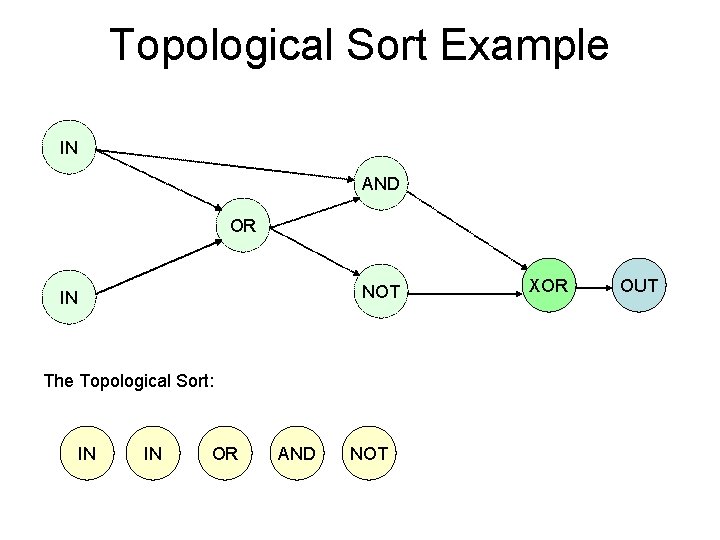
Topological Sort Example IN AND OR NOT IN The Topological Sort: IN IN OR AND NOT XOR OUT
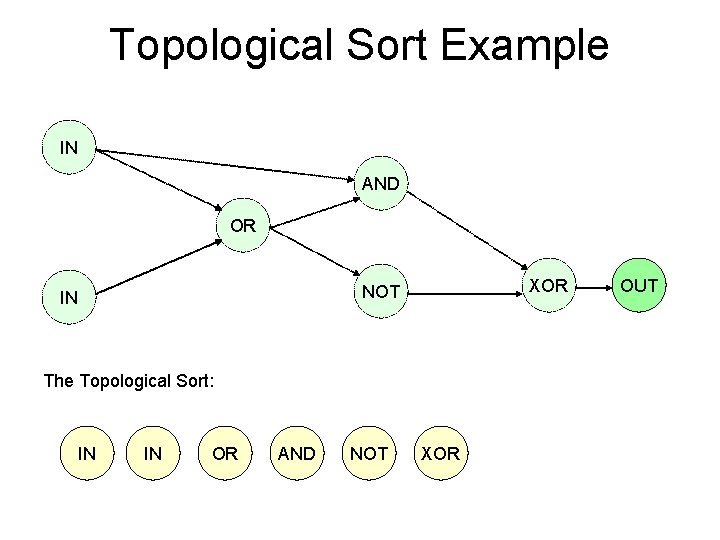
Topological Sort Example IN AND OR XOR NOT IN The Topological Sort: IN IN OR AND NOT XOR OUT
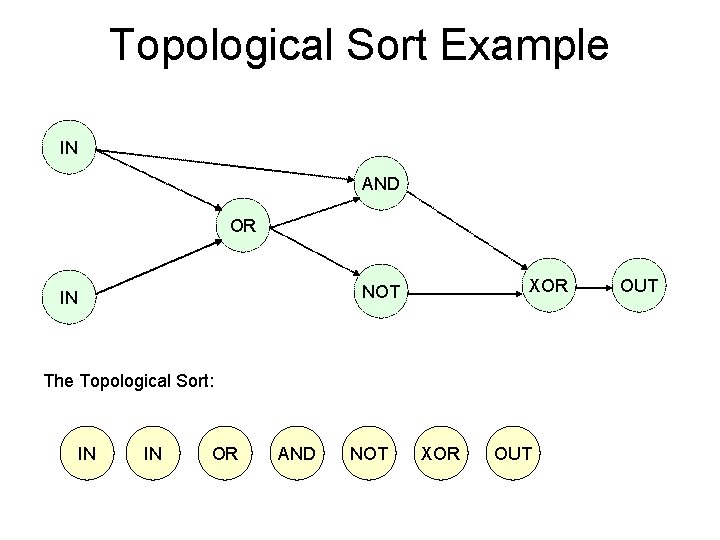
Topological Sort Example IN AND OR XOR NOT IN The Topological Sort: IN IN OR AND NOT XOR OUT

The next slides are for the interested students (home reading)
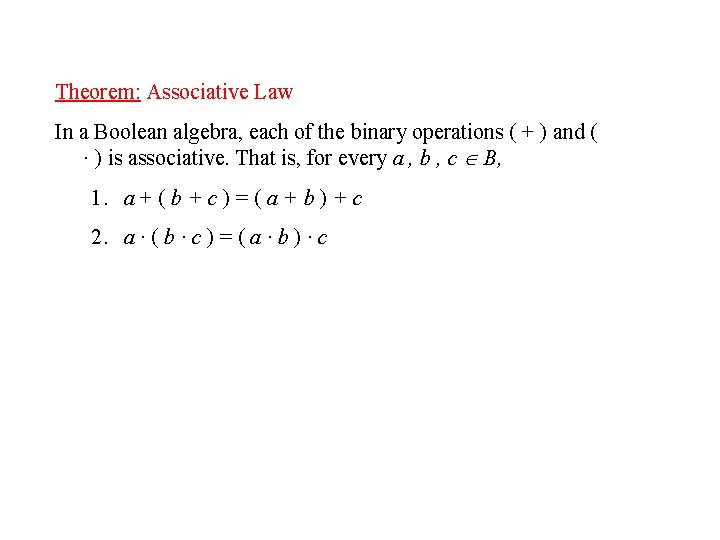
Theorem: Associative Law In a Boolean algebra, each of the binary operations ( + ) and ( · ) is associative. That is, for every a , b , c B, 1. a + ( b + c ) = ( a + b ) + c 2. a · ( b · c ) = ( a · b ) · c
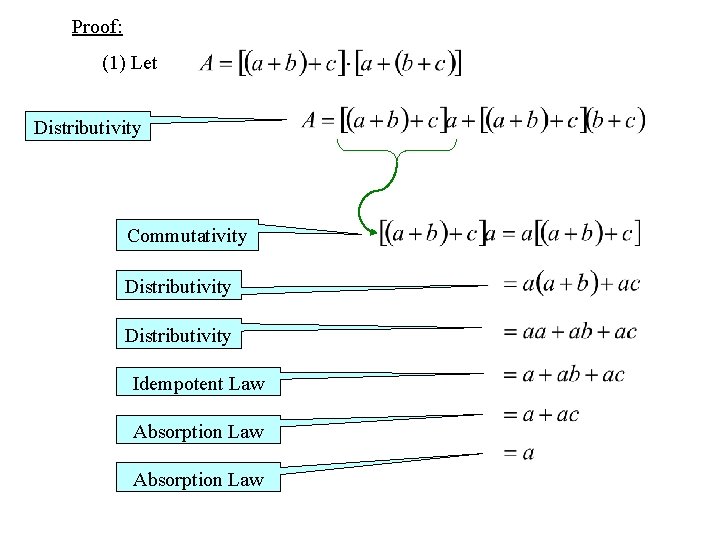
Proof: (1) Let Distributivity Commutativity Distributivity Idempotent Law Absorption Law
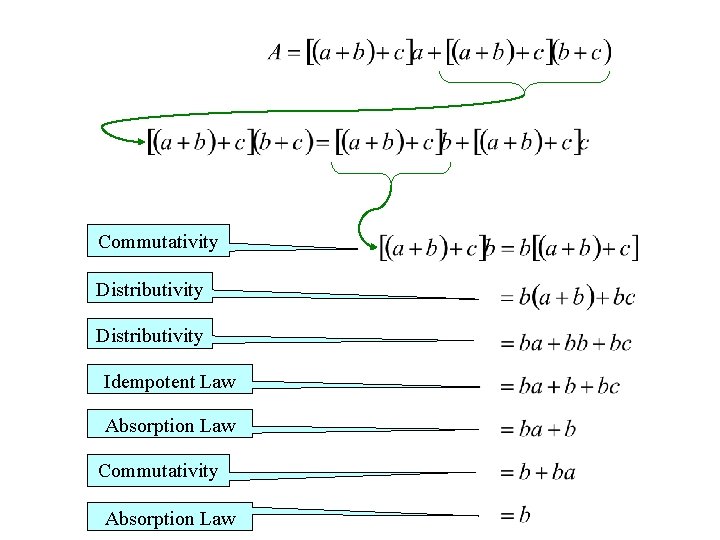
Commutativity Distributivity Idempotent Law Absorption Law Commutativity Absorption Law
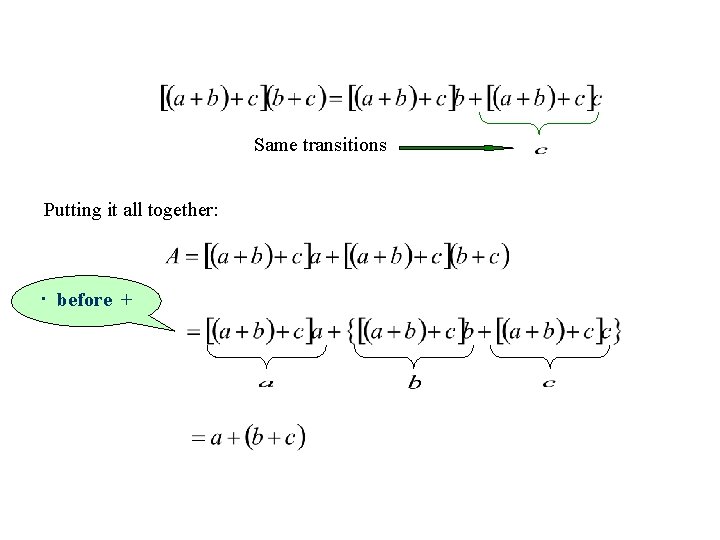
Same transitions Putting it all together: · before +
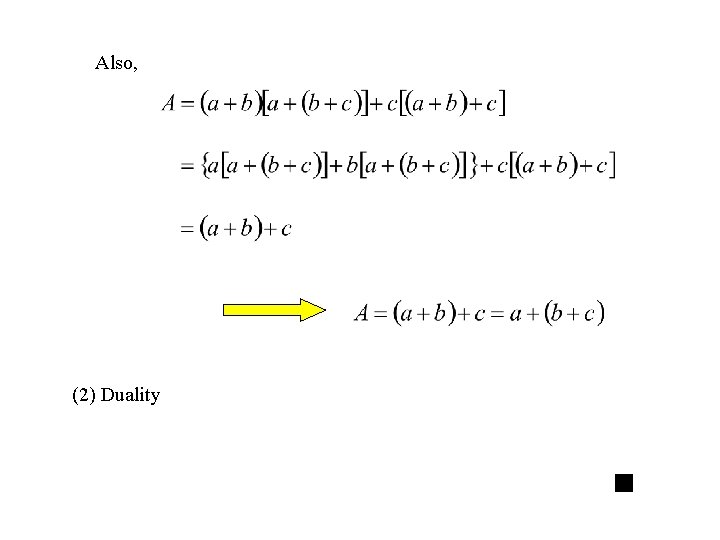
Also, (2) Duality
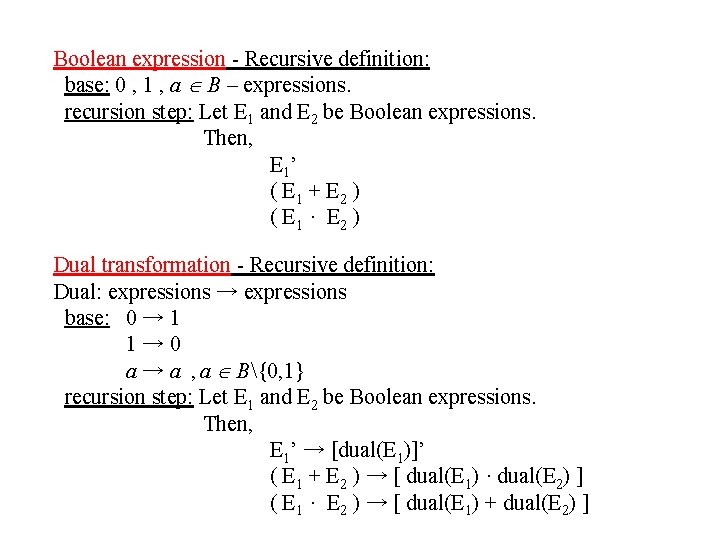
Boolean expression - Recursive definition: base: 0 , 1 , a B – expressions. recursion step: Let E 1 and E 2 be Boolean expressions. Then, E 1’ ( E 1 + E 2 ) ( E 1 · E 2 ) Dual transformation - Recursive definition: Dual: expressions → expressions base: 0 → 1 1→ 0 a → a , a B{0, 1} recursion step: Let E 1 and E 2 be Boolean expressions. Then, E 1’ → [dual(E 1)]’ ( E 1 + E 2 ) → [ dual(E 1) · dual(E 2) ] ( E 1 · E 2 ) → [ dual(E 1) + dual(E 2) ]
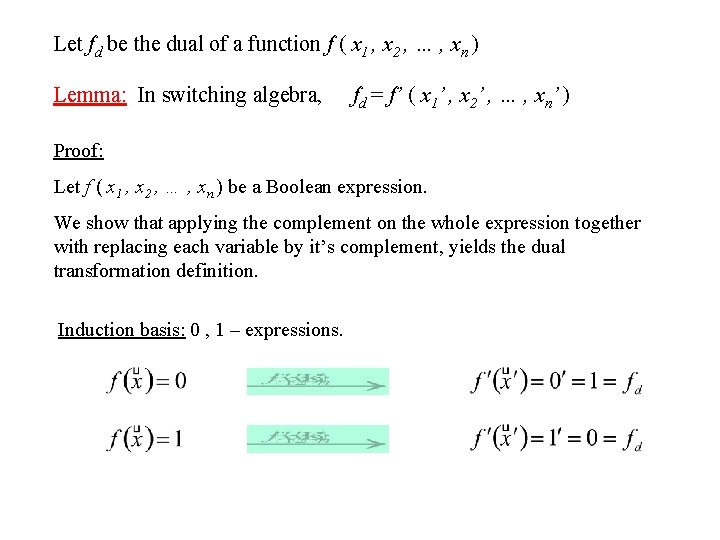
Let fd be the dual of a function f ( x 1 , x 2 , … , xn ) Lemma: In switching algebra, fd = f’ ( x 1’ , x 2’ , … , xn’ ) Proof: Let f ( x 1 , x 2 , … , xn ) be a Boolean expression. We show that applying the complement on the whole expression together with replacing each variable by it’s complement, yields the dual transformation definition. Induction basis: 0 , 1 – expressions.
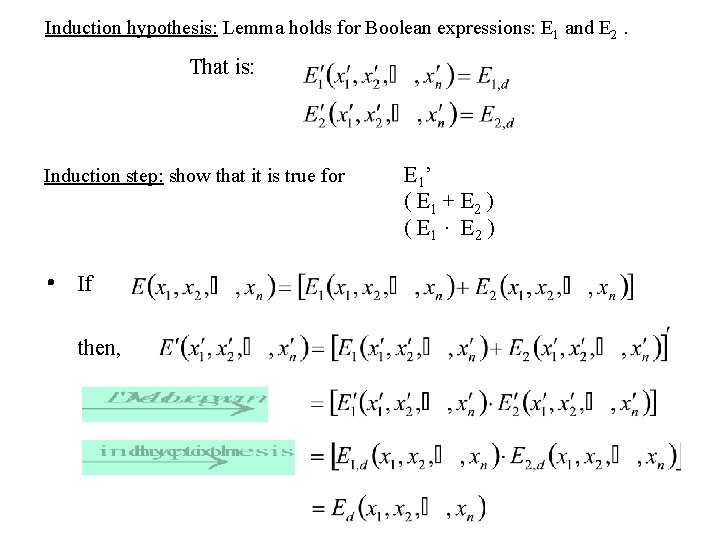
Induction hypothesis: Lemma holds for Boolean expressions: E 1 and E 2. That is: Induction step: show that it is true for If then, E 1’ ( E 1 + E 2 ) ( E 1 · E 2 )
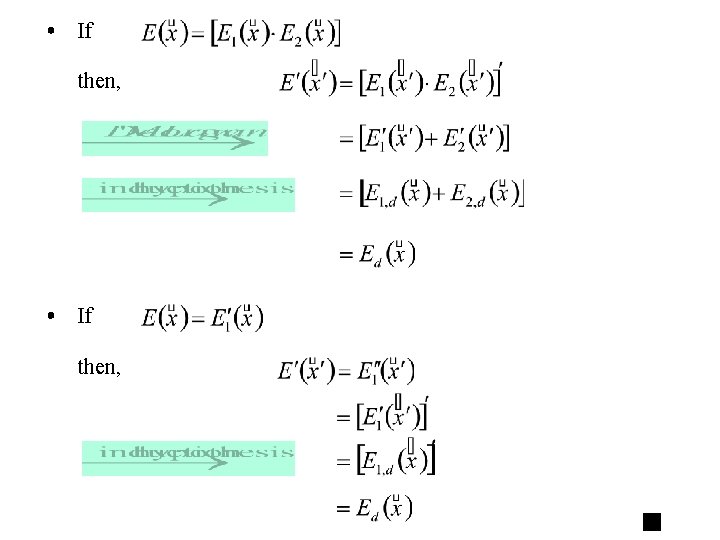
If then,
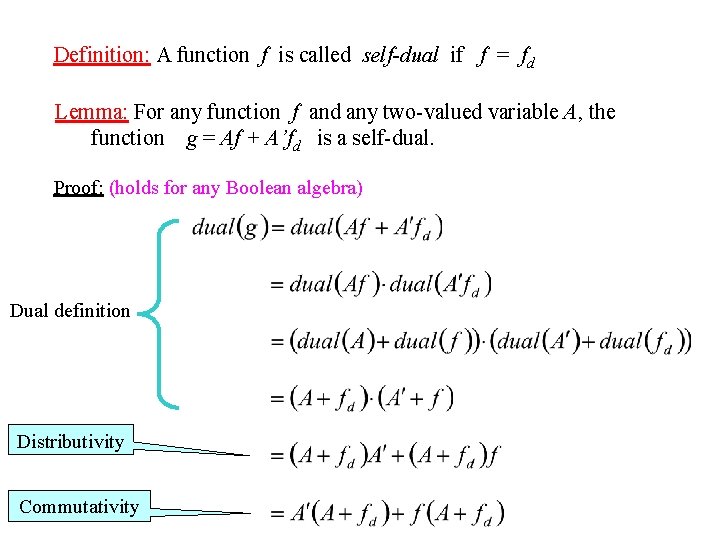
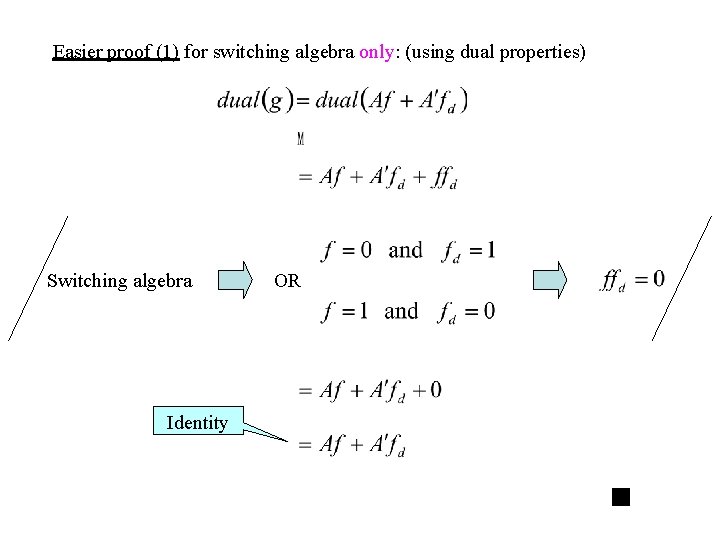
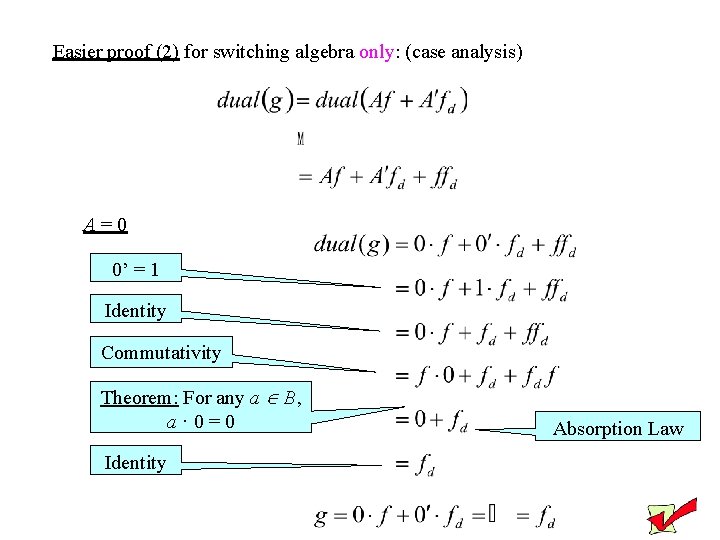
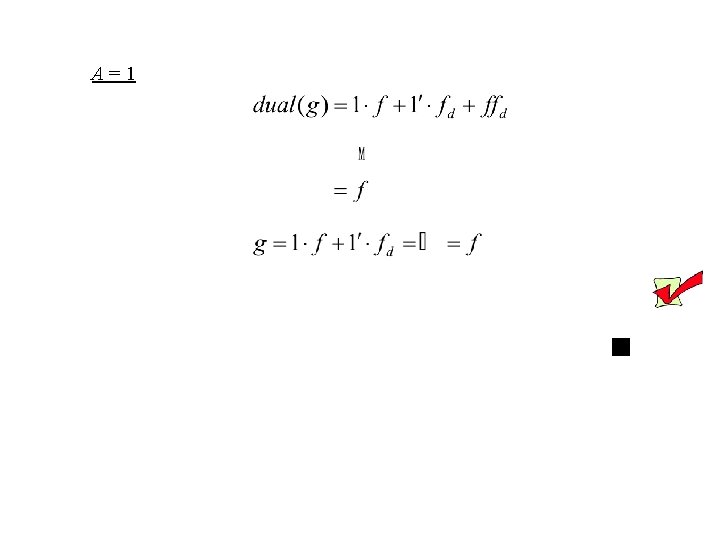
Definition: A function f is called self-dual if f = fd Lemma: For any function f and any two-valued variable A, the function g = Af + A’fd is a self-dual. Proof: (holds for any Boolean algebra) Dual definition Distributivity Commutativity
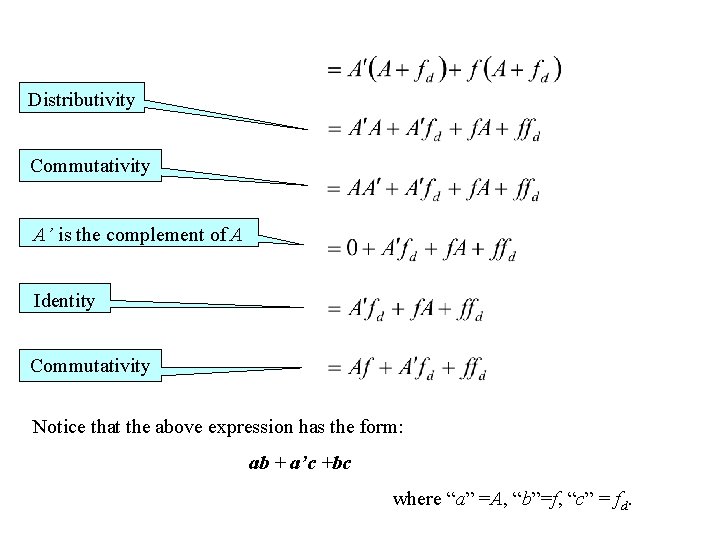
Distributivity Commutativity A’ is the complement of A Identity Commutativity Notice that the above expression has the form: ab + a’c +bc where “a” =A, “b”=f, “c” = fd.
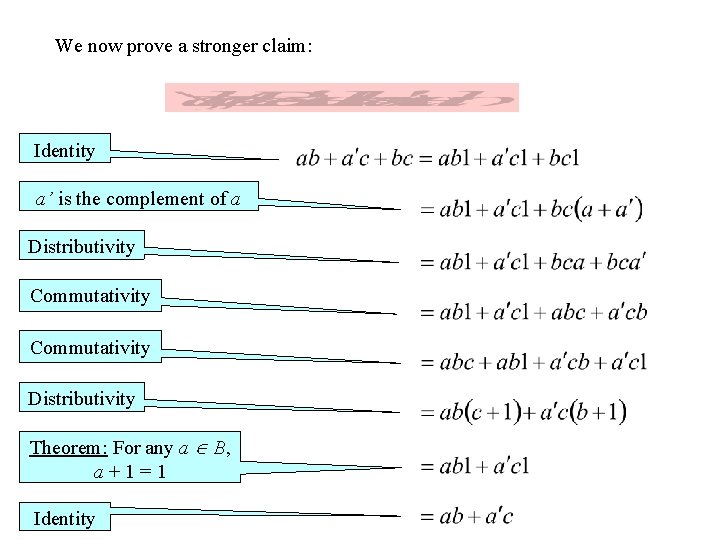
We now prove a stronger claim: Identity a’ is the complement of a Distributivity Commutativity Distributivity Theorem: For any a B, a+1=1 Identity
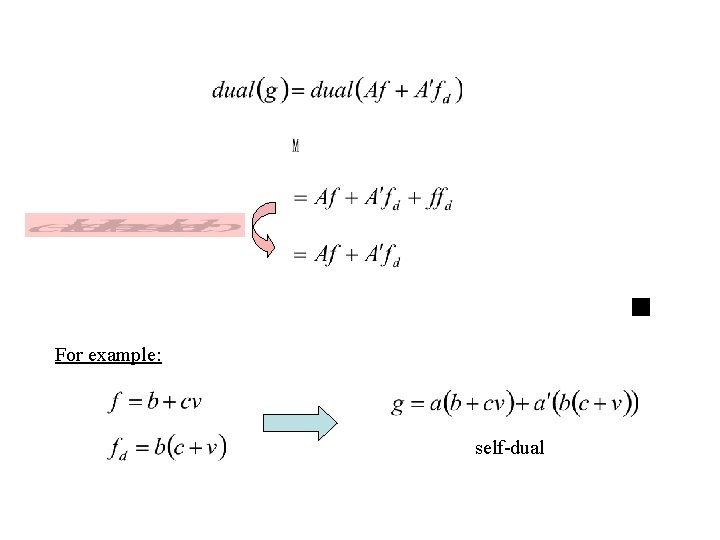
For example: self-dual
Easier proof (1) for switching algebra only: (using dual properties) Switching algebra Identity OR
Easier proof (2) for switching algebra only: (case analysis) A=0 0’ = 1 Identity Commutativity Theorem: For any a B, a· 0=0 Identity Absorption Law
A=1
Algebra of Sets Consider a set S. B = all the subsets of S (denoted by P(S)). “plus” set-union ∪ “times” set-intersection ∩ Additive identity element – empty set Ø Multiplicative identity element – the set S. Complement of X B:
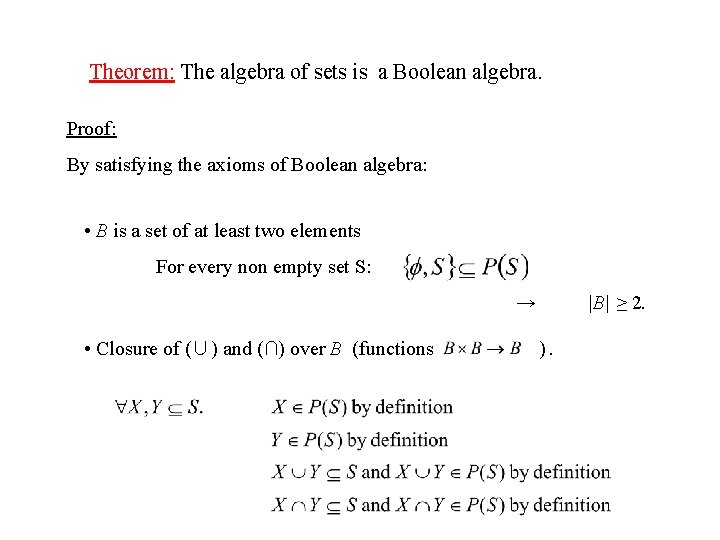
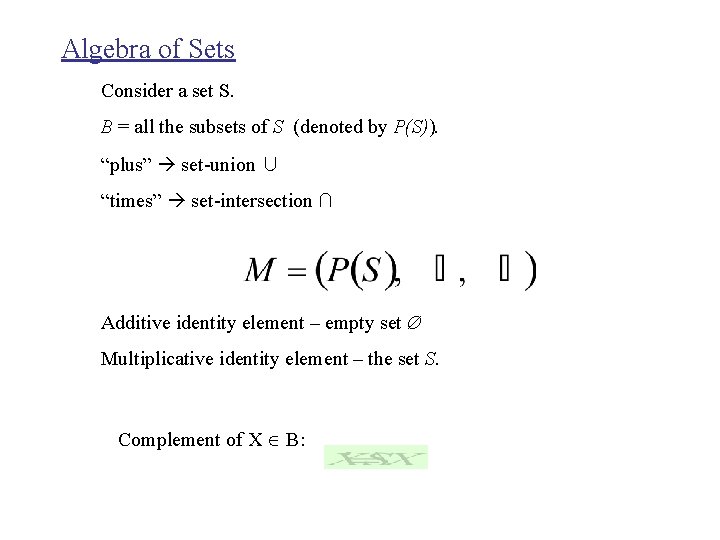
Theorem: The algebra of sets is a Boolean algebra. Proof: By satisfying the axioms of Boolean algebra: • B is a set of at least two elements For every non empty set S: → • Closure of (∪) and (∩) over B (functions |B| ≥ 2. ).
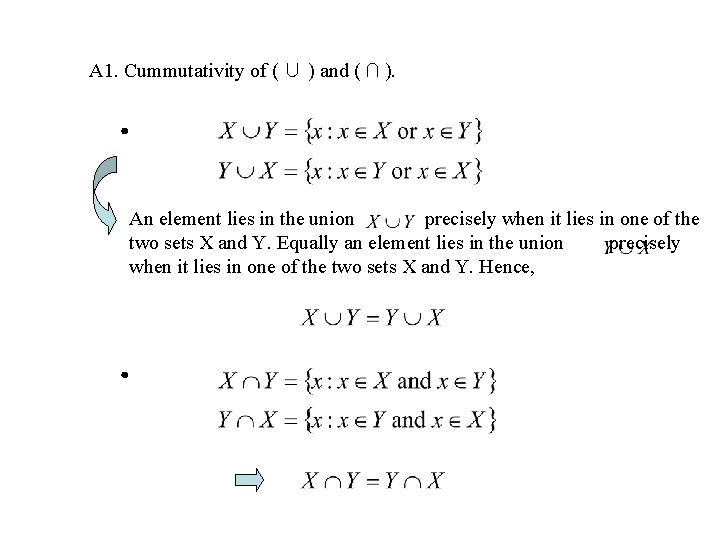
A 1. Cummutativity of ( ∪ ) and ( ∩ ). An element lies in the union precisely when it lies in one of the two sets X and Y. Equally an element lies in the union precisely when it lies in one of the two sets X and Y. Hence,
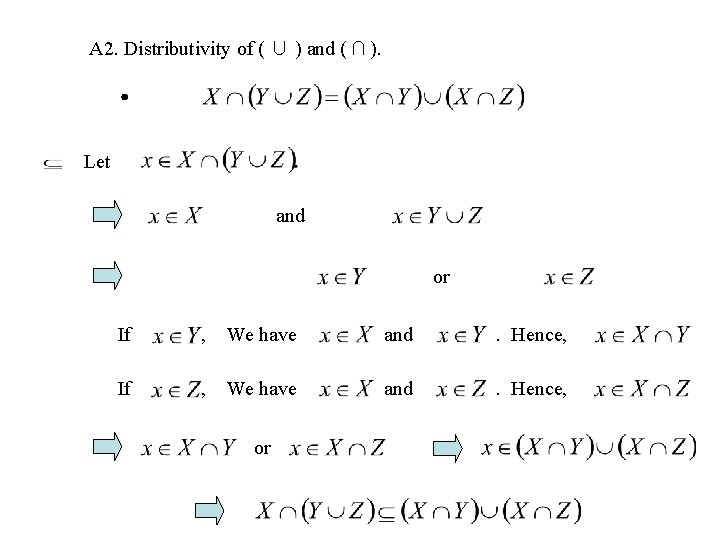
A 2. Distributivity of ( ∪ ) and ( ∩ ). Let and or If , We have and . Hence, or
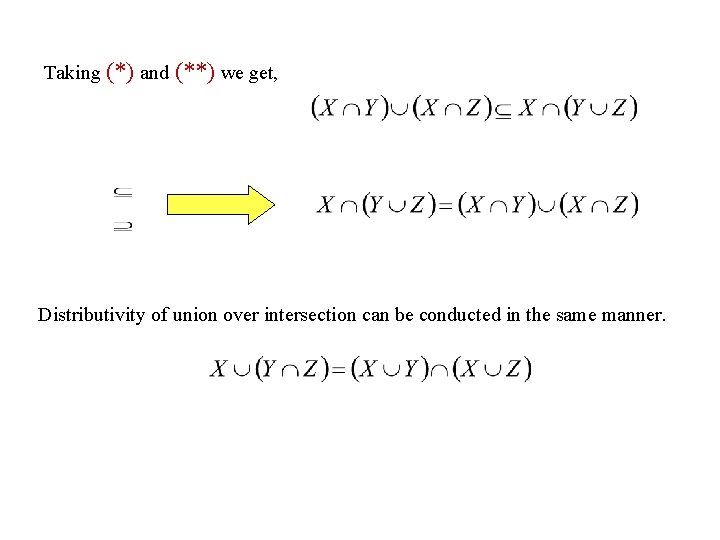
Taking (*) and (**) we get, Distributivity of union over intersection can be conducted in the same manner.
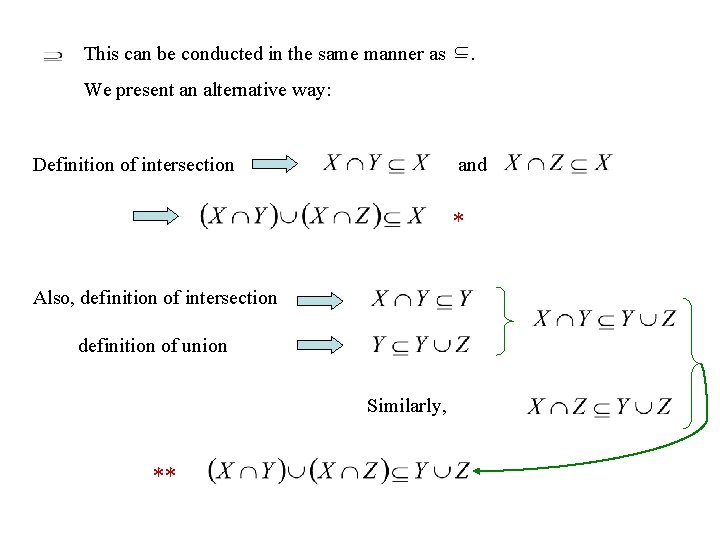
This can be conducted in the same manner as ⊆. We present an alternative way: Definition of intersection and * Also, definition of intersection definition of union Similarly, **
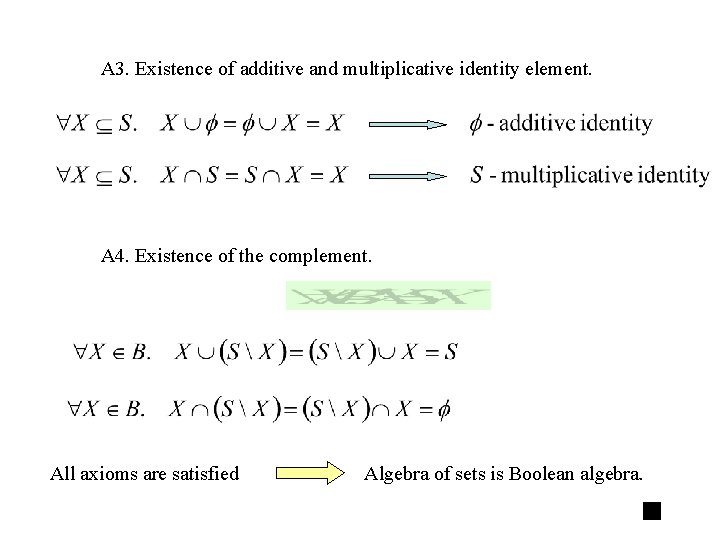
A 3. Existence of additive and multiplicative identity element. A 4. Existence of the complement. All axioms are satisfied Algebra of sets is Boolean algebra.
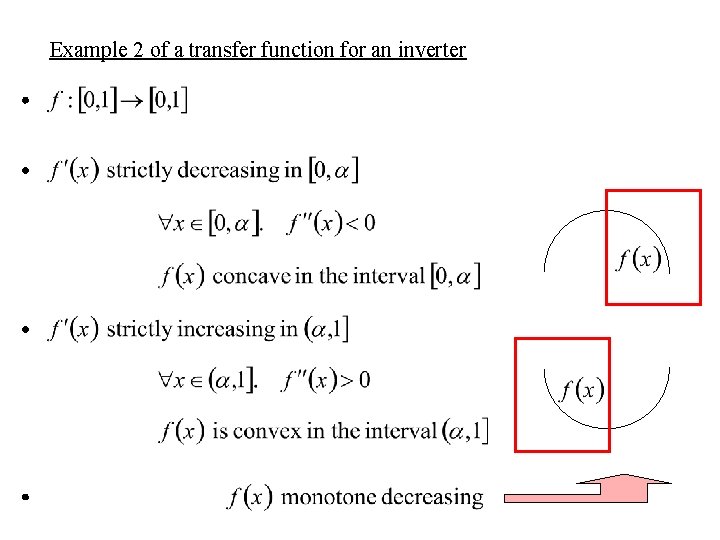
Example 2 of a transfer function for an inverter
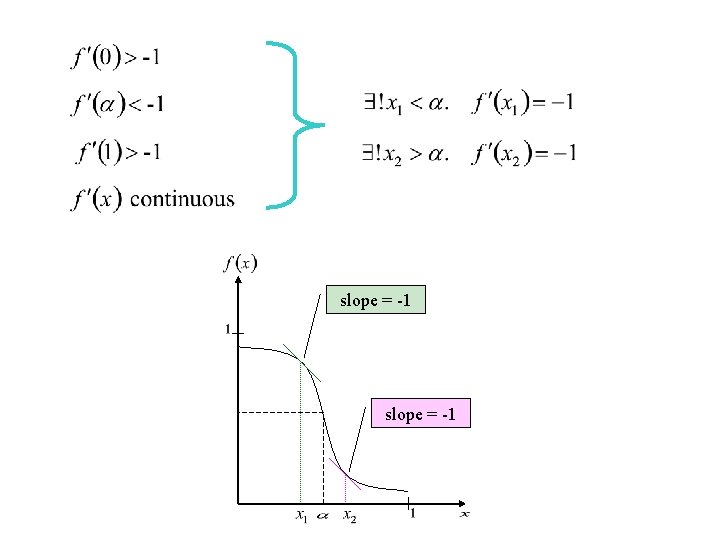
slope = -1
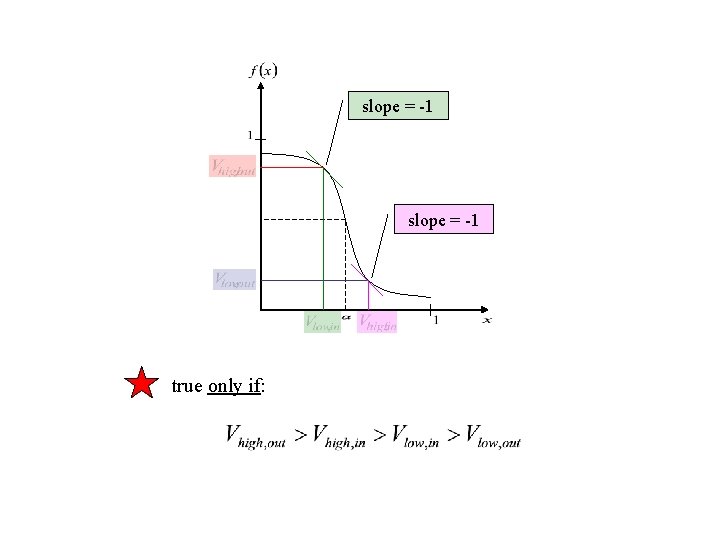
slope = -1 true only if:
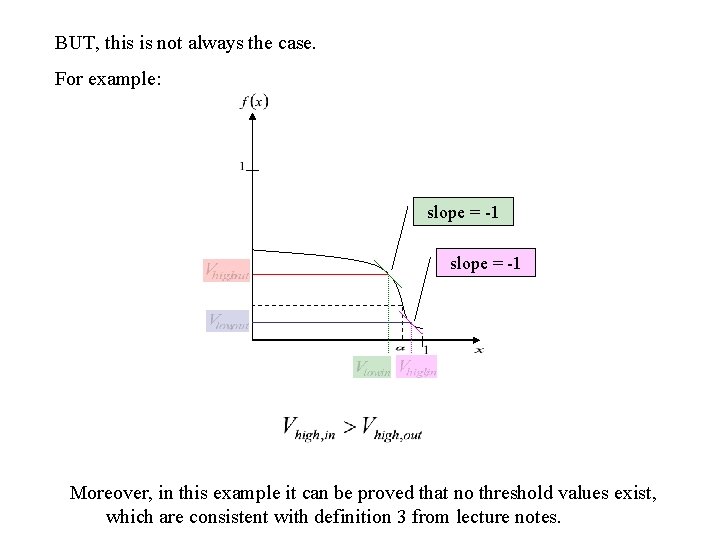
BUT, this is not always the case. For example: slope = -1 Moreover, in this example it can be proved that no threshold values exist, which are consistent with definition 3 from lecture notes.
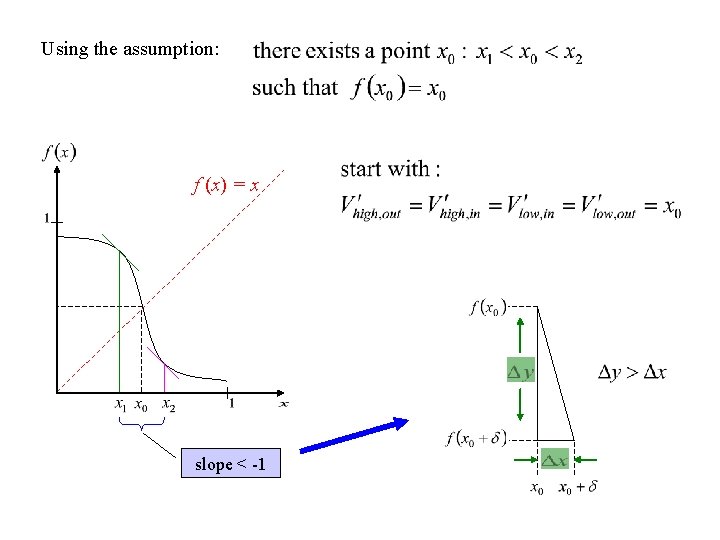
Using the assumption: f (x) = x slope < -1
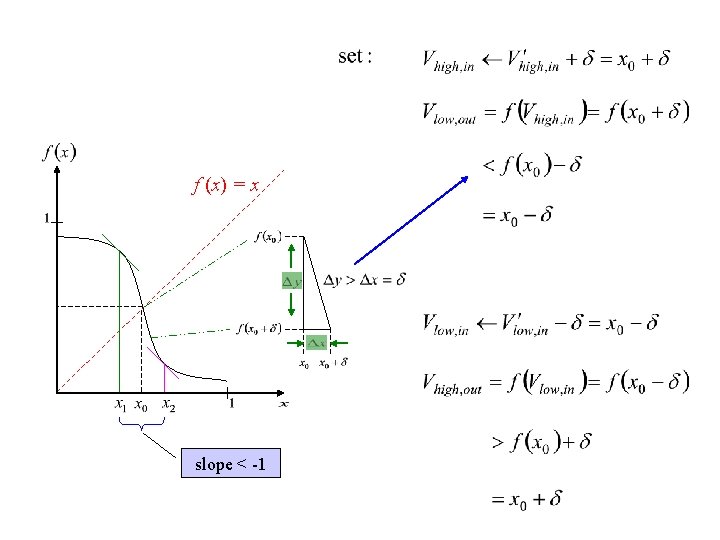
f (x) = x slope < -1
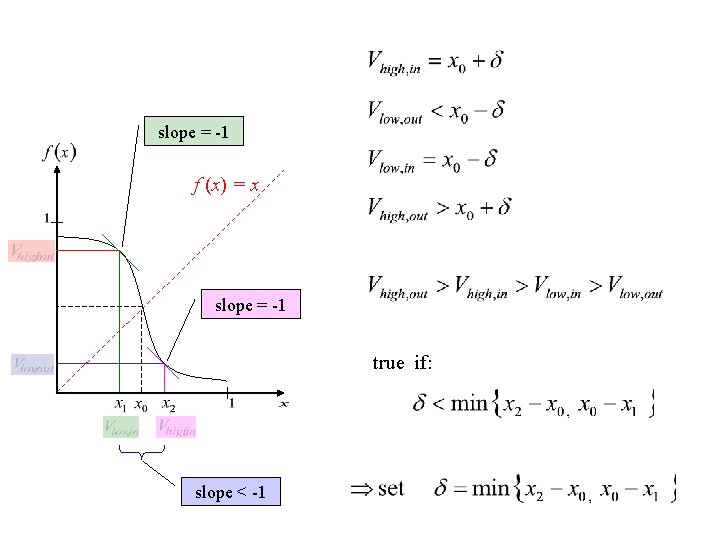
slope = -1 f (x) = x slope = -1 true if: slope < -1
- Slides: 49