
2 Atoms molecules ions 2 3 Atomic structure
- Slides: 13
2. Atoms, molecules & ions 2. 3: Atomic structure & symbolism • Write & interpret symbols that depict atomic number, atomic mass and charge of atoms & ions • Define the atomic mass unit & average atomic mass • Calculate average atomic mass & isotopic abundance
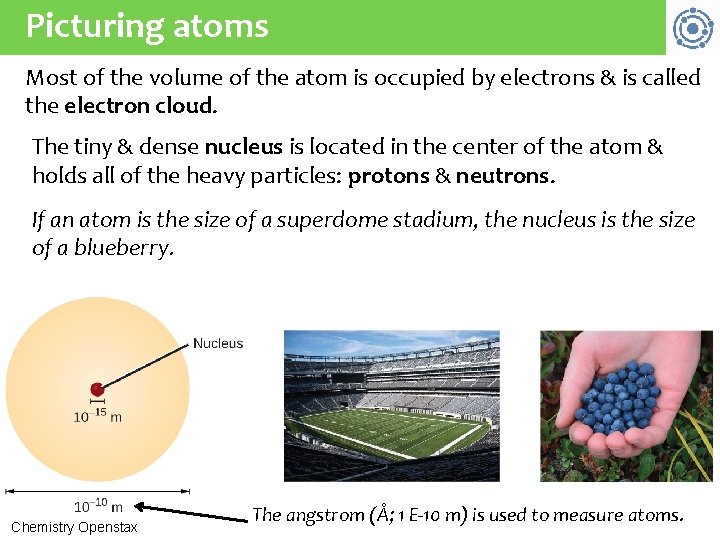
Picturing atoms Most of the volume of the atom is occupied by electrons & is called the electron cloud. The tiny & dense nucleus is located in the center of the atom & holds all of the heavy particles: protons & neutrons. If an atom is the size of a superdome stadium, the nucleus is the size of a blueberry. Chemistry Openstax The angstrom (Å; 1 E-10 m) is used to measure atoms.
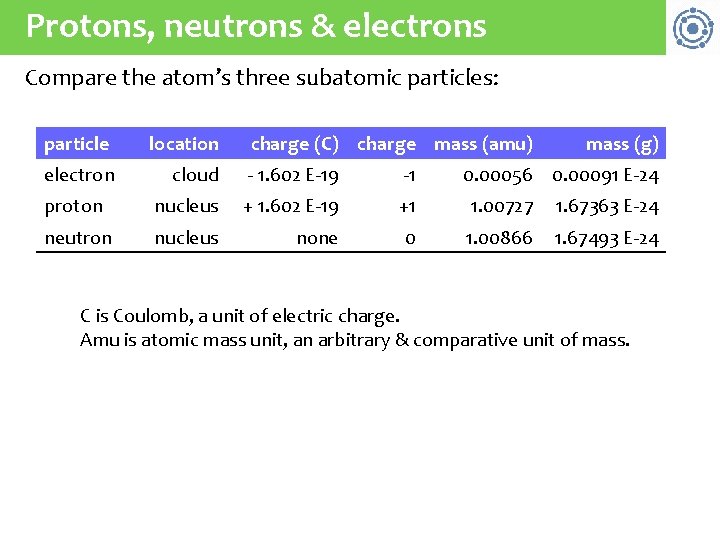
Protons, neutrons & electrons Compare the atom’s three subatomic particles: particle location charge (C) charge mass (amu) mass (g) electron cloud - 1. 602 E-19 -1 proton nucleus + 1. 602 E-19 +1 1. 00727 1. 67363 E-24 neutron nucleus none 0 1. 00866 1. 67493 E-24 0. 00056 0. 00091 E-24 C is Coulomb, a unit of electric charge. Amu is atomic mass unit, an arbitrary & comparative unit of mass.
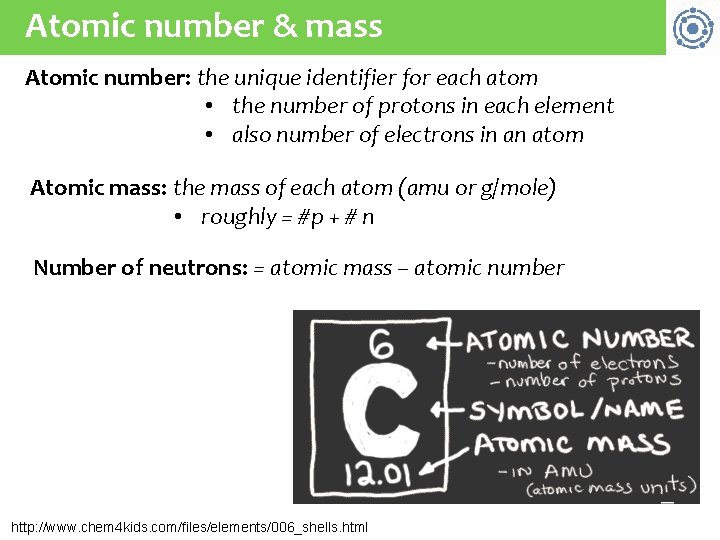
Atomic number & mass Atomic number: the unique identifier for each atom • the number of protons in each element • also number of electrons in an atom Atomic mass: the mass of each atom (amu or g/mole) • roughly = #p + # n Number of neutrons: = atomic mass – atomic number http: //www. chem 4 kids. com/files/elements/006_shells. html
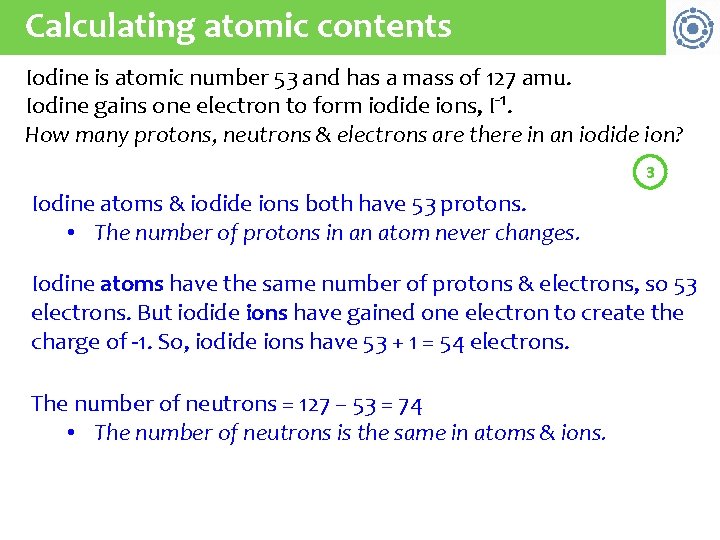
Calculating atomic contents Iodine is atomic number 53 and has a mass of 127 amu. Iodine gains one electron to form iodide ions, I-1. How many protons, neutrons & electrons are there in an iodide ion? 3 Iodine atoms & iodide ions both have 53 protons. • The number of protons in an atom never changes. Iodine atoms have the same number of protons & electrons, so 53 electrons. But iodide ions have gained one electron to create the charge of -1. So, iodide ions have 53 + 1 = 54 electrons. The number of neutrons = 127 – 53 = 74 • The number of neutrons is the same in atoms & ions.
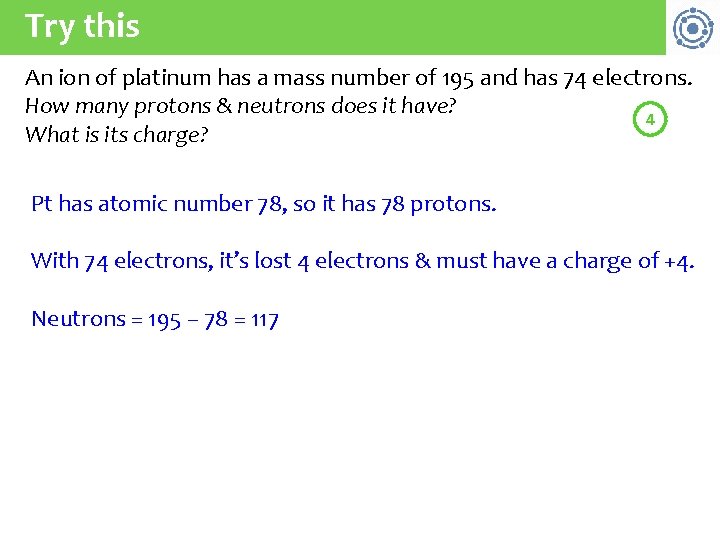
Try this An ion of platinum has a mass number of 195 and has 74 electrons. How many protons & neutrons does it have? 4 What is its charge? Pt has atomic number 78, so it has 78 protons. With 74 electrons, it’s lost 4 electrons & must have a charge of +4. Neutrons = 195 – 78 = 117
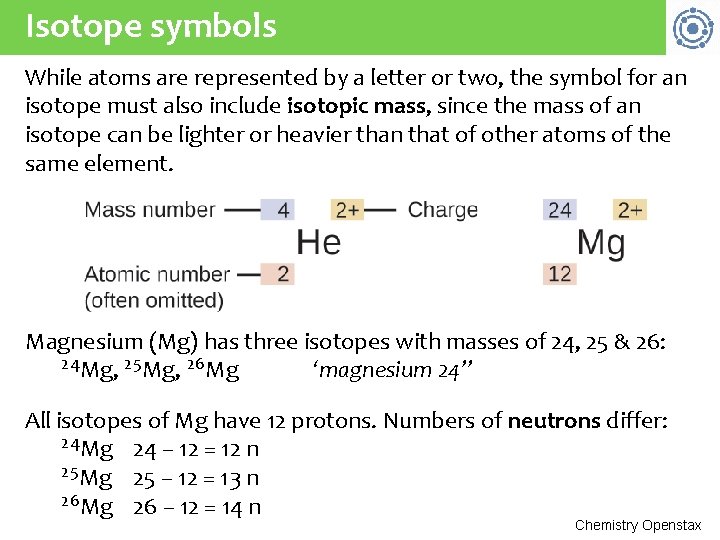
Isotope symbols While atoms are represented by a letter or two, the symbol for an isotope must also include isotopic mass, since the mass of an isotope can be lighter or heavier than that of other atoms of the same element. Magnesium (Mg) has three isotopes with masses of 24, 25 & 26: 24 Mg, 25 Mg, 26 Mg ‘magnesium 24” All isotopes of Mg have 12 protons. Numbers of neutrons differ: 24 Mg 24 – 12 = 12 n 25 Mg 25 – 12 = 13 n 26 Mg 26 – 12 = 14 n Chemistry Openstax
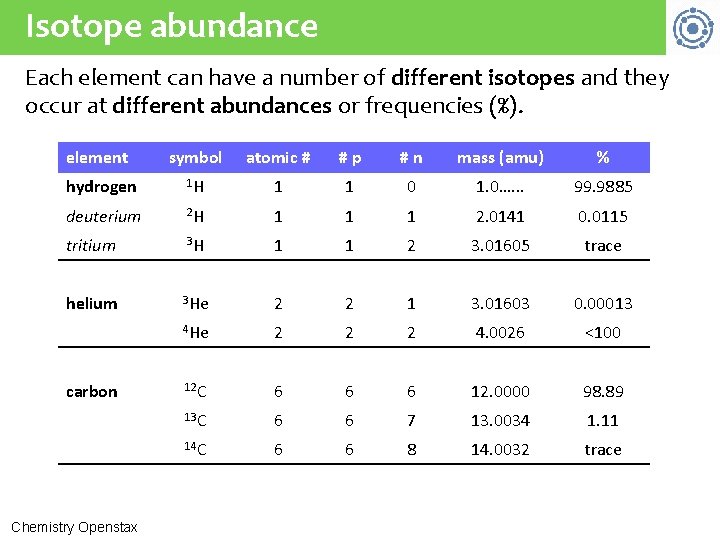
Isotope abundance Each element can have a number of different isotopes and they occur at different abundances or frequencies (%). element symbol atomic # #p #n mass (amu) % hydrogen 1 H 1 1 0 1. 0…. . . 99. 9885 deuterium 2 H 1 1 1 2. 0141 0. 0115 tritium 3 H 1 1 2 3. 01605 trace helium 3 He 2 2 1 3. 01603 0. 00013 4 He 2 2 2 4. 0026 <100 12 C 6 6 6 12. 0000 98. 89 13 C 6 6 7 13. 0034 1. 11 14 C 6 6 8 14. 0032 trace carbon Chemistry Openstax
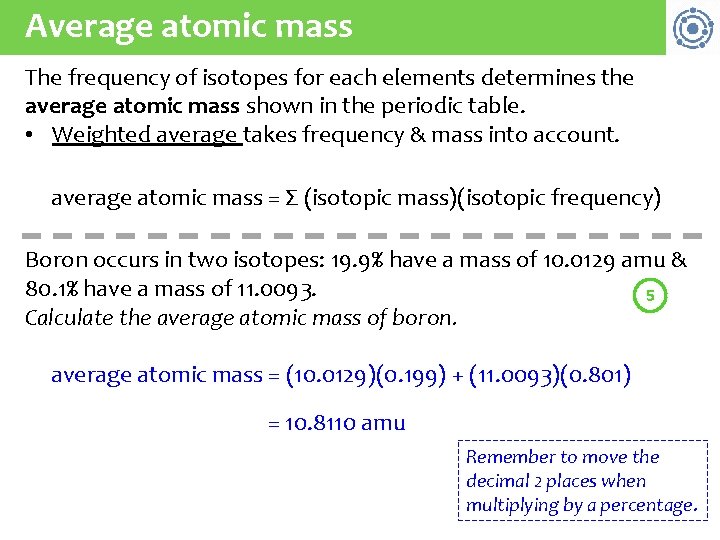
Average atomic mass The frequency of isotopes for each elements determines the average atomic mass shown in the periodic table. • Weighted average takes frequency & mass into account. average atomic mass = Σ (isotopic mass)(isotopic frequency) Boron occurs in two isotopes: 19. 9% have a mass of 10. 0129 amu & 80. 1% have a mass of 11. 0093. 5 Calculate the average atomic mass of boron. average atomic mass = (10. 0129)(0. 199) + (11. 0093)(0. 801) = 10. 8110 amu Remember to move the decimal 2 places when multiplying by a percentage.
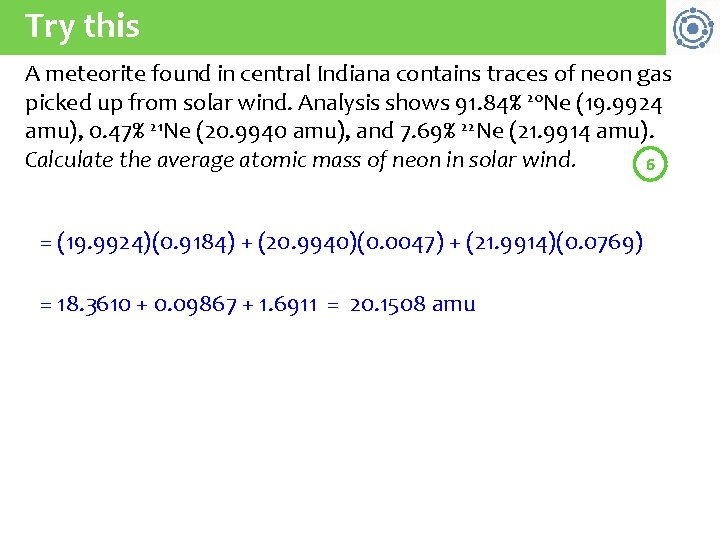
Try this A meteorite found in central Indiana contains traces of neon gas picked up from solar wind. Analysis shows 91. 84% 20 Ne (19. 9924 amu), 0. 47% 21 Ne (20. 9940 amu), and 7. 69% 22 Ne (21. 9914 amu). Calculate the average atomic mass of neon in solar wind. 6 = (19. 9924)(0. 9184) + (20. 9940)(0. 0047) + (21. 9914)(0. 0769) = 18. 3610 + 0. 09867 + 1. 6911 = 20. 1508 amu
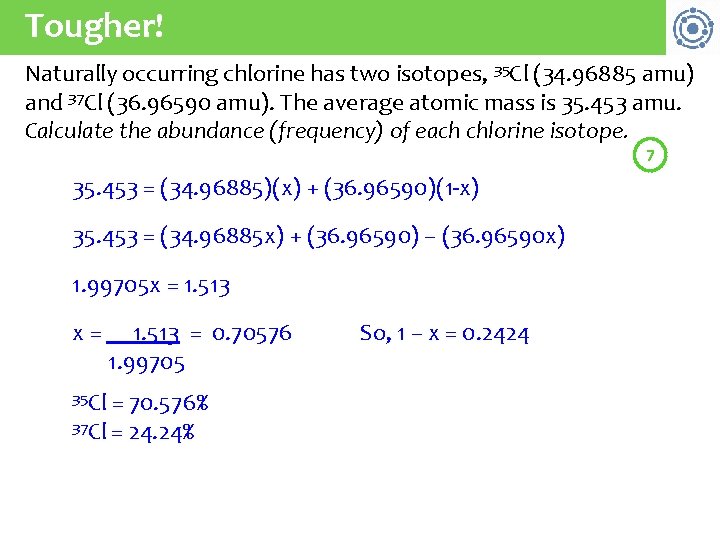
Tougher! Naturally occurring chlorine has two isotopes, 35 Cl (34. 96885 amu) and 37 Cl (36. 96590 amu). The average atomic mass is 35. 453 amu. Calculate the abundance (frequency) of each chlorine isotope. 7 35. 453 = (34. 96885)(x) + (36. 96590)(1 -x) 35. 453 = (34. 96885 x) + (36. 96590) – (36. 96590 x) 1. 99705 x = 1. 513 x= 35 Cl 1. 513 = 0. 70576 1. 99705 = 70. 576% 37 Cl = 24. 24% So, 1 – x = 0. 2424
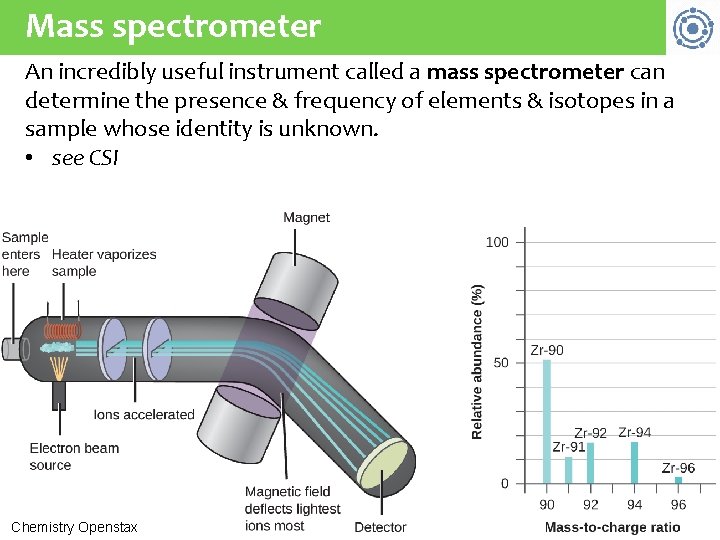
Mass spectrometer An incredibly useful instrument called a mass spectrometer can determine the presence & frequency of elements & isotopes in a sample whose identity is unknown. • see CSI Chemistry Openstax
Can you? (1) Describe the nuclear model of the atom? (2) List the three subatomic particles, their relative masses & charges? (3) Give the number of protons, neutrons & electrons found in any atom using the periodic table? (4) Describe the number added to an atomic symbol to identify an isotope? (5) Calculate average atomic mass from isotopic mass & frequency? (6) Give a basic description of how a mass spec separates isotopes?