
2 Ancient Greece Objectives Describe important Greek developments
2. Ancient Greece
Objectives • Describe important Greek developments in the arts. • Discuss Greek achievements in history, politics, biology, and logic. • Describe how Hellenistic kingdoms became centers of learning and culture.
Geography shapes Greek Civilization • Greece is a peninsula, which means that it is surrounded on three sides by water. • Greece is one big peninsula made up of a series of smaller peninsulas, in addition to many small islands, which means Greece enjoys many natural harbors.
Mountains and Settlements • Because mountains cover much of Greece, there are few flat areas for farmland. • People settled in those flat areas along the coast and in river valleys. • They lived in villages and towns separated by mountains and seas.
Mount Olympus • Greece is covered with mountains. They are not huge mountains but if you are trying to go from place to place in Greece, you'll find the mountains a bit of a hindrance. • The highest mountain in Greece is Mount Olympus.
Mountains and Settlements • Traveling across the mountains and seas was difficult, so communities were isolated from one another. As a result, the people created their own government and ways of life. • Even though they spoke the same language, Greek communities saw themselves as separate villages.
Seas and Ships • Since travel across the rugged mountains was so difficult, the early Greeks turned to the sea. • On the South was the huge Mediterranean Sea, to the west the Ionian Sea, and to the east was the Aegean Sea.
Seas and Ships • The Early Greeks used the sea as a source for food and as a way of trading with other communities. • The Greeks became skilled shipbuilders and sailors.
Volcanic • Another important aspect of the Greek environment is that it is very unstable. • Greece is in the middle of a very volcanic zone, between the European and African tectonic plates. • There are several active volcanoes and earthquakes are common.
The Climate • The climate is Mediterranean. • The Mediterranean Sea affects the Greek climate, cooling the air in summer and providing warmth in winter. • The warm summers are cooled by a seasonal breezes from the Mediterranean.
Soil and Plants • Vegetation is dependent on geographical regions. • Due to the variety of land, there a some 6, 000 indigenous species in Greece. • In Ancient Greece, farmers grew olives, figs, grain, fruit and grapes in the fertile valleys.
Soil and Plants • However, other parts of Ancient Greece had drier soil and less vegetation, particularly around the cities. • Although surrounded by sea water, they found it difficult to find fresh water away from the valleys. • The high mountains also prevented large-scale farming, so the Greeks were forced to look beyond their own country for fertile land.
Capital City • The capital city is Athens. It is famous for beautiful beaches and the sea.
Physical Geography • The Land • Mountains dominate land; cross land travel difficult • Fertile river valleys were center of settlement • River valleys formed basis of polis • No place more than a few miles from sea • Outdoor life common due to temperate climate • The Sea • Greece is a series of peninsulas, islands • Sea travel easier than land communication • Most Greeks took to the sea • Economy • Agriculture: Grains, honey, olives, grapes • Herding: Goats, sheep, cattle • Trade: Necessary to make up for lack of resources
Trading Cultures Develop • Many cultures settled and developed in Greece. • Two of the earliest were the Minoans and the Mycenaens. • By 2000 BC the Minoans had build an advanced society on the island of Crete. • These two civilizations influenced the entire Aegean region and helped shape later cultures in Greece.
The Minoans • Minoans had build an advanced society on the island of Crete, in the eastern Mediterranean. • Because they lived on an island, the Minoans spent much of their time at sea. • They were among the best shipbuilders of their time.
The Minoans • Although Crete’s location was excellent for Minoan traders, sometime in the 1600 s BC a huge volcano erupted just north of Crete. This eruption created a giant wave that flooded much of Crete. • The eruption threw up huge clouds of ash, ruining crops and burying cities. This eruption led to the end of Minoan civilization.
The Mycenaean • Although they lived in what is now Greece and influenced Greek society, historians don’t consider the Minoans to be Greek. • This is because the Minoans didn’t speak the Greek language.
The Mycenaeans • The first people to speak Greek, and therefore the first to be considered Greek were the Mycenaeans. • By the mid-1400 s B. C. , the Myceneans took over Crete and become the major traders in the eastern Mediterranean. • They set up colonies in northern Greece and Italy from which they shipped goods to markets around the Mediterranean and Black Seas.
The Mycenaeans • The Mycenaeans didn’t think trade had to be conducted peacefully. They often attacked other kingdoms. • Some historians think the Mycenaeans attacked the city of Troy, possibly starting the legendary Trojan War.
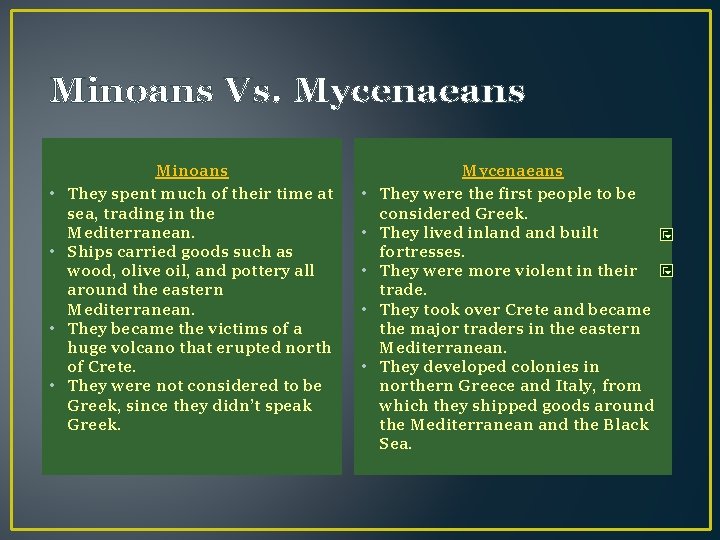
Minoans Vs. Mycenaeans • • Minoans They spent much of their time at sea, trading in the Mediterranean. Ships carried goods such as wood, olive oil, and pottery all around the eastern Mediterranean. They became the victims of a huge volcano that erupted north of Crete. They were not considered to be Greek, since they didn’t speak Greek. • • • Mycenaeans They were the first people to be considered Greek. They lived inland built fortresses. They were more violent in their trade. They took over Crete and became the major traders in the eastern Mediterranean. They developed colonies in northern Greece and Italy, from which they shipped goods around the Mediterranean and the Black Sea.
Greeks Create City-States • About 300 years after the Mycenaean civilization crumbled, the Greeks started to join together in small groups for protection and stability. • Overtime these groups set up independent city-states. • The creation of city-states marked the beginning of what is known as Greece’s classical age.
Life in a City-State • Not everyone who lived in the city-state lived inside the city walls. • Farmers, for example, lived near their fields outside the wall. • Life in the city focused on the marketplace • Because it was a large open space, the market also served as both political and religious meeting place.
Life in the City-State • The city-state became the foundation of Greek civilization. • Beside providing security for its people, the city gave them an identity. • People thought of themselves as residents of a city, not as Greeks.
City-States and Colonization • Groups from city-states around Greece began to set up colonies in distant land in search of trade or to deal with over population. • Once they are established, these colonies become independent City -State.
Patterns of Trade • Although the colonies were independent, they often traded with city-states on the mainland.
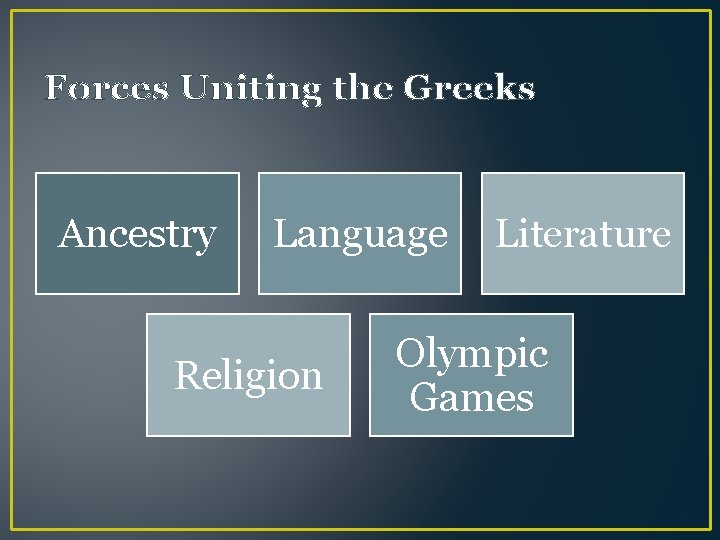
Forces Uniting the Greeks Ancestry Language Religion Literature Olympic Games

Government in Athens
Aristocrats and Tyrants Rule • Greece is the Birthplace of democracy, a type of government which people rule themselves. • Before democracy in Athens, kings rules the city-state. • Later, a group of rich landowners, or aristocrats took power.
Aristocrats and Tyrants Rule • The aristocrats dominated Athenian society. • As the richest men in town, they ran the city’s economy. • They also served as generals and judges. • Common people had little say in the government. • In the 600 s BC, a group of rebels tried to overthrow the aristocrats. • They failed • Their failure resulted in harsher laws.
Athens Creates Democracy • Around 500 BC Cleisthenes overthrow the aristocrats and created a new form of government – Democracy. • All citizens (men) had the right to participate in the assembly.
Changes in Athenian Democracy • As time passed, citizens gained more power. • They served on juries to decide court cases. • Athens remained a democracy for about 170 years. • It reached its height under Pericles. • Pericles encouraged the Athenians to take pride in their city. • He believed that participation in government was as important as defending Athens in war.
End of Democracy in Athens • In 330 s BC Athens was conquered by the Macedonians from north of Greece. • The king ruled like a dictator. No one could make decisions without his approval. • The assembly still met to make laws, but it had to be careful not to upset the king. • Eventually, a new king took over and ended Athenian democracy altogether.
Sparta: A Nation of Soldiers • The Spartans were Dorians who conquered Laconia. • The region lies in Peloponnesus, the Southern part of Greece. • The invaders turned the conquered people into stateowned slaves, called helots, and made them work the land. • Because the helot greatly outnumbered their rulers, the Spartans set up brutal system of strict control.
Spartan government • The Spartan government included two kings and a council of elders who advised the monarchs. • As assembly made up of all citizens approved major decisions. • Citizens were male, native-born Spartans over the age of 30. • The assembly also elected five ephores, officials who help the real power and ran day-to-day affairs
The Rigors of Citizenship • From childhood, a Spartan prepared to be part of the military state. • Every new born was examined and the sickly children were abandoned to die. • At the age of seven, boys began training for a lifetime in the military. • Toughened by a coarse diet, hard exercise, and rigid discipline, Spartan youth became excellent soldiers.
Women • Girls had a rigorous upbringing. • They were expected to produce healthy sons for the army. • They therefore were told to exercise and strengthen their bodies. • Spartan women had to obey their fathers or husbands. But they had the right to inherit property. • Because men were occupied with war, some women took on responsibilities such as running the family’s estate.
Sparta and Its Neighbors • The Spartans isolated themselves from other Greeks. • They looked down on trade and wealth, forbade, their own citizens to travel, and had little use for new ideas or the arts.
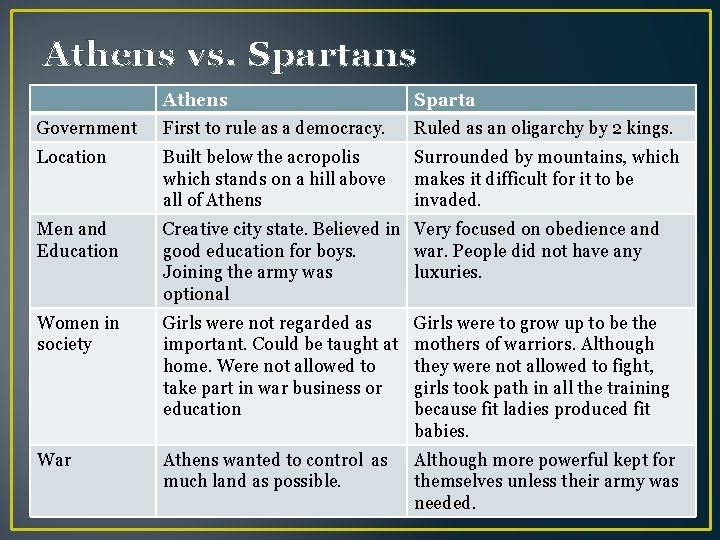
Athens vs. Spartans Athens Sparta Government First to rule as a democracy. Ruled as an oligarchy by 2 kings. Location Built below the acropolis which stands on a hill above all of Athens Surrounded by mountains, which makes it difficult for it to be invaded. Men and Education Creative city state. Believed in Very focused on obedience and good education for boys. war. People did not have any Joining the army was luxuries. optional Women in society Girls were not regarded as important. Could be taught at home. Were not allowed to take part in war business or education Girls were to grow up to be the mothers of warriors. Although they were not allowed to fight, girls took path in all the training because fit ladies produced fit babies. War Athens wanted to control as much land as possible. Although more powerful kept for themselves unless their army was needed.
Forces for Unity • Strong local ties, an independent spirit, and economic rivalry led to fighting among the Greeks city-states. • Despite these divisions, Greeks shared a common culture. • • They spoke the same language. Honored the same ancient heroes. Worshiped the same gods. Participated in common festivals.
The Persian Wars • In 492 B. C. King Darius I of Persia cast an eye across the proud Greek city-states. • Seeking revenge for a Greek insult, he sent messengers throughout Greece demanding gifts of “earth and water. ” – Symbols of submission to Darius.
The Persian Wars • Many of the city-states obeyed Darius’ demands since the Persian empire was the most powerful in the Mediterranean world. • But Athens and Sparta were not so quick to submit. • Instead, the Athenians threw Darius’ messengers into a well, while the Spartans tossed them into a pit. The Persians, they said could collect their own earth and water.
The Persian Wars • The Greek historian Herodotus told this story of Greek defiance and pride. Despite their cultural ties, the Greek city-states were bitterly divided. Yet, when the Persians threatened, the Greeks briefly put aside their differences to defend their freedom.
The Persian Wars • By 500 B. C. , Athens had emerged as the wealthiest Greek city-state. • The Persians conquered a huge empire stretching from Asia Minor to the border of India.
The Persian Wars • Through under Persian rule, these Ionian city-state were largely self government, still, they resented their situation. • In 499 B. C. , Ionian Greeks rebelled against Persian rule. Athens sent ships to help them.
The Persian Wars • The Athenians defeated the Persians at Marathon in 490. • Darius died before he could mass his troops for another attack. • In 480 B. C. his son Xerxes (Zerkseez) sent a much larger force to conquer Greece.
The Persian Wars • By this time, Athens had persuaded Sparta and other citystates to join in the fight against Persia. • A small Spartan force guarded the narrow mountain pass at Thermopylae. Led by the great warrior king Leonidas.
The Persian Wars • After defeating the Spartans, the Persians marched south and burned Athens. • The city was empty. The Athenians had withdrawn to safety. • The Greeks now put their faith in the fleet of ships that Themistocles had urged them to build.
The Persian Wars • The Athenians lured the Persian navy into the narrow strait of Salamis. • Athenian warships, powered by rowers, drove into the Persian boats with underwater battering rams. • On the shore, Xerxes watched helplessly as his might fleet sank.
The Persian War • The following year, the Greeks defeated the Persians on land on Asia Minor. • The victory marked an end of the Persian invasions.
Greek History • The Persians & Greeks: Crash Course World History #5 • http: //www. youtube. com/watch? v=Qmk. VSas. ZIM&list=PLBDA 2 E 52 FB 1 EF 80 C 9&index=5
The Trojan War • Was the Trojan War a real historical event or merely a legend in Mycenaean history?
The Trojan War • About 1200 B. C. , the Mycenaeans fought the Trojan War with the city of Troy in Anatolia. • At the same time, foreigners invaded the Mycenaean homeland • From 1100 to 800 B. C. , chaos reigned throughout the eastern Mediterranean • In the absence of a centralized state or empire, local institutions took the lead in restoring political order to Greece
The Trojan War (13 th-12 th Century B. C. ) • The Trojans were people from ancient Troy (Turkey). • The Trojan War was fought between the Trojans and the Greeks over the beautiful maiden Helen…
The Trojan Horse • The Greeks wanted to sneak into the gates of Ancient Troy, so they built a giant wooden horse and told the Trojans it was a gift from the Aechaens (Greeks).
Trojan War • Two epic poems by Homer “Iliad” and “Odyssey” describe the Trojan War • Approximately 1194 -1184 BCE • Greeks vs Troy • Helen of Sparta + Paris of Troy “the face that launched a thousand ships” • Achilles, Odysseus, Hector, Agamemnon and the Trojan Horse • Archaeologist- Heinrich Schliemann (claims that he found Troy and the early Greek civilization of Myceaneans)
Homer • Epic: a long poem which tells a story involving gods, heroes, and heroic exploits: • Iliad: Greek perspective on the war against Troy in the 12 th century B. C. • Odyssey: Experiences of the Greek hero Odysseus as he sailed home after the Trojan.

Greek Accomplishments
Philosophers: Lovers of Wisdom • Greek thinkers challenged the belief that events were caused by the whims of gods. • Instead, they used observation and reason to find causes for events. • The Greeks called these thinkers philosophers, meaning “lovers of wisdom. ” 59
Philosophers: Lovers of Wisdom • Greek philosophers explored many subjects, from mathematics and music to logic, or rational thinking. • Through reason and observation, they believed, they could discover laws that governed the universe. • Much modern science traces its roots to the Greek search for such principles
Ethical Issues • Other Greek Philosophers were more interested in ethics and morality. • They debated such questions as what was the best kind of government and what standards should rule human behavior.
Socrates Questions Tradition • One outspoken critic of the Sophists was Socrates, an Athenian stonemason and philosopher. • Most of what we know about Socrates comes from his student Plato. • Socrates himself wrote no books. Instead, he passed his days in the marketplace asking people about their beliefs. • Using a process we now call the Socratic method, he would pose a series of questions to a student or passing citizen, and challenge them to examine the implications of their answers 62
Socrates Questions Tradition • When he was about 70 years old, Socrates was put on trial. His enemies accused him of corrupting the city’s youth and failing to respect the gods. • Standing before a jury of 501 citizens, Socrates offered a calm and reasoned defense. But the jurors condemned him to death. Loyal to the laws of Athens, Socrates accepted the death penalty. He drank a cup of hemlock, a deadly poison.
Plato Envisions A Perfect Society • The execution of Socrates left Plato with a lifelong distrust of democracy. • He fled Athens for 10 years. When he returned, he set up a school called the Academy. There, he taught and wrote about his own ideas 64
Plato Envisions A Perfect Society • In his book The Republic, Plato described his vision of an ideal state. • He rejected Athenian democracy because it had condemned Socrates just as it tended to other excesses. • Instead, Plato argued that the state should regulate every aspect of its citizens’ lives in order to provide for their best interests 65
Plato Envisions A Perfect Society • He divided his ideal society into three classes: • workers to produce the necessities of life, • soldiers to defend the state, • and philosophers to rule. This elite class of leaders would be specially trained to ensure order and justice. The wisest of them, a philosopher-king, would have the ultimate authority. 66
Aristotle Pursues the Golden Mean • Plato’s most famous student, Aristotle, developed his own ideas about government. • He analyzed all forms of government, from monarchy to democracy, and found good and bad examples of each. • Like Plato, he was suspicious of democracy, which he thought could lead to mob rule. • In the end, he favored rule by a single strong and virtuous leader 67
Aristotle Pursues the Golden Mean • He left writings on politics, ethics, logic, biology, literature, and many other subjects. • When the first European universities evolved some 1, 500 years later, their courses were based largely on the works and ideas of Aristotle.
Monumental Architecture • Greek architects sought to convey a sense of perfect balance to reflect the harmony and order of the universe. • The most famous example of Greek architecture is the Parthenon, a temple dedicated to the goddess Athena.
Monumental Architecture • Greek architecture has been widely admired for centuries. Today, many public buildings throughout the world have incorporated Greek architectural elements, such as columns, in their designs.
Artists Craft Lifelike Human Forms • Early Greek sculptors carved figures in rigid poses, perhaps imitating Egyptian styles. • By 450 B. C. , Greek sculptors had developed a new style that emphasized more natural forms. • While their work was lifelike, it was also idealistic. That is, sculptors carved gods, goddesses, athletes, and famous men in a way that showed human beings in their most perfect, graceful form.
Sculpture • Ideals of classical art—Order, Balance and Proportion • Sculptures show grace, serenity, strength and perfection • Most Greek Sculptures exist today because the Romans copied them
Arts • The only Greek paintings to survive are on pottery. • They offer intriguing views of every day Greek life. • Women carry water from wells. • warriors race into battle, and athletes compete in javelin contests. • Each scene is designed to fit the shape of the pottery.
Greek Poetry and Fables • Greek poems and stories are the oldest in the Western world and serve as models for European and American poems and stories. • An epic is a long poem about heroic deeds. • The first great epics were the Iliad and the Odyssey, written by Homer. • The Greeks believed these two epics were real history. • A slave named Aesop wrote many fable. • A fable is a short tale that teaches a lesson. • Fables were passed from one person to another through oral traditions.
Drama Comedies • Aristophanes • Plays satirized politics and politicians, poking fun at society and ridiculing the rich Tragedies • Created to honor the God of Wine and fertility– Dionysus • Performed in Amphitheatres • Aeschylus, Sophocles, and Euripides • Sophocles focuses on the individual • Oedipus Rex despite doing everything to change his fate still ends up killing his father and marrying his mother for which he punishes himself by stabbing himself in the eye
Olympic Games • Began in 776 BC in the city-state of Olympia • Held to honor Zeus • Competitions first included footraces then wrestling, boxing, javelin, discus throwing were added • The pankration event combined wrestling and boxing and had no rules except scratching the facial area • Winner would receive a wreath of Olive leaves
Religion and Education • The ancient Greeks created great myths and works of literature that influence the way we speak and wrote today. • The Greeks created myths to explain the world. • The ancient Greeks believed in many gods. These gods were at the center of Greek mythology.
Worshipping the deities • Each city in Greece had a god or goddess that the citizens worshipped. They built temples, statues, and had celebrations to honor that deity. They also made offerings to the gods.
Study of History • Herodotus—History of the Persian wars—often called The father of history • Thucydides—History of the Peloponnesian Wars • Began the scientific analysis of events based on actual eyewitness accounts and factual evidence and then added their own poetic interpretations
Science • Eratosthenes—Correctly measures the earth’s circumference. • Ptolemy—Geocentric theory—cartography, creation of latitude/longitude • Archimedes—Develops a system of levers and pulleys • Hippocrates —Medicine • Astronomy—Aristarchus—proposed • Heliocentric theory • Anaxagoras—eclipses
Activity • Research how did Greece influence our society today?
- Slides: 81