
2 8 Rule Utilitarianism 1 1 Applying Principle

- Slides: 39
2. 8 Rule Utilitarianism 1 -1
Applying Principle of Utility to Rules • We ought to adopt moral rules which, if followed by everyone, will lead to the greatest increase in total happiness • Act utilitarianism applies Principle of Utility to individual actions • Rule utilitarianism applies Principle of Utility to moral rules 1 -2
Anti-Worm Scenario • August 2003: Blaster worm infected thousands of Windows computers • Soon after, Nachi worm appeared – – Took control of vulnerable computer Located and destroyed copies of Blaster Downloaded software patch to fix security problem Used computer as launching pad to try to “infect” other vulnerable PCs 1 -3
Evaluation using Rule Utilitarianism • Proposed rule: If I can write a helpful worm that removes a harmful worm from infected computers and shields them from future attacks, I should do so • Who would benefit – People who do not keep their systems updated • Who would be harmed – People who use networks – People who’s computers are invaded by buggy antiworms – System administrators • Conclusion: Harm outweighs benefits. Releasing anti -worm is wrong. 1 -4
Case for Rule Utilitarianism • Not every moral decision requires performing utilitarian calculus • Moral rules survive exceptional situations • Avoids the problem of moral luck • Reduces the problem of bias • Appeals to a wide cross-section of society 1 -5
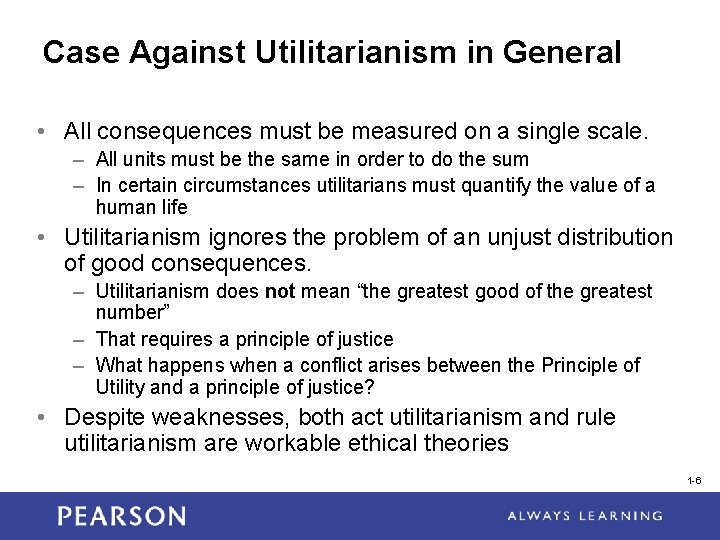
Case Against Utilitarianism in General • All consequences must be measured on a single scale. – All units must be the same in order to do the sum – In certain circumstances utilitarians must quantify the value of a human life • Utilitarianism ignores the problem of an unjust distribution of good consequences. – Utilitarianism does not mean “the greatest good of the greatest number” – That requires a principle of justice – What happens when a conflict arises between the Principle of Utility and a principle of justice? • Despite weaknesses, both act utilitarianism and rule utilitarianism are workable ethical theories 1 -6
2. 9 Social Contract Theory 1 -7
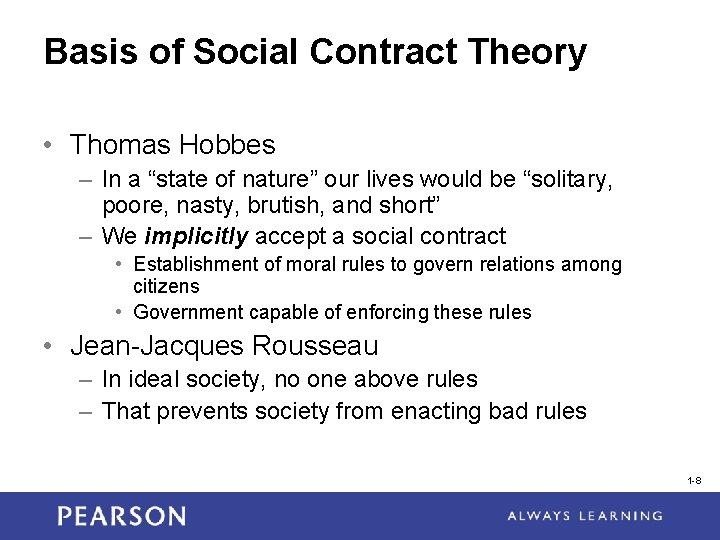
Basis of Social Contract Theory • Thomas Hobbes – In a “state of nature” our lives would be “solitary, poore, nasty, brutish, and short” – We implicitly accept a social contract • Establishment of moral rules to govern relations among citizens • Government capable of enforcing these rules • Jean-Jacques Rousseau – In ideal society, no one above rules – That prevents society from enacting bad rules 1 -8
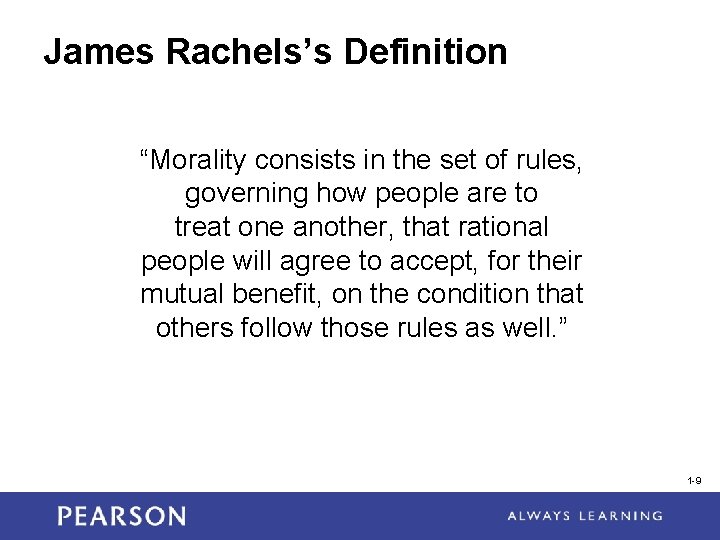
James Rachels’s Definition “Morality consists in the set of rules, governing how people are to treat one another, that rational people will agree to accept, for their mutual benefit, on the condition that others follow those rules as well. ” 1 -9
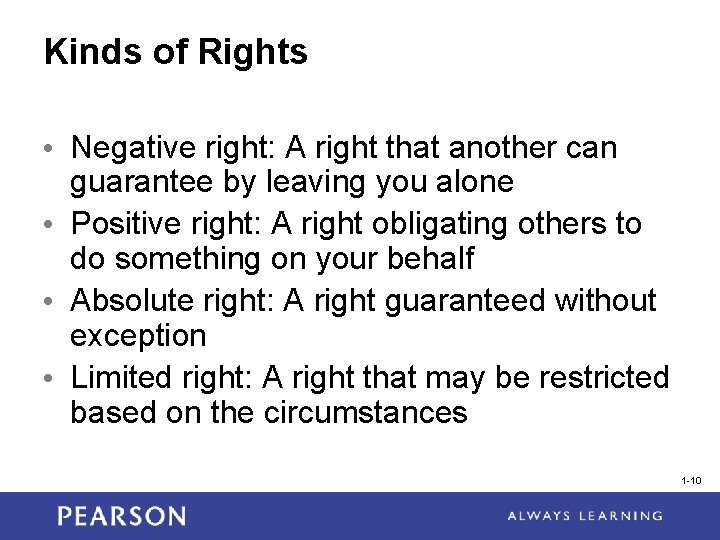
Kinds of Rights • Negative right: A right that another can guarantee by leaving you alone • Positive right: A right obligating others to do something on your behalf • Absolute right: A right guaranteed without exception • Limited right: A right that may be restricted based on the circumstances 1 -10
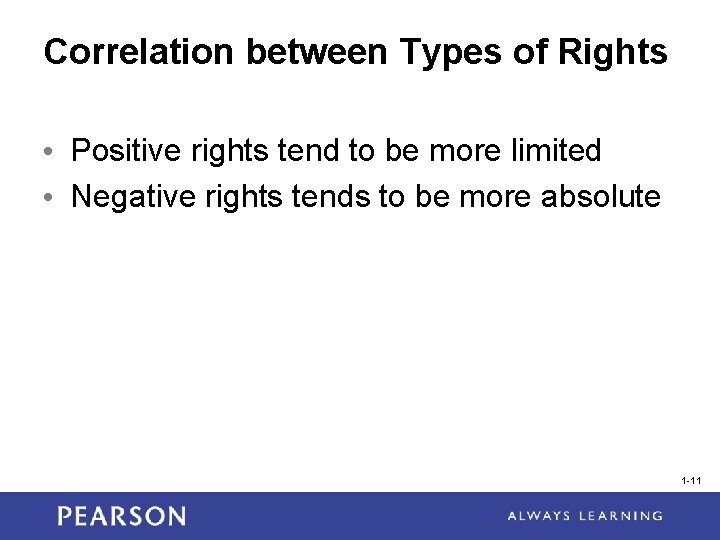
Correlation between Types of Rights • Positive rights tend to be more limited • Negative rights tends to be more absolute 1 -11
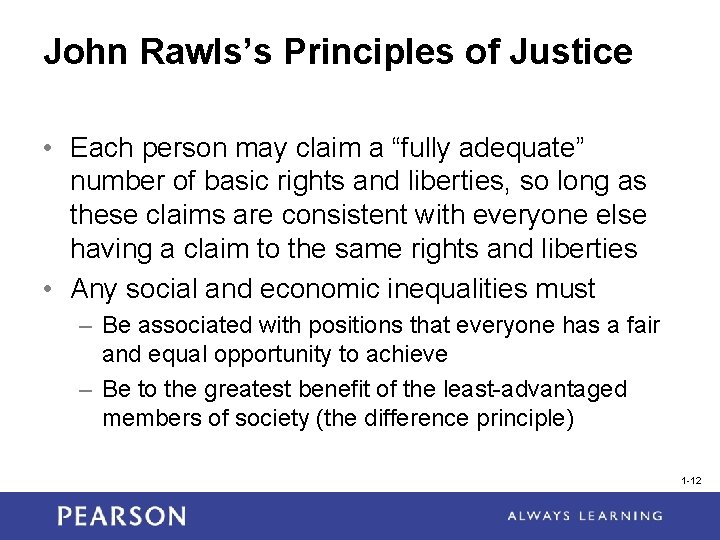
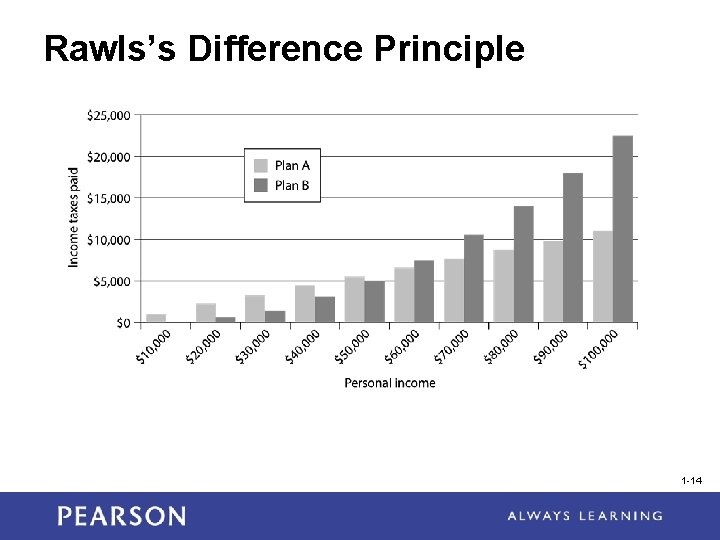
John Rawls’s Principles of Justice • Each person may claim a “fully adequate” number of basic rights and liberties, so long as these claims are consistent with everyone else having a claim to the same rights and liberties • Any social and economic inequalities must – Be associated with positions that everyone has a fair and equal opportunity to achieve – Be to the greatest benefit of the least-advantaged members of society (the difference principle) 1 -12
Rawls’s First Principle of Justice 1 -13
Rawls’s Difference Principle 1 -14
DVD Rental Scenario • Bill owns chain of DVD rental stores • Collects information about rentals from customers • Constructs profiles of customers • Sells profiles to direct marketing firms • Some customers happy to receive more mail order catalogs; others unhappy at increase in “junk mail” 1 -15
Evaluation (Social Contract Theory) • Consider rights of Bill, customers, and mail order companies. • Does customer have right to expect name, address to be kept confidential? • If customer rents DVD from bill, who owns information about transaction? • If Bill and customer have equal rights to information, Bill did nothing wrong to sell information. • If customers have right to expect name and address or transaction to be confidential without giving permission, then Bill was wrong to sell information without asking for permission. 1 -16
Case for Social Contract Theory • Framed in language of rights • Explains why people act in self-interest in absence of common agreement • Provides clear analysis of certain citizen/government problems – Why okay for government to deprive criminals of certain rights – Why civil obedience can be morally right action • Workable ethical theory 1 -17
Case Against Social Contract Theory • • No one signed social contract Some actions have multiple characterizations Conflicting rights problem May unjustly treat people incapable of upholding contract • Despite weaknesses, a workable theory 1 -18
2. 10 Virtue Ethics 1 -19
Critique of Enlightenment Theories • Kantianism, utilitarianism, social contract theory ignore important moral considerations – – moral education moral wisdom family and social relationships role of emotions • Virtue ethics – arete, virtue, excellence: reaching highest potential – Aristotle’s Nicomachean Ethics (4 th century BC) 1 -20
Virtues and Vices • Two types of virtue – intellectual virtues: virtues associated with reasoning and truth – moral virtues: virtues of character (e. g. , honesty) • Moral virtues – developed by habitually performing right action – deep-seated character traits – disposition to act in a certain way and feel in a certain way 1 -21
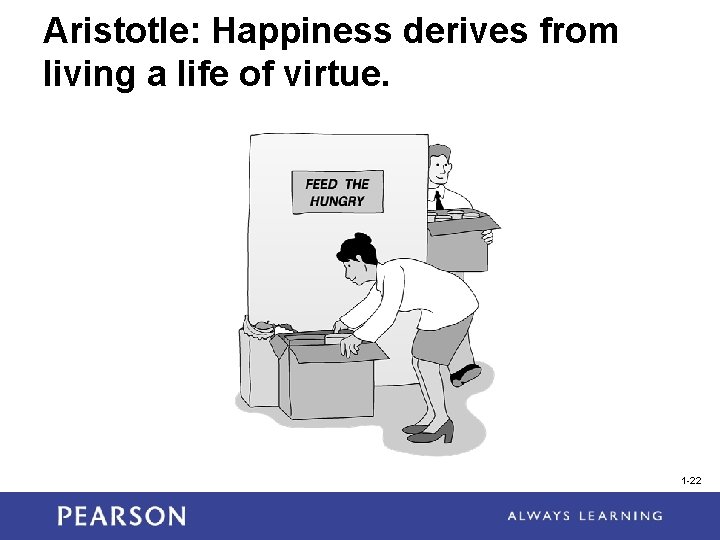
Aristotle: Happiness derives from living a life of virtue. 1 -22
Summary of Virtue Ethics A right action is an action that a virtuous person, acting in character, would do in the same circumstances. A virtuous person is a person who possesses and lives out the virtues. The virtues are those character traits human beings needs in order to flourish and be truly happy. 1 -23
Vices • Vices are opposite of virtues • Vice: a character trait that prevents a human being from flourishing or being truly happy • Often, a virtue situated between two vices – Courage between cowardliness and rashness – Generosity between stinginess and prodigality 1 -24
Case for Virtue Ethics • It often makes more sense to focus on virtues than obligations, rights, or consequences • Personal relationships can be morally relevant to decision making • Our moral decision-making skills develop over time • With this theory there are no irresolvable moral dilemmas • Emotions play an important role in living a moral life 1 -25
Case Against Virtue Ethics • Reasonable people may disagree on character traits needed for human flourishing • Cannot use virtue ethics to guide government policy • Virtue ethics undermines attempts to hold people responsible for their bad actions • Despite weaknesses, virtue ethics a workable theory 1 -26
2. 11 Comparing Workable Ethical Theories 1 -27
Objectivism vs. Relativism • Objectivism: Morality has an existence outside the human mind • Relativism: Morality is a human invention • Divine command theory, ethical egoism, Kantianism, utilitarianism, social contract theory, and virtue ethics examples of objectivism 1 -28
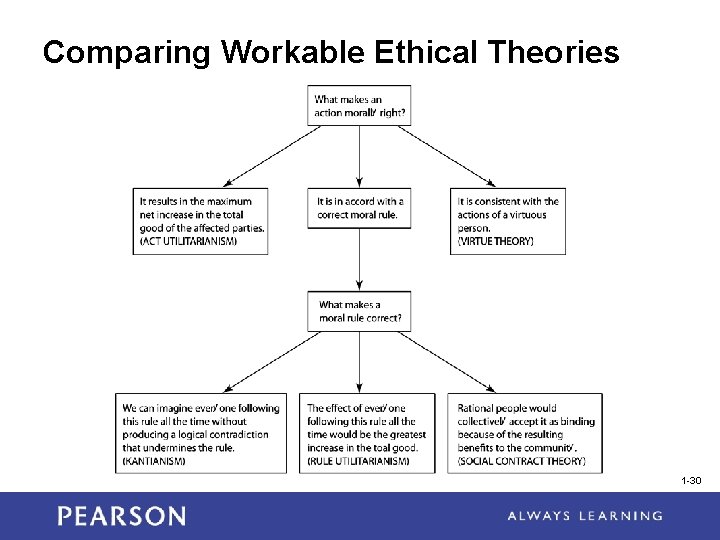
Workable Ethical Theories • We seek theories with these characteristics: – Based on the ethical point of view – Objective moral principles developed using logical reasoning based on facts and commonly held values • Workable ethical theories – – Kantianism Act and rule utilitarianism Social contract theory Virtue ethics 1 -29
Comparing Workable Ethical Theories 1 -30
2. 12 Morality of Breaking the Law 1 -31
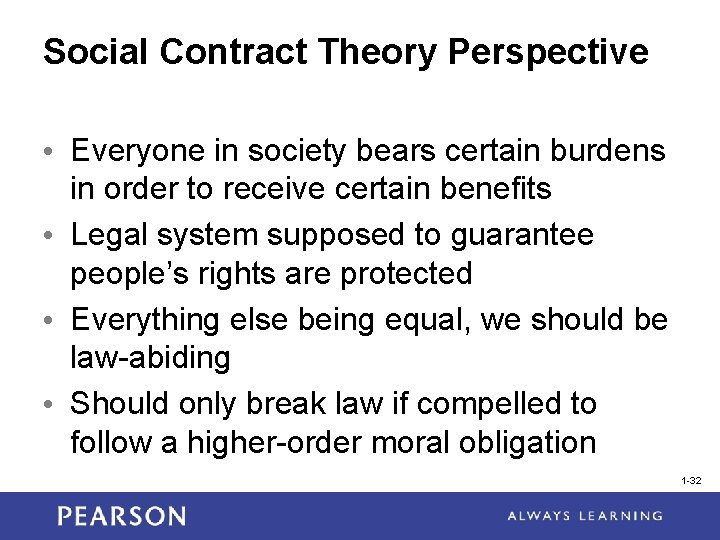
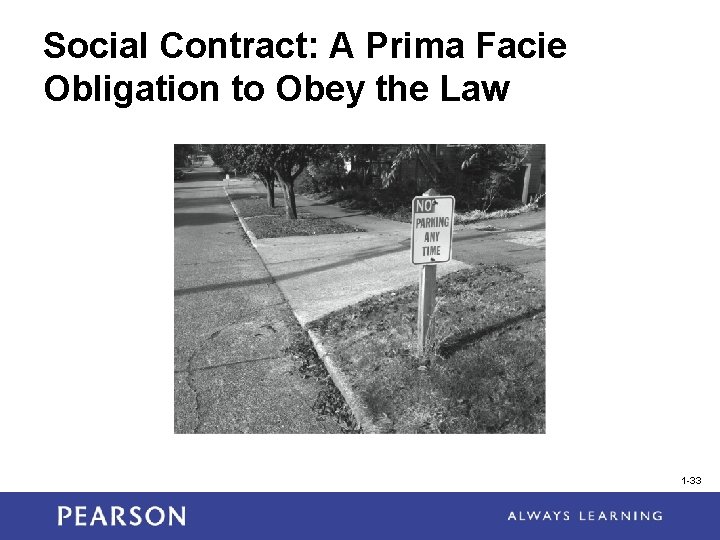
Social Contract Theory Perspective • Everyone in society bears certain burdens in order to receive certain benefits • Legal system supposed to guarantee people’s rights are protected • Everything else being equal, we should be law-abiding • Should only break law if compelled to follow a higher-order moral obligation 1 -32
Social Contract: A Prima Facie Obligation to Obey the Law 1 -33
Kantian Perspective • Everyone wants to be treated justly • Imagine rule: “I may break a law I believe to be unjust” • If everyone acted according to this rule, then laws would be subverted • Contradiction: Cannot both wish to be treated justly and allow laws to be subverted 1 -34
Rule Utilitarian Perspective • What would be consequences of people ignoring laws they felt to be unjust? • Beneficial consequence: Happiness of people who are doing what they please • Harmful consequences: Harm to people directly affected by lawless actions, general loss of respect for laws, increased burden on criminal justice system • Harms greater than benefits 1 -35
Act Utilitarian Perspective • Possible to conceive of situations where benefits of breaking law exceed harms • Suppose give penniless, bedridden friend copy of CD • Friend benefits by $15 (value of CD) • I benefit by $10 (satisfaction of helping friend) • Harms of $0 (no lost sale, no police involvement) • With $25 of benefit and $0 of harm, action is determined to be good 1 -36
Summary 1 -37
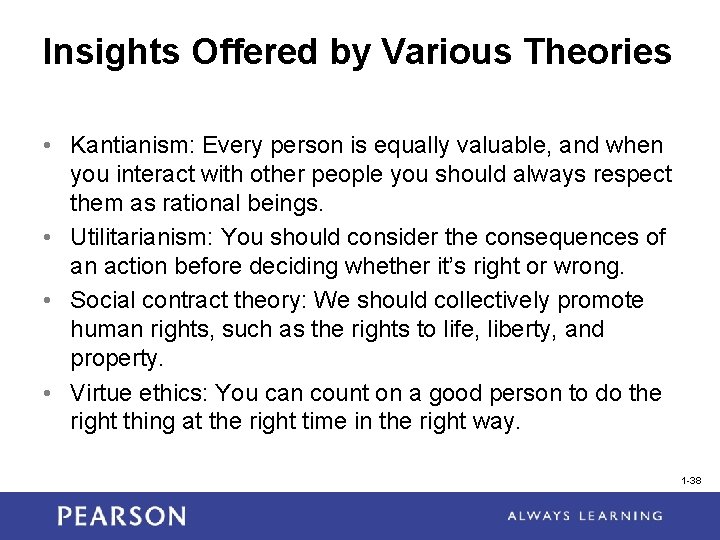
Insights Offered by Various Theories • Kantianism: Every person is equally valuable, and when you interact with other people you should always respect them as rational beings. • Utilitarianism: You should consider the consequences of an action before deciding whether it’s right or wrong. • Social contract theory: We should collectively promote human rights, such as the rights to life, liberty, and property. • Virtue ethics: You can count on a good person to do the right thing at the right time in the right way. 1 -38
It’s Up to You • You can consider duties and rights and consequences and virtues when making moral decisions • Ultimately, you have to decide: – What kind of person do I want to be? – What kind of world do I want to live in? 1 -39