
2 7 SPATIAL PARTITIONING Overview of different forms

- Slides: 33
2. 7. SPATIAL PARTITIONING Overview of different forms of bounding volume hierarchy
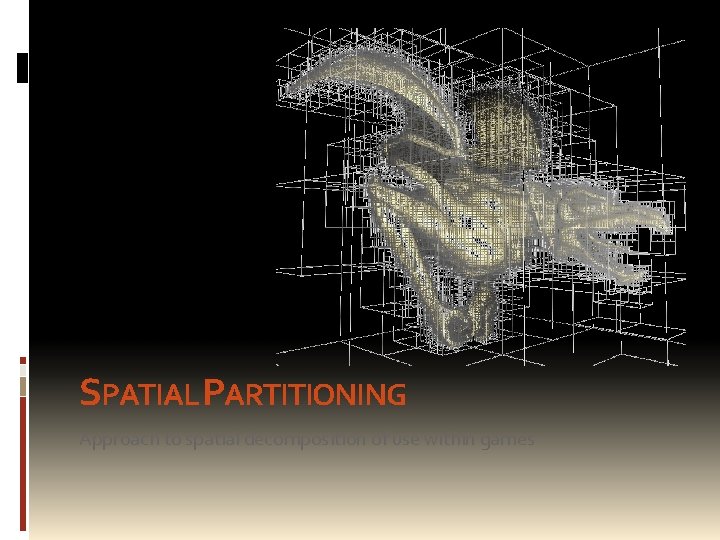
SPATIAL PARTITIONING Approach to spatial decomposition of use within games
Spatial Partitioning As with the use of bounding volume hierarchies, the goal behind spatial partitioning approaches is to restrict the number of pairwise tests that need to be performed within broad-phase processing. Spatial partitioning techniques operate by dividing space into a number of regions that can be quickly tested against each object. Two types of spatial partitioning will be considered: grids and trees. Additionally, a spatial sorting approach will also be considered.
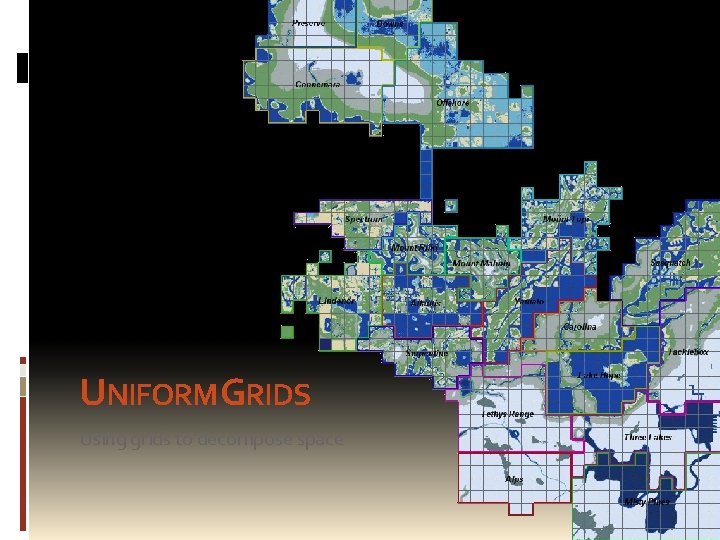
UNIFORM GRIDS Using grids to decompose space
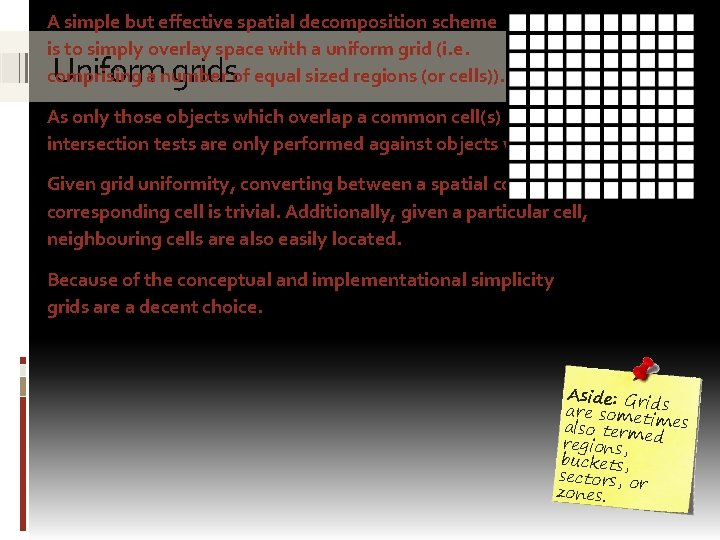
A simple but effective spatial decomposition scheme is to simply overlay space with a uniform grid (i. e. comprising a number of equal sized regions (or cells)). Uniform grids As only those objects which overlap a common cell(s) can be in contact, intersection tests are only performed against objects which share cells. Given grid uniformity, converting between a spatial coordinate and the corresponding cell is trivial. Additionally, given a particular cell, neighbouring cells are also easily located. Because of the conceptual and implementational simplicity grids are a decent choice. Aside: Gri are sometds also termeimes d regions, buckets, sectors, or zones.
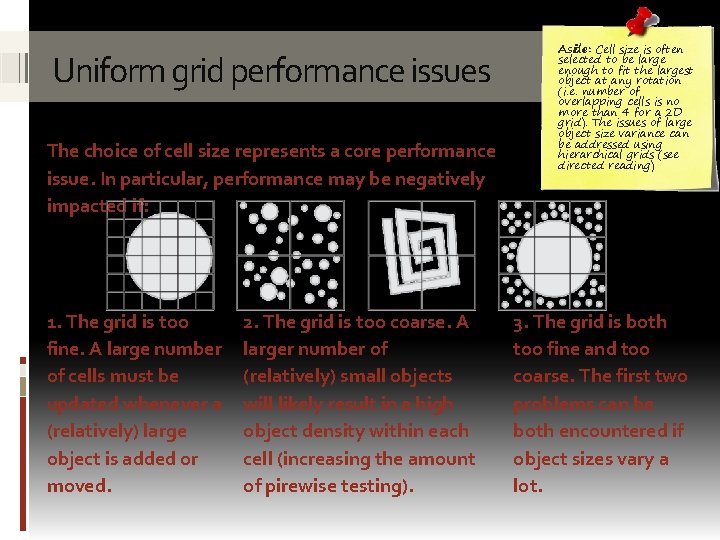
Uniform grid performance issues The choice of cell size represents a core performance issue. In particular, performance may be negatively impacted if: 1. The grid is too fine. A large number of cells must be updated whenever a (relatively) large object is added or moved. 2. The grid is too coarse. A larger number of (relatively) small objects will likely result in a high object density within each cell (increasing the amount of pirewise testing). Aside: Cell size is often selected to be large enough to fit the largest object at any rotation (i. e. number of overlapping cells is no more than 4 for a 2 D grid). The issues of large object size variance can be addressed using hierarchical grids (see directed reading) 3. The grid is both too fine and too coarse. The first two problems can be both encountered if object sizes vary a lot.
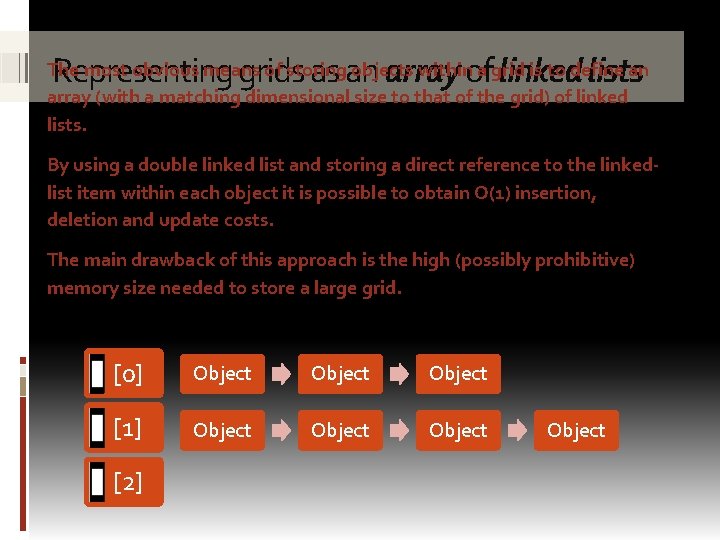
Representing grids as an array of linked lists The most obvious means of storing objects within a grid is to define an array (with a matching dimensional size to that of the grid) of linked lists. By using a double linked list and storing a direct reference to the linkedlist item within each object it is possible to obtain O(1) insertion, deletion and update costs. The main drawback of this approach is the high (possibly prohibitive) memory size needed to store a large grid. [0] Object [1] Object [2] Object
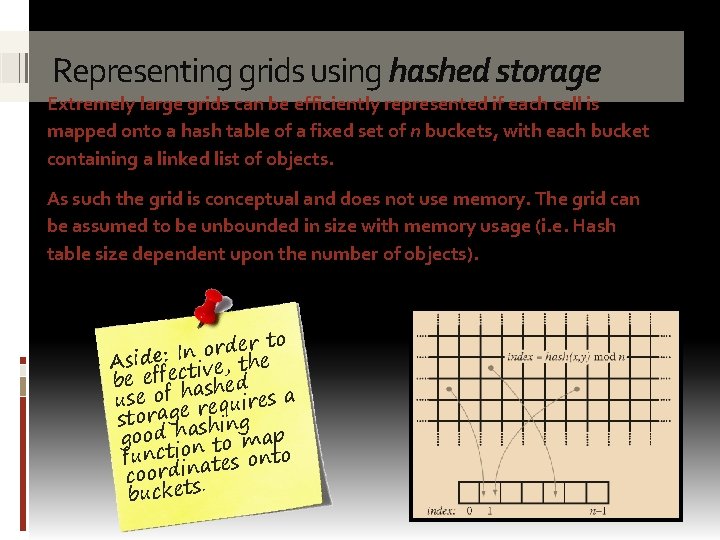
Representing grids using hashed storage Extremely large grids can be efficiently represented if each cell is mapped onto a hash table of a fixed set of n buckets, with each bucket containing a linked list of objects. As such the grid is conceptual and does not use memory. The grid can be assumed to be unbounded in size with memory usage (i. e. Hash table size dependent upon the number of objects). er to d r o n I Aside: tive, the be effec ashed use of h requires a storageashing good h n to map functio ates onto coordin. buckets
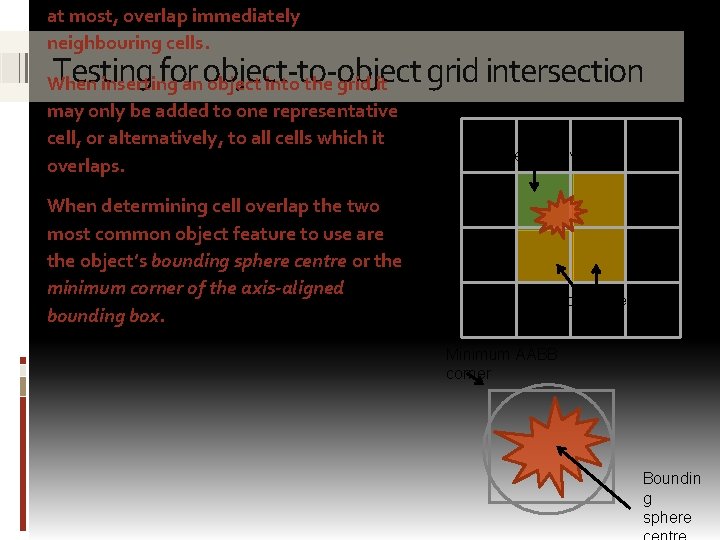
at most, overlap immediately neighbouring cells. Testing for object-to-object grid intersection When inserting an object into the grid it may only be added to one representative cell, or alternatively, to all cells which it overlaps. When determining cell overlap the two most common object feature to use are the object’s bounding sphere centre or the minimum corner of the axis-aligned bounding box. Representative cell Overlapping cells Minimum AABB corner Boundin g sphere
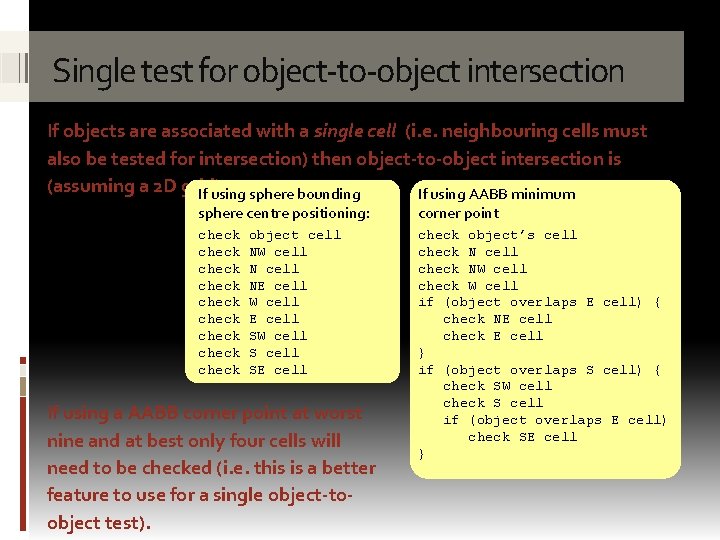
Single test for object-to-object intersection If objects are associated with a single cell (i. e. neighbouring cells must also be tested for intersection) then object-to-object intersection is (assuming a 2 D grid): If using sphere bounding If using AABB minimum sphere centre positioning: corner point check check check object’s cell check NW cell check W cell if (object overlaps E cell) { check NE cell check E cell } if (object overlaps S cell) { check SW cell check S cell if (object overlaps E cell) check SE cell } object cell NW cell NE cell W cell E cell SW cell SE cell If using a AABB corner point at worst nine and at best only four cells will need to be checked (i. e. this is a better feature to use for a single object-toobject test).
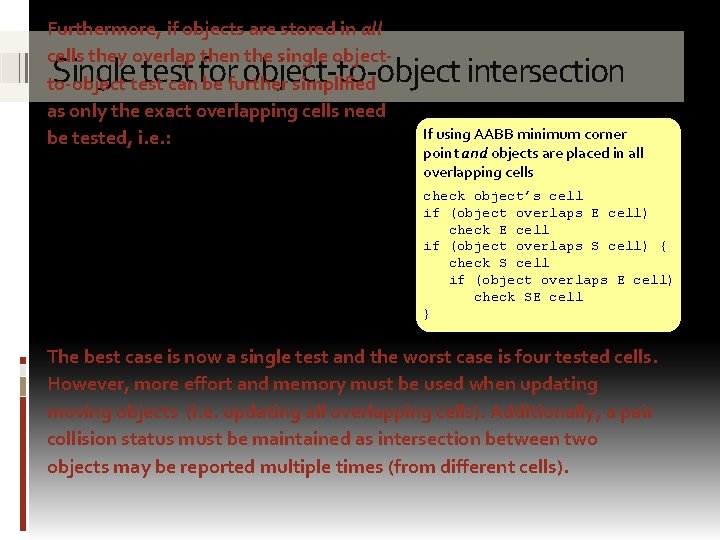
Furthermore, if objects are stored in all cells they overlap then the single objectto-object test can be further simplified as only the exact overlapping cells need be tested, i. e. : Single test for object-to-object intersection If using AABB minimum corner point and objects are placed in all overlapping cells check object’s cell if (object overlaps E cell) check E cell if (object overlaps S cell) { check S cell if (object overlaps E cell) check SE cell } The best case is now a single test and the worst case is four tested cells. However, more effort and memory must be used when updating moving objects (i. e. updating all overlapping cells). Additionally, a pair collision status must be maintained as intersection between two objects may be reported multiple times (from different cells).
Consult the recommended course text for details of the following: Other grid sections • All Tests at a Time for Object-to-object Intersection • Implicit Grids • Hierarchical Grids
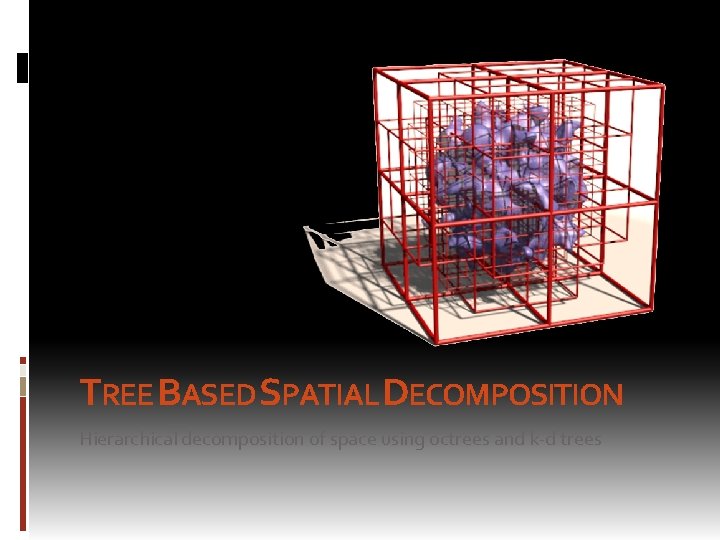
TREE BASED SPATIAL DECOMPOSITION Hierarchical decomposition of space using octrees and k-d trees
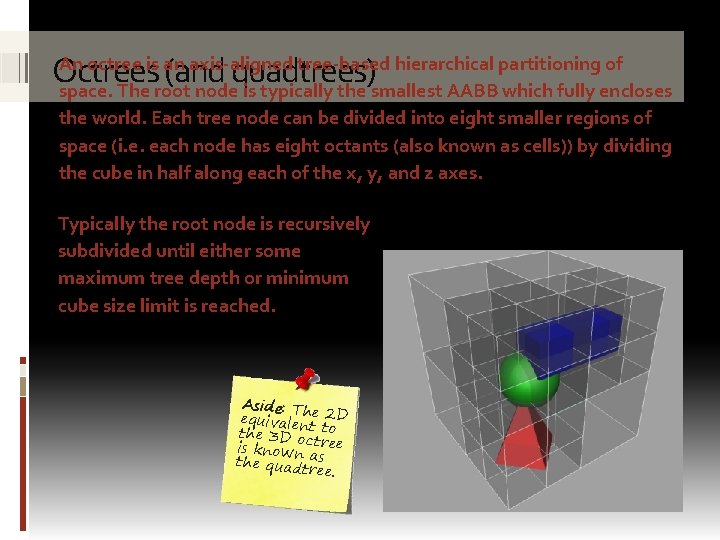
An octree is an axis-aligned tree-based hierarchical partitioning of Octrees (and quadtrees) space. The root node is typically the smallest AABB which fully encloses the world. Each tree node can be divided into eight smaller regions of space (i. e. each node has eight octants (also known as cells)) by dividing the cube in half along each of the x, y, and z axes. Typically the root node is recursively subdivided until either some maximum tree depth or minimum cube size limit is reached. Aside: Th equivalen e 2 D the 3 D oct to is known tree the quadt as ree.
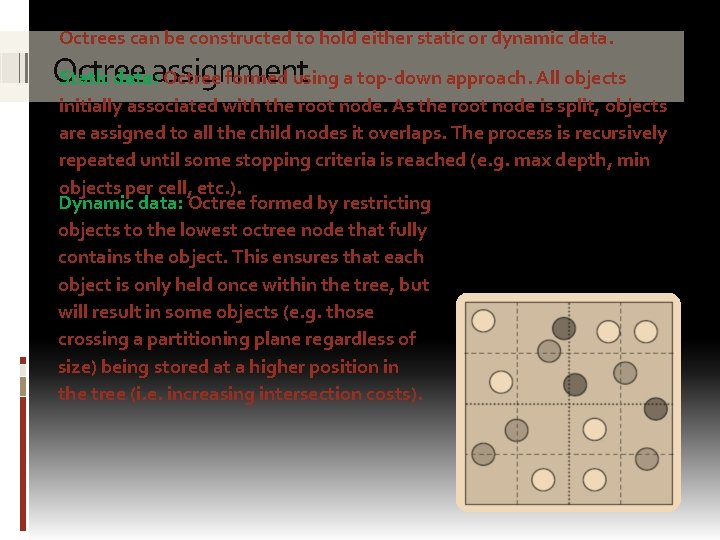
Octrees can be constructed to hold either static or dynamic data. Octree Static data: assignment Octree formed using a top-down approach. All objects initially associated with the root node. As the root node is split, objects are assigned to all the child nodes it overlaps. The process is recursively repeated until some stopping criteria is reached (e. g. max depth, min objects per cell, etc. ). Dynamic data: Octree formed by restricting objects to the lowest octree node that fully contains the object. This ensures that each object is only held once within the tree, but will result in some objects (e. g. those crossing a partitioning plane regardless of size) being stored at a higher position in the tree (i. e. increasing intersection costs).
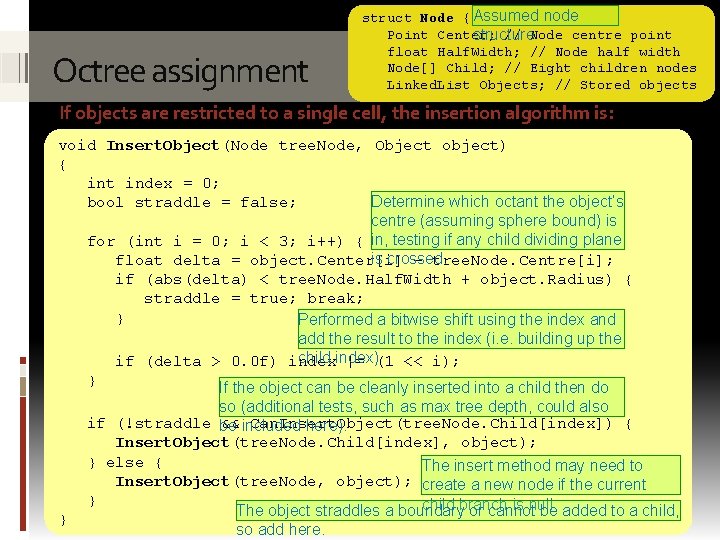
Octree assignment struct Node { Assumed node Point Center; // Node centre point structure float Half. Width; // Node half width Node[] Child; // Eight children nodes Linked. List Objects; // Stored objects If objects are restricted to a single cell, the insertion algorithm is: void Insert. Object(Node tree. Node, Object object) { int index = 0; Determine which octant the object’s bool straddle = false; centre (assuming sphere bound) is for (int i = 0; i < 3; i++) { in, testing if any child dividing plane is crossed. float delta = object. Center[i] – tree. Node. Centre[i]; if (abs(delta) < tree. Node. Half. Width + object. Radius) { straddle = true; break; } Performed a bitwise shift using the index and add the result to the index (i. e. building up the child index) if (delta > 0. 0 f) index |= (1 << i); } If the object can be cleanly inserted into a child then do so (additional tests, such as max tree depth, could also if (!straddle be && included Can. Insert. Object(tree. Node. Child[index]) { here). Insert. Object(tree. Node. Child[index], object); } else { The insert method may need to Insert. Object(tree. Node, object); create a new node if the current } child branch is null The object straddles a boundary or cannot be added to a child, } so add here.
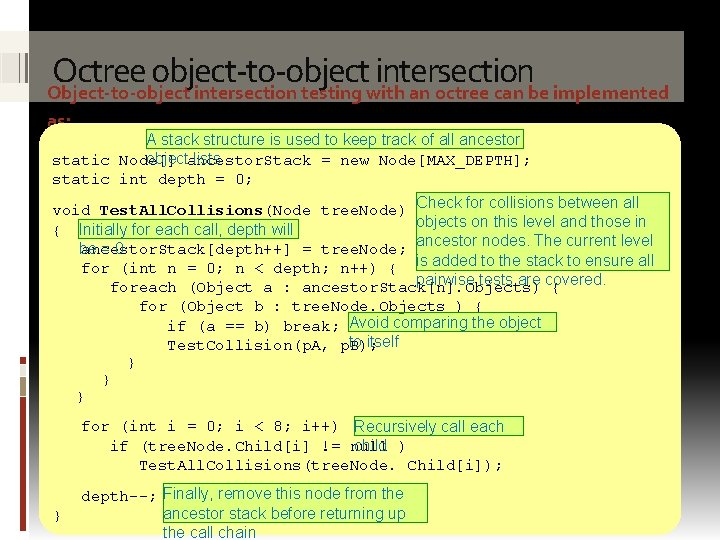
Octree object-to-object intersection Object-to-object intersection testing with an octree can be implemented as: A stack structure is used to keep track of all ancestor objectancestor. Stack lists static Node[] = new Node[MAX_DEPTH]; static int depth = 0; void Test. All. Collisions(Node tree. Node) Check for collisions between all objects on this level and those in { Initially for each call, depth will ancestor. Stack[depth++] = tree. Node; ancestor nodes. The current level be =0 for (int n = 0; n < depth; n++) { is added to the stack to ensure all pairwise tests are covered. foreach (Object a : ancestor. Stack[n]. Objects) { for (Object b : tree. Node. Objects ) { if (a == b) break; Avoid comparing the object to itself Test. Collision(p. A, p. B); } } } for (int i = 0; i < 8; i++) Recursively call each if (tree. Node. Child[i] != null child ) Test. All. Collisions(tree. Node. Child[i]); } depth--; Finally, remove this node from the ancestor stack before returning up the call chain
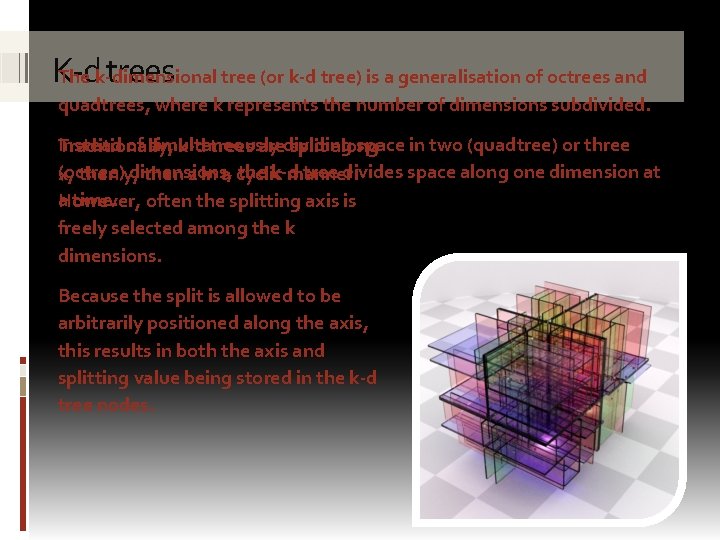
K-d trees tree (or k-d tree) is a generalisation of octrees and The k-dimensional quadtrees, where k represents the number of dimensions subdivided. Instead of simultaneously space in two (quadtree) or three Traditionally, k-d trees aredividing split along (octree) dimensions, the k-d tree divides space along one dimension at x, then y, then z in a cyclic manner. a time. often the splitting axis is However, freely selected among the k dimensions. Because the split is allowed to be arbitrarily positioned along the axis, this results in both the axis and splitting value being stored in the k-d tree nodes.
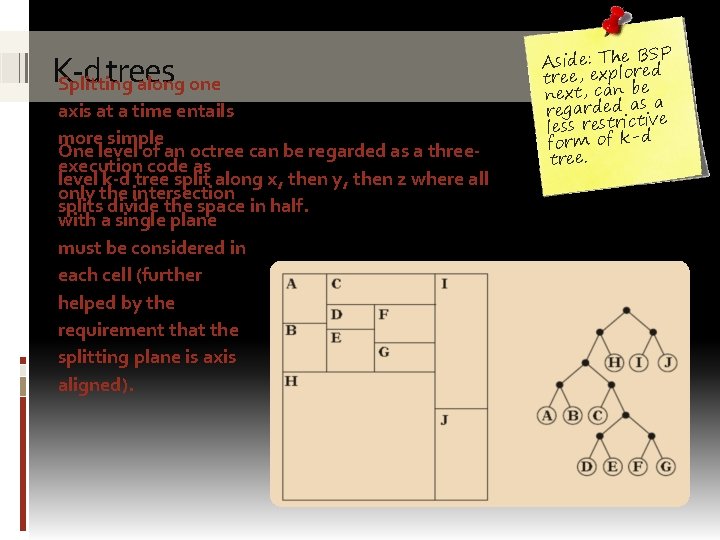
K-d trees Splitting along one axis at a time entails more simple One level of an octree can be regarded as a threeexecution code as level k-d tree split along x, then y, then z where all only the intersection splits divide the space in half. with a single plane must be considered in each cell (further helped by the requirement that the splitting plane is axis aligned). P Aside: The BS tree, explored next, can be a regarded as e less restrictiv form of k-d tree.
SORT ANDSWEEP METHODS Maintaining a spatially sorted collection of objects
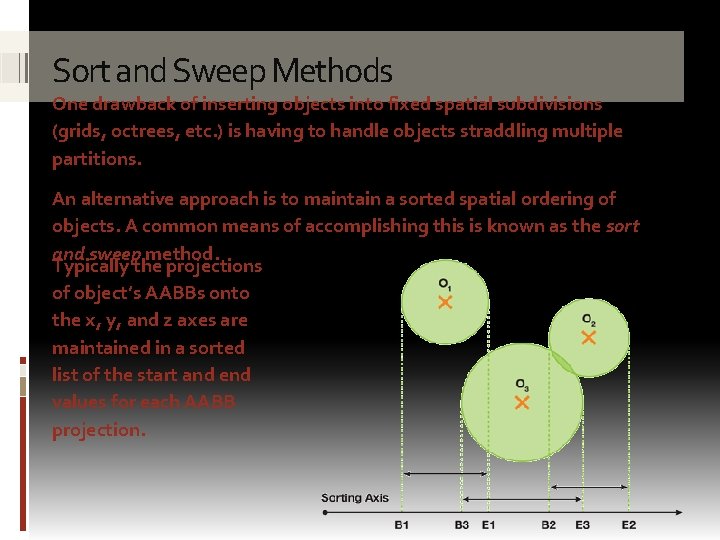
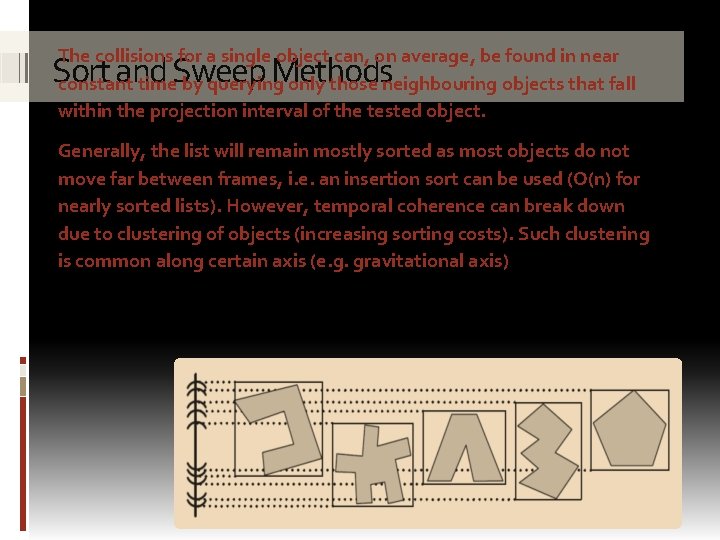
Sort and Sweep Methods One drawback of inserting objects into fixed spatial subdivisions (grids, octrees, etc. ) is having to handle objects straddling multiple partitions. An alternative approach is to maintain a sorted spatial ordering of objects. A common means of accomplishing this is known as the sort and sweep method. Typically the projections of object’s AABBs onto the x, y, and z axes are maintained in a sorted list of the start and end values for each AABB projection.
The collisions for a single object can, on average, be found in near constant time by querying only those neighbouring objects that fall within the projection interval of the tested object. Sort and Sweep Methods Generally, the list will remain mostly sorted as most objects do not move far between frames, i. e. an insertion sort can be used (O(n) for nearly sorted lists). However, temporal coherence can break down due to clustering of objects (increasing sorting costs). Such clustering is common along certain axis (e. g. gravitational axis)
Sort and Sweep Methods One solution is to avoid sorting on the axis on which objects tend to cluster, e. g. only tracking the x and z axes. In most situations, sorting on two axes is likely to be sufficient (and also reduces memory overhead). Refer to the recommended course text for details of Axesaother than the standard andimplemented z axes may also be selected. how sort and sweep method x, cany be using linked lists. The linked-list approach can handle a large number of objects, and entails that very little effort is typically required to maintain the data structure from frame-toframe.
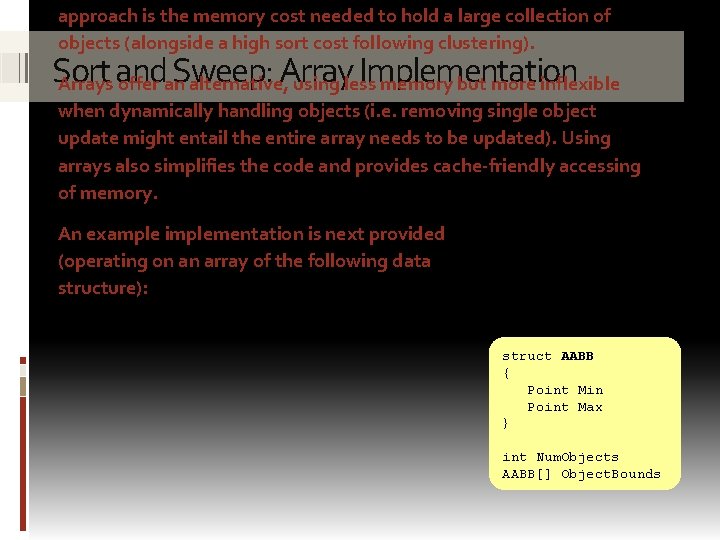
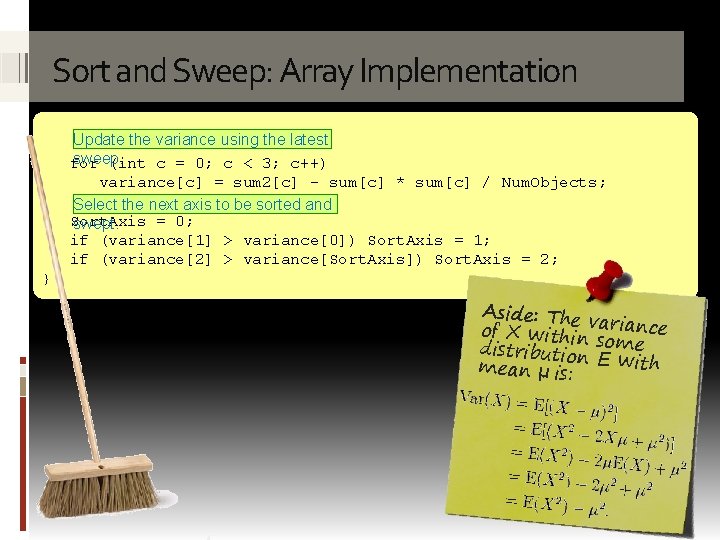
approach is the memory cost needed to hold a large collection of objects (alongside a high sort cost following clustering). Sort Sweep: Array Implementation Arrays and offer an alternative, using less memory but more inflexible when dynamically handling objects (i. e. removing single object update might entail the entire array needs to be updated). Using arrays also simplifies the code and provides cache-friendly accessing of memory. An example implementation is next provided (operating on an array of the following data structure): struct AABB { Point Min Point Max } int Num. Objects AABB[] Object. Bounds
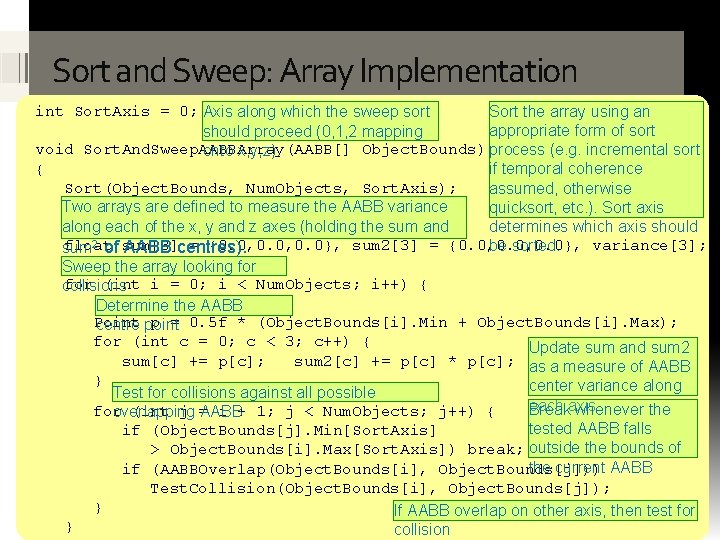
Sort and Sweep: Array Implementation int Sort. Axis = 0; Axis along which the sweep sort Sort the array using an appropriate form of sort should proceed (0, 1, 2 mapping void Sort. And. Sweep. AABBArray(AABB[] Object. Bounds) process (e. g. incremental sort onto x, y, z). { if temporal coherence Sort(Object. Bounds, Num. Objects, Sort. Axis); assumed, otherwise Two arrays are defined to measure the AABB variance quicksort, etc. ). Sort axis along each of the x, y and z axes (holding the sum and determines which axis should 2 float = {0. 0, 0. 0}, sum 2[3] = {0. 0, 0. 0}, variance[3]; be sorted. sum of sum[3] AABB centres). Sweep the array looking for (int i = 0; i < Num. Objects; i++) { collisions Determine the AABB Point p = 0. 5 f * (Object. Bounds[i]. Min + Object. Bounds[i]. Max); centre point for (int c = 0; c < 3; c++) { Update sum and sum 2 sum[c] += p[c]; sum 2[c] += p[c] * p[c]; as a measure of AABB } center variance along Test for collisions against all possible each Breakaxis whenever the for (int j = i + 1; j < Num. Objects; j++) { overlapping AABB tested AABB falls if (Object. Bounds[j]. Min[Sort. Axis] > Object. Bounds[i]. Max[Sort. Axis]) break; outside the bounds of the current AABB if (AABBOverlap(Object. Bounds[i], Object. Bounds[j])) Test. Collision(Object. Bounds[i], Object. Bounds[j]); } If AABB overlap on other axis, then test for } collision
Sort and Sweep: Array Implementation Update the variance using the latest sweep. for (int c = 0; c < 3; c++) variance[c] = sum 2[c] - sum[c] * sum[c] / Num. Objects; Select the next axis to be sorted and Sort. Axis = 0; swept. if (variance[1] > variance[0]) Sort. Axis = 1; if (variance[2] > variance[Sort. Axis]) Sort. Axis = 2; } Aside: The of X withinvariance distribution some mean μ is: E with
CELLS ANDPORTALS Subdividing space into a number of connected regions
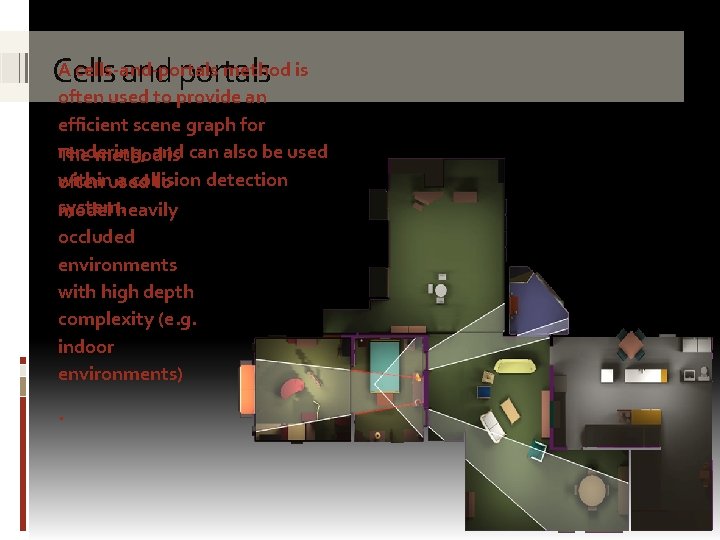
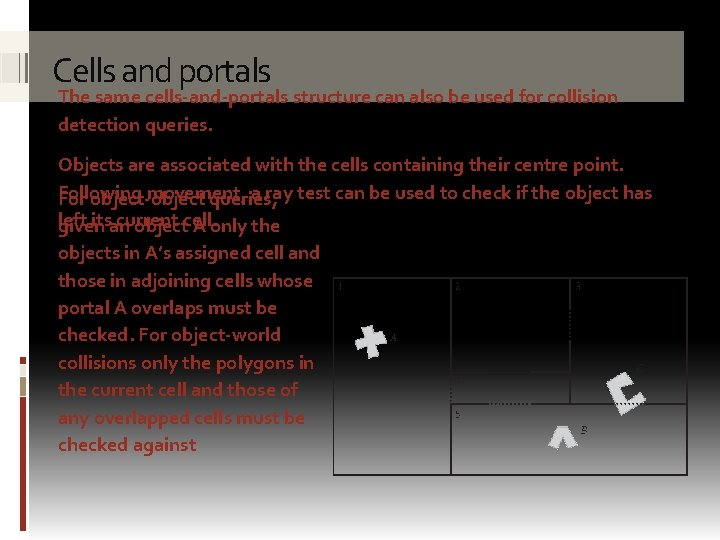
A cells-and-portals method is Cells and portals often used to provide an efficient scene graph for rendering, and The method is can also be used within a collision detection often used to system. model heavily occluded environments with high depth complexity (e. g. indoor environments).
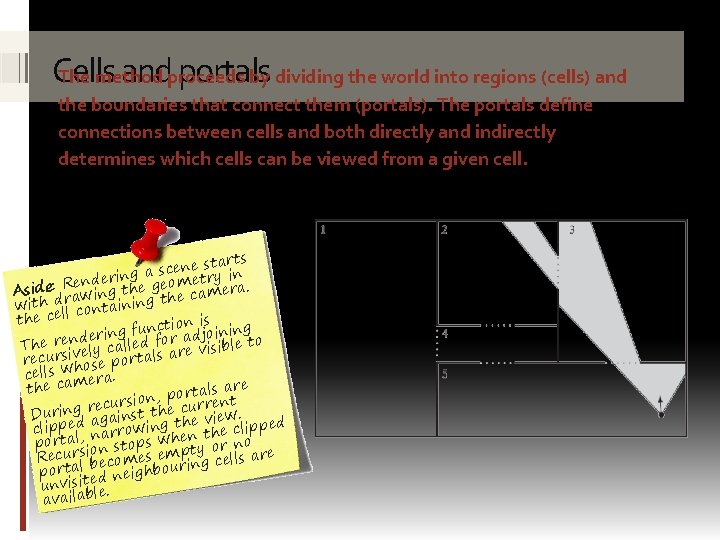
Cells andproceeds portals The method by dividing the world into regions (cells) and the boundaries that connect them (portals). The portals define connections between cells and both directly and indirectly determines which cells can be viewed from a given cell. starts e n e c s a dering geometry in. n e R : e Asid rawing the he camera with d l containing t the cel ction isoining n u f g n i adj der The renvely called for re visible to recursi hose portals a cells w era. the cam tals are r o p , n urrent recursio During against the che view. clipped narrowing t n the clipped portal, ion stops whe ty or no Recurs becomes emping cells are portal ed neighbour unvisit le. availab
Cells and portals The same cells-and-portals structure can also be used for collision detection queries. Objects are associated with the cells containing their centre point. Following movement, a ray test can be used to check if the object has For object-object queries, left itsan current given objectcell. A only the objects in A’s assigned cell and those in adjoining cells whose portal A overlaps must be checked. For object-world collisions only the polygons in the current cell and those of any overlapped cells must be checked against
ed ect r i g D din a e r DIRECTED READING Directed mathematical reading
Directed reading • Read Chapter 7 of Real Time Collision Detection (pp 285 -346) ed ect r i g D din rea • Related papers can be found from: http: //realtimecollisiondetection. net/books/rtcd/references/
Summary Today we explored: ü Spatial decomposition approaches ü Including grids, trees, sweep and sort and portal based approaches : o d o T cted e r i d e h t d a e üR material he t g n i d a e r r e üAft ave h , l a i r e t a m directed is the s i h t f i r e d n a po you l a i r e t a m f o type ore l p x e o t e k i l would t. c e j o r p a n i h t wi