
2 6 Related Rates Day 2 Objective Find

2. 6 Related Rates (Day 2) Objective: Find a related rate and use related rates to solve real-life problems. Miss Battaglia AP Calculus
AP CALCULUS RELATED RATES Related rate problems involve finding the rate at which some ____ variable changes.
AP CALCULUS RELATED RATES For example, when a balloon is being blown up with air, radius both the _______ and volume the ________ of the balloon are changing.
AP CALCULUS RELATED RATES In each case the rate is a derivativethat has to be ______ computed given the rate at which some other variable, like time, is known to change.

AP CALCULUS RELATED RATES To find this derivative we write an equation that relates the two differentiate variables. We then ______ both sides of the equation with time respect to ____ to express the derivative we SEEK in terms of the derivative we KNOW.
AP CALCULUS RELATED RATES Often the key to relating the variables in this type of problem is DRAWING A PICTURE that shows the geometric relationships between the variables.
Procedure: 1. 2. 3. 4. Identify and LABEL all the given info and what you are asked to find. Draw a picture if appropriate. Write an EQUATION relating the variables. Differentiate both sides of the equation with respect to TIME. Substitute and Solve. Sometimes you will need to use the original equation or other equations to solve for missing parts.
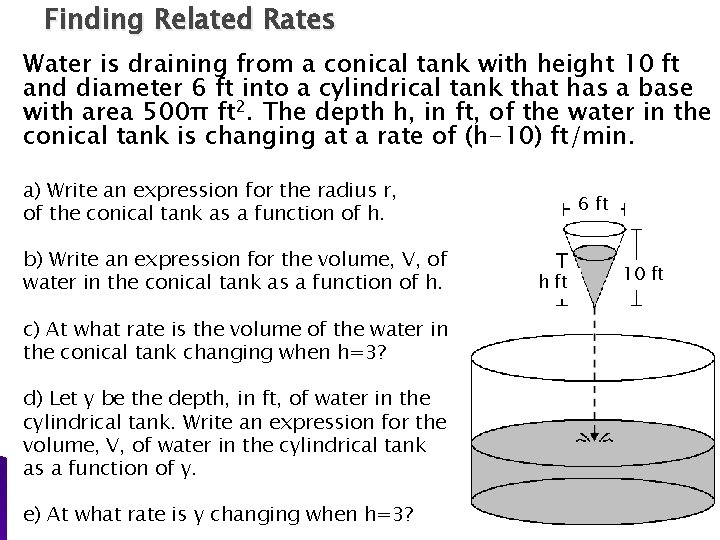
Finding Related Rates Water is draining from a conical tank with height 10 ft and diameter 6 ft into a cylindrical tank that has a base with area 500π ft 2. The depth h, in ft, of the water in the conical tank is changing at a rate of (h-10) ft/min. a) Write an expression for the radius r, of the conical tank as a function of h. b) Write an expression for the volume, V, of water in the conical tank as a function of h. c) At what rate is the volume of the water in the conical tank changing when h=3? d) Let y be the depth, in ft, of water in the cylindrical tank. Write an expression for the volume, V, of water in the cylindrical tank as a function of y. e) At what rate is y changing when h=3? 6 ft h ft 10 ft
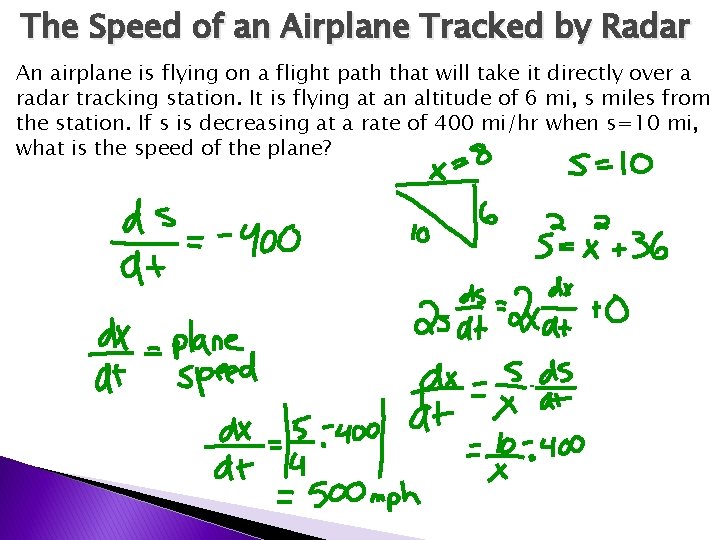
The Speed of an Airplane Tracked by Radar An airplane is flying on a flight path that will take it directly over a radar tracking station. It is flying at an altitude of 6 mi, s miles from the station. If s is decreasing at a rate of 400 mi/hr when s=10 mi, what is the speed of the plane?
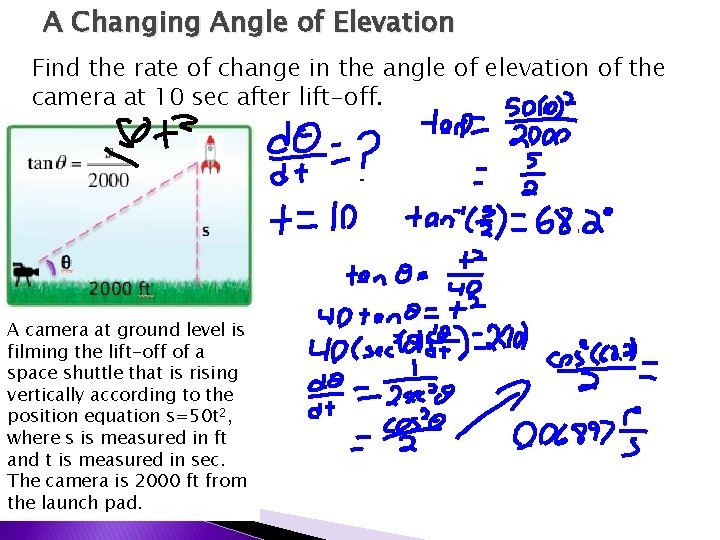
A Changing Angle of Elevation Find the rate of change in the angle of elevation of the camera at 10 sec after lift-off. A camera at ground level is filming the lift-off of a space shuttle that is rising vertically according to the position equation s=50 t 2, where s is measured in ft and t is measured in sec. The camera is 2000 ft from the launch pad.
Oil Spill Oil spills in a circular pattern. The radius grows at 4 ft/min. How fast is the area of oil changing when r=10 ft.
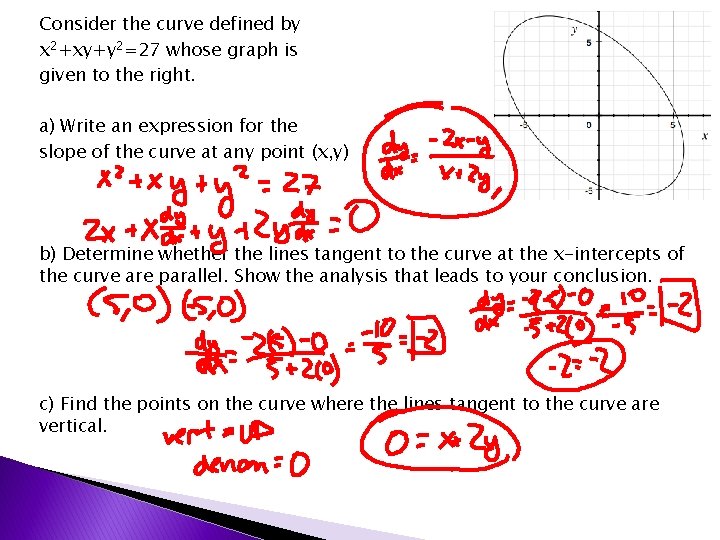
Consider the curve defined by x 2+xy+y 2=27 whose graph is given to the right. a) Write an expression for the slope of the curve at any point (x, y) b) Determine whether the lines tangent to the curve at the x-intercepts of the curve are parallel. Show the analysis that leads to your conclusion. c) Find the points on the curve where the lines tangent to the curve are vertical.
Classwork/Homework �Page 154 #21, 22, 26, 28, 29, 31, 44, 45
- Slides: 13