
2 6 Plans and design points to consider
- Slides: 9
2. 6 Plans and design - points to consider Plan n does ing and d diffe it make esign r a good ence if t ny he or b ad? y are Learning objective: to appreciate the possibilities offered by nature to facilitate easy use and operation of household sanitation arrangements Jan-Olof Drangert, Linköping University, Sweden
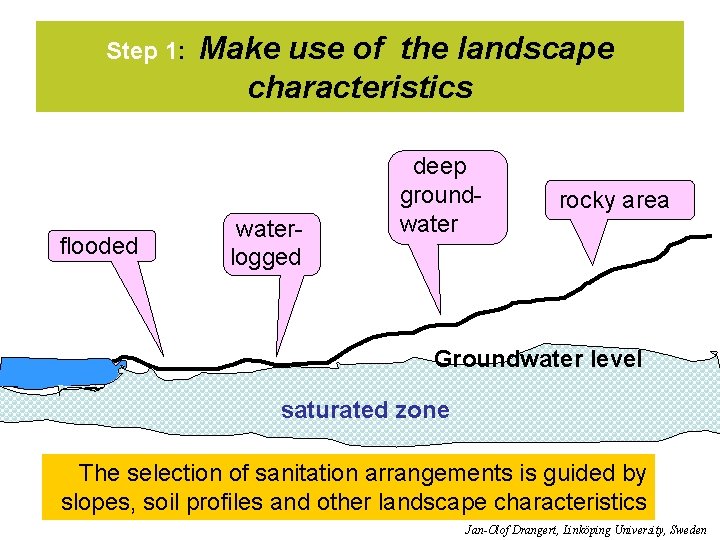
Step 1: flooded Make use of the landscape characteristics waterlogged deep groundwater rocky area Groundwater level saturated zone The selection of sanitation arrangements is guided by slopes, soil profiles and other landscape characteristics Jan-Olof Drangert, Linköping University, Sweden
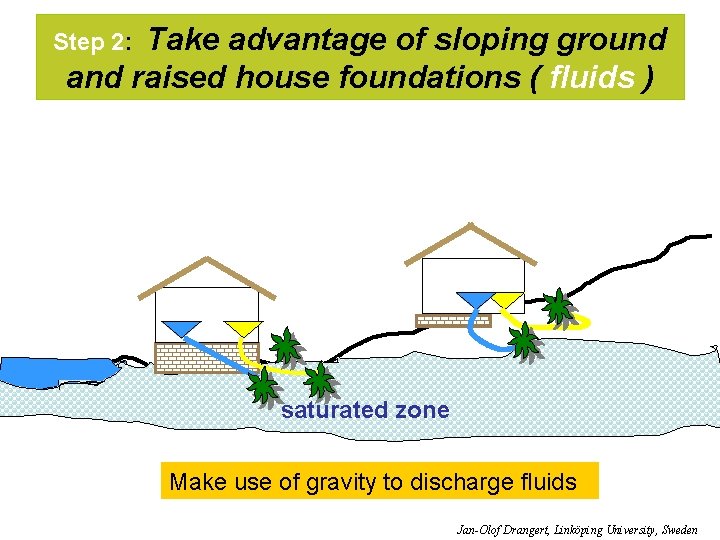
Take advantage of sloping ground and raised house foundations ( fluids ) Step 2: saturated zone Make use of gravity to discharge fluids Jan-Olof Drangert, Linköping University, Sweden
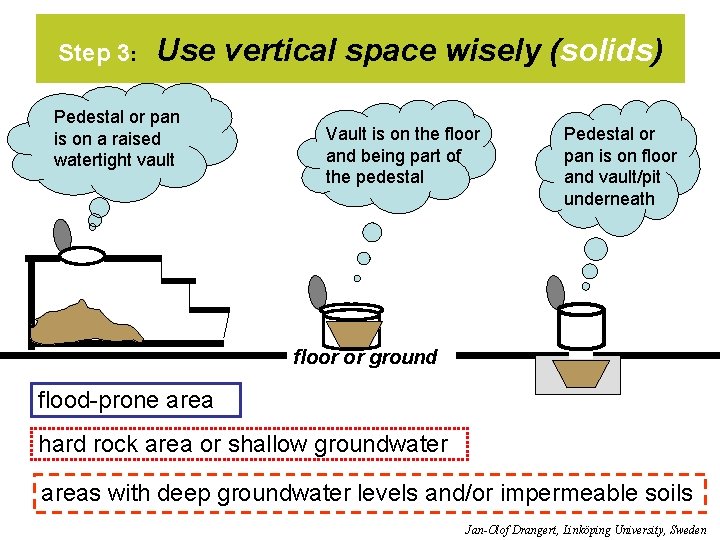
Step 3: Use vertical space wisely (solids) Pedestal or pan is on a raised watertight vault Vault is on the floor and being part of the pedestal Pedestal or pan is on floor and vault/pit underneath floor or ground flood-prone area hard rock area or shallow groundwater areas with deep groundwater levels and/or impermeable soils Jan-Olof Drangert, Linköping University, Sweden
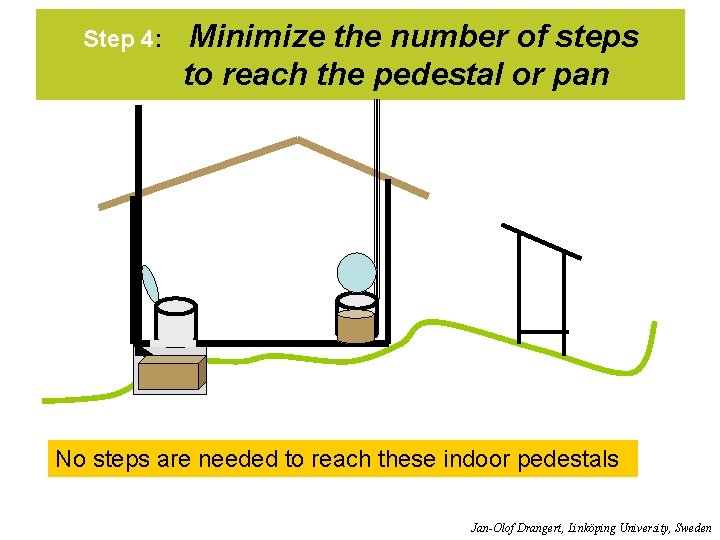
Step 4: Minimize the number of steps to reach the pedestal or pan No steps are needed to reach these indoor pedestals Jan-Olof Drangert, Linköping University, Sweden
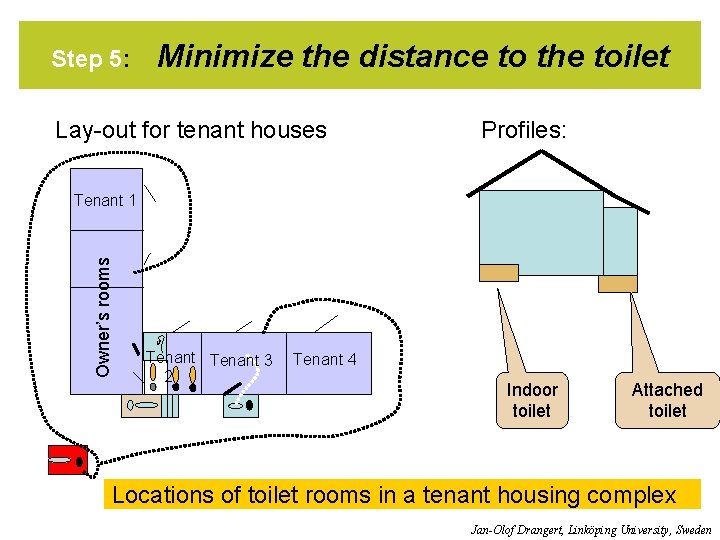
Step 5: Minimize the distance to the toilet Lay-out for tenant houses Profiles: Owner’s rooms Tenant 1 Tenant 3 2 Tenant 4 Indoor toilet Attached toilet Locations of toilet rooms in a tenant housing complex Jan-Olof Drangert, Linköping University, Sweden
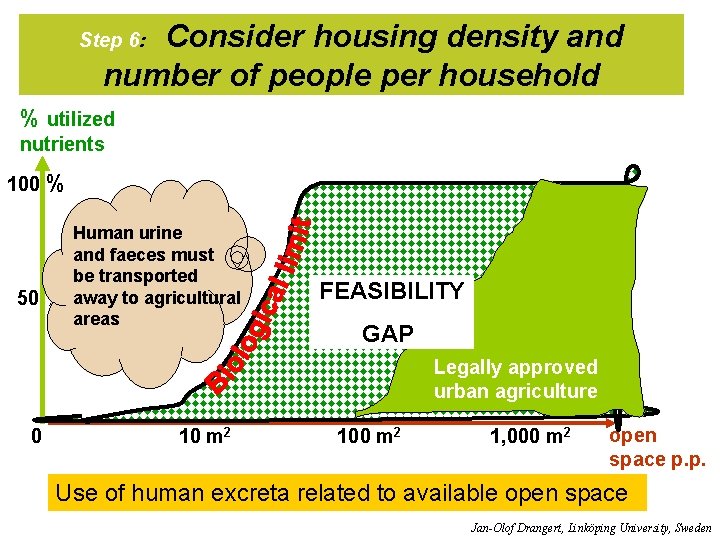
Consider housing density and number of people per household Step 6: % utilized nutrients 100 % 50 % Human urine and faeces must be transported away to agricultural areas FEASIBILITY GAP Legally approved urban agriculture 0 10 m 2 100 m 2 1, 000 m 2 open space p. p. Use of human excreta related to available open space Jan-Olof Drangert, Linköping University, Sweden
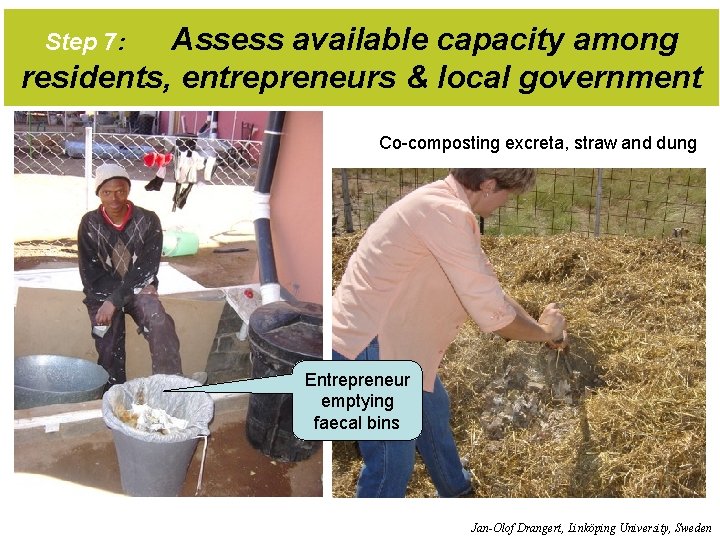
Assess available capacity among residents, entrepreneurs & local government Step 7: Co-composting excreta, straw and dung Entrepreneur emptying faecal bins Jan-Olof Drangert, Linköping University, Sweden
Step 8: Consider the changing local culture space is necessary for reuse in situ, but is not sufficient. Reuse also presupposes an interest to do so. Many societies do not practise urban agriculture, but when given the opportunity residents to a large extent accept the idea of gardening. A strong reason is that sanitised urine and treated dry faecal material are used, not fresh excreta. Professionals: Well-maintained urine-diverting toilets are odourless and can be installed indoors. However, professionals often believe that toilets in poor housing areas have to be in the yard. Repeatedly it has been shown that residents prefer an indoor toilet, once they are aware of the odour-less option. Several benefits of indoor toilets are that they offer better privacy and security, are easy to clean and maintain, and they are convenient for the sick and disabled. From a health point of view the indoor toilet increases the likelihood of hand-washing after defecation. J-O Drangert, Linköping University, Sweden Residents: Enough