
2 5 Deadlock 672021 Ambo University Woliso Campus
2. 5 Deadlock 6/7/2021 Ambo University || Woliso Campus 1
Contents: �Introduction �Resource �Deadlock characterization �Deadlock modeling �Deadlock handling mechanism �Deadlock prevention �Deadlock detection and recovery �Deadlock avoidance �Two phase locking �Communication deadlock �Live lock �starvation 6/7/2021 Ambo University || Woliso Campus 2
Introduction • A set of processes is deadlocked if each process in the set is waiting for an event that only another process in the set can cause. • all the processes are waiting, none of them will ever cause any of the events that could wake up any of the other members of the set, and all the processes continue to wait forever. • Each member of the set of deadlocked processes is waiting for a resource that is owned by a deadlocked process. • None of the processes can run, none of them can release any resources, and none of them can be awakened. • This kind of deadlock is called a resource deadlock. It is probably the most common kind, but it is not the only kind. 6/7/2021 Ambo University || Woliso Campus 3
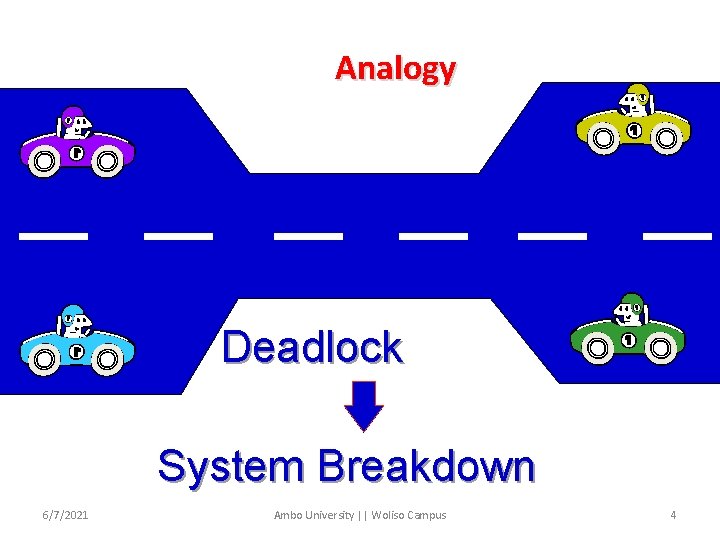
Analogy Deadlock System Breakdown 6/7/2021 Ambo University || Woliso Campus 4
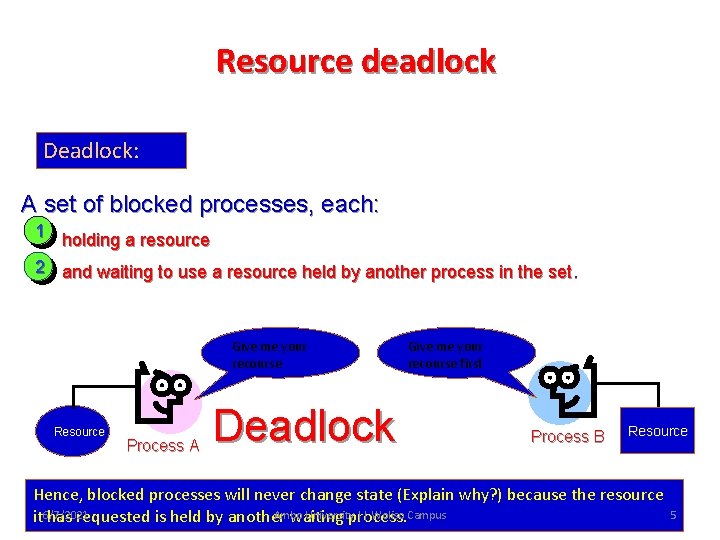
Resource deadlock Deadlock: A set of blocked processes, each: 1 holding a resource 2 and waiting to use a resource held by another process in the set. Give me your recourse Resource Process A Deadlock Give me your recourse first Process B Resource Hence, blocked processes will never change state (Explain why? ) because the resource Ambo University || Woliso Campus it 6/7/2021 has requested is held by another waiting process. 5
Resource o A major class of deadlocks involve resources. o Deadlocks can occur when processes have been granted exclusive access to devices, data records, files, and so forth. o In general the objects granted to a process is referred to as resources. o A resource can be a hardware device (e. g. , a tape drive) or a piece of information (e. g. , a locked record in a database). o process must request a resource before using it and release it after making use of it. Each process utilizes a resource as follows: v. Request : A process requests for an instance of a resource type. If the resource is free, the request will be granted. Otherwise the process should wait until it acquires the resource v. Use : The process uses the resource for its operations v. Release : The process releases the resource 6/7/2021 Ambo University || Woliso Campus 6
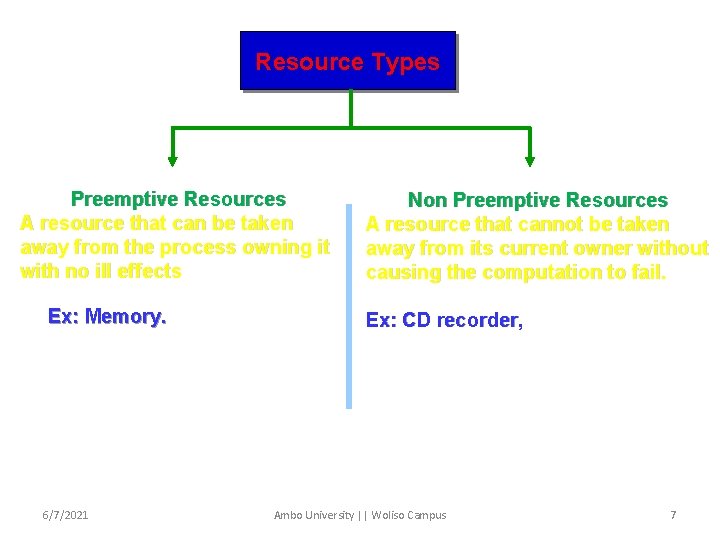
Resource Types Preemptive Resources A resource that can be taken away from the process owning it with no ill effects Ex: Memory. 6/7/2021 Non Preemptive Resources A resource that cannot be taken away from its current owner without causing the computation to fail. Ex: CD recorder, Ambo University || Woliso Campus 7
Resource type (con’t…) Memory: is a preemptive recourse , Because, It allows a low priority process to swapped out form it to the disk when a higher priority process arrives and needs a larger amount of memory than the available. The low priority process can resume execution later (swapped in again). 6/7/2021 Ambo University || Woliso Campus 8
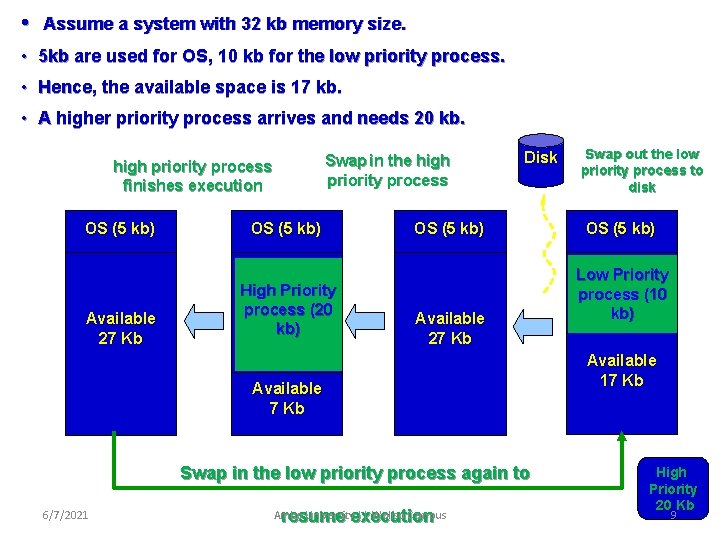
• Assume a system with 32 kb memory size. • 5 kb are used for OS, 10 kb for the low priority process. • Hence, the available space is 17 kb. • A higher priority process arrives and needs 20 kb. Swap in the high priority process finishes execution OS (5 kb) Available 27 Kb OS (5 kb) High Priority process (20 kb) Disk OS (5 kb) Available 27 Kb Available 7 Kb Swap in the low priority process again to 6/7/2021 Ambo Universityexecution || Woliso Campus resume Swap out the low priority process to disk OS (5 kb) Low Priority process (10 kb) Available 17 Kb High Priority 20 Kb 9
Resource type (con’t…) CD recorder: is non preemptive resource, because , If a process has begun to burn a CD-ROM, suddenly taking the CD recorder away from it and giving it to another process will result in a bad CD. 6/7/2021 Ambo University || Woliso Campus 10
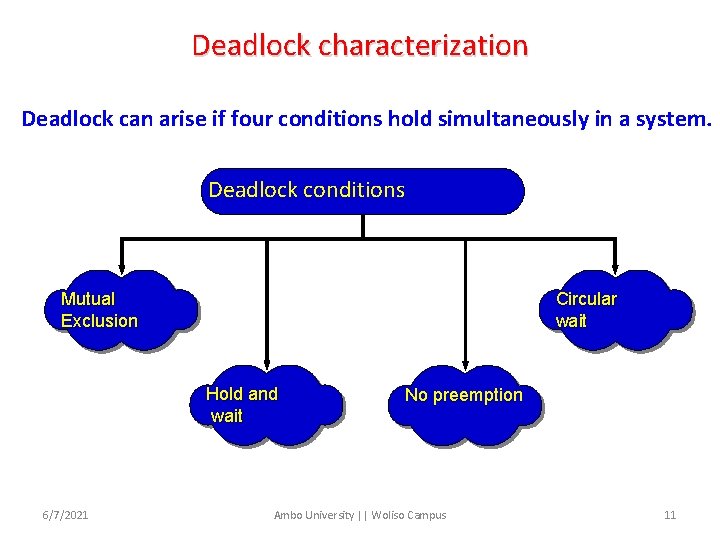
Deadlock characterization Deadlock can arise if four conditions hold simultaneously in a system. Deadlock conditions Mutual Exclusion Circular wait Hold and wait 6/7/2021 No preemption Ambo University || Woliso Campus 11
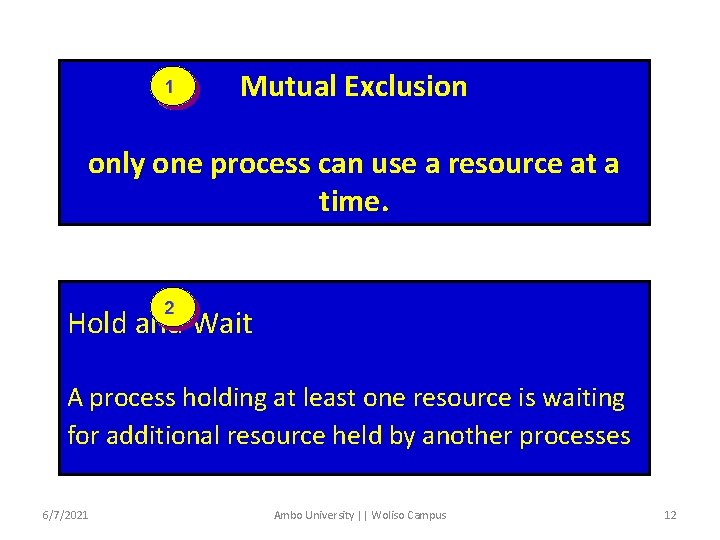
1 Mutual Exclusion only one process can use a resource at a time. 2 Hold and Wait A process holding at least one resource is waiting for additional resource held by another processes 6/7/2021 Ambo University || Woliso Campus 12
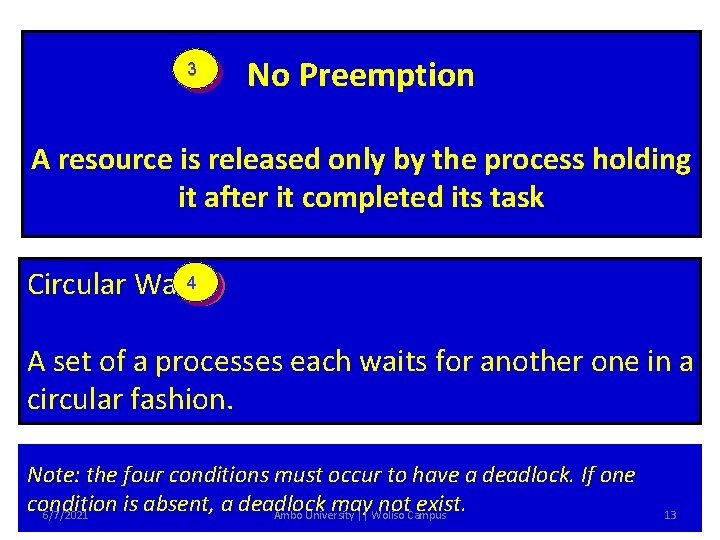
3 No Preemption A resource is released only by the process holding it after it completed its task Circular Wait 44 A set of a processes each waits for another one in a circular fashion. Note: the four conditions must occur to have a deadlock. If one condition is absent, a deadlock may not exist. 6/7/2021 Ambo University || Woliso Campus 13
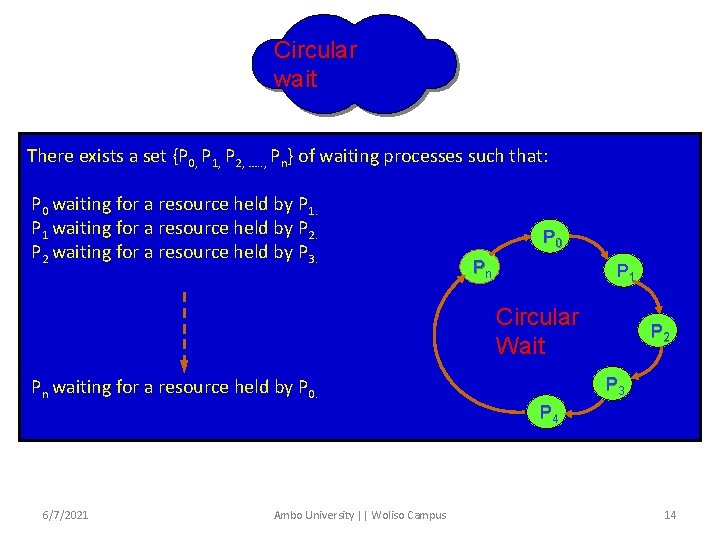
Circular wait There exists a set {P 0, P 1, P 2, …. . , Pn} of waiting processes such that: P 0 waiting for a resource held by P 1 waiting for a resource held by P 2 waiting for a resource held by P 3. P 0 Pn P 1 Circular Wait P 2 P 3 Pn waiting for a resource held by P 0. P 4 6/7/2021 Ambo University || Woliso Campus 14
Deadlock modeling §In order to solve the deadlock problem, we must find a method to express it. §This can be achieved using resource allocation graph. §The graphs have two kinds of nodes and directed arc. §processes, shown as circles §resources, shown as squares. §A directed arc from a resource node to a process node means that the resource has previously been requested by, granted to, and is currently held by that process. §A directed arc from a process to a resource means that the process is currently blocked waiting for that resource. 6/7/2021 Ambo University || Woliso Campus 15
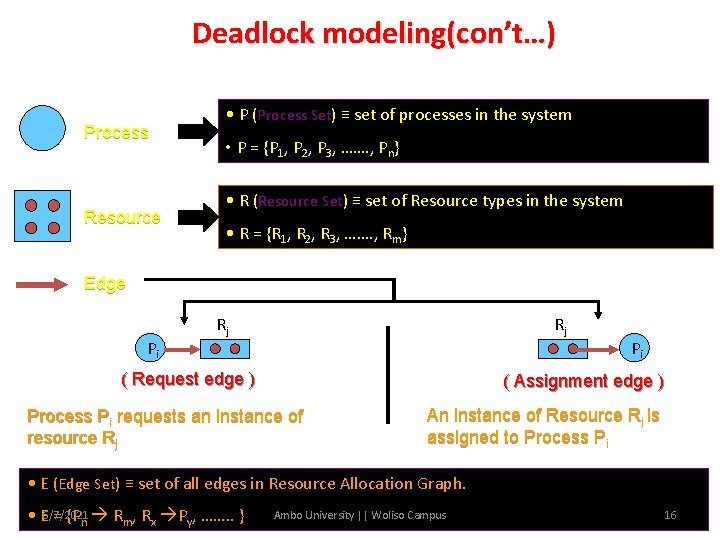
Deadlock modeling(con’t…) Process Resource • P (Process Set) ≡ set of processes in the system • P = {P 1, P 2, P 3, ……. , Pn} • R (Resource Set) ≡ set of Resource types in the system • R = {R 1, R 2, R 3, ……. , Rm} Edge Pi Rj Rj ( Request edge ) Pi ( Assignment edge ) Process Pi requests an instance of resource Rj An instance of Resource Rj is assigned to Process Pi • E (Edge Set) ≡ set of all edges in Resource Allocation Graph. • E 6/7/2021 = {Pn Rm, Rx Py, ……. . } Ambo University || Woliso Campus 16
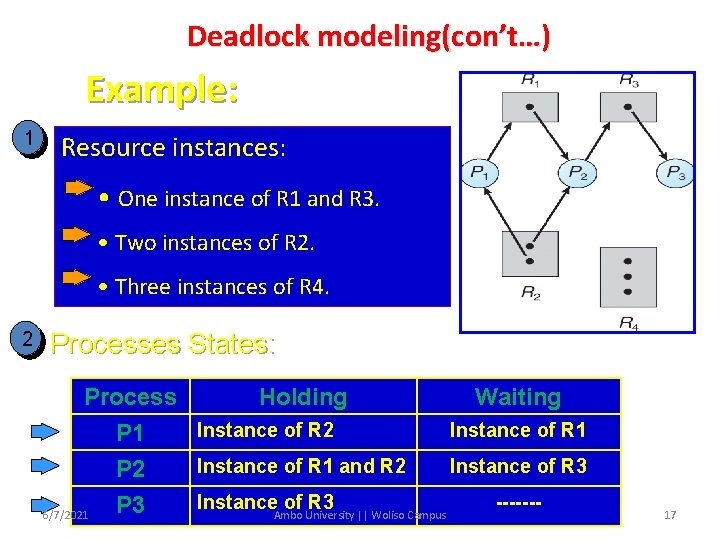
Deadlock modeling(con’t…) Example: 1 Resource instances: • One instance of R 1 and R 3. • Two instances of R 2. • Three instances of R 4. 2 Processes States: Process Holding Waiting Instance of R 2 Instance of R 1 P 1 Instance of R 1 and R 2 Instance of R 3 P 2 Instance. Ambo of University R 3 || Woliso Campus ------P 3 6/7/2021 17
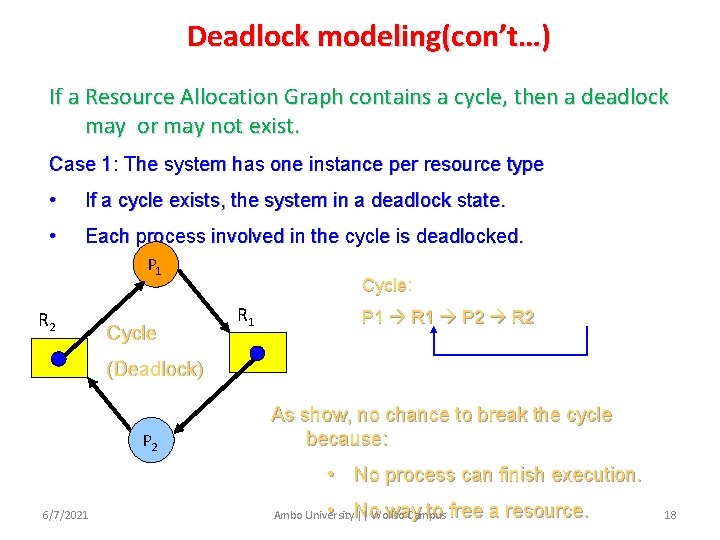
Deadlock modeling(con’t…) If a Resource Allocation Graph contains a cycle, then a deadlock may or may not exist. Case 1: The system has one instance per resource type • If a cycle exists, the system in a deadlock state. • Each process involved in the cycle is deadlocked. P 1 R 2 Cycle: Cycle R 1 P 1 R 1 P 2 R 2 (Deadlock) P 2 As show, no chance to break the cycle because: • No process can finish execution. 6/7/2021 • No way to free a resource. Ambo University || Woliso Campus 18
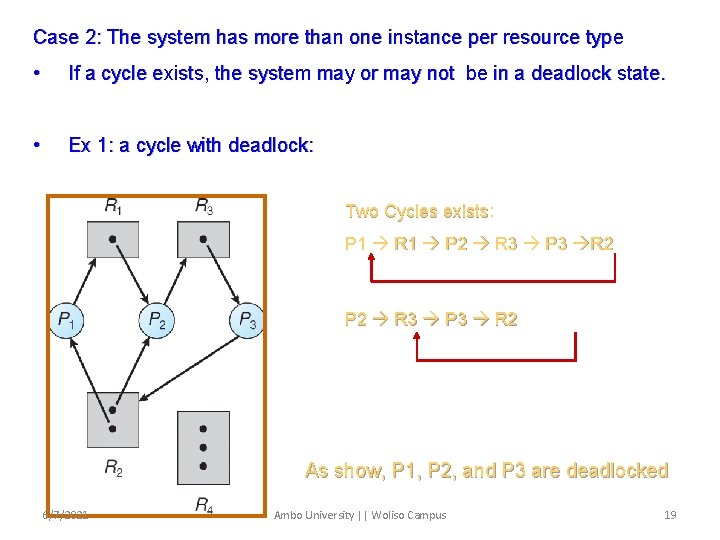
Case 2: The system has more than one instance per resource type • If a cycle exists, the system may or may not be in a deadlock state. • Ex 1: a cycle with deadlock: Two Cycles exists: exists P 1 R 1 P 2 R 3 P 3 R 2 P 2 R 3 P 3 R 2 As show, P 1, P 2, and P 3 are deadlocked 6/7/2021 Ambo University || Woliso Campus 19
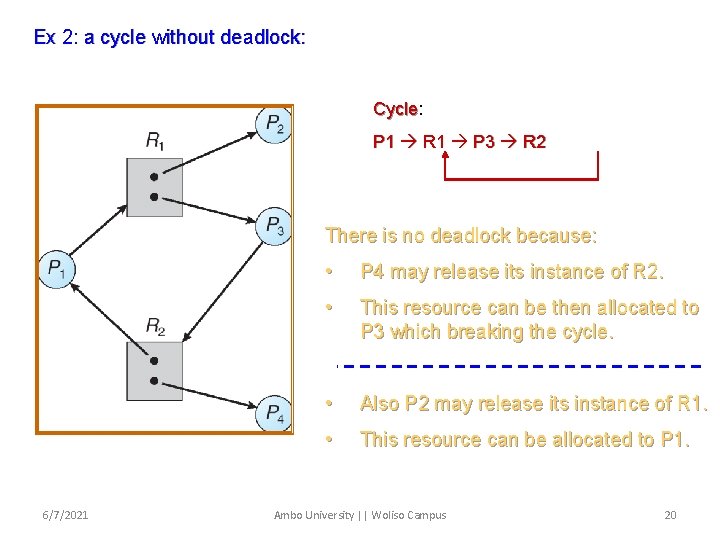
Ex 2: a cycle without deadlock: Cycle: Cycle P 1 R 1 P 3 R 2 There is no deadlock because: 6/7/2021 • P 4 may release its instance of R 2. • This resource can be then allocated to P 3 which breaking the cycle. • Also P 2 may release its instance of R 1. • This resource can be allocated to P 1. Ambo University || Woliso Campus 20
Deadlock handling mechanism Deadlock problems can be handled in one of the following 4 ways: 1. Using a protocol avoids deadlock by ensuring that a system will never enter a deadlock state (deadlock avoidance) 2. structurally negating one of the four required conditions (deadlock prevention). 3. Allow the system to enter a deadlock state and then recover(deadlock detection and recovery) 4. Ignore the problem and pretend that deadlocks never occur in the system(ostrich algorithm); used by most operating systems, including UNIX 21 Ambo University || Woliso Campus 6/7/2021
Deadlock prevention 1. Mutual Exclusion – This is not required for sharable resources; however to prevent a system from deadlock, the mutual exclusion condition must hold for non-sharable resources 2. Hold and Wait – in order to prevent the occurrence of this condition in a system, we must guarantee that whenever a process requests a resource, it does not hold any other resources. Two protocols are used to implement this: 1. Require a process to request and be allocated all its resources before it begins execution or 2. Allow a process to request resources only when the process has none 22 Ambo University || Woliso Campus 6/7/2021
Deadlock prevention(con’t…) v Both protocols have two main disadvantages: o Since resources may be allocated but not used for a long period, resource utilization will be low o A process that needs several popular resources has to wait indefinitely because one of the resources it needs is allocated to another process. Hence starvation is possible. 3. No Preemption • If a process holding certain resources is denied further request, that process must release its original resources allocated to it 23 Ambo University || Woliso Campus 6/7/2021
Deadlock prevention(con’t…) • If a process requests a resource allocated to another process waiting for some additional resources, and the requested resource is not being used, then the resource will be preempted from the waiting process and allocated to the requesting process » Preempted resources are added to the list of resources for which the process is waiting » Process will be restarted only when it can regain its old resources, as well as the new ones that it is requesting » This approach is practical to resources whose state can easily saved and retrieved easily 24 Ambo University || Woliso Campus 6/7/2021
Deadlock prevention(con’t…) 4. Circular Wait • A linear ordering of all resource types is defined and each process requests resources in an increasing order of enumeration. • So, if a process initially is allocated instances of resource type R, then it can subsequently request instances of resources types following R in the ordering 25 Ambo University || Woliso Campus 6/7/2021
Deadlock detection and recovery o The system does not attempt to prevent deadlocks from occurring. o It lets them occur, tries to detect when this happens, and then takes some action to recover after the fact. o In this mechanism, the system must provide : v. A deadlock detection algorithm that examines the state of the system if there is an occurrence of deadlock v. An algorithm to recover from the deadlock 6/7/2021 Ambo University || Woliso Campus 26
Deadlock Detection with One Resource of Each Type o only one resource of each type exists. o If the resource allocation graph contains one or more cycles, a deadlock exists. o Any process that is part of a cycle is deadlocked. If no cycles exist, the system is not deadlocked. o Many algorithms for detecting cycles in directed graphs are known. o Below we will give a simple one that inspects a graph and terminates either when it has found a cycle or when it has shown that none exists. 6/7/2021 Ambo University || Woliso Campus 27
Deadlock Detection with One Resource of Each Type The algorithm operates by carrying out the following steps as specified: 1. For each node, N in the graph, perform the following five steps with N as the starting node. 2. Initialize L to the empty list, and designate all the arcs as unmarked. 3. Add the current node to the end of L and check to see if the node now appears in L two times. If it does, the graph contains a cycle(listed in L) and the algorithm terminates. 4. From the given node, see if there any unmarked outgoing arcs. If so, go to step 5 ; if not, go to step 6. 6/7/2021 Ambo University || Woliso Campus 28
Deadlock Detection with One Resource of Each Type 5. Pick an unmarked outgoing arc at random and mark it. Then follow it to the new current node and go to step 3. 6. If this node is the initial node, the graph does not contain any cycles and the algorithm terminates. Otherwise, we have now reached a dead end. Remove it and go back to the previous node, that is, the one that was current just before this one, make that one the current node, and go to step 3. 6/7/2021 Ambo University || Woliso Campus 29
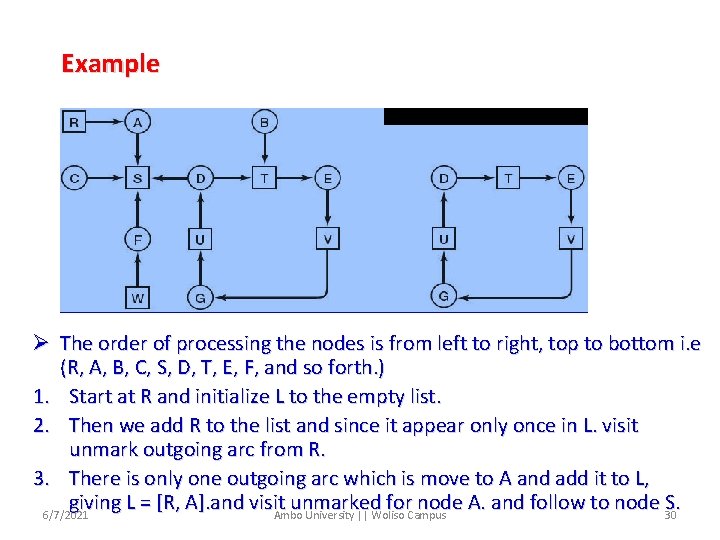
Example Ø The order of processing the nodes is from left to right, top to bottom i. e (R, A, B, C, S, D, T, E, F, and so forth. ) 1. Start at R and initialize L to the empty list. 2. Then we add R to the list and since it appear only once in L. visit unmark outgoing arc from R. 3. There is only one outgoing arc which is move to A and add it to L, giving L = [R, A]. and visit unmarked for node A. and follow to node 30 S. 6/7/2021 Ambo University || Woliso Campus
Example(con’t…) 4. Since there is no unmarked outgoing node, it backtrack to previous node A. also the outgoing arc from node visited or marked, it backtrack to previous node, which is root node R. so from this sub graph there is no cycle found, go to another which is Node A. 5. Follow the same step as node R. it cannot found cycle. Then got the node B. 6. Following the same step we can get L= [B, T, E, V, G, U, D] at given instant time. By choosing one of outgoing arc randomly from Node we can get L= [B, T, E, V, G, U, D, T], if we pick T. 7. Since T is found twice in L, it found cycle from node b, which is deadlock. At this time algorithm is terminated. 6/7/2021 Ambo University || Woliso Campus 31
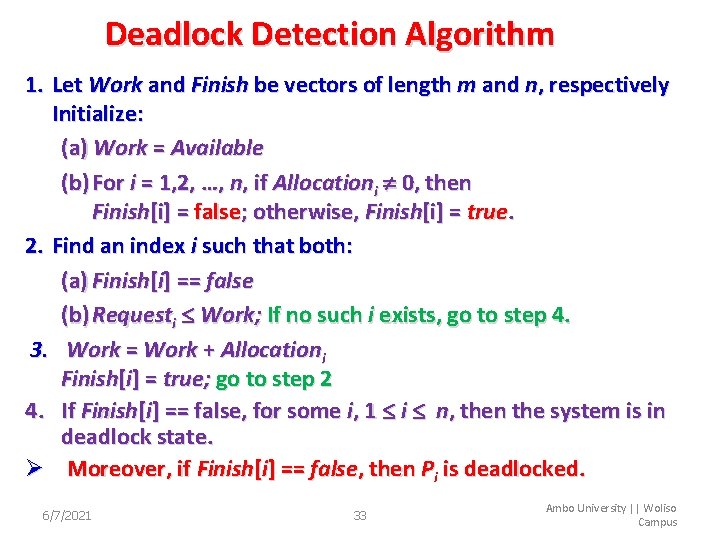
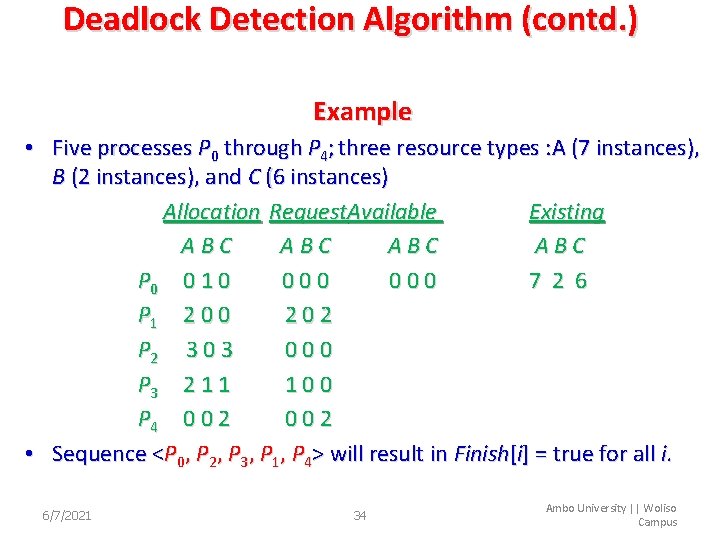
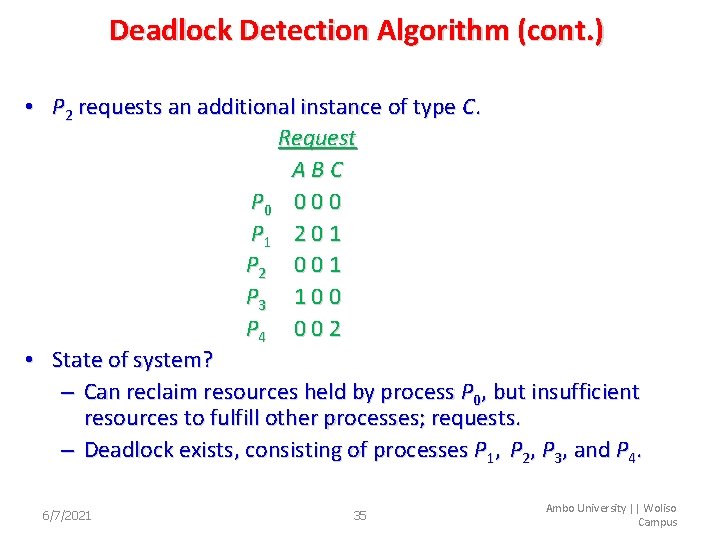
Deadlock Detection with Multiple Resources of Each Type multiple copies of some of the resources exist. Matrix-based algorithm for detecting deadlock among n processes, P 1 through P n is used. o The algorithm uses several data structures similar to the ones in banker’s algorithm. v. Existence: A vector of length m indicates the total number of existing instance of each resources type. v. Available: A vector of length m indicates the number of available resources of each type. v. Allocation: An n x m matrix defines the number of resources of each type currently allocated to each process. v. Request: An n x m matrix indicates the current request of each process. If Request [ij] = k, then process Pi is requesting k more instances of resource type. Rj. o o 6/7/2021 Ambo University || Woliso Campus 32
Deadlock Detection Algorithm 1. Let Work and Finish be vectors of length m and n, respectively Initialize: (a) Work = Available (b) For i = 1, 2, …, n, if Allocationi 0, then Finish[i] = false; otherwise, Finish[i] = true. 2. Find an index i such that both: (a) Finish[i] == false (b) Requesti Work; If no such i exists, go to step 4. 3. Work = Work + Allocationi Finish[i] = true; go to step 2 4. If Finish[i] == false, for some i, 1 i n, then the system is in deadlock state. Ø Moreover, if Finish[i] == false, then Pi is deadlocked. 6/7/2021 33 Ambo University || Woliso Campus
Deadlock Detection Algorithm (contd. ) Example • Five processes P 0 through P 4; three resource types : A (7 instances), B (2 instances), and C (6 instances) Allocation Request. Available Existing ABC ABC P 0 0 1 0 000 7 2 6 P 1 2 0 0 202 P 2 3 000 P 3 2 1 1 100 P 4 0 0 2 002 • Sequence <P 0, P 2, P 3, P 1, P 4> will result in Finish[i] = true for all i. 6/7/2021 34 Ambo University || Woliso Campus
Deadlock Detection Algorithm (cont. ) • P 2 requests an additional instance of type C. Request ABC P 0 0 P 1 2 0 1 P 2 0 0 1 P 3 1 0 0 P 4 0 0 2 • State of system? – Can reclaim resources held by process P 0, but insufficient resources to fulfill other processes; requests. – Deadlock exists, consisting of processes P 1, P 2, P 3, and P 4. 6/7/2021 35 Ambo University || Woliso Campus
Recovery from Deadlock o Once a deadlock has been detected, recovery strategy is needed. There are two possible recovery approaches: v. Process termination v. Resource preemption Process Termination v. Abort all deadlocked processes v. Abort one process at a time until the deadlock cycle is eliminated Ø In which order should we choose a process to abort? Chose the process with ü Least amount of processor time consumed so far ü Least amount of output produced so far ü Most estimated time remaining ü Least total resources allocated so far Ambo University || Woliso 6/7/2021 36 Campus ü Lowest priority
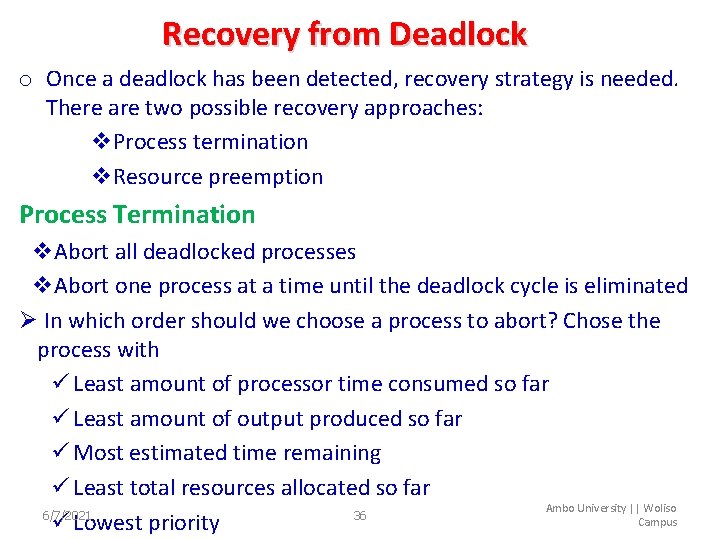
Recovery from Deadlock Resource Preemption o In this recovery strategy, we successively preempt resources and allocate them to another process until the deadlock is broken o While implementing this strategy, there are three issues to be considered v Selecting a victim – which resources and process should be selected to minimize cost just like in process termination. The cost factors may include parameters like the number of resources a deadlocked process is holding, number of resources it used so far v Rollback – if a resource is preempted from a process, then it can not continue its normal execution • The process must be rolled back to some safe state and started v Starvation – same process may always be picked as victim several times. As a result, starvation may occur. The best solution to this problem is to only allow a process to be picked as a victims for a limited finite number of times. This can be done by including the number of rollback in the cost factor 6/7/2021 37 Ambo University || Woliso Campus
Deadlock avoidance • Deadlock avoidance scheme requires each process to declare the maximum number of resources of each type that it may need in advance • The deadlock-avoidance algorithm dynamically examines the resource-allocation state to ensure that there can never be a circular-wait condition. • Resource-allocation state is defined by the number of available and allocated resources, and the maximum demands of the processes. • Simplest and most useful model requires that each process declare the maximum number of resources of each type that it may need. 6/7/2021 38 Ambo University || Woliso Campus
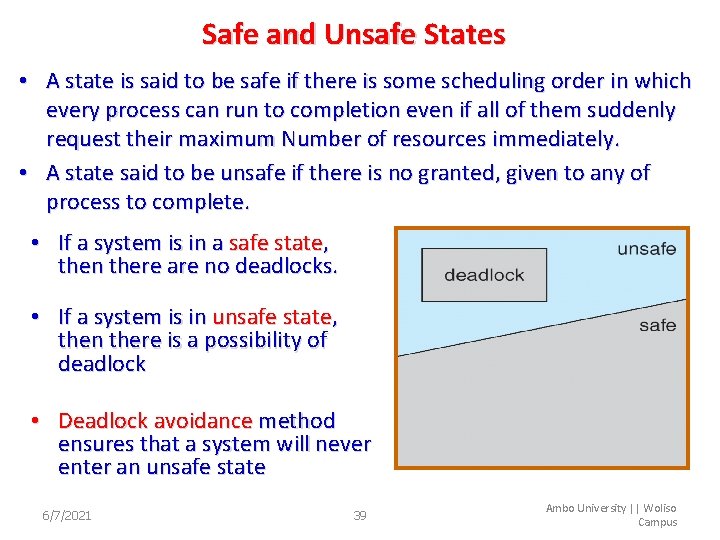
Safe and Unsafe States • A state is said to be safe if there is some scheduling order in which every process can run to completion even if all of them suddenly request their maximum Number of resources immediately. • A state said to be unsafe if there is no granted, given to any of process to complete. • If a system is in a safe state, then there are no deadlocks. • If a system is in unsafe state, then there is a possibility of deadlock • Deadlock avoidance method ensures that a system will never enter an unsafe state 6/7/2021 39 Ambo University || Woliso Campus
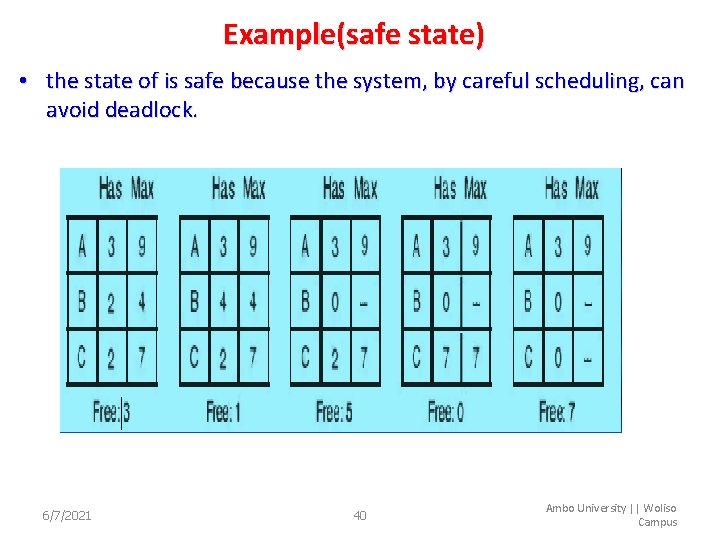
Example(safe state) • the state of is safe because the system, by careful scheduling, can avoid deadlock. 6/7/2021 40 Ambo University || Woliso Campus
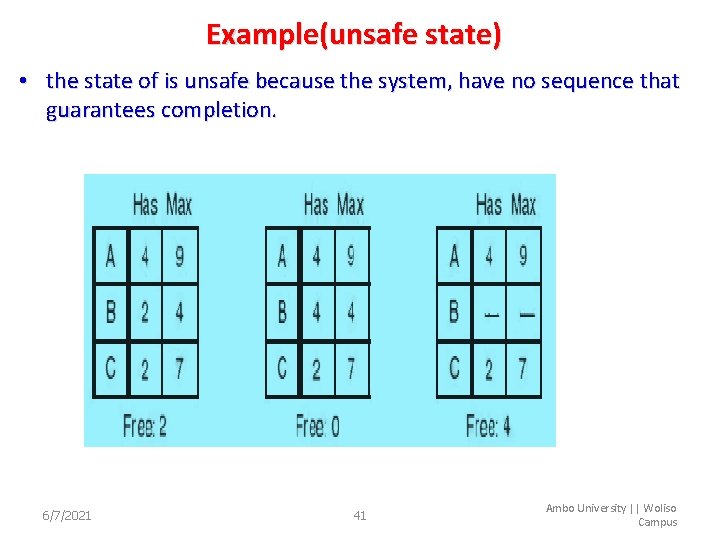
Example(unsafe state) • the state of is unsafe because the system, have no sequence that guarantees completion. 6/7/2021 41 Ambo University || Woliso Campus
Deadlock Avoidance Algorithms • Based on the concept of safe state, we can define algorithms that ensures the system will never deadlock. • If there is a single instance of a resource type, v. Use a resource-allocation graph • If there are multiple instances of a resource type, v. Use the Dijkstra’s banker’s algorithm 6/7/2021 42 Ambo University || Woliso Campus
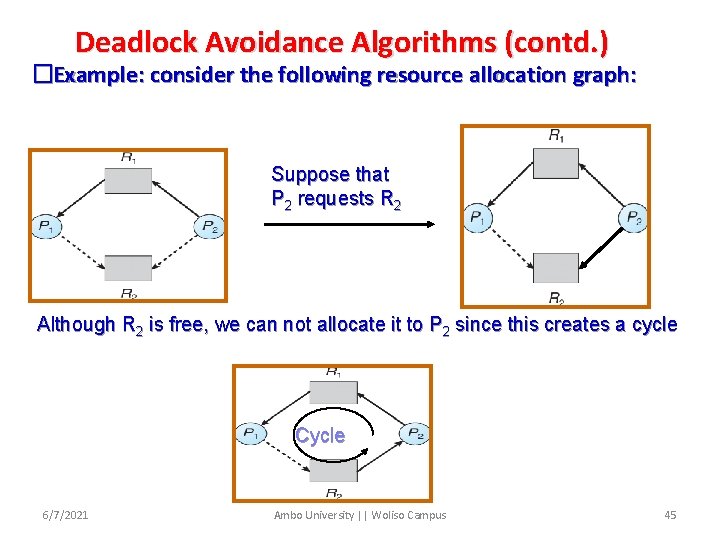
Deadlock Avoidance Algorithms (contd. ) Resource-Allocation Graph Scheme • A new type of edge (Claim edge), in addition to the request and assignment edge is introduced. • Claim edge Pi Rj indicates that process Pi may request resource Rj at some point in the future. The edge resembles a request edge but is represented by a dashed line in the graph – Claim edge is converted to request edge when a process requests a resource – Request edge is converted to an assignment edge when the resource is allocated to the process – When a resource is released by a process, assignment edge reconverts to a claim edge – If no cycle exists in the allocation, then system is in safe state Ambo University || Woliso 6/7/2021 otherwise the system is in unsafe 43 state Campus
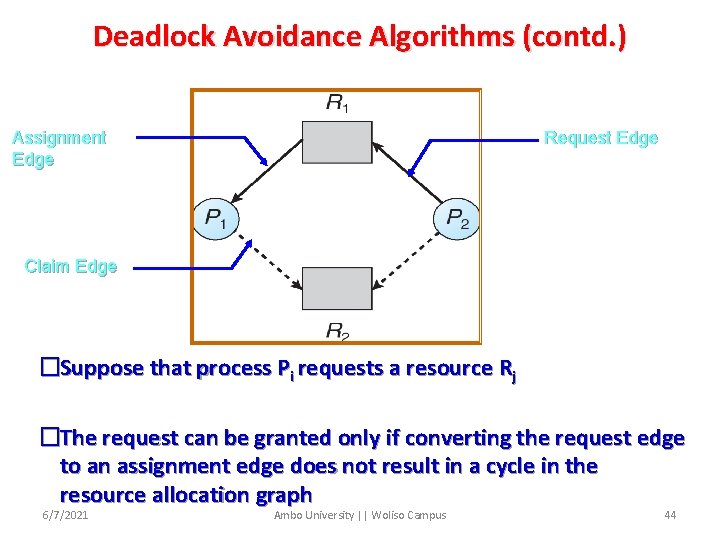
Deadlock Avoidance Algorithms (contd. ) Assignment Edge Request Edge Claim Edge �Suppose that process Pi requests a resource Rj �The request can be granted only if converting the request edge to an assignment edge does not result in a cycle in the resource allocation graph 6/7/2021 Ambo University || Woliso Campus 44
Deadlock Avoidance Algorithms (contd. ) �Example: consider the following resource allocation graph: Suppose that P 2 requests R 2 Although R 2 is free, we can not allocate it to P 2 since this creates a cycle Cycle 6/7/2021 Ambo University || Woliso Campus 45
Deadlock Avoidance Algorithms (contd. ) Banker’s Algorithm • This algorithm is used when there are multiple instances of resources • When a process enters a system, it must declare the maximum number of each instance of resource types it may need – The number however may not exceed the total number of resource types in the system • When a process requests a resource it may have to wait • When a process gets all its resources it must return them in a finite amount of time 6/7/2021 46 Ambo University || Woliso Campus
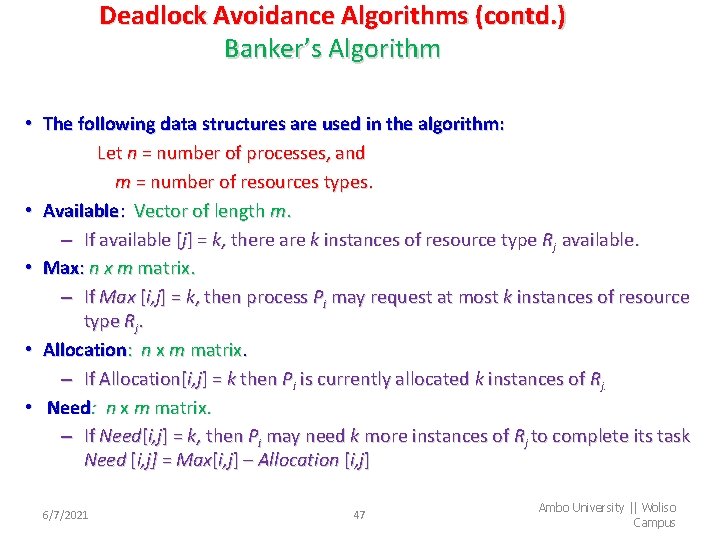
Deadlock Avoidance Algorithms (contd. ) Banker’s Algorithm • The following data structures are used in the algorithm: Let n = number of processes, and m = number of resources types. • Available: Vector of length m. – If available [j] = k, there are k instances of resource type Rj available. • Max: n x m matrix. – If Max [i, j] = k, then process Pi may request at most k instances of resource type Rj. • Allocation: n x m matrix. – If Allocation[i, j] = k then Pi is currently allocated k instances of Rj. • Need: n x m matrix. – If Need[i, j] = k, then Pi may need k more instances of Rj to complete its task Need [i, j] = Max[i, j] – Allocation [i, j] 6/7/2021 47 Ambo University || Woliso Campus
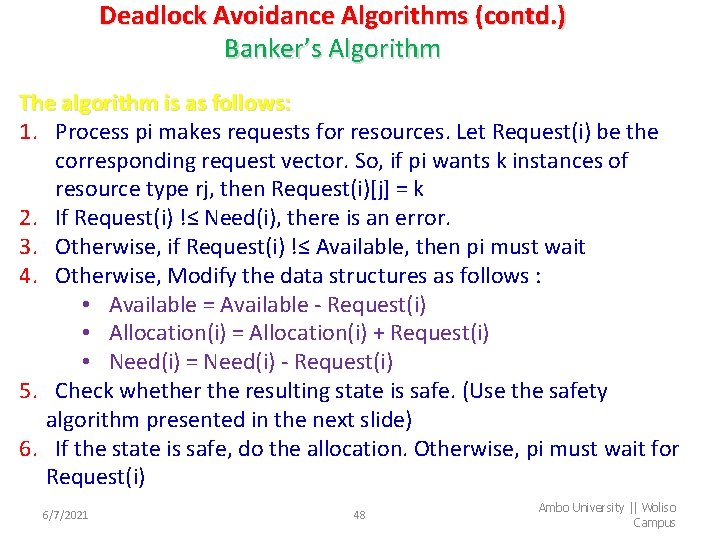
Deadlock Avoidance Algorithms (contd. ) Banker’s Algorithm The algorithm is as follows: 1. Process pi makes requests for resources. Let Request(i) be the corresponding request vector. So, if pi wants k instances of resource type rj, then Request(i)[j] = k 2. If Request(i) !≤ Need(i), there is an error. 3. Otherwise, if Request(i) !≤ Available, then pi must wait 4. Otherwise, Modify the data structures as follows : • Available = Available - Request(i) • Allocation(i) = Allocation(i) + Request(i) • Need(i) = Need(i) - Request(i) 5. Check whether the resulting state is safe. (Use the safety algorithm presented in the next slide) 6. If the state is safe, do the allocation. Otherwise, pi must wait for Request(i) 6/7/2021 48 Ambo University || Woliso Campus
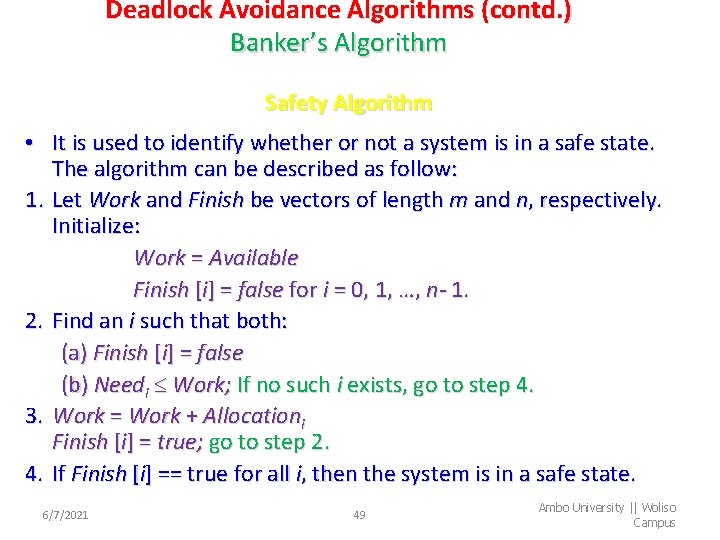
Deadlock Avoidance Algorithms (contd. ) Banker’s Algorithm Safety Algorithm • It is used to identify whether or not a system is in a safe state. The algorithm can be described as follow: 1. Let Work and Finish be vectors of length m and n, respectively. Initialize: Work = Available Finish [i] = false for i = 0, 1, …, n- 1. 2. Find an i such that both: (a) Finish [i] = false (b) Needi Work; If no such i exists, go to step 4. 3. Work = Work + Allocationi Finish [i] = true; go to step 2. 4. If Finish [i] == true for all i, then the system is in a safe state. 6/7/2021 49 Ambo University || Woliso Campus
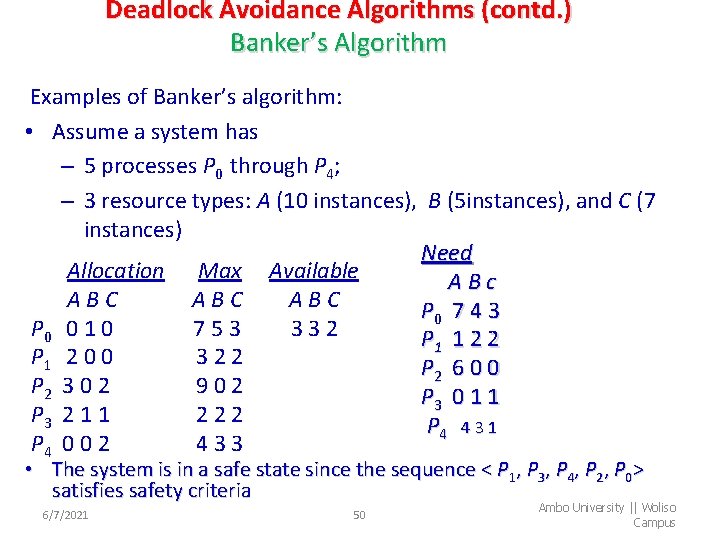
Deadlock Avoidance Algorithms (contd. ) Banker’s Algorithm Examples of Banker’s algorithm: • Assume a system has – 5 processes P 0 through P 4; – 3 resource types: A (10 instances), B (5 instances), and C (7 instances) Need Allocation Max Available ABc ABC ABC P 0 7 4 3 P 0 0 1 0 753 332 P 1 1 2 2 P 1 2 0 0 322 P 2 6 0 0 P 2 3 0 2 902 P 3 0 1 1 P 3 2 1 1 222 P 4 4 3 1 P 4 0 0 2 433 • The system is in a safe state since the sequence < P 1, P 3, P 4, P 2, P 0> satisfies safety criteria 6/7/2021 50 Ambo University || Woliso Campus
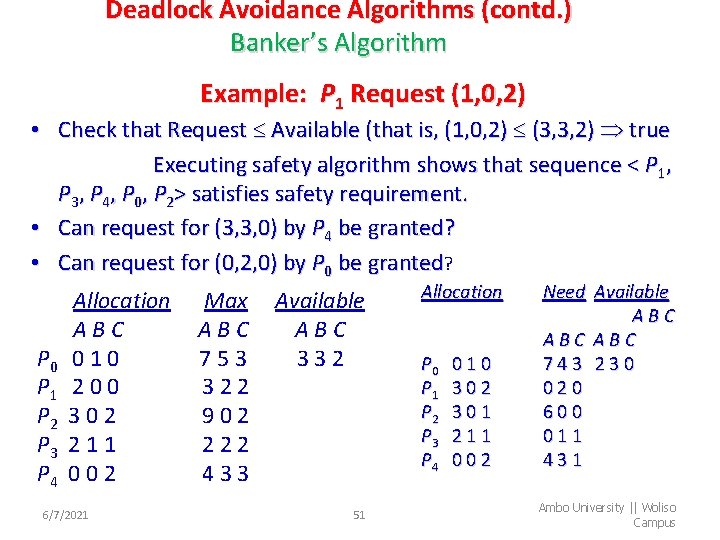
Deadlock Avoidance Algorithms (contd. ) Banker’s Algorithm Example: P 1 Request (1, 0, 2) • Check that Request Available (that is, (1, 0, 2) (3, 3, 2) true Executing safety algorithm shows that sequence < P 1, P 3, P 4, P 0, P 2> satisfies safety requirement. • Can request for (3, 3, 0) by P 4 be granted? • Can request for (0, 2, 0) by P 0 be granted? P 0 P 1 P 2 P 3 P 4 Allocation ABC 010 200 302 211 002 6/7/2021 Max ABC 753 322 902 222 433 Available ABC 332 51 Allocation P 0 P 1 P 2 P 3 P 4 010 302 301 211 002 Need Available ABC ABC 743 230 020 600 011 431 Ambo University || Woliso Campus
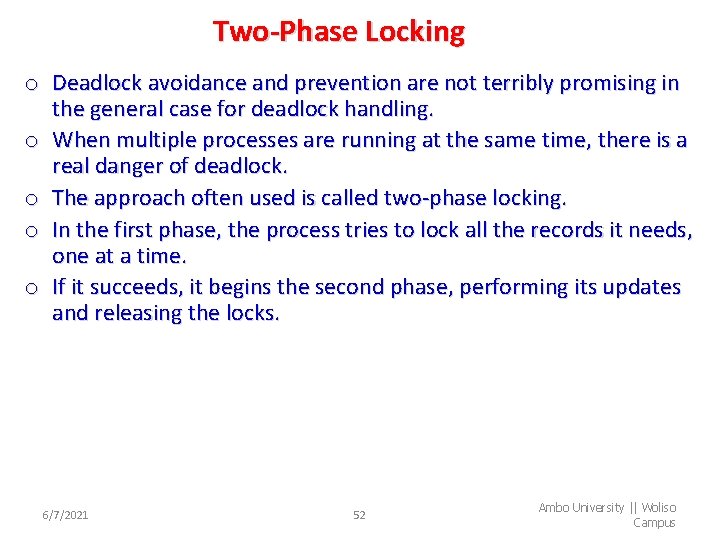
Two-Phase Locking o Deadlock avoidance and prevention are not terribly promising in the general case for deadlock handling. o When multiple processes are running at the same time, there is a real danger of deadlock. o The approach often used is called two-phase locking. o In the first phase, the process tries to lock all the records it needs, one at a time. o If it succeeds, it begins the second phase, performing its updates and releasing the locks. 6/7/2021 52 Ambo University || Woliso Campus
Communication deadlock o process wants something that another process has and must wait until the first one gives it up. o Another kind of deadlock can occur in communication systems (e. g. , networks), in which two or more processes communicate by sending messages. o A common arrangement is that process A sends a request message to process B, and then blocks until B sends back a reply message. o Communication deadlocks cannot be prevented by ordering the resources (since there are none) or avoided by careful scheduling (since there are no moments when a request could be postponed). o The technique that can usually be employed to break communication deadlocks: timeouts. o In most network communication systems, whenever a message is sent to which a reply is expected a timer is also started. o If the timer goes off before the reply arrives, the sender of the message assumes that the message has been lost and sends it again (and again if needed). 6/7/2021 53 Ambo University || Woliso Campus
Livelock o In some situations, polling (busy waiting) is used to enter a critical region or access a resource. o Let pair of processes (process A and process B)using two resources. o process A is use resource 1 and request resource 2 and process 2 use resource 2 and request o if the processes wait for required resource by spooling rather than blocking, this situation is called livelock. o Thus we do not have a deadlock (because no process is blocked) but we have something functionally equivalent to deadlock; will make no further progress. 6/7/2021 54 Ambo University || Woliso Campus
Starvation o A problem closely related to deadlock and livelock is starvation. o When processes wait for execution, but it cannot be possible to get CPU to be run, because of scheduler or something else these processes are said to be under starvation. 6/7/2021 55 Ambo University || Woliso Campus
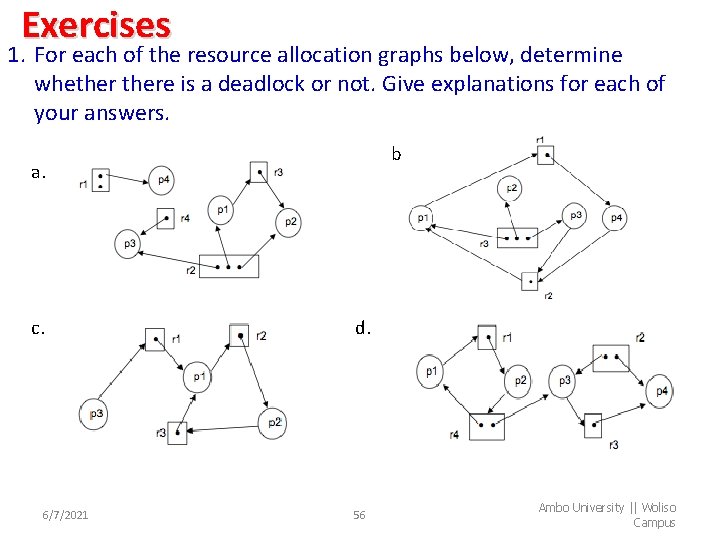
Exercises 1. For each of the resource allocation graphs below, determine whethere is a deadlock or not. Give explanations for each of your answers. b. a. c. 6/7/2021 d. 56 Ambo University || Woliso Campus
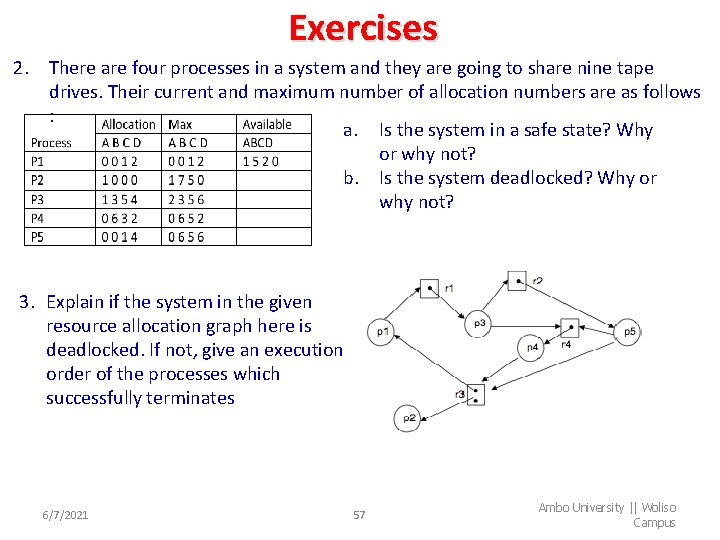
Exercises 2. There are four processes in a system and they are going to share nine tape drives. Their current and maximum number of allocation numbers are as follows : a. Is the system in a safe state? Why or why not? b. Is the system deadlocked? Why or why not? 3. Explain if the system in the given resource allocation graph here is deadlocked. If not, give an execution order of the processes which successfully terminates 6/7/2021 57 Ambo University || Woliso Campus
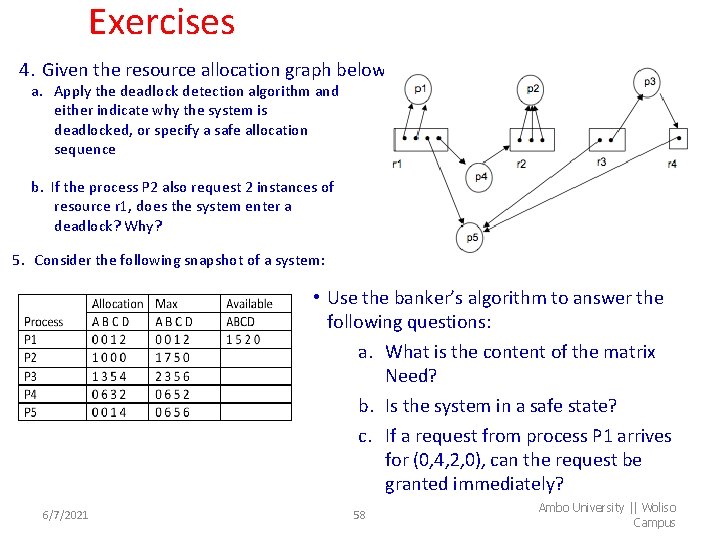
Exercises 4. Given the resource allocation graph below: a. Apply the deadlock detection algorithm and either indicate why the system is deadlocked, or specify a safe allocation sequence b. If the process P 2 also request 2 instances of resource r 1, does the system enter a deadlock? Why? 5. Consider the following snapshot of a system: • Use the banker’s algorithm to answer the following questions: a. What is the content of the matrix Need? b. Is the system in a safe state? c. If a request from process P 1 arrives for (0, 4, 2, 0), can the request be granted immediately? 6/7/2021 58 Ambo University || Woliso Campus
- Slides: 58