
2 5 Additive Rules Theorem 2 10 If
- Slides: 22
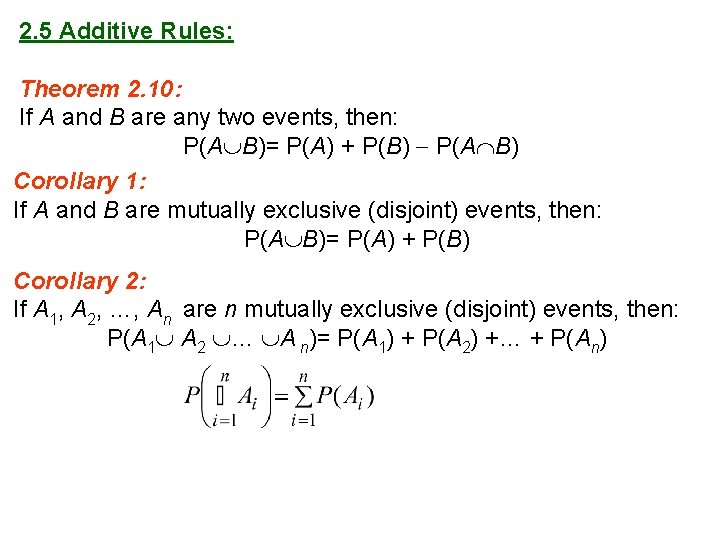
2. 5 Additive Rules: Theorem 2. 10: If A and B are any two events, then: P(A B)= P(A) + P(B) P(A B) Corollary 1: If A and B are mutually exclusive (disjoint) events, then: P(A B)= P(A) + P(B) Corollary 2: If A 1, A 2, …, An are n mutually exclusive (disjoint) events, then: P(A 1 A 2 … A n)= P(A 1) + P(A 2) +… + P(An)
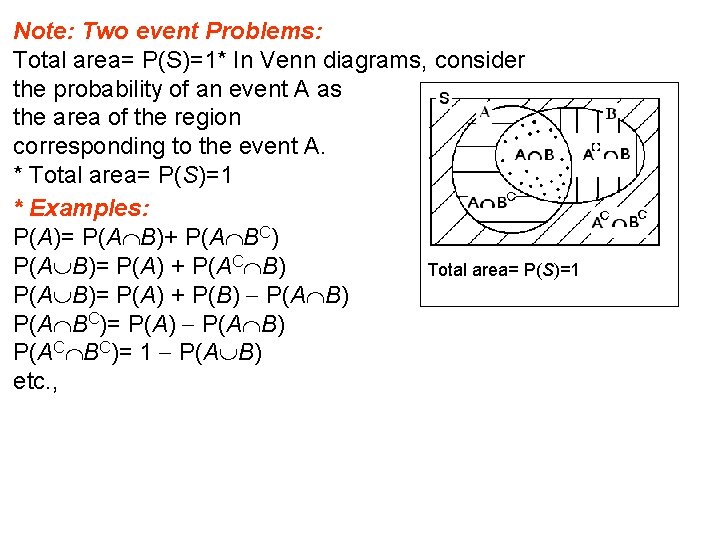
Note: Two event Problems: Total area= P(S)=1* In Venn diagrams, consider the probability of an event A as the area of the region corresponding to the event A. * Total area= P(S)=1 * Examples: P(A)= P(A B)+ P(A BC) P(A B)= P(A) + P(AC B) Total area= P(S)=1 P(A B)= P(A) + P(B) P(A B) P(A BC)= P(A) P(A B) P(AC BC)= 1 P(A B) etc. ,
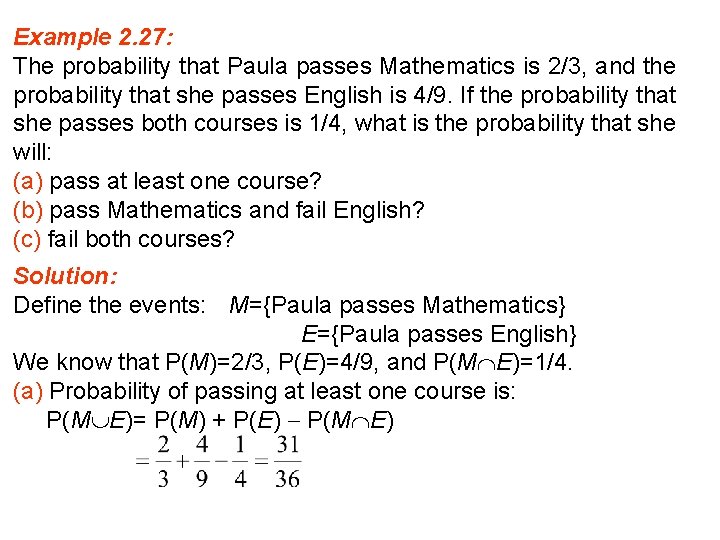
Example 2. 27: The probability that Paula passes Mathematics is 2/3, and the probability that she passes English is 4/9. If the probability that she passes both courses is 1/4, what is the probability that she will: (a) pass at least one course? (b) pass Mathematics and fail English? (c) fail both courses? Solution: Define the events: M={Paula passes Mathematics} E={Paula passes English} We know that P(M)=2/3, P(E)=4/9, and P(M E)=1/4. (a) Probability of passing at least one course is: P(M E)= P(M) + P(E) P(M E)
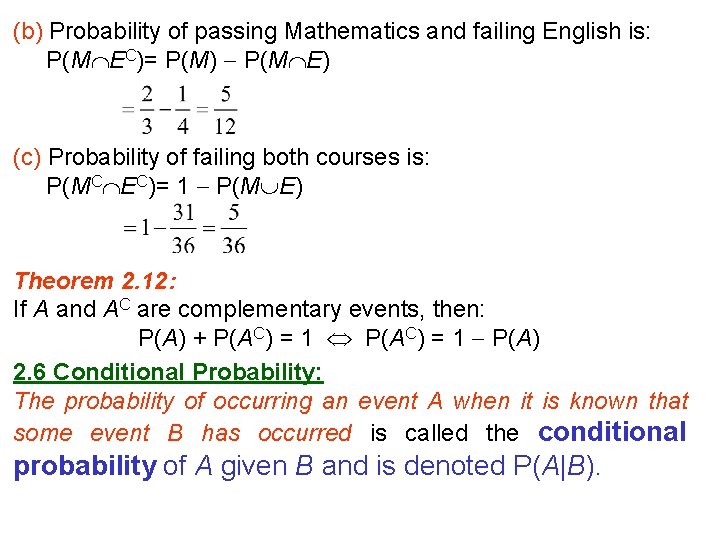
(b) Probability of passing Mathematics and failing English is: P(M EC)= P(M) P(M E) (c) Probability of failing both courses is: P(MC EC)= 1 P(M E) Theorem 2. 12: If A and AC are complementary events, then: P(A) + P(AC) = 1 P(A) 2. 6 Conditional Probability: The probability of occurring an event A when it is known that some event B has occurred is called the conditional probability of A given B and is denoted P(A|B).
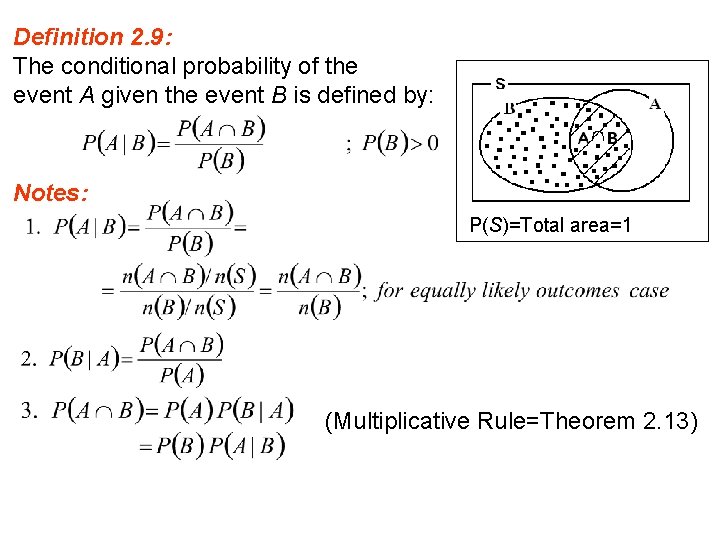
Definition 2. 9: The conditional probability of the event A given the event B is defined by: Notes: P(S)=Total area=1 (Multiplicative Rule=Theorem 2. 13)
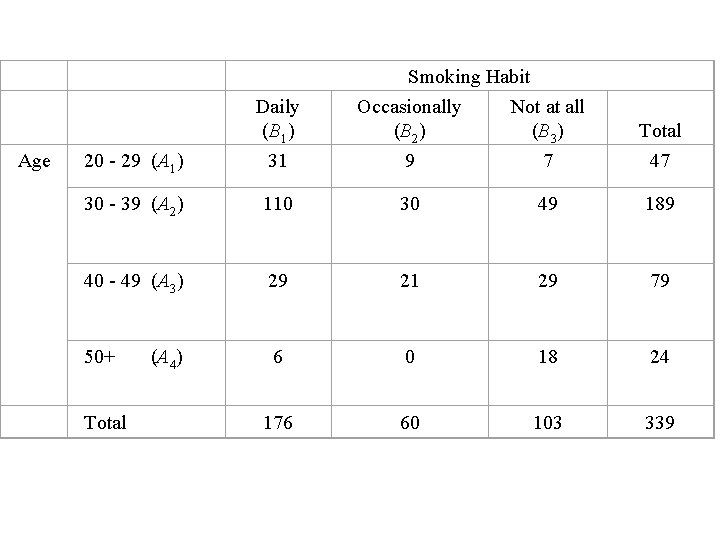
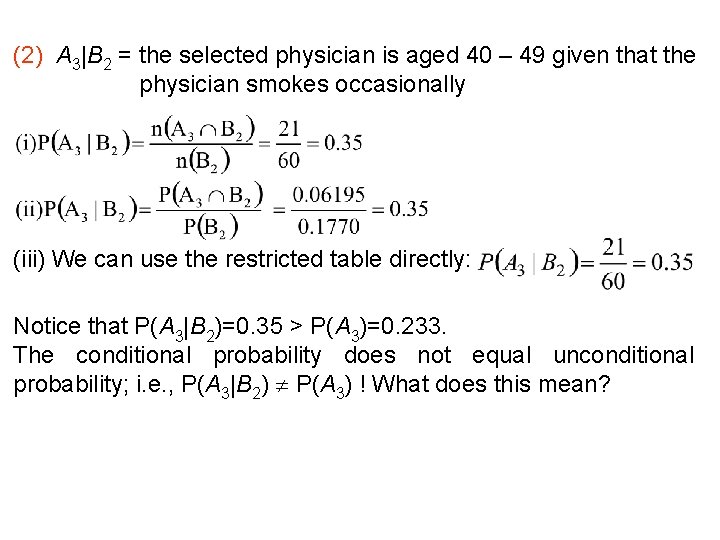
Example: 339 physicians are classified as given in the table below. A physician is to be selected at random. (1) Find the probability that: (a) the selected physician is aged 40 – 49 (b) the selected physician smokes occasionally (c) the selected physician is aged 40 – 49 and smokes occasionally (2) Find the probability that the selected physician is aged 40 – 49 given that the physician smokes occasionally.
Daily (B 1) Age Smoking Habit Occasionally Not at all (B 2) (B 3) Total 20 - 29 (A 1) 31 9 7 47 30 - 39 (A 2) 110 30 49 189 40 - 49 (A 3) 29 21 29 79 50+ 6 0 18 24 176 60 103 339 Total (A 4)
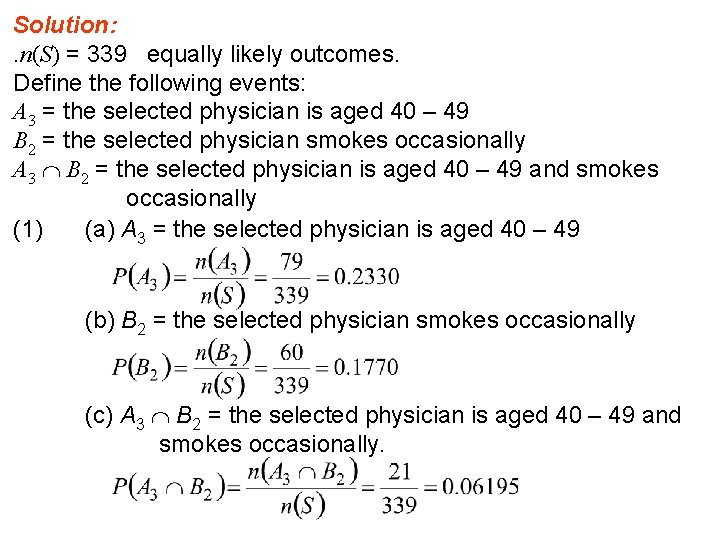
Solution: . n(S) = 339 equally likely outcomes. Define the following events: A 3 = the selected physician is aged 40 – 49 B 2 = the selected physician smokes occasionally A 3 B 2 = the selected physician is aged 40 – 49 and smokes occasionally (1) (a) A 3 = the selected physician is aged 40 – 49 (b) B 2 = the selected physician smokes occasionally (c) A 3 B 2 = the selected physician is aged 40 – 49 and smokes occasionally.
(2) A 3|B 2 = the selected physician is aged 40 – 49 given that the physician smokes occasionally (iii) We can use the restricted table directly: Notice that P(A 3|B 2)=0. 35 > P(A 3)=0. 233. The conditional probability does not equal unconditional probability; i. e. , P(A 3|B 2) P(A 3) ! What does this mean?
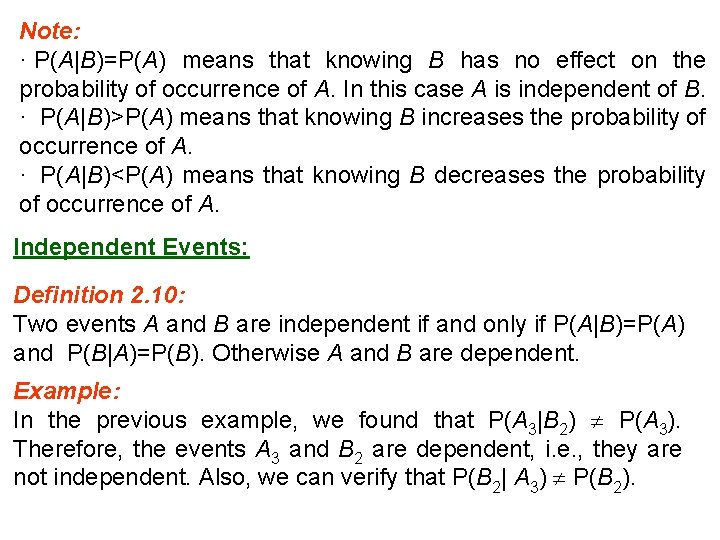
Note: · P(A|B)=P(A) means that knowing B has no effect on the probability of occurrence of A. In this case A is independent of B. · P(A|B)>P(A) means that knowing B increases the probability of occurrence of A. · P(A|B)<P(A) means that knowing B decreases the probability of occurrence of A. Independent Events: Definition 2. 10: Two events A and B are independent if and only if P(A|B)=P(A) and P(B|A)=P(B). Otherwise A and B are dependent. Example: In the previous example, we found that P(A 3|B 2) P(A 3). Therefore, the events A 3 and B 2 are dependent, i. e. , they are not independent. Also, we can verify that P(B 2| A 3) P(B 2).
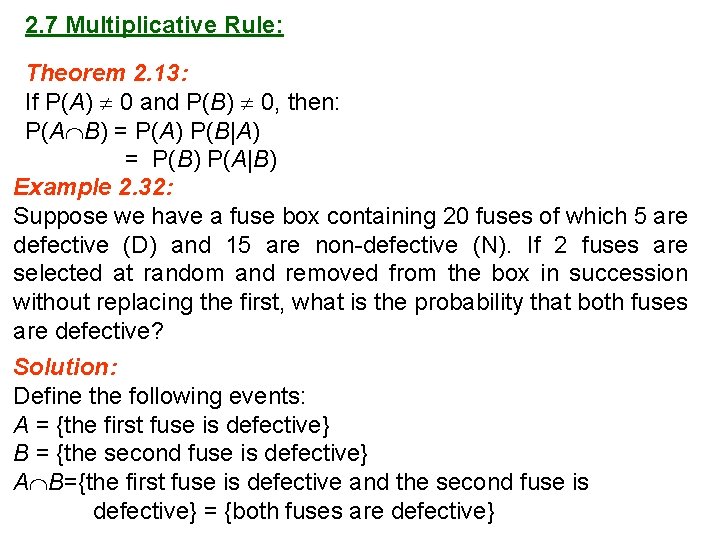
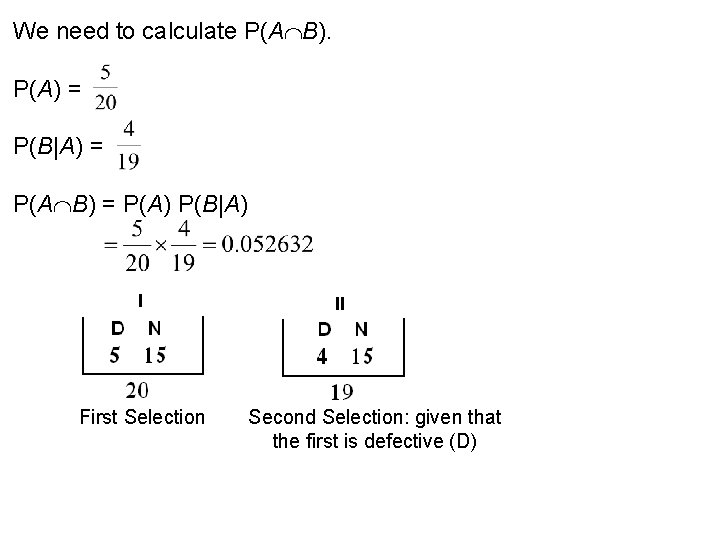
2. 7 Multiplicative Rule: Theorem 2. 13: If P(A) 0 and P(B) 0, then: P(A B) = P(A) P(B|A) = P(B) P(A|B) Example 2. 32: Suppose we have a fuse box containing 20 fuses of which 5 are defective (D) and 15 are non-defective (N). If 2 fuses are selected at random and removed from the box in succession without replacing the first, what is the probability that both fuses are defective? Solution: Define the following events: A = {the first fuse is defective} B = {the second fuse is defective} A B={the first fuse is defective and the second fuse is defective} = {both fuses are defective}
We need to calculate P(A B). P(A) = P(B|A) = P(A B) = P(A) P(B|A) First Selection Second Selection: given that the first is defective (D)
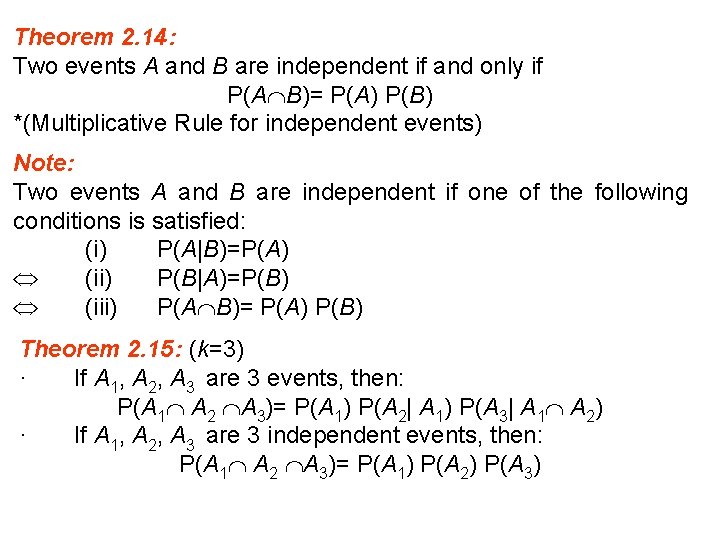
Theorem 2. 14: Two events A and B are independent if and only if P(A B)= P(A) P(B) *(Multiplicative Rule for independent events) Note: Two events A and B are independent if one of the following conditions is satisfied: (i) P(A|B)=P(A) (ii) P(B|A)=P(B) (iii) P(A B)= P(A) P(B) Theorem 2. 15: (k=3) · If A 1, A 2, A 3 are 3 events, then: P(A 1 A 2 A 3)= P(A 1) P(A 2| A 1) P(A 3| A 1 A 2) · If A 1, A 2, A 3 are 3 independent events, then: P(A 1 A 2 A 3)= P(A 1) P(A 2) P(A 3)
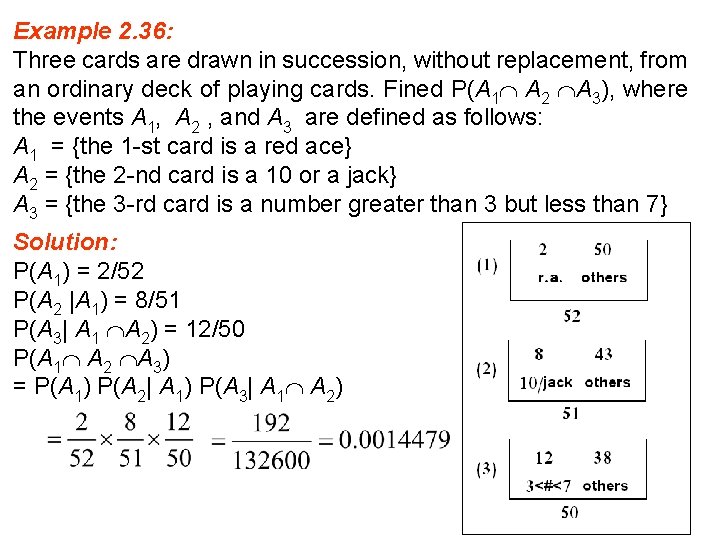
Example 2. 36: Three cards are drawn in succession, without replacement, from an ordinary deck of playing cards. Fined P(A 1 A 2 A 3), where the events A 1, A 2 , and A 3 are defined as follows: A 1 = {the 1 -st card is a red ace} A 2 = {the 2 -nd card is a 10 or a jack} A 3 = {the 3 -rd card is a number greater than 3 but less than 7} Solution: P(A 1) = 2/52 P(A 2 |A 1) = 8/51 P(A 3| A 1 A 2) = 12/50 P(A 1 A 2 A 3) = P(A 1) P(A 2| A 1) P(A 3| A 1 A 2)
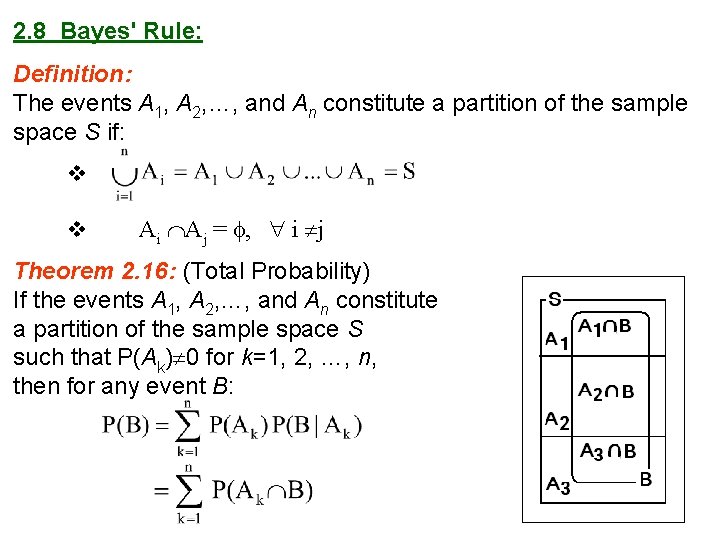
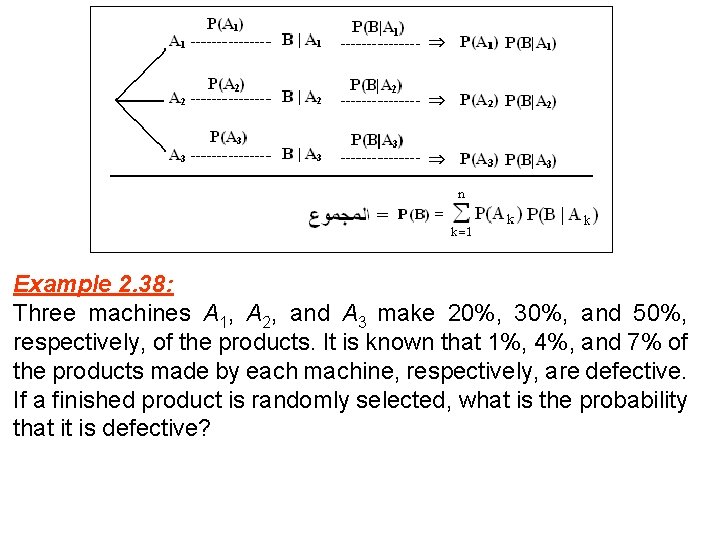
2. 8 Bayes' Rule: Definition: The events A 1, A 2, …, and An constitute a partition of the sample space S if: v v Ai Aj = , i j Theorem 2. 16: (Total Probability) If the events A 1, A 2, …, and An constitute a partition of the sample space S such that P(Ak) 0 for k=1, 2, …, n, then for any event B:
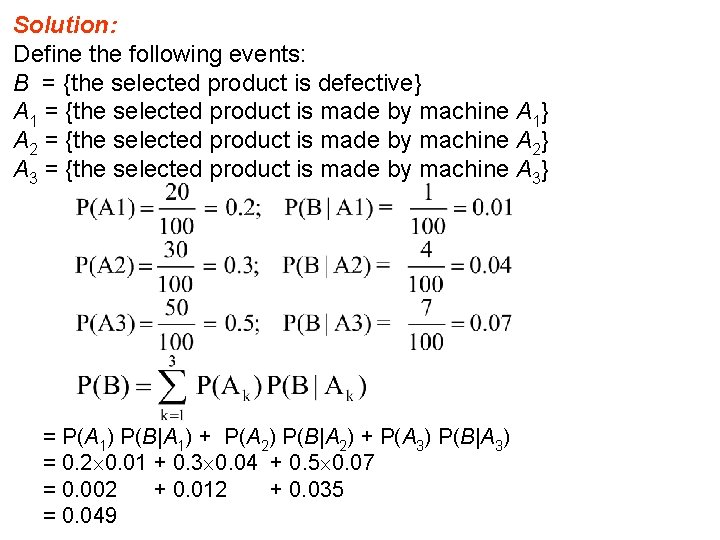
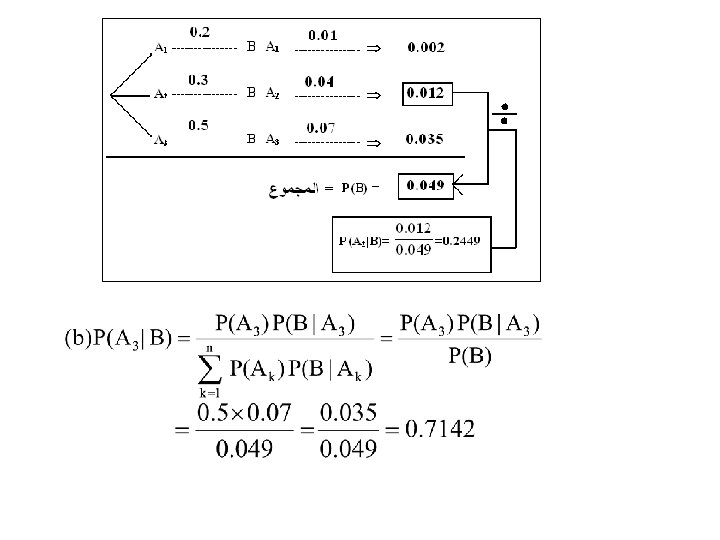
Example 2. 38: Three machines A 1, A 2, and A 3 make 20%, 30%, and 50%, respectively, of the products. It is known that 1%, 4%, and 7% of the products made by each machine, respectively, are defective. If a finished product is randomly selected, what is the probability that it is defective?
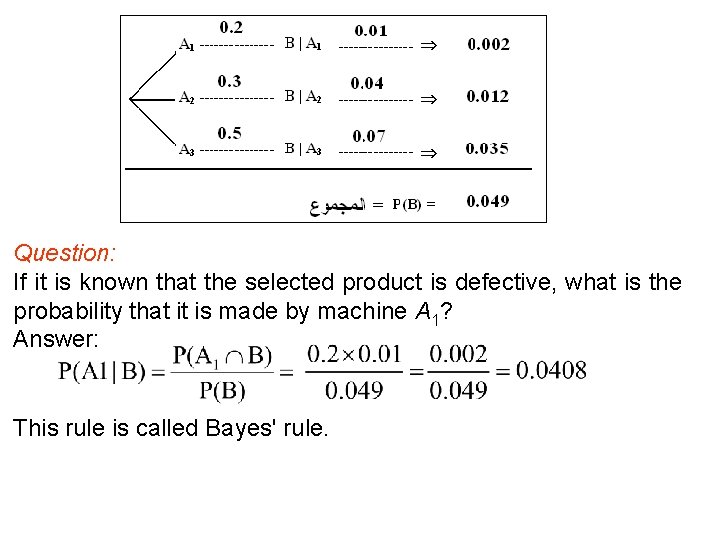
Solution: Define the following events: B = {the selected product is defective} A 1 = {the selected product is made by machine A 1} A 2 = {the selected product is made by machine A 2} A 3 = {the selected product is made by machine A 3} = P(A 1) P(B|A 1) + P(A 2) P(B|A 2) + P(A 3) P(B|A 3) = 0. 2 0. 01 + 0. 3 0. 04 + 0. 5 0. 07 = 0. 002 + 0. 012 + 0. 035 = 0. 049
Question: If it is known that the selected product is defective, what is the probability that it is made by machine A 1? Answer: This rule is called Bayes' rule.
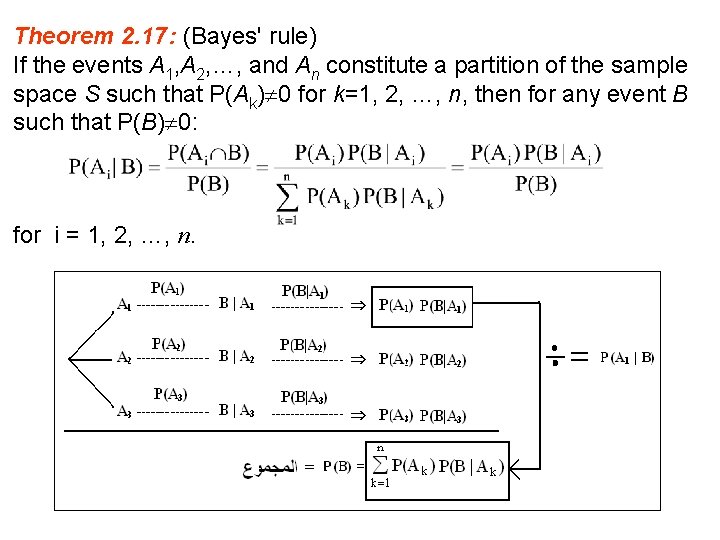
Theorem 2. 17: (Bayes' rule) If the events A 1, A 2, …, and An constitute a partition of the sample space S such that P(Ak) 0 for k=1, 2, …, n, then for any event B such that P(B) 0: for i = 1, 2, …, n.
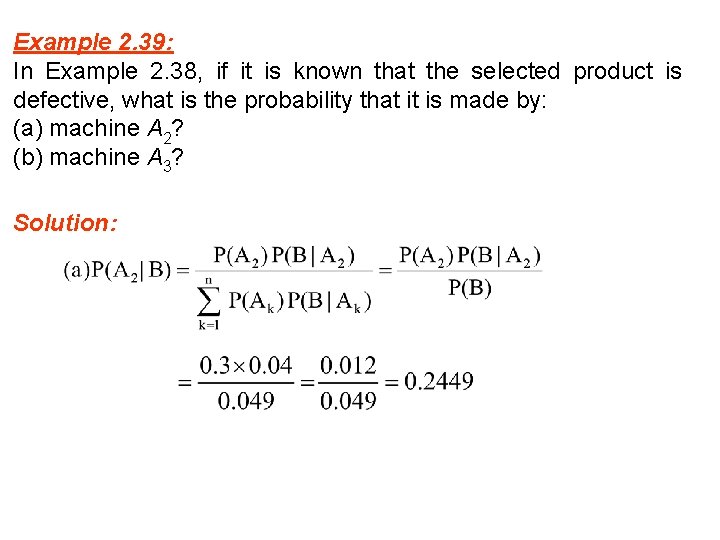
Example 2. 39: In Example 2. 38, if it is known that the selected product is defective, what is the probability that it is made by: (a) machine A 2? (b) machine A 3? Solution:
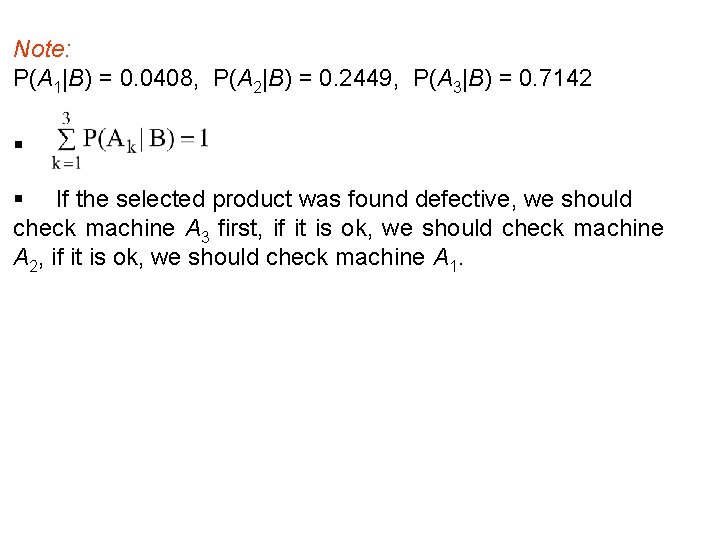
Note: P(A 1|B) = 0. 0408, P(A 2|B) = 0. 2449, P(A 3|B) = 0. 7142 § § If the selected product was found defective, we should check machine A 3 first, if it is ok, we should check machine A 2, if it is ok, we should check machine A 1.