
2 4 Resource Mobilization Humanitarian Financing Supply and
2. 4. Resource Mobilization Humanitarian Financing, Supply and Human Resources
Objectives ü Describe the importance of resource mobilisation within the Humanitarian Programme Cycle. ü Distinguish between three components of resource mobilisation ü Identify the roles, responsibilities and accountabilities of partners in resource mobilization. ü Explain how an HRP, sector plans and flash appeals are financially resourced. ü Relate capacity development and surge mechanisms to the delivery of quality emergency response.
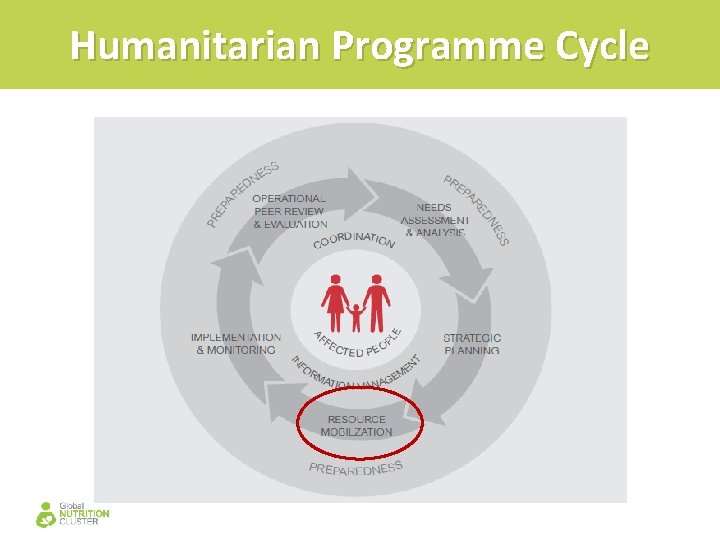
Humanitarian Programme Cycle
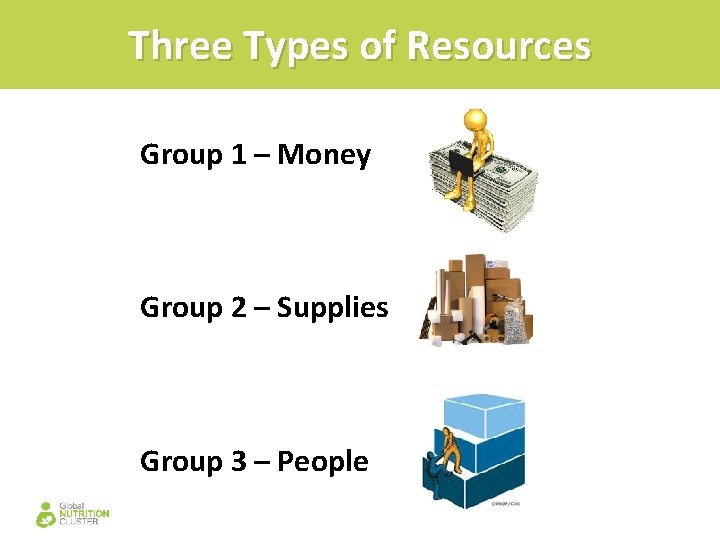
Three Types of Resources Group 1 – Money Group 2 – Supplies Group 3 – People
Finance Financing of Strategic Objectives and sector plans NOTE: Financing is per SO (budget per SO!)
Supply The procurement, transport and distribution of commodities necessary for programme implementation to meet the affected population’s needs.
Human Resources Capacity ability of individuals, institutions and societies to perform functions, solve problems, and set and achieve objectives in a sustainable manner. Includes community engagement!
Group Work: Resource Mobilisation Group 1 – Finance Group 2 – Supplies Group 3 – Human Resource In your group, be prepared to answer the questions on your sheet to the plenary.
Group 1: Finance 1. Why is this type of resource important? 2. What funds do you know of that are used to finance the HRP and Sector Plans? 3. How can the sector prepare for this type of resource mobilisation? 4. What is the role of partners? NCC Training 2013 9
Finance – Financing of strategic objectives and sector plans through… • • • Agency-specific resource mobilisation Central Emergency Response Fund (CERF) Country-based Pooled Funds Private sector / civil society National governments • bilateral donations • multilateral donations NOTE: Financing is per SO (budget per SO!)
CERF (Central Emergency Response Fund) Rapid Response Grant and Grant for Underfunded Emergencies; • Disbursed by OCHA only to UN agencies and IOM; • Grant to jump start critical operations and fund life-saving activities based on Flash Appeal / HRP objectives; • Sector in consultation with partners identify priority areas for funding, including funds for sector coordination; • Sector Coordinator ensures the inclusion of nutrition sector interventions in the CERF application submitted by CLA on behalf of UN partners; • NGOs can receive funds as implementing partners of UN agencies.
Country-Based Pooled Funds (CBPFs) • CBPFs are multi-donor humanitarian financing instruments established by the Emergency Relief Coordinator (ERC). • Managed by OCHA at country-level under the leadership of the HC. • Donor contributions are un-earmarked and allocated by the HC through an in-country consultative process. • Based on needs at the country level and can go to all partners (UN, NGO, etc. )
Resource Mobilisation and AAP • Strong evidence of needs, and information on the priorities of affected people, increases the credibility of funding requests • More donors looking for participation and engagement of affected people as criteria for funding decisions – what can the NC do to support this in proposals? • Specifically include budgets for community engagement activities and request flexibility to adapt programmes • Showing the added value of collaborative and joint approaches can also help successful proposals. • Transparency with partners and communities about available funding and priority allocations helps build trust and manage unrealistic expectations
Partners’ Role in Financial resource mobilisation • Inform the sector of the agency financial requirements, including through OPS; • Inform the sector on the funding received through Financial Tracking System or using other tools; • Engage in your agency fundraising activities; • Participate in donor presentations by presenting the results of your works, gaps and ways forward to address the gaps;
Key Messages • Resource mobilisation is informed by all elements of the HPC. • The Nutrition Sector often needs to rank and prioritise its projects and activities in relation to fundraising. • Clear information about the funding mechanism, consultative development of the prioritisation criteria and process, and documentation of the outcomes can help to promote participation in fundraising. • Communicating back to partners and communities on resource allocations and priorities helps build trust and manage expectations
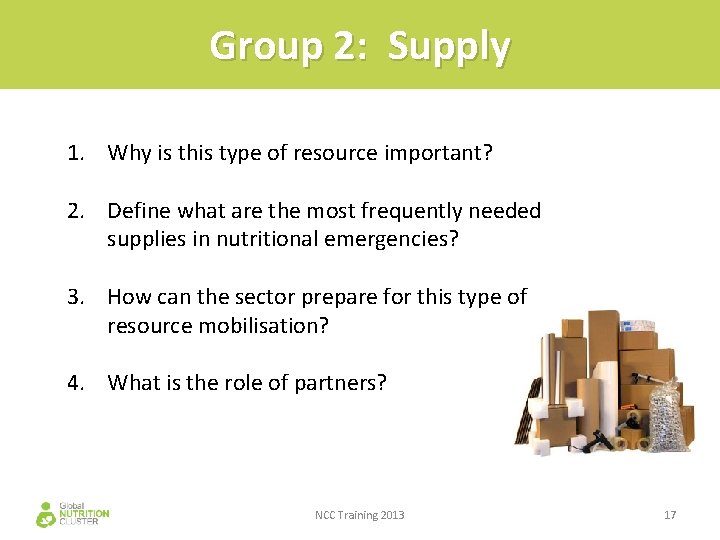
Group 2: Supply 1. Why is this type of resource important? 2. Define what are the most frequently needed supplies in nutritional emergencies? 3. How can the sector prepare for this type of resource mobilisation? 4. What is the role of partners? NCC Training 2013 17
Which supplies? Supplies: - To treat and/or prevent SAM and MAM; - To treat and/or prevent micronutrient deficiencies (iron/folate, sprinkles, vit. A, etc); - To address needs for IYCF-E (hygiene kits, baby -kits, BMS, baby-tents, etc); - Anthropometric equipment.
Role of NC Partners • Share information with the NSC to ensure that overall Nutrition Sector needs for stocks of supplies and equipment are identified. This includes information on expected pipeline breaks, risks of shortage, etc • Procure supplies or request them from the pipeline management agencies Note: Some agencies have their own independent supply/equipment pipelines and do not necessarily participate in joint supply planning via the Nutrition Sector. However, these agencies are still encouraged to share! • Willingness to make temporarily available supplies to other organisations (‘lending’)
Key Messages • The NCC is responsible for coordination between Nutrition Sector partners to ensure that overall supply and equipment needs for the emergency response are regularly identified and that the Nutrition Sector as a whole can identify and address any pipeline issues • Both the NCC and the NC partners have important complementary roles to play in the SUPPLY process. • There are various ways to improve the caseload calculations
Group 3: People 1. Why is this type of resource important? 2. What is capacity development and capacity building an element of quality response to emergencies? 3. How can the sector prepare for this type of resource mobilisation? 4. What is the role of partners? NCC Training 2013 21
GNC Capacity Building Initiatives • Harmonised Training Package; • In-service Training / Pre-Service Training – Nutrition. Works, UNICEF, other partners; • GNC Sector Coordination Training; • GNC Country-level partners’ Orientation; • GNC IM Training All tools and resources are available at: http: //www. nutritionsector. net
Partners’ Role in Capacity Building • Contribute to the sector Capacity mapping • Establish capacity building/development needs in your agency • Inform the sector on your capacity building strengths, e. g. in any of the Ni. E technical area • Implementation of capacity building activities: organise training sessions on technical Ni. E for your agency • Support other sector partners if your agency has sufficient capacity to do that • Provide inputs for the updated and revision of the capacity building plans to reflect relevant needs; • Integrate AAP in your capacity building activities
Capacity Building and AAP • Consider ways alternative ways to build local capacity beyond trainings or hiring international staff: – Coaching and mentoring between partners – Co-financing staff costs of local partners to strengthen implementation and management capacity – Long-term financial support for staffing to ensure continuity and more sustainable local capacity • Think of ways to build community capacity to support implementation and management of nutrition activities: – Supporting community structures and organisations for CMAM – Using community members for nutritional status monitoring – Using communications and engagement to strengthen longerterm knowledge, awareness and practices around nutrition
Key Messages • Capacity building activities need to be based on a clear assessment of available capacity – don’t forget to look at local actors first! • Also take time to identify gaps and needs within the sector member agencies including the national authority. • There a variety of options for capacity building activities – try to think of innovative and alternative approaches than just training • Capacity building is a critical component of quality assurance for the Nutrition Sector response and effective transition from the sector response to nutrition sector coordination.
- Slides: 24