
2 4 Reasoning Properties of Equality POE Addition
- Slides: 4
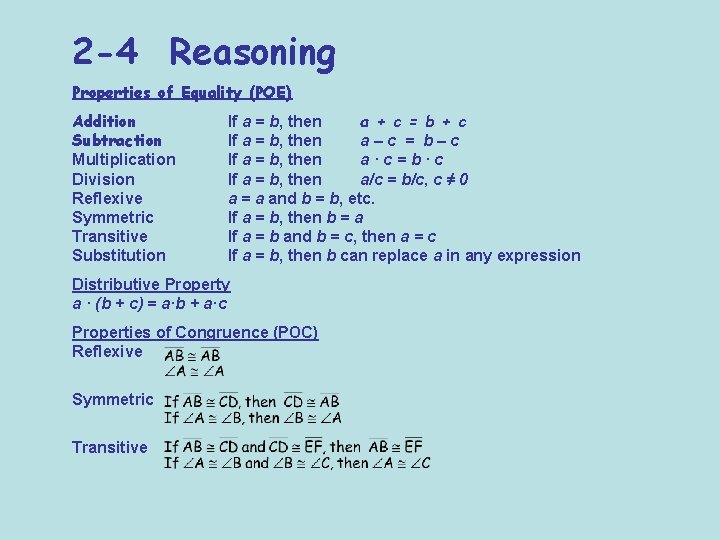
2 -4 Reasoning Properties of Equality (POE) Addition Subtraction Multiplication Division Reflexive Symmetric Transitive Substitution If a = b, then a + c = b + c If a = b, then a–c = b–c If a = b, then a·c=b·c If a = b, then a/c = b/c, c ≠ 0 a = a and b = b, etc. If a = b, then b = a If a = b and b = c, then a = c If a = b, then b can replace a in any expression Distributive Property a · (b + c) = a·b + a·c Properties of Congruence (POC) Reflexive Symmetric Transitive
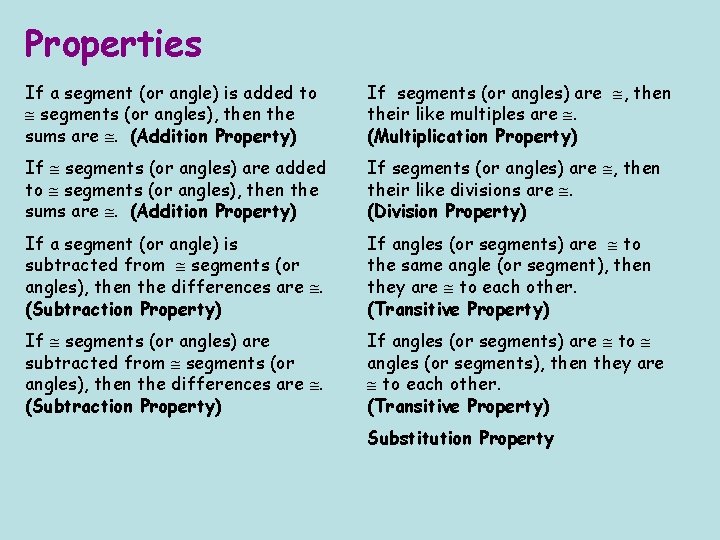
Properties If a segment (or angle) is added to segments (or angles), then the sums are . (Addition Property) If segments (or angles) are , then their like multiples are . (Multiplication Property) If segments (or angles) are added to segments (or angles), then the sums are . (Addition Property) If segments (or angles) are , then their like divisions are . (Division Property) If a segment (or angle) is subtracted from segments (or angles), then the differences are . (Subtraction Property) If angles (or segments) are to the same angle (or segment), then they are to each other. (Transitive Property) If segments (or angles) are subtracted from segments (or angles), then the differences are . (Subtraction Property) If angles (or segments) are to angles (or segments), then they are to each other. (Transitive Property) Substitution Property
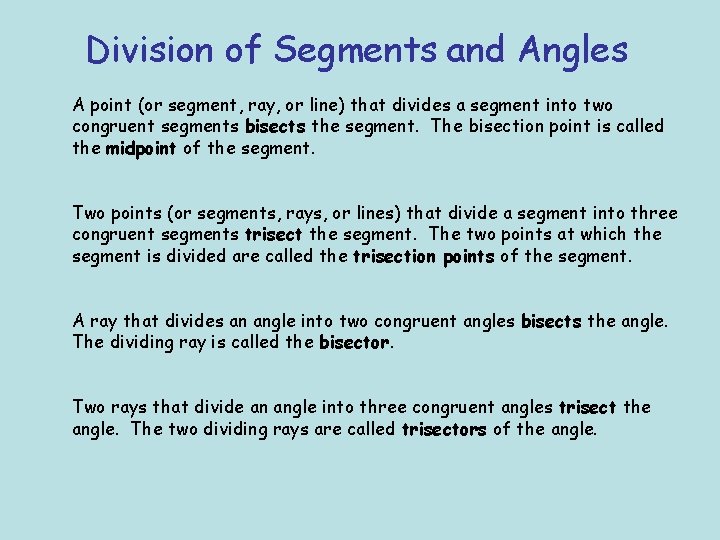
Division of Segments and Angles A point (or segment, ray, or line) that divides a segment into two congruent segments bisects the segment. The bisection point is called the midpoint of the segment. Two points (or segments, rays, or lines) that divide a segment into three congruent segments trisect the segment. The two points at which the segment is divided are called the trisection points of the segment. A ray that divides an angle into two congruent angles bisects the angle. The dividing ray is called the bisector. Two rays that divide an angle into three congruent angles trisect the angle. The two dividing rays are called trisectors of the angle.
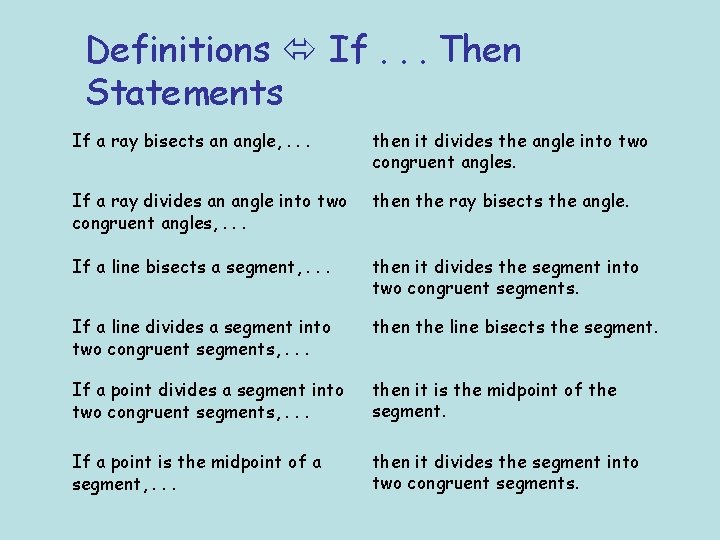
Definitions If. . . Then Statements If a ray bisects an angle, . . . then it divides the angle into two congruent angles. If a ray divides an angle into two congruent angles, . . . then the ray bisects the angle. If a line bisects a segment, . . . then it divides the segment into two congruent segments. If a line divides a segment into two congruent segments, . . . then the line bisects the segment. If a point divides a segment into two congruent segments, . . . then it is the midpoint of the segment. If a point is the midpoint of a segment, . . . then it divides the segment into two congruent segments.