
2 4 Formulas and Applications A formula is

- Slides: 17
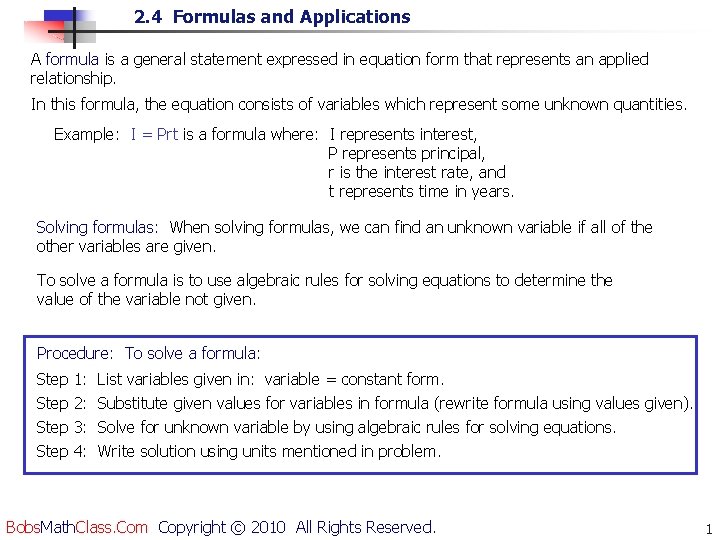
2. 4 Formulas and Applications A formula is a general statement expressed in equation form that represents an applied relationship. In this formula, the equation consists of variables which represent some unknown quantities. Example: I = Prt is a formula where: I represents interest, P represents principal, r is the interest rate, and t represents time in years. Solving formulas: When solving formulas, we can find an unknown variable if all of the other variables are given. To solve a formula is to use algebraic rules for solving equations to determine the value of the variable not given. Procedure: To solve a formula: Step 1: List variables given in: variable = constant form. Step 2: Substitute given values for variables in formula (rewrite formula using values given). Step 3: Solve for unknown variable by using algebraic rules for solving equations. Step 4: Write solution using units mentioned in problem. Bobs. Math. Class. Com Copyright © 2010 All Rights Reserved. 1
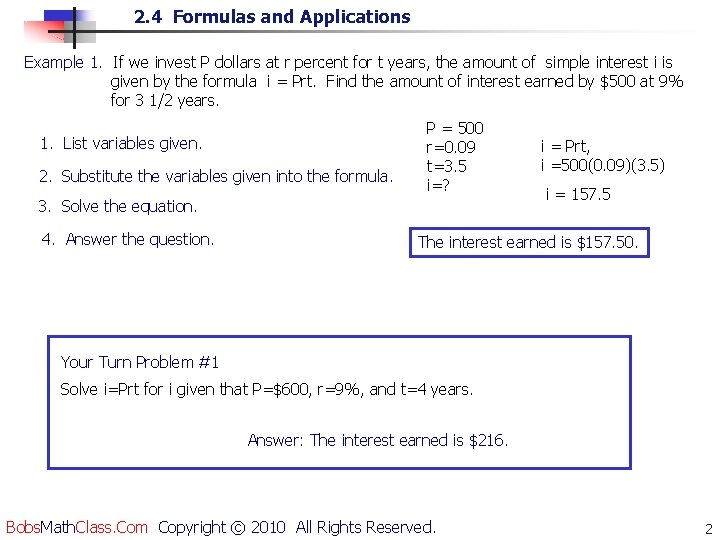
2. 4 Formulas and Applications Example 1. If we invest P dollars at r percent for t years, the amount of simple interest i is given by the formula i = Prt. Find the amount of interest earned by $500 at 9% for 3 1/2 years. 1. List variables given. 2. Substitute the variables given into the formula. P = 500 r=0. 09 t=3. 5 i=? 3. Solve the equation. 4. Answer the question. i = Prt, i =500(0. 09)(3. 5) i = 157. 5 The interest earned is $157. 50. Your Turn Problem #1 Solve i=Prt for i given that P=$600, r=9%, and t=4 years. Answer: The interest earned is $216. Bobs. Math. Class. Com Copyright © 2010 All Rights Reserved. 2
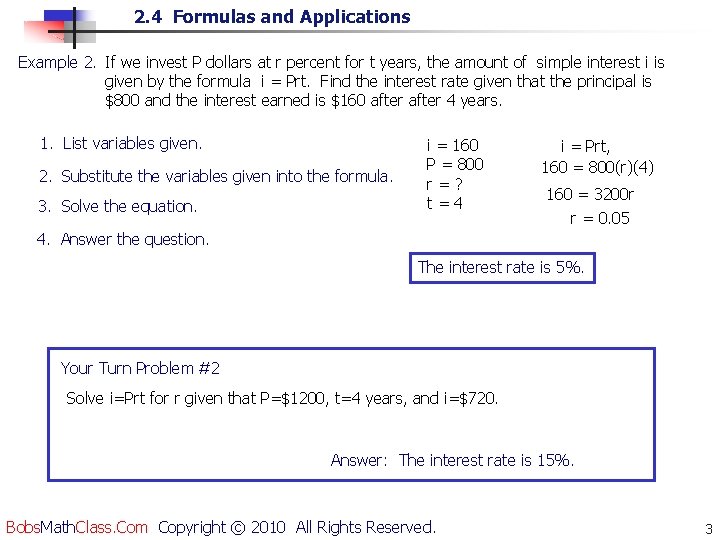
2. 4 Formulas and Applications Example 2. If we invest P dollars at r percent for t years, the amount of simple interest i is given by the formula i = Prt. Find the interest rate given that the principal is $800 and the interest earned is $160 after 4 years. 1. List variables given. 2. Substitute the variables given into the formula. 3. Solve the equation. i = 160 P = 800 r=? t=4 i = Prt, 160 = 800(r)(4) 160 = 3200 r r = 0. 05 4. Answer the question. The interest rate is 5%. Your Turn Problem #2 Solve i=Prt for r given that P=$1200, t=4 years, and i=$720. Answer: The interest rate is 15%. Bobs. Math. Class. Com Copyright © 2010 All Rights Reserved. 3
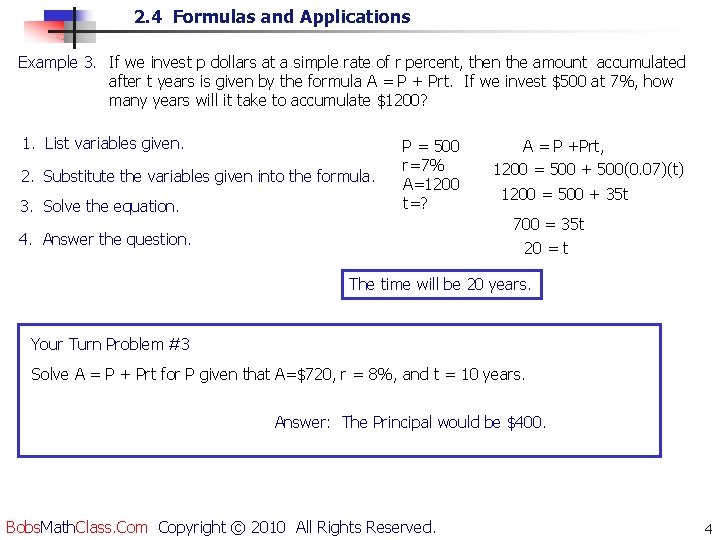
2. 4 Formulas and Applications Example 3. If we invest p dollars at a simple rate of r percent, then the amount accumulated after t years is given by the formula A = P + Prt. If we invest $500 at 7%, how many years will it take to accumulate $1200? 1. List variables given. 2. Substitute the variables given into the formula. 3. Solve the equation. P = 500 r=7% A=1200 t=? A = P +Prt, 1200 = 500 + 500(0. 07)(t) 1200 = 500 + 35 t 700 = 35 t 20 = t 4. Answer the question. The time will be 20 years. Your Turn Problem #3 Solve A = P + Prt for P given that A=$720, r = 8%, and t = 10 years. Answer: The Principal would be $400. Bobs. Math. Class. Com Copyright © 2010 All Rights Reserved. 4
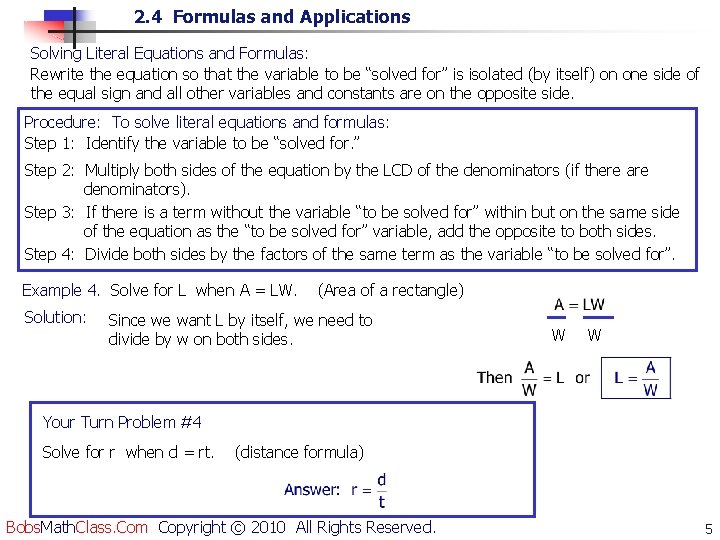
2. 4 Formulas and Applications Solving Literal Equations and Formulas: Rewrite the equation so that the variable to be “solved for” is isolated (by itself) on one side of the equal sign and all other variables and constants are on the opposite side. Procedure: To solve literal equations and formulas: Step 1: Identify the variable to be “solved for. ” Step 2: Multiply both sides of the equation by the LCD of the denominators (if there are denominators). Step 3: If there is a term without the variable “to be solved for” within but on the same side of the equation as the “to be solved for” variable, add the opposite to both sides. Step 4: Divide both sides by the factors of the same term as the variable “to be solved for”. Example 4. Solve for L when A = LW. Solution: (Area of a rectangle) Since we want L by itself, we need to divide by w on both sides. W W Your Turn Problem #4 Solve for r when d = rt. (distance formula) Bobs. Math. Class. Com Copyright © 2010 All Rights Reserved. 5
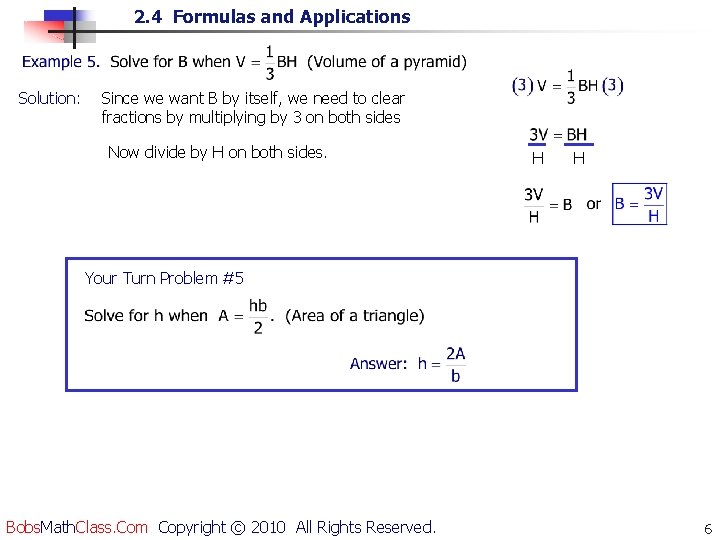
2. 4 Formulas and Applications Solution: Since we want B by itself, we need to clear fractions by multiplying by 3 on both sides Now divide by H on both sides. H H Your Turn Problem #5 Bobs. Math. Class. Com Copyright © 2010 All Rights Reserved. 6
2. 4 Formulas and Applications Solution: Since we want F by itself, multiply by 9 on both sides to clear fractions. Distribute to “get rid” of the parentheses. +160 Add 160 to both sides. +160 Instead of multiplying by 9, we could have multiplied by 9/5. Your Turn Problem #6 +32 Bobs. Math. Class. Com Copyright © 2010 All Rights Reserved. 7
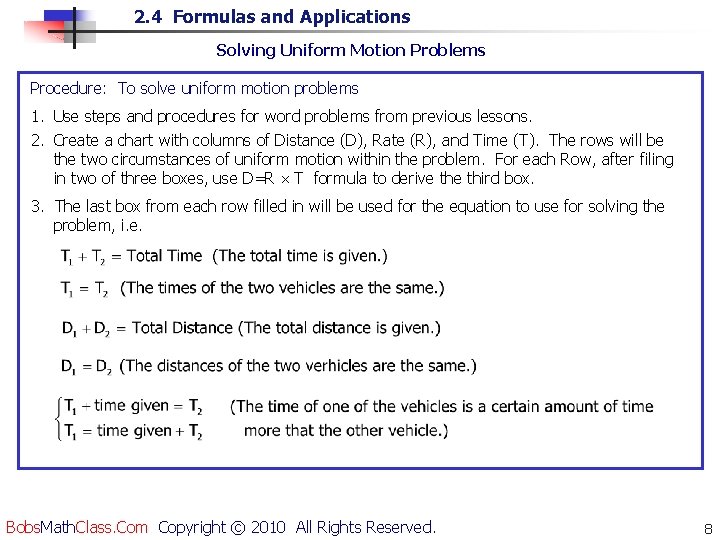
2. 4 Formulas and Applications Solving Uniform Motion Problems Procedure: To solve uniform motion problems 1. Use steps and procedures for word problems from previous lessons. 2. Create a chart with columns of Distance (D), Rate (R), and Time (T). The rows will be the two circumstances of uniform motion within the problem. For each Row, after filing in two of three boxes, use D=R T formula to derive third box. 3. The last box from each row filled in will be used for the equation to use for solving the problem, i. e. Bobs. Math. Class. Com Copyright © 2010 All Rights Reserved. 8
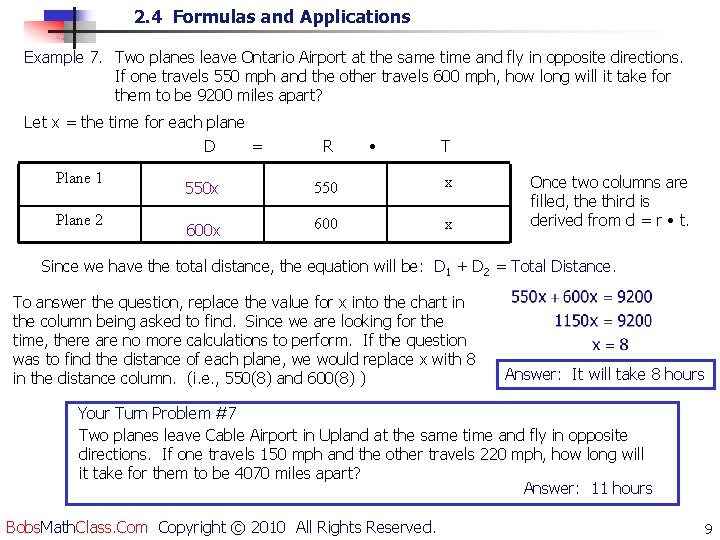
2. 4 Formulas and Applications Example 7. Two planes leave Ontario Airport at the same time and fly in opposite directions. If one travels 550 mph and the other travels 600 mph, how long will it take for them to be 9200 miles apart? Let x = the time for each plane D = Plane 1 Plane 2 R • T 550 x 550 x 600 x Once two columns are filled, the third is derived from d = r • t. Since we have the total distance, the equation will be: D 1 + D 2 = Total Distance. To answer the question, replace the value for x into the chart in the column being asked to find. Since we are looking for the time, there are no more calculations to perform. If the question was to find the distance of each plane, we would replace x with 8 in the distance column. (i. e. , 550(8) and 600(8) ) Answer: It will take 8 hours Your Turn Problem #7 Two planes leave Cable Airport in Upland at the same time and fly in opposite directions. If one travels 150 mph and the other travels 220 mph, how long will it take for them to be 4070 miles apart? Answer: 11 hours Bobs. Math. Class. Com Copyright © 2010 All Rights Reserved. 9
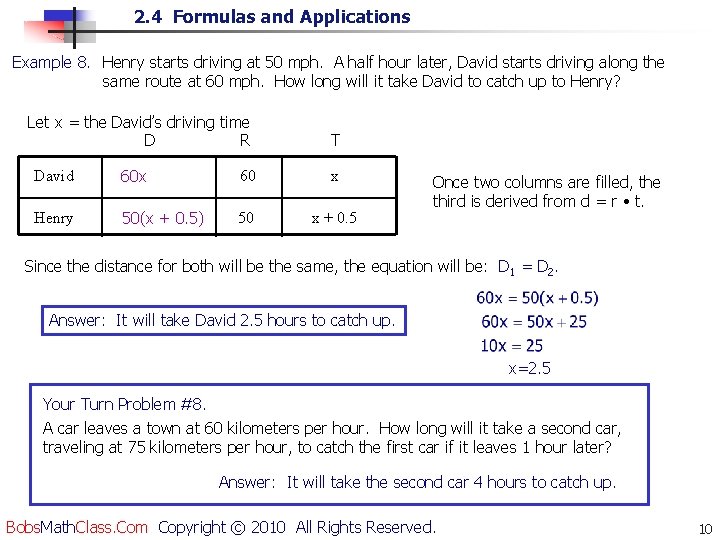
2. 4 Formulas and Applications Example 8. Henry starts driving at 50 mph. A half hour later, David starts driving along the same route at 60 mph. How long will it take David to catch up to Henry? Let x = the David’s driving time D R T David 60 x 60 x Henry 50(x + 0. 5) 50 x + 0. 5 Once two columns are filled, the third is derived from d = r • t. Since the distance for both will be the same, the equation will be: D 1 = D 2. Answer: It will take David 2. 5 hours to catch up. x=2. 5 Your Turn Problem #8. A car leaves a town at 60 kilometers per hour. How long will it take a second car, traveling at 75 kilometers per hour, to catch the first car if it leaves 1 hour later? Answer: It will take the second car 4 hours to catch up. Bobs. Math. Class. Com Copyright © 2010 All Rights Reserved. 10
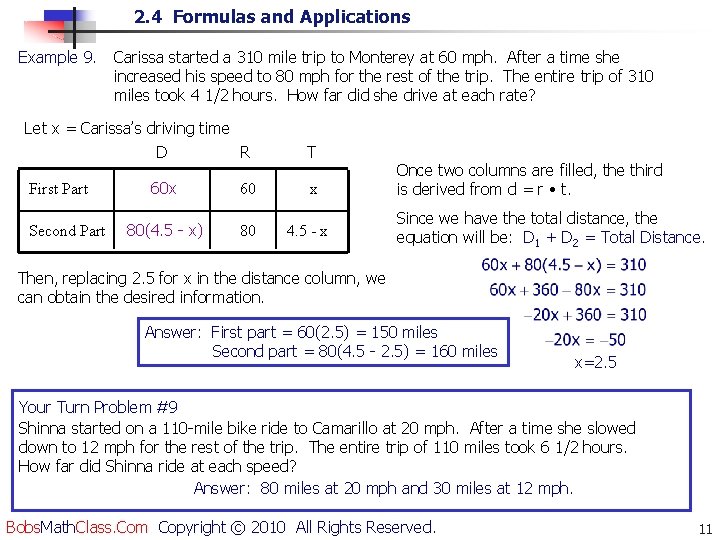
2. 4 Formulas and Applications Example 9. Carissa started a 310 mile trip to Monterey at 60 mph. After a time she increased his speed to 80 mph for the rest of the trip. The entire trip of 310 miles took 4 1/2 hours. How far did she drive at each rate? Let x = Carissa’s driving time First Part Second Part D R T 60 x 60 x 80(4. 5 - x) 80 4. 5 - x Once two columns are filled, the third is derived from d = r • t. Since we have the total distance, the equation will be: D 1 + D 2 = Total Distance. Then, replacing 2. 5 for x in the distance column, we can obtain the desired information. Answer: First part = 60(2. 5) = 150 miles Second part = 80(4. 5 - 2. 5) = 160 miles x=2. 5 Your Turn Problem #9 Shinna started on a 110 -mile bike ride to Camarillo at 20 mph. After a time she slowed down to 12 mph for the rest of the trip. The entire trip of 110 miles took 6 1/2 hours. How far did Shinna ride at each speed? Answer: 80 miles at 20 mph and 30 miles at 12 mph. Bobs. Math. Class. Com Copyright © 2010 All Rights Reserved. 11
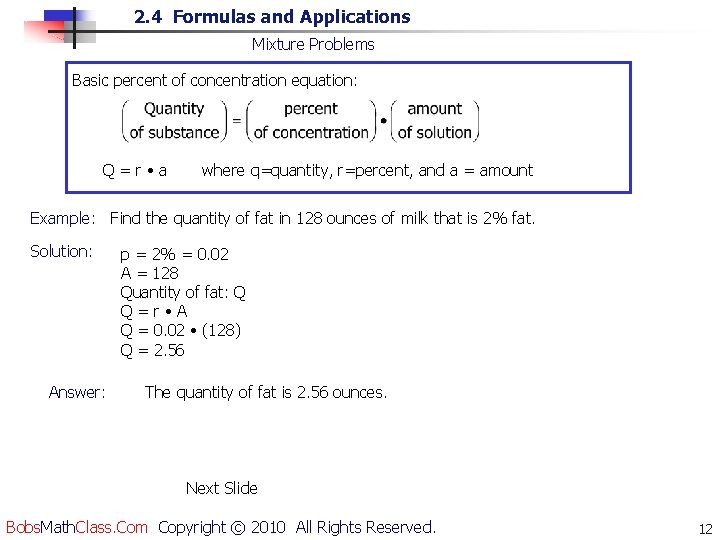
2. 4 Formulas and Applications Mixture Problems Basic percent of concentration equation: Q=r • a where q=quantity, r=percent, and a = amount Example: Find the quantity of fat in 128 ounces of milk that is 2% fat. Solution: Answer: p = 2% = 0. 02 A = 128 Quantity of fat: Q Q=r • A Q = 0. 02 • (128) Q = 2. 56 The quantity of fat is 2. 56 ounces. Next Slide Bobs. Math. Class. Com Copyright © 2010 All Rights Reserved. 12
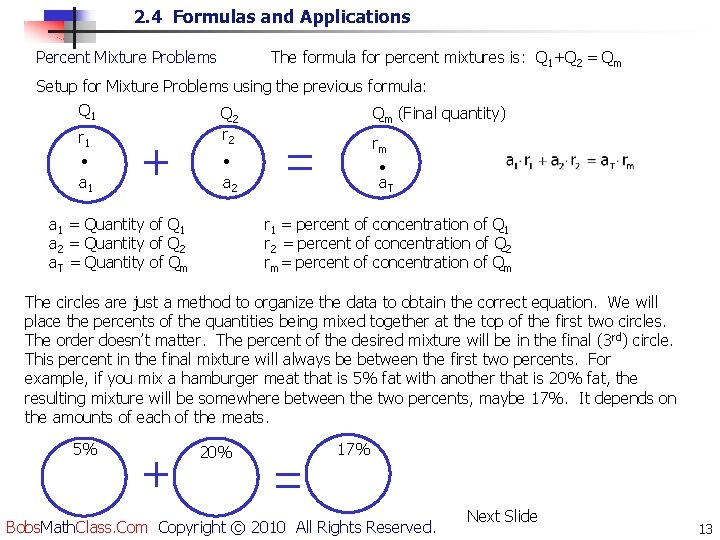
2. 4 Formulas and Applications Percent Mixture Problems The formula for percent mixtures is: Q 1+Q 2 = Qm Setup for Mixture Problems using the previous formula: Q 1 Q 2 Qm (Final quantity) r 2 r 1 rm • • • a 1 a 2 a. T a 1 = Quantity of Q 1 a 2 = Quantity of Q 2 a. T = Quantity of Qm r 1 = percent of concentration of Q 1 r 2 = percent of concentration of Q 2 rm= percent of concentration of Qm The circles are just a method to organize the data to obtain the correct equation. We will place the percents of the quantities being mixed together at the top of the first two circles. The order doesn’t matter. The percent of the desired mixture will be in the final (3 rd) circle. This percent in the final mixture will always be between the first two percents. For example, if you mix a hamburger meat that is 5% fat with another that is 20% fat, the resulting mixture will be somewhere between the two percents, maybe 17%. It depends on the amounts of each of the meats. 5% 20% 17% Bobs. Math. Class. Com Copyright © 2010 All Rights Reserved. Next Slide 13
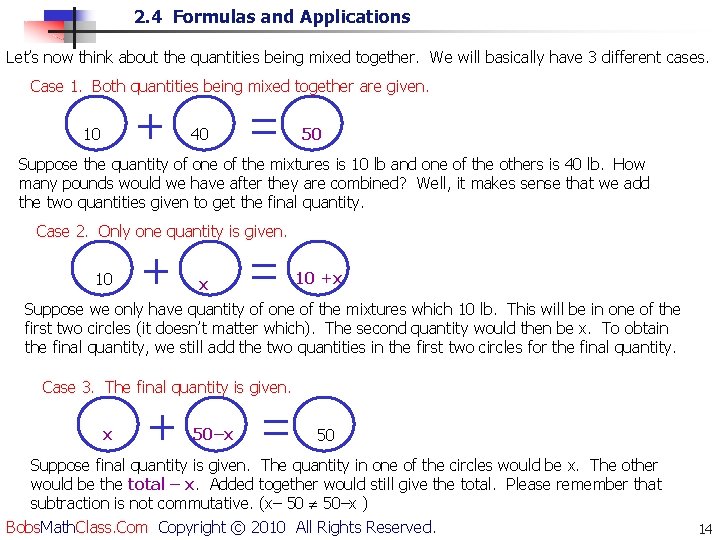
2. 4 Formulas and Applications Let’s now think about the quantities being mixed together. We will basically have 3 different cases. Case 1. Both quantities being mixed together are given. 10 40 50 Suppose the quantity of one of the mixtures is 10 lb and one of the others is 40 lb. How many pounds would we have after they are combined? Well, it makes sense that we add the two quantities given to get the final quantity. Case 2. Only one quantity is given. 10 x 10 +x Suppose we only have quantity of one of the mixtures which 10 lb. This will be in one of the first two circles (it doesn’t matter which). The second quantity would then be x. To obtain the final quantity, we still add the two quantities in the first two circles for the final quantity. Case 3. The final quantity is given. x 50–x 50 Suppose final quantity is given. The quantity in one of the circles would be x. The other would be the total – x. Added together would still give the total. Please remember that subtraction is not commutative. (x– 50 50–x ) Bobs. Math. Class. Com Copyright © 2010 All Rights Reserved. 14
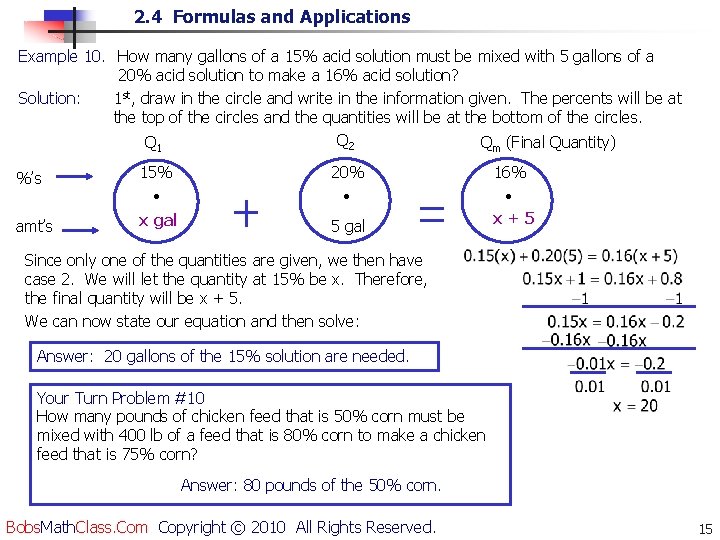
2. 4 Formulas and Applications Example 10. How many gallons of a 15% acid solution must be mixed with 5 gallons of a 20% acid solution to make a 16% acid solution? Solution: 1 st, draw in the circle and write in the information given. The percents will be at the top of the circles and the quantities will be at the bottom of the circles. Q 2 Q 1 Qm (Final Quantity) %’s amt’s 15% 20% 16% • x gal • • x+5 5 gal Since only one of the quantities are given, we then have case 2. We will let the quantity at 15% be x. Therefore, the final quantity will be x + 5. We can now state our equation and then solve: Answer: 20 gallons of the 15% solution are needed. Your Turn Problem #10 How many pounds of chicken feed that is 50% corn must be mixed with 400 lb of a feed that is 80% corn to make a chicken feed that is 75% corn? Answer: 80 pounds of the 50% corn. Bobs. Math. Class. Com Copyright © 2010 All Rights Reserved. 15
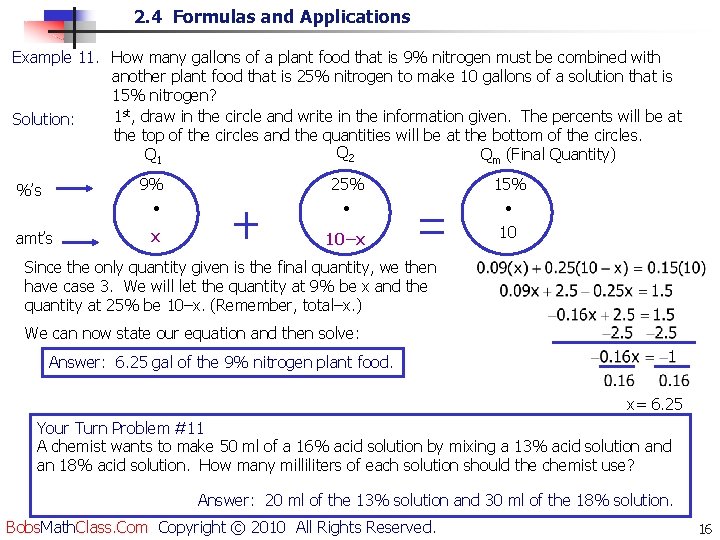
2. 4 Formulas and Applications Example 11. How many gallons of a plant food that is 9% nitrogen must be combined with another plant food that is 25% nitrogen to make 10 gallons of a solution that is 15% nitrogen? 1 st, draw in the circle and write in the information given. The percents will be at Solution: the top of the circles and the quantities will be at the bottom of the circles. Q 2 Q 1 Qm (Final Quantity) %’s amt’s 9% • 25% • x 10–x 15% • 10 Since the only quantity given is the final quantity, we then have case 3. We will let the quantity at 9% be x and the quantity at 25% be 10–x. (Remember, total–x. ) We can now state our equation and then solve: Answer: 6. 25 gal of the 9% nitrogen plant food. x= 6. 25 Your Turn Problem #11 A chemist wants to make 50 ml of a 16% acid solution by mixing a 13% acid solution and an 18% acid solution. How many milliliters of each solution should the chemist use? Answer: 20 ml of the 13% solution and 30 ml of the 18% solution. Bobs. Math. Class. Com Copyright © 2010 All Rights Reserved. 16
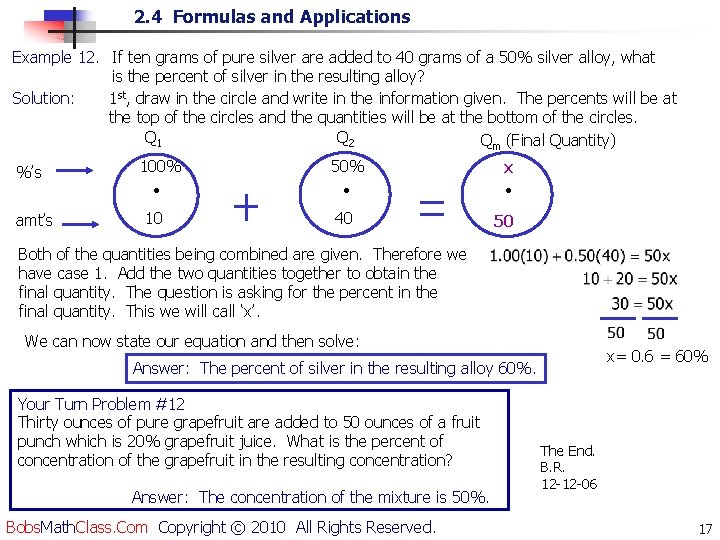
2. 4 Formulas and Applications Example 12. If ten grams of pure silver are added to 40 grams of a 50% silver alloy, what is the percent of silver in the resulting alloy? Solution: 1 st, draw in the circle and write in the information given. The percents will be at the top of the circles and the quantities will be at the bottom of the circles. Q 1 Q 2 Qm (Final Quantity) %’s amt’s 100% • 10 50% • x • 40 50 Both of the quantities being combined are given. Therefore we have case 1. Add the two quantities together to obtain the final quantity. The question is asking for the percent in the final quantity. This we will call ‘x’. We can now state our equation and then solve: x= 0. 6 = 60% Answer: The percent of silver in the resulting alloy 60%. Your Turn Problem #12 Thirty ounces of pure grapefruit are added to 50 ounces of a fruit punch which is 20% grapefruit juice. What is the percent of concentration of the grapefruit in the resulting concentration? Answer: The concentration of the mixture is 50%. Bobs. Math. Class. Com Copyright © 2010 All Rights Reserved. The End. B. R. 12 -12 -06 17