
2 4 Diode Limiting Clamping Circuits OBJECTIVE Analyze
2 -4 Diode Limiting & Clamping Circuits OBJECTIVE Ø Analyze the operation of diode limiting, clamping circuit, voltage multipliers and interpret and use diode data sheet. Ø Determine V of biased limiter & used voltage-divider bias to set limiting level. Ø Discuss voltage doublers, triplers & quadruples. Ø Identify V & current ratings. Ø Determine the electrical characteristics of a diode. Ø Analyze graphical data Ø Select an appropriate diode for a given set of specifications. 1
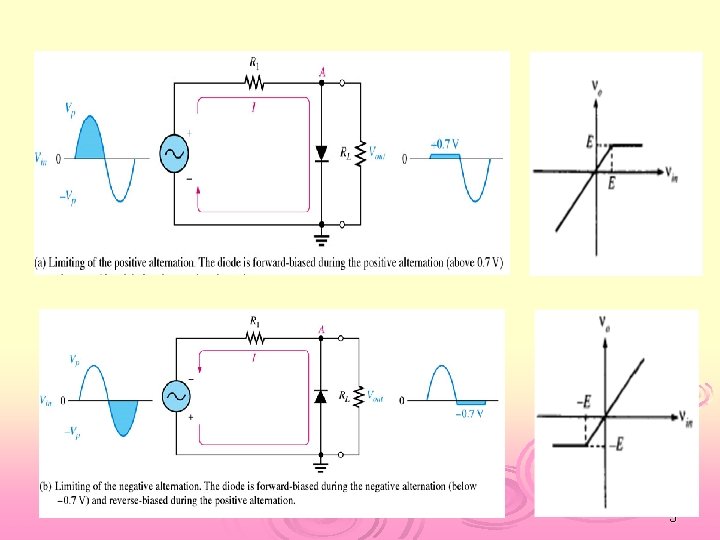
Diode Limiters § Diode limiters/clippers – that limits/clips the portion of signal voltage above or below certain level. § Limiting circuits limit the positive or negative amount of an input voltage to a specific value. § When i/p is +ve – the diode becomes FB – limited to +0. 7 V because cathode is at ground. § When i/p << 0. 7 V-diode is RB – o/p voltage likes –ve part of i/p voltage § Turn the diode around-negative part of i/p voltage is clipped off. § When diode is FB-negative part of i/p voltage-diode drop -0. 7 V 2
3
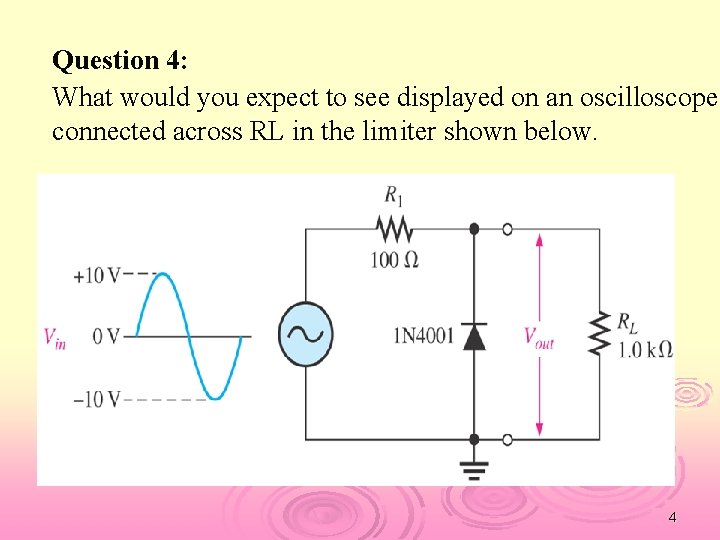
Question 4: What would you expect to see displayed on an oscilloscope connected across RL in the limiter shown below. 4
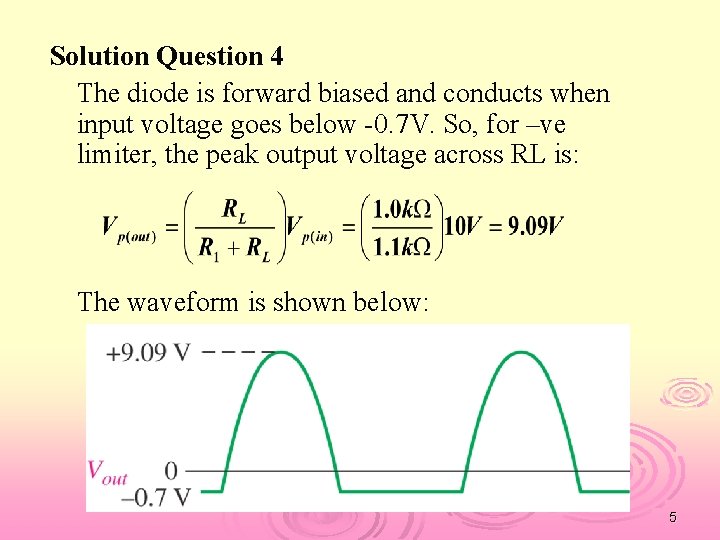
Solution Question 4 The diode is forward biased and conducts when input voltage goes below -0. 7 V. So, for –ve limiter, the peak output voltage across RL is: The waveform is shown below: 5
Diode Limiters Biased Limiters q The level to which an ac voltage is limited can be adjusted by adding bias voltage VBIAS in series with diode. q Voltage at point A : VA = VBIAS + 0. 7 V (forward-biased & conduct). So, all Vin > VA is clipped off. q For –ve level, then VA = -VBIAS - 0. 7 V to forward-biased. q Turning diode around, +ve limiter – modified to limit Vout to the portion of Vin waveform above VBIAS – 0. 7 V. q -ve limiter; below -VBIAS - 0. 7 V. q By tuning the diode around- the +ve limiter can modified to limit the o/p voltage to the portion of the i/p voltage waveform above VBIAS-0. 7 V q Negative limiter – limit the o/p voltage to the i/p voltage below –VBIAS+0. 7 V 6
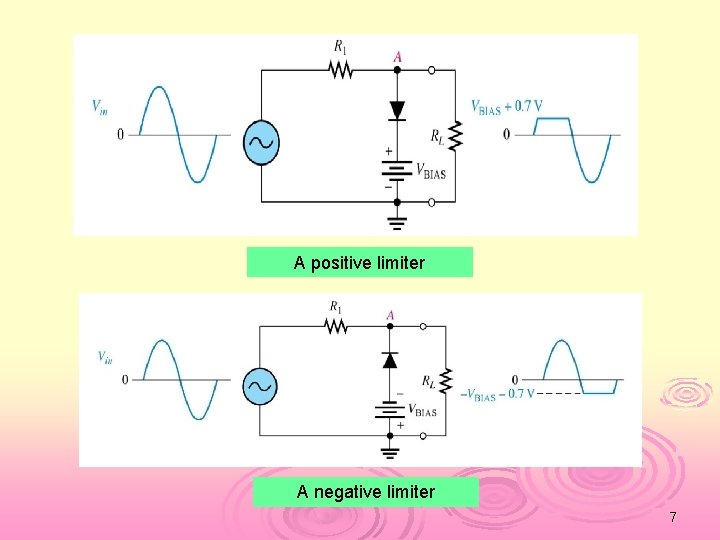
A positive limiter A negative limiter 7
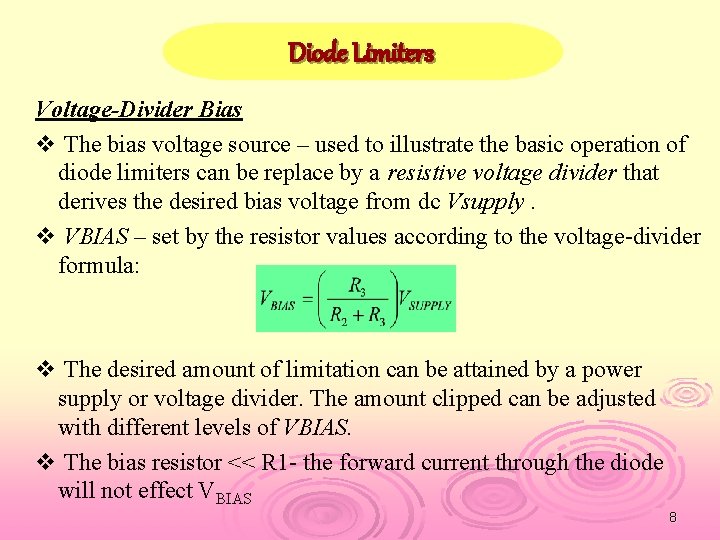
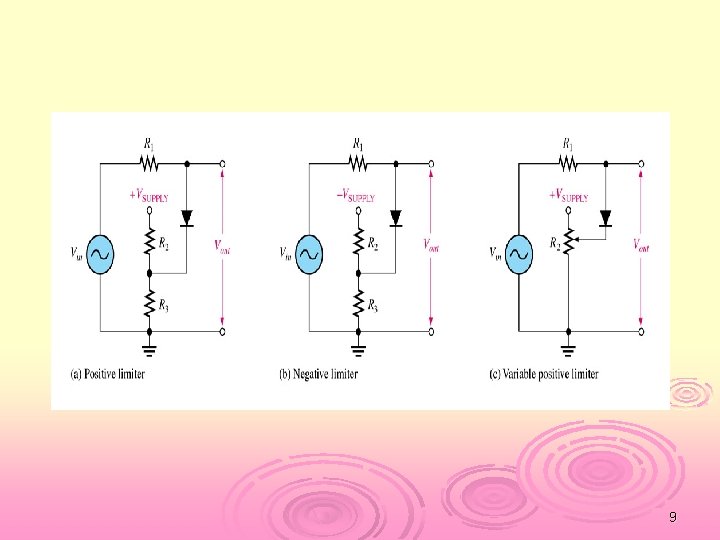
Diode Limiters Voltage-Divider Bias v The bias voltage source – used to illustrate the basic operation of diode limiters can be replace by a resistive voltage divider that derives the desired bias voltage from dc Vsupply. v VBIAS – set by the resistor values according to the voltage-divider formula: v The desired amount of limitation can be attained by a power supply or voltage divider. The amount clipped can be adjusted with different levels of VBIAS. v The bias resistor << R 1 - the forward current through the diode will not effect VBIAS 8
9

Example 5: 1. Sketch the output voltage waveform as shown in the circuit combining a positive limiter with negative limiter in Figure 5 -1. +15 V 6 V 6 V -15 V Figure 5 -1 10
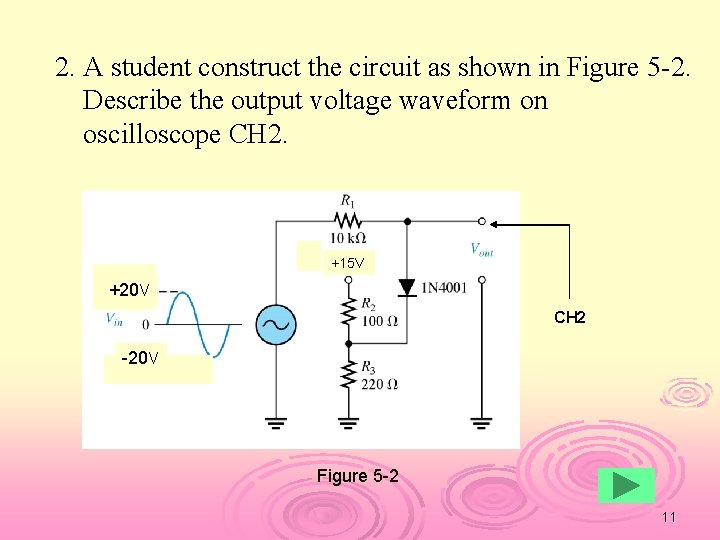
2. A student construct the circuit as shown in Figure 5 -2. Describe the output voltage waveform on oscilloscope CH 2. +15 V +20 V CH 2 -20 V Figure 5 -2 11
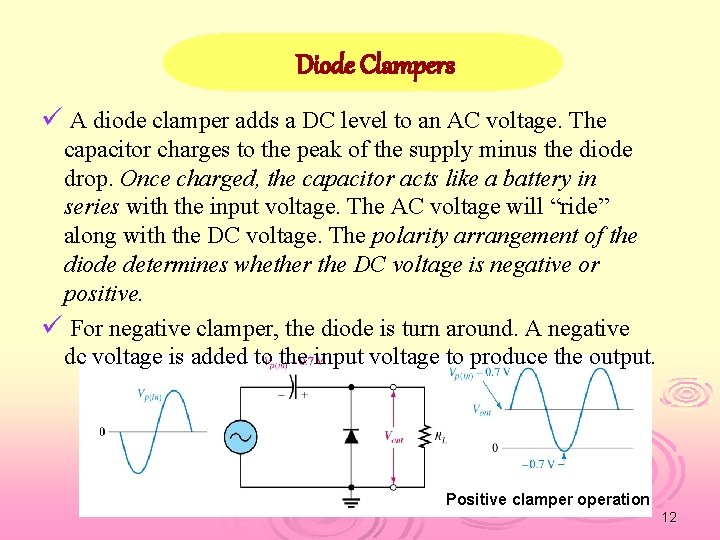
Diode Clampers ü A diode clamper adds a DC level to an AC voltage. The capacitor charges to the peak of the supply minus the diode drop. Once charged, the capacitor acts like a battery in series with the input voltage. The AC voltage will “ride” along with the DC voltage. The polarity arrangement of the diode determines whether the DC voltage is negative or positive. ü For negative clamper, the diode is turn around. A negative dc voltage is added to the input voltage to produce the output. Positive clamper operation 12
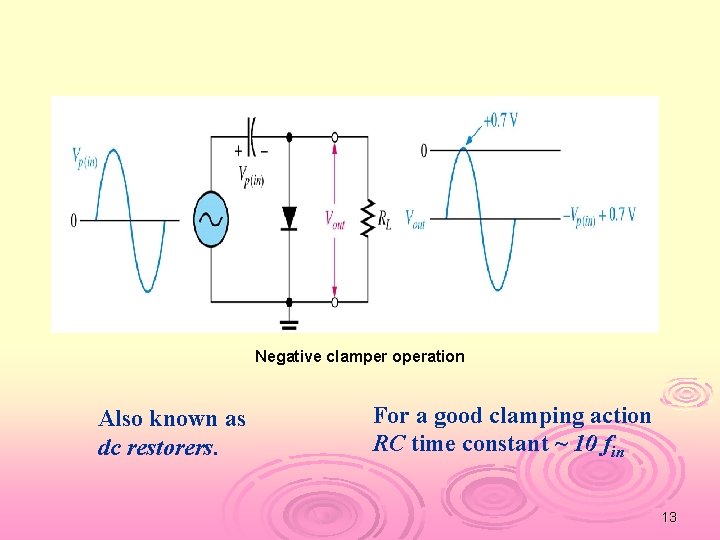
Negative clamper operation Also known as dc restorers. For a good clamping action RC time constant ~ 10 fin 13
Diode Clampers A Clamper Application: Ø A clamping circuit is often used in TV receivers as a dc restorer. Ø The incoming composite video signal is normally processed through capacitively coupled amplifiers that eliminate the dc component, thus losing black and white reference levels and the blanking level. Before applied to the picture tube, these reference level must be restored. 14
2 -5 Voltage Multiplier § Use clamping action to increase peak rectified voltages without necessary to increase input transformer’s voltage rating. § Multiplication factors: two, three or four. § Three types of voltage multipliers: * Voltage doubler - Half – wave voltage doubler - Full – wave voltage doubler * Voltage tripler * Voltage Quadrupler § Voltage multipliers are used in high-voltage, low current applications, i. e TV receivers. 15
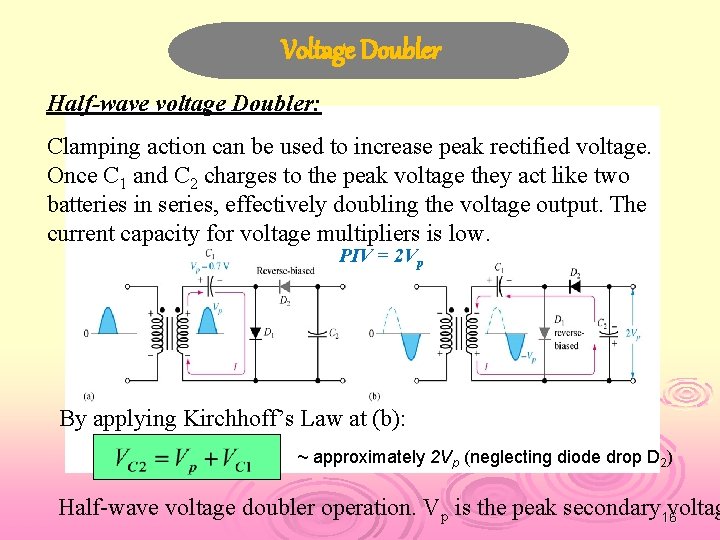
Voltage Doubler Half-wave voltage Doubler: Clamping action can be used to increase peak rectified voltage. Once C 1 and C 2 charges to the peak voltage they act like two batteries in series, effectively doubling the voltage output. The current capacity for voltage multipliers is low. PIV = 2 Vp By applying Kirchhoff’s Law at (b): ~ approximately 2 Vp (neglecting diode drop D 2) Half-wave voltage doubler operation. Vp is the peak secondary 16 voltag
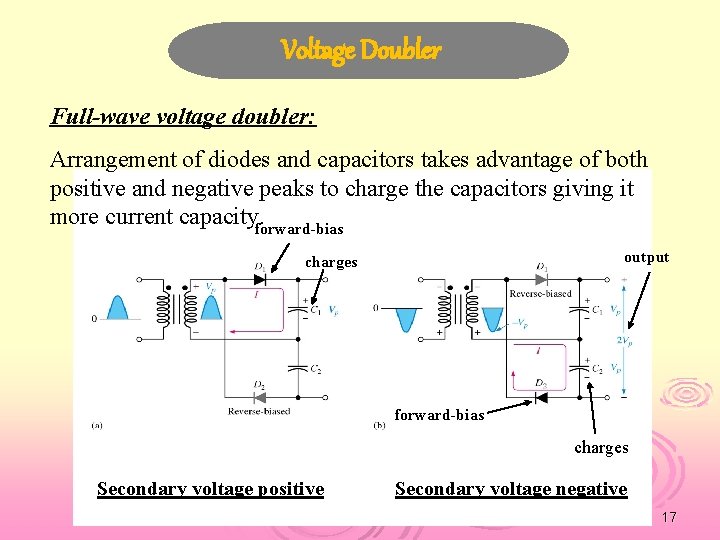
Voltage Doubler Full-wave voltage doubler: Arrangement of diodes and capacitors takes advantage of both positive and negative peaks to charge the capacitors giving it more current capacity. forward-bias output charges forward-bias charges Secondary voltage positive Secondary voltage negative 17
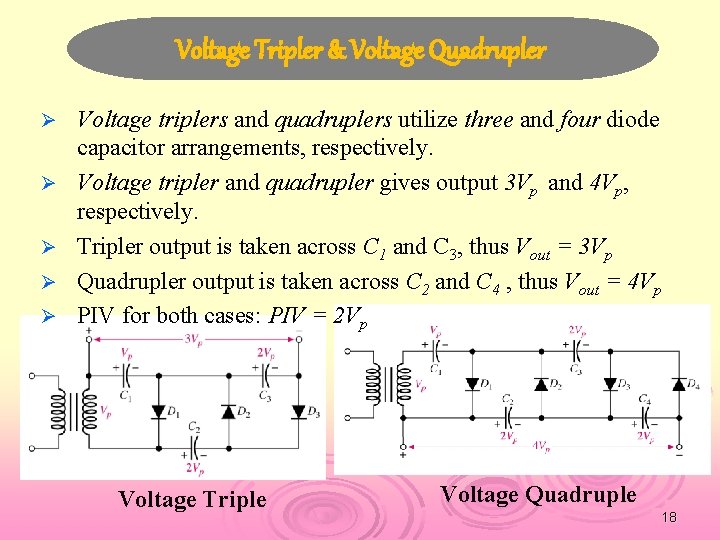
Voltage Tripler & Voltage Quadrupler Ø Ø Ø Voltage triplers and quadruplers utilize three and four diode capacitor arrangements, respectively. Voltage tripler and quadrupler gives output 3 Vp and 4 Vp, respectively. Tripler output is taken across C 1 and C 3, thus Vout = 3 Vp Quadrupler output is taken across C 2 and C 4 , thus Vout = 4 Vp PIV for both cases: PIV = 2 Vp Voltage Triple Voltage Quadruple 18

2 -6 The Diode Data Sheet q The data sheet for diodes and other devices gives detailed information about specific characteristics such as the various maximum current and voltage ratings, temperature range, and voltage versus current curves (V-I characteristic). q It is sometimes a very valuable piece of information, even for a technician. There are cases when you might have to select a replacement diode when the type of diode needed may no longer be available. q These are the absolute max. values under which the diode can be operated without damage to the device. 19
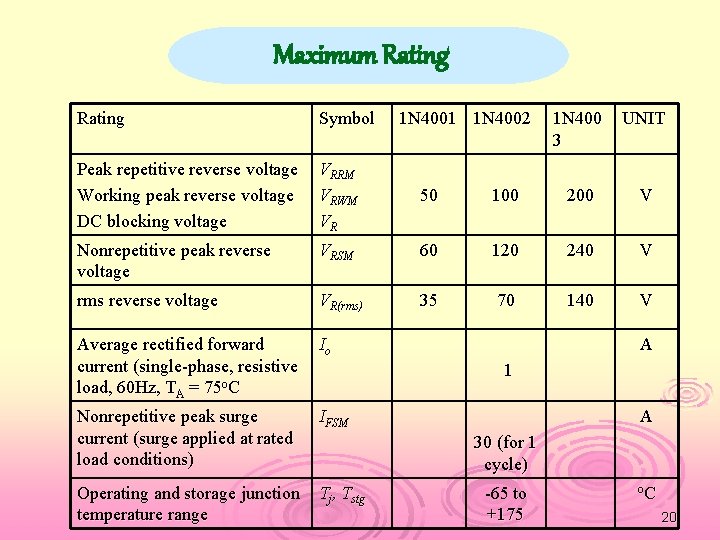
Maximum Rating Symbol 1 N 4001 1 N 4002 1 N 400 3 UNIT Peak repetitive reverse voltage Working peak reverse voltage DC blocking voltage VRRM VRWM VR 50 100 200 V Nonrepetitive peak reverse voltage VRSM 60 120 240 V rms reverse voltage VR(rms) 35 70 140 V Average rectified forward current (single-phase, resistive load, 60 Hz, TA = 75 o. C Io Nonrepetitive peak surge current (surge applied at rated load conditions) IFSM Operating and storage junction temperature range Tj, Tstg A 1 A 30 (for 1 cycle) -65 to +175 o. C 20
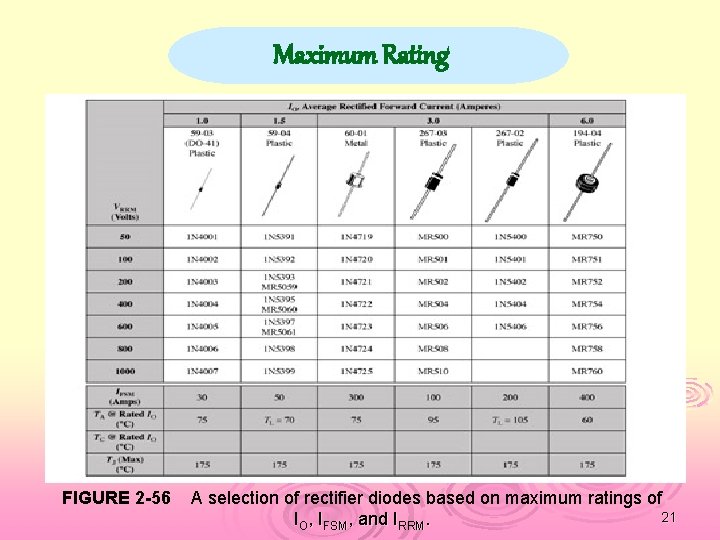
Maximum Rating FIGURE 2 -56 A selection of rectifier diodes based on maximum ratings of 21 IO, IFSM, and IRRM.
2 -7 Troubleshooting OBJECTIVE Ø Troubleshoot diode circuits using accepted techniques. Ø Discuss the relationship between symptom & cause, power check, sensory check, component replacement method and discuss the signal tracing technique in the three variations. Ø Our. Fault studyanalysis. of these devices and how they work leads more effective troubleshooting. Efficient troubleshooting requires us to take logical steps in sequence. Knowing how a device, circuit, or system works when operating properly must be known before any attempts are made to troubleshoot. The symptoms shown by a defective device often point directly to the point of failure. There are many different methods for 22
Troubleshooting Techniques Here are some helpful troubleshooting techniques: Ø Power Check: Sometimes the obvious eludes the most proficient troubleshooters. Check for fuses blown, power cords plugged in, and correct battery placement. Ø Sensory Check: What you see or smell may lead you directly to the failure or to a symptom of a failure. Ø Component Replacement: Educated guesswork in replacing components is sometimes effective. Ø Signal Tracing: Look at the point in the circuit or system where you first lose the signal or incorrect signal. 23
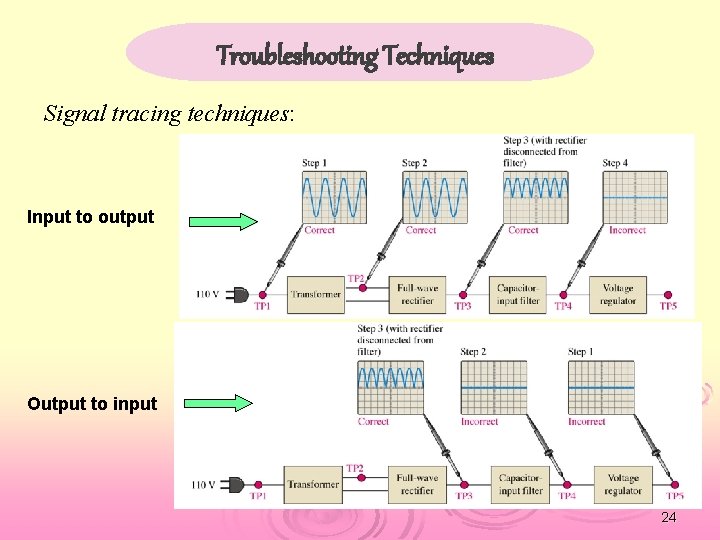
Troubleshooting Techniques Signal tracing techniques: Input to output Output to input 24
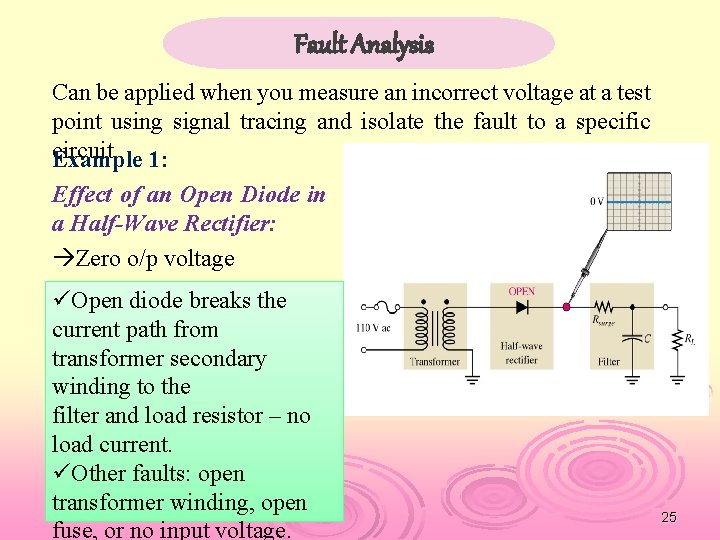
Fault Analysis Can be applied when you measure an incorrect voltage at a test point using signal tracing and isolate the fault to a specific circuit. 1: Example Effect of an Open Diode in a Half-Wave Rectifier: Zero o/p voltage üOpen diode breaks the current path from transformer secondary winding to the filter and load resistor – no load current. üOther faults: open transformer winding, open fuse, or no input voltage. 25
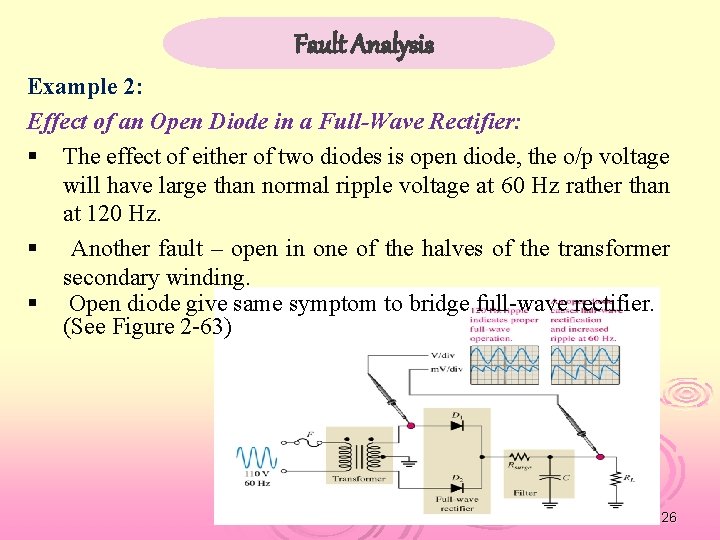
Fault Analysis Example 2: Effect of an Open Diode in a Full-Wave Rectifier: § The effect of either of two diodes is open diode, the o/p voltage will have large than normal ripple voltage at 60 Hz rather than at 120 Hz. § Another fault – open in one of the halves of the transformer secondary winding. § Open diode give same symptom to bridge full-wave rectifier. (See Figure 2 -63) 26
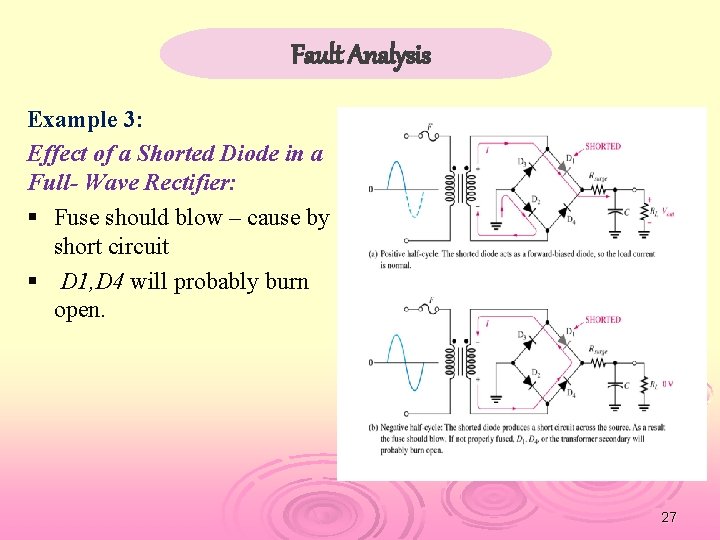
Fault Analysis Example 3: Effect of a Shorted Diode in a Full- Wave Rectifier: § Fuse should blow – cause by short circuit § D 1, D 4 will probably burn open. 27
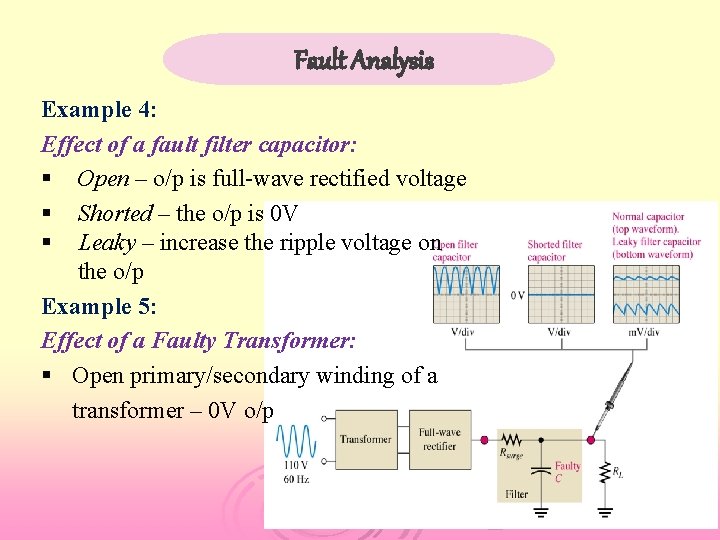
Fault Analysis Example 4: Effect of a fault filter capacitor: § Open – o/p is full-wave rectified voltage § Shorted – the o/p is 0 V § Leaky – increase the ripple voltage on the o/p Example 5: Effect of a Faulty Transformer: § Open primary/secondary winding of a transformer – 0 V o/p 28
The complete Troubleshooting Process Ø The complete troubleshooting process: i. Identify the symptom(s). ii. Perform a power check iii. Perform a sensory check iv. Apply a signal tracing technique. v. Apply fault analysis vi. Use component replacement to fix the problem. 29
Summary Ø The basic function of a power supply to give us a smooth ripple free DC voltage from an AC voltage. Ø Half-wave rectifiers only utilize half of the cycle to produce a DC voltage. Ø Transformer Coupling allows voltage manipulation through its windings ratio Ø Full-Wave rectifiers efficiently make use of the whole cycle. This makes it easier to filter. Ø The full-wave bridge rectifier allows use of the full secondary winding output whereas the center-tapped full wave uses only half. Ø Filtering and Regulating the output of a rectifier helps keep the 30 DC voltage smooth and accurate
Summary Ø Limiters are used to set the output peak(s) to a given value. Ø Clampers are used to add a DC voltage to an AC voltage. Ø Voltage Multipliers allow a doubling, tripling, or quadrupling of rectified DC voltage for low current applications. Ø The Data Sheet gives us useful information and characteristics of device for use in replacement or designing circuits. Ø Troubleshooting requires use of common sense along with proper troubleshooting techniques to effectively determine the point of failure in a defective circuit or 31
- Slides: 31