
2 4 Complex Numbers Copyright Cengage Learning All
2. 4 Complex Numbers Copyright © Cengage Learning. All rights reserved.
What You Should Learn • Use the imaginary unit i to write complex numbers. • • Add, subtract, and multiply complex numbers. • Find complex solutions of quadratic equations. Use complex conjugates to write the quotient of two complex numbers in standard form. 2
The Imaginary Unit i 3
The Imaginary Unit i Some quadratic equations have no real solutions. For instance, the quadratic equation x 2 + 1 = 0 has no real solution because there is no real number that can be squared to produce – 1. To overcome this deficiency, mathematicians created an expanded system of numbers using the imaginary unit i, defined as Imaginary unit where i 2 = – 1. By adding real numbers to real multiples of this imaginary unit, you obtain the set of complex numbers. 4
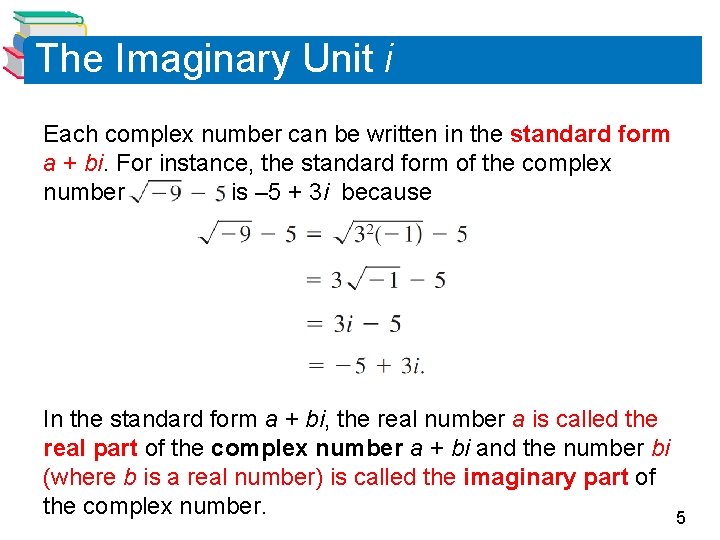
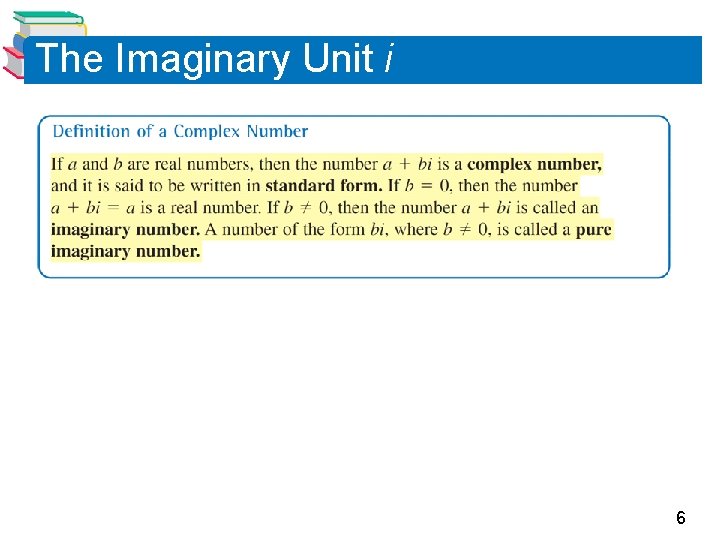
The Imaginary Unit i Each complex number can be written in the standard form a + bi. For instance, the standard form of the complex number is – 5 + 3 i because In the standard form a + bi, the real number a is called the real part of the complex number a + bi and the number bi (where b is a real number) is called the imaginary part of the complex number. 5
The Imaginary Unit i 6
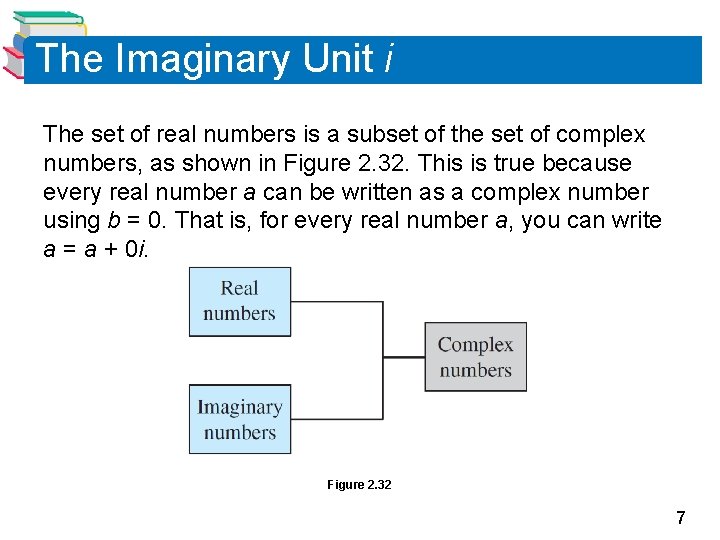
The Imaginary Unit i The set of real numbers is a subset of the set of complex numbers, as shown in Figure 2. 32. This is true because every real number a can be written as a complex number using b = 0. That is, for every real number a, you can write a = a + 0 i. Figure 2. 32 7
Operations with Complex Numbers 8
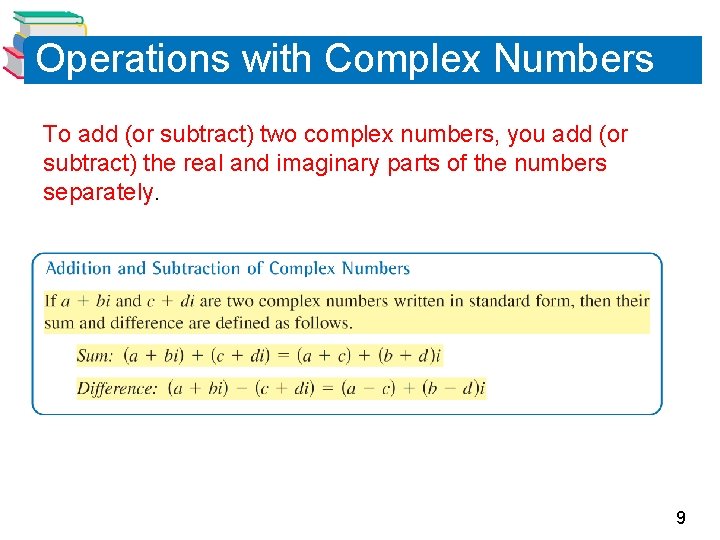
Operations with Complex Numbers To add (or subtract) two complex numbers, you add (or subtract) the real and imaginary parts of the numbers separately. 9
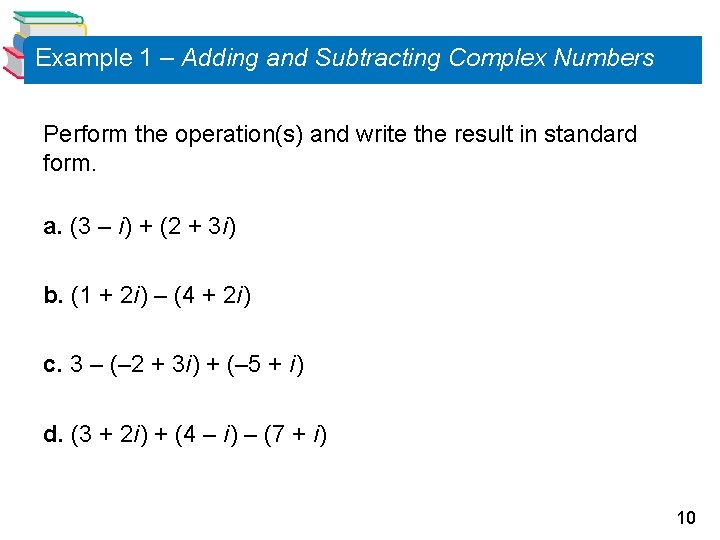
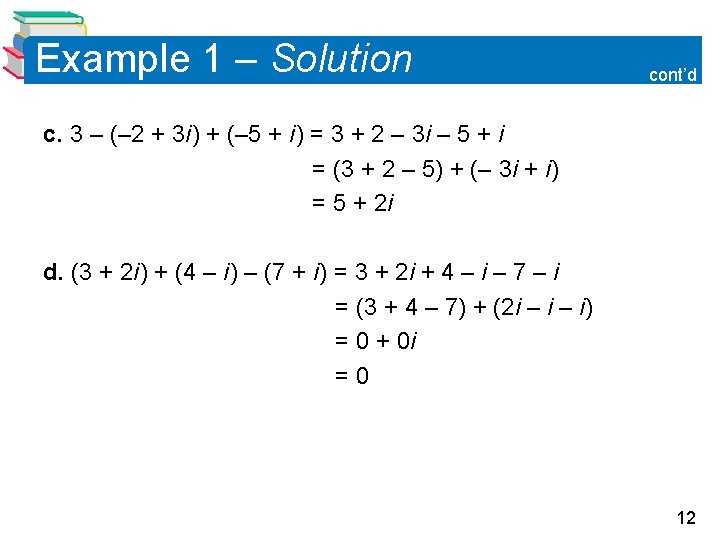
Example 1 – Adding and Subtracting Complex Numbers Perform the operation(s) and write the result in standard form. a. (3 – i ) + (2 + 3 i ) b. (1 + 2 i ) – (4 + 2 i ) c. 3 – (– 2 + 3 i ) + (– 5 + i ) d. (3 + 2 i ) + (4 – i ) – (7 + i ) 10
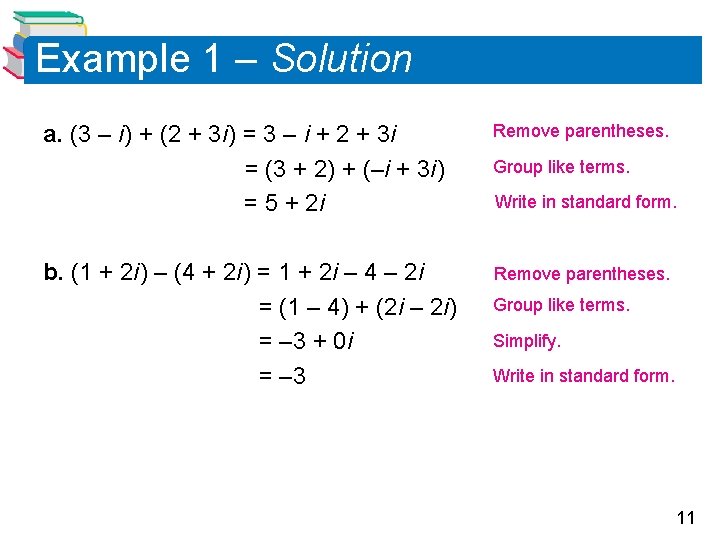
Example 1 – Solution a. (3 – i ) + (2 + 3 i ) = 3 – i + 2 + 3 i = (3 + 2) + (–i + 3 i ) = 5 + 2 i Remove parentheses. b. (1 + 2 i ) – (4 + 2 i ) = 1 + 2 i – 4 – 2 i = (1 – 4) + (2 i – 2 i ) = – 3 + 0 i = – 3 Remove parentheses. Group like terms. Write in standard form. Group like terms. Simplify. Write in standard form. 11
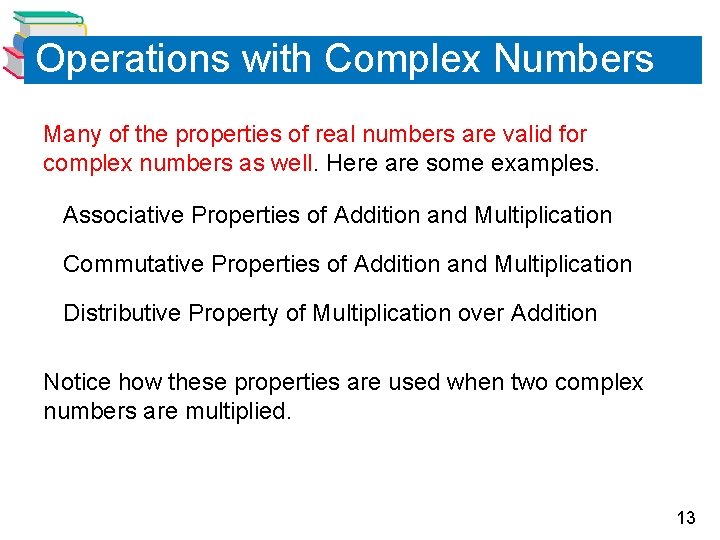
Operations with Complex Numbers Many of the properties of real numbers are valid for complex numbers as well. Here are some examples. Associative Properties of Addition and Multiplication Commutative Properties of Addition and Multiplication Distributive Property of Multiplication over Addition Notice how these properties are used when two complex numbers are multiplied. 13
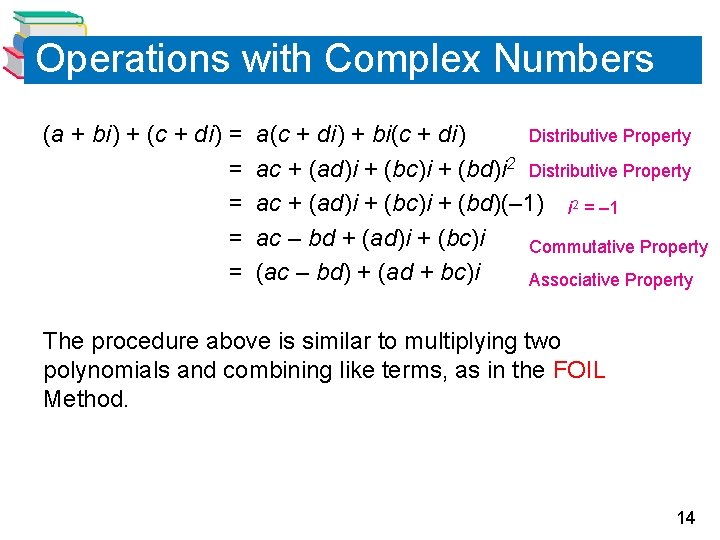
Operations with Complex Numbers (a + bi ) + (c + di ) = = = a(c + di ) + bi(c + di ) Distributive Property ac + (ad)i + (bc)i + (bd)i 2 Distributive Property ac + (ad)i + (bc)i + (bd)(– 1) i 2 = – 1 ac – bd + (ad)i + (bc)i Commutative Property (ac – bd) + (ad + bc)i Associative Property The procedure above is similar to multiplying two polynomials and combining like terms, as in the FOIL Method. 14
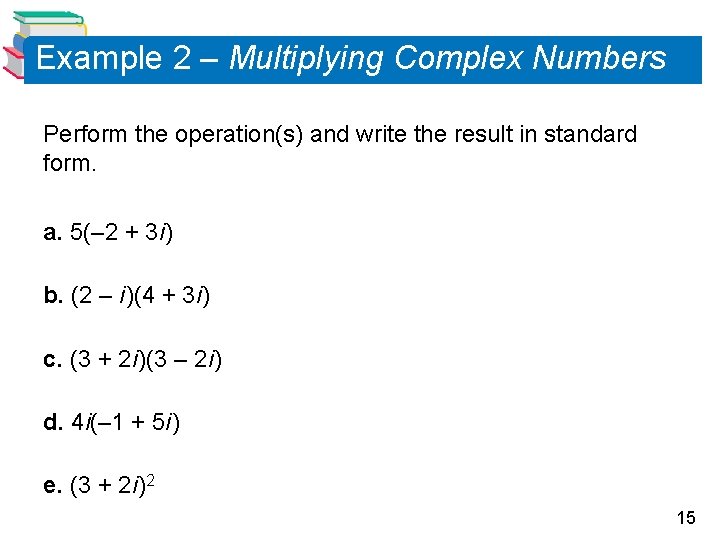
Example 2 – Multiplying Complex Numbers Perform the operation(s) and write the result in standard form. a. 5(– 2 + 3 i ) b. (2 – i )(4 + 3 i ) c. (3 + 2 i )(3 – 2 i ) d. 4 i(– 1 + 5 i ) e. (3 + 2 i )2 15

Example 2 – Solution a. 5(– 2 + 3 i ) = 5(– 2) + 5(3 i ) = – 10 + 15 i Distributive Property b. (2 – i )(4 + 3 i ) = 2(4 + 3 i ) – i(4 + 3 i ) = 8 + 6 i – 4 i – 3 i 2 = 8 + 6 i – 4 i – 3(– 1) = 8 + 3 + 6 i – 4 i = 11 + 2 i Distributive Property Simplify. Product of binomials i 2 = – 1 Group like terms. Write in standard form. 16
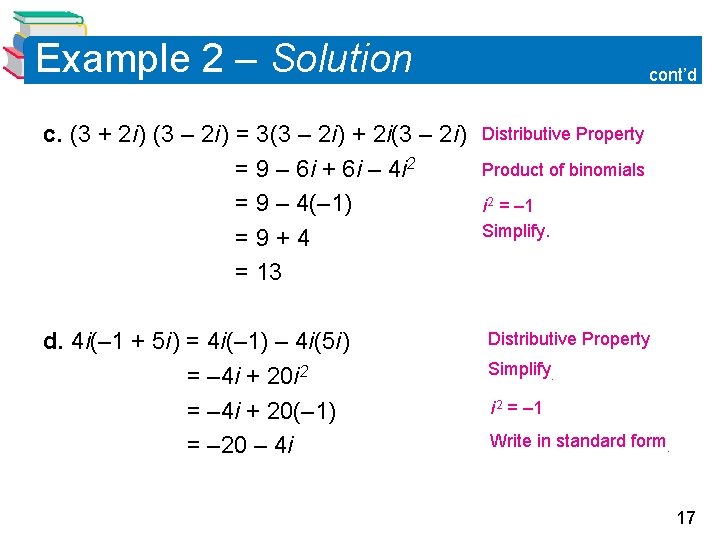
Example 2 – Solution c. (3 + 2 i ) (3 – 2 i ) = 3(3 – 2 i ) + 2 i(3 – 2 i ) = 9 – 6 i + 6 i – 4 i 2 = 9 – 4(– 1) =9+4 = 13 d. 4 i(– 1 + 5 i ) = 4 i(– 1) – 4 i(5 i ) = – 4 i + 20 i 2 = – 4 i + 20(– 1) = – 20 – 4 i cont’d Distributive Property Product of binomials i 2 = – 1 Simplify. Distributive Property Simplify. i 2 = – 1 Write in standard form. 17
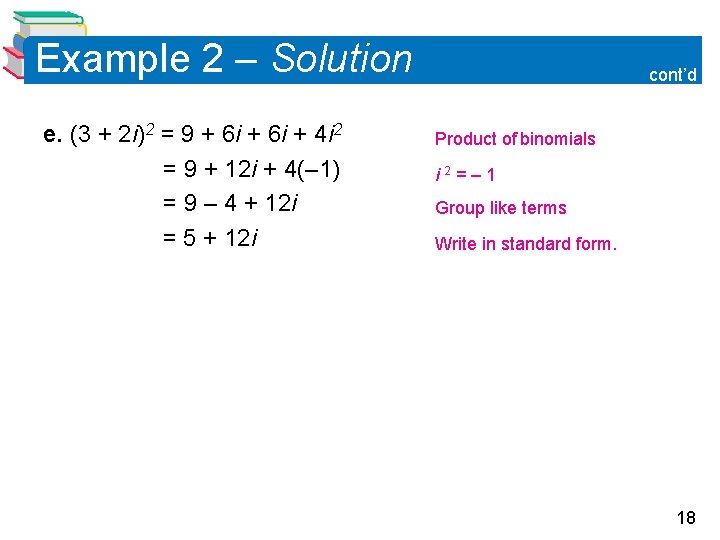
Example 2 – Solution e. (3 + 2 i)2 = 9 + 6 i + 4 i 2 = 9 + 12 i + 4(– 1) = 9 – 4 + 12 i = 5 + 12 i cont’d Product of binomials i 2=– 1 Group like terms Write in standard form. 18
Complex Conjugates 19
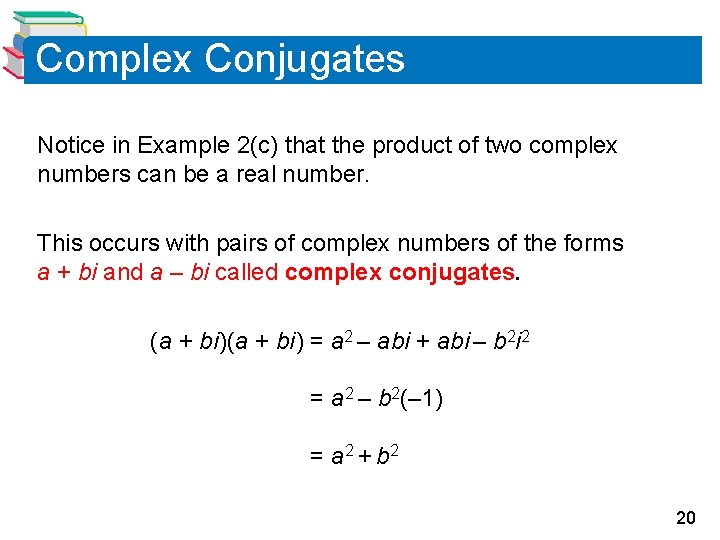
Complex Conjugates Notice in Example 2(c) that the product of two complex numbers can be a real number. This occurs with pairs of complex numbers of the forms a + bi and a – bi called complex conjugates. (a + bi ) = a 2 – abi + abi – b 2 i 2 = a 2 – b 2(– 1) = a 2 + b 2 20
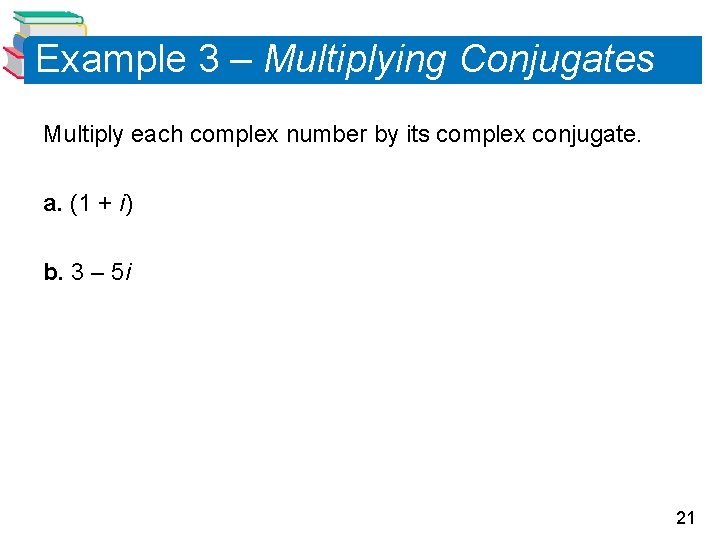
Example 3 – Multiplying Conjugates Multiply each complex number by its complex conjugate. a. (1 + i ) b. 3 – 5 i 21
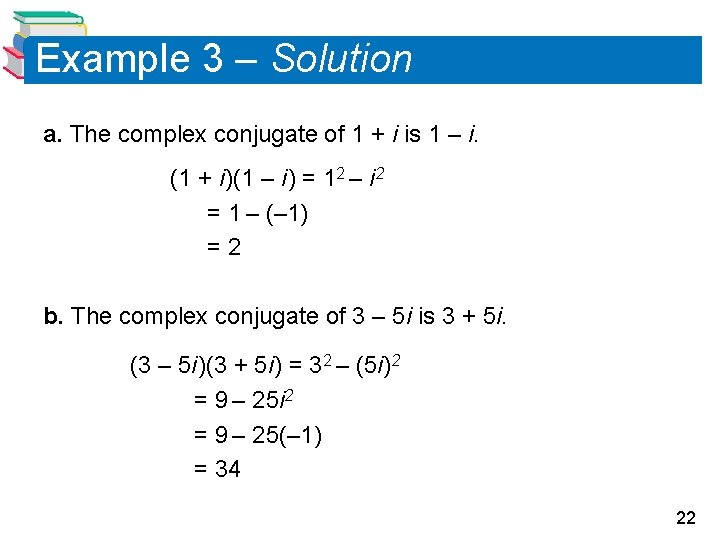
Example 3 – Solution a. The complex conjugate of 1 + i is 1 – i. (1 + i )(1 – i ) = 12 – i 2 = 1 – (– 1) =2 b. The complex conjugate of 3 – 5 i is 3 + 5 i. (3 – 5 i )(3 + 5 i ) = 32 – (5 i)2 = 9 – 25 i 2 = 9 – 25(– 1) = 34 22
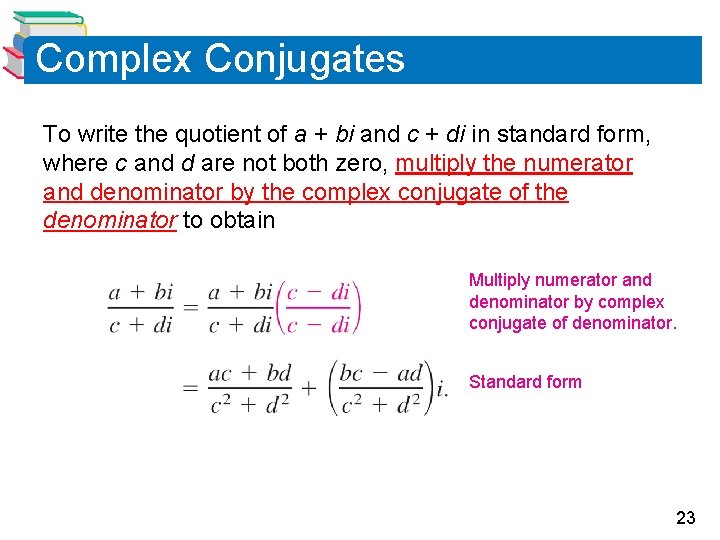
Complex Conjugates To write the quotient of a + bi and c + di in standard form, where c and d are not both zero, multiply the numerator and denominator by the complex conjugate of the denominator to obtain Multiply numerator and denominator by complex conjugate of denominator. Standard form 23
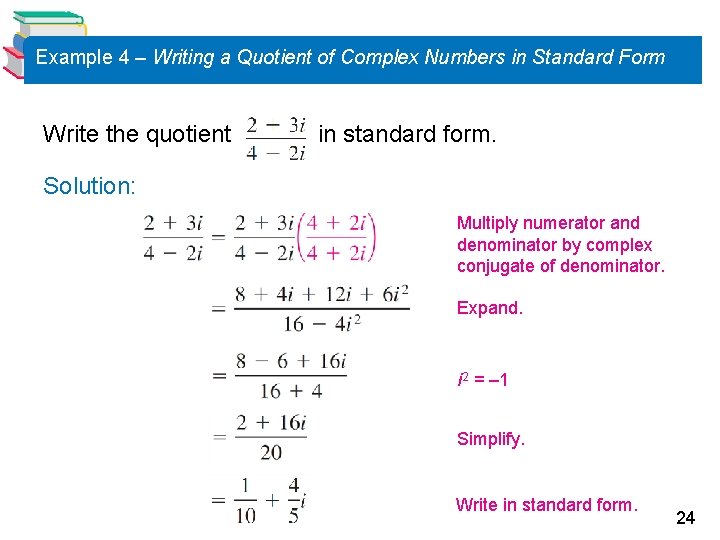
Example 4 – Writing a Quotient of Complex Numbers in Standard Form Write the quotient in standard form. Solution: Multiply numerator and denominator by complex conjugate of denominator. Expand. i 2 = – 1 Simplify. Write in standard form. 24
Complex Solutions of Quadratic Equations 25
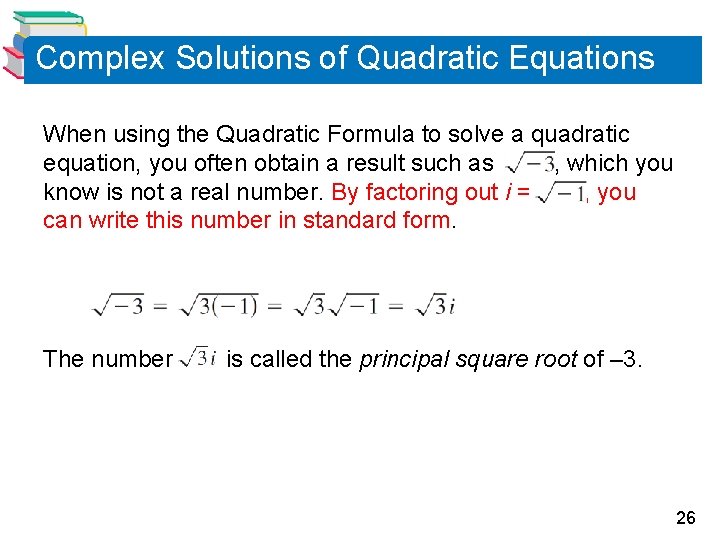
Complex Solutions of Quadratic Equations When using the Quadratic Formula to solve a quadratic equation, you often obtain a result such as , which you know is not a real number. By factoring out i = , you can write this number in standard form. The number is called the principal square root of – 3. 26
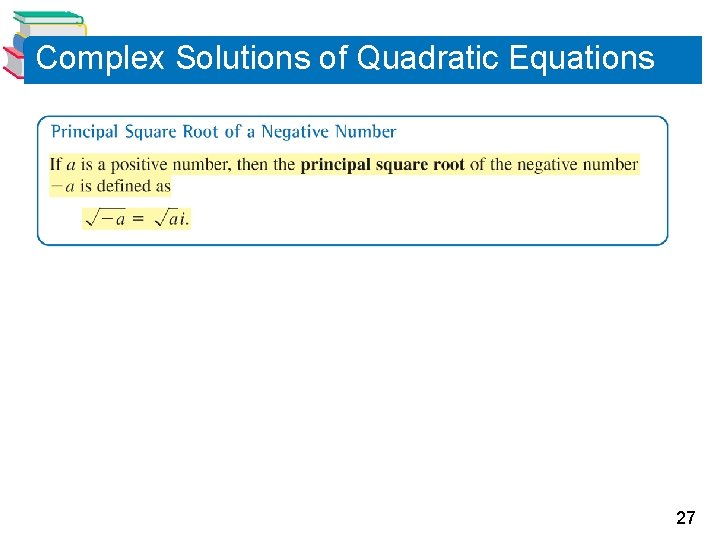
Complex Solutions of Quadratic Equations 27
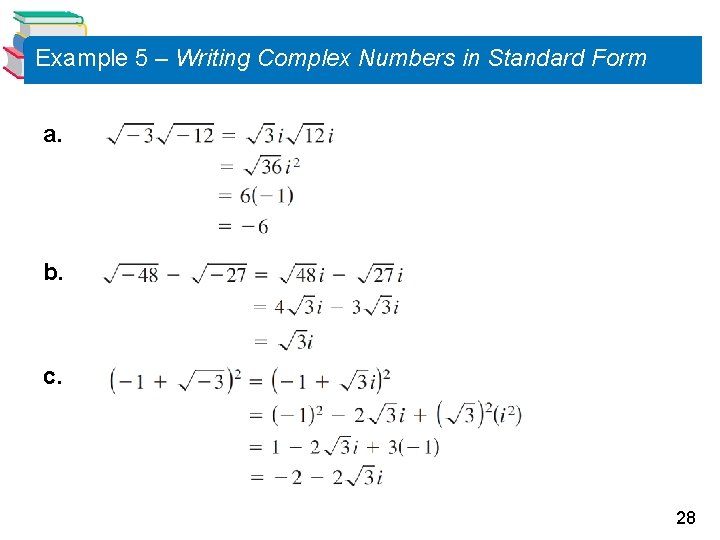
Example 5 – Writing Complex Numbers in Standard Form a. b. c. 28
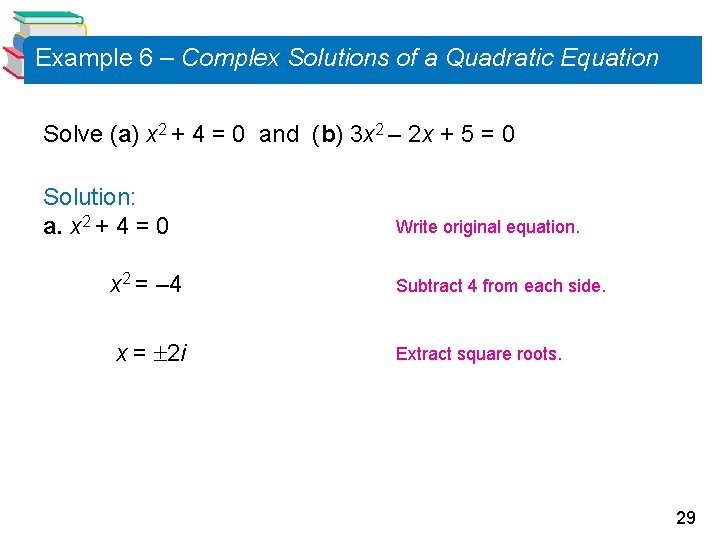
Example 6 – Complex Solutions of a Quadratic Equation Solve (a) x 2 + 4 = 0 and (b) 3 x 2 – 2 x + 5 = 0 Solution: a. x 2 + 4 = 0 x 2 = – 4 x = 2 i Write original equation. Subtract 4 from each side. Extract square roots. 29
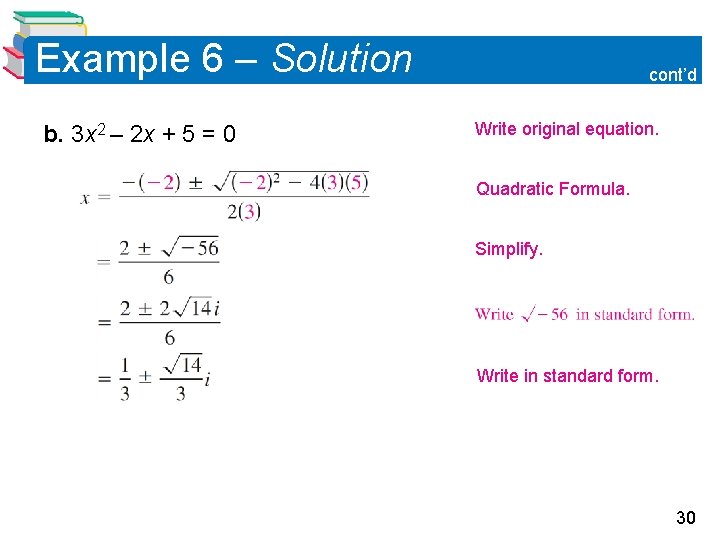
Example 6 – Solution b. 3 x 2 – 2 x + 5 = 0 cont’d Write original equation. Quadratic Formula. Simplify. Write in standard form. 30
- Slides: 30