
2 4 Calculating Bandwidth Requirements for Vo IP
2. 4: Calculating Bandwidth Requirements for Vo. IP © 2006 Cisco Systems, Inc. All rights reserved.
Objectives § Describe factors influencing encapsulation overhead and bandwidth requirements for Vo. IP. § Explain how the packetization period impacts Vo. IP packet size and rate. § Explain how link encapsulation effects data-link overhead on a per link basis. § Explain the bandwidth impact of adding a tunneling protocol header to voice packets. § Use the bandwidth calculation process to calculate bandwidth needs for various Vo. IP call types. § Describe how VAD is used in Vo. IP implementations. © 2006 Cisco Systems, Inc. All rights reserved.
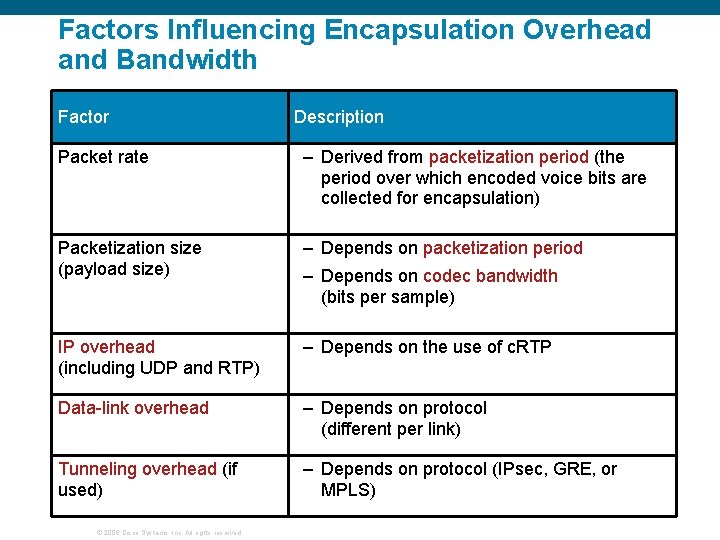
Factors Influencing Encapsulation Overhead and Bandwidth Factor Description Packet rate – Derived from packetization period (the period over which encoded voice bits are collected for encapsulation) Packetization size (payload size) – Depends on packetization period IP overhead (including UDP and RTP) – Depends on the use of c. RTP Data-link overhead – Depends on protocol (different per link) Tunneling overhead (if used) – Depends on protocol (IPsec, GRE, or MPLS) © 2006 Cisco Systems, Inc. All rights reserved. – Depends on codec bandwidth (bits per sample)
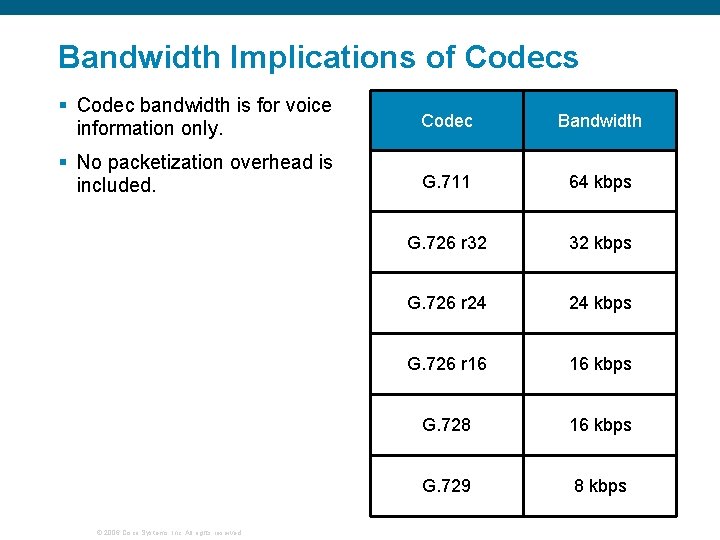
Bandwidth Implications of Codecs § Codec bandwidth is for voice information only. Codec Bandwidth § No packetization overhead is included. G. 711 64 kbps G. 726 r 32 32 kbps G. 726 r 24 24 kbps G. 726 r 16 16 kbps G. 728 16 kbps G. 729 8 kbps © 2006 Cisco Systems, Inc. All rights reserved.
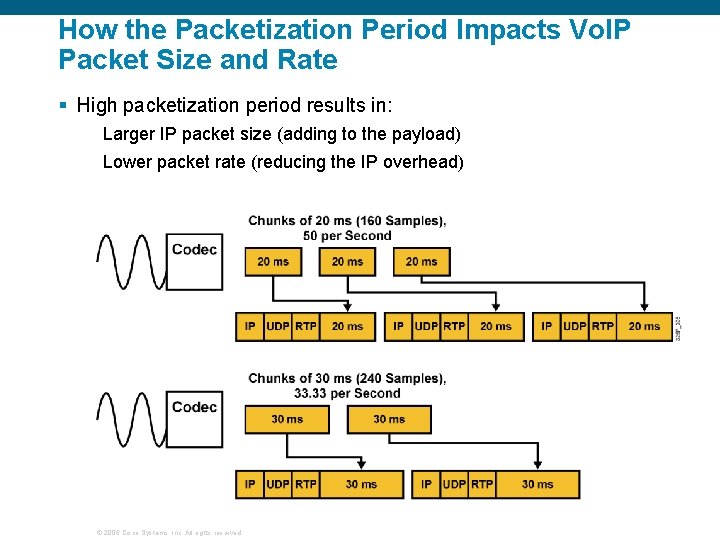
How the Packetization Period Impacts Vo. IP Packet Size and Rate § High packetization period results in: Larger IP packet size (adding to the payload) Lower packet rate (reducing the IP overhead) © 2006 Cisco Systems, Inc. All rights reserved.
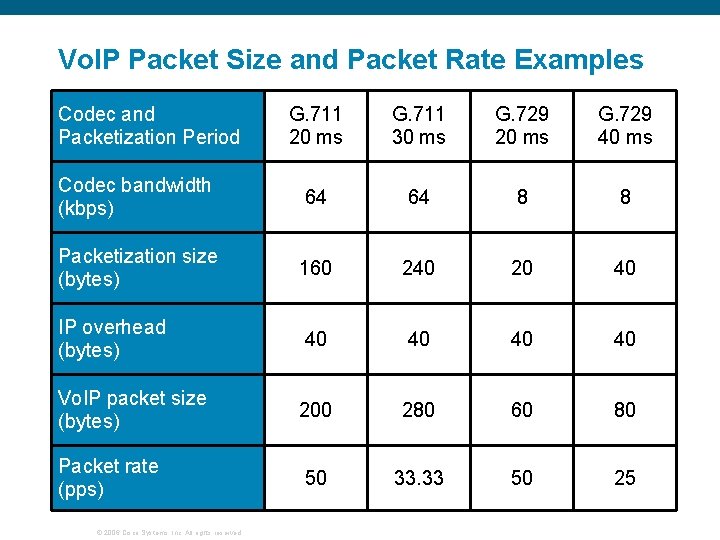
Vo. IP Packet Size and Packet Rate Examples Codec and Packetization Period G. 711 20 ms G. 711 30 ms G. 729 20 ms G. 729 40 ms Codec bandwidth (kbps) 64 64 8 8 Packetization size (bytes) 160 240 20 40 IP overhead (bytes) 40 40 Vo. IP packet size (bytes) 200 280 60 80 Packet rate (pps) 50 33. 33 50 25 © 2006 Cisco Systems, Inc. All rights reserved.
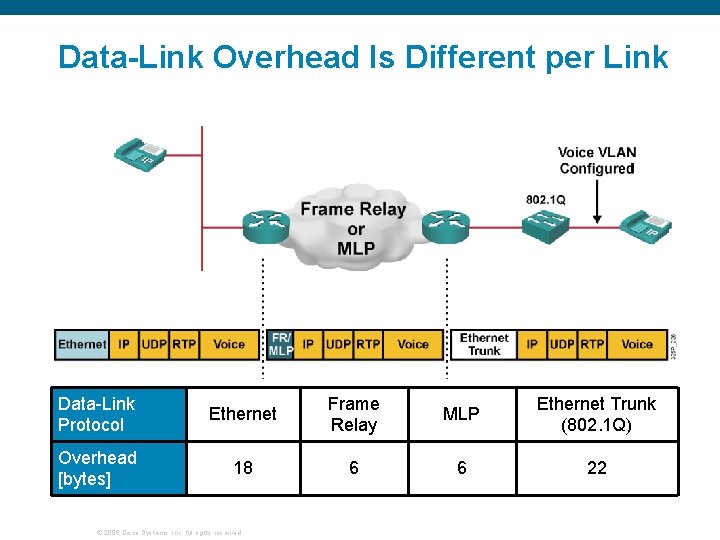
Data-Link Overhead Is Different per Link Data-Link Protocol Ethernet Frame Relay MLP Ethernet Trunk (802. 1 Q) Overhead [bytes] 18 6 6 22 © 2006 Cisco Systems, Inc. All rights reserved.
Security and Tunneling Overhead § IP packets can be secured by IPsec. § Additionally, IP packets or data-link frames can be tunneled over a variety of protocols. § Characteristics of IPsec and tunneling protocols are: The original frame or packet is encapsulated into another protocol. The added headers result in larger packets and higher bandwidth requirements. The extra bandwidth can be extremely critical for voice packets because of the transmission of small packets at a high rate. © 2006 Cisco Systems, Inc. All rights reserved.
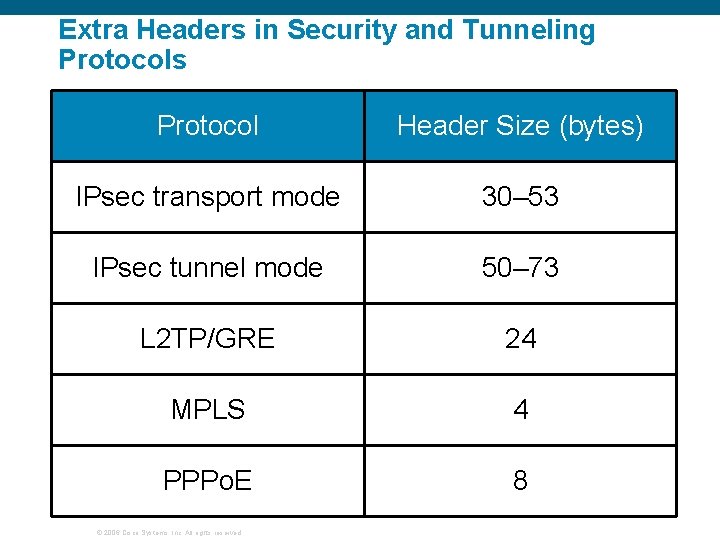
Extra Headers in Security and Tunneling Protocols Protocol Header Size (bytes) IPsec transport mode 30– 53 IPsec tunnel mode 50– 73 L 2 TP/GRE 24 MPLS 4 PPPo. E 8 © 2006 Cisco Systems, Inc. All rights reserved.
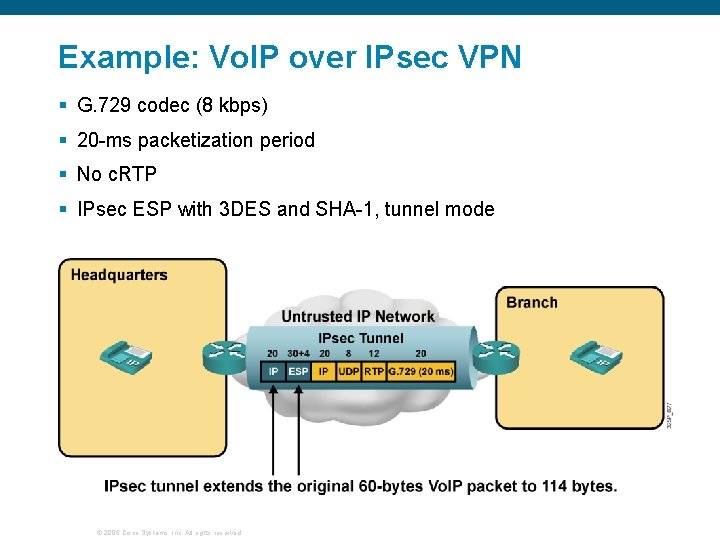
Example: Vo. IP over IPsec VPN § G. 729 codec (8 kbps) § 20 -ms packetization period § No c. RTP § IPsec ESP with 3 DES and SHA-1, tunnel mode © 2006 Cisco Systems, Inc. All rights reserved.
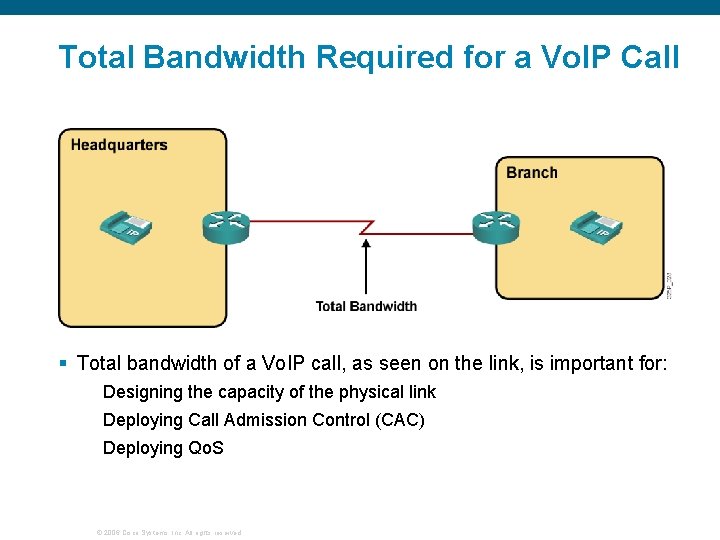
Total Bandwidth Required for a Vo. IP Call § Total bandwidth of a Vo. IP call, as seen on the link, is important for: Designing the capacity of the physical link Deploying Call Admission Control (CAC) Deploying Qo. S © 2006 Cisco Systems, Inc. All rights reserved.
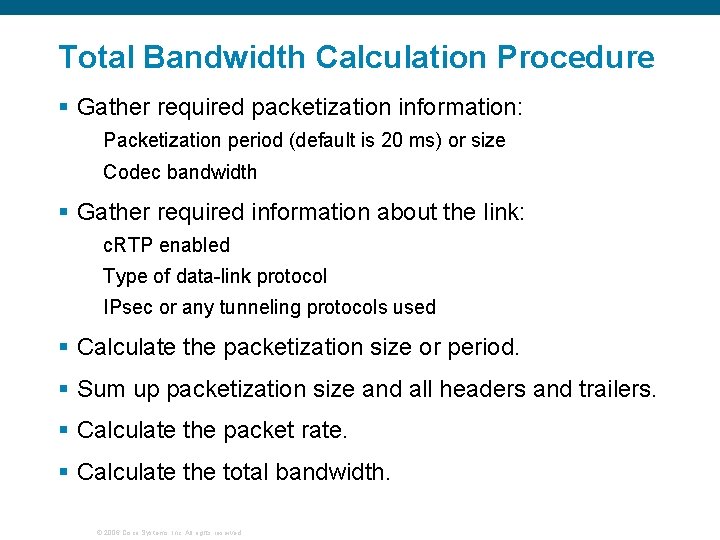
Total Bandwidth Calculation Procedure § Gather required packetization information: Packetization period (default is 20 ms) or size Codec bandwidth § Gather required information about the link: c. RTP enabled Type of data-link protocol IPsec or any tunneling protocols used § Calculate the packetization size or period. § Sum up packetization size and all headers and trailers. § Calculate the packet rate. § Calculate the total bandwidth. © 2006 Cisco Systems, Inc. All rights reserved.
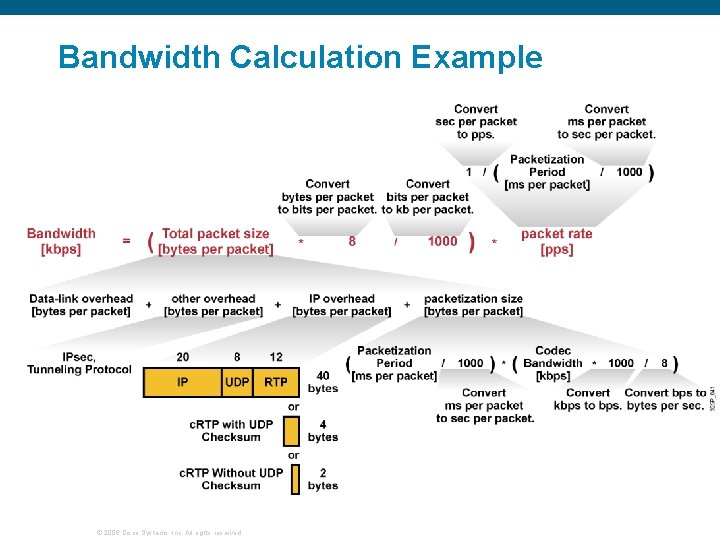
Bandwidth Calculation Example © 2006 Cisco Systems, Inc. All rights reserved.
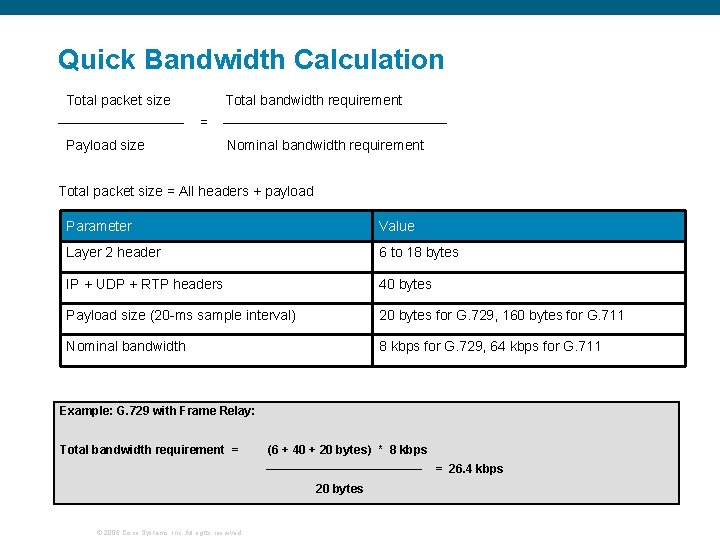
Quick Bandwidth Calculation Total packet size ————— Total bandwidth requirement = ———————— Payload size Nominal bandwidth requirement Total packet size = All headers + payload Parameter Value Layer 2 header 6 to 18 bytes IP + UDP + RTP headers 40 bytes Payload size (20 -ms sample interval) 20 bytes for G. 729, 160 bytes for G. 711 Nominal bandwidth 8 kbps for G. 729, 64 kbps for G. 711 Example: G. 729 with Frame Relay: Total bandwidth requirement = (6 + 40 + 20 bytes) * 8 kbps ——————— 20 bytes © 2006 Cisco Systems, Inc. All rights reserved. = 26. 4 kbps
VAD Characteristics § Detects silence (speech pauses) § Suppresses transmission of “silence patterns” § Depends on multiple factors: Type of audio (for example, speech or Mo. H) Level of background noise Other factors (for example, language, character of speaker, or type of call) § Can save up to 35 percent of bandwidth © 2006 Cisco Systems, Inc. All rights reserved.
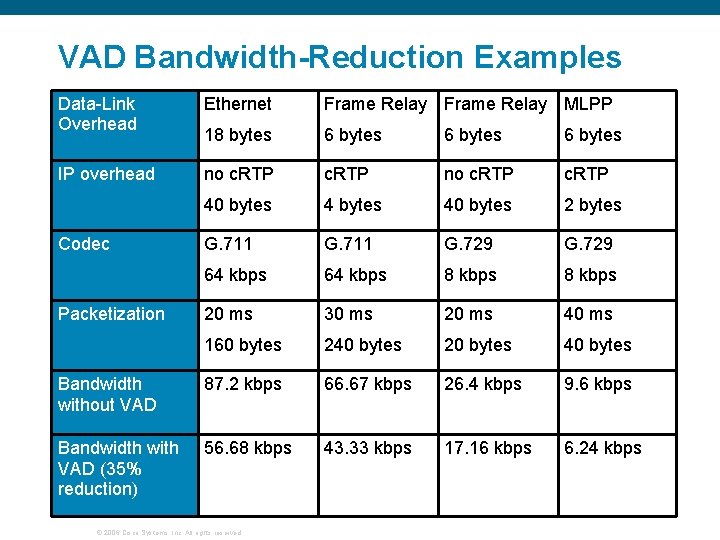
VAD Bandwidth-Reduction Examples Data-Link Overhead Ethernet Frame Relay MLPP 18 bytes 6 bytes IP overhead no c. RTP 40 bytes 2 bytes G. 711 G. 729 64 kbps 8 kbps 20 ms 30 ms 20 ms 40 ms 160 bytes 240 bytes 20 bytes 40 bytes Bandwidth without VAD 87. 2 kbps 66. 67 kbps 26. 4 kbps 9. 6 kbps Bandwidth with VAD (35% reduction) 56. 68 kbps 43. 33 kbps 17. 16 kbps 6. 24 kbps Codec Packetization © 2006 Cisco Systems, Inc. All rights reserved.
Self Check 1. Describe the relationship between packetization period and packet size and packet rate. 2. How does the data-link protocol used effect bandwidth considerations? 3. What is the default packetization period on Cisco devices? 4. What is VAD? 5. How much bandwidth can be saved, on average, using VAD? © 2006 Cisco Systems, Inc. All rights reserved.
Summary § Vo. IP packet size and rate are determined by the packetization period. § Data-link overhead must be considered with calculating bandwidth requirements. Different links have different overhead requirements. § Adding a tunneling protocol header effects the bandwidth requirements for voice packets. This additional overhead must be considered when calculating bandwidth requirements. § Voice Activity Detection (VAD) is a process used to detect silence in order to save bandwidth. VAD can save 34% on average. © 2006 Cisco Systems, Inc. All rights reserved.
- Slides: 18