
2 3 Modeling RealWorld Data with Matrices Objectives

2. 3 Modeling Real-World Data with Matrices Objectives: 1. Model data using matrices. 2. Add, subtract, and multiply matrices.
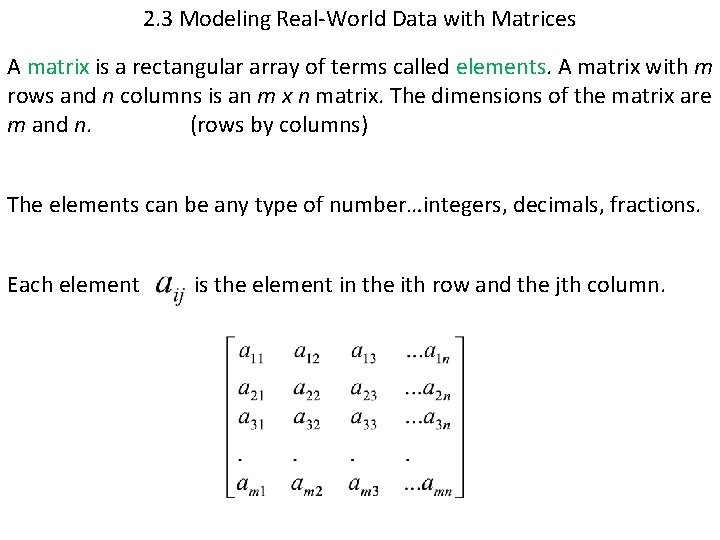
2. 3 Modeling Real-World Data with Matrices A matrix is a rectangular array of terms called elements. A matrix with m rows and n columns is an m x n matrix. The dimensions of the matrix are m and n. (rows by columns) The elements can be any type of number…integers, decimals, fractions. Each element is the element in the ith row and the jth column.

2. 3 Modeling Real-World Data with Matrices Two matrices (plural for matrix) are equal if and only if they have he same dimensions and are identical, element by element. Matrices are named with capital letters such as A, B, etc. Find the value of x and y for which each matrix equation is true.
2. 3 Modeling Real-World Data with Matrices Two matrices (plural for matrix) are equal if and only if they have he same dimensions and are identical, element by element. Matrices are named with capital letters such as A, B, etc. You can add or subtract two matrices with the exact same dimensions. The sum of two m x n matrices, A + B, is also an m x n matrix. Add the corresponding elements together get the new matrix. The difference of two m x n matrices, A – B, is also an m x n matrix. Subtract the corresponding elements together get the new matrix.
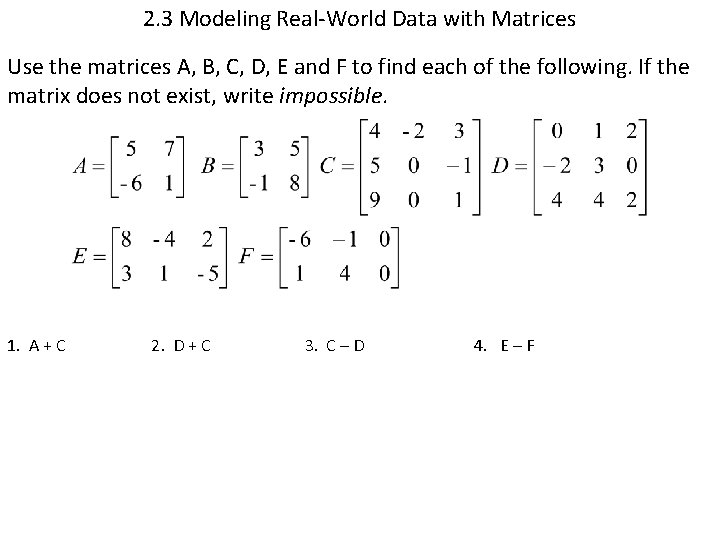
2. 3 Modeling Real-World Data with Matrices Use the matrices A, B, C, D, E and F to find each of the following. If the matrix does not exist, write impossible. 1. A + C 2. D + C 3. C – D 4. E – F
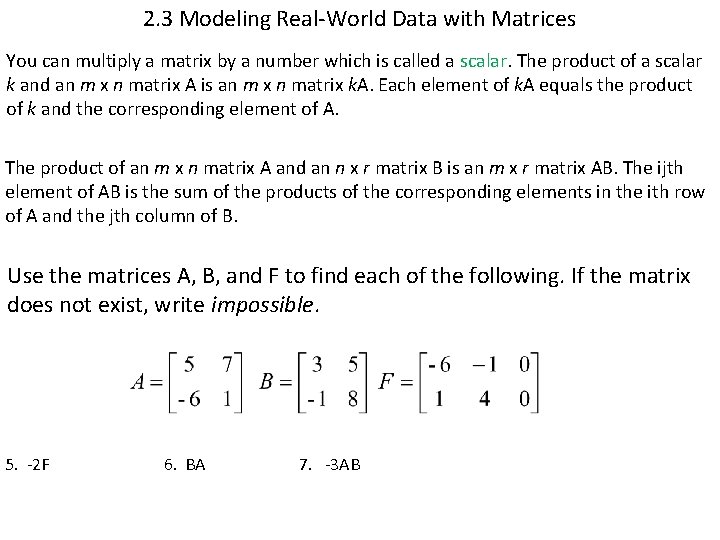
2. 3 Modeling Real-World Data with Matrices You can multiply a matrix by a number which is called a scalar. The product of a scalar k and an m x n matrix A is an m x n matrix k. A. Each element of k. A equals the product of k and the corresponding element of A. The product of an m x n matrix A and an n x r matrix B is an m x r matrix AB. The ijth element of AB is the sum of the products of the corresponding elements in the ith row of A and the jth column of B. Use the matrices A, B, and F to find each of the following. If the matrix does not exist, write impossible. 5. -2 F 6. BA 7. -3 AB

2. 3 Modeling Real-World Data with Matrices In football, a player scores 6 points for a touchdown (TD), 3 points for kicking a field goal (FG), and 1 point for kicking the extra point after a touchdown (PAT). The chart lists the record of the top five all time professional football scorers (as of the end of the 2003 season). Use matrix multiplication to find the number of points each player scored. Scorer TD FG PAT Gary Anderson 0 521 783 Morten Anderson 0 502 753 George Blanda 9 335 943 Norm Johnson 0 366 638 Nick Lowery 0 383 562
9/25 2. 3 83 -84 15, 19, 23 -45 odd, 47, 48, 49 17 Read pages 87 for tomorrow.
- Slides: 8