
2 3 Irregular Waves Simulation by LWT Linear
2. 3 Irregular Waves Simulation by LWT Linear Superposition of free (linear) waves Free Wave Information: Based on the results of the wave decomposition Based on a wave spectrum
• Types of Wave (Energy Density-Frequency) Spectra Pierson-Moskowitz (PM) JONSWAP spectrum • Discrete Amplitude Spectrum • Simulations of Long- & Short-Crest Waves Initial Phases (Randomly Selected) Random Fourier Coefficient • Energy Spreading or Wave Direction Double or Single Summation Model
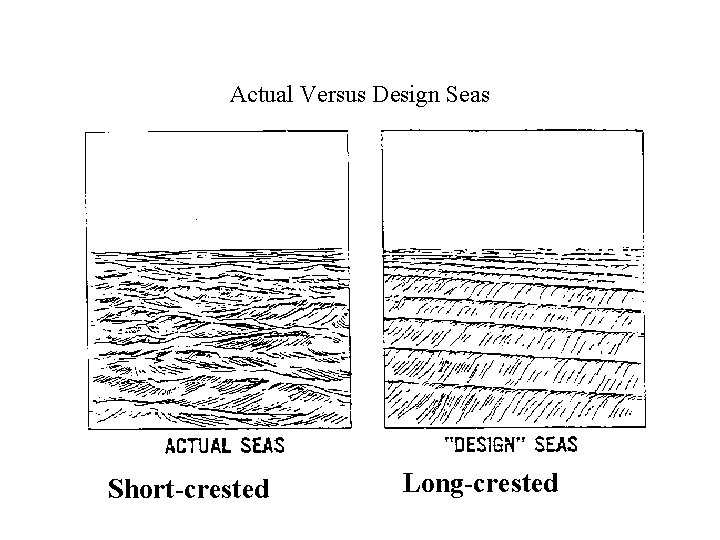
Actual Versus Design Seas Short-crested Long-crested
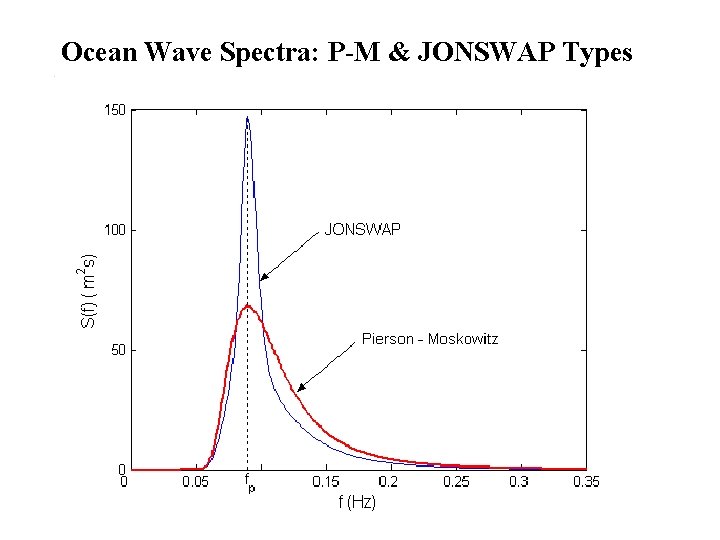
Ocean Wave Spectra: P-M & JONSWAP Types

Pierson-Moskowitz Spectrum JONSWAP Spectrum

JONSWAP Spectra & H 1/3 and Tp Goda (1987)
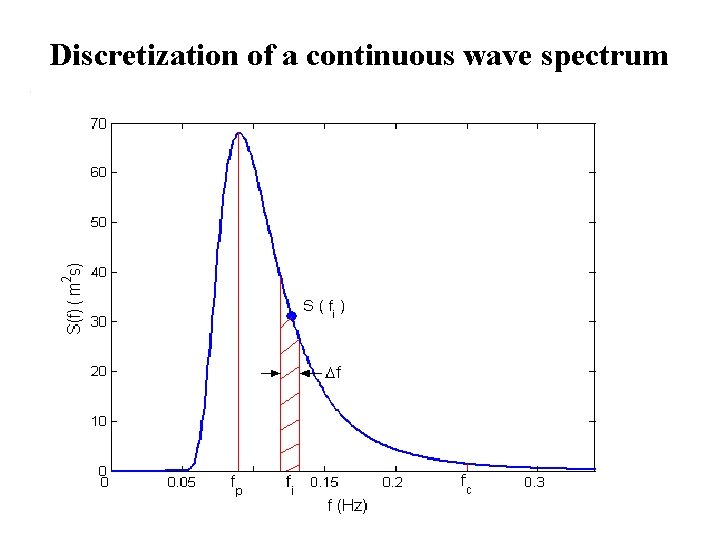
Discretization of a continuous wave spectrum
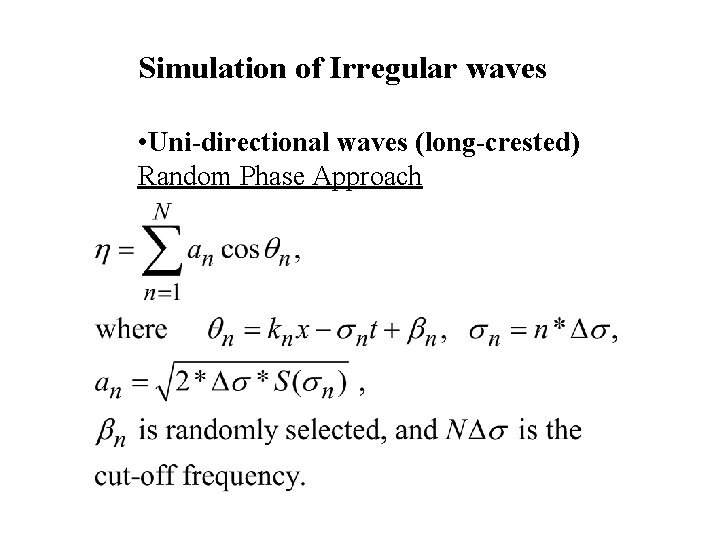
Simulation of Irregular waves • Uni-directional waves (long-crested) Random Phase Approach
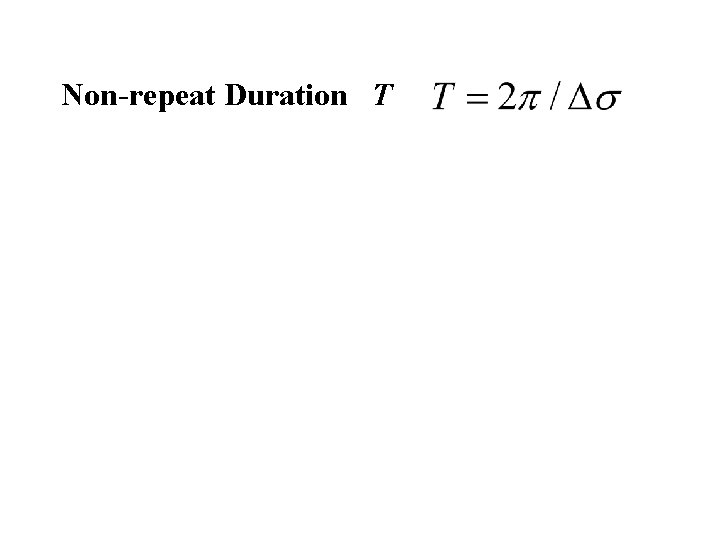
Non-repeat Duration T
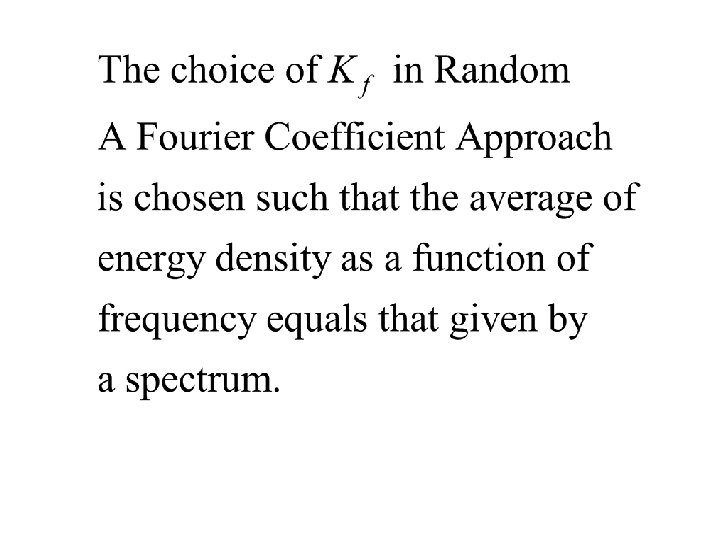
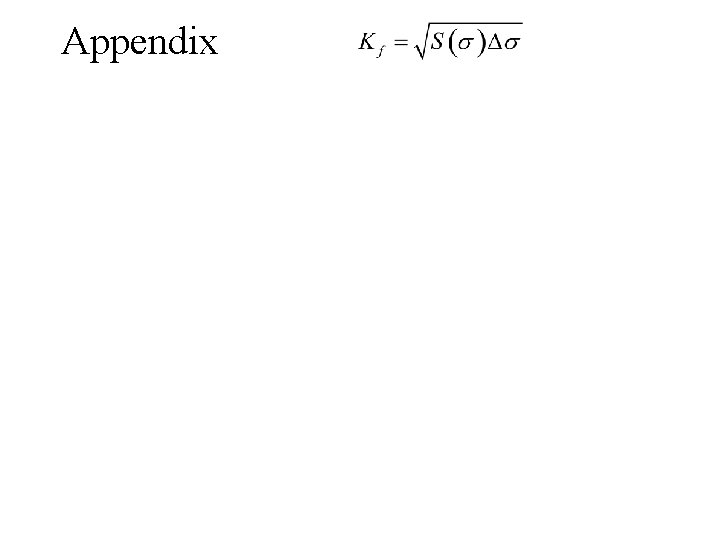
Uni-directional waves (long-crested) Random Fourier Coefficient Approach
Appendix
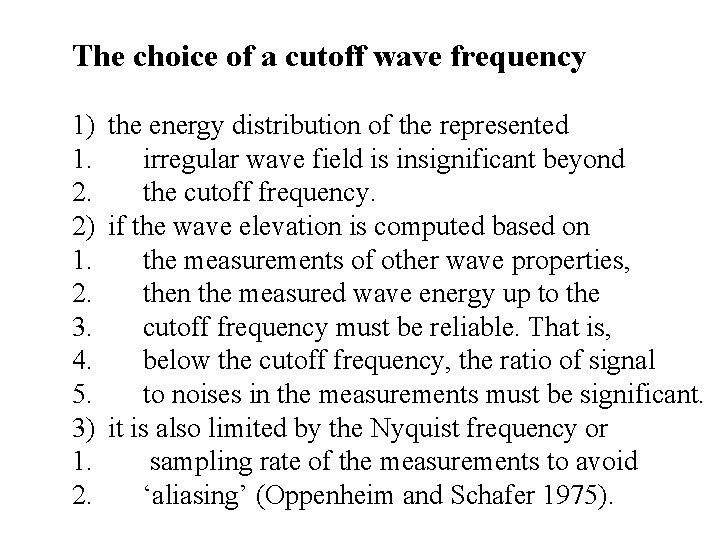
The choice of a cutoff wave frequency 1) the energy distribution of the represented 1. irregular wave field is insignificant beyond 2. the cutoff frequency. 2) if the wave elevation is computed based on 1. the measurements of other wave properties, 2. then the measured wave energy up to the 3. cutoff frequency must be reliable. That is, 4. below the cutoff frequency, the ratio of signal 5. to noises in the measurements must be significant. 3) it is also limited by the Nyquist frequency or 1. sampling rate of the measurements to avoid 2. ‘aliasing’ (Oppenheim and Schafer 1975).
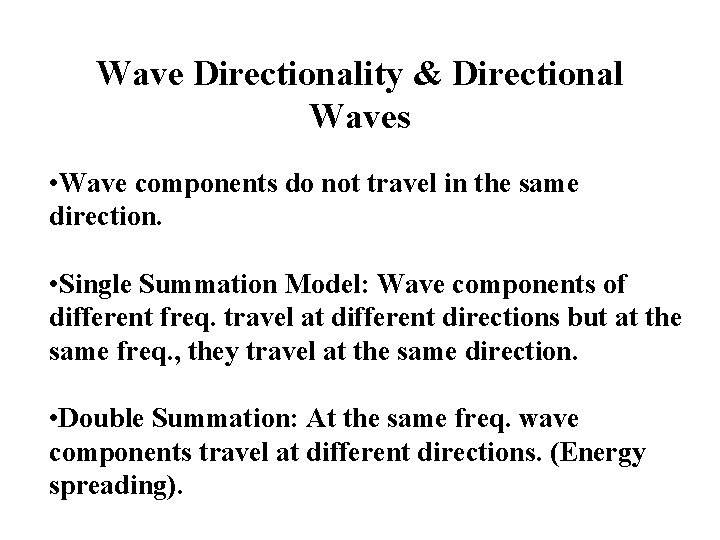
Wave Directionality & Directional Waves • Wave components do not travel in the same direction. • Single Summation Model: Wave components of different freq. travel at different directions but at the same freq. , they travel at the same direction. • Double Summation: At the same freq. wave components travel at different directions. (Energy spreading).
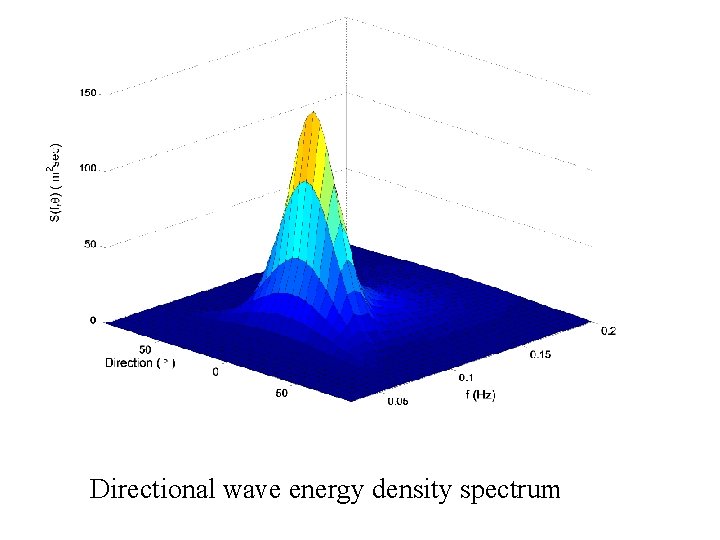
Directional wave energy density spectrum
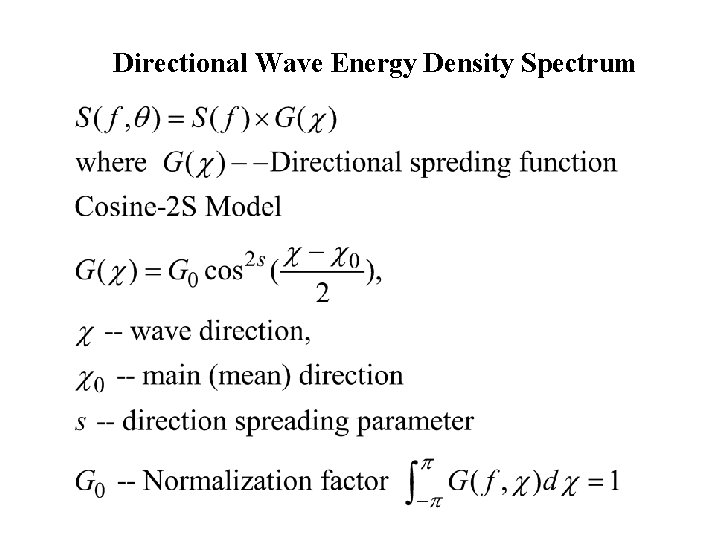
Directional Wave Energy Density Spectrum
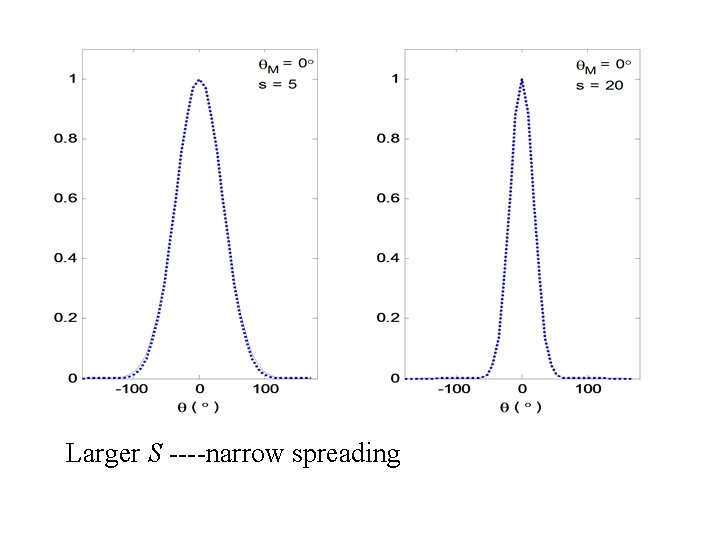
Larger S ----narrow spreading
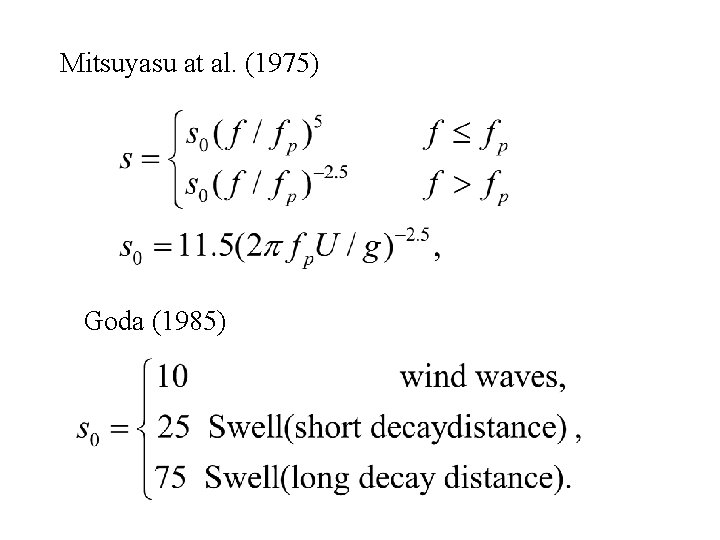
Mitsuyasu at al. (1975) Goda (1985)
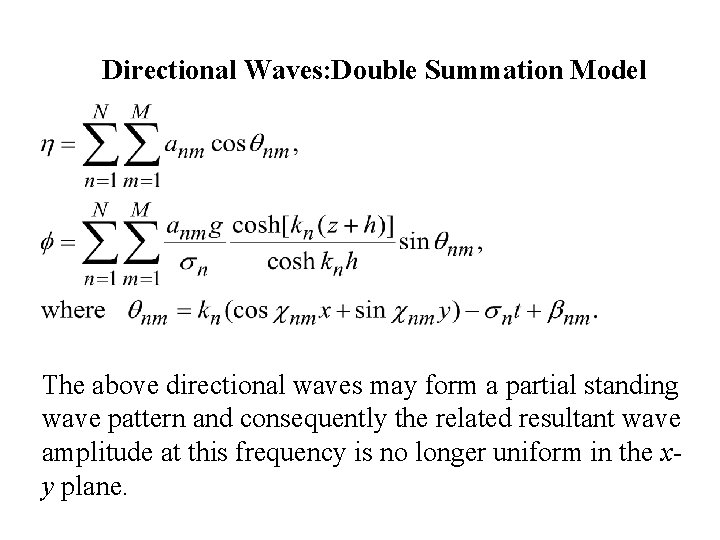
Directional Waves: Double Summation Model The above directional waves may form a partial standing wave pattern and consequently the related resultant wave amplitude at this frequency is no longer uniform in the xy plane.
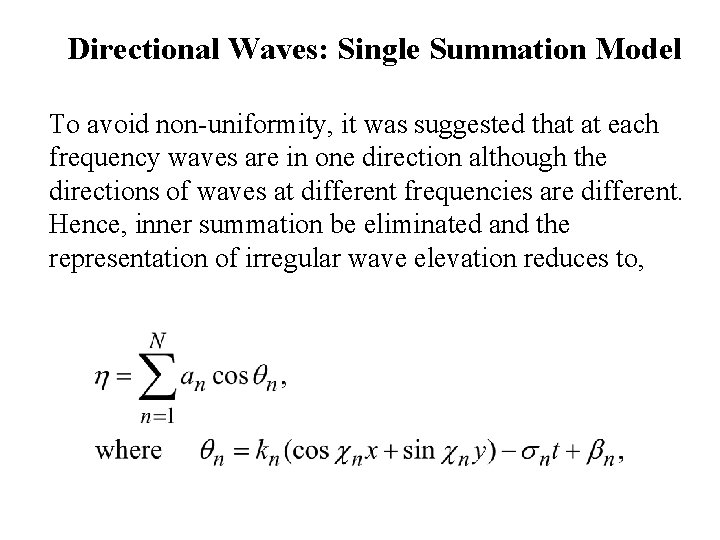
Directional Waves: Single Summation Model To avoid non-uniformity, it was suggested that at each frequency waves are in one direction although the directions of waves at different frequencies are different. Hence, inner summation be eliminated and the representation of irregular wave elevation reduces to,
- Slides: 20