
2 3 Indentifying Functional Groups Bondline structures allow
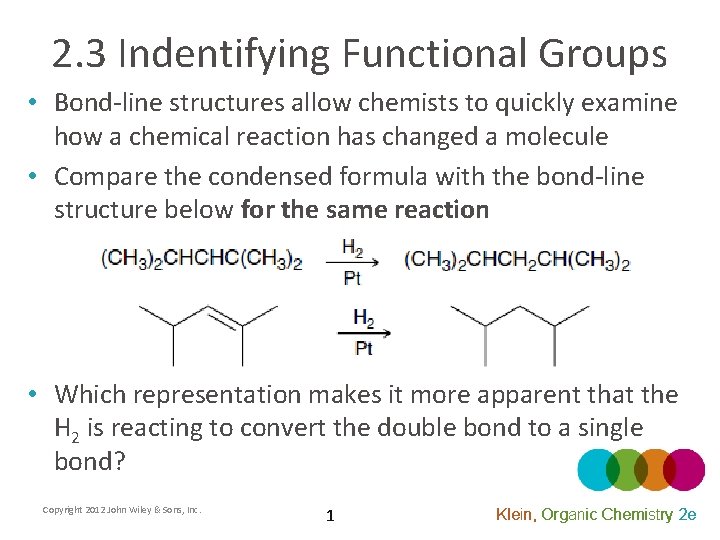
2. 3 Indentifying Functional Groups • Bond-line structures allow chemists to quickly examine how a chemical reaction has changed a molecule • Compare the condensed formula with the bond-line structure below for the same reaction • Which representation makes it more apparent that the H 2 is reacting to convert the double bond to a single bond? Copyright 2012 John Wiley & Sons, Inc. 1 Klein, Organic Chemistry 2 e
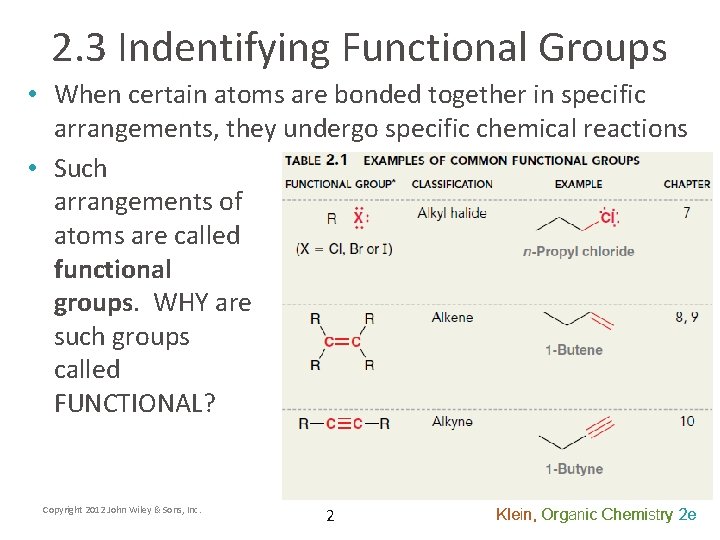
2. 3 Indentifying Functional Groups • When certain atoms are bonded together in specific arrangements, they undergo specific chemical reactions • Such arrangements of atoms are called functional groups. WHY are such groups called FUNCTIONAL? Copyright 2012 John Wiley & Sons, Inc. 2 Klein, Organic Chemistry 2 e

2. 3 Indentifying Functional Groups • More functional groups are listed in table 2. 1 • Practice with conceptual checkpoint 2. 11 Copyright 2012 John Wiley & Sons, Inc. 3 Klein, Organic Chemistry 2 e
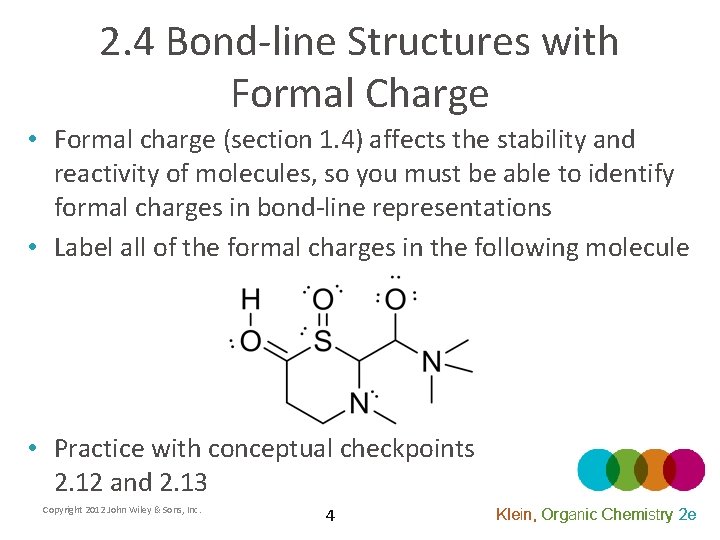
2. 4 Bond-line Structures with Formal Charge • Formal charge (section 1. 4) affects the stability and reactivity of molecules, so you must be able to identify formal charges in bond-line representations • Label all of the formal charges in the following molecule • Practice with conceptual checkpoints 2. 12 and 2. 13 Copyright 2012 John Wiley & Sons, Inc. 4 Klein, Organic Chemistry 2 e
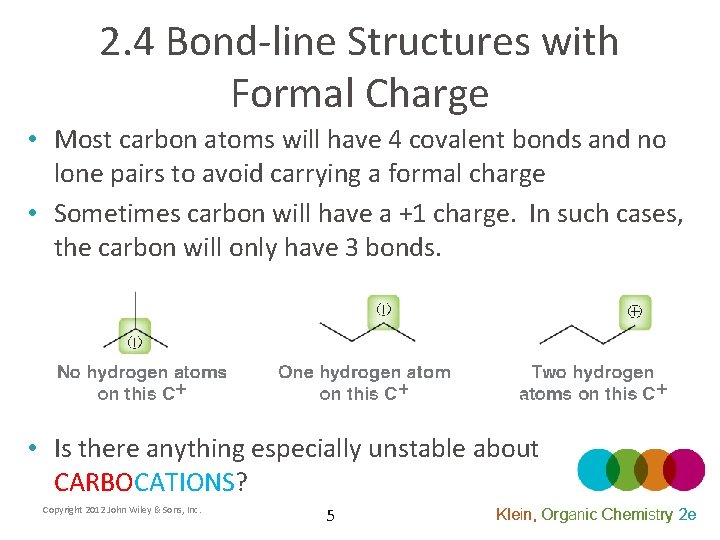
2. 4 Bond-line Structures with Formal Charge • Most carbon atoms will have 4 covalent bonds and no lone pairs to avoid carrying a formal charge • Sometimes carbon will have a +1 charge. In such cases, the carbon will only have 3 bonds. • Is there anything especially unstable about CARBOCATIONS? Copyright 2012 John Wiley & Sons, Inc. 5 Klein, Organic Chemistry 2 e
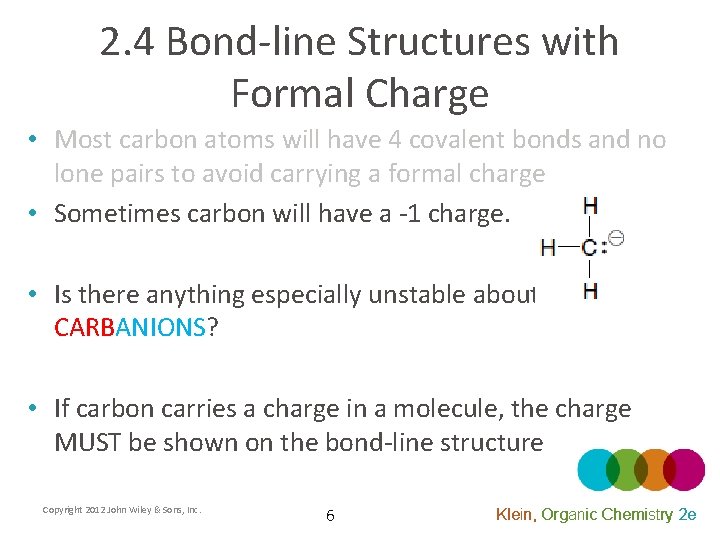
2. 4 Bond-line Structures with Formal Charge • Most carbon atoms will have 4 covalent bonds and no lone pairs to avoid carrying a formal charge • Sometimes carbon will have a -1 charge. • Is there anything especially unstable about CARBANIONS? • If carbon carries a charge in a molecule, the charge MUST be shown on the bond-line structure Copyright 2012 John Wiley & Sons, Inc. 6 Klein, Organic Chemistry 2 e
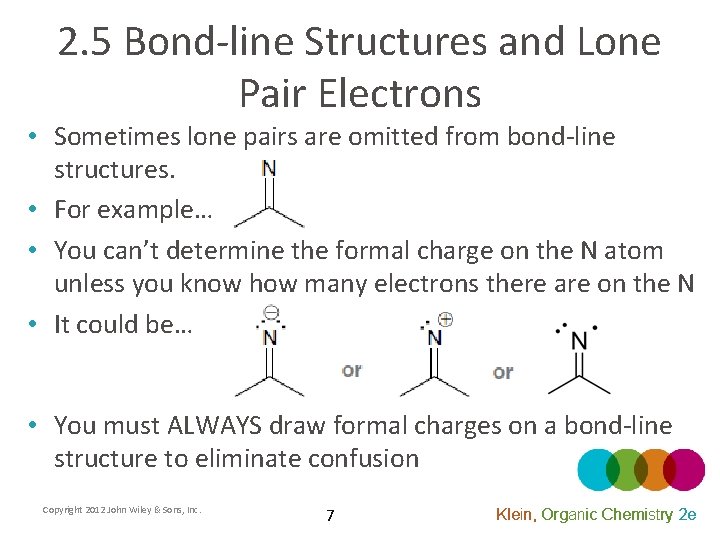
2. 5 Bond-line Structures and Lone Pair Electrons • Sometimes lone pairs are omitted from bond-line structures. • For example… • You can’t determine the formal charge on the N atom unless you know how many electrons there are on the N • It could be… • You must ALWAYS draw formal charges on a bond-line structure to eliminate confusion Copyright 2012 John Wiley & Sons, Inc. 7 Klein, Organic Chemistry 2 e
2. 5 Bond-line Structures and Lone Pair Electrons • If the formal charge is indicated on an atom, you can determine how many lone pairs are present • To calculate the number of lone pair electrons for an atom, compare the number of valence electrons that should be associated with the atom to the number of valence electrons that are actually associated with an atom (section 1. 4) Copyright 2012 John Wiley & Sons, Inc. 8 Klein, Organic Chemistry 2 e
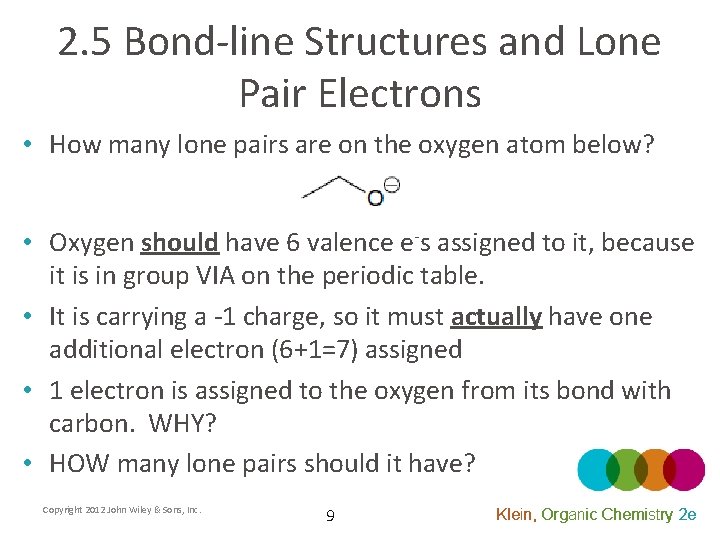
2. 5 Bond-line Structures and Lone Pair Electrons • How many lone pairs are on the oxygen atom below? • Oxygen should have 6 valence e-s assigned to it, because it is in group VIA on the periodic table. • It is carrying a -1 charge, so it must actually have one additional electron (6+1=7) assigned • 1 electron is assigned to the oxygen from its bond with carbon. WHY? • HOW many lone pairs should it have? Copyright 2012 John Wiley & Sons, Inc. 9 Klein, Organic Chemistry 2 e
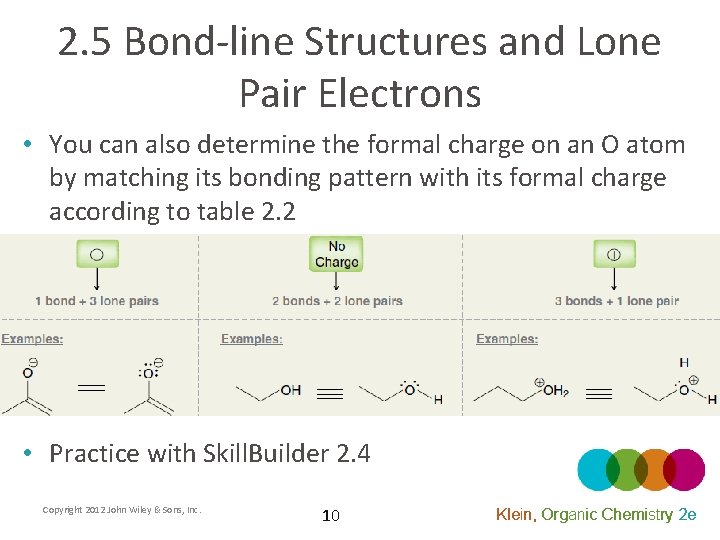
2. 5 Bond-line Structures and Lone Pair Electrons • You can also determine the formal charge on an O atom by matching its bonding pattern with its formal charge according to table 2. 2 • Practice with Skill. Builder 2. 4 Copyright 2012 John Wiley & Sons, Inc. 10 Klein, Organic Chemistry 2 e

2. 5 Bond-line Structures and Lone Pair Electrons • The formal charge on a N atoms can be calculated the same way or by matching its bonding pattern with its formal charge according to table 2. 3 • Practice with Skill. Builder 2. 5 Copyright 2012 John Wiley & Sons, Inc. 11 Klein, Organic Chemistry 2 e
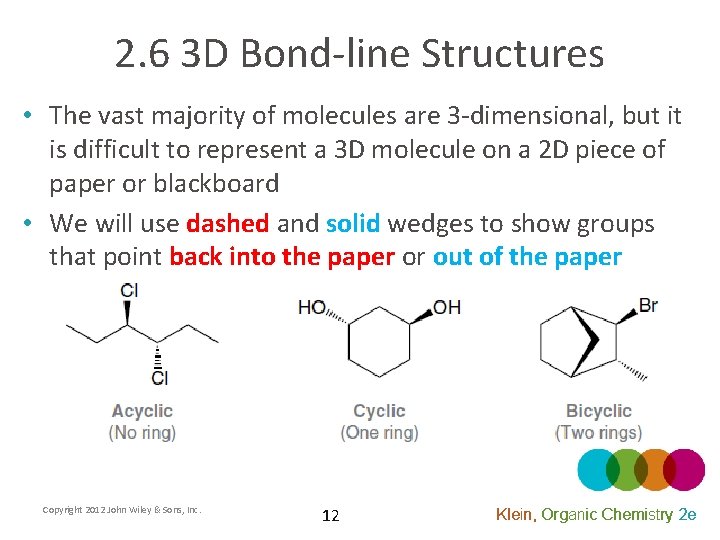
2. 6 3 D Bond-line Structures • The vast majority of molecules are 3 -dimensional, but it is difficult to represent a 3 D molecule on a 2 D piece of paper or blackboard • We will use dashed and solid wedges to show groups that point back into the paper or out of the paper Copyright 2012 John Wiley & Sons, Inc. 12 Klein, Organic Chemistry 2 e
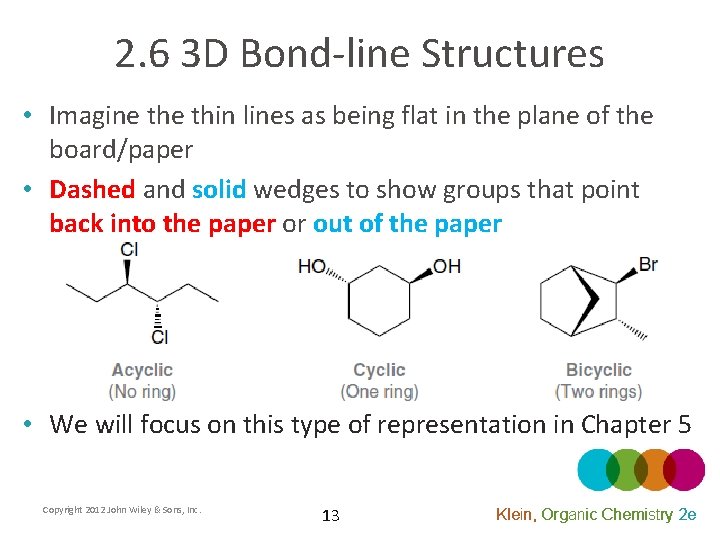
2. 6 3 D Bond-line Structures • Imagine thin lines as being flat in the plane of the board/paper • Dashed and solid wedges to show groups that point back into the paper or out of the paper • We will focus on this type of representation in Chapter 5 Copyright 2012 John Wiley & Sons, Inc. 13 Klein, Organic Chemistry 2 e

2. 6 3 D Bond-line Structures • Here are some other ways to show 3 D structure • Read the “Medically Speaking” section of Chapter 2 to see one example of how 3 D structure is important Copyright 2012 John Wiley & Sons, Inc. 14 Klein, Organic Chemistry 2 e
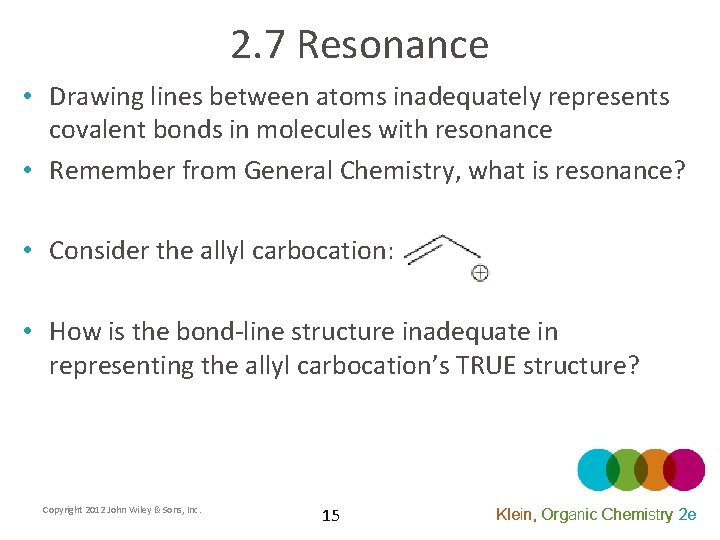
2. 7 Resonance • Drawing lines between atoms inadequately represents covalent bonds in molecules with resonance • Remember from General Chemistry, what is resonance? • Consider the allyl carbocation: • How is the bond-line structure inadequate in representing the allyl carbocation’s TRUE structure? Copyright 2012 John Wiley & Sons, Inc. 15 Klein, Organic Chemistry 2 e
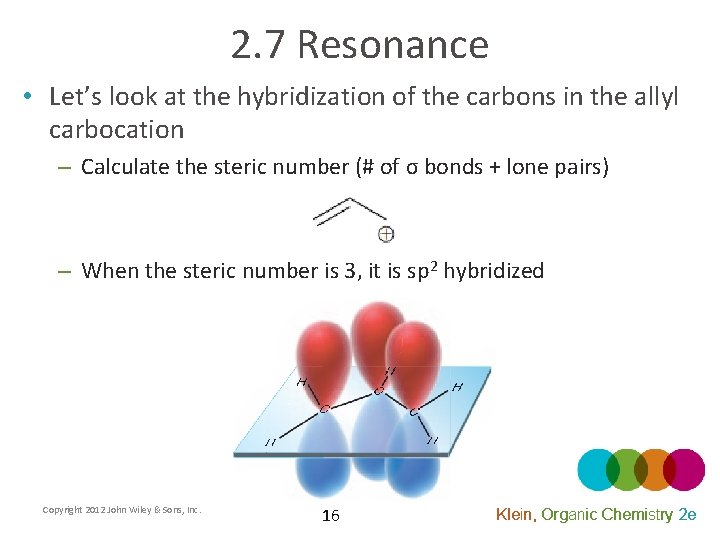
2. 7 Resonance • Let’s look at the hybridization of the carbons in the allyl carbocation – Calculate the steric number (# of σ bonds + lone pairs) – When the steric number is 3, it is sp 2 hybridized Copyright 2012 John Wiley & Sons, Inc. 16 Klein, Organic Chemistry 2 e
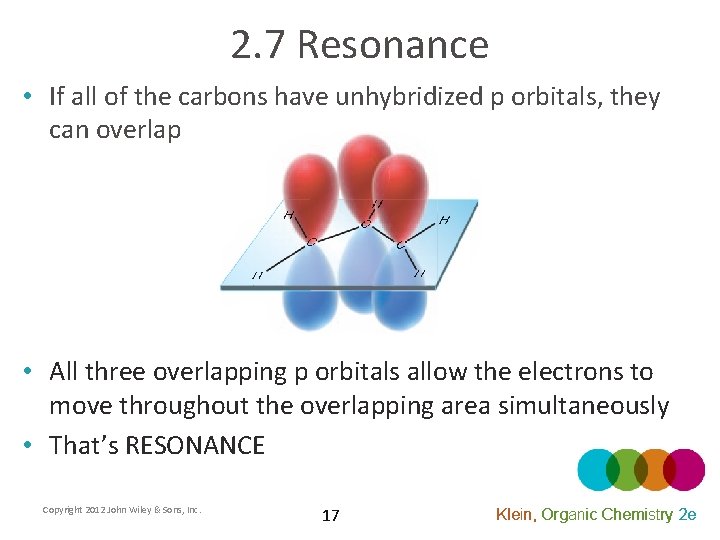
2. 7 Resonance • If all of the carbons have unhybridized p orbitals, they can overlap • All three overlapping p orbitals allow the electrons to move throughout the overlapping area simultaneously • That’s RESONANCE Copyright 2012 John Wiley & Sons, Inc. 17 Klein, Organic Chemistry 2 e
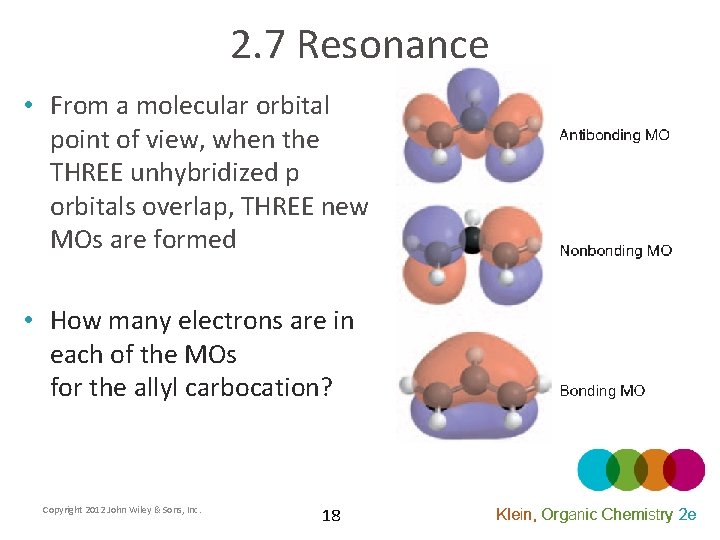
2. 7 Resonance • From a molecular orbital point of view, when the THREE unhybridized p orbitals overlap, THREE new MOs are formed • How many electrons are in each of the MOs for the allyl carbocation? Copyright 2012 John Wiley & Sons, Inc. 18 Klein, Organic Chemistry 2 e
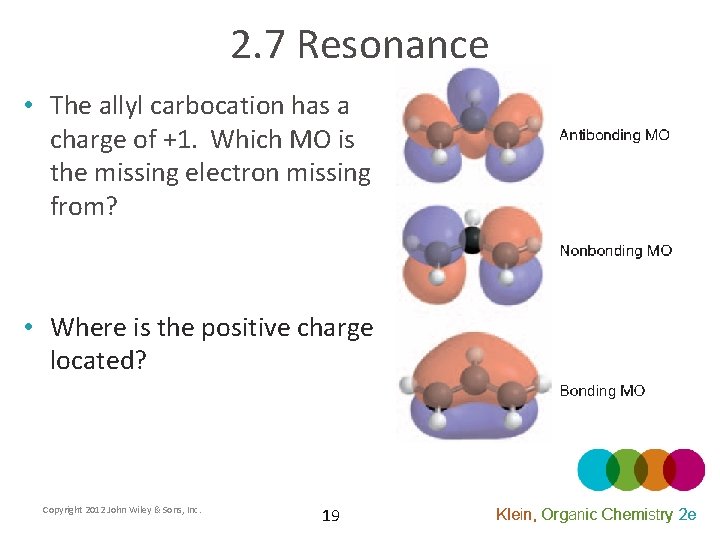
2. 7 Resonance • The allyl carbocation has a charge of +1. Which MO is the missing electron missing from? • Where is the positive charge located? Copyright 2012 John Wiley & Sons, Inc. 19 Klein, Organic Chemistry 2 e
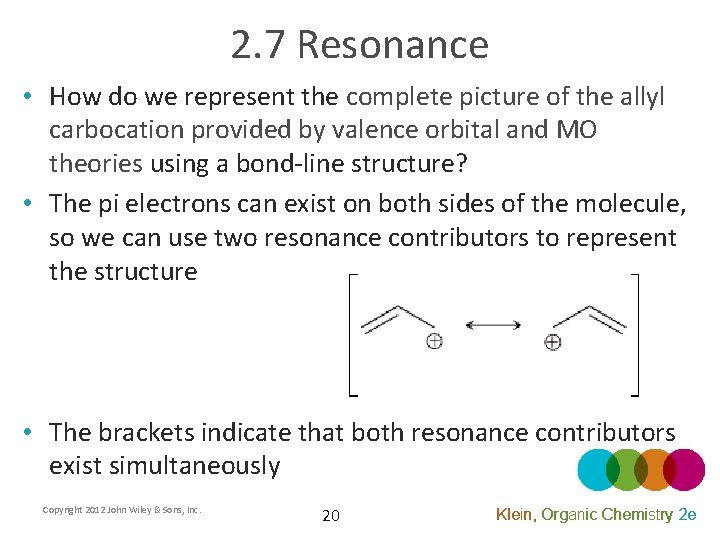
2. 7 Resonance • How do we represent the complete picture of the allyl carbocation provided by valence orbital and MO theories using a bond-line structure? • The pi electrons can exist on both sides of the molecule, so we can use two resonance contributors to represent the structure • The brackets indicate that both resonance contributors exist simultaneously Copyright 2012 John Wiley & Sons, Inc. 20 Klein, Organic Chemistry 2 e
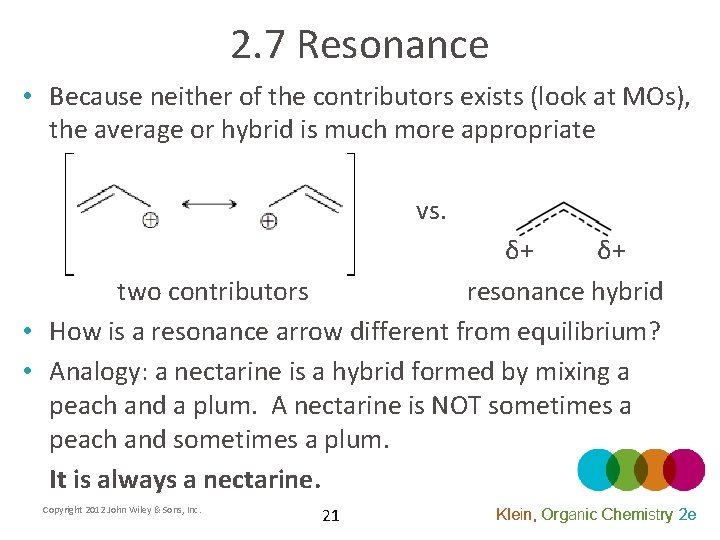
2. 7 Resonance • Because neither of the contributors exists (look at MOs), the average or hybrid is much more appropriate vs. δ+ δ+ two contributors resonance hybrid • How is a resonance arrow different from equilibrium? • Analogy: a nectarine is a hybrid formed by mixing a peach and a plum. A nectarine is NOT sometimes a peach and sometimes a plum. It is always a nectarine. Copyright 2012 John Wiley & Sons, Inc. 21 Klein, Organic Chemistry 2 e
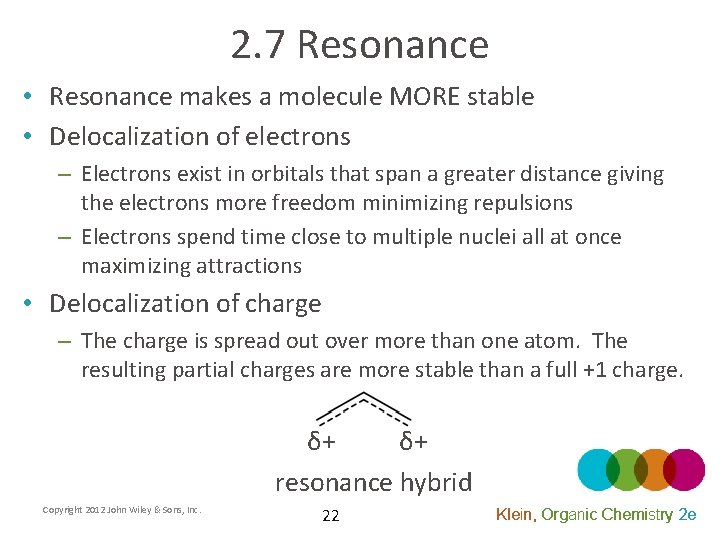
2. 7 Resonance • Resonance makes a molecule MORE stable • Delocalization of electrons – Electrons exist in orbitals that span a greater distance giving the electrons more freedom minimizing repulsions – Electrons spend time close to multiple nuclei all at once maximizing attractions • Delocalization of charge – The charge is spread out over more than one atom. The resulting partial charges are more stable than a full +1 charge. δ+ δ+ resonance hybrid Copyright 2012 John Wiley & Sons, Inc. 22 Klein, Organic Chemistry 2 e
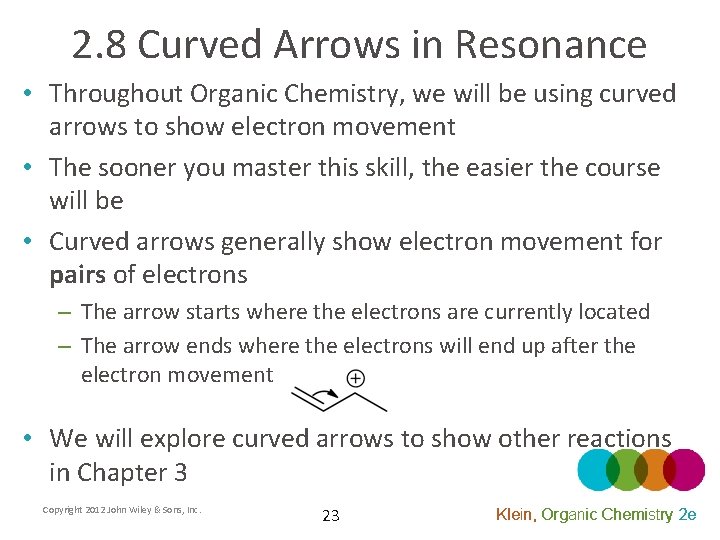
2. 8 Curved Arrows in Resonance • Throughout Organic Chemistry, we will be using curved arrows to show electron movement • The sooner you master this skill, the easier the course will be • Curved arrows generally show electron movement for pairs of electrons – The arrow starts where the electrons are currently located – The arrow ends where the electrons will end up after the electron movement • We will explore curved arrows to show other reactions in Chapter 3 Copyright 2012 John Wiley & Sons, Inc. 23 Klein, Organic Chemistry 2 e
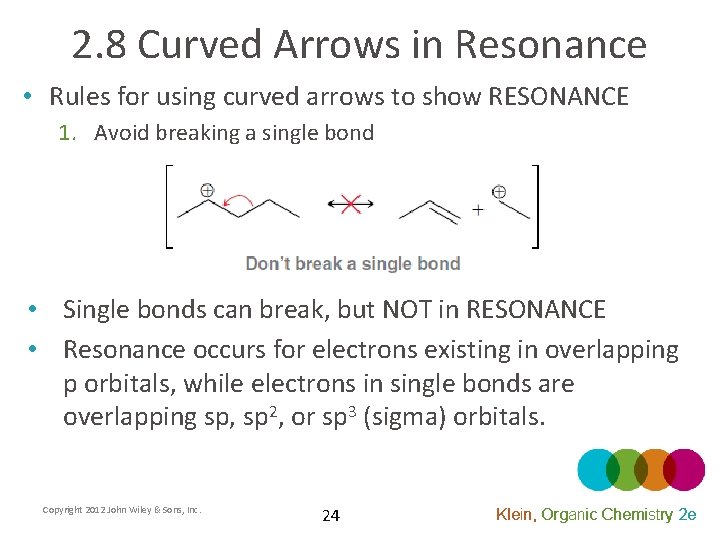
2. 8 Curved Arrows in Resonance • Rules for using curved arrows to show RESONANCE 1. Avoid breaking a single bond • Single bonds can break, but NOT in RESONANCE • Resonance occurs for electrons existing in overlapping p orbitals, while electrons in single bonds are overlapping sp, sp 2, or sp 3 (sigma) orbitals. Copyright 2012 John Wiley & Sons, Inc. 24 Klein, Organic Chemistry 2 e
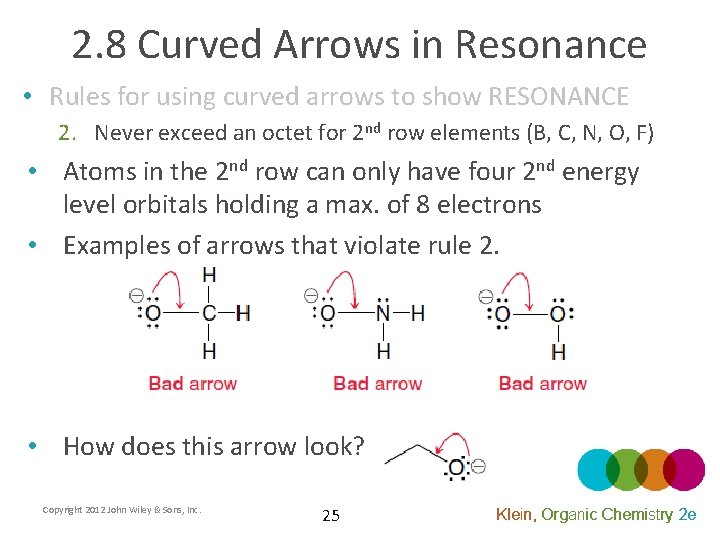
2. 8 Curved Arrows in Resonance • Rules for using curved arrows to show RESONANCE 2. Never exceed an octet for 2 nd row elements (B, C, N, O, F) • Atoms in the 2 nd row can only have four 2 nd energy level orbitals holding a max. of 8 electrons • Examples of arrows that violate rule 2. • How does this arrow look? Copyright 2012 John Wiley & Sons, Inc. 25 Klein, Organic Chemistry 2 e
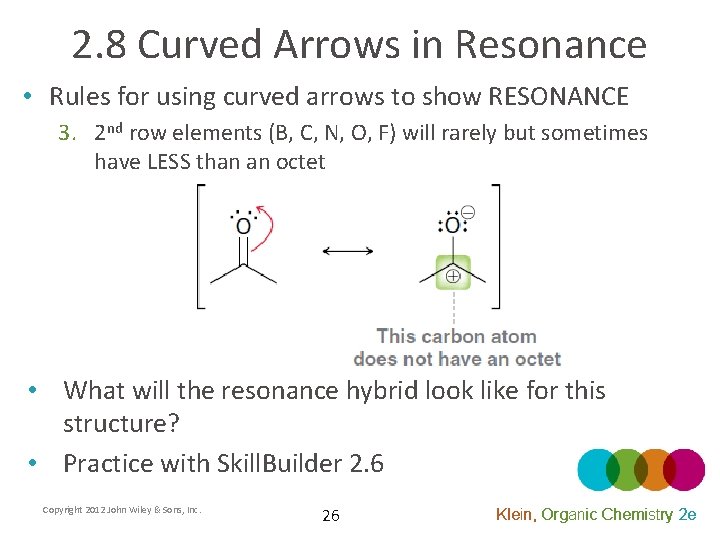
2. 8 Curved Arrows in Resonance • Rules for using curved arrows to show RESONANCE 3. 2 nd row elements (B, C, N, O, F) will rarely but sometimes have LESS than an octet • What will the resonance hybrid look like for this structure? • Practice with Skill. Builder 2. 6 Copyright 2012 John Wiley & Sons, Inc. 26 Klein, Organic Chemistry 2 e
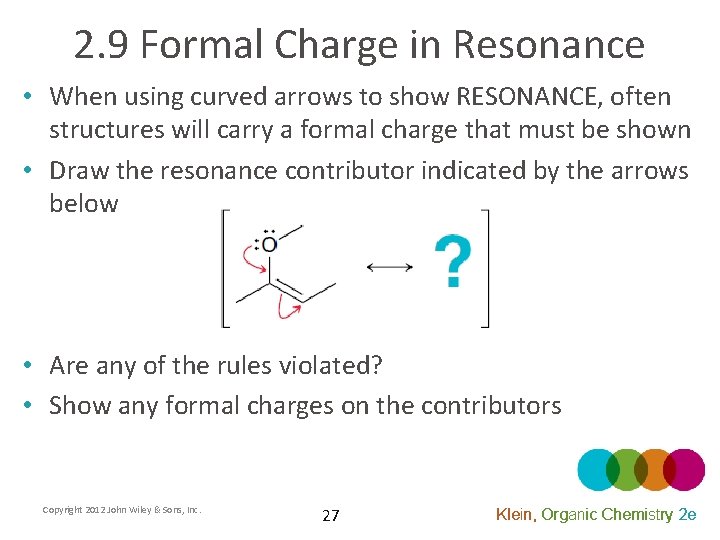
2. 9 Formal Charge in Resonance • When using curved arrows to show RESONANCE, often structures will carry a formal charge that must be shown • Draw the resonance contributor indicated by the arrows below • Are any of the rules violated? • Show any formal charges on the contributors Copyright 2012 John Wiley & Sons, Inc. 27 Klein, Organic Chemistry 2 e
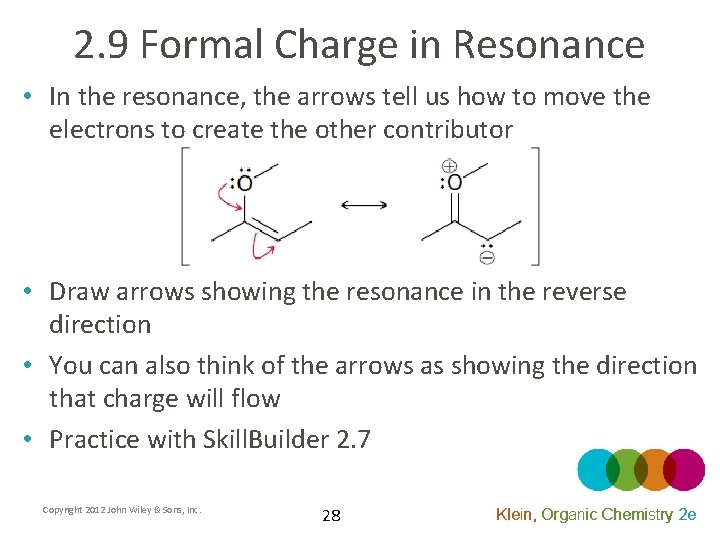
2. 9 Formal Charge in Resonance • In the resonance, the arrows tell us how to move the electrons to create the other contributor • Draw arrows showing the resonance in the reverse direction • You can also think of the arrows as showing the direction that charge will flow • Practice with Skill. Builder 2. 7 Copyright 2012 John Wiley & Sons, Inc. 28 Klein, Organic Chemistry 2 e
2. 10 Patterns in Resonance • There are 5 main bonding patterns in which resonance occurs. Recognize these patterns to predict when resonance will occur 1. 2. 3. 4. Allylic lone pairs Allylic positive charge Lone pair of electrons adjacent to a positive charge A pi bond between two atoms with different electronegativities 5. Conjugated pi bonds in a ring • We will see many examples in the next few slides Copyright 2012 John Wiley & Sons, Inc. 29 Klein, Organic Chemistry 2 e
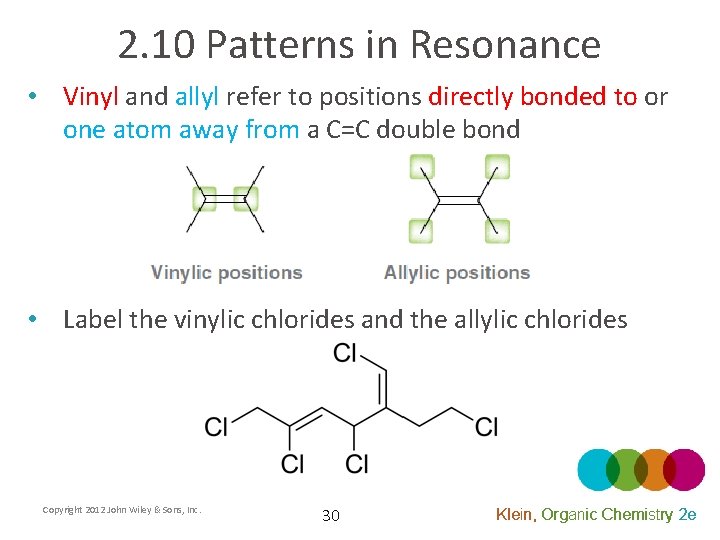
2. 10 Patterns in Resonance • Vinyl and allyl refer to positions directly bonded to or one atom away from a C=C double bond • Label the vinylic chlorides and the allylic chlorides Copyright 2012 John Wiley & Sons, Inc. 30 Klein, Organic Chemistry 2 e
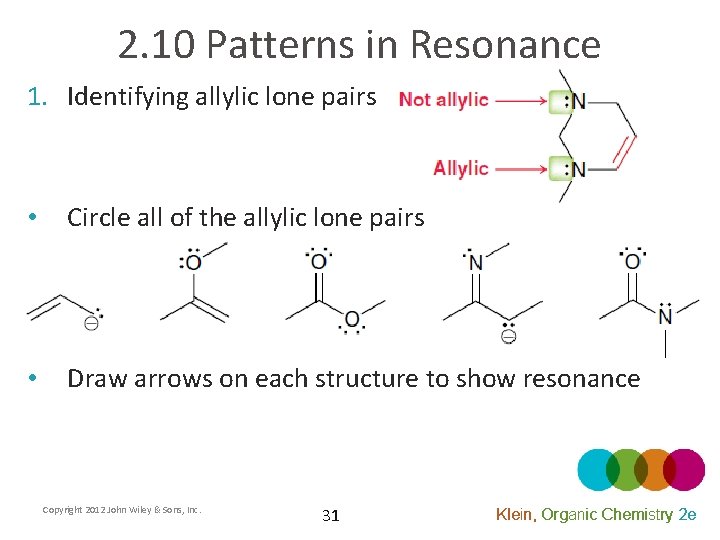
2. 10 Patterns in Resonance 1. Identifying allylic lone pairs • Circle all of the allylic lone pairs • Draw arrows on each structure to show resonance Copyright 2012 John Wiley & Sons, Inc. 31 Klein, Organic Chemistry 2 e
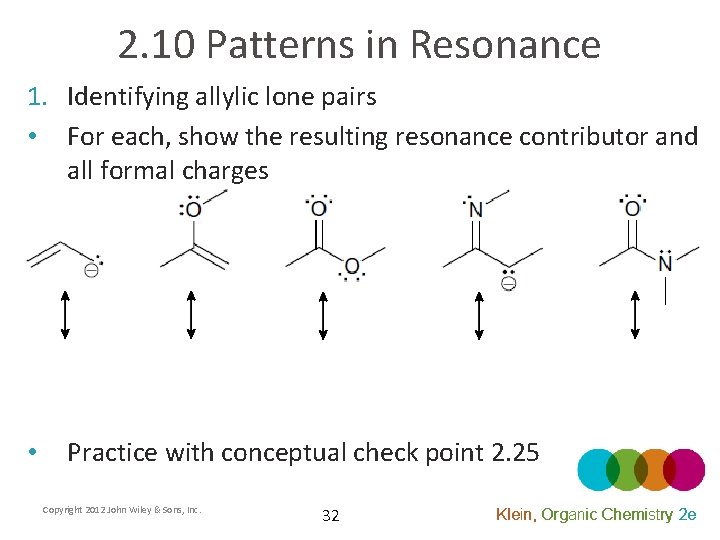
2. 10 Patterns in Resonance 1. Identifying allylic lone pairs • For each, show the resulting resonance contributor and all formal charges • Practice with conceptual check point 2. 25 Copyright 2012 John Wiley & Sons, Inc. 32 Klein, Organic Chemistry 2 e
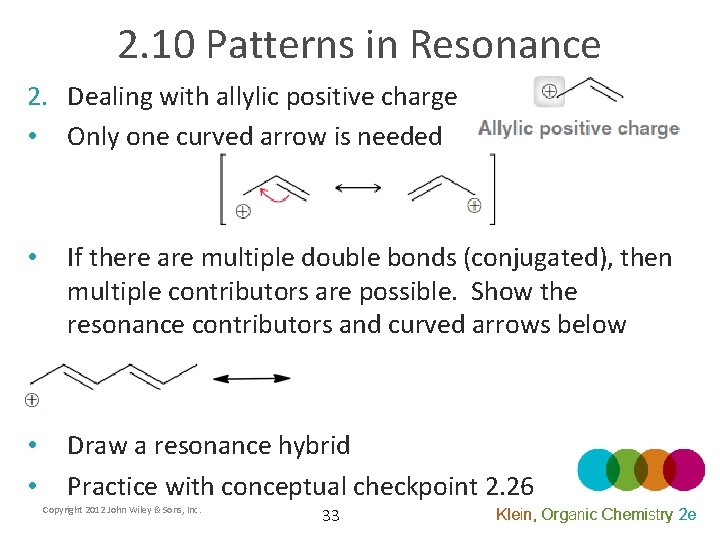
2. 10 Patterns in Resonance 2. Dealing with allylic positive charge • Only one curved arrow is needed • If there are multiple double bonds (conjugated), then multiple contributors are possible. Show the resonance contributors and curved arrows below • • Draw a resonance hybrid Practice with conceptual checkpoint 2. 26 Copyright 2012 John Wiley & Sons, Inc. 33 Klein, Organic Chemistry 2 e
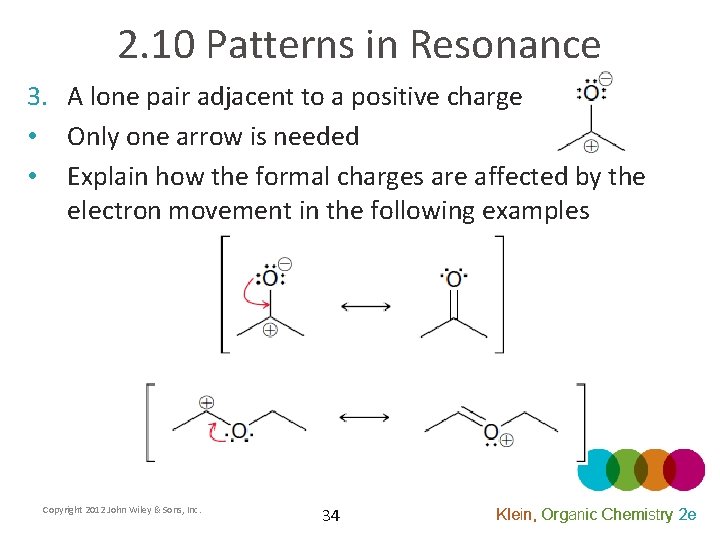
2. 10 Patterns in Resonance 3. A lone pair adjacent to a positive charge • Only one arrow is needed • Explain how the formal charges are affected by the electron movement in the following examples Copyright 2012 John Wiley & Sons, Inc. 34 Klein, Organic Chemistry 2 e
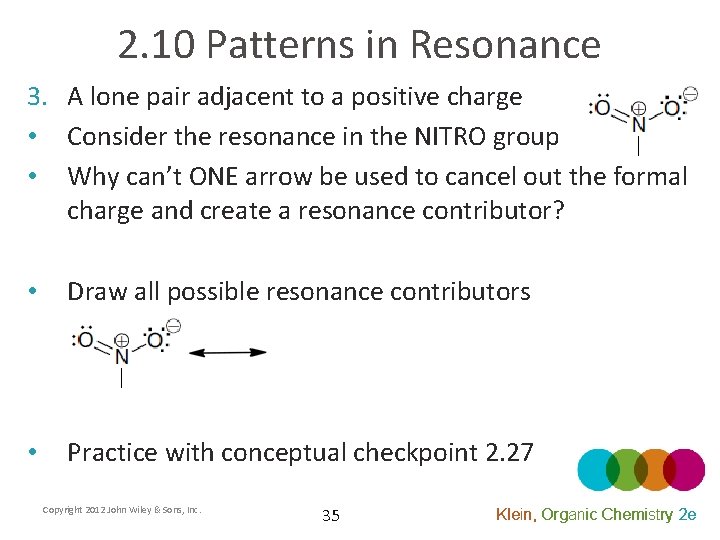
2. 10 Patterns in Resonance 3. A lone pair adjacent to a positive charge • Consider the resonance in the NITRO group • Why can’t ONE arrow be used to cancel out the formal charge and create a resonance contributor? • Draw all possible resonance contributors • Practice with conceptual checkpoint 2. 27 Copyright 2012 John Wiley & Sons, Inc. 35 Klein, Organic Chemistry 2 e
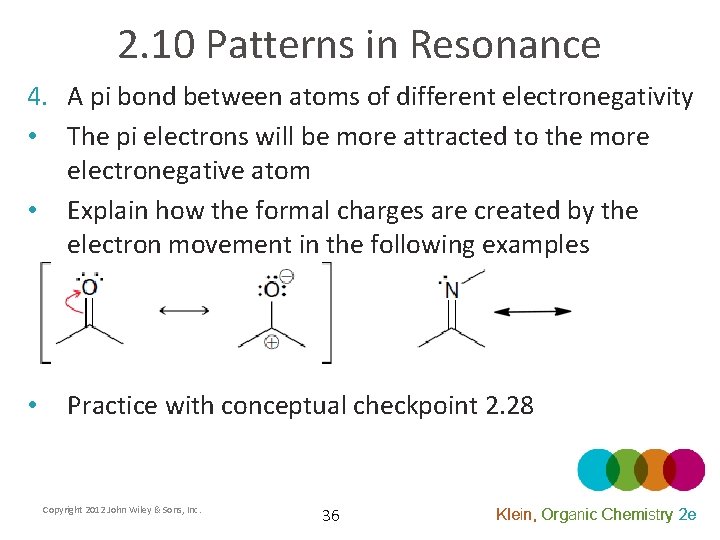
2. 10 Patterns in Resonance 4. A pi bond between atoms of different electronegativity • The pi electrons will be more attracted to the more electronegative atom • Explain how the formal charges are created by the electron movement in the following examples • Practice with conceptual checkpoint 2. 28 Copyright 2012 John Wiley & Sons, Inc. 36 Klein, Organic Chemistry 2 e
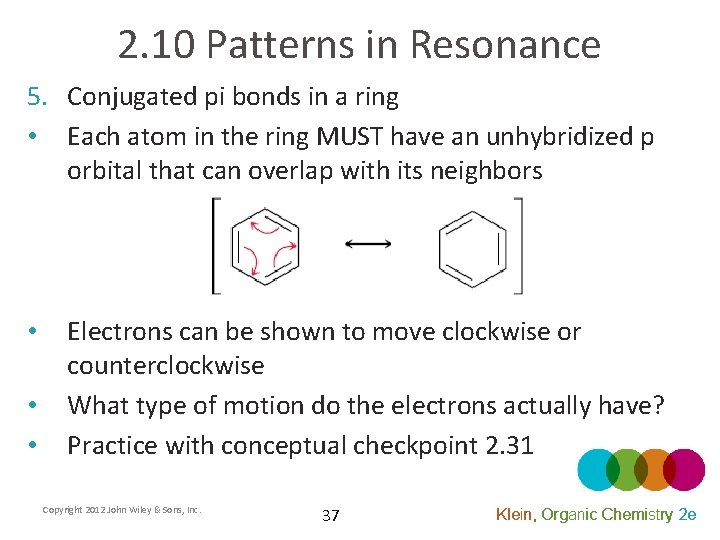
2. 10 Patterns in Resonance 5. Conjugated pi bonds in a ring • Each atom in the ring MUST have an unhybridized p orbital that can overlap with its neighbors • • • Electrons can be shown to move clockwise or counterclockwise What type of motion do the electrons actually have? Practice with conceptual checkpoint 2. 31 Copyright 2012 John Wiley & Sons, Inc. 37 Klein, Organic Chemistry 2 e
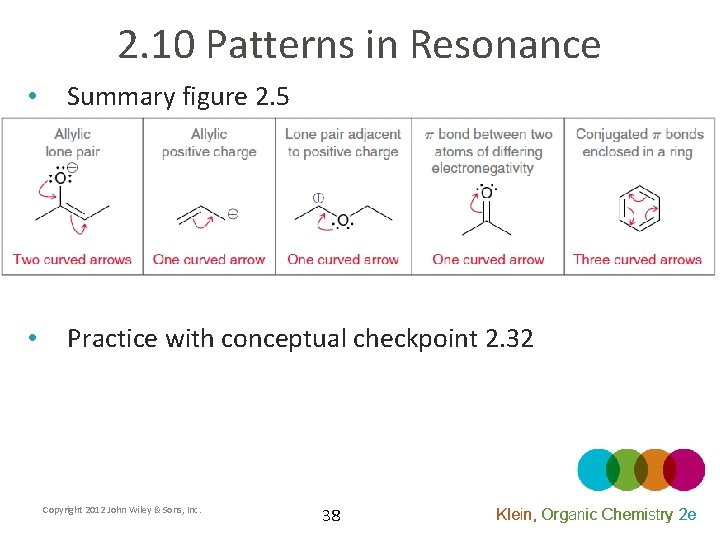
2. 10 Patterns in Resonance • Summary figure 2. 5 • Practice with conceptual checkpoint 2. 32 Copyright 2012 John Wiley & Sons, Inc. 38 Klein, Organic Chemistry 2 e
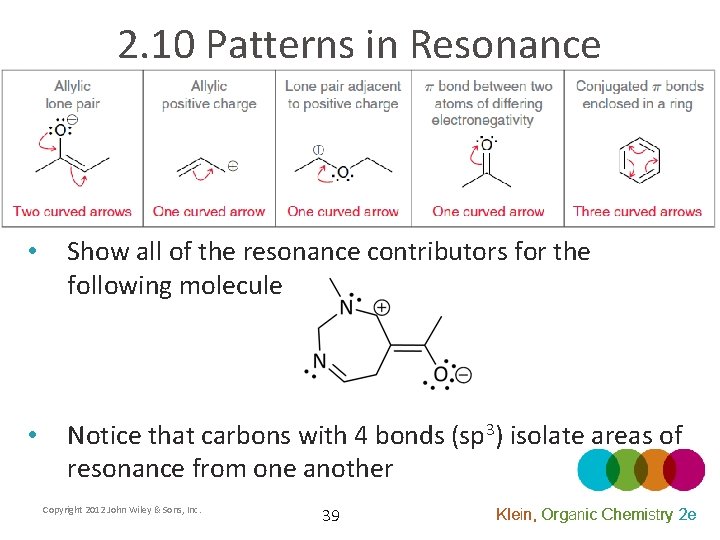
2. 10 Patterns in Resonance • Show all of the resonance contributors for the following molecule • Notice that carbons with 4 bonds (sp 3) isolate areas of resonance from one another Copyright 2012 John Wiley & Sons, Inc. 39 Klein, Organic Chemistry 2 e
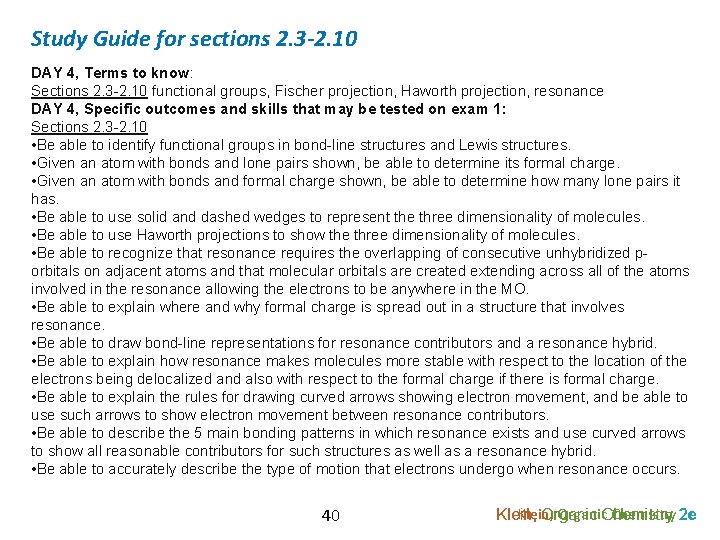
Study Guide for sections 2. 3 -2. 10 DAY 4, Terms to know: Sections 2. 3 -2. 10 functional groups, Fischer projection, Haworth projection, resonance DAY 4, Specific outcomes and skills that may be tested on exam 1: Sections 2. 3 -2. 10 • Be able to identify functional groups in bond-line structures and Lewis structures. • Given an atom with bonds and lone pairs shown, be able to determine its formal charge. • Given an atom with bonds and formal charge shown, be able to determine how many lone pairs it has. • Be able to use solid and dashed wedges to represent the three dimensionality of molecules. • Be able to use Haworth projections to show the three dimensionality of molecules. • Be able to recognize that resonance requires the overlapping of consecutive unhybridized porbitals on adjacent atoms and that molecular orbitals are created extending across all of the atoms involved in the resonance allowing the electrons to be anywhere in the MO. • Be able to explain where and why formal charge is spread out in a structure that involves resonance. • Be able to draw bond-line representations for resonance contributors and a resonance hybrid. • Be able to explain how resonance makes molecules more stable with respect to the location of the electrons being delocalized and also with respect to the formal charge if there is formal charge. • Be able to explain the rules for drawing curved arrows showing electron movement, and be able to use such arrows to show electron movement between resonance contributors. • Be able to describe the 5 main bonding patterns in which resonance exists and use curved arrows to show all reasonable contributors for such structures as well as a resonance hybrid. • Be able to accurately describe the type of motion that electrons undergo when resonance occurs. 40 Klein, Organic. Chemistry 2 e 2 e Klein, Organic
Practice Problems for sections 2. 3 -2. 10 Complete these problems outside of class until you are confident you have learned the SKILLS in this section outlined on the study guide and we will review some of them next class period. 2. 11 2. 12 2. 13 2. 16 2. 17 2. 18 2. 21 2. 22 2. 23 2. 24 2. 25 2. 26 2. 27 2. 28 2. 32 41 Klein, Organic. Chemistry 2 e 2 e Klein, Organic
Prep for day 5 Must Watch videos: https: //www. youtube. com/watch? v=zm 1 -g. Ux. Kr 3 g (drawing a resonance hybrid) https: //www. youtube. com/watch? v=-t-Uk. Kdv. Bk 0 (major versus minor resonance contributors) https: //www. youtube. com/watch? v=k. QCS 1 Ah. An. MI (localized versus delocalized) https: //www. youtube. com/watch? v=j. IL 333 CKE 9 A (curved arrows in acid base reactions) https: //www. youtube. com/watch? v=vf. Hnn. ASd 3 RM (using p. Ka to quantify strength) Other helpful videos: https: //www. youtube. com/watch? v=qp. P 8 D 7 y. QV 50 (common mistakes drawing resonance structures) https: //www. youtube. com/watch? v=m 8 mm. Mi. NGILo (acid base basics) https: //www. youtube. com/watch? v=0 JEy. MYTKq. CY (acid base practice) http: //ps. uci. edu/content/chem-51 a-organic-chemistry (UC-Irvine lecture 5) Read sections 2. 11 -2. 12, 3. 1 -3. 3 42 Klein, Organic. Chemistry 2 e 2 e Klein, Organic
- Slides: 42