
2 3 Factors Affecting Solubility Review 2 2
2. 3 Factors Affecting Solubility
Review 2. 2 What is a pure substance? What is a mixture? What is the difference between a heterogeneous and homogeneous mixture? What is the difference between a saturated and unsaturated solution?

Factors Affecting Solubility • We learned that solubility is the maximum amount of solute that you can dissolve in a given amount of solvent at a given temperature. • Solubility depends on at least three factors.

Factors Affecting Solubility 1) The Type of Solvent -Most common solvent is water -It is sometimes referred to as the universal solvent because it can dissolve so many things. -Aqueous Solutions= solution where water is the solvent
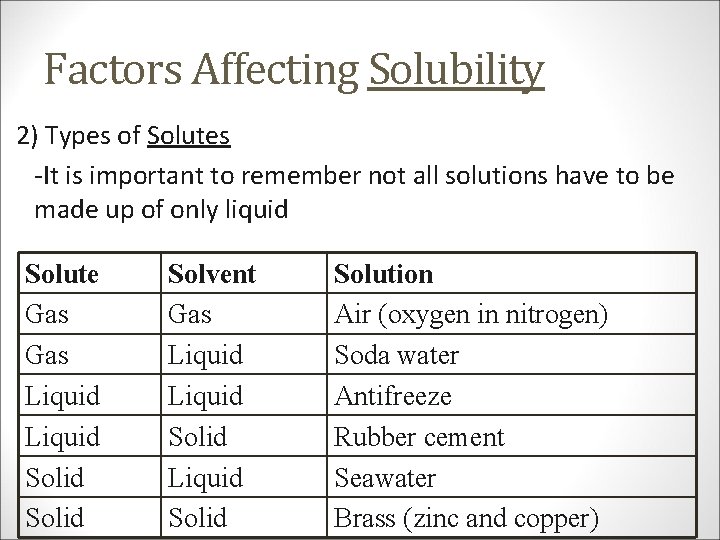
Factors Affecting Solubility 2) Types of Solutes -It is important to remember not all solutions have to be made up of only liquid Solute Gas Liquid Solid Solvent Gas Liquid Solid Liquid Solution Air (oxygen in nitrogen) Soda water Antifreeze Rubber cement Seawater Brass (zinc and copper)
Factors Affecting Solubility • 3) Temperature -For most common solid or liquid substances, solubility increases as the temperature of the solvent increases Example: At 25°C 36. 2 g of salt dissolves in 100 ml of water At 100°C 39. 2 g of salt dissolves in 100 ml of water
Factors Affecting Solubility We said previously that for most common solid or liquid substances, solubility increases as the temperature of the solvent increases The opposite is true for gases. As the temperature increases, the solubility of a gas in a liquid solvent decreases.

Thermal Pollution • This decrease in the solubility of gases can have a serious effect on the environment • Water is used as a coolant in many industries. Once the water is used it is warmer than it was. It has to be cooled before it is returned to the lake or river it was taken from. Why?
Review ? ? ? Any Questions? ? ? I have some for you… What is a solution? What is a solvent? What is a solute? What is solubility? What is the concentration of a solution?
- Slides: 9