
2 3 CarbonBased Molecules KEY CONCEPT Carbonbased molecules
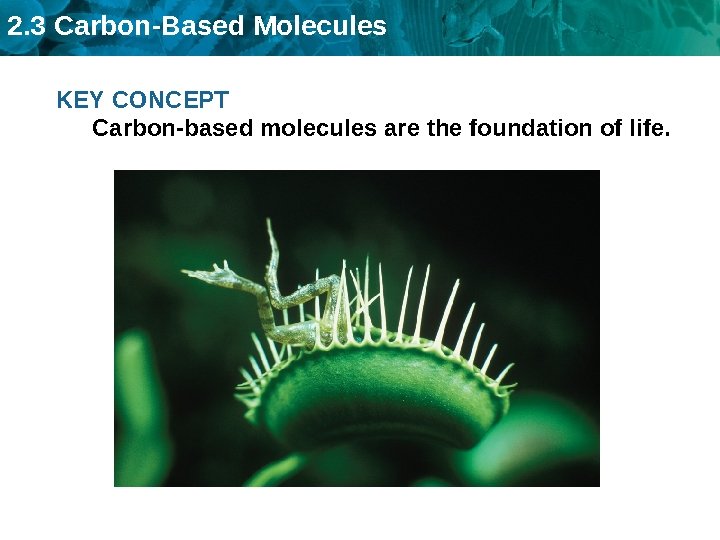
2. 3 Carbon-Based Molecules KEY CONCEPT Carbon-based molecules are the foundation of life.
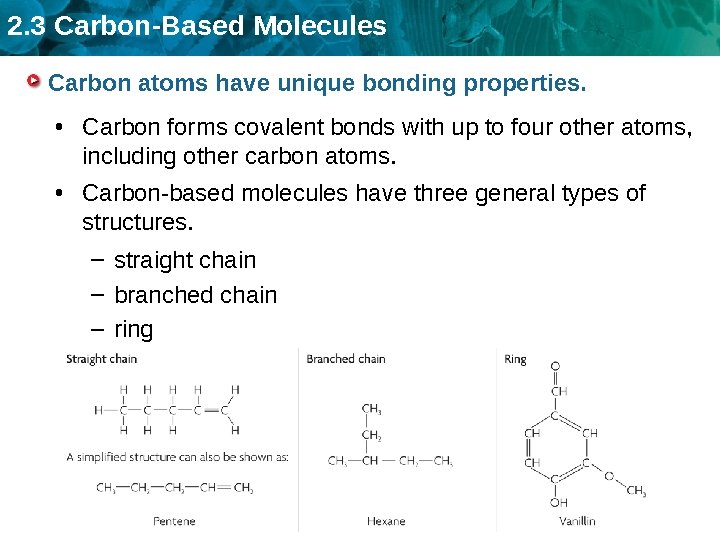
2. 3 Carbon-Based Molecules Carbon atoms have unique bonding properties. • Carbon forms covalent bonds with up to four other atoms, including other carbon atoms. • Carbon-based molecules have three general types of structures. – straight chain – branched chain – ring
2. 3 Carbon-Based Molecules Isomers • Isomers are molecules that have the same chemical formula but a different Shape. • Remember – “ form determines function” – the shape of the molecule has everything to do with its function
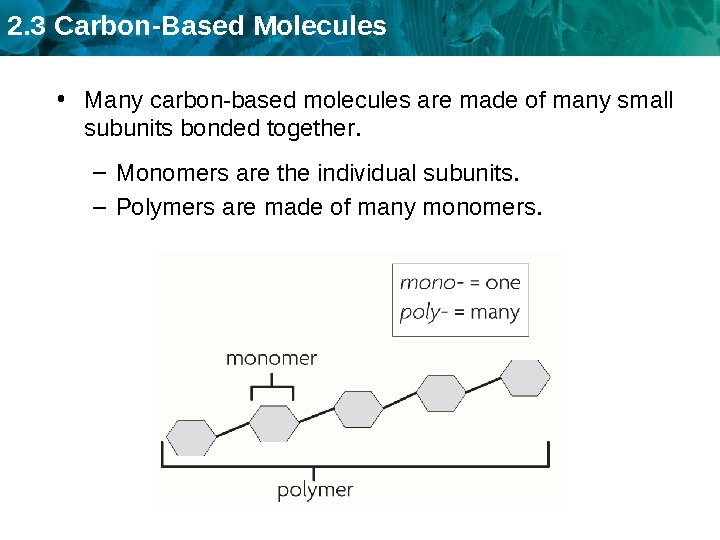
2. 3 Carbon-Based Molecules • Many carbon-based molecules are made of many small subunits bonded together. – Monomers are the individual subunits. – Polymers are made of many monomers.
2. 3 Carbon-Based Molecules Biomolecules (continued) • Polymers – a large molecule that is made from smaller building blocks called monomers 1. Carbohydrates – polymer made from monomers called monosaccharides (simple sugars) 2. Proteins – polymer made from monomers called amino acids 3. Nucleic acids – polymer made from monomers called nucleotides
2. 3 Carbon-Based Molecules Four main types of carbon-based molecules are found in living things. • Macromolecules – large biomolecules 1. Carbohydrates 2. Proteins 3. Nucleic acids 4. Lipids
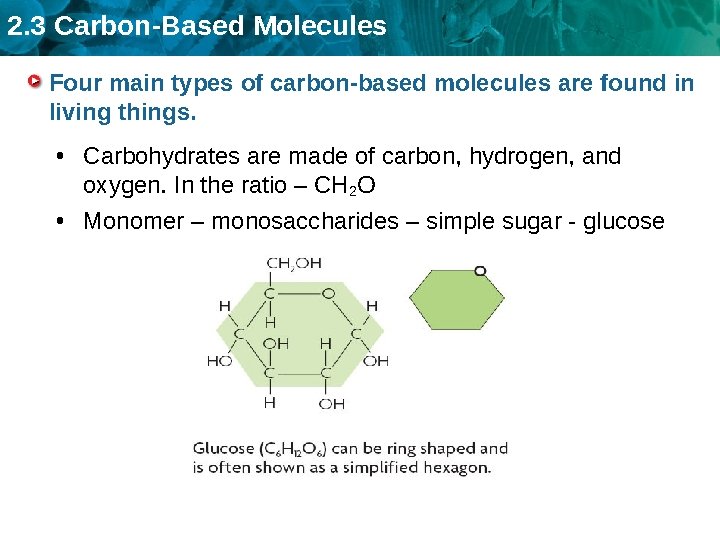
2. 3 Carbon-Based Molecules Four main types of carbon-based molecules are found in living things. • Carbohydrates are made of carbon, hydrogen, and oxygen. In the ratio – CH 2 O • Monomer – monosaccharides – simple sugar - glucose
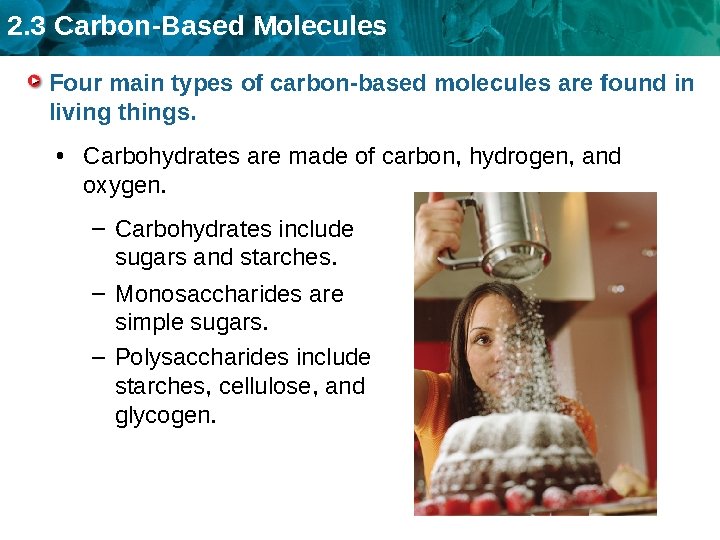
2. 3 Carbon-Based Molecules Four main types of carbon-based molecules are found in living things. • Carbohydrates are made of carbon, hydrogen, and oxygen. – Carbohydrates include sugars and starches. – Monosaccharides are simple sugars. – Polysaccharides include starches, cellulose, and glycogen.
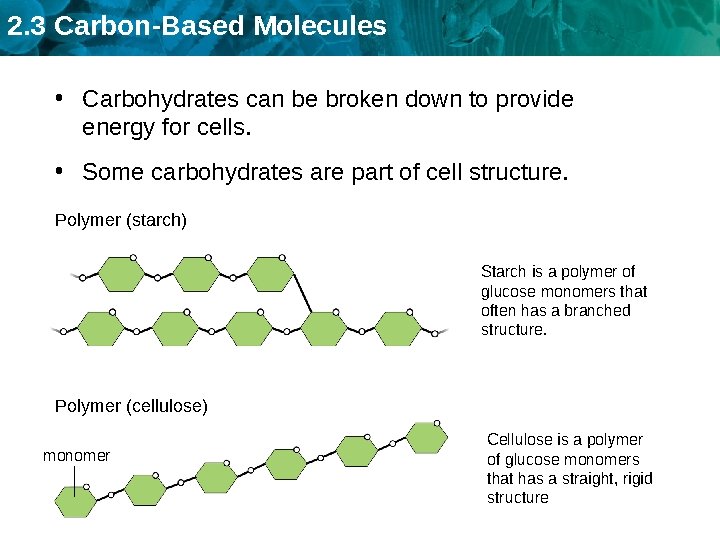
2. 3 Carbon-Based Molecules • Carbohydrates can be broken down to provide energy for cells. • Some carbohydrates are part of cell structure. Polymer (starch) Starch is a polymer of glucose monomers that often has a branched structure. Polymer (cellulose) monomer Cellulose is a polymer of glucose monomers that has a straight, rigid structure
2. 3 Carbon-Based Molecules Biomolecules • Lipids – fats and oils – C, O, and much more H than carbohydrates – 2 unique properties 1. Not a polymer 2. Nonpolar – not soluble in water
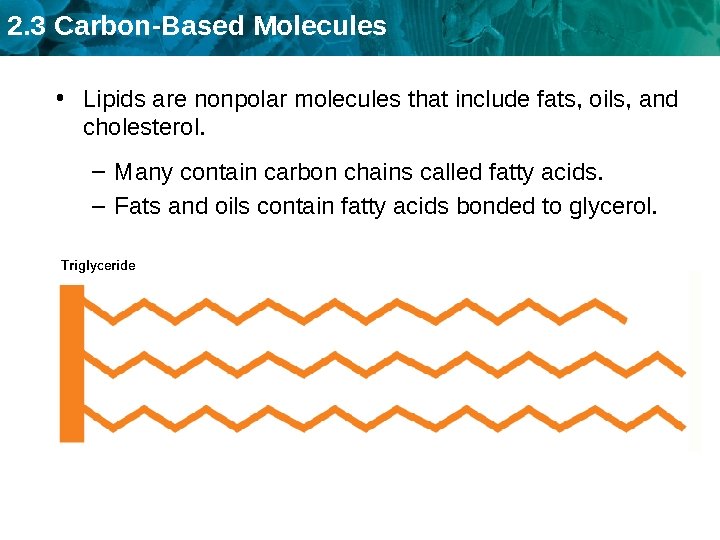
2. 3 Carbon-Based Molecules • Lipids are nonpolar molecules that include fats, oils, and cholesterol. – Many contain carbon chains called fatty acids. – Fats and oils contain fatty acids bonded to glycerol. Triglyceride
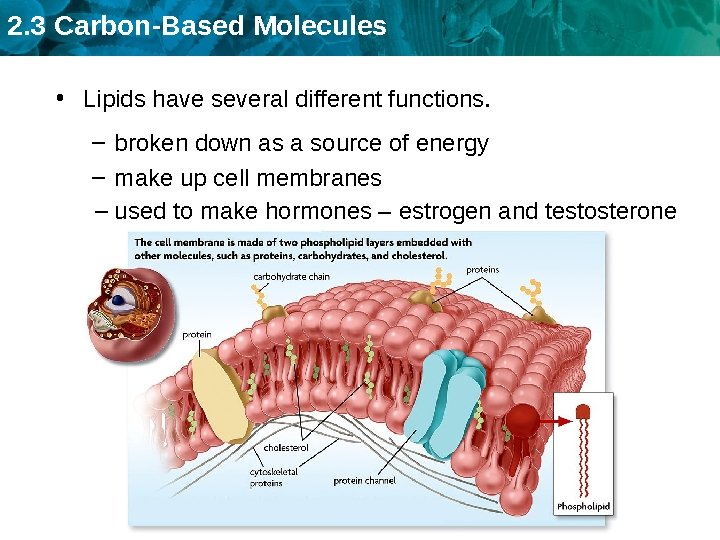
2. 3 Carbon-Based Molecules • Lipids have several different functions. – broken down as a source of energy – make up cell membranes – used to make hormones – estrogen and testosterone
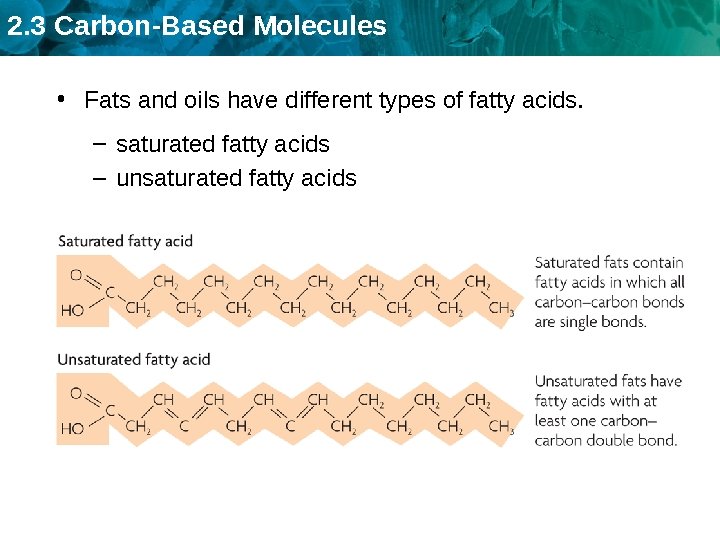
2. 3 Carbon-Based Molecules • Fats and oils have different types of fatty acids. – saturated fatty acids – unsaturated fatty acids
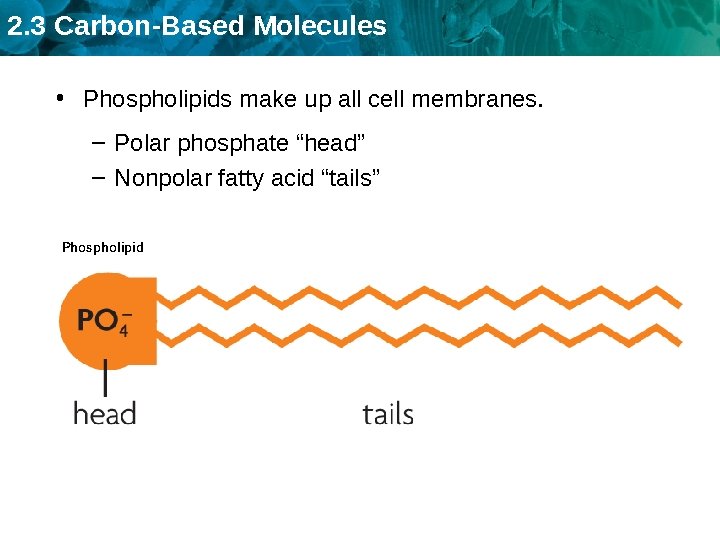
2. 3 Carbon-Based Molecules • Phospholipids make up all cell membranes. – Polar phosphate “head” – Nonpolar fatty acid “tails” Phospholipid
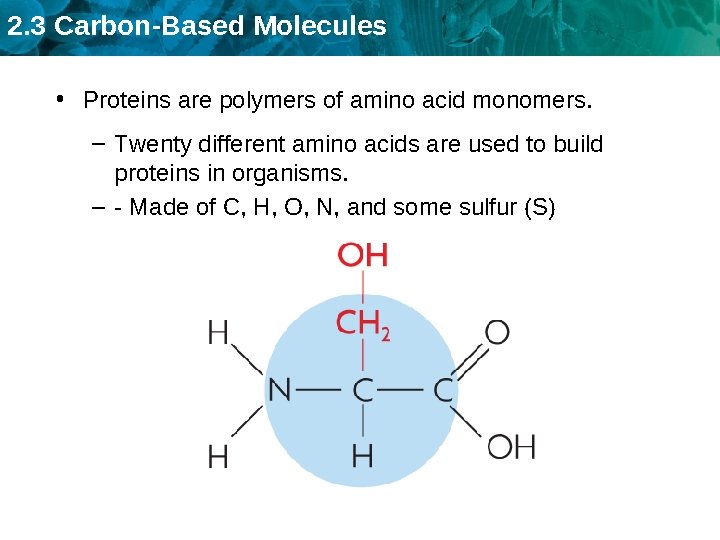
2. 3 Carbon-Based Molecules • Proteins are polymers of amino acid monomers. – Twenty different amino acids are used to build proteins in organisms. – - Made of C, H, O, N, and some sulfur (S)
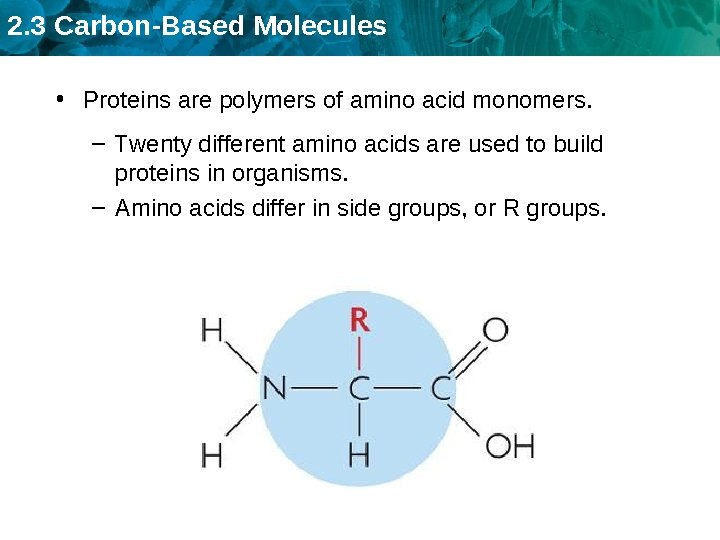
2. 3 Carbon-Based Molecules • Proteins are polymers of amino acid monomers. – Twenty different amino acids are used to build proteins in organisms. – Amino acids differ in side groups, or R groups.
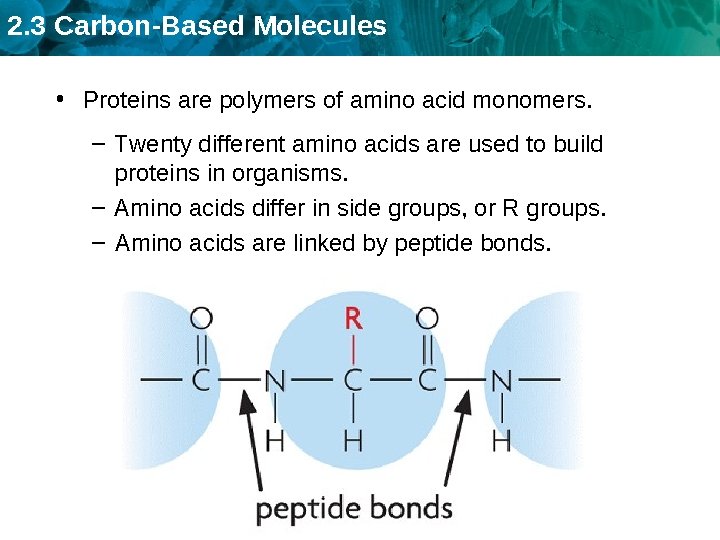
2. 3 Carbon-Based Molecules • Proteins are polymers of amino acid monomers. – Twenty different amino acids are used to build proteins in organisms. – Amino acids differ in side groups, or R groups. – Amino acids are linked by peptide bonds.
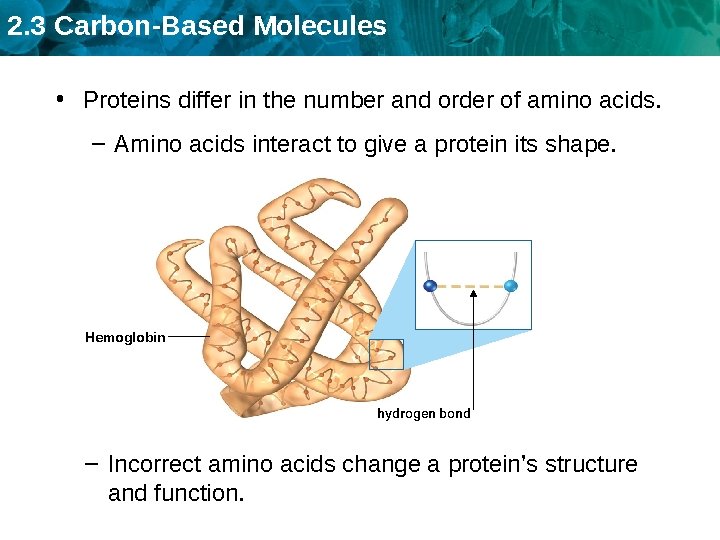
2. 3 Carbon-Based Molecules • Proteins differ in the number and order of amino acids. – Amino acids interact to give a protein its shape. Hemoglobin hydrogen bond – Incorrect amino acids change a protein’s structure and function.
2. 3 Carbon-Based Molecules Biomolecules (cont. ) • Protein uses a. Enzymes – controls the rate of chemical reactions b. Structure c. Blood – hemoglobin in red blood cells – carries oxygen d. Immunity – fights diseases e. Muscles - movement
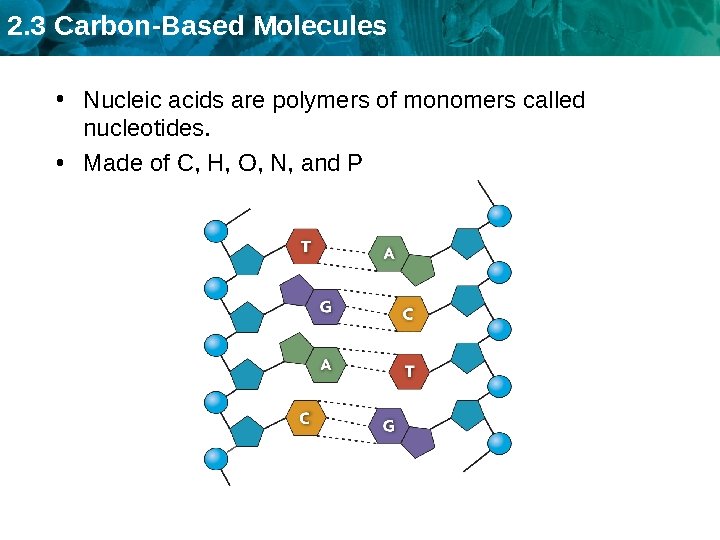
2. 3 Carbon-Based Molecules • Nucleic acids are polymers of monomers called nucleotides. • Made of C, H, O, N, and P
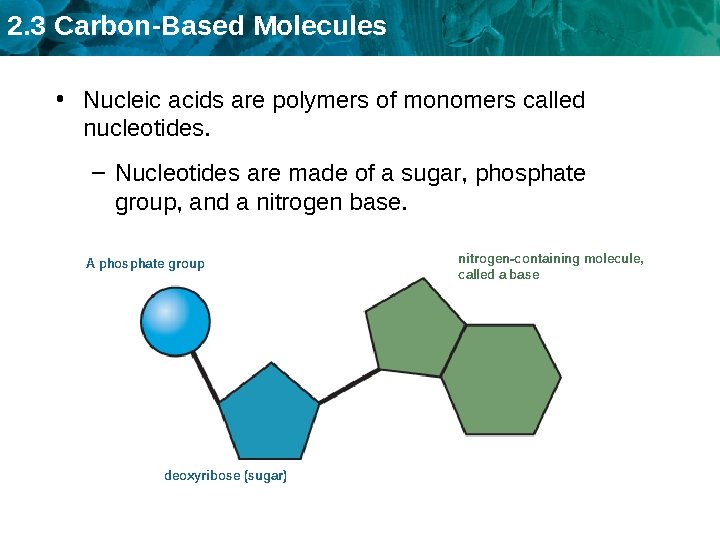
2. 3 Carbon-Based Molecules • Nucleic acids are polymers of monomers called nucleotides. – Nucleotides are made of a sugar, phosphate group, and a nitrogen base. A phosphate group deoxyribose (sugar) nitrogen-containing molecule, called a base
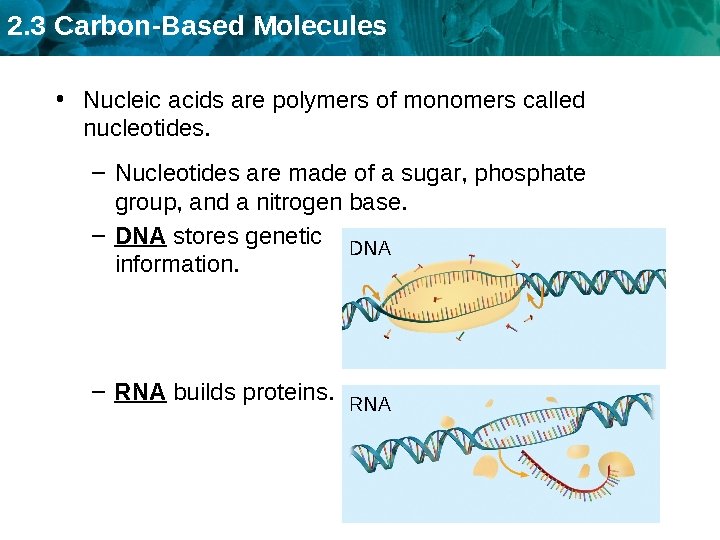
2. 3 Carbon-Based Molecules • Nucleic acids are polymers of monomers called nucleotides. – Nucleotides are made of a sugar, phosphate group, and a nitrogen base. – DNA stores genetic DNA information. – RNA builds proteins. RNA
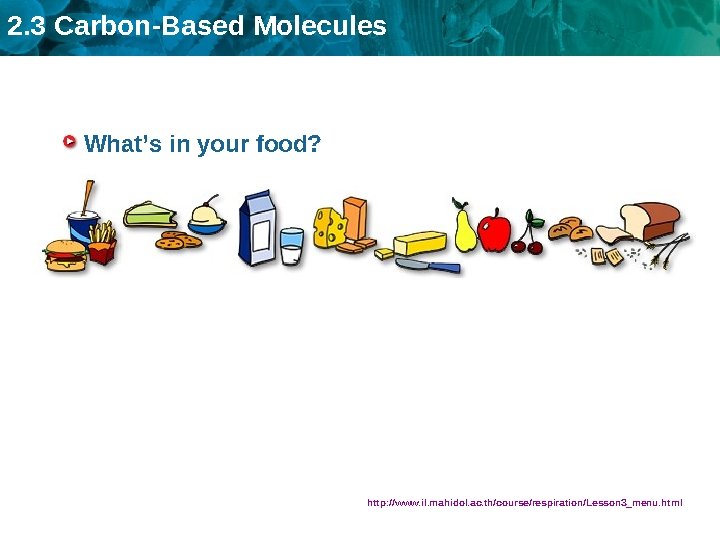
2. 3 Carbon-Based Molecules What’s in your food? http: //www. il. mahidol. ac. th/course/respiration/Lesson 3_menu. html
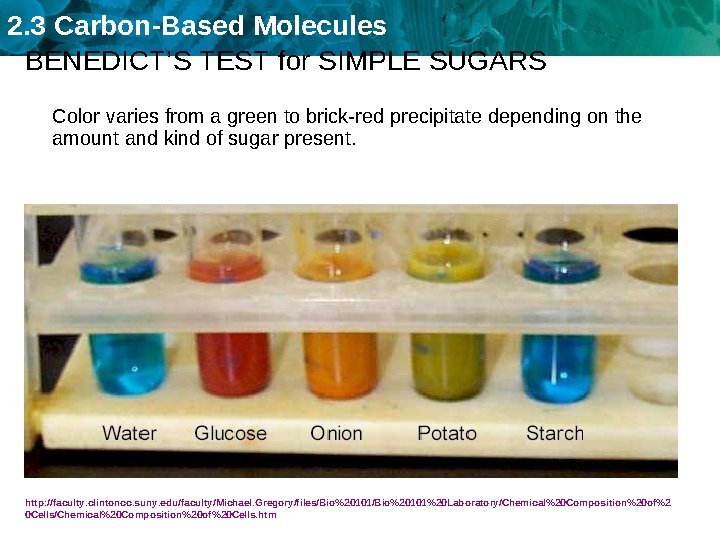
2. 3 Carbon-Based Molecules BENEDICT’S TEST for SIMPLE SUGARS Color varies from a green to brick-red precipitate depending on the amount and kind of sugar present. http: //faculty. clintoncc. suny. edu/faculty/Michael. Gregory/files/Bio%20101%20 Laboratory/Chemical%20 Composition%20 of%2 0 Cells/Chemical%20 Composition%20 of%20 Cells. htm
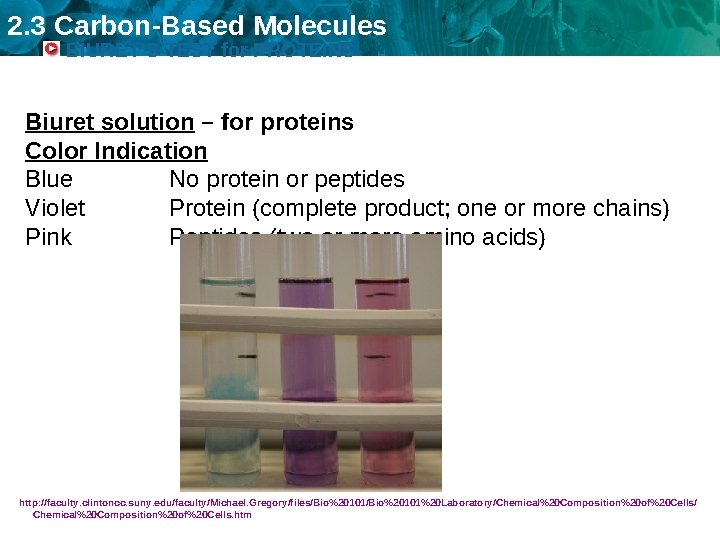
2. 3 Carbon-Based Molecules BIURET’S TEST for PROTEINS Biuret solution – for proteins Color Indication Blue No protein or peptides Violet Protein (complete product; one or more chains) Pink Peptides (two or more amino acids) http: //faculty. clintoncc. suny. edu/faculty/Michael. Gregory/files/Bio%20101%20 Laboratory/Chemical%20 Composition%20 of%20 Cells/ Chemical%20 Composition%20 of%20 Cells. htm
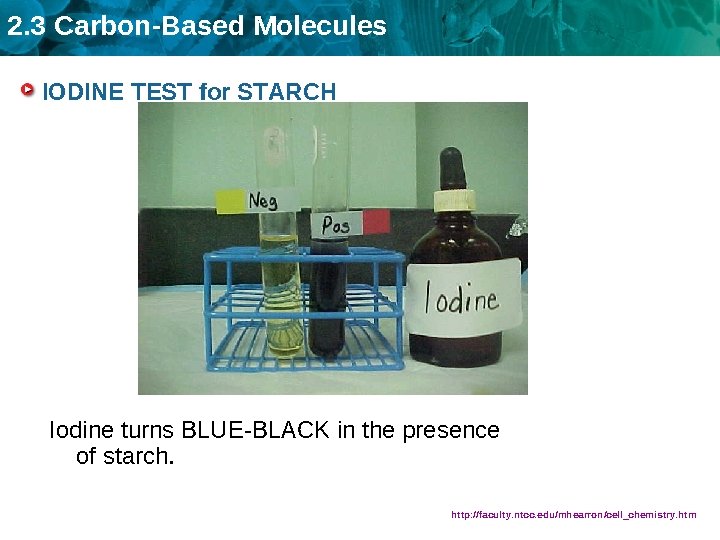
2. 3 Carbon-Based Molecules IODINE TEST for STARCH Iodine turns BLUE-BLACK in the presence of starch. http: //faculty. ntcc. edu/mhearron/cell_chemistry. htm
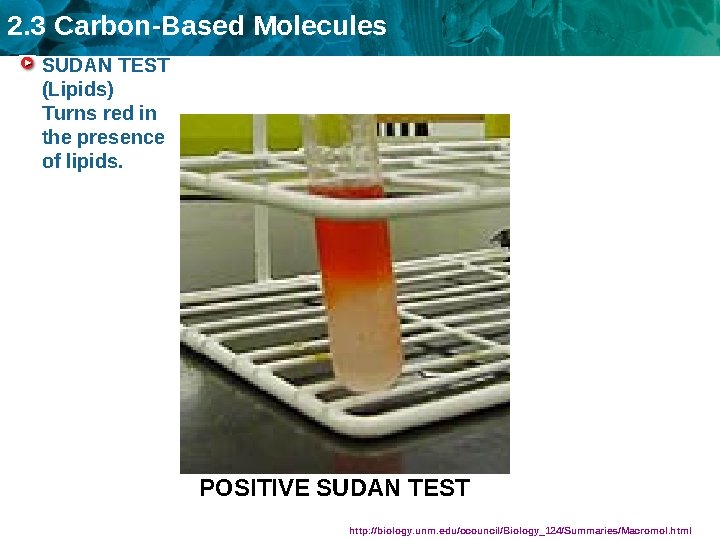
2. 3 Carbon-Based Molecules SUDAN TEST (Lipids) Turns red in the presence of lipids. POSITIVE SUDAN TEST http: //biology. unm. edu/ccouncil/Biology_124/Summaries/Macromol. html
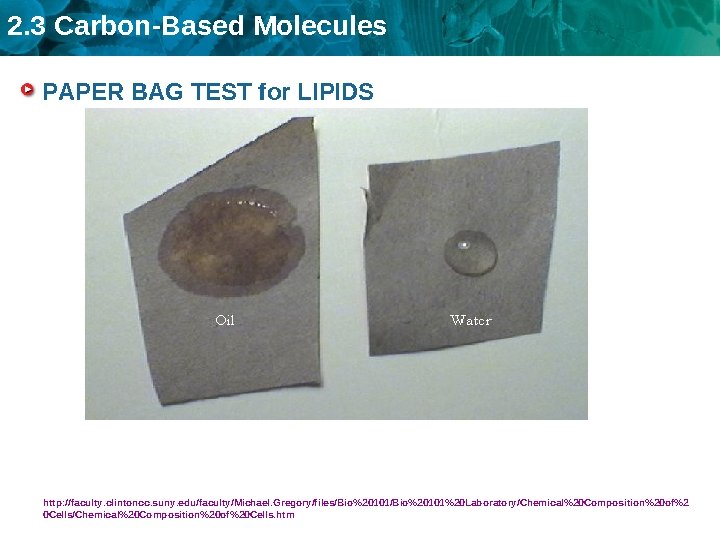
2. 3 Carbon-Based Molecules PAPER BAG TEST for LIPIDS http: //faculty. clintoncc. suny. edu/faculty/Michael. Gregory/files/Bio%20101%20 Laboratory/Chemical%20 Composition%20 of%2 0 Cells/Chemical%20 Composition%20 of%20 Cells. htm
- Slides: 28