
2 3 Carbohydrates and Lipids Learning Goals Monosaccharides
2. 3 Carbohydrates and Lipids Learning Goals: • • Monosaccharides are linked together by condensation reactions to form disaccharides and polysaccharides Fatty acids can be saturated, monounsaturated or polyunsaturated Unsaturated fatty acids can be cis or trans Triglycerides can be formed by condensation reactions involving 3 fatty acids and 1 glycerol molecule
Important Words/Phrases • • Carbohydrates Lipids Monosaccharide, disaccharide, polysaccharide Pentose, hexose Fatty acids, triglycerides, glycerol Condensation, hydrolysis Cis, trans
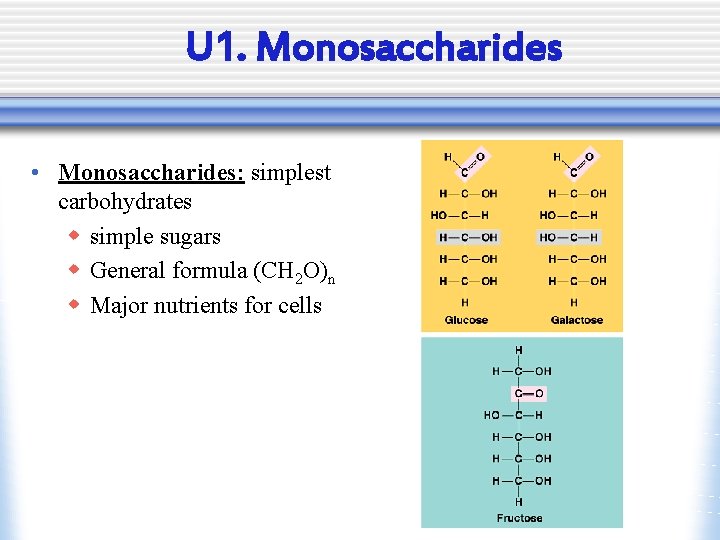
U 1. Monosaccharides • Monosaccharides: simplest carbohydrates w simple sugars w General formula (CH 2 O)n w Major nutrients for cells
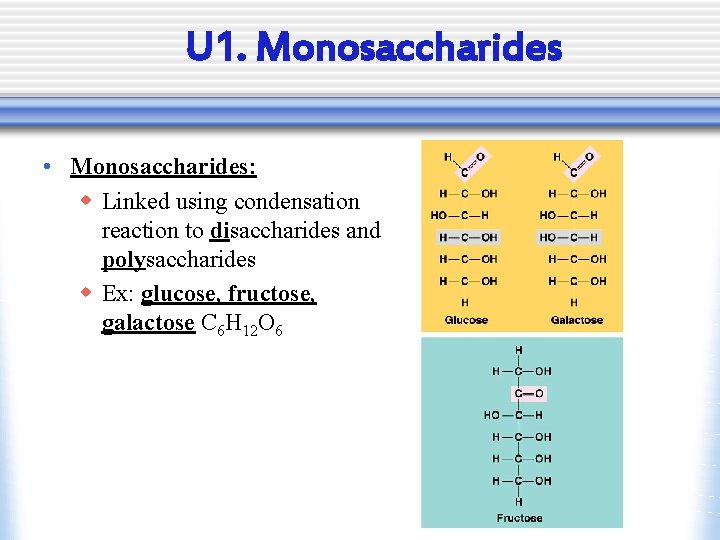
U 1. Monosaccharides • Monosaccharides: w Linked using condensation reaction to disaccharides and polysaccharides w Ex: glucose, fructose, galactose C 6 H 12 O 6
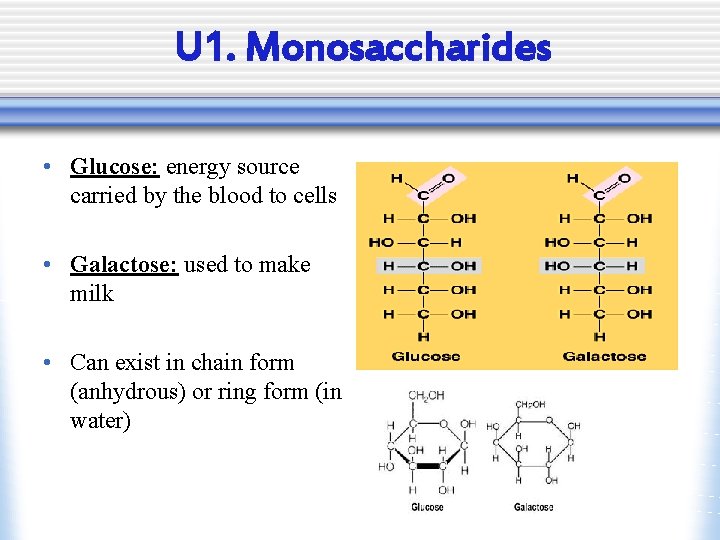
U 1. Monosaccharides • Glucose: energy source carried by the blood to cells • Galactose: used to make milk • Can exist in chain form (anhydrous) or ring form (in water)
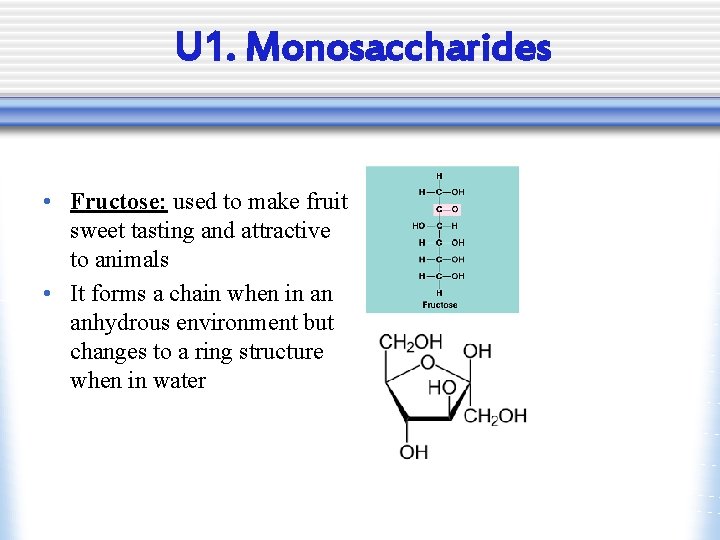
U 1. Monosaccharides • Fructose: used to make fruit sweet tasting and attractive to animals • It forms a chain when in an anhydrous environment but changes to a ring structure when in water
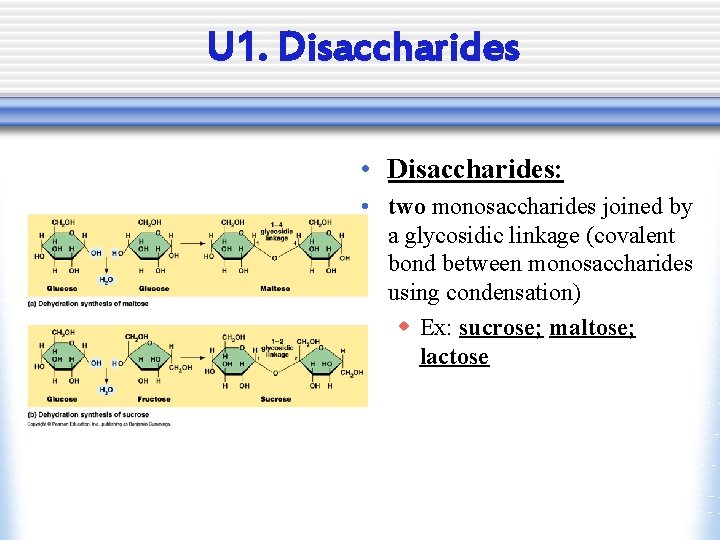
U 1. Disaccharides • Disaccharides: • two monosaccharides joined by a glycosidic linkage (covalent bond between monosaccharides using condensation) w Ex: sucrose; maltose; lactose
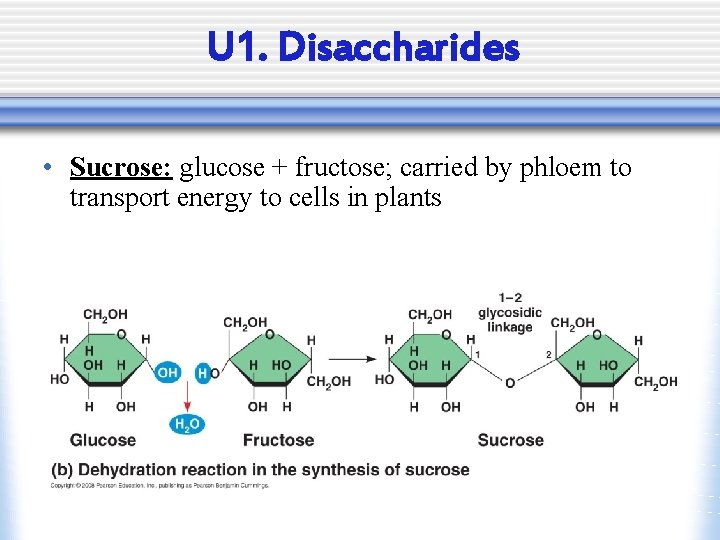
U 1. Disaccharides • Sucrose: glucose + fructose; carried by phloem to transport energy to cells in plants
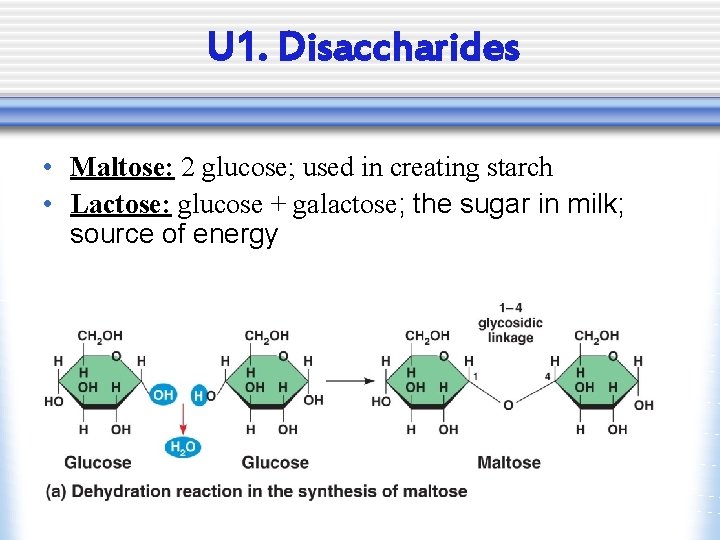
U 1. Disaccharides • Maltose: 2 glucose; used in creating starch • Lactose: glucose + galactose; the sugar in milk; source of energy
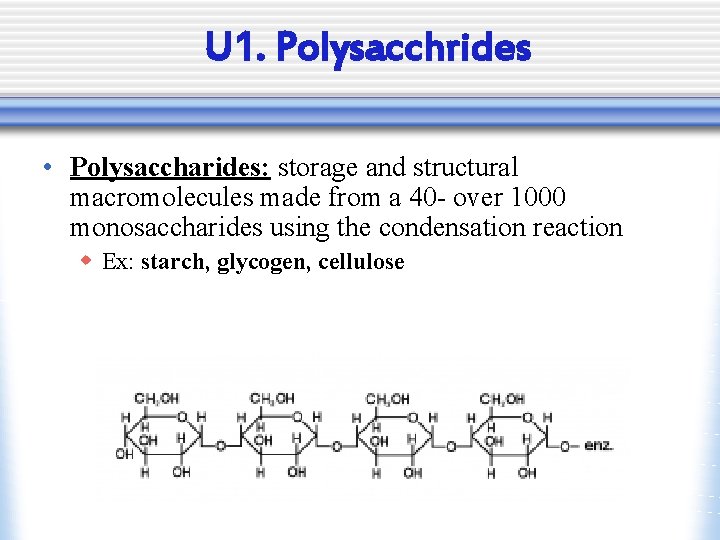
U 1. Polysacchrides • Polysaccharides: storage and structural macromolecules made from a 40 - over 1000 monosaccharides using the condensation reaction w Ex: starch, glycogen, cellulose
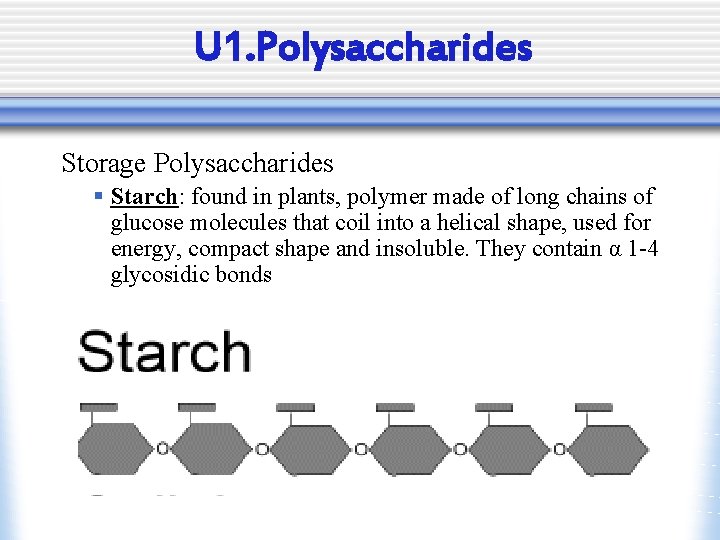
U 1. Polysaccharides Storage Polysaccharides § Starch: found in plants, polymer made of long chains of glucose molecules that coil into a helical shape, used for energy, compact shape and insoluble. They contain α 1 -4 glycosidic bonds
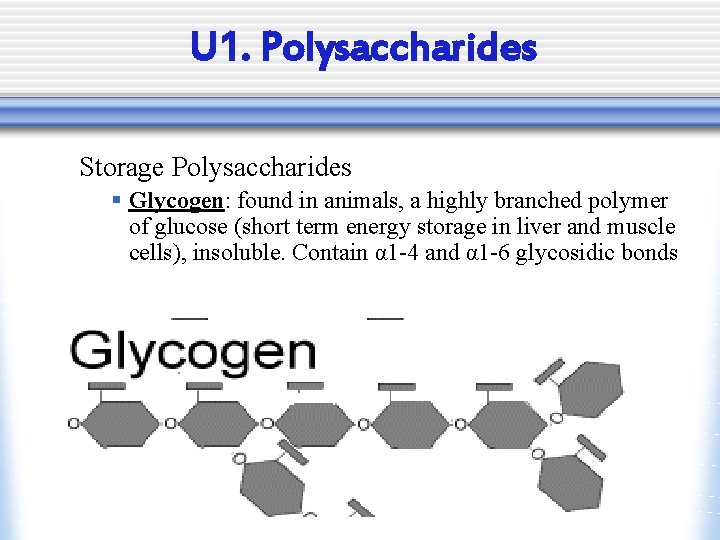
U 1. Polysaccharides Storage Polysaccharides § Glycogen: found in animals, a highly branched polymer of glucose (short term energy storage in liver and muscle cells), insoluble. Contain α 1 -4 and α 1 -6 glycosidic bonds
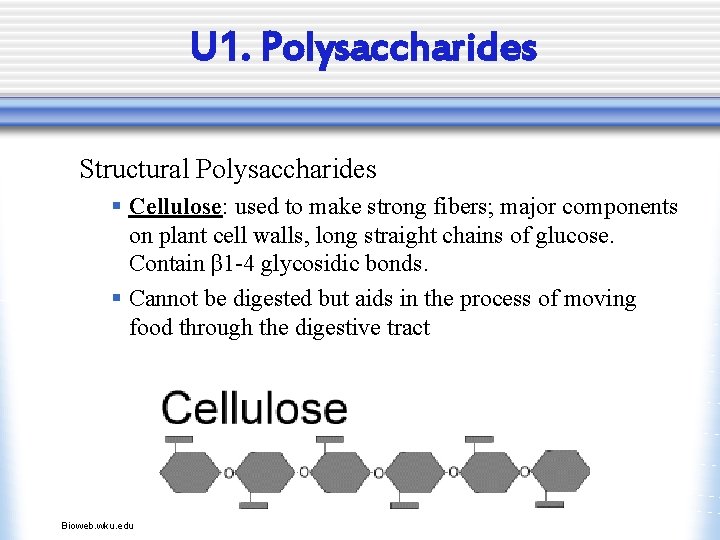
U 1. Polysaccharides Structural Polysaccharides § Cellulose: used to make strong fibers; major components on plant cell walls, long straight chains of glucose. Contain β 1 -4 glycosidic bonds. § Cannot be digested but aids in the process of moving food through the digestive tract Bioweb. wku. edu
U 2. Lipids • Purposes of lipids (fats) w Source of energy w Protection w Insulation w Hormones (chemical messengers in the body) w Cell membrane structure
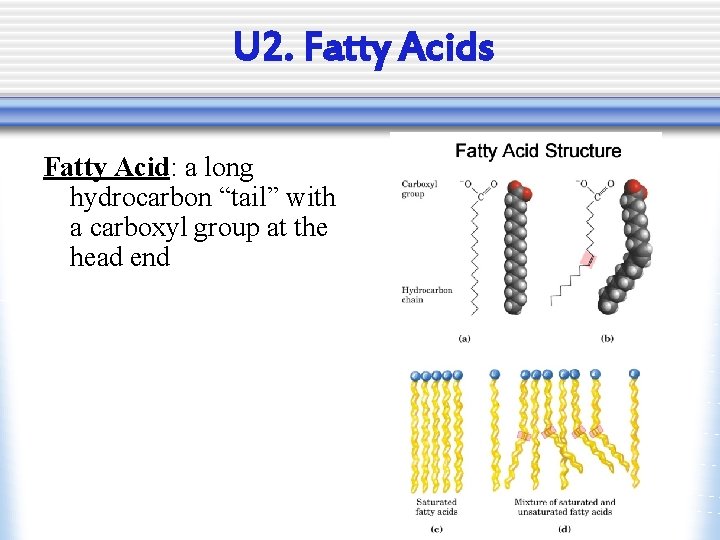
U 2. Fatty Acids Fatty Acid: a long hydrocarbon “tail” with a carboxyl group at the head end
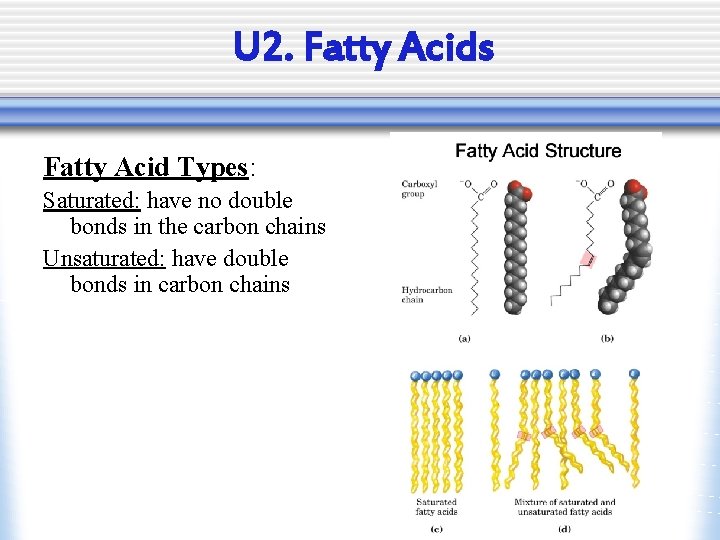
U 2. Fatty Acids Fatty Acid Types: Saturated: have no double bonds in the carbon chains Unsaturated: have double bonds in carbon chains
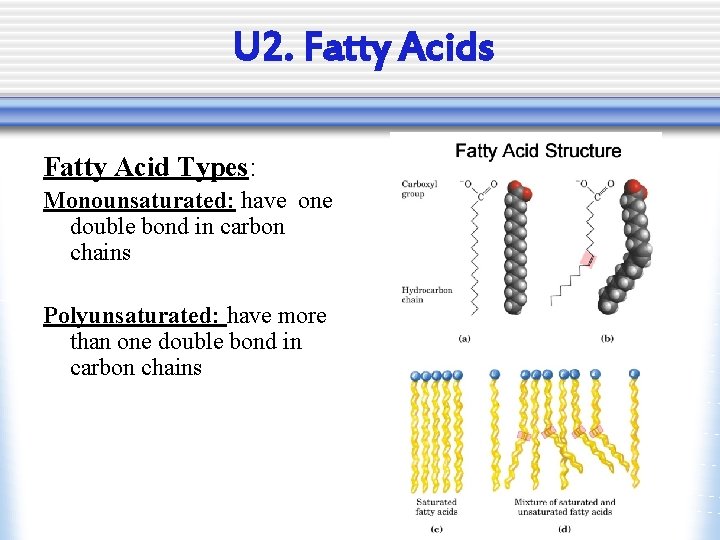
U 2. Fatty Acids Fatty Acid Types: Monounsaturated: have one double bond in carbon chains Polyunsaturated: have more than one double bond in carbon chains
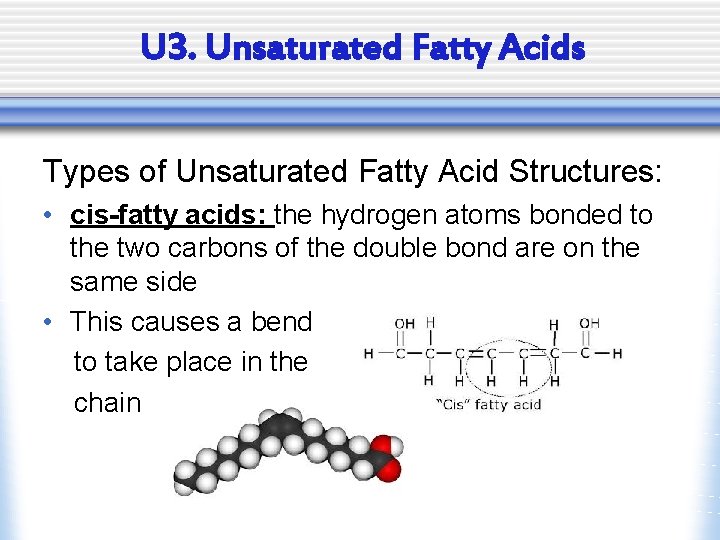
U 3. Unsaturated Fatty Acids Types of Unsaturated Fatty Acid Structures: • cis-fatty acids: the hydrogen atoms bonded to the two carbons of the double bond are on the same side • This causes a bend to take place in the chain
U 3. Unsaturated Fatty Acids Types of Unsaturated Fatty Acid Structures: • cis-fatty acids: w Have a bend in the carbon chain w Usually liquid at room temp – oils w Have a lower melting point
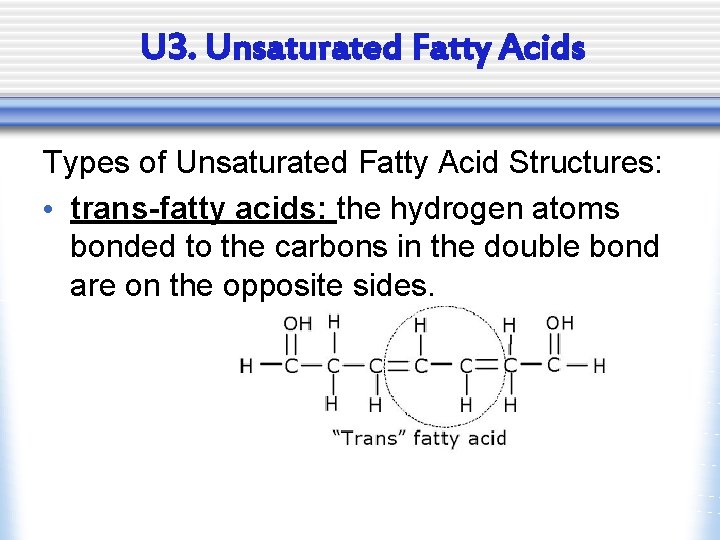
U 3. Unsaturated Fatty Acids Types of Unsaturated Fatty Acid Structures: • trans-fatty acids: the hydrogen atoms bonded to the carbons in the double bond are on the opposite sides.
U 3. Unsaturated Fatty Acids Types of Unsaturated Fatty Acid Structures: • trans-fatty acids: w Do not have a bend in the carbon chain w Solid at room temperature – usually artificially produced – margarine and partially hydrogenated
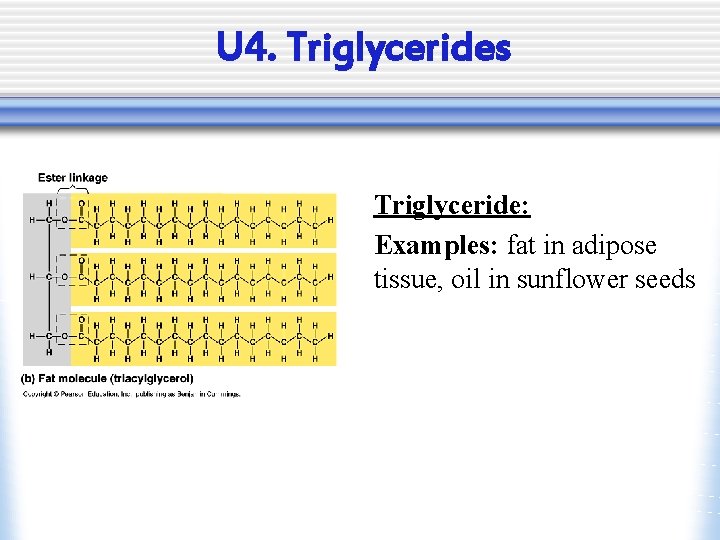
U 4. Triglycerides Triglyceride: Examples: fat in adipose tissue, oil in sunflower seeds
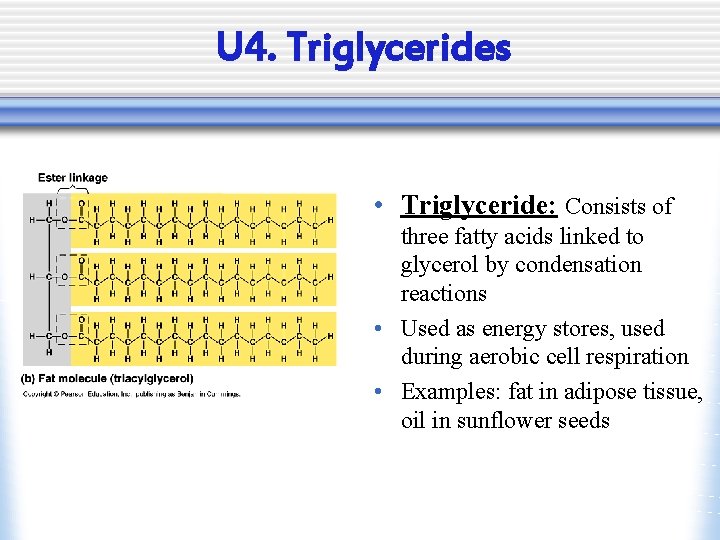
U 4. Triglycerides • Triglyceride: Consists of three fatty acids linked to glycerol by condensation reactions • Used as energy stores, used during aerobic cell respiration • Examples: fat in adipose tissue, oil in sunflower seeds
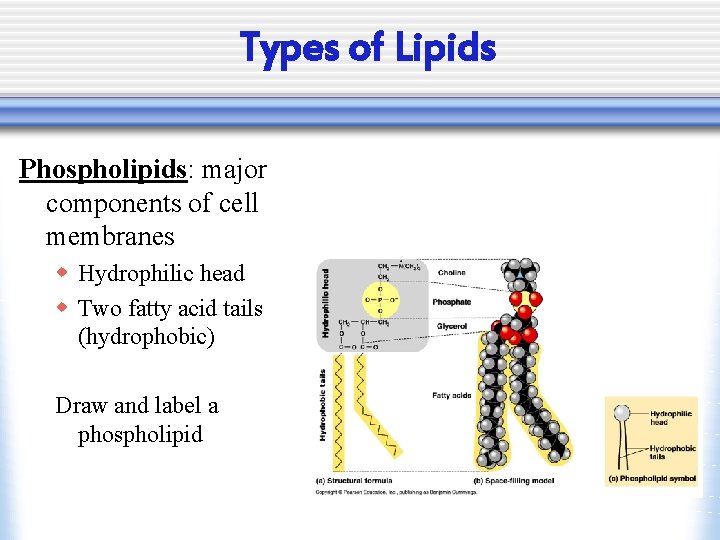
Types of Lipids Phospholipids: major components of cell membranes w Hydrophilic head w Two fatty acid tails (hydrophobic) Draw and label a phospholipid
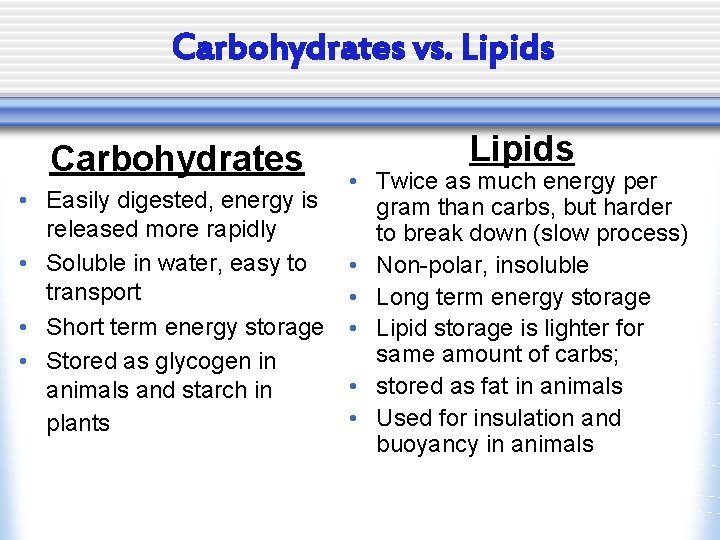
Carbohydrates vs. Lipids Carbohydrates • • Lipids • Twice as much energy per Easily digested, energy is gram than carbs, but harder released more rapidly to break down (slow process) Soluble in water, easy to • Non-polar, insoluble transport • Long term energy storage Short term energy storage • Lipid storage is lighter for same amount of carbs; Stored as glycogen in • stored as fat in animals and starch in • Used for insulation and plants buoyancy in animals
Time to Explore!! • Go to http: //www. biotopics. co. uk/ and click on “ 3 -D Molecules”. Practice moving the various carbohydrate and lipid molecules around to visualize what they look like in 3 dimensions.
- Slides: 26