
2 3 bremsstrahlung A charged particle of mass

2
3
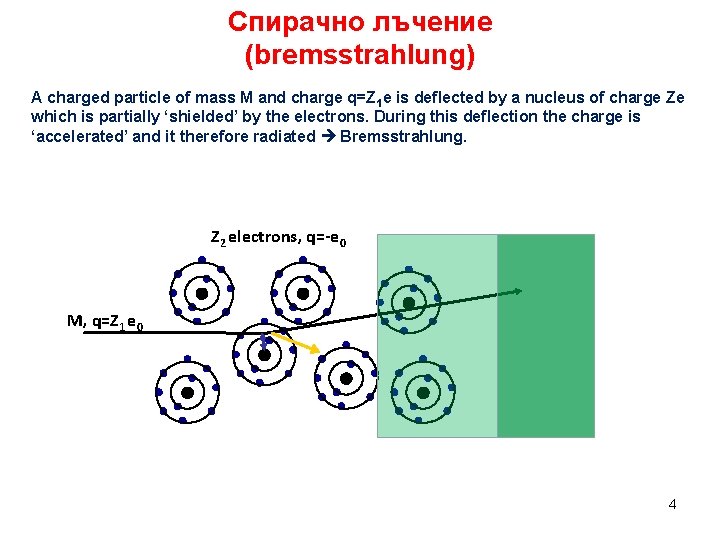
Спирачно лъчение (bremsstrahlung) A charged particle of mass M and charge q=Z 1 e is deflected by a nucleus of charge Ze which is partially ‘shielded’ by the electrons. During this deflection the charge is ‘accelerated’ and it therefore radiated Bremsstrahlung. Z 2 electrons, q=-e 0 M, q=Z 1 e 0 4
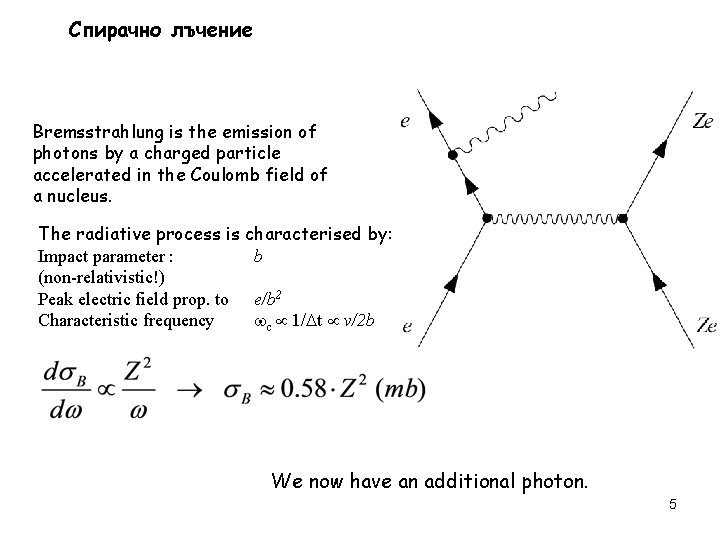
Спирачно лъчение Bremsstrahlung is the emission of photons by a charged particle accelerated in the Coulomb field of a nucleus. The radiative process is characterised by: Impact parameter : b (non-relativistic!) Peak electric field prop. to e/b 2 Characteristic frequency c 1/ t v/2 b We now have an additional photon. 5

6
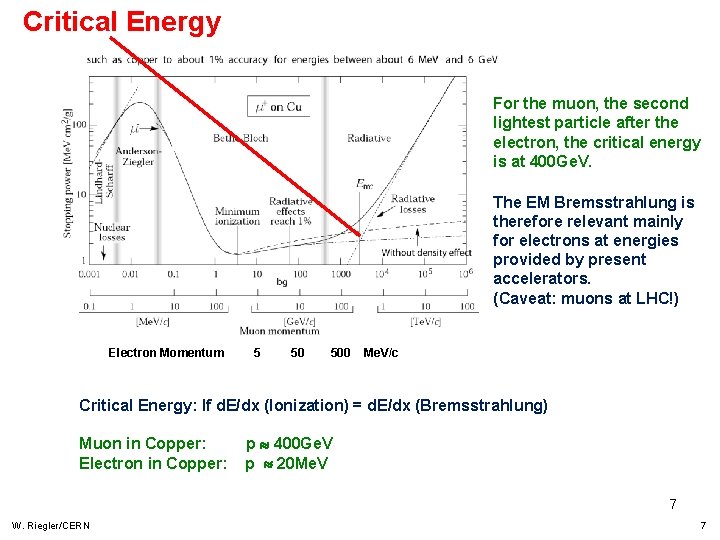
Critical Energy For the muon, the second lightest particle after the electron, the critical energy is at 400 Ge. V. The EM Bremsstrahlung is therefore relevant mainly for electrons at energies provided by present accelerators. (Caveat: muons at LHC!) Electron Momentum 5 50 500 Me. V/c Critical Energy: If d. E/dx (Ionization) = d. E/dx (Bremsstrahlung) Muon in Copper: Electron in Copper: p 400 Ge. V p 20 Me. V 7 W. Riegler/CERN 7

8
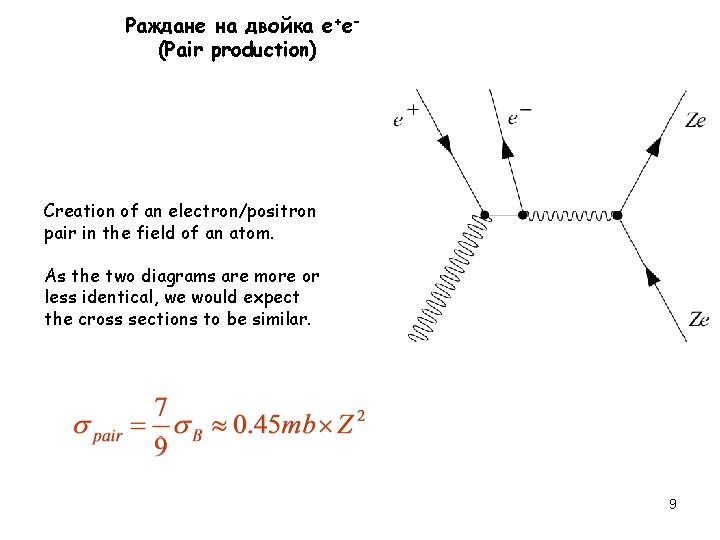
Раждане на двойка е+е(Pair production) Creation of an electron/positron pair in the field of an atom. As the two diagrams are more or less identical, we would expect the cross sections to be similar. 9
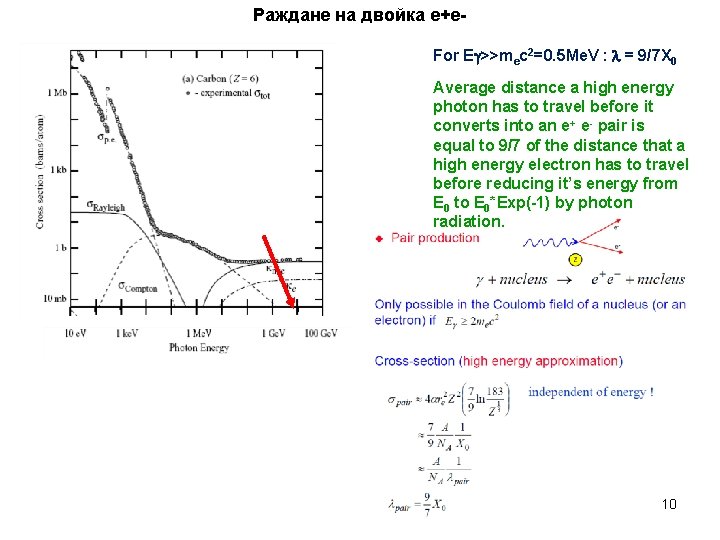
Раждане на двойка е+е. For E >>mec 2=0. 5 Me. V : = 9/7 X 0 Average distance a high energy photon has to travel before it converts into an e+ e- pair is equal to 9/7 of the distance that a high energy electron has to travel before reducing it’s energy from E 0 to E 0*Exp(-1) by photon radiation. 10
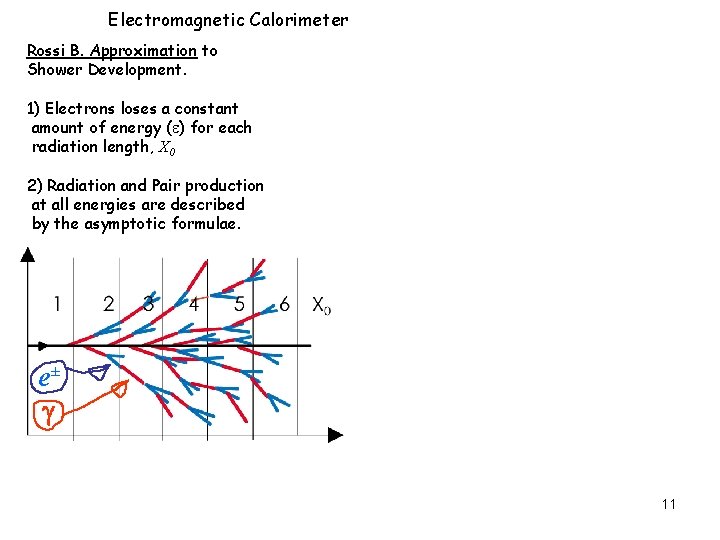
Electromagnetic Calorimeter Rossi B. Approximation to Shower Development. 1) Electrons loses a constant amount of energy (e) for each radiation length, X 0 2) Radiation and Pair production at all energies are described by the asymptotic formulae. e± 11
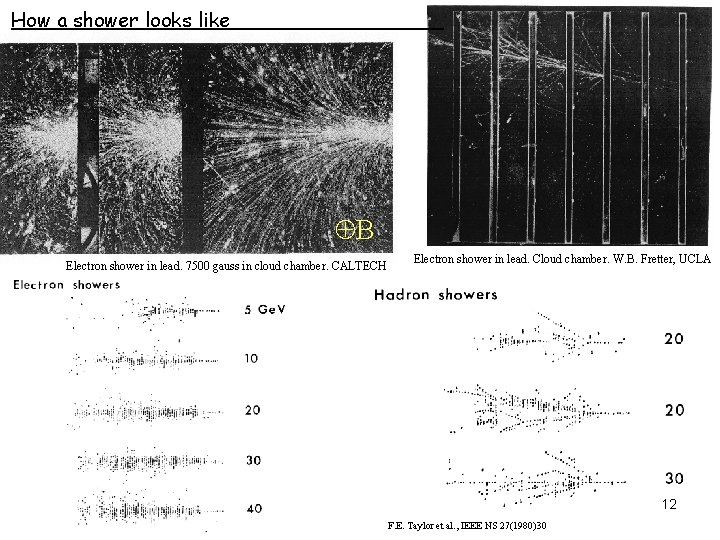
How a shower looks like B Electron shower in lead. 7500 gauss in cloud chamber. CALTECH Electron shower in lead. Cloud chamber. W. B. Fretter, UCLA 12 F. E. Taylor et al. , IEEE NS 27(1980)30
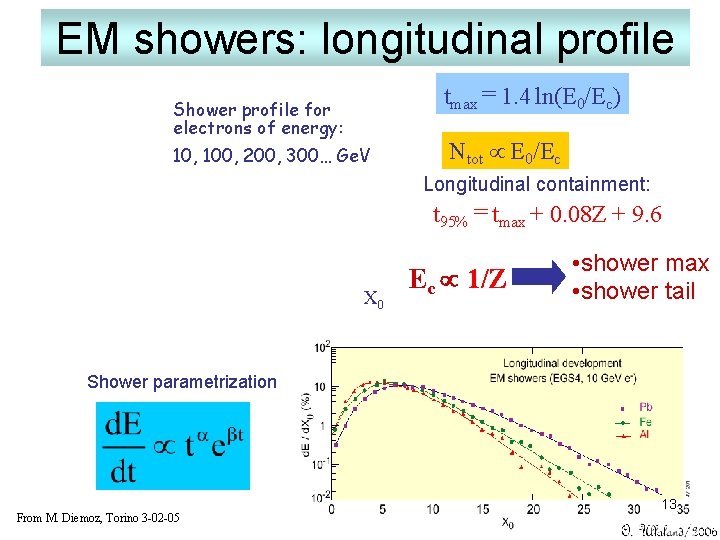
EM showers: longitudinal profile tmax = 1. 4 ln(E 0/Ec) Shower profile for electrons of energy: 10, 100, 200, 300… Ge. V Ntot E 0/Ec Longitudinal containment: t 95% = tmax + 0. 08 Z + 9. 6 X 0 Ec 1/Z • shower max • shower tail Shower parametrization From M. Diemoz, Torino 3 -02 -05 13
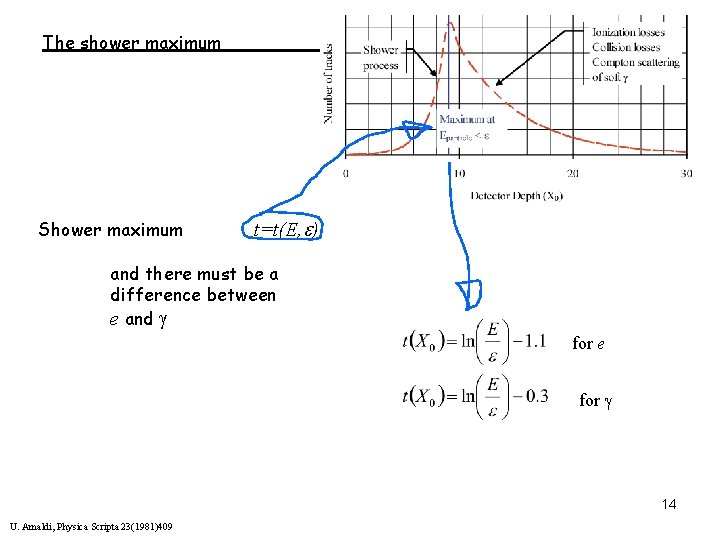
The shower maximum Shower maximum t=t(E, e) and there must be a difference between e and g for e for g 14 U. Amaldi, Physica Scripta 23(1981)409
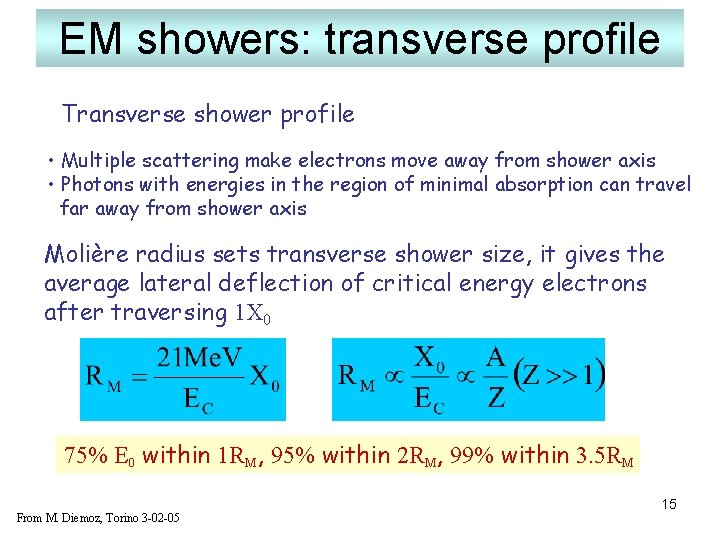
EM showers: transverse profile Transverse shower profile • Multiple scattering make electrons move away from shower axis • Photons with energies in the region of minimal absorption can travel far away from shower axis Molière radius sets transverse shower size, it gives the average lateral deflection of critical energy electrons after traversing 1 X 0 75% E 0 within 1 RM, 95% within 2 RM, 99% within 3. 5 RM From M. Diemoz, Torino 3 -02 -05 15
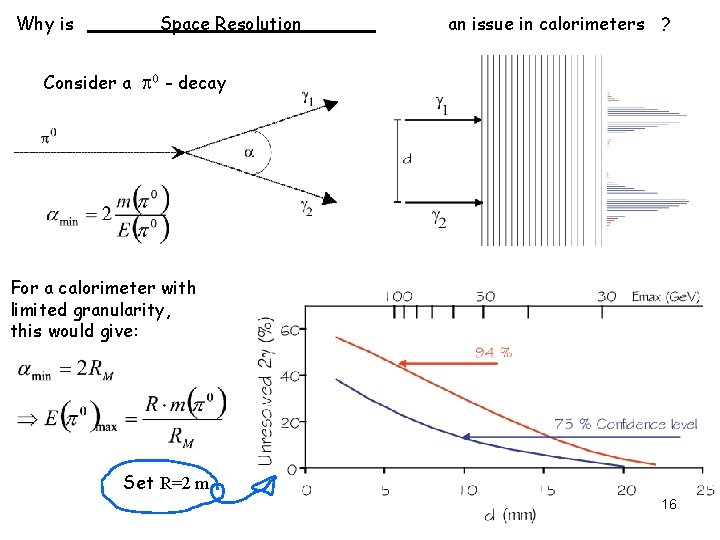
Why is Space Resolution an issue in calorimeters ? Consider a p 0 - decay For a calorimeter with limited granularity, this would give: Set R=2 m 16
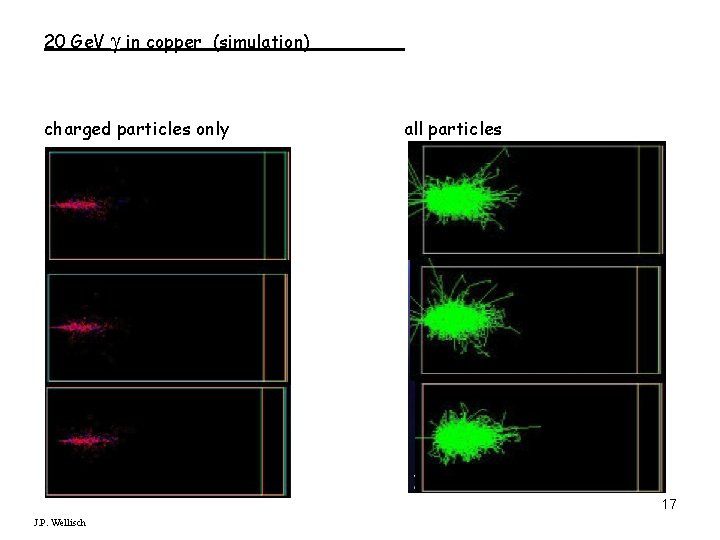
20 Ge. V g in copper (simulation) charged particles only all particles 17 J. P. Wellisch

18

19
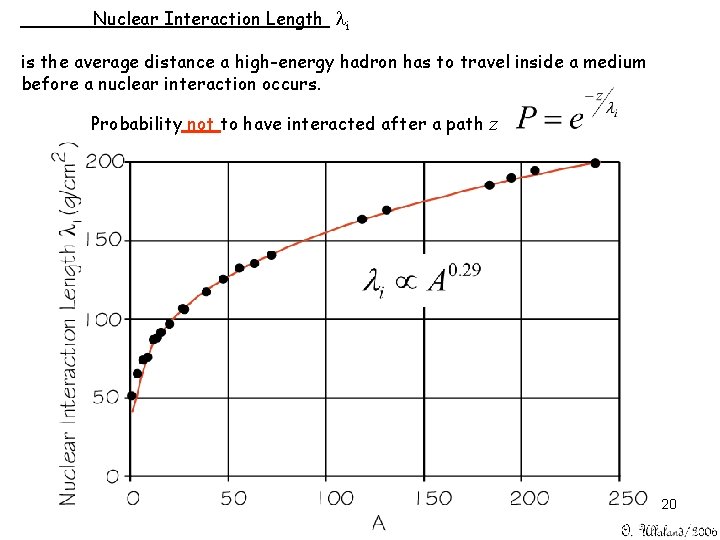
Nuclear Interaction Length li is the average distance a high-energy hadron has to travel inside a medium before a nuclear interaction occurs. Probability not to have interacted after a path z 20
21
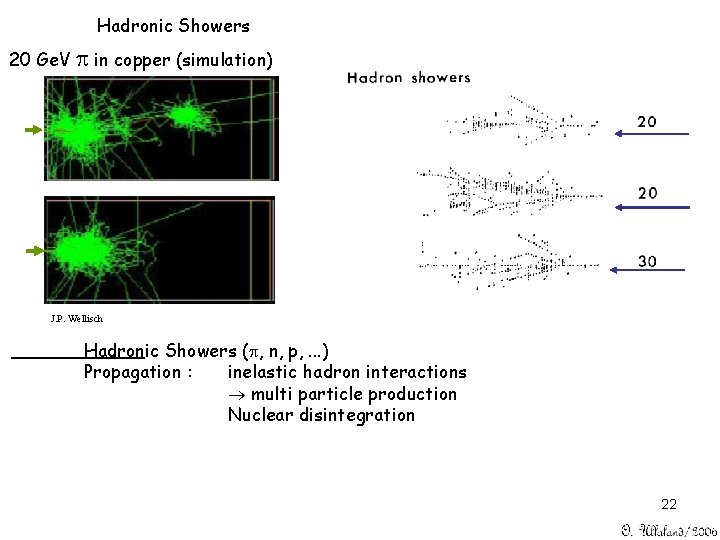
Hadronic Showers 20 Ge. V p in copper (simulation) J. P. Wellisch Hadronic Showers (p, n, p, . . . ) Propagation : inelastic hadron interactions multi particle production Nuclear disintegration 22
23
24

25
26

27
28
29
30
31

32

33

34
35

36

37

39
- Slides: 39