
2 3 Apply Deductive Reasoning Use deductive reasoning


- Slides: 18
2. 3 Apply Deductive Reasoning Use deductive reasoning to form a logical argument
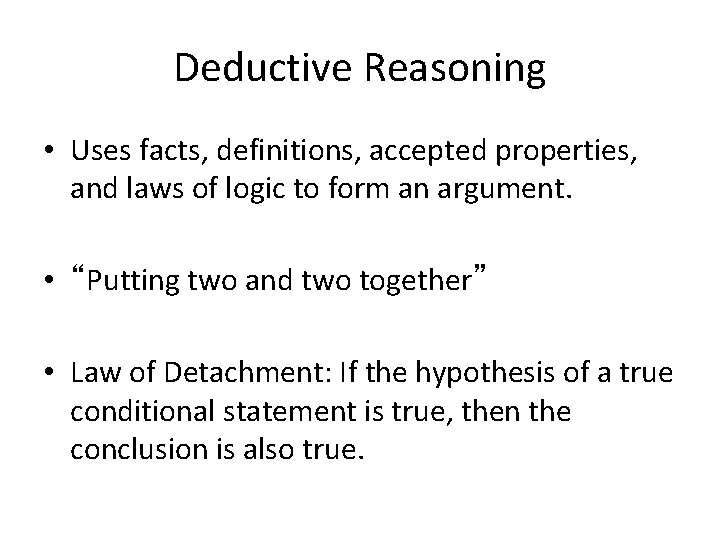
Deductive Reasoning • Uses facts, definitions, accepted properties, and laws of logic to form an argument. • “Putting two and two together” • Law of Detachment: If the hypothesis of a true conditional statement is true, then the conclusion is also true.
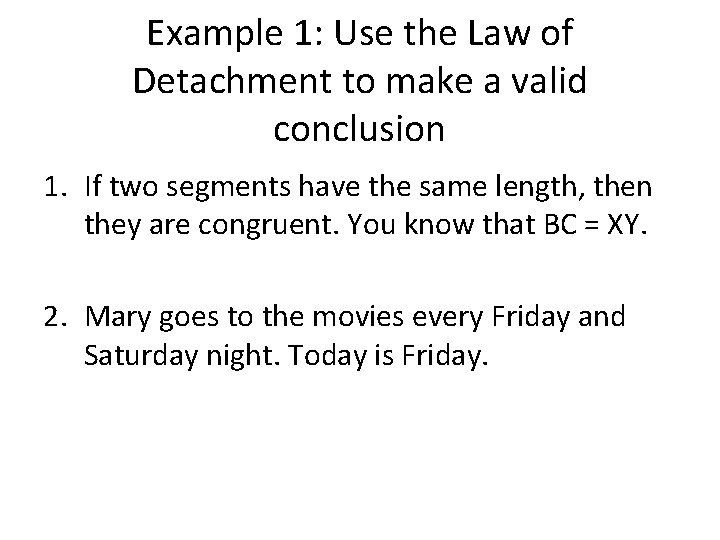
Example 1: Use the Law of Detachment to make a valid conclusion 1. If two segments have the same length, then they are congruent. You know that BC = XY. 2. Mary goes to the movies every Friday and Saturday night. Today is Friday.
Guided Practice #1 page 88
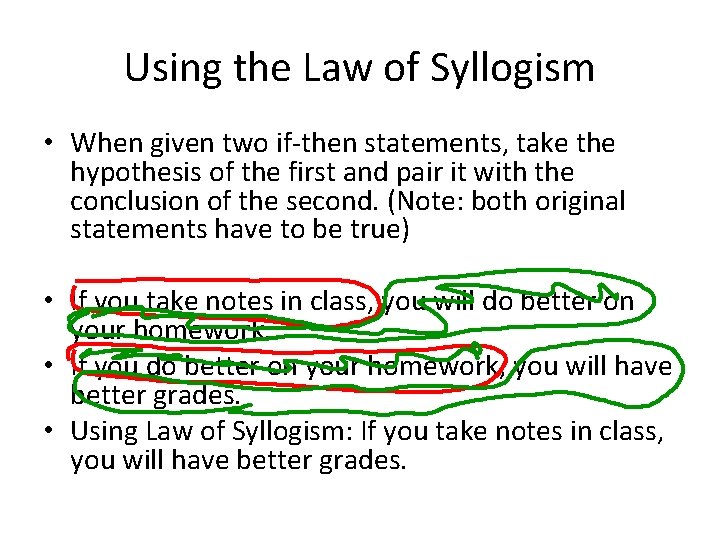
Using the Law of Syllogism • When given two if-then statements, take the hypothesis of the first and pair it with the conclusion of the second. (Note: both original statements have to be true) • If you take notes in class, you will do better on your homework. • If you do better on your homework, you will have better grades. • Using Law of Syllogism: If you take notes in class, you will have better grades.
Important Note About Using the Law of Syllogism • The conclusion of the one statement must be the hypothesis of the other statement.
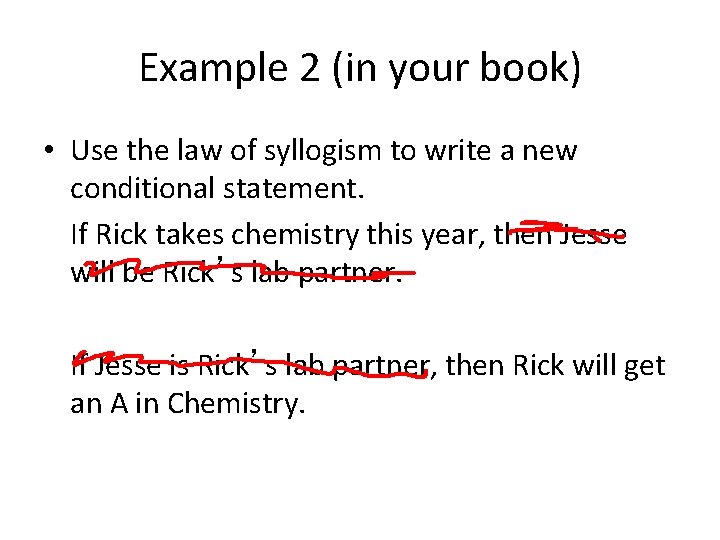
Example 2 (in your book) • Use the law of syllogism to write a new conditional statement. If Rick takes chemistry this year, then Jesse will be Rick’s lab partner. If Jesse is Rick’s lab partner, then Rick will get an A in Chemistry.
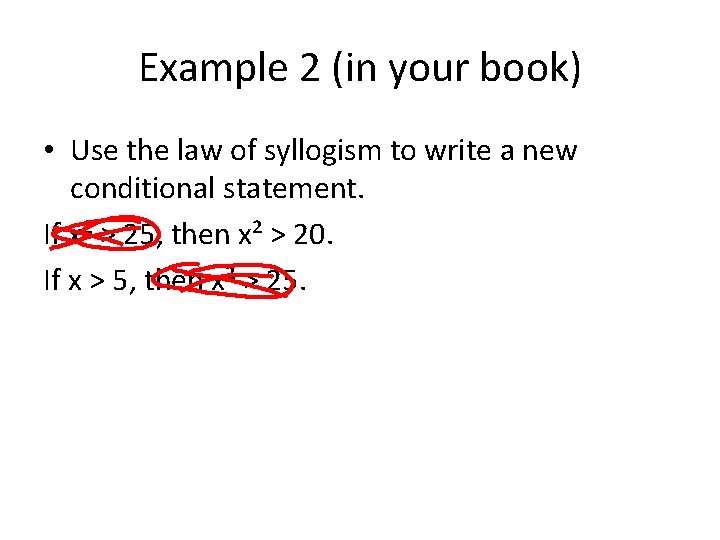
Example 2 (in your book) • Use the law of syllogism to write a new conditional statement. If x² > 25, then x² > 20. If x > 5, then x² > 25.
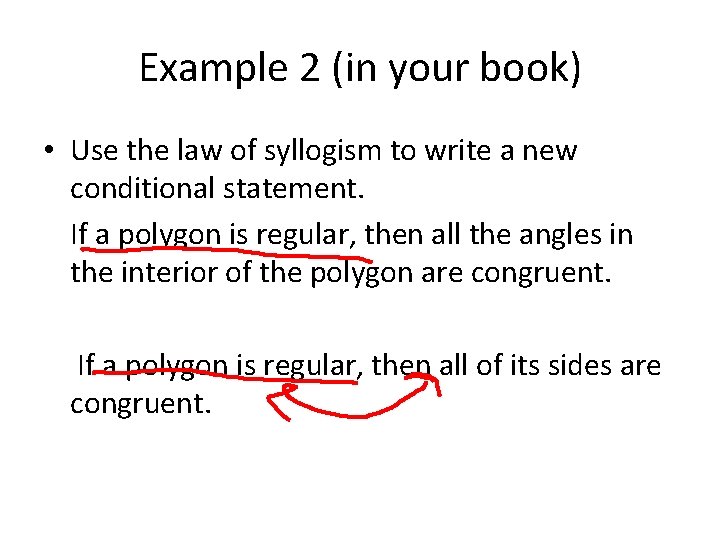
Example 2 (in your book) • Use the law of syllogism to write a new conditional statement. If a polygon is regular, then all the angles in the interior of the polygon are congruent. If a polygon is regular, then all of its sides are congruent.
Your Turn! GP 2 – 4 page 80
Example 3: Use inductive and deductive reasoning • What conclusion can you make about the product of an even integer and any other integer?
Extra Example 3 • What conclusion can you make about the product of two odd numbers?
Deciding between Inductive and Deductive Reasoning • Inductive: You looked at a pattern • Deductive: You looked at facts, rules, etc. , and used simple logic
Example 4 (in your book) Inductive or Deductive, Explain. Each time Monica kicks a ball up in the air, it returns to the ground. So the next time Monica kicks a ball up in the air, it will return to the ground. Reptiles are cold-blooded. Parrots are not cold -blooded. Sue’s pet parrot is not a reptile.
Inductive or Deductive • Whenever it rains in the morning, afternoon baseball games are canceled. The baseball game this afternoon was not canceled. So, it did not rain this morning.
Inductive or Deductive • Every time Tom has eaten strawberries, he has had a mild allergic reaction. The next time he eats strawberries, he will have a mild allgergic reaction.
Closure Activity • Create your own example of using the law of syllogism.
Homework • 1 -23 odd Due Wednesday Quiz coming up over 2. 1 – 2. 3!