
2 3 2 4 Tangent Normal Lines Write



- Slides: 9
2. 3 -2. 4 Tangent & Normal Lines ― Write the equation of a tangent line for a function at a point. ― Find horizontal tangent lines from the derivative. ― Graphs and derivatives
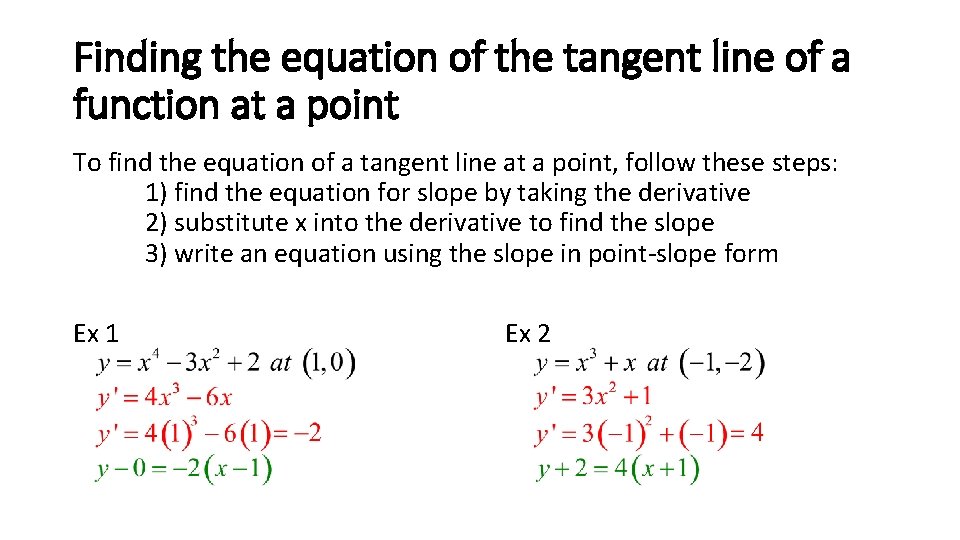
Finding the equation of the tangent line of a function at a point To find the equation of a tangent line at a point, follow these steps: 1) find the equation for slope by taking the derivative 2) substitute x into the derivative to find the slope 3) write an equation using the slope in point-slope form Ex 1 Ex 2
Normal Lines The normal line is defined as the line that is perpendicular to the tangent line at the point of tangency. Because the slopes of perpendicular lines (neither of which is vertical) are negative reciprocals of one another, the slope of the normal line to the graph of f(x) is − 1/ f′(x). (meaning the opposite reciprocal of the derivative) Ex 1 Ex 2
Finding a horizontal tangent line To find where a function has a horizontal tangent line: 1) take the derivative of the function zero 2) set the derivative equal to _______. Ex 3 Ex 4 Ex 5
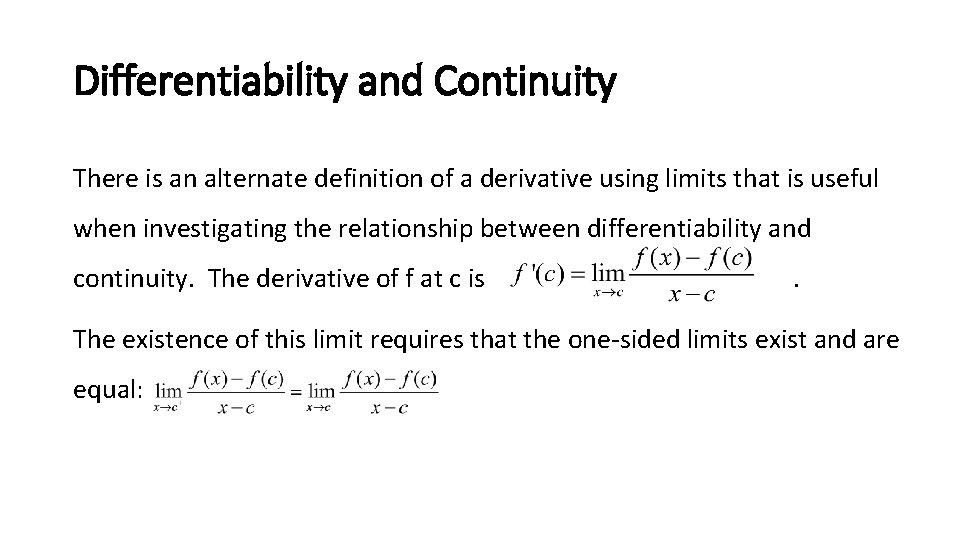
Differentiability and Continuity There is an alternate definition of a derivative using limits that is useful when investigating the relationship between differentiability and continuity. The derivative of f at c is . The existence of this limit requires that the one-sided limits exist and are equal:
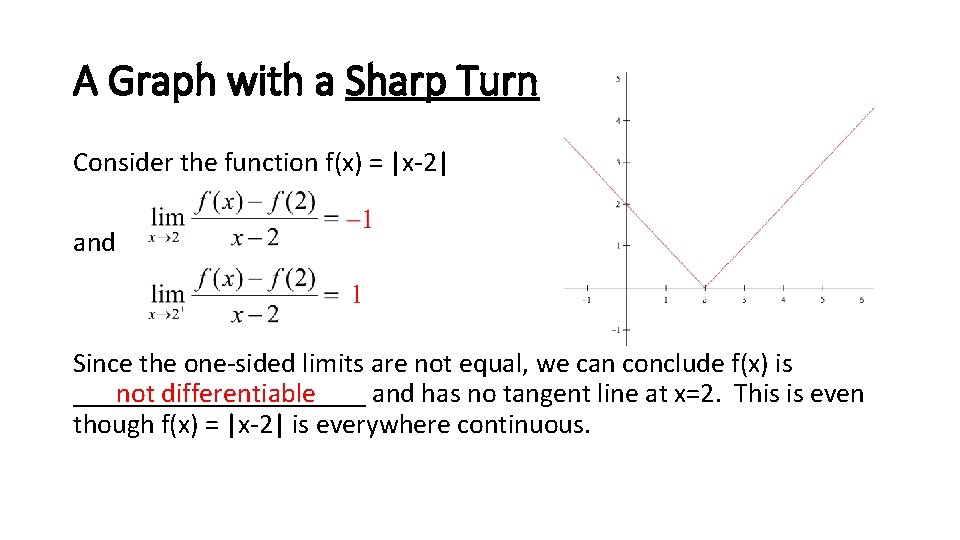
A Graph with a Sharp Turn Consider the function f(x) = |x-2| and Since the one-sided limits are not equal, we can conclude f(x) is not differentiable ___________ and has no tangent line at x=2. This is even though f(x) = |x-2| is everywhere continuous.
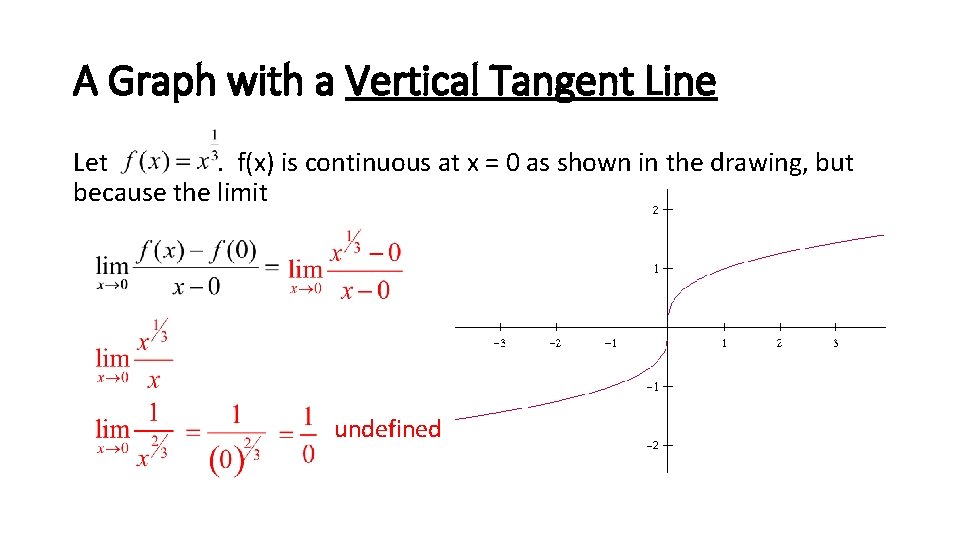
A Graph with a Vertical Tangent Line Let . f(x) is continuous at x = 0 as shown in the drawing, but because the limit undefined
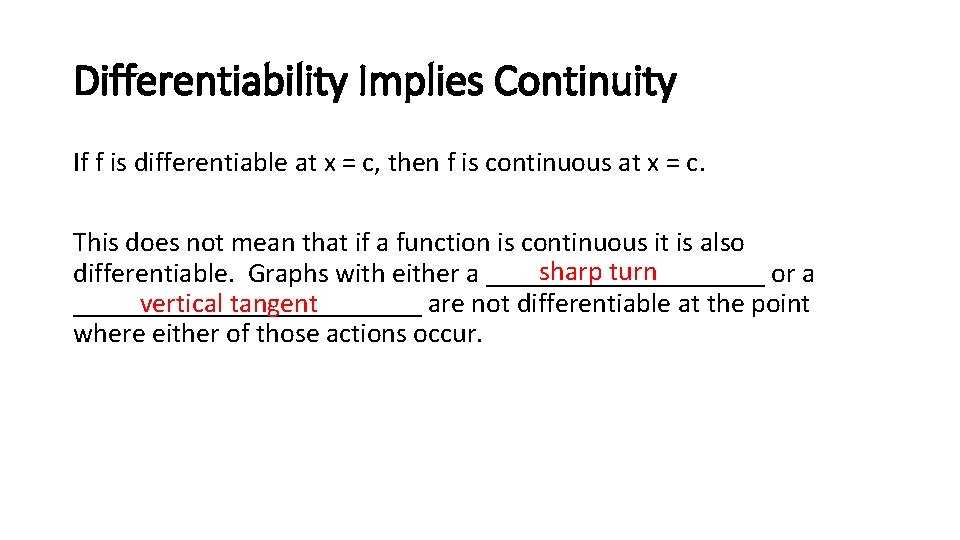
Differentiability Implies Continuity If f is differentiable at x = c, then f is continuous at x = c. This does not mean that if a function is continuous it is also sharp turn differentiable. Graphs with either a __________ or a _____________ are not differentiable at the point vertical tangent where either of those actions occur.
WS 2. 3 -2. 4 RADIANS!!