
2 2 Hamilton Circuits Tucker Applied Combinatorics Section
2. 2 Hamilton Circuits Tucker, Applied Combinatorics, Section 2. 2, Tamsen Hunter Hamilton Circuits n. Hamilton Paths n
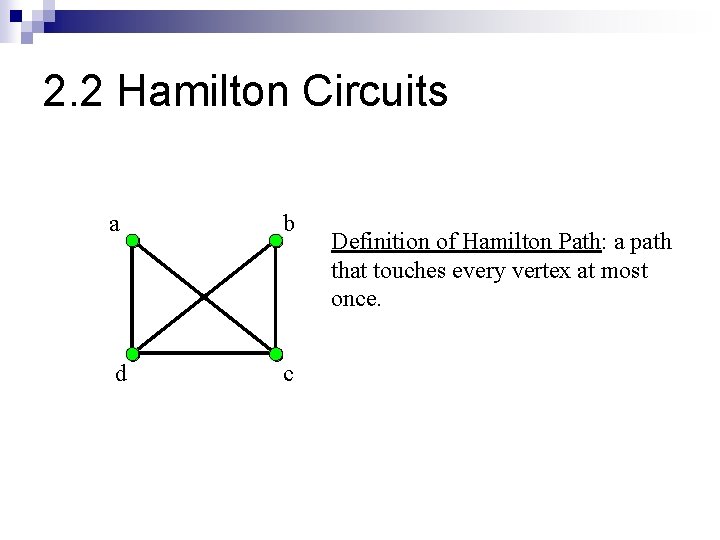
2. 2 Hamilton Circuits a b d c Definition of Hamilton Path: a path that touches every vertex at most once.
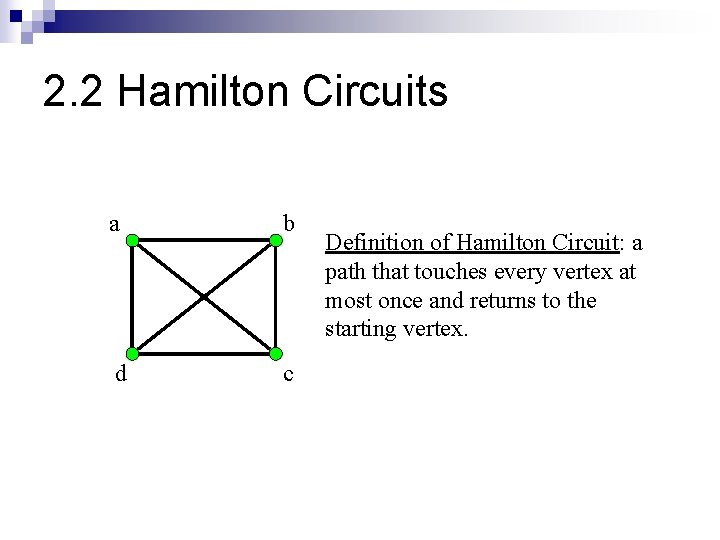
2. 2 Hamilton Circuits a b d c Definition of Hamilton Circuit: a path that touches every vertex at most once and returns to the starting vertex.
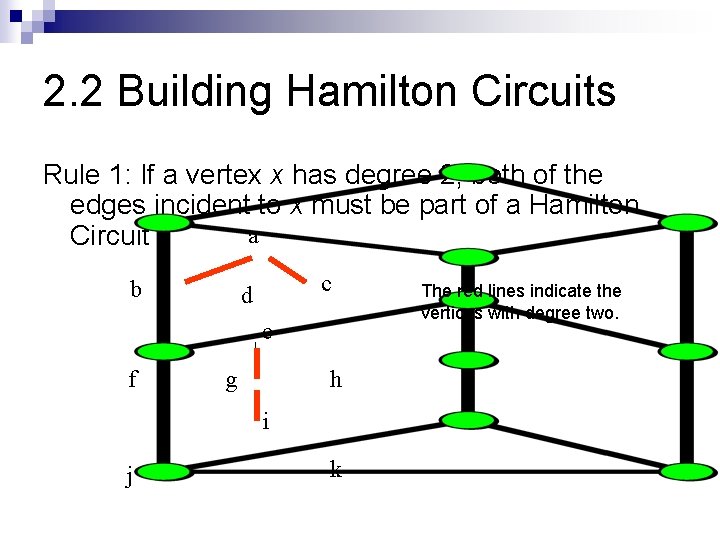
2. 2 Building Hamilton Circuits Rule 1: If a vertex x has degree 2, both of the edges incident to x must be part of a Hamilton a Circuit b c d e f g h i j k The red lines indicate the vertices with degree two.
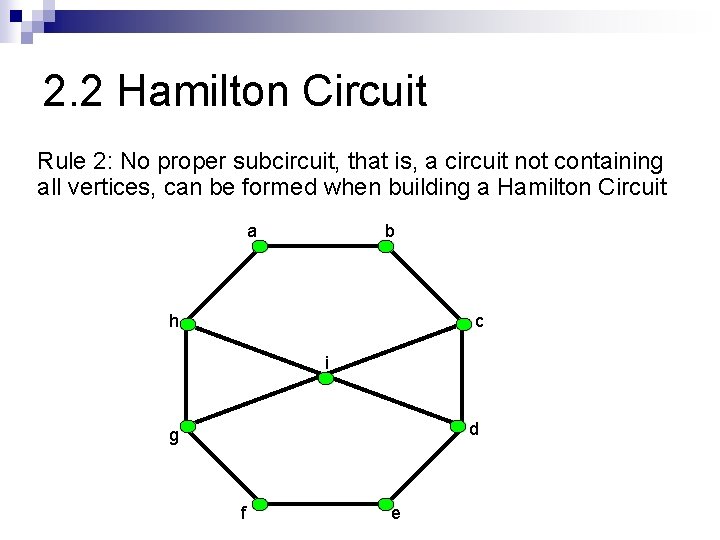
2. 2 Hamilton Circuit Rule 2: No proper subcircuit, that is, a circuit not containing all vertices, can be formed when building a Hamilton Circuit a b h c i d g f e
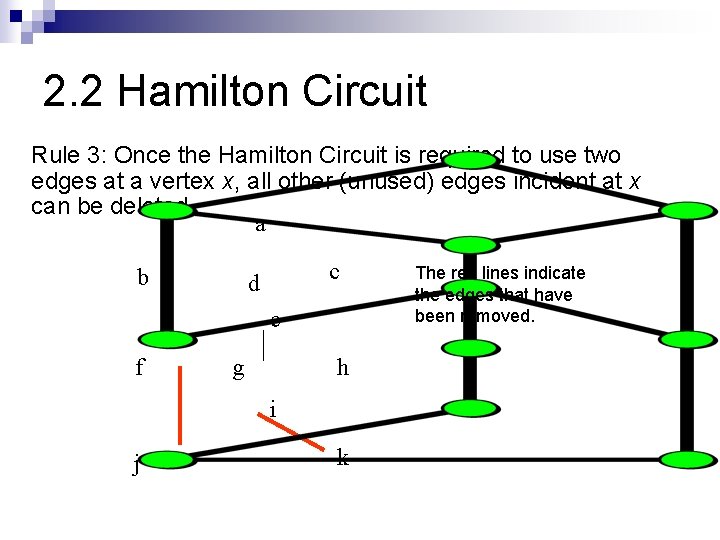
2. 2 Hamilton Circuit Rule 3: Once the Hamilton Circuit is required to use two edges at a vertex x, all other (unused) edges incident at x can be deleted. a b c d e f g h i j k The red lines indicate the edges that have been removed.
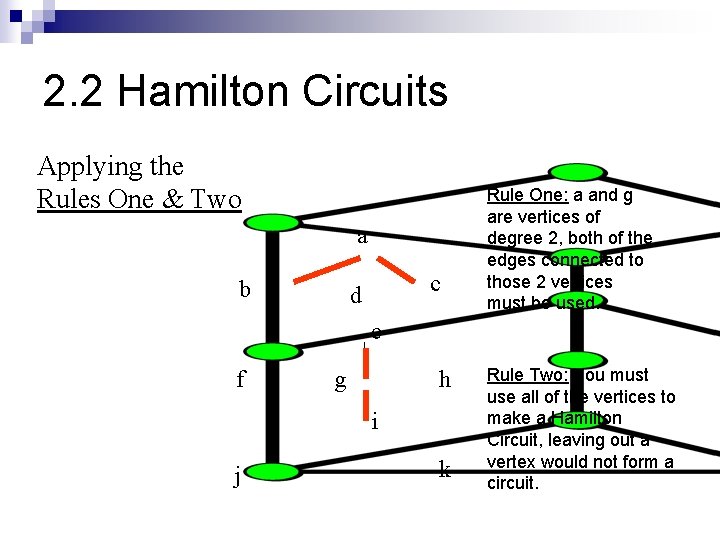
2. 2 Hamilton Circuits Applying the Rules One & Two a b c d Rule One: a and g are vertices of degree 2, both of the edges connected to those 2 vertices must be used. e f g h i j k Rule Two: You must use all of the vertices to make a Hamilton Circuit, leaving out a vertex would not form a circuit.
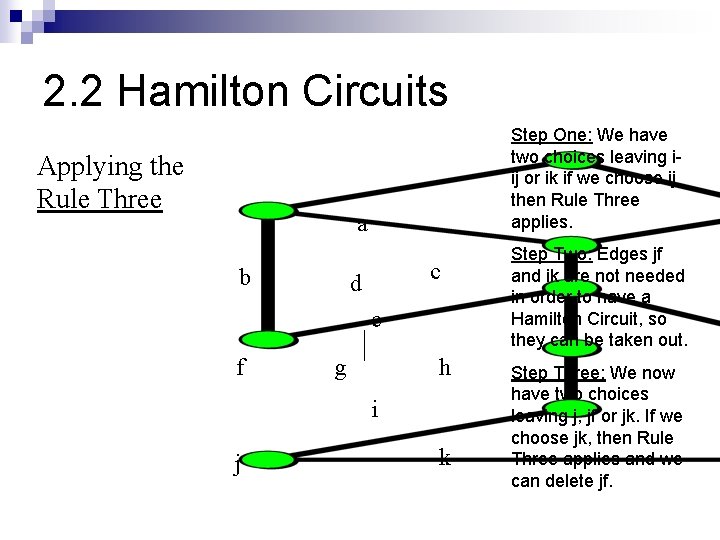
2. 2 Hamilton Circuits Applying the Rule Three Step One: We have two choices leaving iij or ik if we choose ij then Rule Three applies. a b c d e f g h i j k Step Two: Edges jf and ik are not needed in order to have a Hamilton Circuit, so they can be taken out. Step Three: We now have two choices leaving j, jf or jk. If we choose jk, then Rule Three applies and we can delete jf.
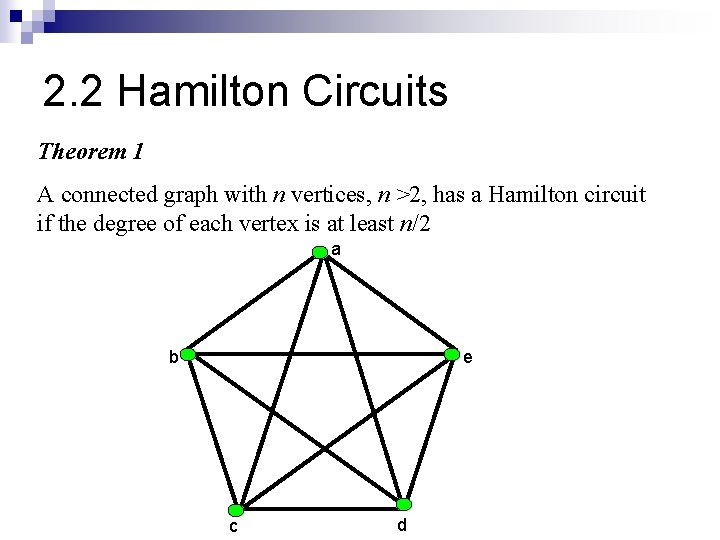
2. 2 Hamilton Circuits Theorem 1 A connected graph with n vertices, n >2, has a Hamilton circuit if the degree of each vertex is at least n/2 a b e c d
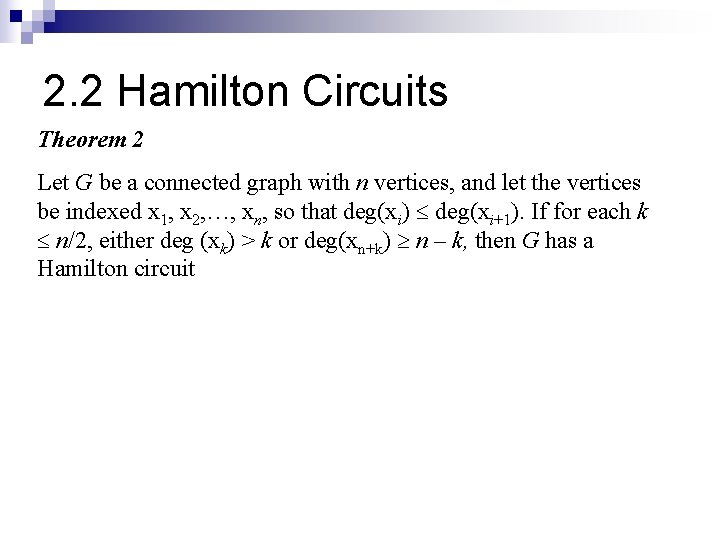
2. 2 Hamilton Circuits Theorem 2 Let G be a connected graph with n vertices, and let the vertices be indexed x 1, x 2, …, xn, so that deg(xi) deg(xi+1). If for each k n/2, either deg (xk) > k or deg(xn+k) n – k, then G has a Hamilton circuit
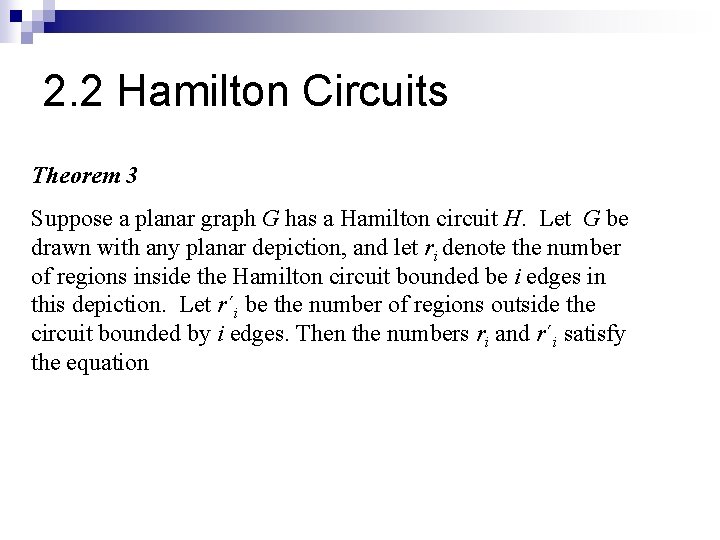
2. 2 Hamilton Circuits Theorem 3 Suppose a planar graph G has a Hamilton circuit H. Let G be drawn with any planar depiction, and let ri denote the number of regions inside the Hamilton circuit bounded be i edges in this depiction. Let r´i be the number of regions outside the circuit bounded by i edges. Then the numbers ri and r´i satisfy the equation
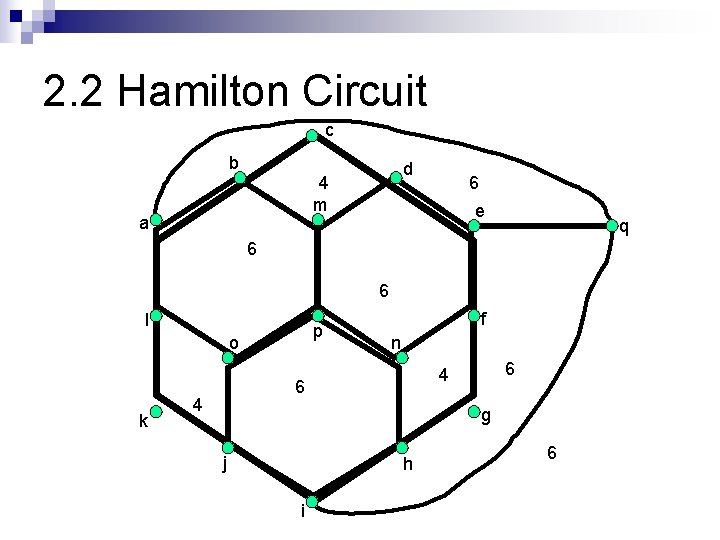
2. 2 Hamilton Circuit c b d 4 m a 6 e q 6 6 l p o k f n 6 4 g j h i 6
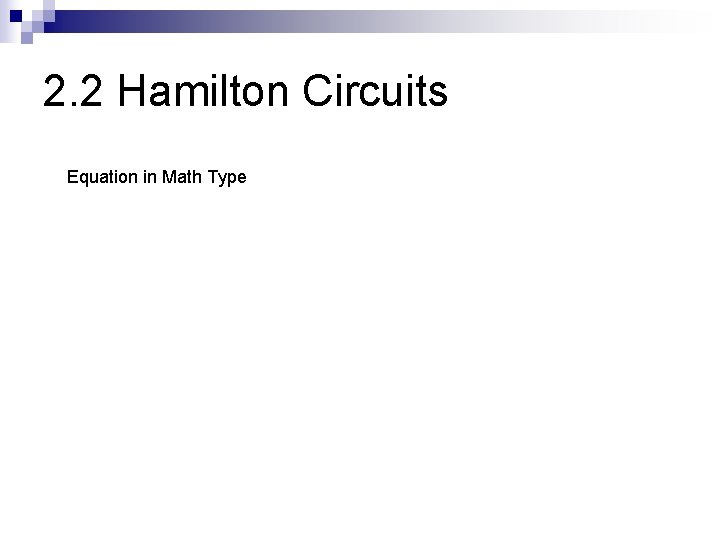
2. 2 Hamilton Circuits Equation in Math Type
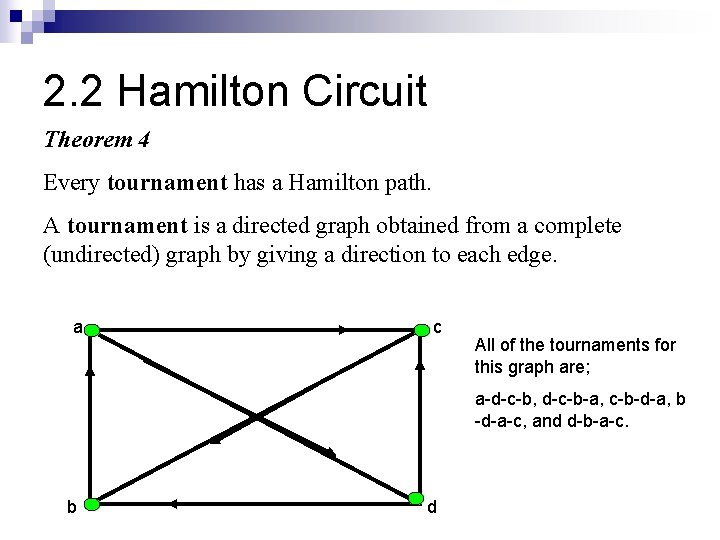
2. 2 Hamilton Circuit Theorem 4 Every tournament has a Hamilton path. A tournament is a directed graph obtained from a complete (undirected) graph by giving a direction to each edge. a c All of the tournaments for this graph are; a-d-c-b, d-c-b-a, c-b-d-a, b -d-a-c, and d-b-a-c. b d
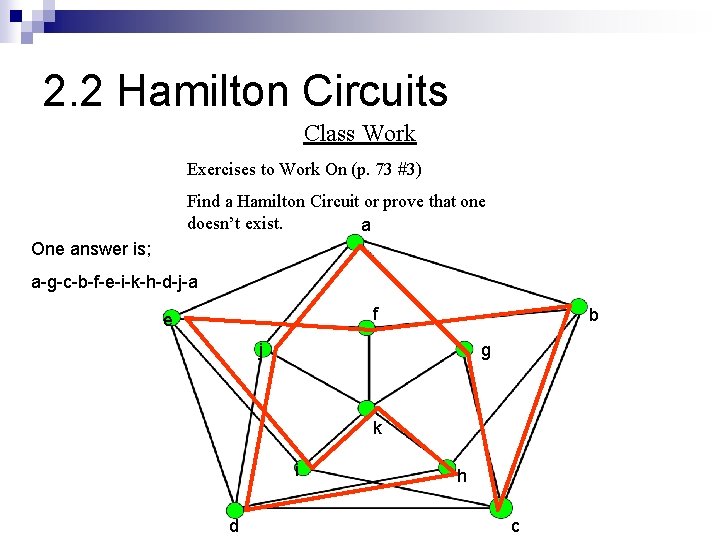
2. 2 Hamilton Circuits Class Work Exercises to Work On (p. 73 #3) Find a Hamilton Circuit or prove that one doesn’t exist. a One answer is; a-g-c-b-f-e-i-k-h-d-j-a f e b j g k i d h c
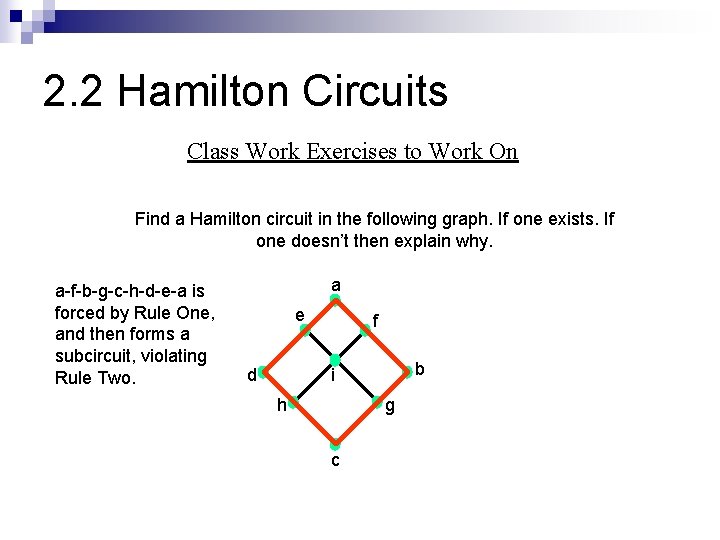
2. 2 Hamilton Circuits Class Work Exercises to Work On Find a Hamilton circuit in the following graph. If one exists. If one doesn’t then explain why. a-f-b-g-c-h-d-e-a is forced by Rule One, and then forms a subcircuit, violating Rule Two. a e d f b i h g c
- Slides: 16