
2 14 13 Visible Light Sources of visible
2 -14 -13 Visible Light Sources of visible light: • • The sun Stars Light bulbs Fire/flame • Lightning • Fireflies • Laser pointers
An object is “seen” only when an object emits or reflects light to the eye. luminous Objects that generate their own light. • Ex: illuminated Objects that are capable of reflecting light to our eyes. • Ex:
Speed of Light Q: Does light travel faster through a solid, liquid or a gas? H: Light waves travel fastest through a _____ because_____.
Demonstration
Explanation: Light travels the fastest through a gas (actually empty space) because there are less particles to move through and slow it down.
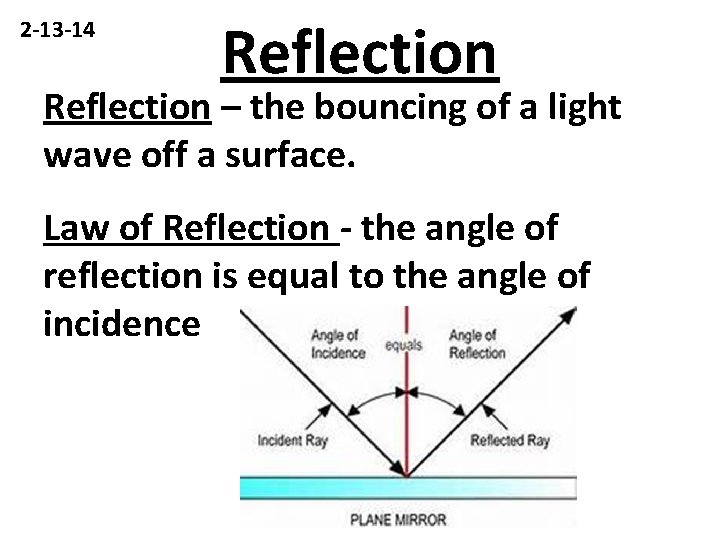
2 -13 -14 Reflection – the bouncing of a light wave off a surface. Law of Reflection - the angle of reflection is equal to the angle of incidence
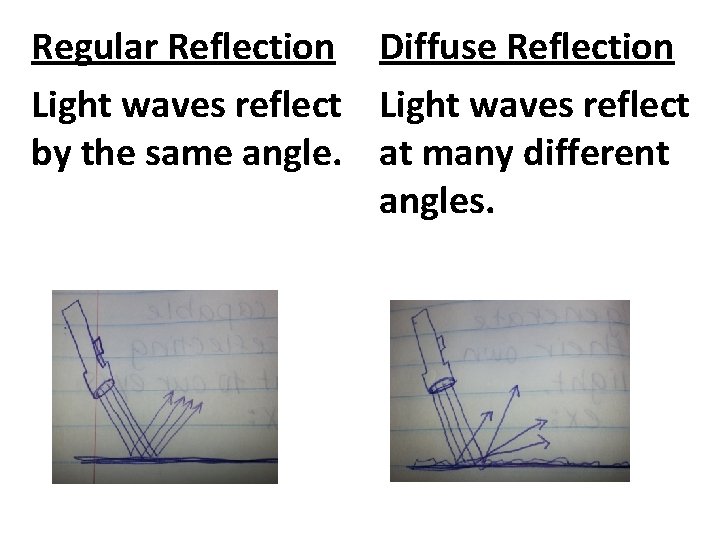
Regular Reflection Diffuse Reflection Light waves reflect by the same angle. at many different angles.
Laser Reflection Activity Purpose: Compare reflection of visible light on different surfaces. 1. smooth 2. rough 3. shiny 4. dull
• DO NOT SHINE LASER POINTERS NEAR ANYONE’S FACE – CAN CAUSE EYE DAMAGE
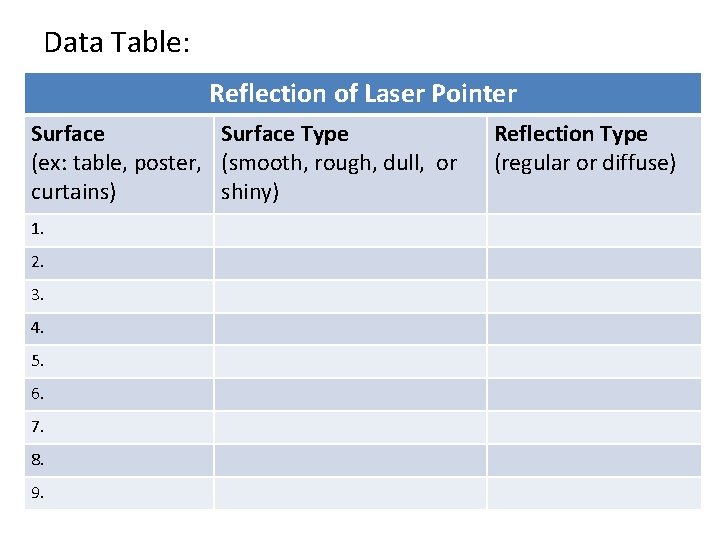
Data Table: Reflection of Laser Pointer Surface Type (ex: table, poster, (smooth, rough, dull, or curtains) shiny) 1. 2. 3. 4. 5. 6. 7. 8. 9. Reflection Type (regular or diffuse)
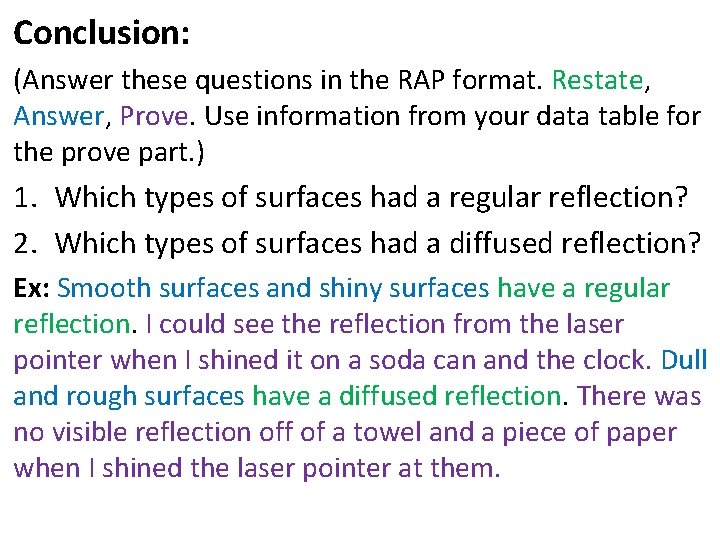
Conclusion: (Answer these questions in the RAP format. Restate, Answer, Prove. Use information from your data table for the prove part. ) 1. Which types of surfaces had a regular reflection? 2. Which types of surfaces had a diffused reflection? Ex: Smooth surfaces and shiny surfaces have a regular reflection. I could see the reflection from the laser pointer when I shined it on a soda can and the clock. Dull and rough surfaces have a diffused reflection. There was no visible reflection off of a towel and a piece of paper when I shined the laser pointer at them.
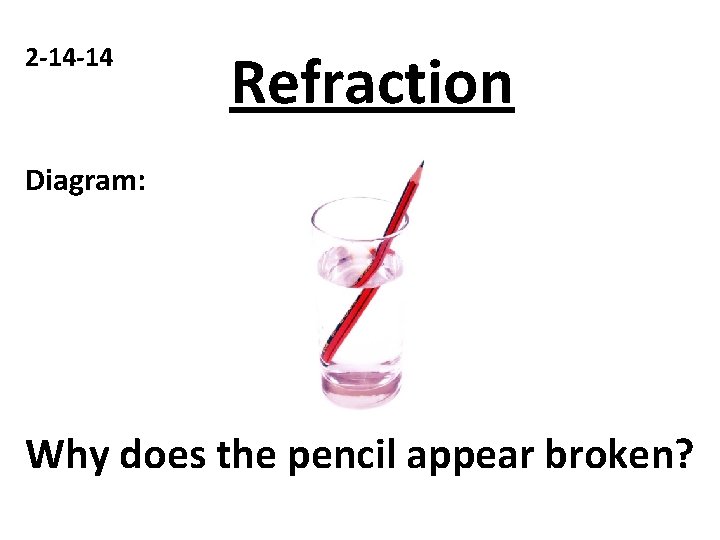
2 -14 -14 Refraction Diagram: Why does the pencil appear broken?

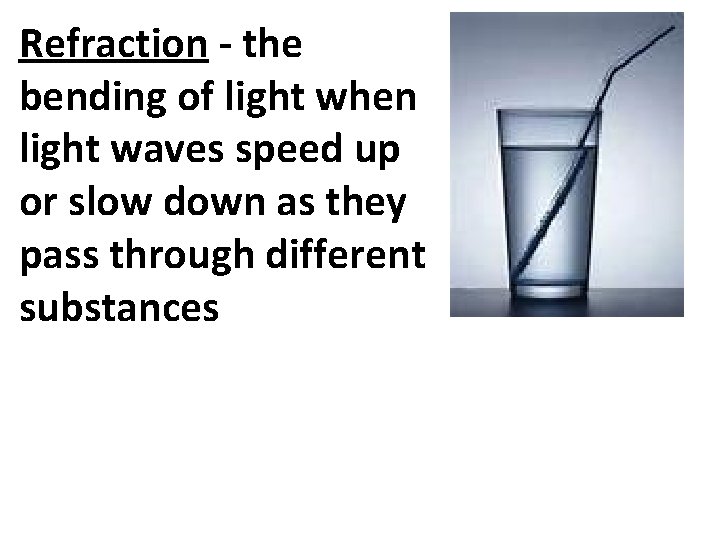
Refraction - the bending of light when light waves speed up or slow down as they pass through different substances
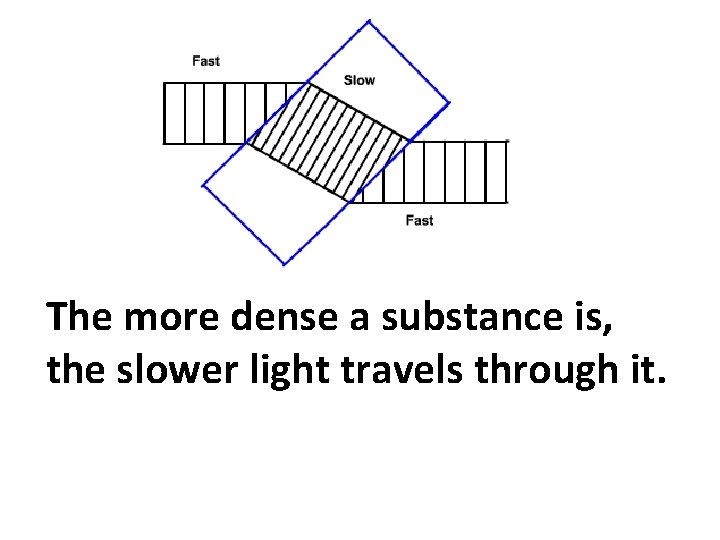
The more dense a substance is, the slower light travels through it.
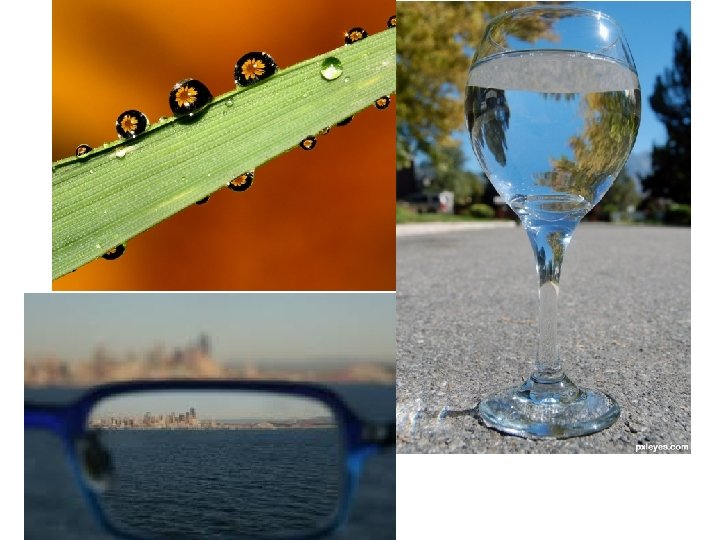
Refraction Picture Contest • With a partner you will take pictures of light refracting. You will submit ONE for the contest. • Your goal is to take the COOLEST most CREATIVE picture possible that demonstrates refraction! • It MUST be a picture that YOU or your partner have taken! • We will vote on the best picture on Wednesday, February 19 th in class • Email the picture to Mrs. Schneider by Tuesday night by 10: 01 pm. Make sure both of your names on mentioned in the email. aschneider@lindberghschools. ws • For Full Credit – take an accurate picture of refraction and email it on time. Two extra credit points for the winners!
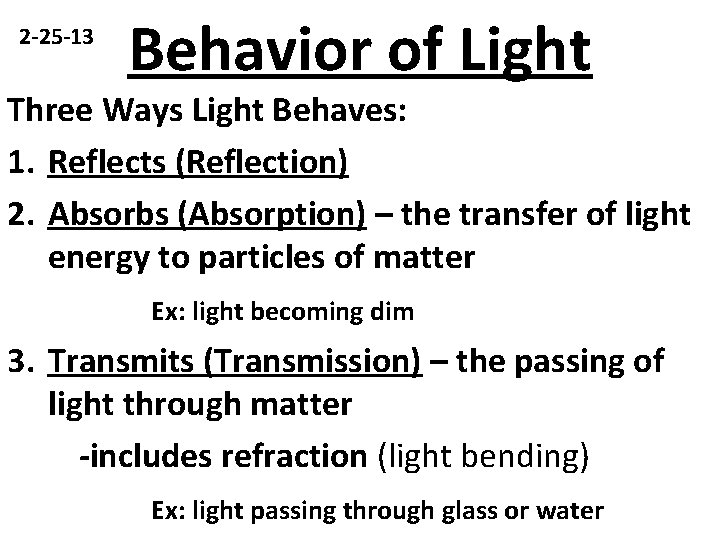
2 -25 -13 Behavior of Light Three Ways Light Behaves: 1. Reflects (Reflection) 2. Absorbs (Absorption) – the transfer of light energy to particles of matter Ex: light becoming dim 3. Transmits (Transmission) – the passing of light through matter -includes refraction (light bending) Ex: light passing through glass or water
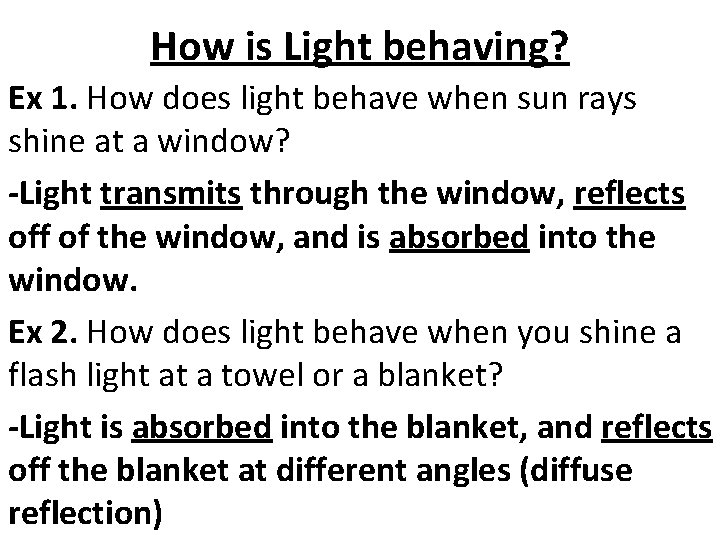
How is Light behaving? Ex 1. How does light behave when sun rays shine at a window? -Light transmits through the window, reflects off of the window, and is absorbed into the window. Ex 2. How does light behave when you shine a flash light at a towel or a blanket? -Light is absorbed into the blanket, and reflects off the blanket at different angles (diffuse reflection)
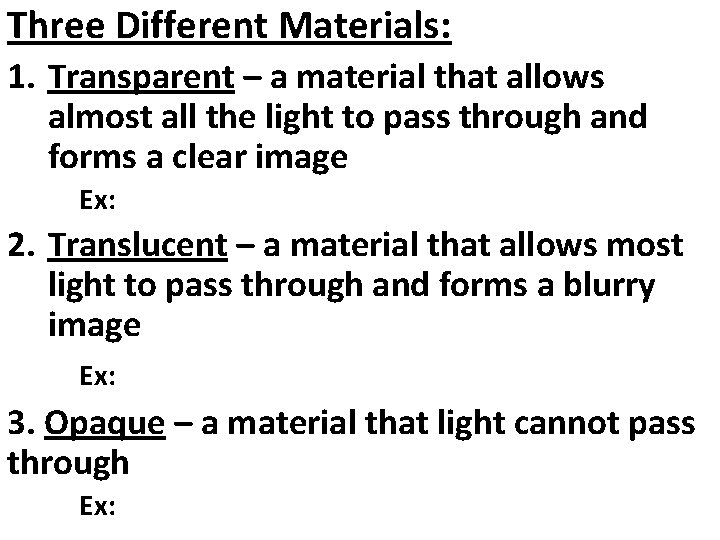
Three Different Materials: 1. Transparent – a material that allows almost all the light to pass through and forms a clear image Ex: 2. Translucent – a material that allows most light to pass through and forms a blurry image Ex: 3. Opaque – a material that light cannot pass through Ex:
- Slides: 20