
2 1 Skill Acquisition Classification of Skills Continuums
- Slides: 14
2. 1 Skill Acquisition
Classification of Skills
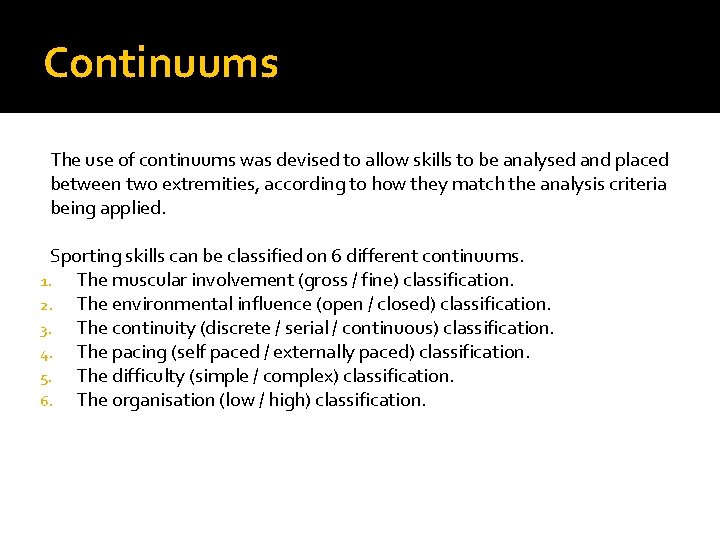
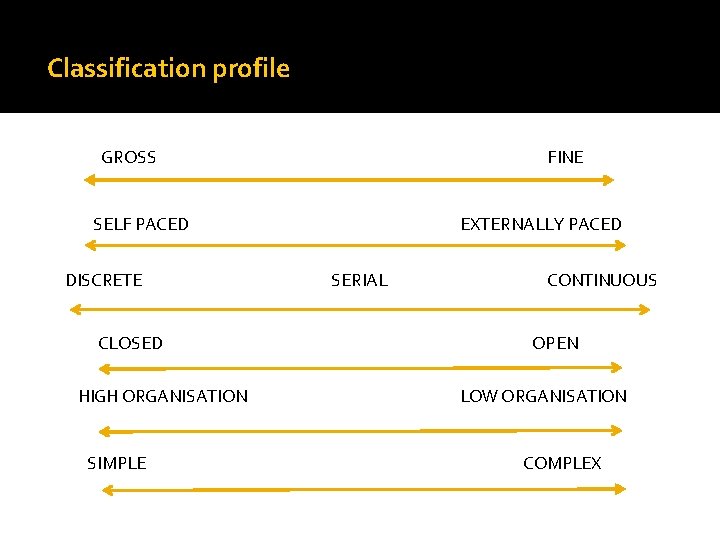
Continuums The use of continuums was devised to allow skills to be analysed and placed between two extremities, according to how they match the analysis criteria being applied. Sporting skills can be classified on 6 different continuums. 1. The muscular involvement (gross / fine) classification. 2. The environmental influence (open / closed) classification. 3. The continuity (discrete / serial / continuous) classification. 4. The pacing (self paced / externally paced) classification. 5. The difficulty (simple / complex) classification. 6. The organisation (low / high) classification.
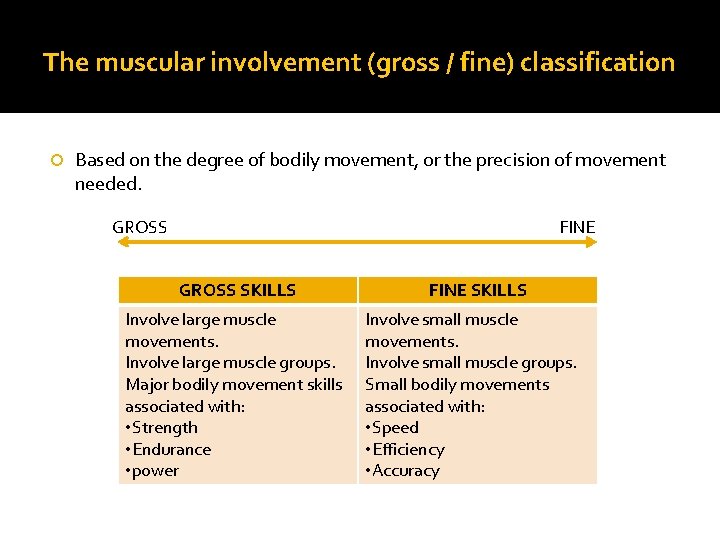
The muscular involvement (gross / fine) classification Based on the degree of bodily movement, or the precision of movement needed. GROSS FINE GROSS SKILLS Involve large muscle movements. Involve large muscle groups. Major bodily movement skills associated with: • Strength • Endurance • power FINE SKILLS Involve small muscle movements. Involve small muscle groups. Small bodily movements associated with: • Speed • Efficiency • Accuracy
Gross or fine skills? http: //www. youtube. com/watch? v=Avpwb. G 3 d. RFI http: //www. youtube. com/view_play_list? p=F 057 FCAFC 8 F 08 219&search_query=basketball+free+throw http: //www. youtube. com/watch? v=9 N 7 q. Mqx 9 r. Ns http: //www. youtube. com/watch? v=7 Xvfk 0 e. XOGg
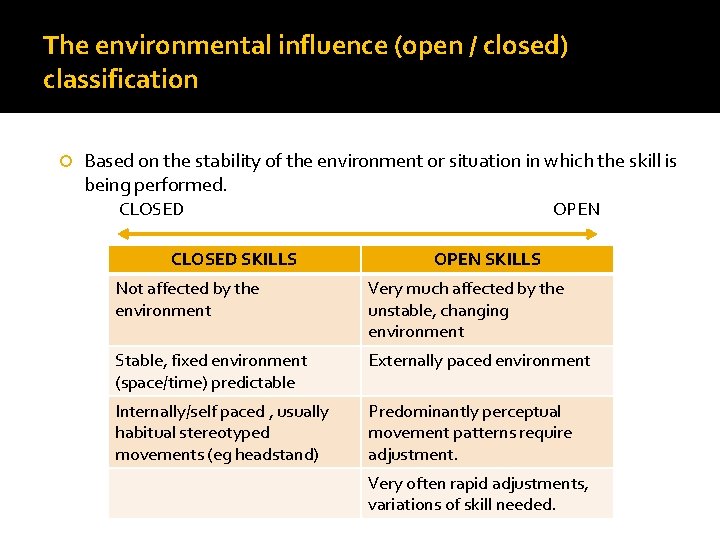
The environmental influence (open / closed) classification Based on the stability of the environment or situation in which the skill is being performed. CLOSED SKILLS OPEN SKILLS Not affected by the environment Very much affected by the unstable, changing environment Stable, fixed environment (space/time) predictable Externally paced environment Internally/self paced , usually habitual stereotyped movements (eg headstand) Predominantly perceptual movement patterns require adjustment. Very often rapid adjustments, variations of skill needed.
Open or closed continuum https: //www. youtube. com/watch? v=2 wx. Us. Kv. P 0 a. I https: //www. youtube. com/watch? v=ga 6 Hl. Jqrx. EE https: //www. youtube. com/watch? v=d 6 b. Krs 6 gb. Wk https: //www. youtube. com/watch? v=MOFWQb. ZYK 7 s https: //www. youtube. com/watch? v=Ifdmb. AXnouw https: //www. youtube. com/watch? v=Eiq. EFUFM-KI
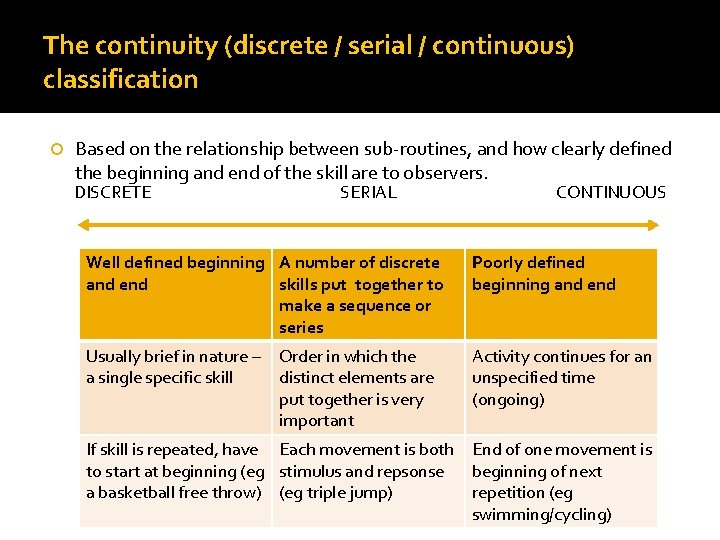
The continuity (discrete / serial / continuous) classification Based on the relationship between sub-routines, and how clearly defined the beginning and end of the skill are to observers. DISCRETE SERIAL CONTINUOUS Well defined beginning A number of discrete and end skills put together to make a sequence or series Poorly defined beginning and end Usually brief in nature – a single specific skill Activity continues for an unspecified time (ongoing) Order in which the distinct elements are put together is very important If skill is repeated, have Each movement is both to start at beginning (eg stimulus and repsonse a basketball free throw) (eg triple jump) End of one movement is beginning of next repetition (eg swimming/cycling)
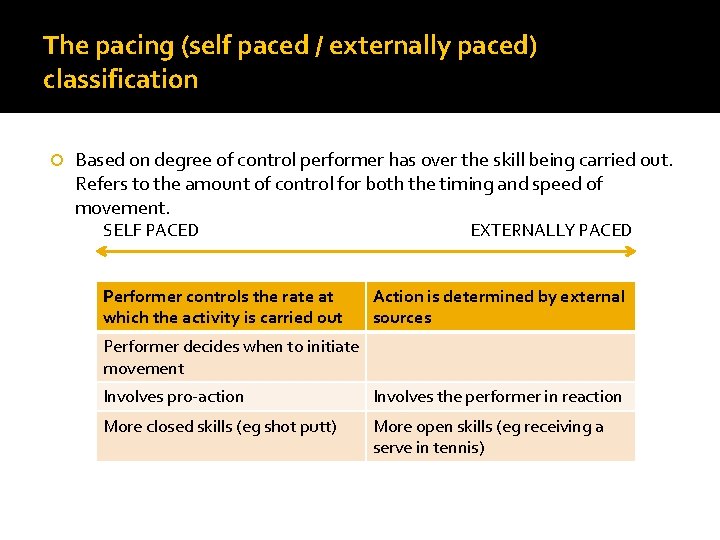
The pacing (self paced / externally paced) classification Based on degree of control performer has over the skill being carried out. Refers to the amount of control for both the timing and speed of movement. SELF PACED Performer controls the rate at which the activity is carried out EXTERNALLY PACED Action is determined by external sources Performer decides when to initiate movement Involves pro-action Involves the performer in reaction More closed skills (eg shot putt) More open skills (eg receiving a serve in tennis)
Self paced or Externally paced https: //www. youtube. com/watch? v=zs 97 EQNJTFA https: //www. youtube. com/watch? v=_9 q. TJFOk. ICc https: //www. youtube. com/watch? v=cj. Mr. Oj 54 b. JQ https: //www. youtube. com/watch? v=sot. Gh 2 C 8 z. IA
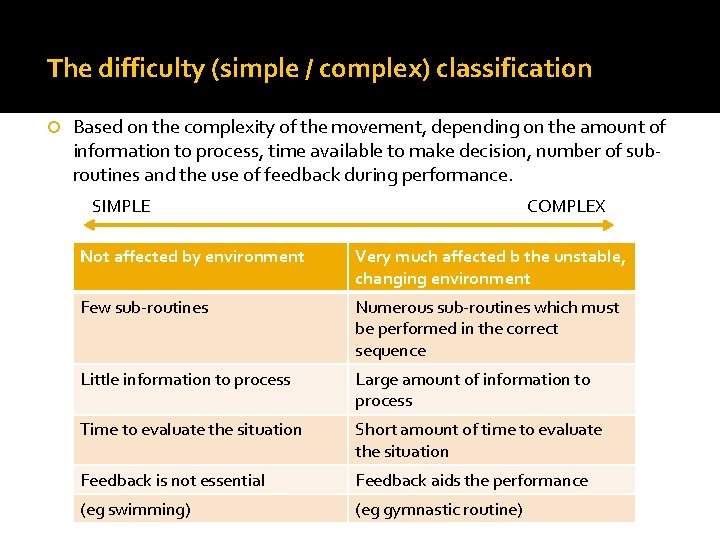
The difficulty (simple / complex) classification Based on the complexity of the movement, depending on the amount of information to process, time available to make decision, number of subroutines and the use of feedback during performance. SIMPLE COMPLEX Not affected by environment Very much affected b the unstable, changing environment Few sub-routines Numerous sub-routines which must be performed in the correct sequence Little information to process Large amount of information to process Time to evaluate the situation Short amount of time to evaluate the situation Feedback is not essential Feedback aids the performance (eg swimming) (eg gymnastic routine)
The organisation (high/ low) classification HIGH LOW
Classification profile GROSS FINE SELF PACED DISCRETE CLOSED HIGH ORGANISATION SIMPLE EXTERNALLY PACED SERIAL CONTINUOUS OPEN LOW ORGANISATION COMPLEX
Skill Classification Homework Set Tuesday 12 th September Due Tuesday 19 th September Questions available on alevelpe. weebly. com 1. A continuum is used to classify skills. The continuity continuum contains three elements – discrete, serial and continuous whilst the environmental continuum contains open and closed skills. Use practical examples to explain each of these elements. (5 MARKS) 2. Identify three characteristics of a ‘complex’ skill. (3 MARKS) 3. Give two examples of a ‘low organisation’ skill. (2 MARKS) 4. Identify and explain five characteristics of a skillful performance. (5 MARKS) 5. How can the use of classification systems assist a teacher/coach when deciding which training or practice method is the most appropriate. (3 MARKS) TOTAL 18 MARKS