
2 1 Functions Modified from Sedgewick Waynes original
- Slides: 23
2. 1 Functions Modified from Sedgewick & Wayne's original slides Introduction to Programming in Java: An Interdisciplinary Approach · Robert Sedgewick and Kevin Wayne · Copyright © 2008 · 9/10/08
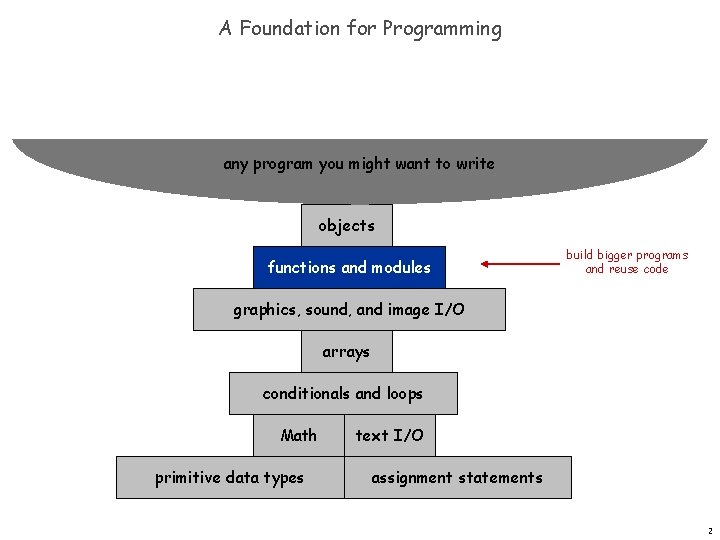
A Foundation for Programming any program you might want to write objects functions and modules build bigger programs and reuse code graphics, sound, and image I/O arrays conditionals and loops Math primitive data types text I/O assignment statements 2
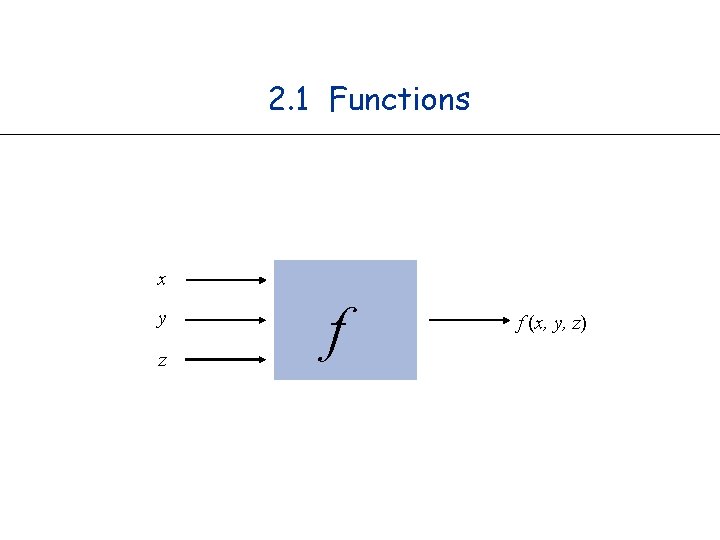
2. 1 Functions x y z f f (x, y, z)
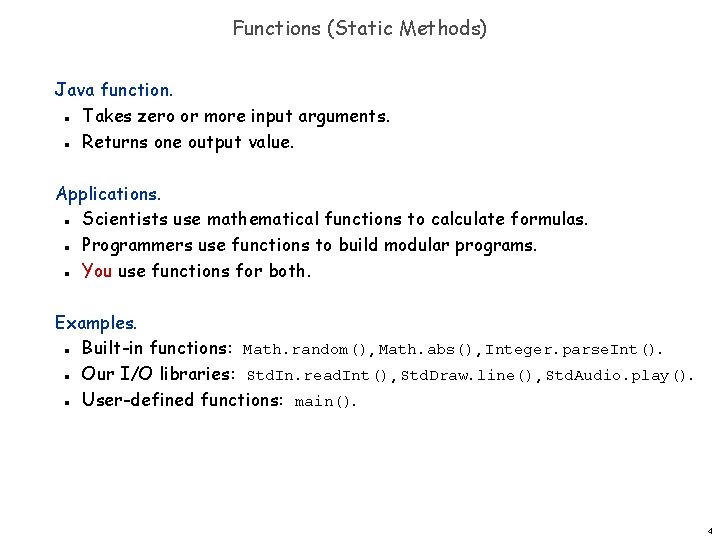
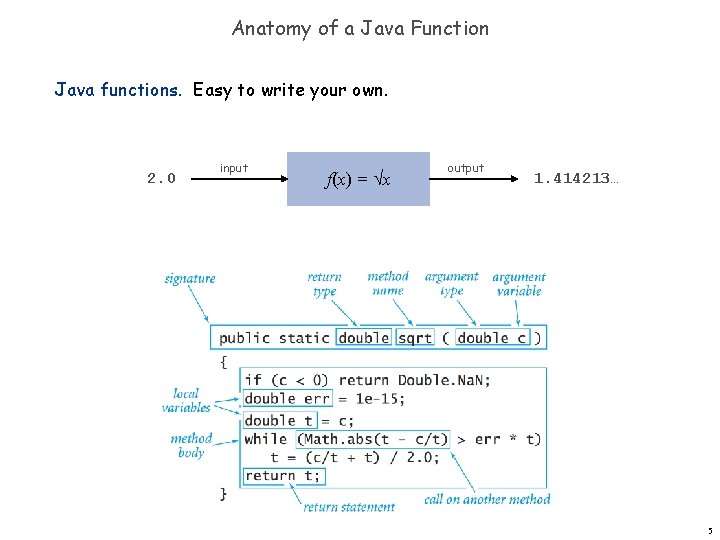
Functions (Static Methods) Java function. Takes zero or more input arguments. Returns one output value. Applications. Scientists use mathematical functions to calculate formulas. Programmers use functions to build modular programs. You use functions for both. Examples. Built-in functions: Math. random(), Math. abs(), Integer. parse. Int(). Our I/O libraries: Std. In. read. Int(), Std. Draw. line(), Std. Audio. play(). User-defined functions: main(). 4
Anatomy of a Java Function Java functions. Easy to write your own. 2. 0 input f(x) = x output 1. 414213… 5
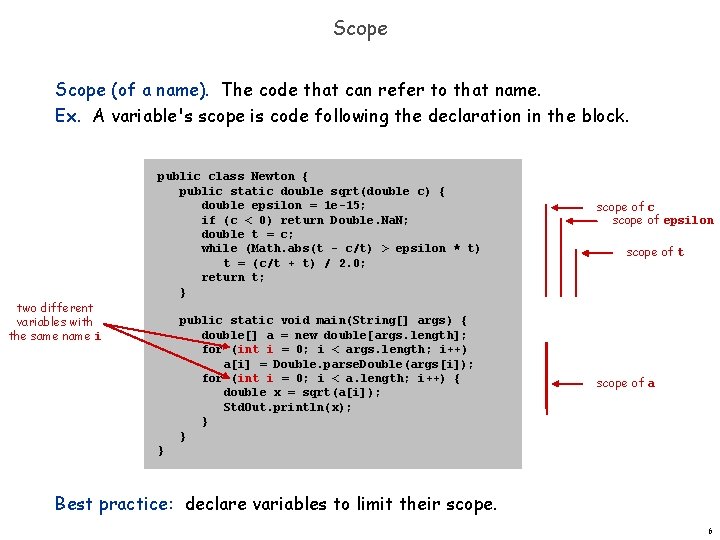
Scope (of a name). The code that can refer to that name. Ex. A variable's scope is code following the declaration in the block. two different variables with the same name i public class Newton { public static double sqrt(double c) { double epsilon = 1 e-15; if (c < 0) return Double. Na. N; double t = c; while (Math. abs(t - c/t) > epsilon * t) t = (c/t + t) / 2. 0; return t; } public static void main(String[] args) { double[] a = new double[args. length]; for (int i = 0; i < args. length; i++) a[i] = Double. parse. Double(args[i]); for (int i = 0; i < a. length; i++) { double x = sqrt(a[i]); Std. Out. println(x); } } scope of c scope of epsilon scope of t scope of a } Best practice: declare variables to limit their scope. 6
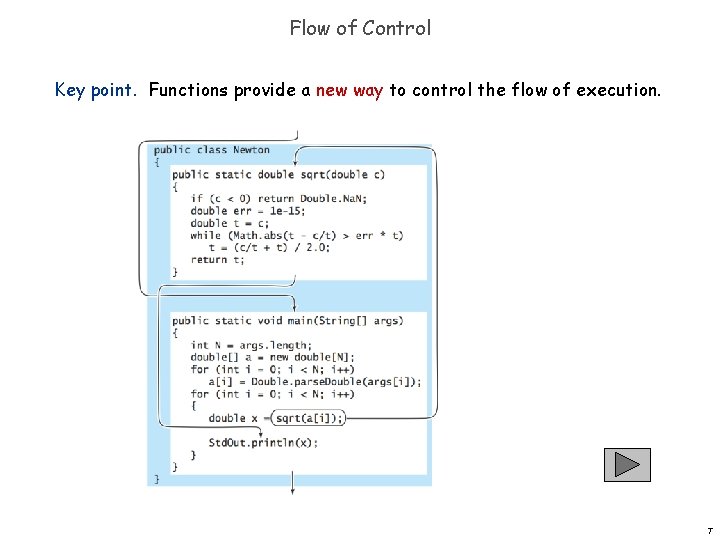
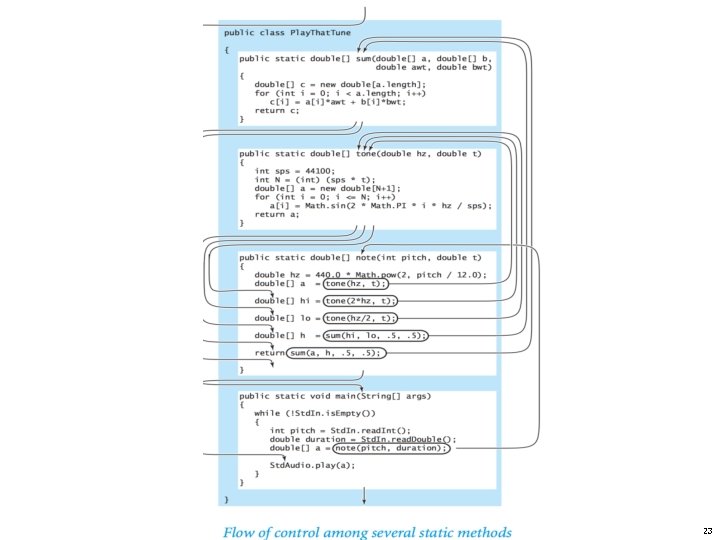
Flow of Control Key point. Functions provide a new way to control the flow of execution. 7
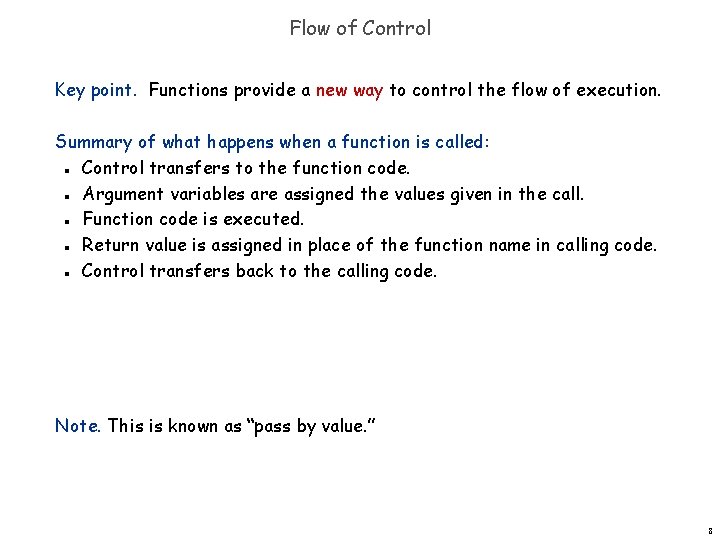
Flow of Control Key point. Functions provide a new way to control the flow of execution. Summary of what happens when a function is called: Control transfers to the function code. Argument variables are assigned the values given in the call. Function code is executed. Return value is assigned in place of the function name in calling code. Control transfers back to the calling code. Note. This is known as “pass by value. ” 8
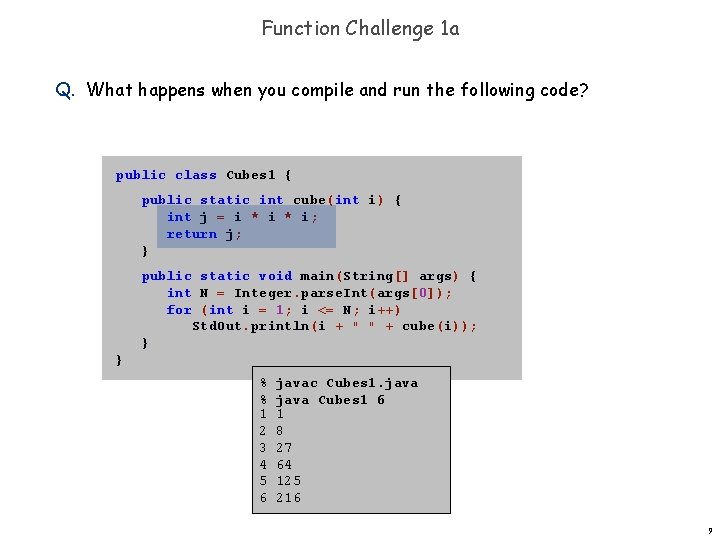
Function Challenge 1 a Q. What happens when you compile and run the following code? public class Cubes 1 { public static int cube(int i) { int j = i * i; return j; } public static void main(String[] args) { int N = Integer. parse. Int(args[0]); for (int i = 1; i <= N; i++) Std. Out. println(i + " " + cube(i)); } } % % 1 2 3 4 5 6 javac Cubes 1. java Cubes 1 6 1 8 27 64 125 216 9
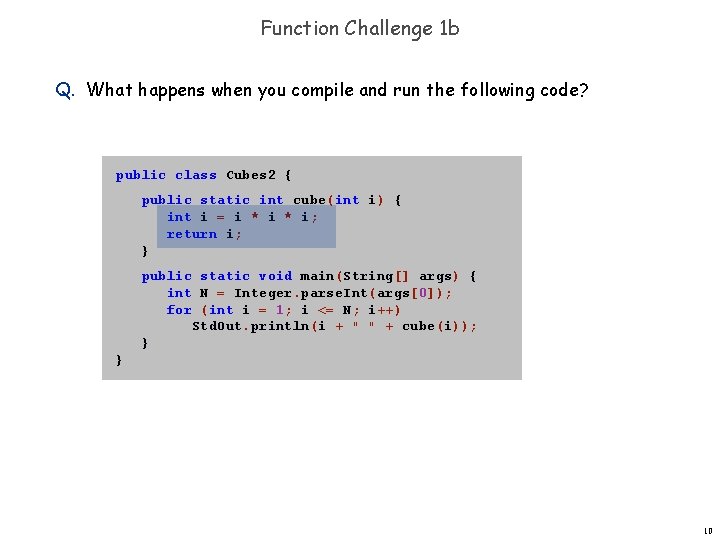
Function Challenge 1 b Q. What happens when you compile and run the following code? public class Cubes 2 { public static int cube(int i) { int i = i * i; return i; } public static void main(String[] args) { int N = Integer. parse. Int(args[0]); for (int i = 1; i <= N; i++) Std. Out. println(i + " " + cube(i)); } } 10
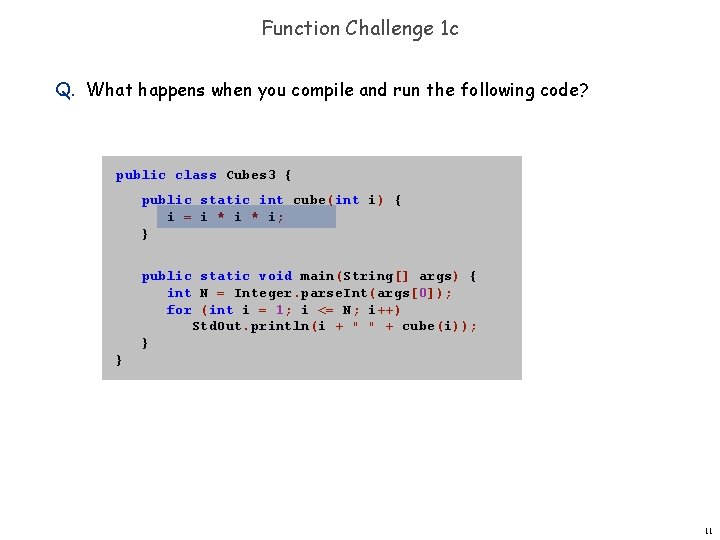
Function Challenge 1 c Q. What happens when you compile and run the following code? public class Cubes 3 { public static int cube(int i) { i = i * i; } public static void main(String[] args) { int N = Integer. parse. Int(args[0]); for (int i = 1; i <= N; i++) Std. Out. println(i + " " + cube(i)); } } 11
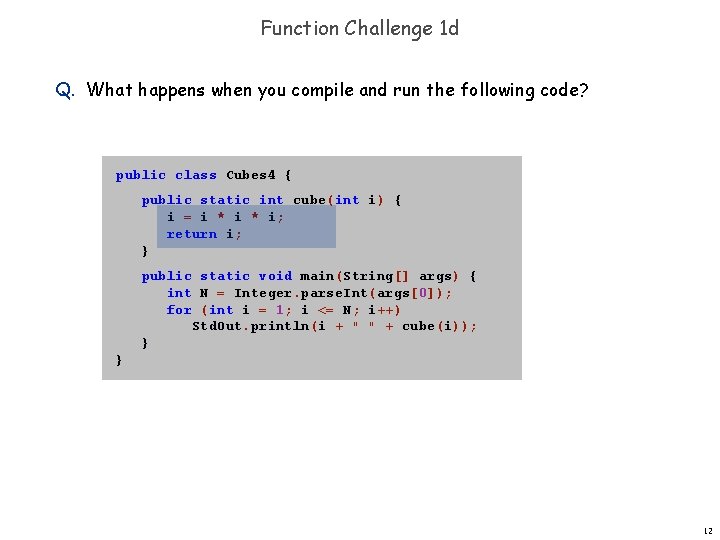
Function Challenge 1 d Q. What happens when you compile and run the following code? public class Cubes 4 { public static int cube(int i) { i = i * i; return i; } public static void main(String[] args) { int N = Integer. parse. Int(args[0]); for (int i = 1; i <= N; i++) Std. Out. println(i + " " + cube(i)); } } 12
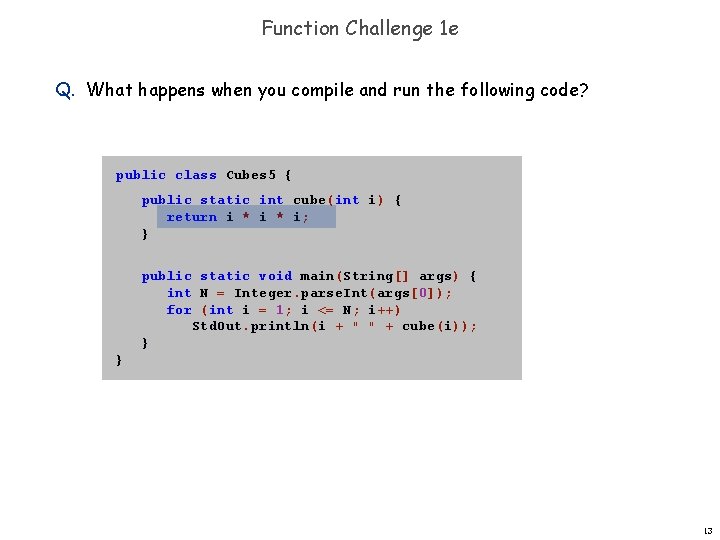
Function Challenge 1 e Q. What happens when you compile and run the following code? public class Cubes 5 { public static int cube(int i) { return i * i; } public static void main(String[] args) { int N = Integer. parse. Int(args[0]); for (int i = 1; i <= N; i++) Std. Out. println(i + " " + cube(i)); } } 13
Building Functions enable you to build a new layer of abstraction. Takes you beyond pre-packaged libraries. You build the tools you need: Gaussian. phi(), … Process. Step 1: identify a useful feature. Step 2: implement it. Step 3: use it. Step 3': re-use it in any of your programs. 14
Digital Audio
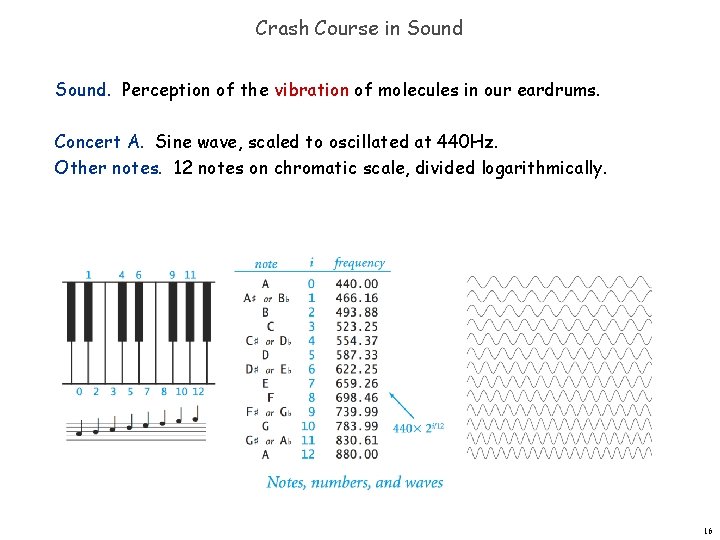
Crash Course in Sound. Perception of the vibration of molecules in our eardrums. Concert A. Sine wave, scaled to oscillated at 440 Hz. Other notes. 12 notes on chromatic scale, divided logarithmically. 16
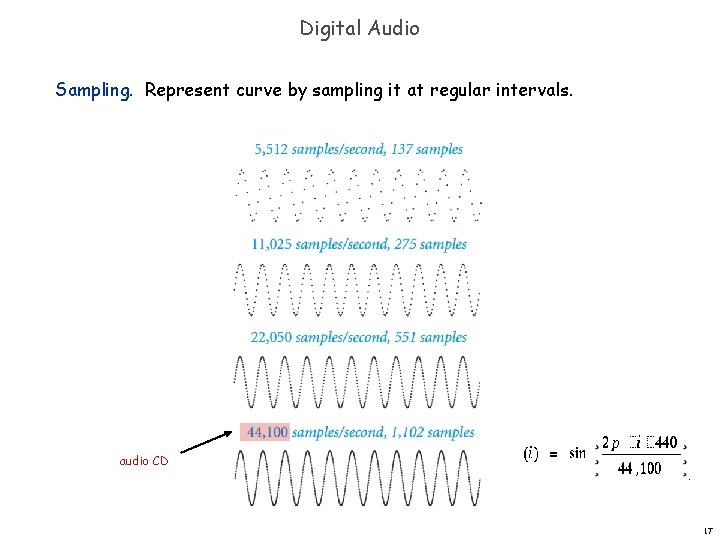
Digital Audio Sampling. Represent curve by sampling it at regular intervals. audio CD 17
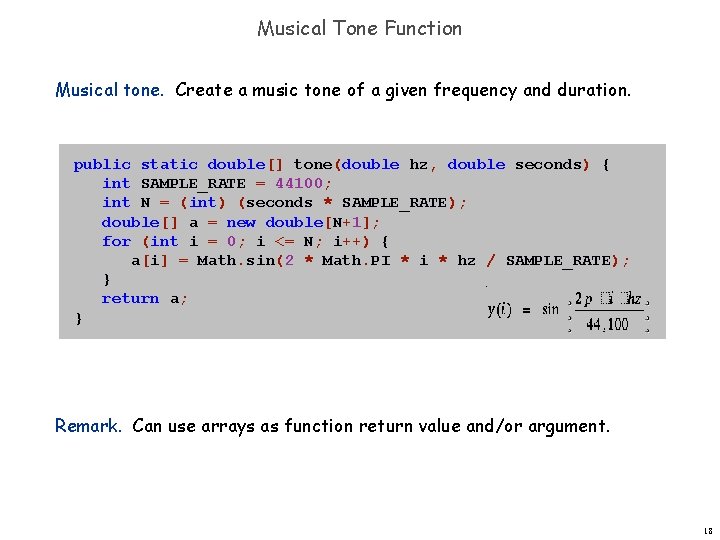
Musical Tone Function Musical tone. Create a music tone of a given frequency and duration. public static double[] tone(double hz, double seconds) { int SAMPLE_RATE = 44100; int N = (int) (seconds * SAMPLE_RATE); double[] a = new double[N+1]; for (int i = 0; i <= N; i++) { a[i] = Math. sin(2 * Math. PI * i * hz / SAMPLE_RATE); } return a; } Remark. Can use arrays as function return value and/or argument. 18
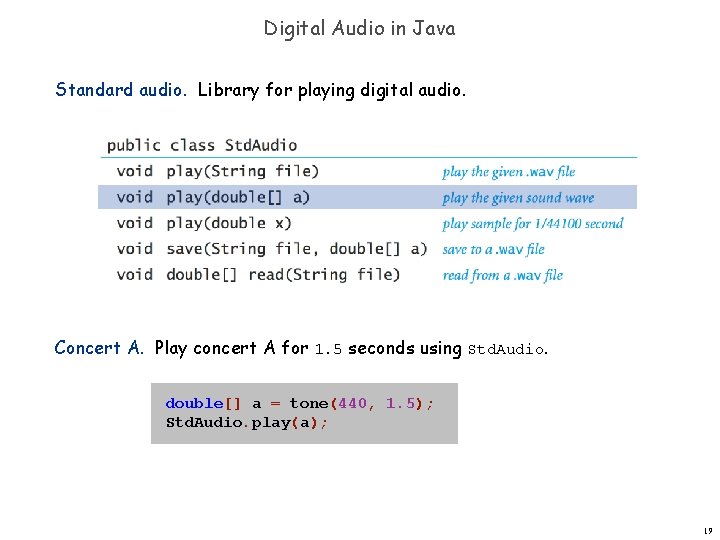
Digital Audio in Java Standard audio. Library for playing digital audio. Concert A. Play concert A for 1. 5 seconds using Std. Audio. double[] a = tone(440, 1. 5); Std. Audio. play(a); 19
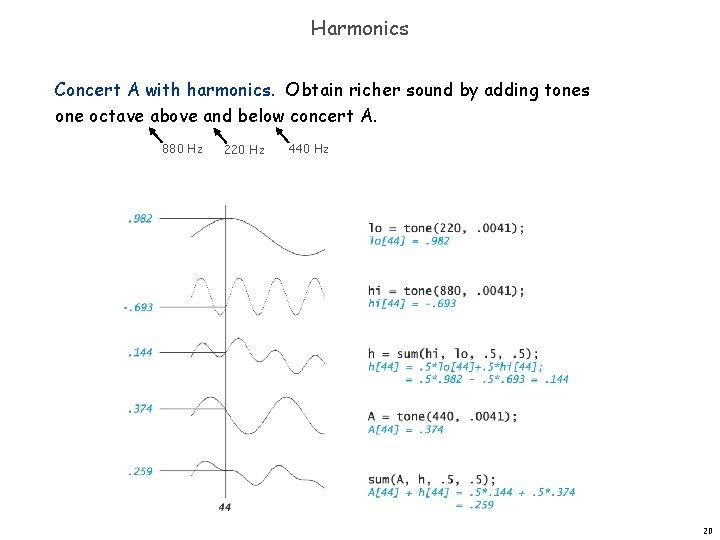
Harmonics Concert A with harmonics. Obtain richer sound by adding tones one octave above and below concert A. 880 Hz 220 Hz 440 Hz 20
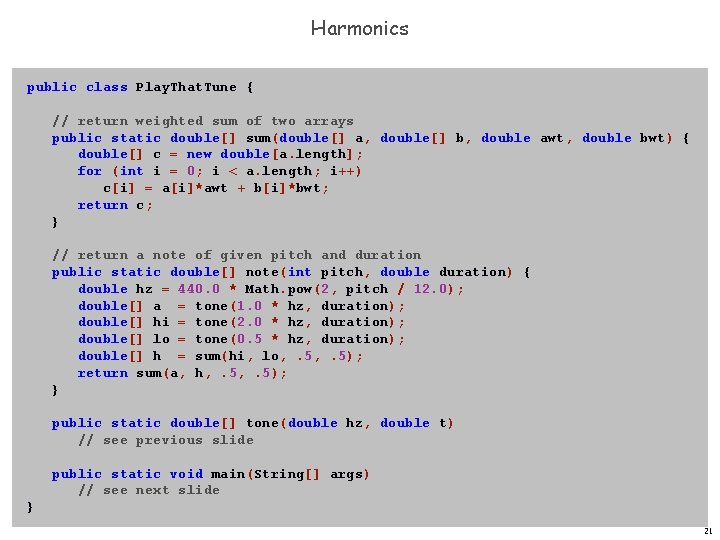
Harmonics public class Play. That. Tune { // return weighted sum of two arrays public static double[] sum(double[] a, double[] b, double awt, double bwt) { double[] c = new double[a. length]; for (int i = 0; i < a. length; i++) c[i] = a[i]*awt + b[i]*bwt; return c; } // return a note of given pitch and duration public static double[] note(int pitch, double duration) { double hz = 440. 0 * Math. pow(2, pitch / 12. 0); double[] a = tone(1. 0 * hz, duration); double[] hi = tone(2. 0 * hz, duration); double[] lo = tone(0. 5 * hz, duration); double[] h = sum(hi, lo, . 5); return sum(a, h, . 5); } public static double[] tone(double hz, double t) // see previous slide public static void main(String[] args) // see next slide } 21
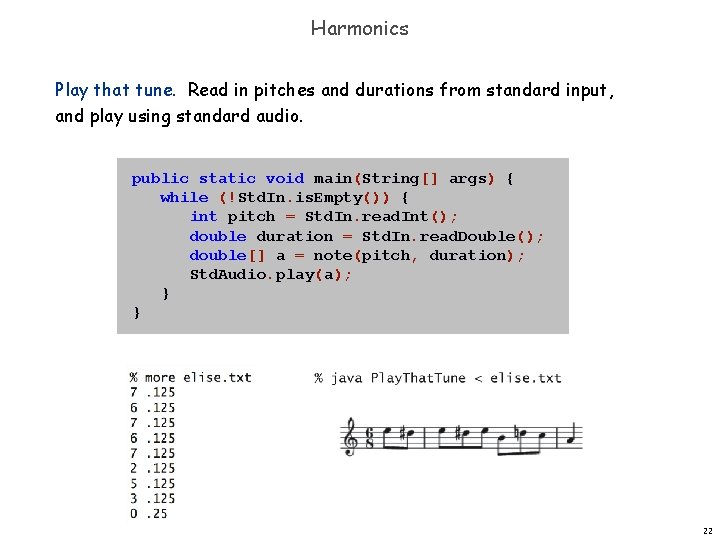
Harmonics Play that tune. Read in pitches and durations from standard input, and play using standard audio. public static void main(String[] args) { while (!Std. In. is. Empty()) { int pitch = Std. In. read. Int(); double duration = Std. In. read. Double(); double[] a = note(pitch, duration); Std. Audio. play(a); } } 22
23