
2 1 Conditional Statements StandardsObjectives l Students will
2. 1 Conditional Statements
Standards/Objectives: l Students will learn and apply geometric concepts. l Objectives: Recognize and analyze a conditional statement l Write postulates about points, lines, and planes using conditional statements. l
Conditional Statement l. A logical statement with 2 parts l 2 parts are called the hypothesis & conclusion l Can be written in “if-then” form; such as, “If…, then…”
Conditional Statement l Hypothesis is the part after the word “If” l Conclusion is the part after the word “then”
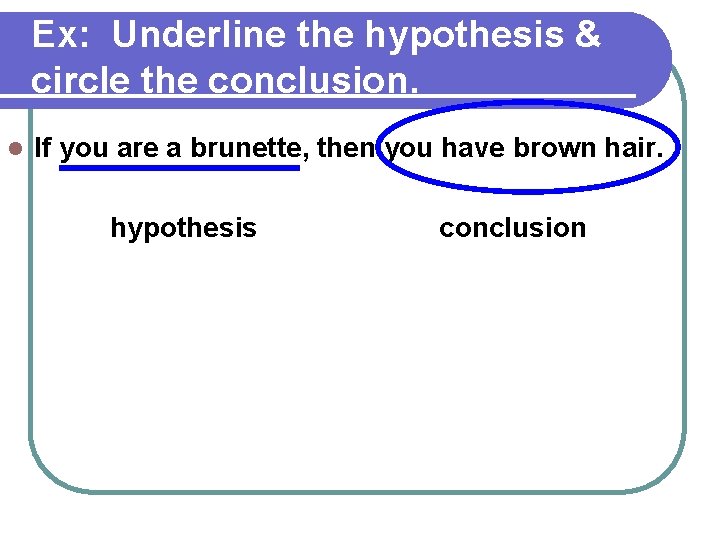
Ex: Underline the hypothesis & circle the conclusion. l If you are a brunette, then you have brown hair. hypothesis conclusion
Ex: Rewrite the statement in “if-then” form 1. Vertical angles are congruent. If the angles are vertical, then they are congruent. If 2 angles are vertical, then they are congruent.
Ex: Rewrite the statement in “if-then” form 2. An object weighs one ton if it weighs 2000 lbs. If an object weighs 2000 lbs, then it weighs one ton.
Converse l Switch the hypothesis & conclusion parts of a conditional statement. l Ex: Write the converse of “If you are a brunette, then you have brown hair. ” If you have brown hair, then you are a brunette.
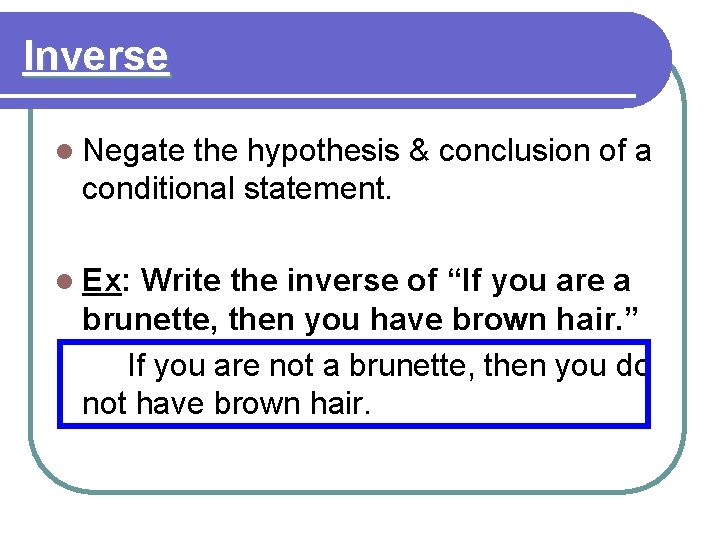
Inverse l Negate the hypothesis & conclusion of a conditional statement. l Ex: Write the inverse of “If you are a brunette, then you have brown hair. ” If you are not a brunette, then you do not have brown hair.
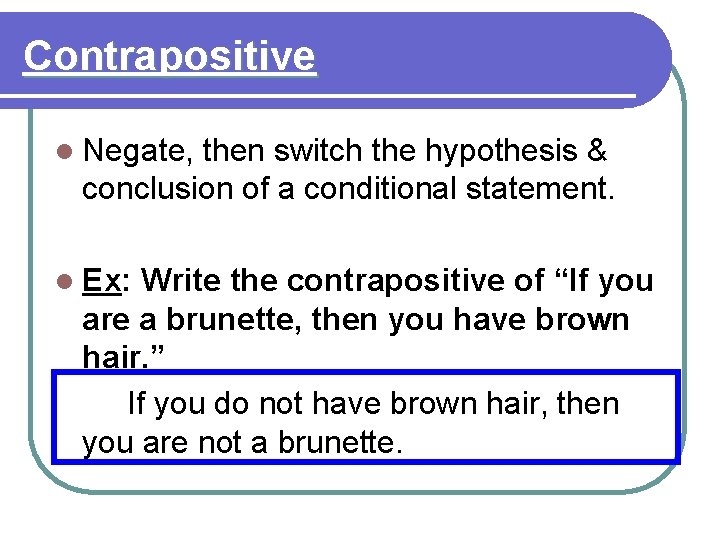
Contrapositive l Negate, then switch the hypothesis & conclusion of a conditional statement. l Ex: Write the contrapositive of “If you are a brunette, then you have brown hair. ” If you do not have brown hair, then you are not a brunette.
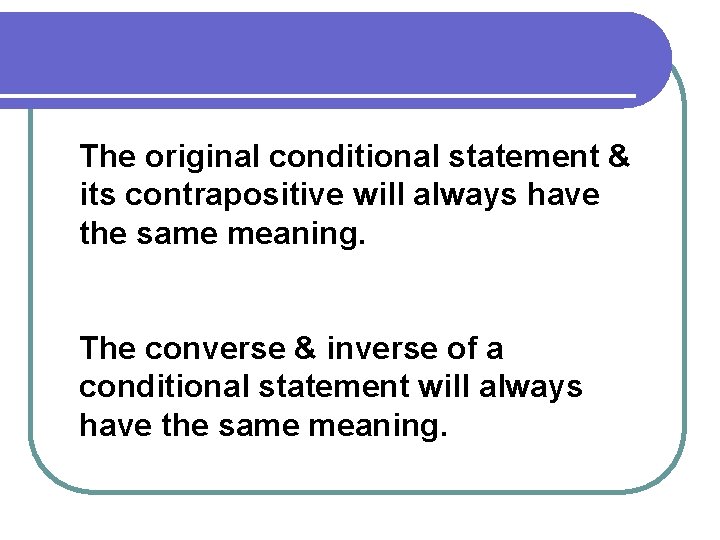
The original conditional statement & its contrapositive will always have the same meaning. The converse & inverse of a conditional statement will always have the same meaning.
- Slides: 11