
2 1 Causal Analysis and Problem Trees The
2. 1 Causal Analysis and Problem Trees
The TOC Process üData collection and analysis (identify problems) 2. Use causal analysis to create a problem tree You are here ! 3. Create a solution tree and identify pathways of change 4. Identify assumptions and articulate rationales 5. Prioritize outcomes the project will address 6. Identify intervention outputs 7. Transfer the TOC to the logframe 8. Identify indicators for TOC components 9. Complete complementary documentation 10. Review annually at minimum 2
Session Objectives • To understand how to used causal analysis to create a problem tree • To identify strong and weak causal linkages in sample problem trees • To practice drafting concise problem statements for all problem levels • To critically analyze and organize problems and causes into a logical flow 3
Holistic problem analysis • Improves ability to design and implement integrated programs that improve well-being outcomes. • does not mean bigger broader programs by one institution • is a non-sectoral or cross-sectoral approach • sectors and stakeholders working together to adopt complementary strategies to address common issues • Relies on rigorous causal analysis • the identification of common constraints and opportunities, feedback loops, and underlying causes of food and nutrition insecurity 4
Causal Analysis • Helps to understand why a key problem exists • Explores cause-effect pathways, including cross-causal linkages • Identifies specific causes that can be acted upon 5
Problem Trees • Represent a systems-thinking approach to analyzing cause and effect • helps to identify multiple causal linkages • Most critical (and overlooked) element of rigorous project design 6
Prioritize an Overarching Problem Overarching problems will be selected based primarily on such criteria as: • The significance or scope of the problem (i. e. , the number of people it impacts or the degree to which society considers it a serious problem) • The degree to which resolution of the problem will result in well-being for the impact group • In FFP-funded Activities the overarching problem is often pre-determined to be food and nutrition insecurity. 7
Identify key problems, underlying causes, contextual conditions Start with an inventory of problems/causes Then, organize/arrange/filter into: • Key problems – broad conditions that negatively affect people (e. g. , low income, poor health status), and contribute to an overarching problem. • Underlying / root causes – specific contributors to key problems (often the effects of other root causes). • Contextual conditions – social, economic, political, or natural conditions that contribute to underlying causes and often are the result of key problems (cycle of vulnerability). 8
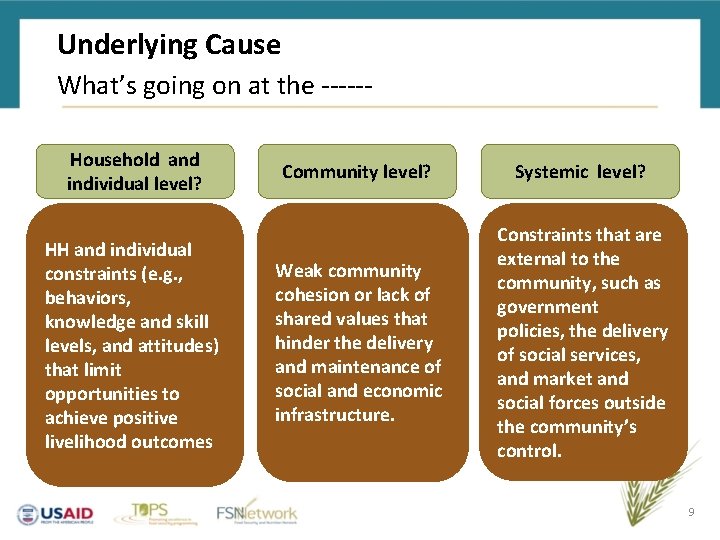
Underlying Cause What’s going on at the -----Household and individual level? HH and individual constraints (e. g. , behaviors, knowledge and skill levels, and attitudes) that limit opportunities to achieve positive livelihood outcomes Community level? Systemic level? Weak community cohesion or lack of shared values that hinder the delivery and maintenance of social and economic infrastructure. Constraints that are external to the community, such as government policies, the delivery of social services, and market and social forces outside the community’s control. 9
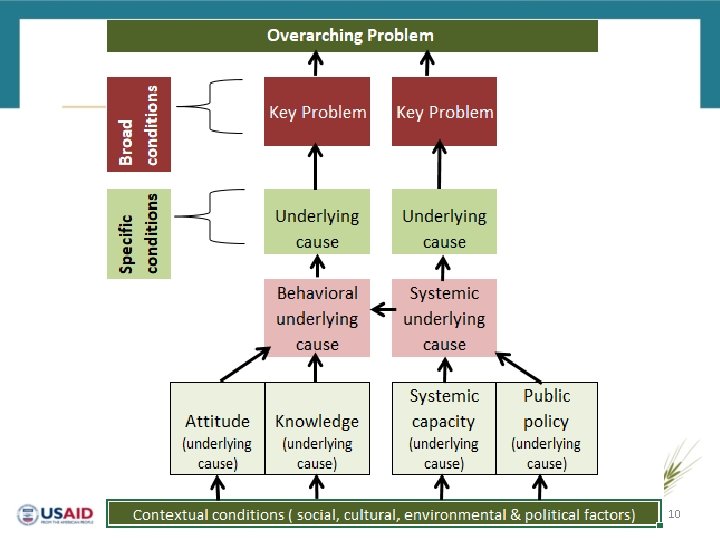
10
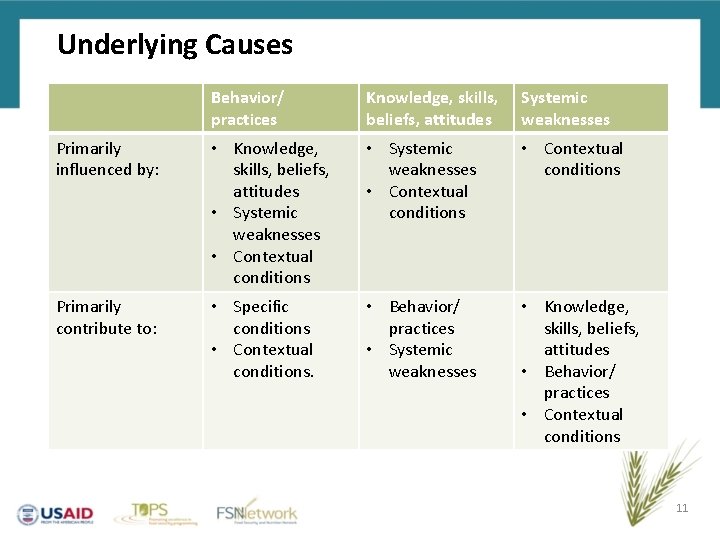
Underlying Causes Behavior/ practices Knowledge, skills, beliefs, attitudes Systemic weaknesses Primarily influenced by: • Knowledge, skills, beliefs, attitudes • Systemic weaknesses • Contextual conditions Primarily contribute to: • Specific conditions • Contextual conditions. • Behavior/ practices • Systemic weaknesses • Knowledge, skills, beliefs, attitudes • Behavior/ practices • Contextual conditions 11
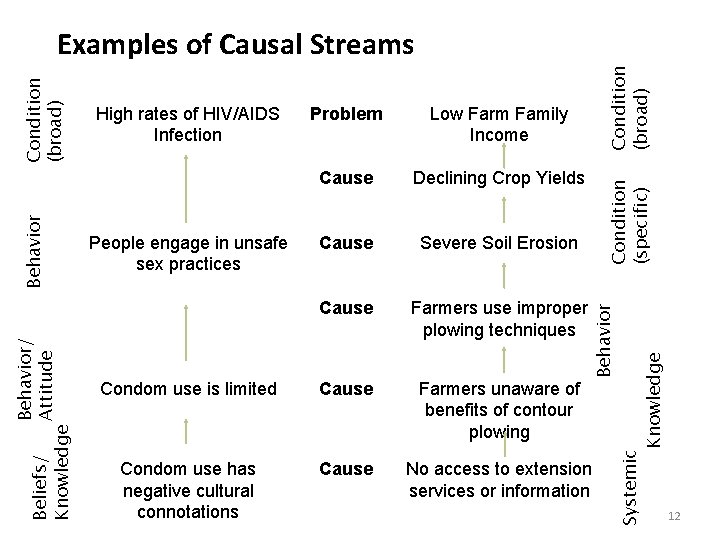
Condition (broad) Low Farm Family Income Cause Declining Crop Yields Cause Severe Soil Erosion Cause Farmers use improper plowing techniques Condom use is limited Cause Farmers unaware of benefits of contour plowing Condom use has negative cultural connotations Cause No access to extension services or information Knowledge People engage in unsafe sex practices Condition (specific) Problem Behavior High rates of HIV/AIDS Infection Systemic Beliefs/ Knowledge Behavior/ Attitude Behavior Condition (broad) Examples of Causal Streams 12
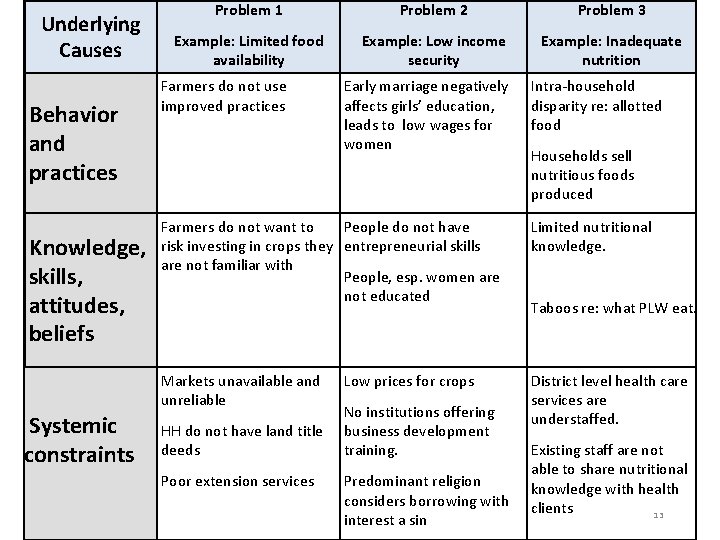
Underlying Causes Behavior and practices Knowledge, skills, attitudes, beliefs Systemic constraints Problem 1 Problem 2 Problem 3 Example: Limited food availability Example: Low income security Example: Inadequate nutrition Farmers do not use improved practices Early marriage negatively affects girls’ education, leads to low wages for women Intra-household disparity re: allotted food Households sell nutritious foods produced Farmers do not want to People do not have risk investing in crops they entrepreneurial skills are not familiar with People, esp. women are not educated Limited nutritional knowledge. Markets unavailable and unreliable District level health care services are understaffed. HH do not have land title deeds Poor extension services Low prices for crops No institutions offering business development training. Predominant religion considers borrowing with interest a sin Taboos re: what PLW eat. Existing staff are not able to share nutritional knowledge with health clients 13
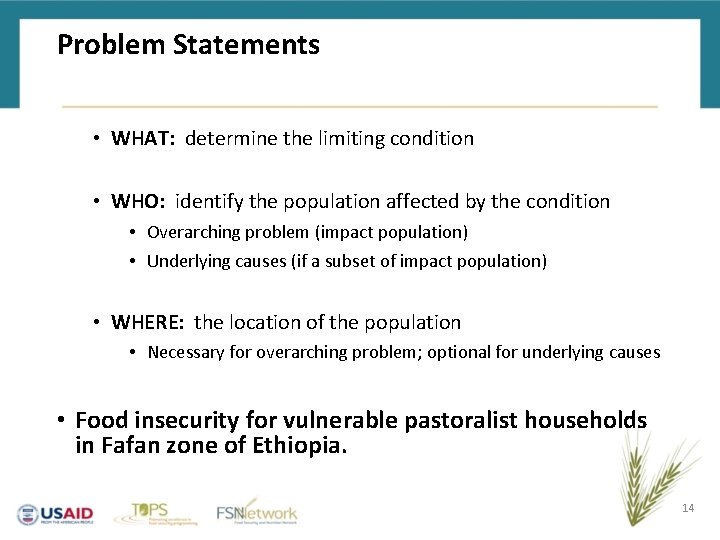
Problem Statements • WHAT: determine the limiting condition • WHO: identify the population affected by the condition • Overarching problem (impact population) • Underlying causes (if a subset of impact population) • WHERE: the location of the population • Necessary for overarching problem; optional for underlying causes • Food insecurity for vulnerable pastoralist households in Fafan zone of Ethiopia. 14
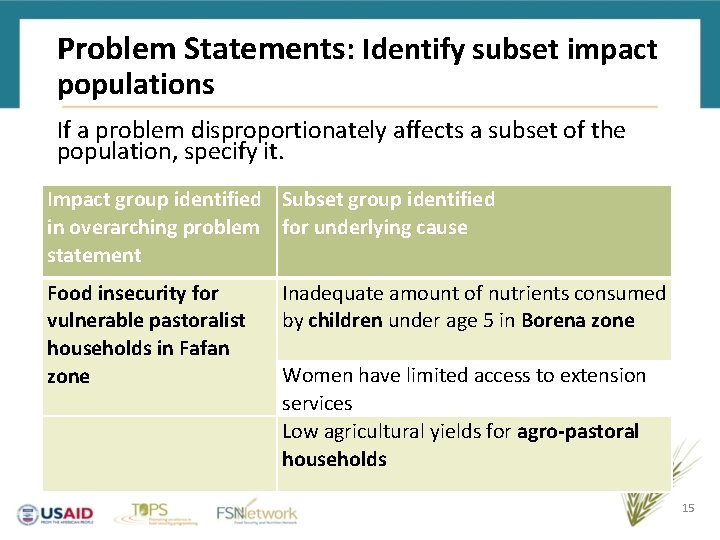
Problem Statements: Identify subset impact populations If a problem disproportionately affects a subset of the population, specify it. Impact group identified Subset group identified in overarching problem for underlying cause statement Food insecurity for vulnerable pastoralist households in Fafan zone Inadequate amount of nutrients consumed by children under age 5 in Borena zone Women have limited access to extension services Low agricultural yields for agro-pastoral households 15
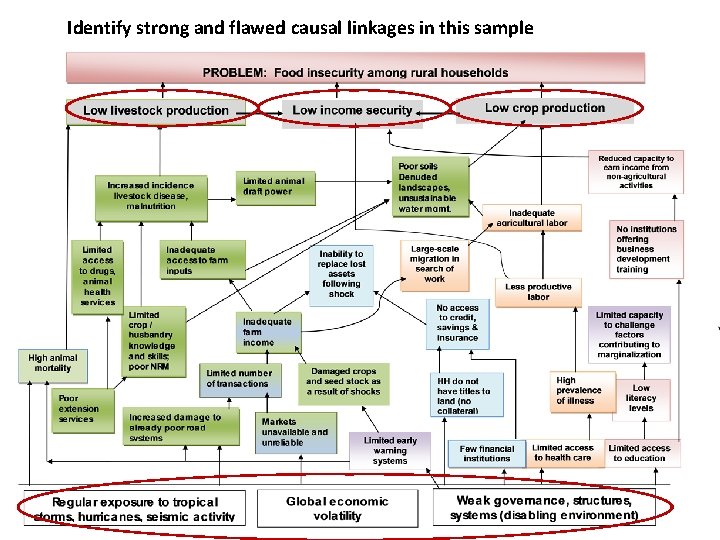
Identify strong and flawed causal linkages in this sample 16
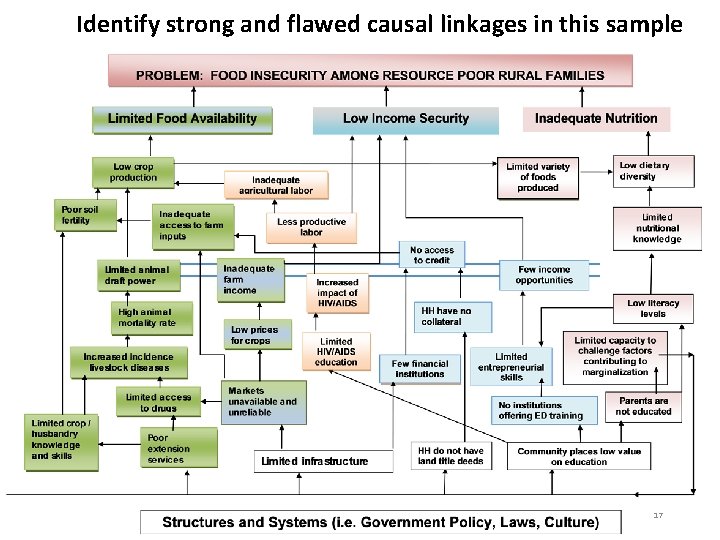
Identify strong and flawed causal linkages in this sample 17
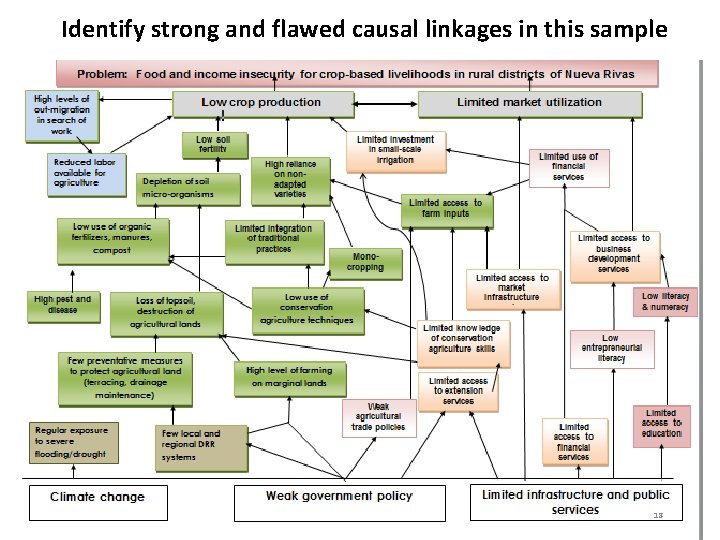
Identify strong and flawed causal linkages in this sample 18
Summary • Different populations or different regions may appear to have the same broad categories of problems, yet it is critical that we identify context-specific underlying causes. • Causes occur at multiple levels (household, community, and systems) and in various forms (behaviors/ practices; knowledge, skills, attitudes, beliefs; and systemic weaknesses). • A problem tree helps us to visualize the non-linear causal logic of problematic conditions. • A problem tree with strong causal logic can be easily transformed into a TOC with strong causal logic. 19
Group Activity 2. 1 Create a problem tree • Use your group’s preliminary analysis 1. Prioritize an overarching problem and write a problem statement: • WHAT: Determine the condition the project is intended to address. • WHO: Identify the population affected by the condition (e. g. , target population). • WHERE: The area or location of the population. 2. Identify key problems (broad conditions) and draft concise statements. 20
Group Activity 2. 1 Create a problem tree • 3) Document underlying causes on sticky notes • Write as concise statements • Make it clear if a problem disproportionately affects a subset population • Be sure to include the various types of causes (systemic; knowledge, skills, attitudes, beliefs; behavior/practices) • Note the evidence base for each identified cause. If supporting data do not exist in your data set, note the data gap on the flip chart! 21
Group Activity 2. 1 Create a problem tree • 4) Begin causal analysis to develop the problem tree • Organize causes to demonstrate how they occur sequentially or simultaneously. • Start by putting contextual constraints at the bottom of the tree. • Next work your way down from the key problems • Ask “ what are the key reasons problem X exists? ” Keep asking “any other reason”, until all causes that can explain most of the problem are identified. 22
Group Activity 2. 1 Create a problem tree • 4) Once a causal stream is in place re-check causal logic: • Move down the stream using statements such as “Condition X exists……. because of Condition Y”. For example, there is a high prevalence of livestock disease because there is limited adoption of improved husbandry practice. • There is limited adoption of improved husbandry practices because there is limited access to animal health care supplies (deworming meds; vaccinations, etc. ) and limited knowledge of how to protect livestock health • Check causal logic moving up the stream, e. g. , Condition X and Condition Y and Condition Z are the main reasons Condition A exists. • 5) Check the balance of types of constraints 23
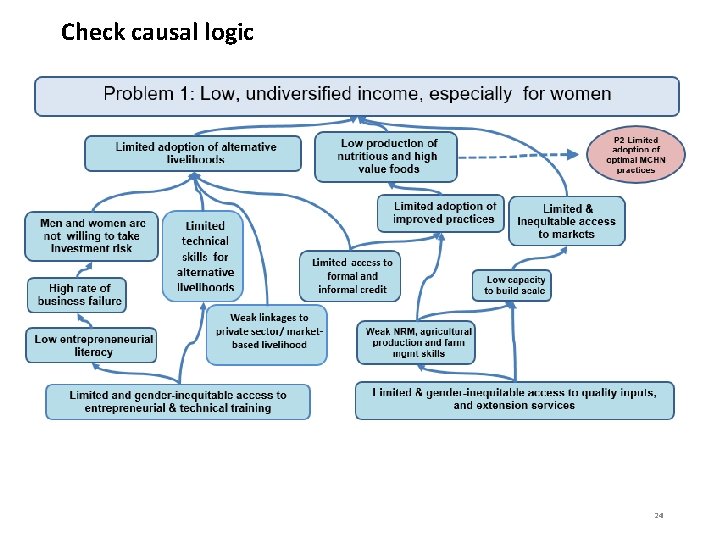
Check causal logic 24
Group Activity 2. 1 Create a problem tree • 6) Once the logic begins to hold, capture the problem tree in an electronic format • If the diagram cannot fit legibly on one page, create a separate page for each key problem. • Be sure to show the problems link to one another across pages. (Handout 2. 1 c) 25
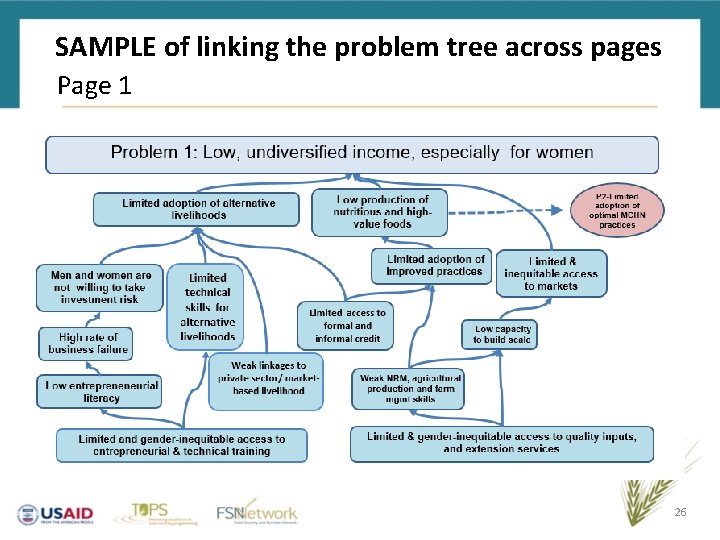
SAMPLE of linking the problem tree across pages Page 1 26
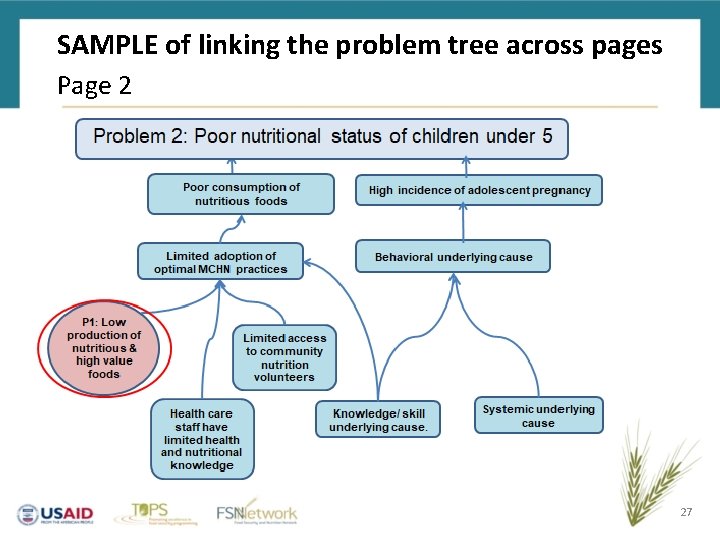
SAMPLE of linking the problem tree across pages Page 2 27
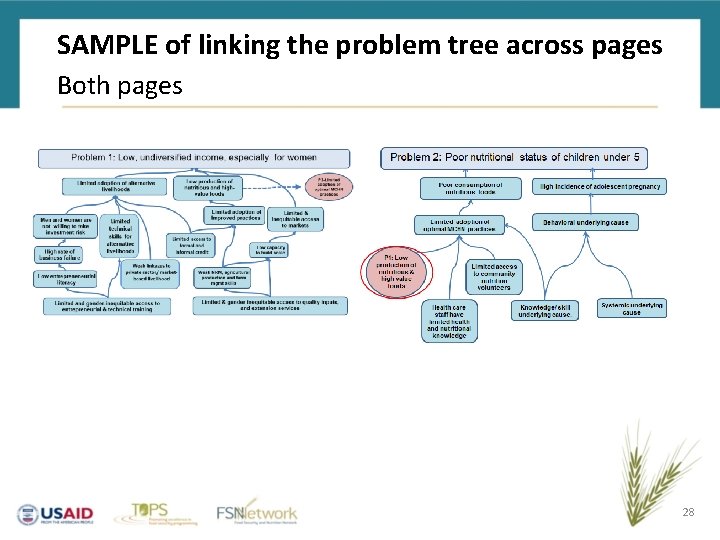
SAMPLE of linking the problem tree across pages Both pages 28
- Slides: 29