
2 1 1 Orange County Homeless Management Information
- Slides: 63
2 -1 -1 Orange County Homeless Management Information System (HMIS) HMIS Training Part III Data Validation 211 Orange County 1
Housekeeping The class is interactive – don’t expect to just sit and listen. You need to participate. OCHMIS. org 211 Orange County 2
What’s in Your Folder? • • Data Validation Power. Point HMIS Data Quality Checklist – Long HMIS Data Quality Checklist – Short HMIS Fake Client Scenario 211 Orange County 3
Goals/Objectives At the end of this 2 hour training, you will be able to: • Understand HUD’s definitions – Disabling condition – Chronically homeless – Housing Status • Review client case scenarios • Validate the HMIS Client Intake/Assessment/Exit Forms • Validate data entered from the HMIS forms in HMIS OCHMIS. org 211 Orange County 4
Agenda • Review HUD’s disabling conditions, homeless and chronically homeless definitions • Review Client Intake Forms • Enter client’s demographics and program enrollment • Review Annual Assessment • Enter Annual Assessments in HMIS • Updating Snapshots • Review Client Exit Forms • Exit clients out of program • Review Data Quality Checklist OCHMIS. org 211 Orange County 5
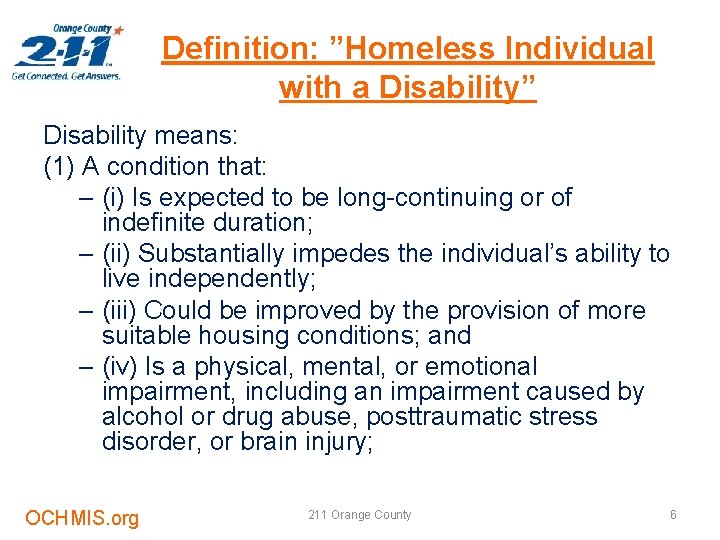
Definition: ”Homeless Individual with a Disability” Disability means: (1) A condition that: – (i) Is expected to be long continuing or of indefinite duration; – (ii) Substantially impedes the individual’s ability to live independently; – (iii) Could be improved by the provision of more suitable housing conditions; and – (iv) Is a physical, mental, or emotional impairment, including an impairment caused by alcohol or drug abuse, posttraumatic stress disorder, or brain injury; OCHMIS. org 211 Orange County 6
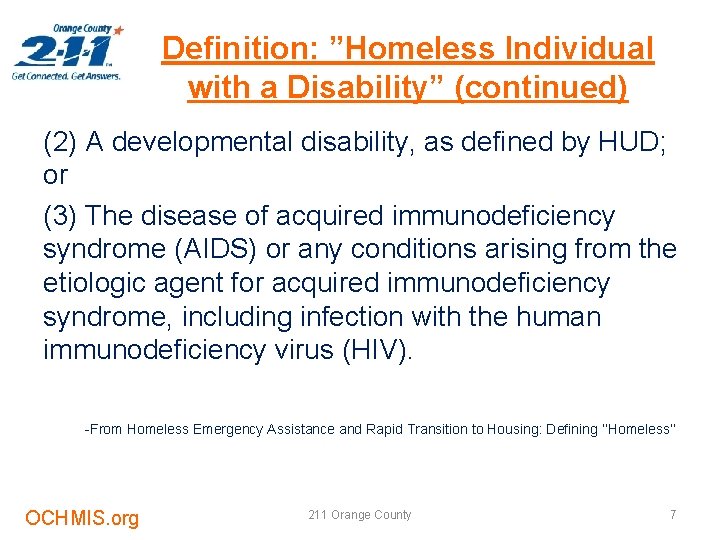
Definition: ”Homeless Individual with a Disability” (continued) (2) A developmental disability, as defined by HUD; or (3) The disease of acquired immunodeficiency syndrome (AIDS) or any conditions arising from the etiologic agent for acquired immunodeficiency syndrome, including infection with the human immunodeficiency virus (HIV). From Homeless Emergency Assistance and Rapid Transition to Housing: Defining ‘‘Homeless’’ OCHMIS. org 211 Orange County 7
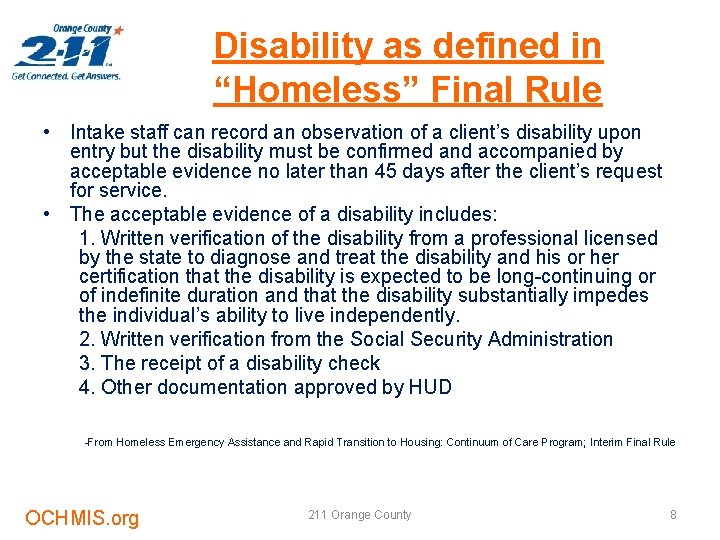
Disability as defined in “Homeless” Final Rule • Intake staff can record an observation of a client’s disability upon entry but the disability must be confirmed and accompanied by acceptable evidence no later than 45 days after the client’s request for service. • The acceptable evidence of a disability includes: 1. Written verification of the disability from a professional licensed by the state to diagnose and treat the disability and his or her certification that the disability is expected to be long continuing or of indefinite duration and that the disability substantially impedes the individual’s ability to live independently. 2. Written verification from the Social Security Administration 3. The receipt of a disability check 4. Other documentation approved by HUD From Homeless Emergency Assistance and Rapid Transition to Housing: Continuum of Care Program; Interim Final Rule OCHMIS. org 211 Orange County 8
Definition: Chronically Homeless Effective January 15, 2016: 1) A “homeless individual with a disability, ” as defined in the Act, who: • Lives in a place not meant for human habitation, a safe haven, or in an emergency shelter; and • Has been homeless (as described above) continuously for at least 12 months or on at least 4 separate occasions in the last 3 years where the combined occasions must total at least 12 months – Occasions separated by a break of at least seven nights – Stays in institution of fewer than 90 days does not constitute a break (Amends 24 CFR 91. 5 and 24 CFR 578. 3) From Homeless Emergency Assistance and Rapid Transition to Housing: Defining “Chronically Homeless” Final Rule Webinar OCHMIS. org 211 Orange County 9
Definition: Chronically Homeless (continued) 2) An individual who has been residing in an institutional care facility for fewer than 90 days and met all of the criteria in paragraph (1) of this definition, before entering that facility; or 3) A family with an adult head of household (or if there is no adult in the family, a minor head of household) who meets all of the criteria in paragraphs (1) or (2) of this definition, including a family whose composition has fluctuated while the head of household has been homeless. OCHMIS. org 211 Orange County 10
Definition: Summary of Major Changes to Chronically Homeless (continued) • Four occasions must total 12 months • Replaced “disabling condition” with “homeless individual with a disability” • Occasion is defined by a break of at least seven nights not residing in an emergency shelter, safe haven, or residing in a place meant for human habitation • Stays in institution of fewer than 90 days do not constitute a break and count toward total time homeless • New Recordkeeping Requirements under Co. C Program OCHMIS. org 211 Orange County 11
Record Requirements for Defintion of Chronically Homeless (continued) • Applies to any Co. C Program funded PSH that is required to serve the chronically homeless • Consistent with recordkeeping requirements established in Notice CPD 14 012 • Creates a reasonable, uniform standard to ensure consistency in how chronic homelessness is documented OCHMIS. org 211 Orange County 12
Documenting Chronically Homeless Status: Written Intake Procedures • Required for all PSH projects that dedicate or prioritize beds for chronically homeless individuals or families • The recipient must maintain and follow written intake procedures that – Require documentation at intake of the evidence relied on to verify status – Establish the following order of priority for obtaining evidence: • Third party • Intake worker observation • Certification from the person seeking assistance OCHMIS. org 211 Orange County 13
Documenting Chronically Homeless Status: Third Party Documentation • Documenting an individual’s time in a place not meant for human habitation, an emergency shelter, or a safe haven. • Third party documentation is preferred; however: – For all clients, up to 3 months can be documented through self certification – In limited circumstances, up to the full 12 months can be obtained through self certification OCHMIS. org 211 Orange County 14
Documenting Chronically Homeless Status: Third Party Documentation (continued) • Documenting an individual’s time in a place not meant for human habitation, an emergency shelter, or a safe haven. – Single encounter in month is sufficient to consider household homeless for entire month unless evidence of a break – If third party documentation cannot be obtained, a written record of intake worker’s due diligence to obtain, the intake worker’s documentation of the living situation, AND the individual’s self certification of the living situation OCHMIS. org 211 Orange County 15
Documenting Chronically Homeless Status: Documenting Breaks • Evidence of a break can be documented by: – Third party evidence – The self report of the individual seeking assistance – 100% of the breaks can be documented by self report OCHMIS. org 211 Orange County 16
Documenting Chronically Homeless Status: Institutional Stays • Discharge paperwork or written or oral referral from a social worker, case manager, or other appropriate official stating the beginning and end dates of the time residing in the institutional care facility • Where the above is not attainable, a written record of intake workers due diligence to obtain AND the individual’s self certification that he or she is exiting an institutional care facility where resided less than 90 days OCHMIS. org 211 Orange County 17
Documenting Chronically Homeless Status: A Homeless History 12 Months Continuous • Start by looking in HMIS to determine if there are 12 months of continuous homelessness and no evidence of break (i. e. , HMIS record of stay in transitional housing) – Ex. If there is evidence of at least one night in shelter each month for the last 12 months, it is not necessary to ask about breaks • If there are not 12 months in HMIS but client reports that they have been homeless for the last 12 months with no breaks, identify other third party sources (i. e. , outreach worker, other professional source) – Ex. There are 8 months documented in HMIS over the last year but intake worker can obtain discharge paperwork or a written certification from mental health professional for at least one other month of a stay in an institution and self certification for up to 3 months. It is not necessary to ask about breaks. OCHMIS. org 211 Orange County 18
Documenting Chronically Homeless Status: A Homeless History (continued) 12 Months Cumulative • Start by looking in HMIS to determine if there are 12 months of cumulative homelessness over the last 3 years. – Ex. There is evidence of at least one night in shelter for 12 months over the last 18 months. • If there are not 12 months in HMIS but client reports that they have been homeless for the last 12 months in the last three years, identify other third party sources (i. e. , outreach worker, other professional source) • Next, identify any documented breaks in HMIS (i. e. , stay in transitional housing). • If there are fewer than 3 breaks found in HMIS, with client to identify breaks between four occasions (current experience counts as one occasion). OCHMIS. org 211 Orange County 19
Documenting Chronically Homeless Status: A Homeless History (continued) • If at least 9 months of homelessness (cumulative or continuous) cannot be obtained by third party documentation, up to the full 12 months can be documented via self certification only: – Must thoroughly document attempts to obtain third party documentation and why third party documentation was not obtained – Must obtain a written certification from individual or head of household of the living situation of the undocumented time period – Limited to rare and extreme cases and no more than 25 percent of households served in an operating year OCHMIS. org 211 Orange County 20
Documenting Chronically Homeless Status: Disability • Must be third party, and includes: – Written verification from a professional licensed by the State to diagnose and treat the disability and certification that the disability is expected to be long continuing or of indefinite duration and substantially impedes the individual’s ability to live independently – Written verification from SSA – The receipt of a disability check – Intake staff recorded observation of a disability that is confirmed and accompanied by evidence above within 45 days OCHMIS. org 211 Orange County 21
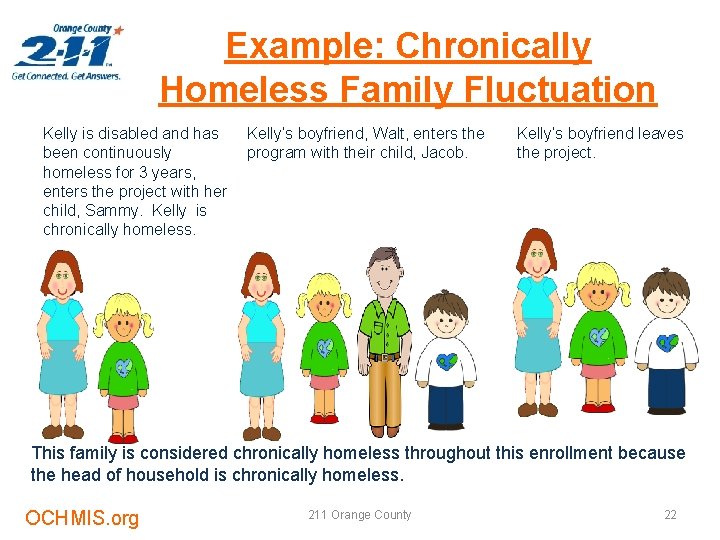
Example: Chronically Homeless Family Fluctuation Kelly is disabled and has Kelly’s boyfriend, Walt, enters the been continuously program with their child, Jacob. homeless for 3 years, enters the project with her child, Sammy. Kelly is chronically homeless. Kelly’s boyfriend leaves the project. Mark Lisa This family is considered chronically homeless throughout this enrollment because the head of household is chronically homeless. OCHMIS. org 211 Orange County 22
Housing Status – Category 1 - Homeless “Category 1 – Homeless” An individual or family who lacks a fixed, regular, and adequate nighttime residence, meaning: (i) An individual or family with a primary nighttime residence that is a public or private place not designed for or ordinarily used as a regular sleeping accommodation for human beings, including a car, park, abandoned building, bus or train station, airport, or camping ground; OR (ii) An individual or family living in a supervised publicly or privately operated shelter designated to provide temporary living arrangements (including congregate shelters, transitional housing, and hotels and motels paid for by charitable organizations or by federal, state, or local government programs for low income individuals); OR (iii) An individual who is exiting an institution where he or she resided for 90 days or less and who resided in an emergency shelter or place not meant for human habitation immediately before entering that institution. OCHMIS. org 211 Orange County 23
Housing Status – Category 2 – At Imminent Risk of losing housing “Category 2 – At imminent risk of losing housing” Housing Loss in 14 Days: An individual or family who will imminently lose their primary nighttime residence 1 provided that: (i) The primary nighttime residence will be lost within 14 days of the date of their application for homeless assistance; AND (ii) No subsequent residence has been identified; AND (iii) The individual or family lacks the resources or support network, e. g. , family, friends, faith based or other social networks needed to obtain other permanent housing. 1 A primary nighttime residence may include housing an individual or family owns, rents, or lives in without paying rent, are sharing with others, and rooms in hotels or motels not paid for by federal, state, or local government programs for low income individuals or by charitable organizations. 211 Orange County 24
Housing Status – Category 3 “Category 3 – Homeless only under other federal statutes” • This does not apply to the Orange County Co. C. 211 Orange County 25
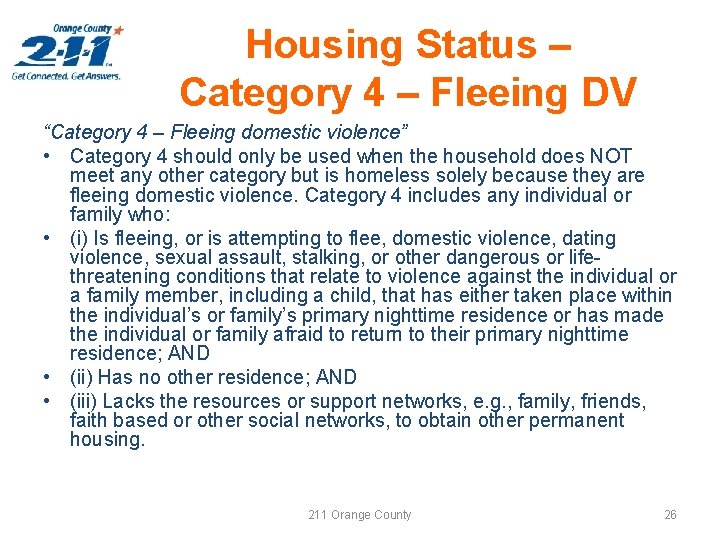
Housing Status – Category 4 – Fleeing DV “Category 4 – Fleeing domestic violence” • Category 4 should only be used when the household does NOT meet any other category but is homeless solely because they are fleeing domestic violence. Category 4 includes any individual or family who: • (i) Is fleeing, or is attempting to flee, domestic violence, dating violence, sexual assault, stalking, or other dangerous or life threatening conditions that relate to violence against the individual or a family member, including a child, that has either taken place within the individual’s or family’s primary nighttime residence or has made the individual or family afraid to return to their primary nighttime residence; AND • (ii) Has no other residence; AND • (iii) Lacks the resources or support networks, e. g. , family, friends, faith based or other social networks, to obtain other permanent housing. 211 Orange County 26
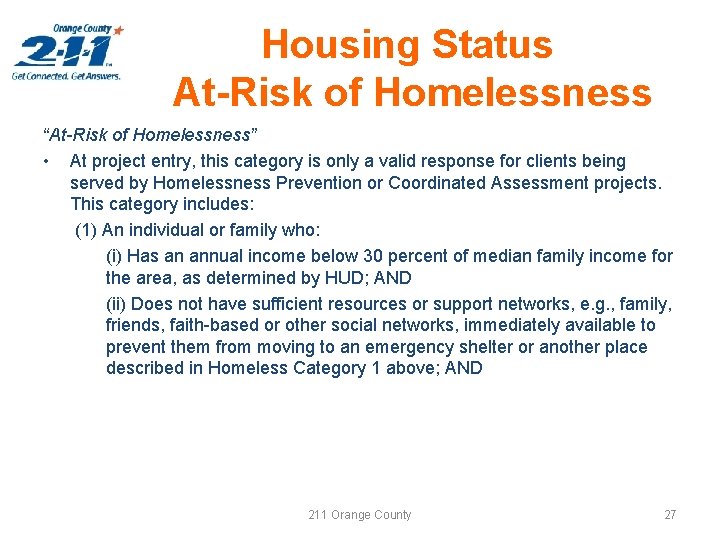
Housing Status At-Risk of Homelessness “At-Risk of Homelessness” • At project entry, this category is only a valid response for clients being served by Homelessness Prevention or Coordinated Assessment projects. This category includes: (1) An individual or family who: (i) Has an annual income below 30 percent of median family income for the area, as determined by HUD; AND (ii) Does not have sufficient resources or support networks, e. g. , family, friends, faith based or other social networks, immediately available to prevent them from moving to an emergency shelter or another place described in Homeless Category 1 above; AND 211 Orange County 27
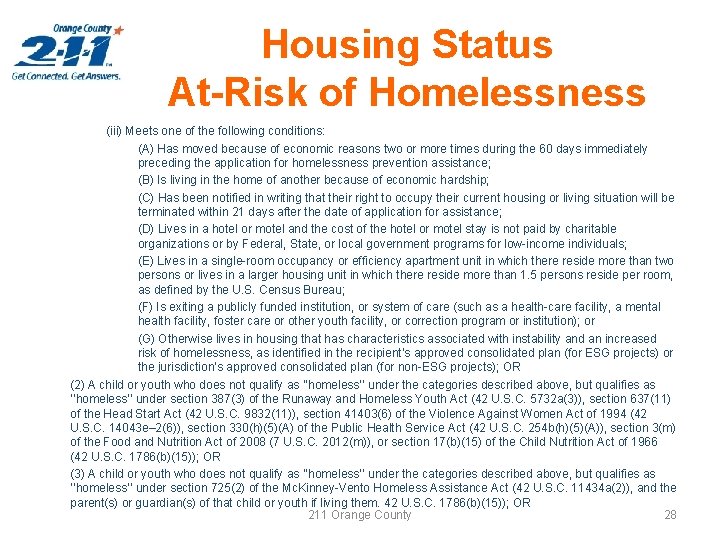
Housing Status At-Risk of Homelessness (iii) Meets one of the following conditions: (A) Has moved because of economic reasons two or more times during the 60 days immediately preceding the application for homelessness prevention assistance; (B) Is living in the home of another because of economic hardship; (C) Has been notified in writing that their right to occupy their current housing or living situation will be terminated within 21 days after the date of application for assistance; (D) Lives in a hotel or motel and the cost of the hotel or motel stay is not paid by charitable organizations or by Federal, State, or local government programs for low income individuals; (E) Lives in a single room occupancy or efficiency apartment unit in which there reside more than two persons or lives in a larger housing unit in which there reside more than 1. 5 persons reside per room, as defined by the U. S. Census Bureau; (F) Is exiting a publicly funded institution, or system of care (such as a health care facility, a mental health facility, foster care or other youth facility, or correction program or institution); or (G) Otherwise lives in housing that has characteristics associated with instability and an increased risk of homelessness, as identified in the recipient’s approved consolidated plan (for ESG projects) or the jurisdiction’s approved consolidated plan (for non ESG projects); OR (2) A child or youth who does not qualify as ‘‘homeless’’ under the categories described above, but qualifies as ‘‘homeless’’ under section 387(3) of the Runaway and Homeless Youth Act (42 U. S. C. 5732 a(3)), section 637(11) of the Head Start Act (42 U. S. C. 9832(11)), section 41403(6) of the Violence Against Women Act of 1994 (42 U. S. C. 14043 e– 2(6)), section 330(h)(5)(A) of the Public Health Service Act (42 U. S. C. 254 b(h)(5)(A)), section 3(m) of the Food and Nutrition Act of 2008 (7 U. S. C. 2012(m)), or section 17(b)(15) of the Child Nutrition Act of 1966 (42 U. S. C. 1786(b)(15)); OR (3) A child or youth who does not qualify as ‘‘homeless’’ under the categories described above, but qualifies as ‘‘homeless’’ under section 725(2) of the Mc. Kinney Vento Homeless Assistance Act (42 U. S. C. 11434 a(2)), and the parent(s) or guardian(s) of that child or youth if living them. 42 U. S. C. 1786(b)(15)); OR 211 Orange County 28
Housing Status – Stably Housed “Stably Housed” • An individual or family who is not otherwise experiencing homelessness or at risk of homelessness according to the categories above. 211 Orange County 29
Clients Who Do Not Meet the Homeless Definition • Persons living in housing, even though they are paying an excessive amount for their housing, the housing is substandard and in need of repair, or the housing is crowded. • Persons living with relatives or friends. • Persons staying in a motel, including a pay by the week motels. • Persons living in a Board and Care, Adult Congregate Living Facility, or similar place. • Persons being discharged from an institution that is required to provide or arrange housing upon release. • Wards of the State, although youth in foster care may receive needed supportive services which supplements, but does not substitute for, the state’s assistance. OCHMIS. org 211 Orange County 30
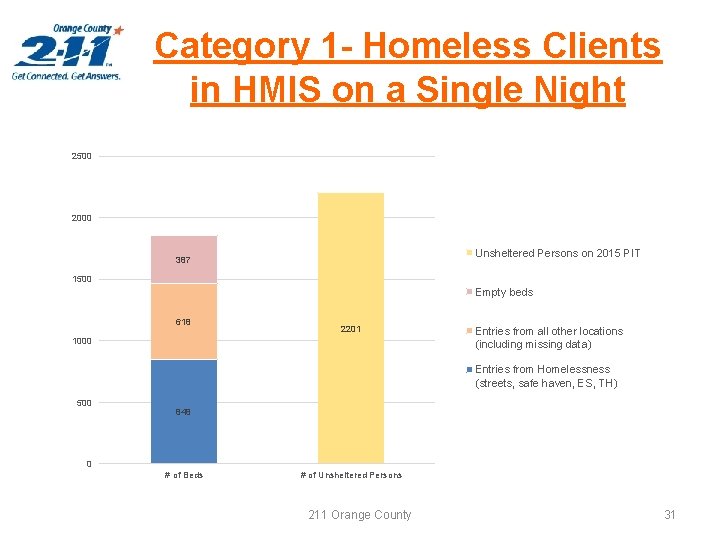
Category 1 - Homeless Clients in HMIS on a Single Night 2500 2000 Unsheltered Persons on 2015 PIT 387 1500 Empty beds 618 2201 1000 Entries from all other locations (including missing data) Entries from Homelessness (streets, safe haven, ES, TH) 500 848 0 # of Beds # of Unsheltered Persons 211 Orange County 31
Pop Quiz #1 • Ms. Reyes was liv ing in a studio apartment until 75% of the building burned down in a fire. She’s been “couch surfing”—spending a few nights at a cousin’s apartment, then a few nights at her brother’s house, etc. —for the past three weeks. Is Ms. Reyes homeless? Ms. Reyes would NOT be considered home less. Though she is “couch surfing”, which implies no fixed or regular housing, she is not spending her nights in a shelter, an institution, or a place “not designed for, or ordinarily used as, a regular sleeping accommodation for human beings. ” 211 Orange County 32
Pop Quiz #2 • Mr. France works at the restaurant around the cor ner. He’s the server. For the past year, he’s had an agree ment with his boss: He closes the restau rant every night at mid night and cleans up the shop. He can then sleep on some card board in the pantry until seven o’ clock in the morning. Is Mr. France homeless? • Mr. France would likely be con sid ered home less. The pizze ria is “fixed” and “reg u lar”, though not nec es sar ily “ade quate”. The restaurant meets one of the criteria’s. Indi vid u als who live in cars, sub way sta tions, and aban doned build ings would also be con sid ered home less for the same reasons. 211 Orange County 33
Pop Quiz #3 • Ms. Wendy is in rehab. She was rent ing a room, but still has another five months left in rehab. She has been evicted from the room because of unpaid rent. She lost her job due to her rehab and has no other sources of income. Is Ms. Wendy homeless? • Ms. Wendy would NOT be con sid ered home less, though this is not evi dent from the def i n i tion pro vided above. In prac tice, it doesn’t mat ter if some one loses her hous ing while incar cer ated: If she had hous ing prior to jail, she is not con sid ered home less, even though she has no place to go upon release. The same applies to hos pi tal iza tions. 211 Orange County 34
Pop Quiz #4 • Mr. Mister lost his job as a salesman after he filed a workers compensation case. He has not been working for 6 months. Due to his only income of workers compensation pay he is unable to pay his rent. His land lord evicted him. He has no where to go. Is Mr. Mister homeless? • Mr. Mister is not con sid ered home less. 211 Orange County 35
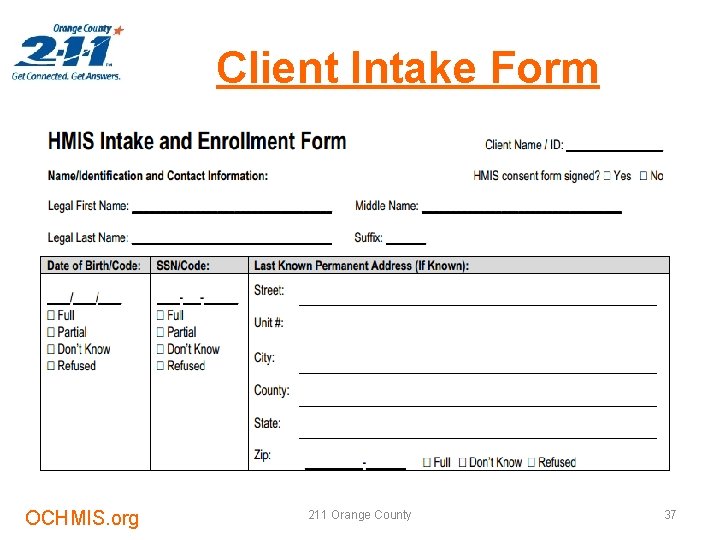
HMIS Client Intake and Enrollment Form • Validate Client Intake Form (in folder) – Read case scenario to determine if data is correct on Client Intake and Enrollment Form • Did the client fill out the form correct? • Did the case manager gather/capture the information correctly? • All clients entering project will need to be entered in HMIS within 3 days of project entry OCHMIS. org 211 Orange County 36
Client Intake Form OCHMIS. org 211 Orange County 37
Client Intake and Enrollment Form Based on your Client Intake review. • Enter data into HMIS – Demographics – Program Enrollment (See next page) OCHMIS. org 211 Orange County 38
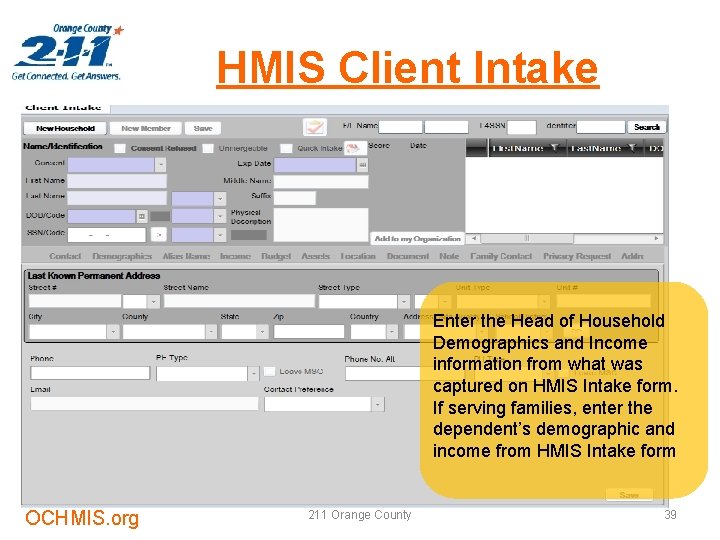
HMIS Client Intake Enter the Head of Household Demographics and Income information from what was captured on HMIS Intake form. If serving families, enter the dependent’s demographic and income from HMIS Intake form OCHMIS. org 211 Orange County 39
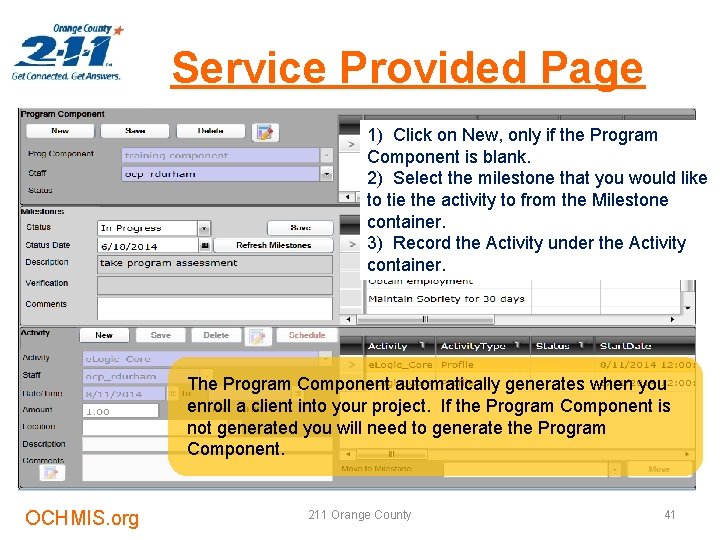
Service Provided Page After enrolling client(s) into project. – Ensure that the Program Component is generated. – Track client’s milestone • Complete • In Progress • NA – Record services (activities/case notes) • Activity (third container) of the Service Provided page • Case Notes page Clients who have received services should be recorded in HMIS within 3 days (See next page) OCHMIS. org 211 Orange County 40
Service Provided Page 1) Click on New, only if the Program Component is blank. 2) Select the milestone that you would like to tie the activity to from the Milestone container. 3) Record the Activity under the Activity container. The Program Component automatically generates when you enroll a client into your project. If the Program Component is not generated you will need to generate the Program Component. OCHMIS. org 211 Orange County 41
HMIS Annual Assessment Form For HUD funded Transitional Housing and Permanent Housing projects whose client(s) is in program for 1 year record their annual assessment within 3 days. • Validate Client Assessment Form (in folder) • Did the case manager gather/capture the information correctly? • Did the client’s income increase/decrease? OCHMIS. org 211 Orange County 42
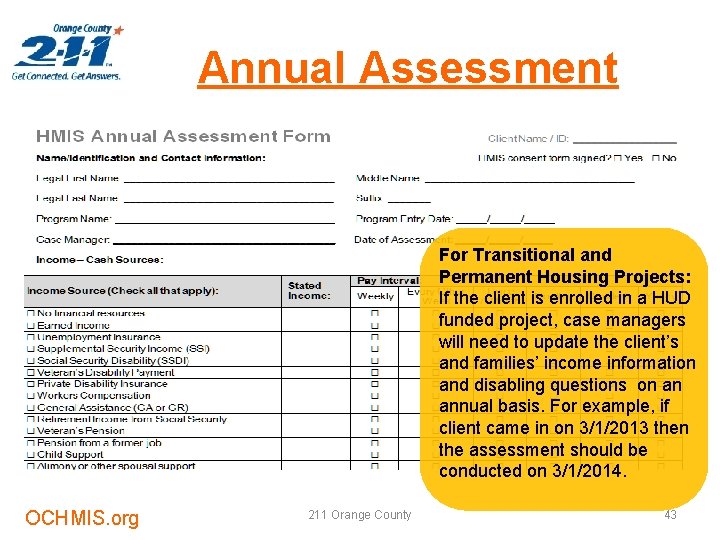
Annual Assessment For Transitional and Permanent Housing Projects: If the client is enrolled in a HUD funded project, case managers will need to update the client’s and families’ income information and disabling questions on an annual basis. For example, if client came in on 3/1/2013 then the assessment should be conducted on 3/1/2014. OCHMIS. org 211 Orange County 43
Client Annual Assessment Form • Enter updated information in HMIS – Income and Health Insurance via Manage (See the next page) OCHMIS. org 211 Orange County 44
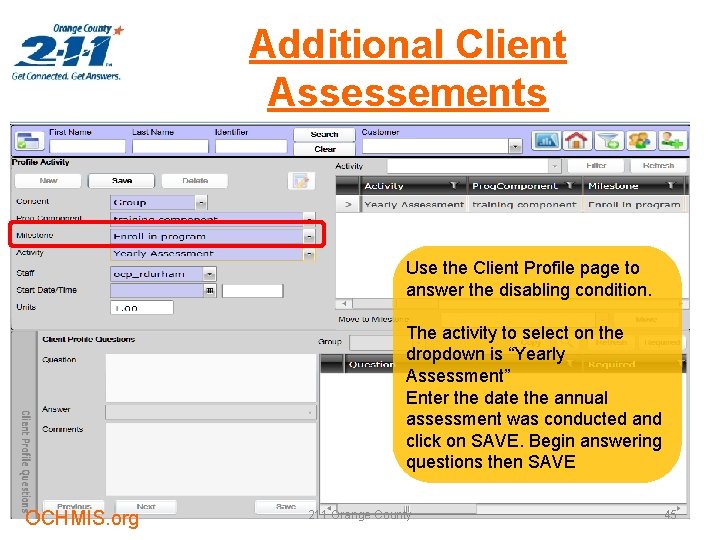
Additional Client Assessements Use the Client Profile page to answer the disabling condition. The activity to select on the dropdown is “Yearly Assessment” Enter the date the annual assessment was conducted and click on SAVE. Begin answering questions then SAVE OCHMIS. org 211 Orange County 45
Manage Snapshot Page • Validate the data on Client Assessment Form – Ensure the information is accurate – Create a new snapshot, and enter updated income information • The client(s) should have at least 2 snapshots. Ensure that the 1 st snapshot has the program entry date an the 2 nd snapshot has the annual date. (See the next page) OCHMIS. org 211 Orange County 46
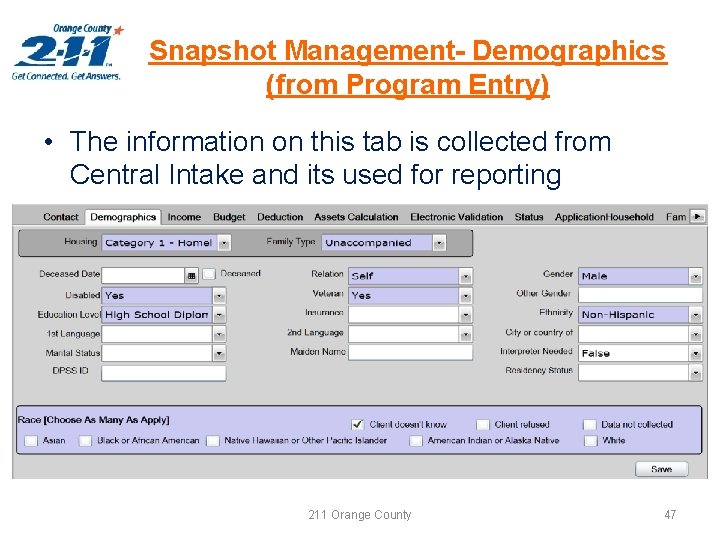
Snapshot Management- Demographics (from Program Entry) • The information on this tab is collected from Central Intake and its used for reporting 211 Orange County 47
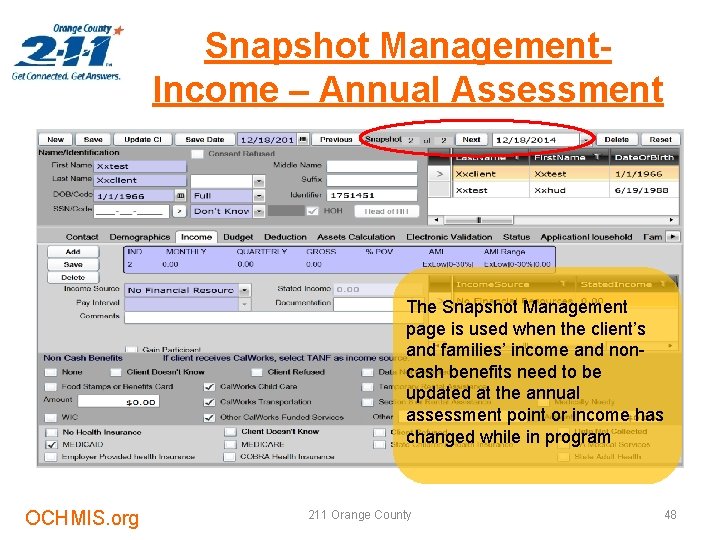
Snapshot Management. Income – Annual Assessment The Snapshot Management page is used when the client’s and families’ income and non cash benefits need to be updated at the annual assessment point or income has changed while in program OCHMIS. org 211 Orange County 48
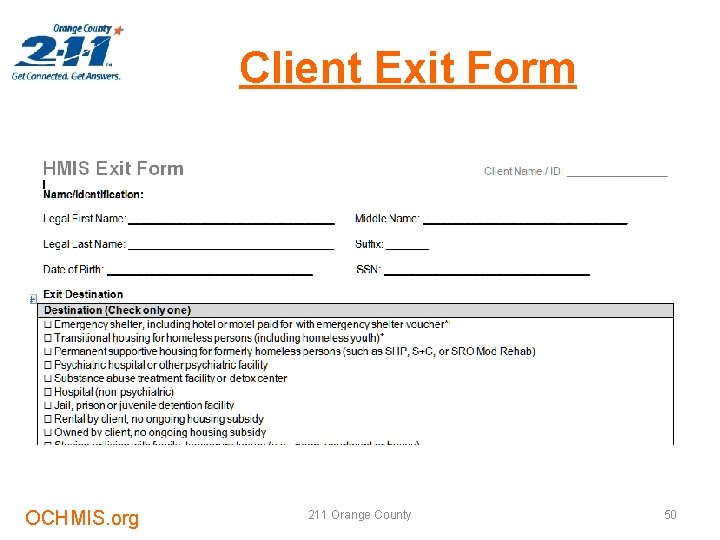
HMIS Exit Form All clients who have exited the project will need to be exited out of HMIS within 3 days. • Validate Exit form (in folder) • Did the case manager gather/capture the information correctly? • Did the client’s income increase/decrease? • Did the client exit to permanent housing or another housing type? • Did the client provide their destination address? – Begin exiting client out of program OCHMIS. org 211 Orange County 49
Client Exit Form OCHMIS. org 211 Orange County 50
Client Exit Form • All data should be entered into HMIS within 3 days of the date it occurred. • Run monthly reports to ensure the data is complete and accurate. (See the next page) OCHMIS. org 211 Orange County 51
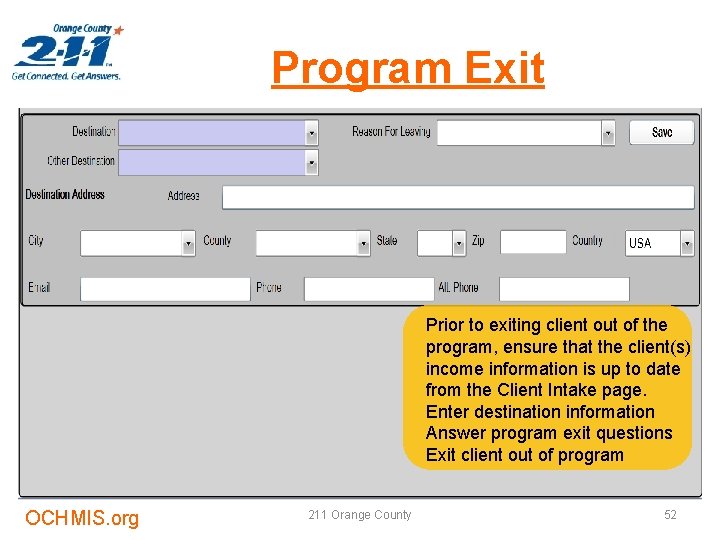
Program Exit Prior to exiting client out of the program, ensure that the client(s) income information is up to date from the Client Intake page. Enter destination information Answer program exit questions Exit client out of program OCHMIS. org 211 Orange County 52
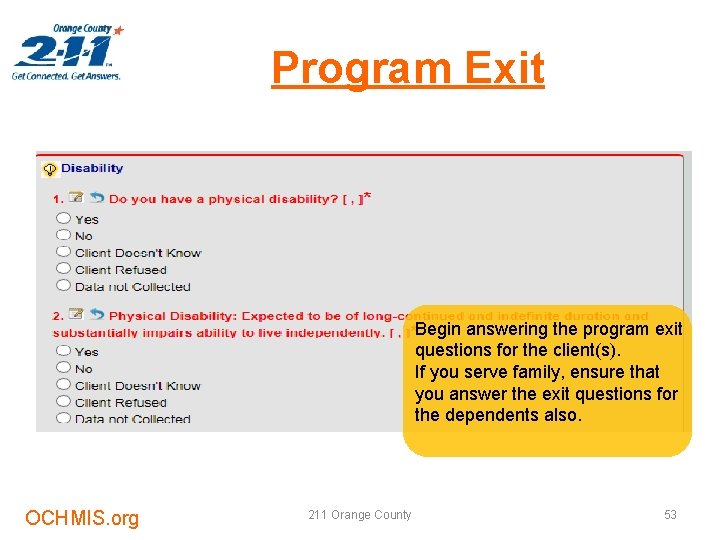
Program Exit Begin answering the program exit questions for the client(s). If you serve family, ensure that you answer the exit questions for the dependents also. OCHMIS. org 211 Orange County 53
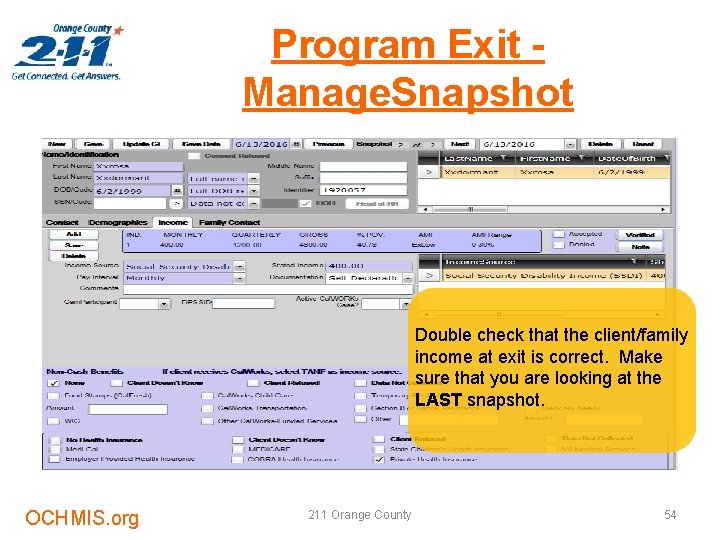
Program Exit Manage. Snapshot Double check that the client/family income at exit is correct. Make sure that you are looking at the LAST snapshot. OCHMIS. org 211 Orange County 54
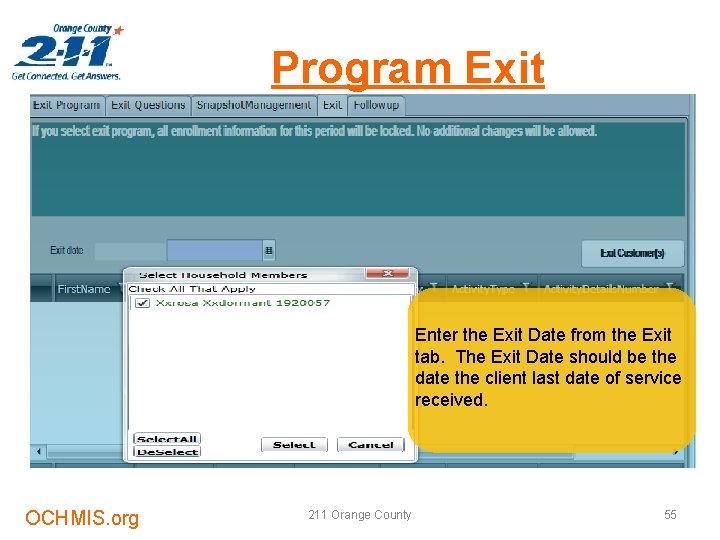
Program Exit Enter the Exit Date from the Exit tab. The Exit Date should be the date the client last date of service received. OCHMIS. org 211 Orange County 55
Verifying Your Data Entry Reports 211 Orange County 56
Universal Data Element (UDE)_Details Report • Run the UDE Details Report to verify that the client’s demographic information entered is correct. • Enter today’s date on both fields (start and end) in the parameters. • Export to Excel to view the report. – Does the report have areas marked in red? – Is your client’s demographic information on report correct? No reds in any of the fields. 211 Orange County 57
Program Specific Data Element (PDE)_Details Report • Run the PDE Details Report (Entry and Exit) to verify that the client’s project information entered is correct. • Enter today’s date on both fields (start and end) in the parameters. • Export to Excel to view the report. – Does the report have areas marked in red? – Is your client’s program information on report correct? No reds in any of the fields. 211 Orange County 58
Data Timeliness and Completeness • All data should be entered into HMIS within 3 days of the date it occurred. • Run monthly reports to ensure the data is complete and accurate. OCHMIS. org 211 Orange County 59
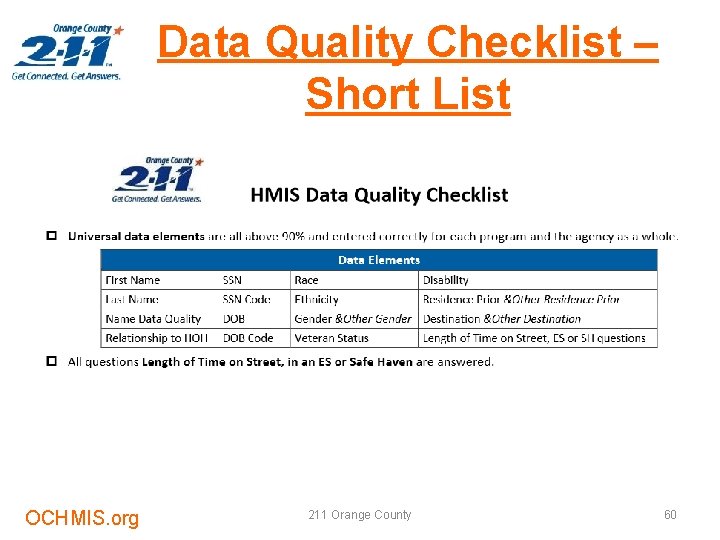
Data Quality Checklist – Short List OCHMIS. org 211 Orange County 60
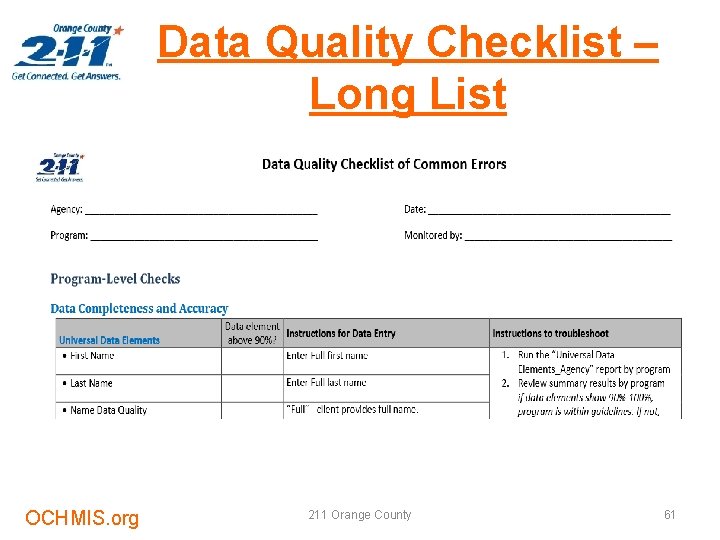
Data Quality Checklist – Long List OCHMIS. org 211 Orange County 61
Downloadable Documents • To download HMIS Intake, Exit, and Assessment forms go to OCHMIS. org – HMIS Help > HMIS v 5 Forms – Available in English and Spanish • HMIS Data Quality lists also available for download 211 Orange County 62
211 Orange County HMIS Contact Information To obtain the HMIS Forms or updates please visit Website: ochmis. org 211 Orange County 63