
1984 By George Orwell Literary analysis by Abigail
1984 By George Orwell Literary analysis by: Abigail Neuer
Contents • • Key Words & Phrases = slides 3, 4, 5, & 6 Literary Devices = slides 7, 8, & 9 Intertextual Connections = slides 10, 11, & 12 Questions = slides 13, 14, & 15 Personal Reactions = slides 16, 17, 18, & 19 Contextual Information = 20, 21, & 22 Synthesis = 23 & 24 Resources = slide 25
Key Words & Phrases (Part 1) • “ The patrols did not matter, however. Only the Thought Police mattered. “ (page 2) • This quote introduces the reader to the one of the concepts that plagues Winston’s mind day to day. • Its important for that reason and the fact that its one of the ways the government maintains their control over the citizens. • This connects to the overall theme of power, because , as stated previously, this is one of the ways that the government maintains control over their citizens and control is power. • Also, the reader can interrupt that Winston is fearful of the police and fear is another source of power because fear can propel someone to do something that they might not want to do or what they know to be wrong. ( Peer pressure can fall under this kind of fear. )
Key Words & Phrases (Part 2) • “ War is Peace, Freedom is Slavery, Ignorance is Strength. ” (page 4) • This rule of three phrases enhance the understanding of the story, because from this the reader can clearly infer that the government/society is at war with another part of the world. The reader can also infer that the government controls the people’s lives, considering the fact that it states that freedom is slavery and that the government control the media and hides the truth from the people. “ Ignorance is bliss. ” • This connects to the overall theme of power, because the government is at war with others, in an attempt to get more power and to maintain their power. • Also, this connects to power, because the government is controlling every aspect of the citizens lives.
Key Words & Phrases (Part 3) • “ Until they become conscious they will never rebel, and until after they have rebelled they cannot become conscious. ” (page 70) • This quote is a key phrase, because as Winton states previously, the future is in the proles and they are the ones who can over throw the government and change how their society is. • Also, this gives the reader and insight on how Winston thinks. He is a very practical man who at times can seem very complicated. Its also quiet interesting how he thinks similar to the party with the contradicting ideas. • This relates to overall theme of power, because it shows the people aren't conscious of what is occurring, which is ignorance, and this is a way that the government controls the people.
Key Words & Phrases (Part 4) • “ Nothing holds it together except an idea that’s indestructible. “ (page 176) • This phrase is important , because as O’Brien previously states in this section of the book, it doesn’t matter whether members of the Brotherhood get captured the concept that they fight or rebel for will always remain and always be lingering around the government. • Its also a important phrase , because that section in the book seems to foreshadow that Winston will get arrested by the Thought Police. • This connects to power, because it shows how this ‘idea’ has its own kind of power. It states that the government is not capable of destroying or ridding the world of this , because it’s a concept or a simple principle that cannot be terminated, and that gives it power over the government.
Literary Devices (Part 1) • “ War is Peace, Freedom is Slavery, Ignorance is Strength. ” (page 4) • This is rule of three, or tricolon , because it has three phrases to describe the government system of control over the people, which is also why this phrase is significant. • This contributes to the overall mood of despair or helplessness, because when one thinks about these terms, its kind of depressing that the only thing that seems to bring the citizens together is war. Also, that their society believes that freedom is slavery, which leaves the individual with a feeling of helplessness. In addition to that, if the reader thinks and translates “ Ignorance is Strength, ” that person can determine that the government leaves the people in the dark regarding certain things which can be depressing and also make one feel like they are helpless in this society.
Literary Devices (Part 2) • “ “ We shall meet in the place where there is no darkness. “ ”(page 103) • This is foreshadowing, because the Ministry of Peace is basically almost in complete darkness; however since its like that twenty-four/ seven there is no darkness. • This contributes to the story because its basically telling you what exactly is going to occur, if one infers about what this statement means. • This contributes to the mood of despair or helplessness in the book, because darkness can be connected to despair; however, since it says no darkness, one may assume that it would be positive. So, the foreshadowing might throw someone off when interrupting it, but one can interrupt it that the government is not in the ‘dark’ about what the citizen’s intentions or thoughts are.
Literary Devices (Part 3) • “ “ And by the way, while we are the subject, Here comes a candle to light you to bed, here comes a chopper to chop off your head! “” (page 222) • This is symbolism , because the short poem portrays how Winston and Julia are supposedly going to die or that the two of them are in big trouble. • This quote contributes to the story , because Mr. Charrington , who says this quote, is actually a member of the Thought Police. Also, he and his house were the two things that Winston thought it would be safe to be with Julia. This just goes to show that in this society you cannot trust anyone. • This contributes to the mood of despair or helplessness in the book, because the quote basically says that they are in trouble and may die, which is depressing and can make one feel as though they are helpless.
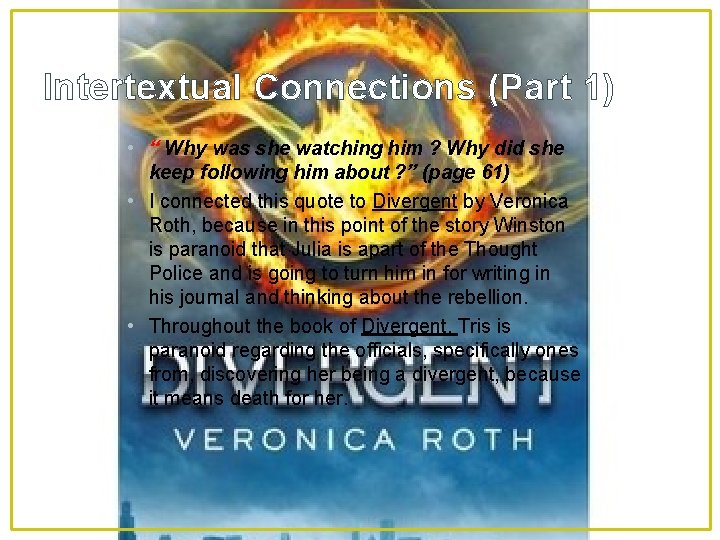
Intertextual Connections (Part 1) • “ Why was she watching him ? Why did she keep following him about ? ” (page 61) • I connected this quote to Divergent by Veronica Roth, because in this point of the story Winston is paranoid that Julia is apart of the Thought Police and is going to turn him in for writing in his journal and thinking about the rebellion. • Throughout the book of Divergent, Tris is paranoid regarding the officials, specifically ones from, discovering her being a divergent, because it means death for her.
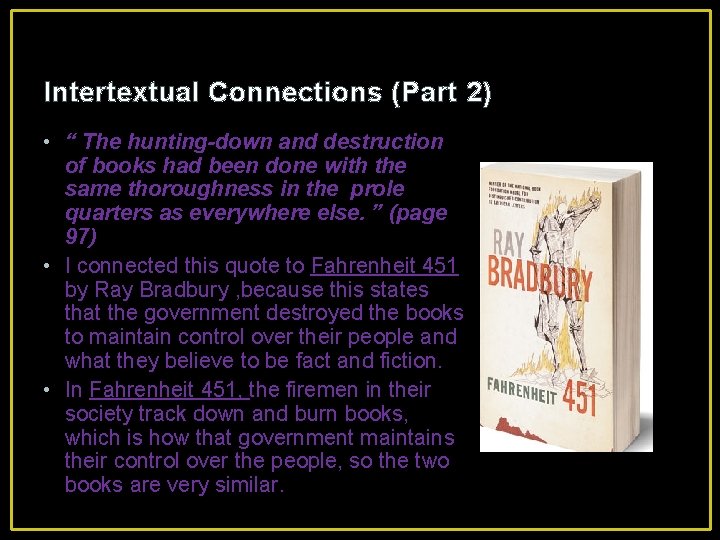
Intertextual Connections (Part 2) • “ The hunting-down and destruction of books had been done with the same thoroughness in the prole quarters as everywhere else. ” (page 97) • I connected this quote to Fahrenheit 451 by Ray Bradbury , because this states that the government destroyed the books to maintain control over their people and what they believe to be fact and fiction. • In Fahrenheit 451, the firemen in their society track down and burn books, which is how that government maintains their control over the people, so the two books are very similar.
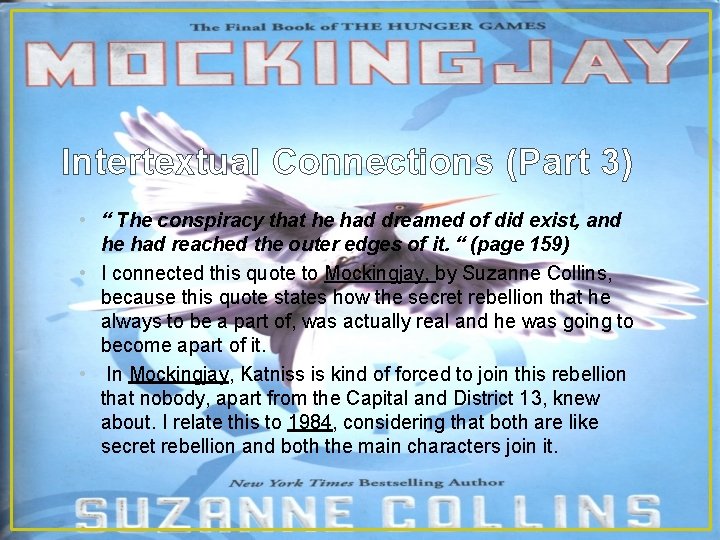
Intertextual Connections (Part 3) • “ The conspiracy that he had dreamed of did exist, and he had reached the outer edges of it. “ (page 159) • I connected this quote to Mockingjay, by Suzanne Collins, because this quote states how the secret rebellion that he always to be a part of, was actually real and he was going to become apart of it. • In Mockingjay, Katniss is kind of forced to join this rebellion that nobody, apart from the Capital and District 13, knew about. I relate this to 1984, considering that both are like secret rebellion and both the main characters join it.
Questions (Part 1) • “ It was part of the economy drive in for Hate Week. “ (page 1) • When I first read this statement I asked my self the question : What is “Hate Week” ? • Later on in the book, however, the narrator describes Hate Week as a celebration when the society comes together and “hate on” the country that they are at war at. Which originally was Eurasia and then switches to Eastasia, in the middle of the ceremony.
Questions (Part 2) • “ Inside the flat a fruity voice was reading out a list of figures which had something to do with the production of pig iron. “ (page 2) • From this quote , in the book, I asked the question : What is pig iron? • Again on page 2 of 1984, “pig iron” is mentioned. “ Behind Winston’s back the voice from the telescreen was still babbling away about pig iron and the overfillment of the Ninth Three-Year Plan. “ • I think pig iron is a type of iron that is suppose to be thinner and easier to shape.
Questions (Part 3) • “ He had not bothered to look up when the servant showed Julia and Winston in. “ (page 167) • From this quote I asked a rhetorical question: What exactly is the servant ? What I mean is, is he a party member or a prole ? o The proles, though, are suppose to live on their own, within the governments’ powers. o However, the party members are suppose to live in luxury, for the inner party members, and the outer party members live in what I would consider a laid back environment.
Personal Reactions (Part 1) • “ He was the leader of a vast shadowy army, an underground network of conspirators dedicated to the overthrow of the State. “ (page 13) • My initial response to this quote is that I actually like this quote. It gives off a feeling of suspense and eeriness to the story, that there is a secret organization that is just waiting for Winston is get involved with. Also, if I knew that there was a rebellion, I would be eager to join and would be slightly terrified at the same time. It would be quite exciting to be part of this kind of organization, that is plotting to take over the government; however, if I got caught it would mean torture and possibly even death, which is rather freaky to think about.
Personal Reactions (Part 2) • “ Already he had instinctively started forward to help her. In the moment when he had seen her fall on the bandaged arm, it had been as though he felt the pain in his own body. “ (page 106) • I , personally, like this quote because it means that Winston has empathy for the girl. At this point in the story Winston still believes Julia, or the girl, is apart of the Thought Police and is out to get him, yet he still goes to her aid when she hurts herself. So, to me this means that he still has somewhat of human emotions and hasn’t been completely brainwashed by the government.
Personal Reactions (Part 3) • “ Anything that hinted corruption always filled him with a wild hope. Who knew? Perhaps the Party was rotten under the surface…. ” (page 125) • I , genuinely, do not like this quote. To me corruption is a sin and that goes against my personal beliefs. However, it is slightly interesting that Winston gets filled with a “wild hope” when thinking about corruption and corruption within the government. It seems as though Winston feels that if the government is corrupt, it justifies his own corrupt actions.
Personal Reactions (Part 4) • “” Do it to Julia ! Not me ! Julia ! I don’t care what you do to her. Tear her face off, strip her to the bones. Not me ! Julia ! Not me ! ”” (page 286) • This quote was the turning point in the story, because Winston finally broke and betrayed Julia. I certainly didn’t like this quote, since the main character, or the protagonist, didn’t not succeed in defeating the antagonist. So, this quote irritated me and made feel disappointed, because the ending wasn’t the one I was excepting or wanting.
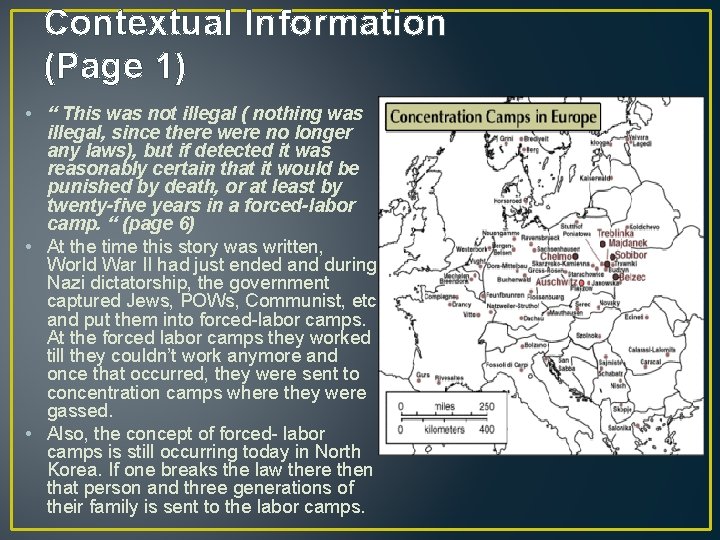
Contextual Information (Page 1) • “ This was not illegal ( nothing was illegal, since there were no longer any laws), but if detected it was reasonably certain that it would be punished by death, or at least by twenty-five years in a forced-labor camp. “ (page 6) • At the time this story was written, World War II had just ended and during Nazi dictatorship, the government captured Jews, POWs, Communist, etc. and put them into forced-labor camps. At the forced labor camps they worked till they couldn’t work anymore and once that occurred, they were sent to concentration camps where they were gassed. • Also, the concept of forced- labor camps is still occurring today in North Korea. If one breaks the law there then that person and three generations of their family is sent to the labor camps.
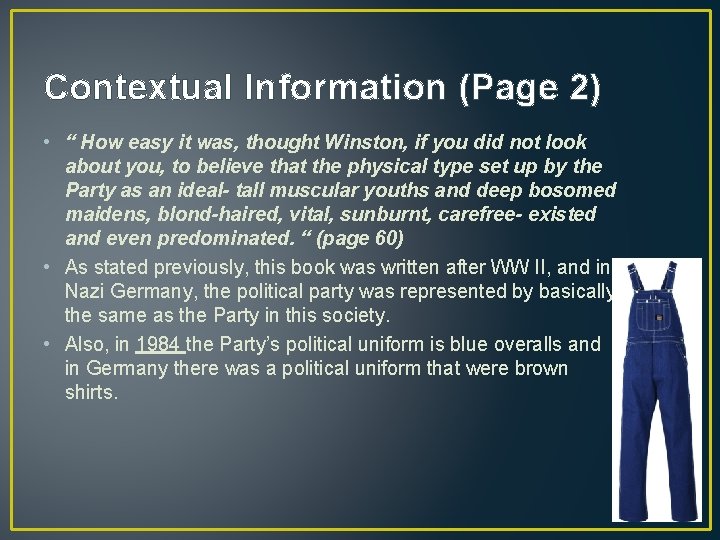
Contextual Information (Page 2) • “ How easy it was, thought Winston, if you did not look about you, to believe that the physical type set up by the Party as an ideal- tall muscular youths and deep bosomed maidens, blond-haired, vital, sunburnt, carefree- existed and even predominated. “ (page 60) • As stated previously, this book was written after WW II, and in Nazi Germany, the political party was represented by basically the same as the Party in this society. • Also, in 1984 the Party’s political uniform is blue overalls and in Germany there was a political uniform that were brown shirts.
Contextual Information (Part 3) • “ They simply swallowed everything, and they swallowed did them no harm, because it left no residue behind, just as a grain of corn will pass undigested through the body of a bird. “ (page 156) • This is linked to Nazi Germany, because during that time the people were completely oblivious to what was really going on in their country and their government “brainwashed” the people, just as what the government did in 1984. • Nazi Video
Synthesis (Part 1) • I think that the overall point or theme that the author is trying to show in the book 1984, is basically power. At the time of George Orwell writing this book, World War II had just ended. During World War II, Nazi Germany had gone power hungry. They attacked and conquered several countries claiming the land for themselves. Hitler enforced a dictatorship government upon his people and selected a common enemy to unit the German people against, the Jewish people. Anyone who resisted or disgraced the government was sent to a forced-labor camp, as were the Jewish people. The ones who followed under Hitler were completely oblivious to the horrors he caused and loved the Führer.
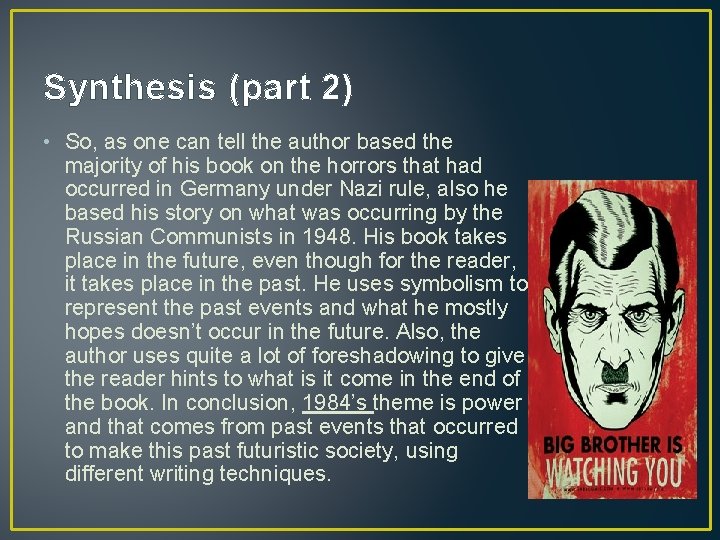
Synthesis (part 2) • So, as one can tell the author based the majority of his book on the horrors that had occurred in Germany under Nazi rule, also he based his story on what was occurring by the Russian Communists in 1948. His book takes place in the future, even though for the reader, it takes place in the past. He uses symbolism to represent the past events and what he mostly hopes doesn’t occur in the future. Also, the author uses quite a lot of foreshadowing to give the reader hints to what is it come in the end of the book. In conclusion, 1984’s theme is power and that comes from past events that occurred to make this past futuristic society, using different writing techniques.
Recourses • Orwell, G. (1948). 1984 (p. 1 to 312). Signet Classics. 1. Picture = http: //cdn 2 b. examiner. com/sites/default/files/styles/image_content_width/hash/d 4/37/Divergent _16. jpg? itok=Pz. A 7 b. Z 1 b 2. Picture = http: //upload. wikimedia. org/wikipedia/en/d/db/Fahrenheit_451_1 st_ed_cover. jpg 3. Picture = http: //3. bp. blogspot. com/NRn. EHqx. W 3 o. Q/Tlzj 6 y. RBEAI/AAAABb. M/CGqnyihrv. PU/s 1600/mockingjay%2 Bcover. jpg 4. Picture = http: //www. subbrit. org. uk/sbsites/a/alderney/lager_sylt/map_of_camps. gif 5. Picture = http: //www. operationworld. org/files/ow/maps/lgmap/korn-MMAP-md. png 6. Picture = http: //www. constructiongear. com/media/catalog/product/cache/3/image/9 df 78 eab 33 525 d 08 d 6 e 5 fb 8 d 27136 e 95/c/s/csgovmu 1000013085_-00_big-smith-mens-rigiddenim-bib-overalls-indigo-blue. jpg 7. Video = http: //www. youtube. com/watch? v=Af 44 Slin 7 lg 8. Picture = http: //de 027. k 12. sd. us/Pictures/1984 -Big-Brother-Poster. jpg
- Slides: 25