
1975 1985 Dtente to Second Cold War Failure
- Slides: 8
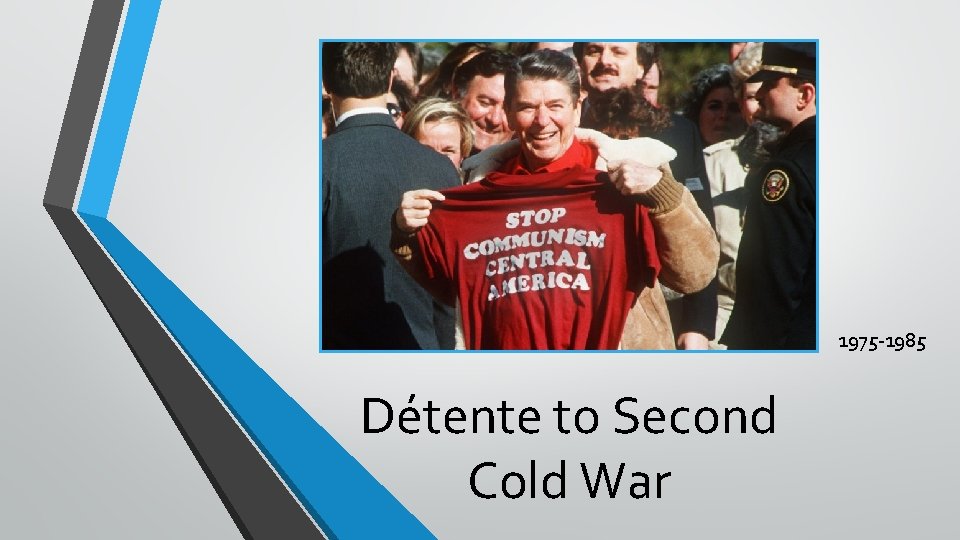
1975 -1985 Détente to Second Cold War
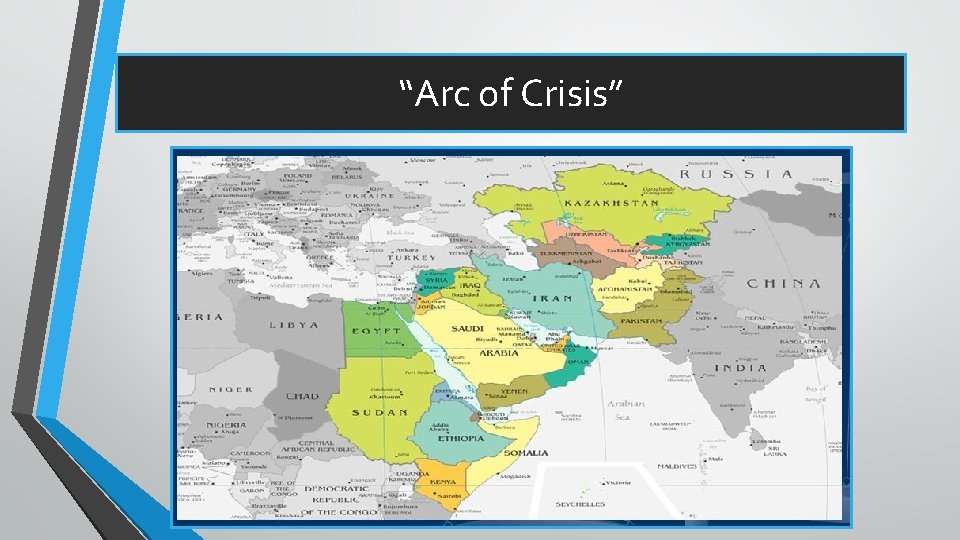
Failure of Detente Factors contributing to the shift from pursuing détente to the start of a second Cold War include: 1. Resignation of Richard Nixon • allowed those in US policy positions who were opposed to détente to gain more influence once he was gone (saw limits to SALT I and II) • Carter’s foreign policy was inconsistent, relied heavily on two advisors who had conflicting opinions about Cold War initiatives (Cyrus Vance – Sec of State, Zbigniew Brzezinski – National Security Advisor) 2. Soviet Offensive • • The Soviet Union wanted to extend its influence in the developing world Seen as taking advantage of US reluctance to risk involvement in another conflict by taking the offensive in gaining strategic influence in the “arc of crisis” – region running through Afghanistan, through Iran and into Ethiopia and Somalia
“Arc of Crisis”
Failure of Detente 3. Carter’s support for human rights in the Soviet bloc • Alarmed the USSR, seemed a public denouncement of their governance in the region • • • Communists gained power in Afghanistan (1978) • Many Americans (up to 10% by 1980) were employed in some way in the militaryindustrial complex • As the aerospace industry grew in the southwestern US, there was the emergence of a more conservative political agenda represented by the ‘New Right’ • • They supported interventionist policy and took cues from the policies of the 1950 s 4. Changes in the Developing World Shah of Iran was overthrown (1979) Leftist, pro-Soviet governments came to power in Nicaragua and Grenada (1979) 5. Emergence of the ‘New Right’ Dominated Congress by 1980
Second Cold War Carter’s reaction to the Soviet invasion of Afghanistan in 1979 is considered by many historians to be the start of the Second Cold War. • Jan 1980: US blocked exports to USSR (including much-needed grain), refused US ratification of SALT II and called for a boycott of the 1980 Olympics • July 1980: Carter signed a decree that opened up the possibility of military engagement with the Soviet Union, set up a Rapid Deployment Force for intervention in the Developing World and went back on election promises to withdraw troops from South Korea
Second Cold War - Reagan • Nov. 1980: Ronald Reagan elected president (in large part because of rise of ‘New Right’) • committed to restoring US nuclear superiority (linked to expanding the US economy in general, and the military-industrial complex specifically) • Dec. 1981: The Polish government imposed martial law in an attempt to stop the growth of the independent Solidarity trade union movement. • Soviets intervened, fearing that if Poland was allowed to become more democratic then other Eastern European states might try to do the same • US responded by putting economic and trade sanctions on both countries, hoping that Western European countries would do the same – but they didn’t because they were still hoping for a W. European-Soviet détente • June 1982: Strategic Arms Reductions Talks (START)
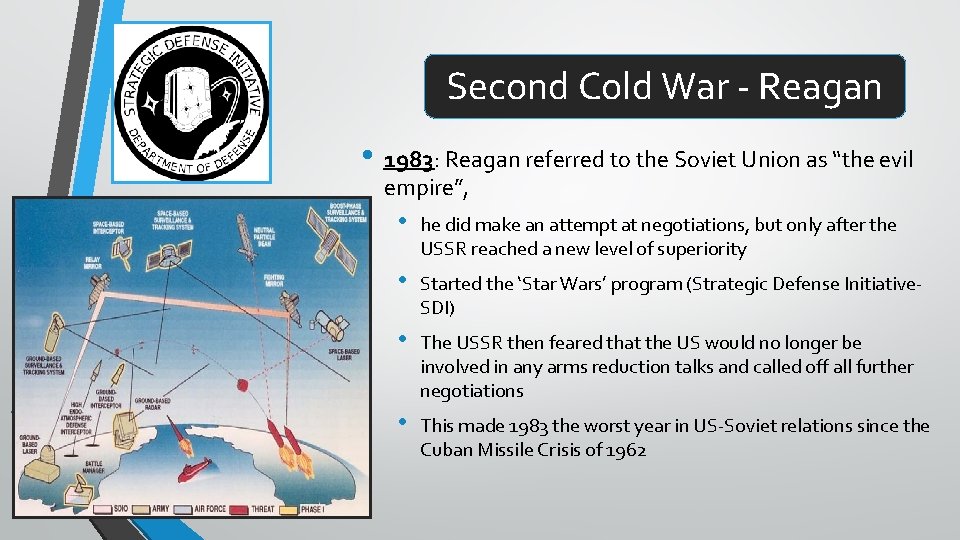
Second Cold War - Reagan • 1983: Reagan referred to the Soviet Union as “the evil empire”, • he did make an attempt at negotiations, but only after the USSR reached a new level of superiority • Started the ‘Star Wars’ program (Strategic Defense Initiative. SDI) • The USSR then feared that the US would no longer be involved in any arms reduction talks and called off all further negotiations • This made 1983 the worst year in US-Soviet relations since the Cuban Missile Crisis of 1962
Second Cold War - USSR • 1982 -1985: The Soviet Union was struggling during the 1980 s • • Had rapid leadership succession: Brezhnev (1982), Andropov (1984) , Chernenko (1985) • • Struggled with a huge technological gap with US (micro-electronics and computers) Faced serious economic problems caused by the attempt to keep up with the US military strength Government was weakening due to inefficient bureaucracy and centralization • 1985: Mikhail Gorbachev elected leader of USSR • This would turn out to be the “beginning of the end” of both the Cold War and the Soviet Union itself • Led reforms to revive and modernize the Soviet economy, as well as liberalize the political system